
LOCAL CLUSTER
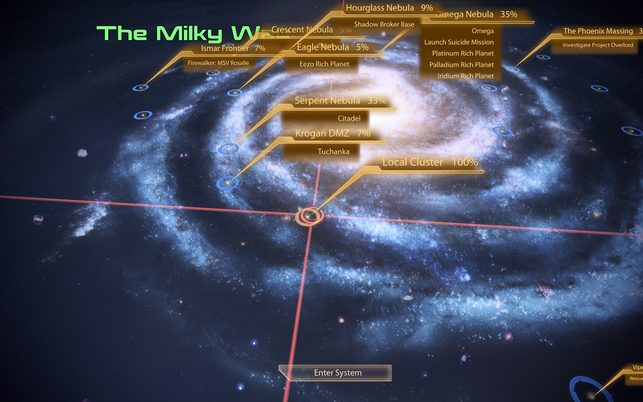
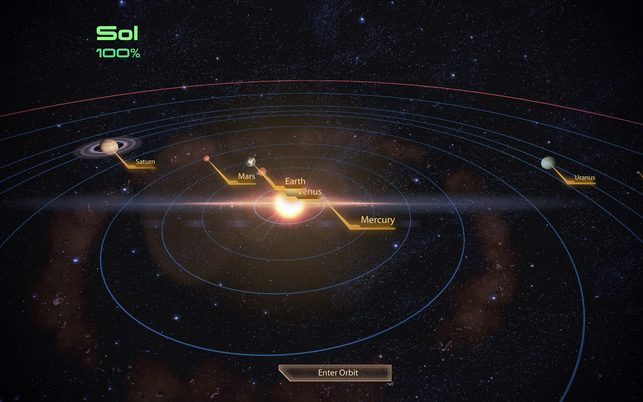
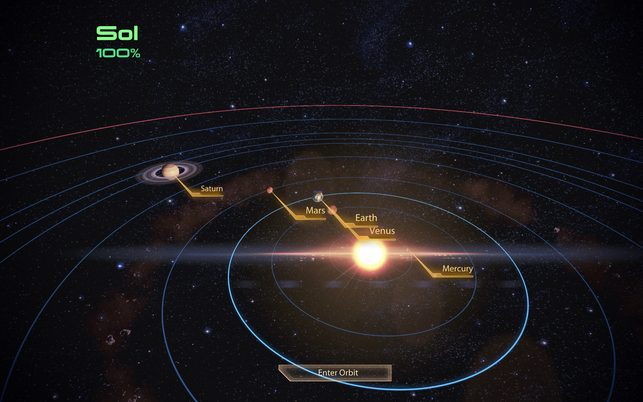
SOL
Mercury
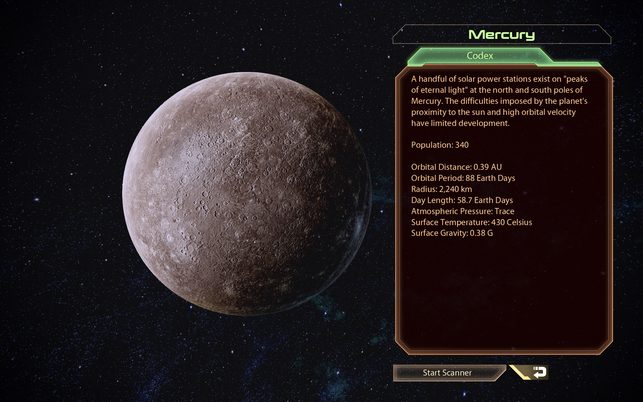
A handful of solar power stations exist on “peaks of eternal light” at the north and south poles of Mercury. The difficulties imposed by the planet’s proximity to the sun and high orbital velocity have limited development.
Population: 340
Orbital Distance: 0.39 AU
Orbital Period: 88 Earth Days
Radius: 2,440 km
Day Length: 58.7 Earth Days
Atmospheric Pressure: Trace
Surface Temperature: 430 Celsius
Surface Gravity: 0.38 G
Earth
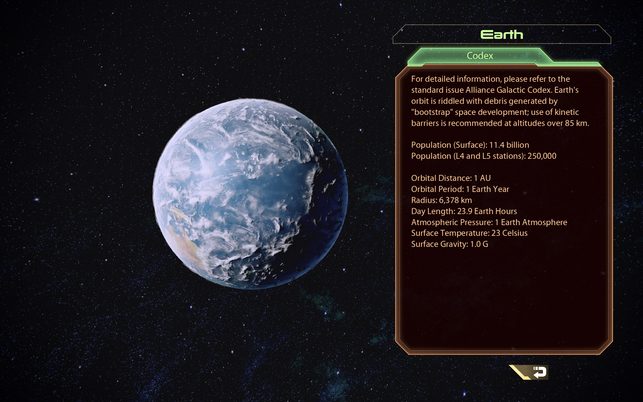
For detailed information, please refer to the standard issue Alliance Galactic Codex. Earth’s orbit is riddled with debris generated by “bootstrap” space development; use of kinetic barriers is recommended at altitudes over 85 km.
Population (Surface): 11.4 billion
Population (L4 and L5 stations): 250,000
Orbital Distance: 1 AU
Orbital Period: 1 Earth Year
Radius: 6,378 km
Day Length: 23.9 Earth Hours
Atmospheric Pressure: 1 Earth Atmosphere
Surface Temperature: 23 Celsius
Surface Gravity: 1.0 G
Venus
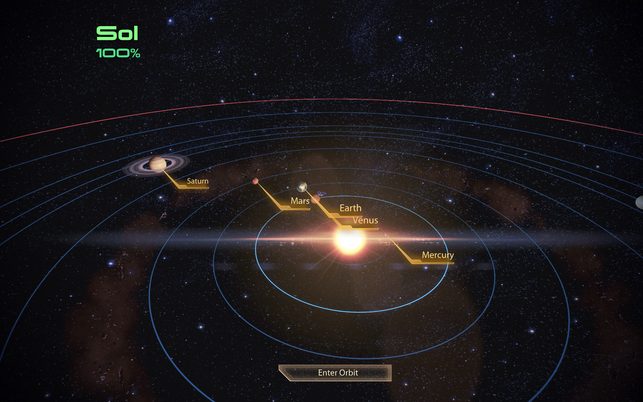
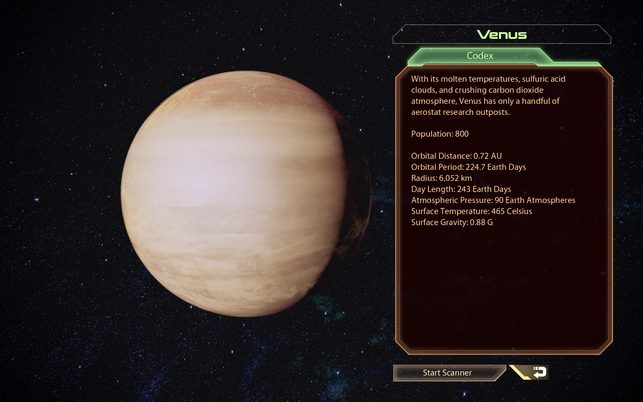
With its molten temperatures, sulphuric acid clouds, and crushing carbon dioxide atmosphere, Venus has only a handful of aerostat research outposts.
Population: 800
Orbital Distance: 0.72 AU
Orbital Period: 224.7 Earth Days
Radius: 6,052 km
Day Length: 243 Earth Days
Atmospheric Pressure: 90 Earth Atmospheres
Surface Temperature: 465 Celsius
Surface Gravity: 0.88 G
Mars
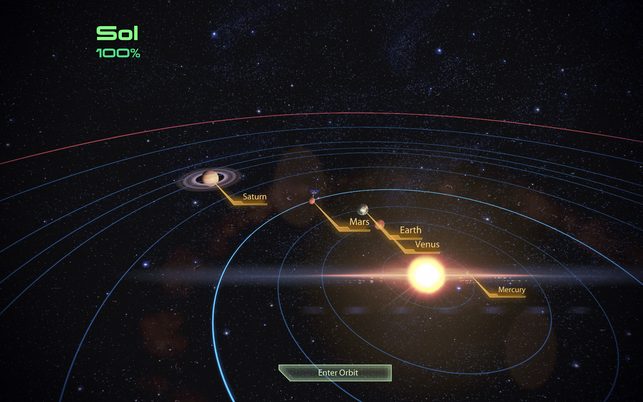
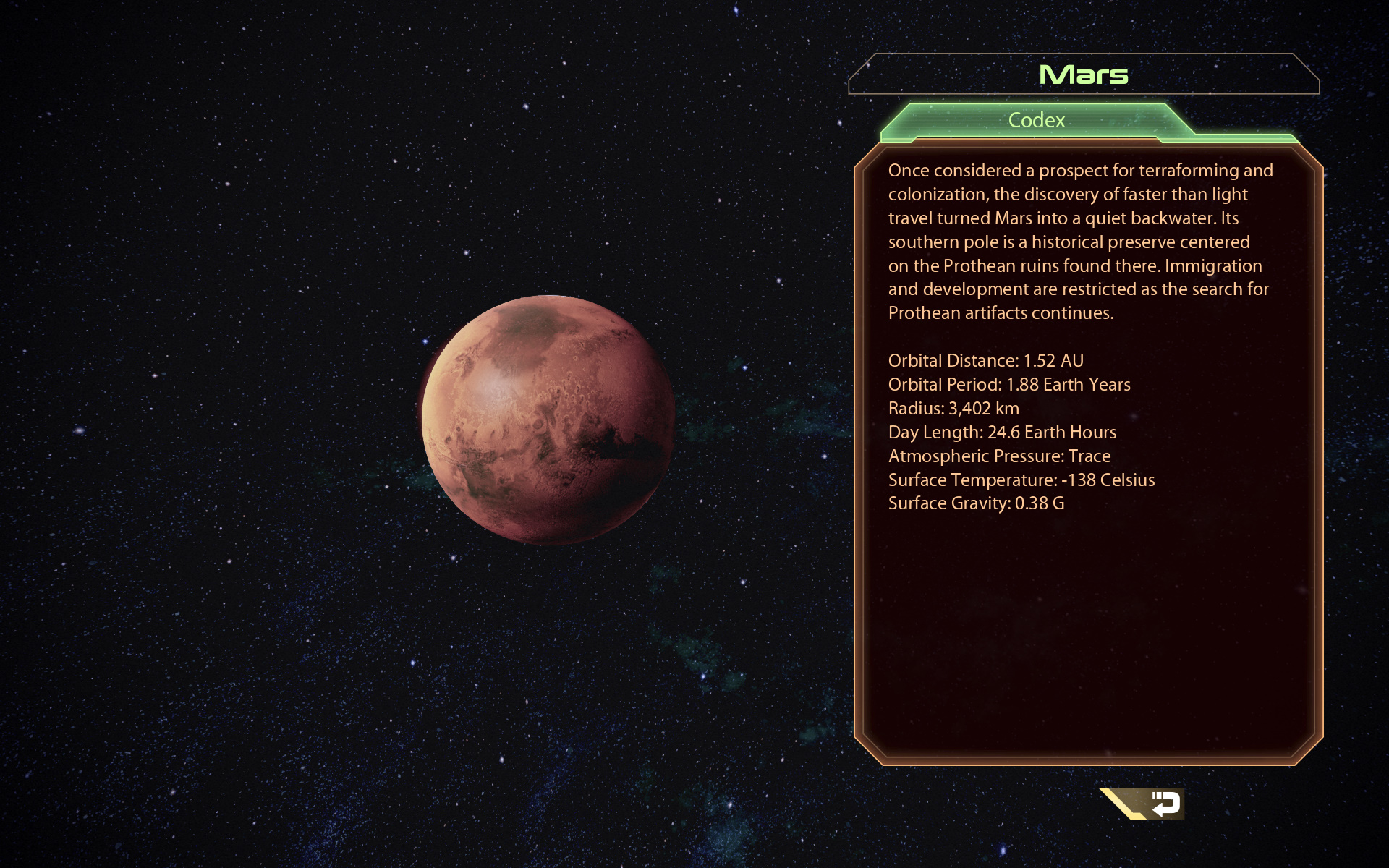
Once considered a prospect for terraforming and colonization, the discovery of faster than light travel turned Mars into a quiet backwater. Its southern pole is a historical preserve centered on the Prothean ruins found there. Immigration and development are restricted as the search for Prothean artifacts continues.
Orbital Distance: 1.52 AU
Orbital Period: 1.88 Earth Years
Radius: 3,402 km
Day Length: 24.6 Earth Hours
Atmospheric Pressure: Trace
Surface Temperature: -138 Celsius
Surface Gravity: 0.38 G
Uranus
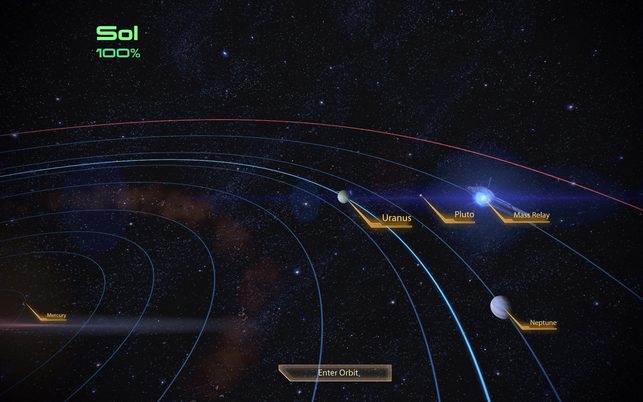
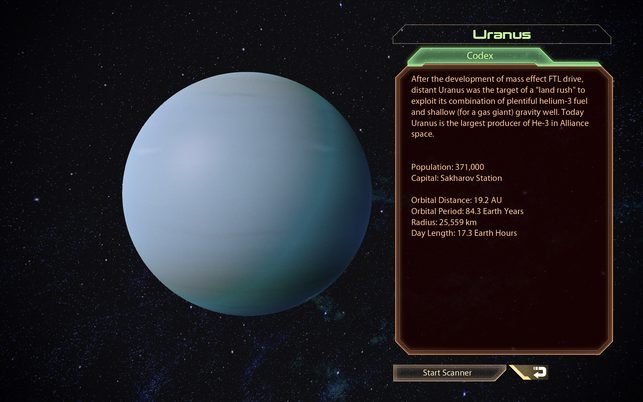
After the development of mass effect FTL drive, distant Uranus was the target of a “land rush” to exploit its combination of plentiful helium-3 fuel and shallow (for a gas giant) gravity well. Today Uranus is the largest producer of He-3 in Alliance space.
Population: 371,000
Capital: Sakharov Station
Orbital Distance: 19.2 AU
Orbital Period: 121.1 Earth Years
Radius: 25,559 km
Day Length: 17.3 Earth Hours
Neptune
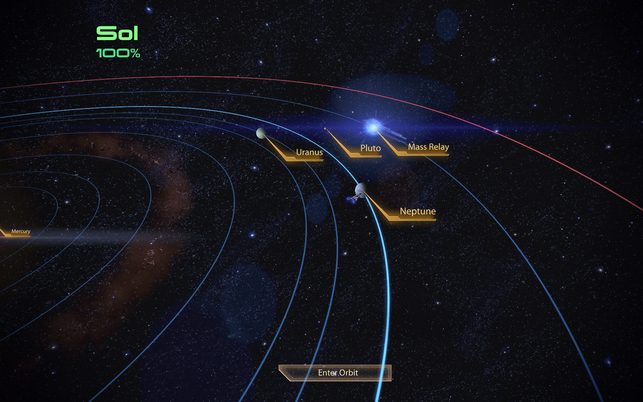
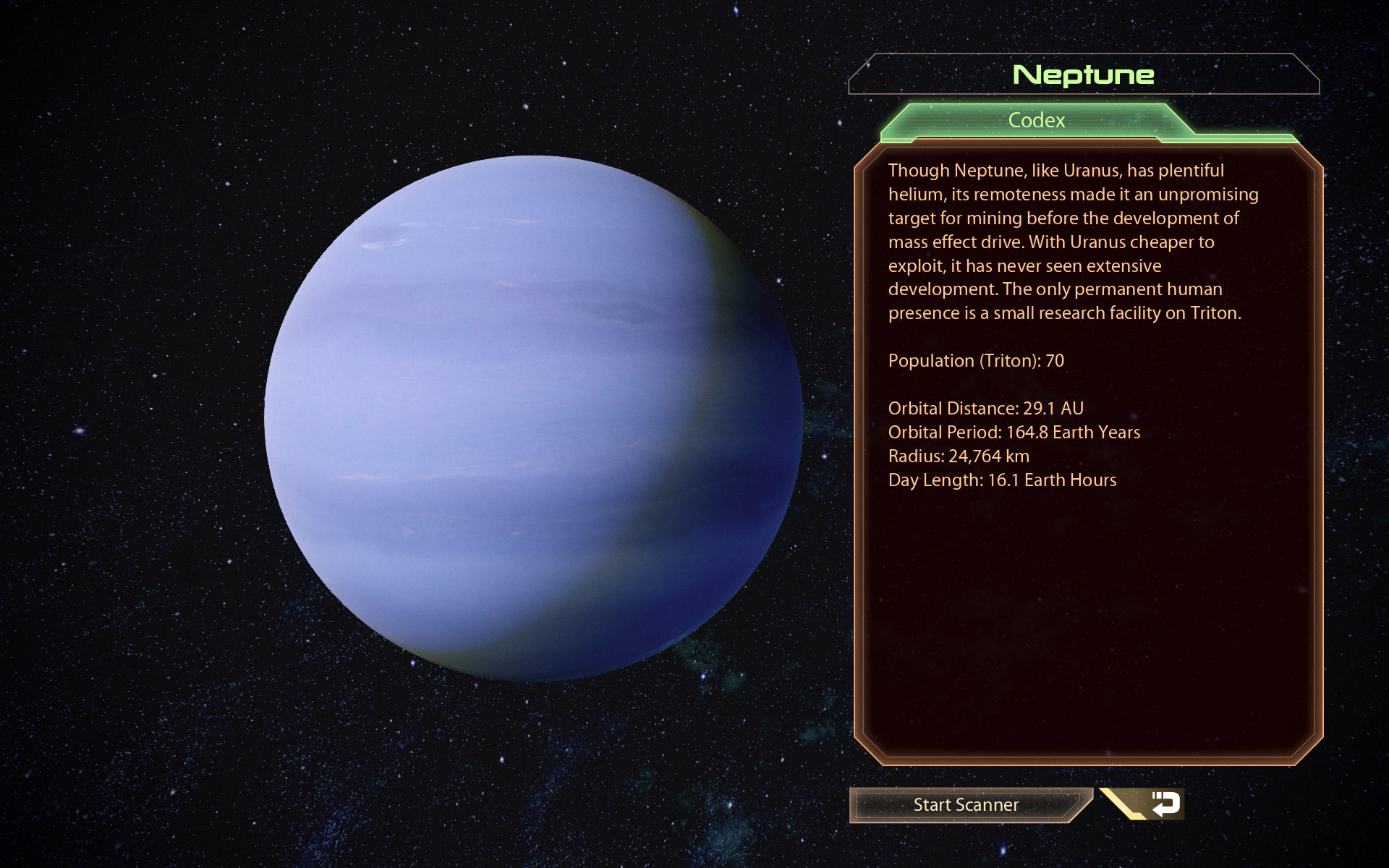
Though Neptune, like Uranus, has plentiful helium, its remoteness made it an unpromising target for mining before the development of mass effect drive. With Uranus cheaper to exploit, it has never seen extensive development. The only permanent human presence is a small research facility on Triton.
Population (Triton): 70
Orbital Distance: 29.1 AU
Orbital Period: 164.8 Earth Years
Radius: 24,764 km
Day Length: 16.1 Earth Hours
Jupiter
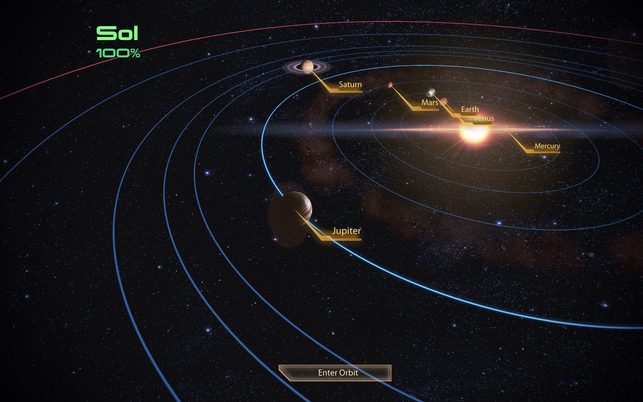
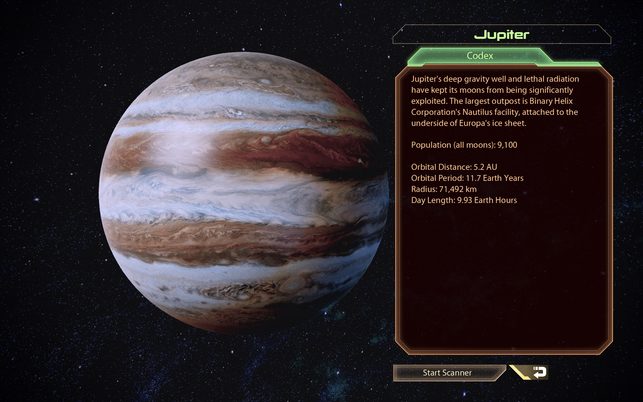
Jupiter’s deep gravity well and lethal radiation have kept its moons from being significantly exploited. The largest outpost is Binary Helix Corporation’s Nautilus facility, attached to the underside of Europa’s ice sheet.
Population (all moons): 9,100
Orbital Distance: 5.2 AU
Orbital Period: 11.7 Earth Years
Radius: 71,492 km
Day Length: 9.93 Earth Hours
Saturn
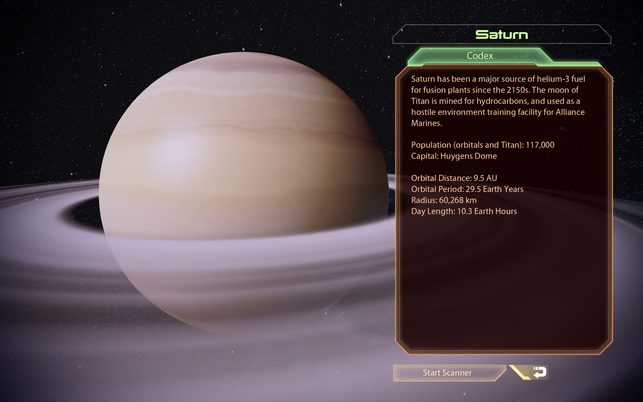
Saturn has been a major source of helium-3 fuel for fusion plants since the 2150s. The moon of Titan is mined for hydrocarbons, and used as a hostile environment training facility for Alliance Marines.
Population (orbitals and Titan): 117,000
Capital: Huygens Dome
Orbital Distance: 9.5 AU
Orbital Period: 29.5 Earth Years
Radius: 60,268 km
Day Length: 10.3 Earth Hours
Pluto
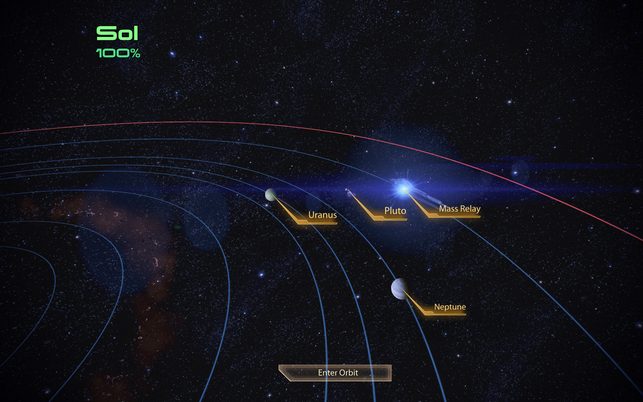
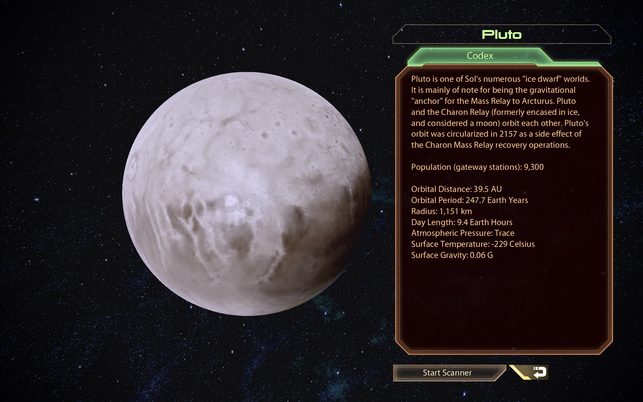
Pluto is one of Sol’s numerous “ice dwarf” worlds. It is mainly of note for being the gravitational “anchor” for the Mass Relay to Arcturus. Pluto and the Charon Relay (formerly encased in ice, and considered a moon) orbit each other. Pluto’s orbit was circularized in 2157 as a side effect of the Charon Mass Relay recovery operations.
Population (gateway stations): 9,300
Orbital Distance: 39.5 AU
Orbital Period: 247.7 Earth Years
Radius: 1,151 km
Day Length: 9.4 Earth Hours
Atmospheric Pressure: Trace
Surface Temperature: -229 Celsius
Surface Gravity: 0.06 G
KROGAN DMZ
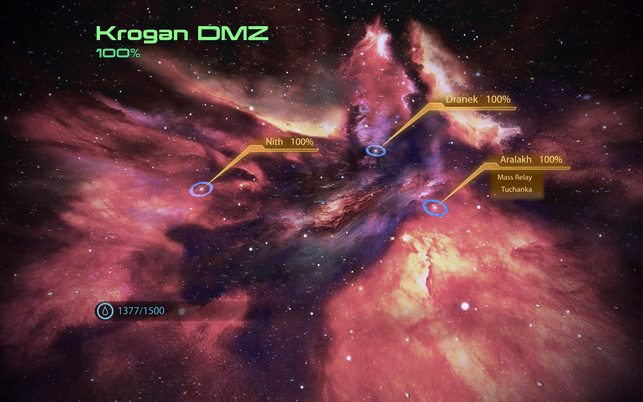
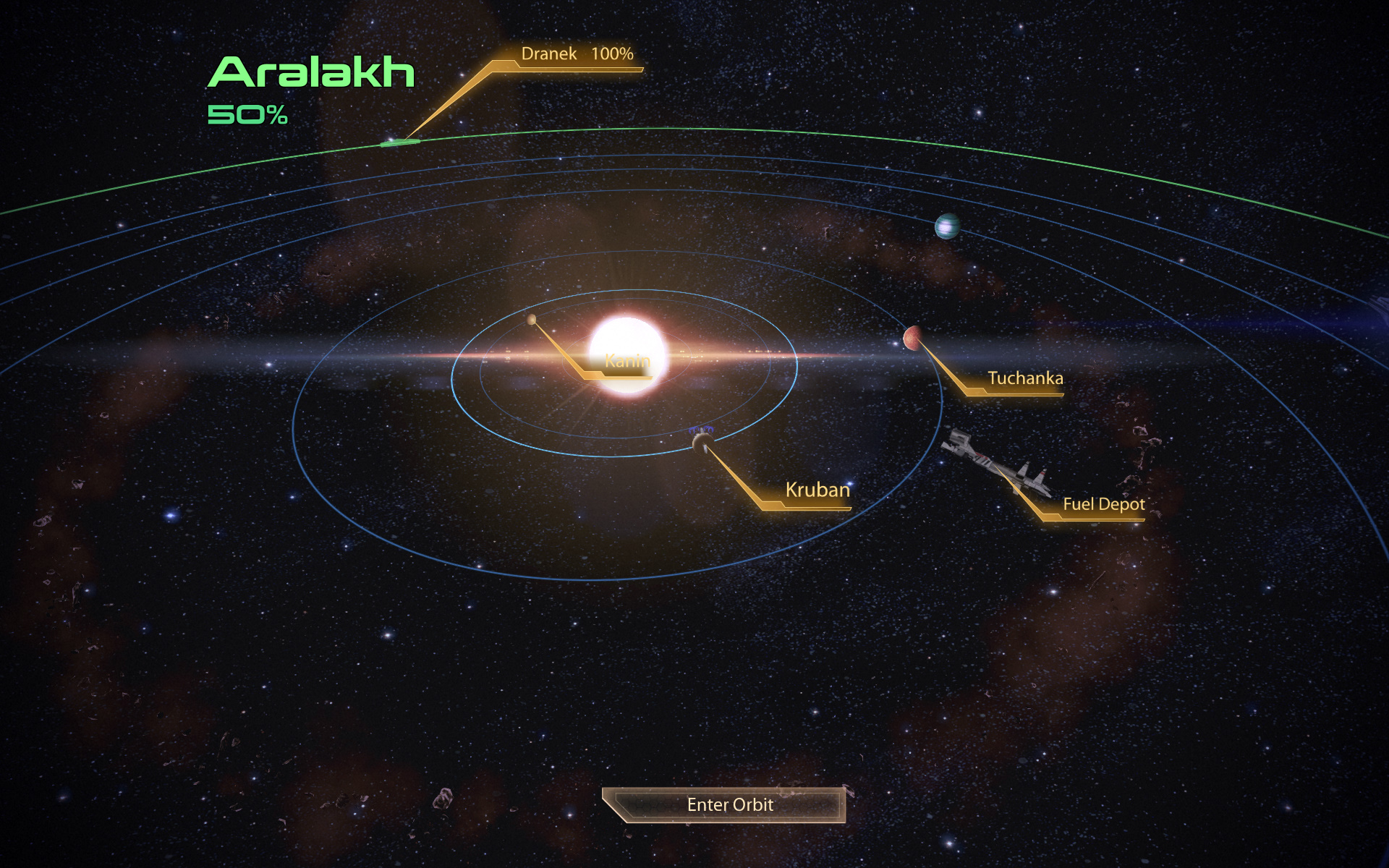
ARALAKH
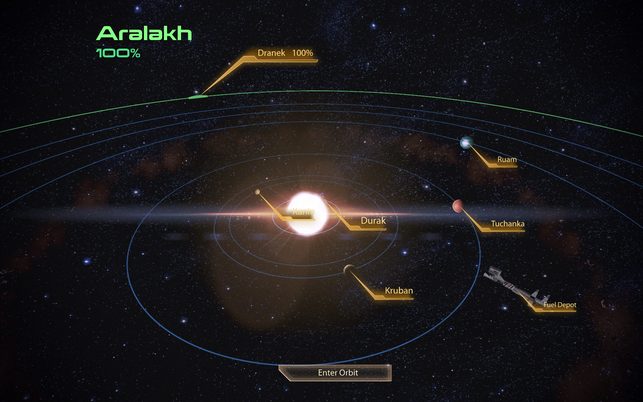
Durak
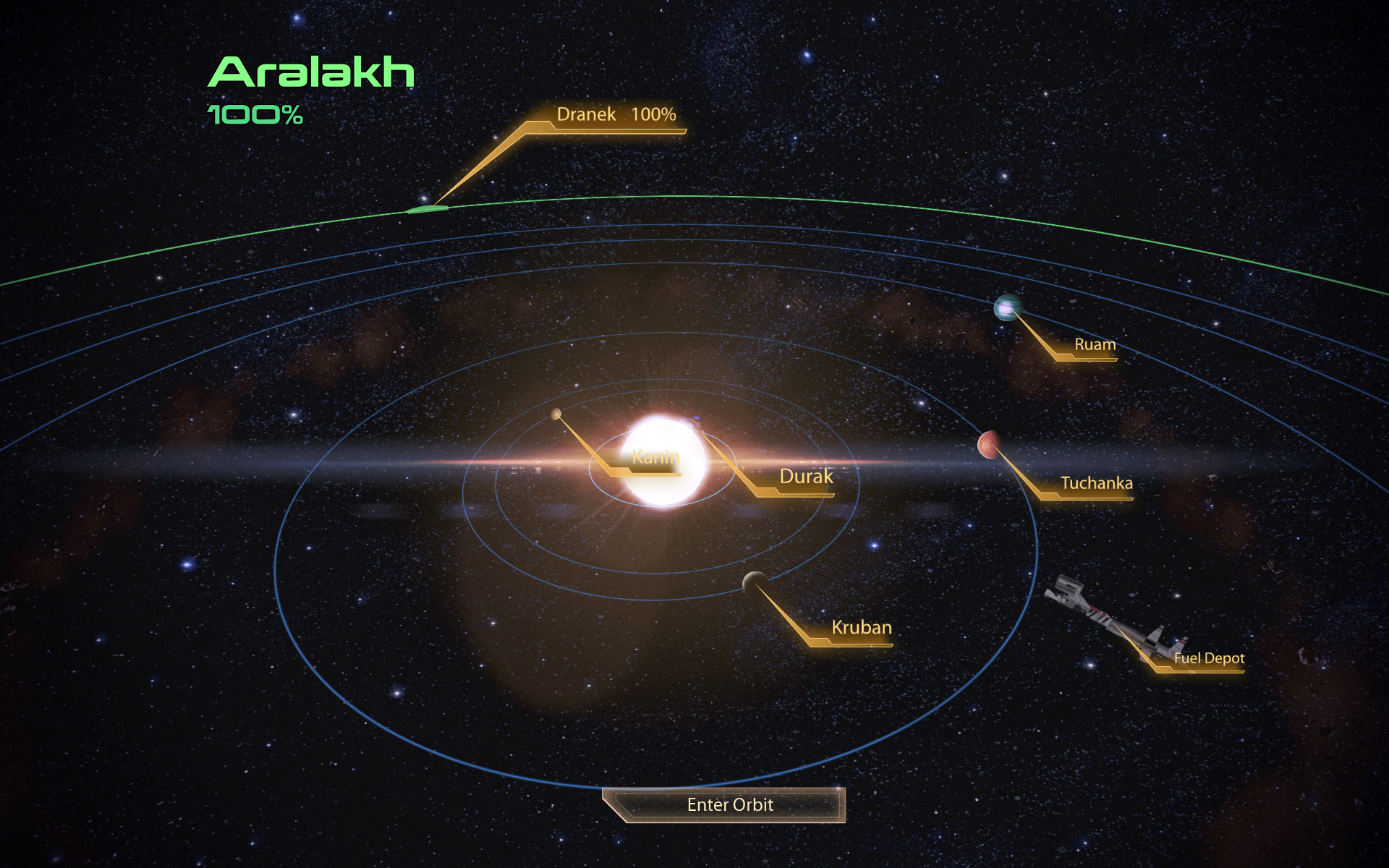
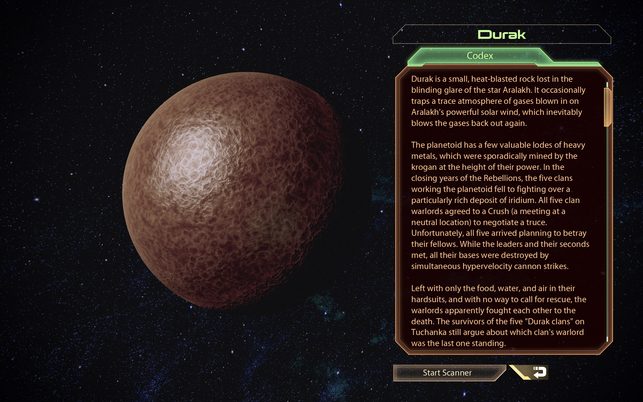
Durak is a small, heat-blasted rock lost in the blinding glare of the star Aralakh. It occasionally traps a trace atmosphere of gases blown in on Aralakh’s powerful solar wind, which inevitably blows the gases back out again.
The planetoid has a few valuable lodes of heavy metals, which were sporadically mined by the krogan at the height of their power. In the closing years of the Rebellions, the five clans working the planetoid fell to fighting over a particularly rich deposit of iridium. All five clan warlords agreed to a Crush (a meeting at a neutral location) to negotiate a truce. Unfortunately, all five arrived planning to betray their fellows. While the leaders and their seconds met, all their bases were destroyed by simultaneous hypervelocity cannon strikes.
Left with only the food, water, and air in their hardsuits, and with no way to call for rescue, the warlords apparently fought each other to the death. The survivors of the five “Durak clans” on Tuchanka still argue about which clan’s warlord was the last one standing.
Orbital Distance: 0.83 AU
Orbital Period: 0.6 Earth Years
Radius: 1,972 km
Orbital Period: 0.6 Earth Years
Atmospheric Pressure: Trace
Surface Temperature: 348 Celsius
Surface Gravity: 0.22 G
Kanin
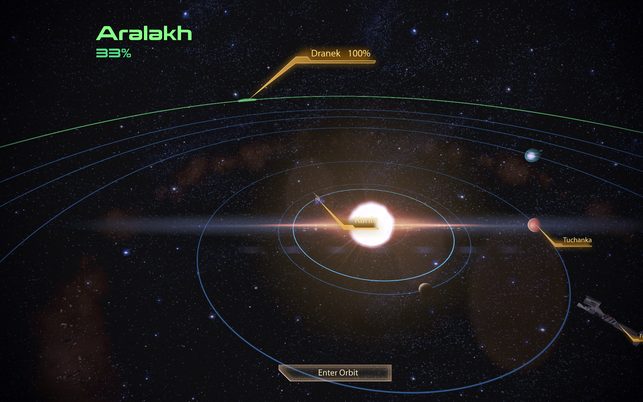
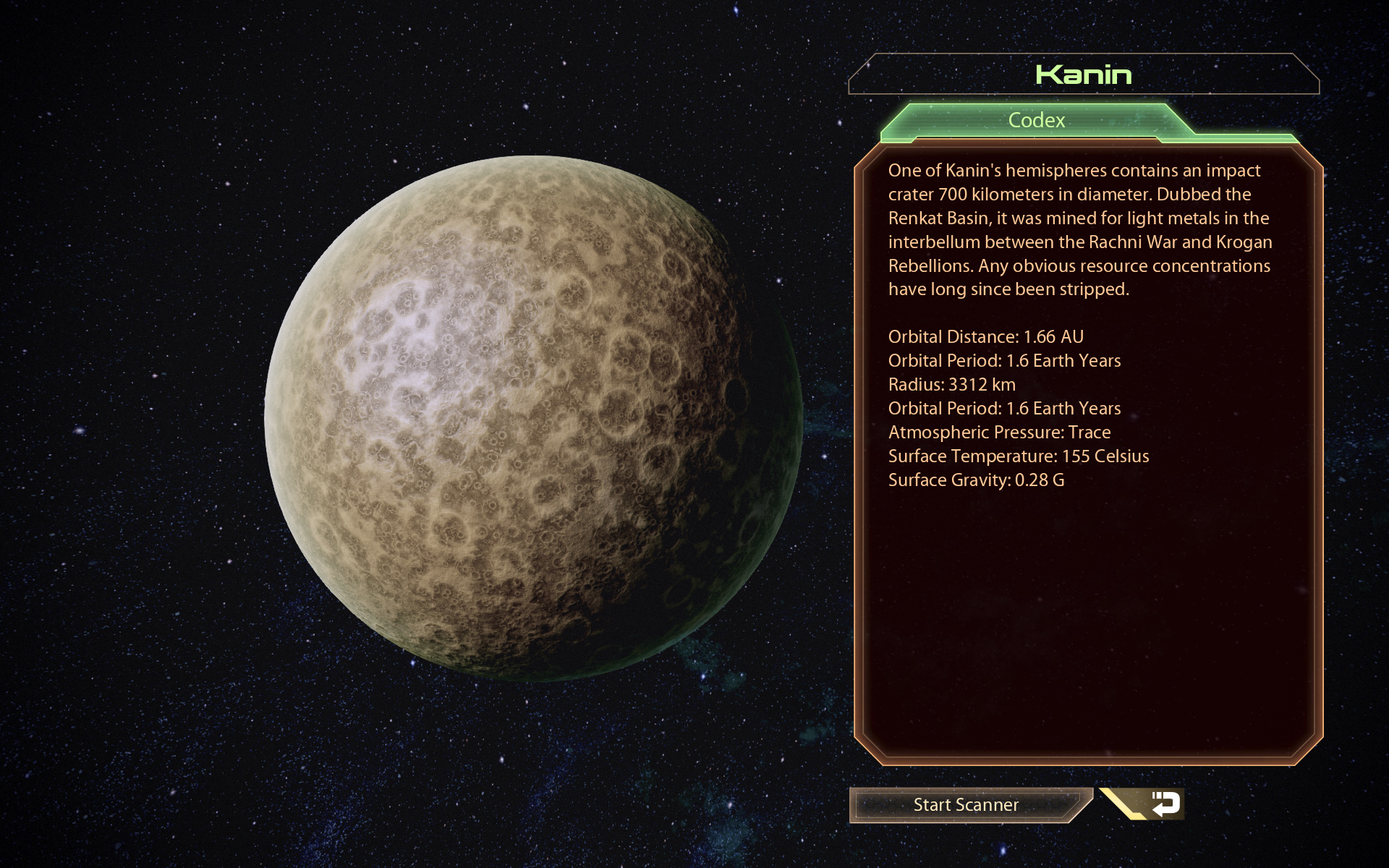
One of Kanin’s hemispheres contains an impact crater 700 kilometers in diameter. Dubbed the Renkat Basin, it was mined for light metals in the interbellum between the Rachni War and Krogan Rebellions. Any obvious resource concentrations have long since been stripped.
Orbital Distance: 1.66 AU
Orbital Period: 1.6 Earth Years
Radius: 3312 km
Orbital Period: 1.6 Earth Years
Atmospheric Pressure: Trace
Surface Temperature: 155 Celsius
Surface Gravity: 0.28 G
Kruban
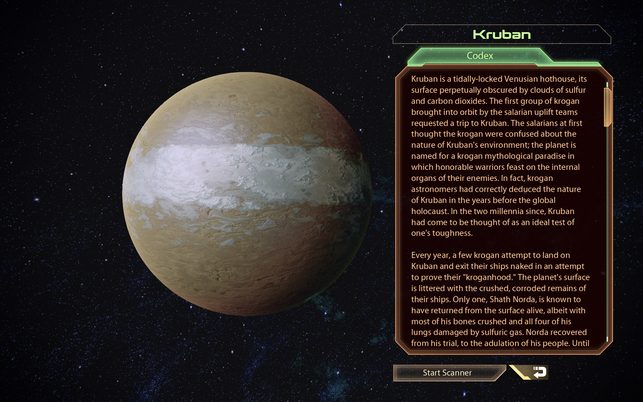
Kruban is a tidally-locked Venusian hothouse, its surface perpetually obscured by clouds of sulfur and carbon dioxides. The first group of krogan brought into orbit by the salarian uplift teams requested a trip to Kruban. The salarians at first thought the krogan were confused about the nature of Kruban’s environment; the planet is named for a krogan mythological paradise in which honorable warriors feast on the internal organs of their enemies. In fact, krogan astronomers had correctly deduced the nature of Kruban in the years before the global holocaust. In the two millennia since, Kruban had come to be thought of as an ideal test of one’s toughness.
Every year, a few krogan attempt to land on Kruban and exit their ships naked in an attempt to prove their “kroganhood.” The planet’s surface is littered with the crushed, corroded remains of their ships. Only one, Shath Norda, is known to have returned from the surface alive, albeit with most of his bones crushed and all four of his lungs damaged by sulfuric gas. Norda recovered from his trial, to the adulation of his people. Until he died in 1943, he could lie with any fertile female he wished.
Orbital Distance: 3.31 AU
Orbital Period: 4.6 Earth Years
Radius: 5,443 km
Orbital Period: 4.6 Earth Years
Atmospheric Pressure: 47.3 Earth Atmospheres
Surface Temperature: 728 Celsius
Surface Gravity: 0.7 G
Ruam
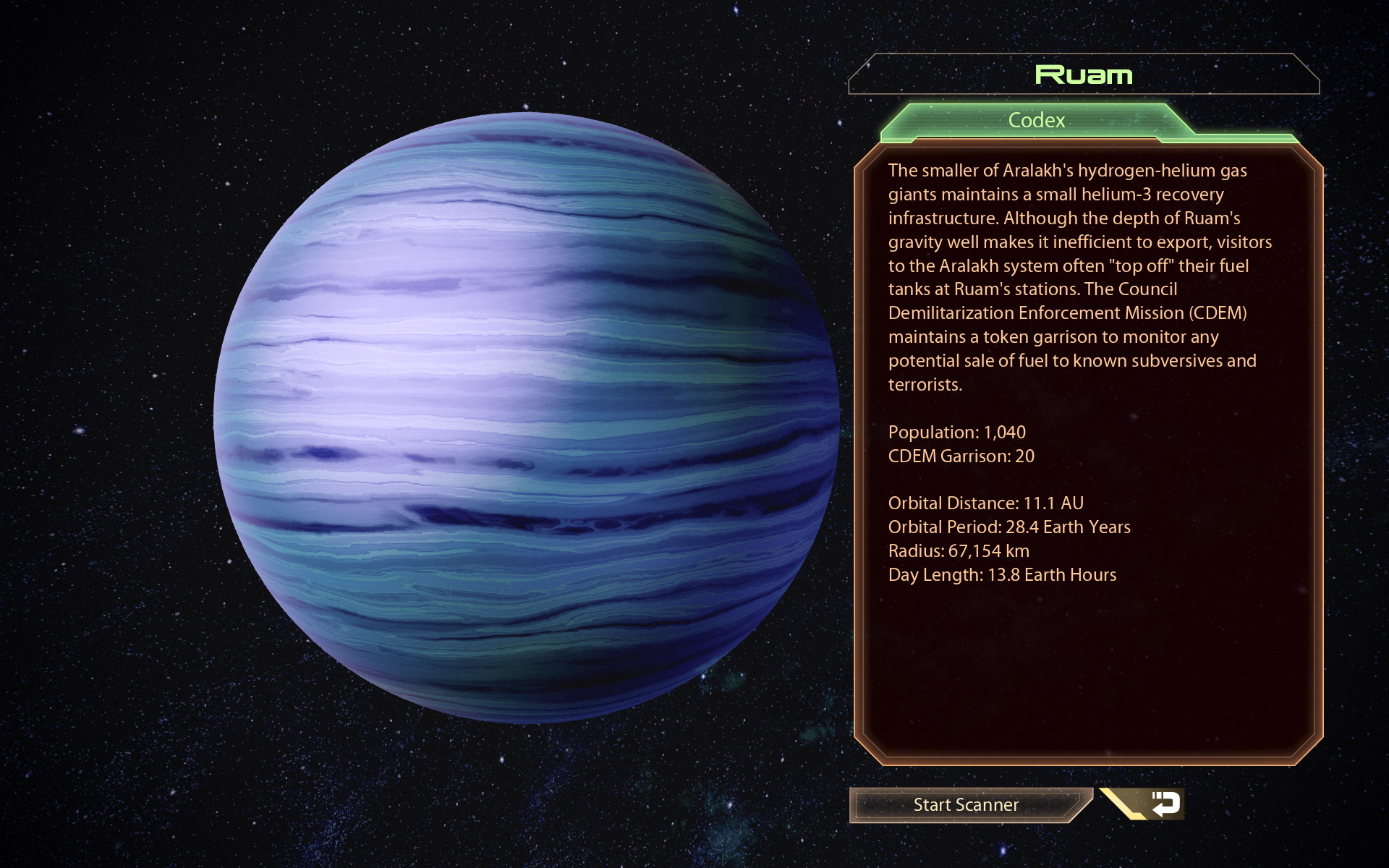
The smaller of Aralakh’s hydrogen-helium gas giants maintains a small helium-3 recovery infrastructure. Although the depth of Ruam’s gravity well makes it inefficient to export, visitors to the Aralakh system often “top off” their fuel tanks at Ruam’s stations. The Council Demilitarization Enforcement Mission (CDEM) maintains a token garrison to monitor any potential sale of fuel to known subversives and terrorists.
Population: 1,040
CDEM Garrison: 20
Orbital Distance: 11.1 AU
Orbital Period: 28.4 Earth Years
Radius: 67,154 km
Day Length: 13.8 Earth Hours
Tuchanka
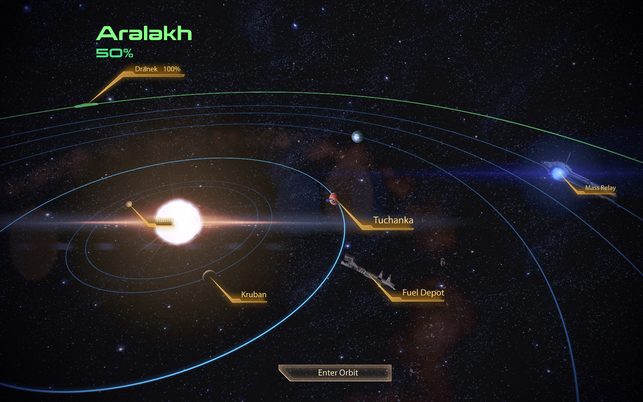
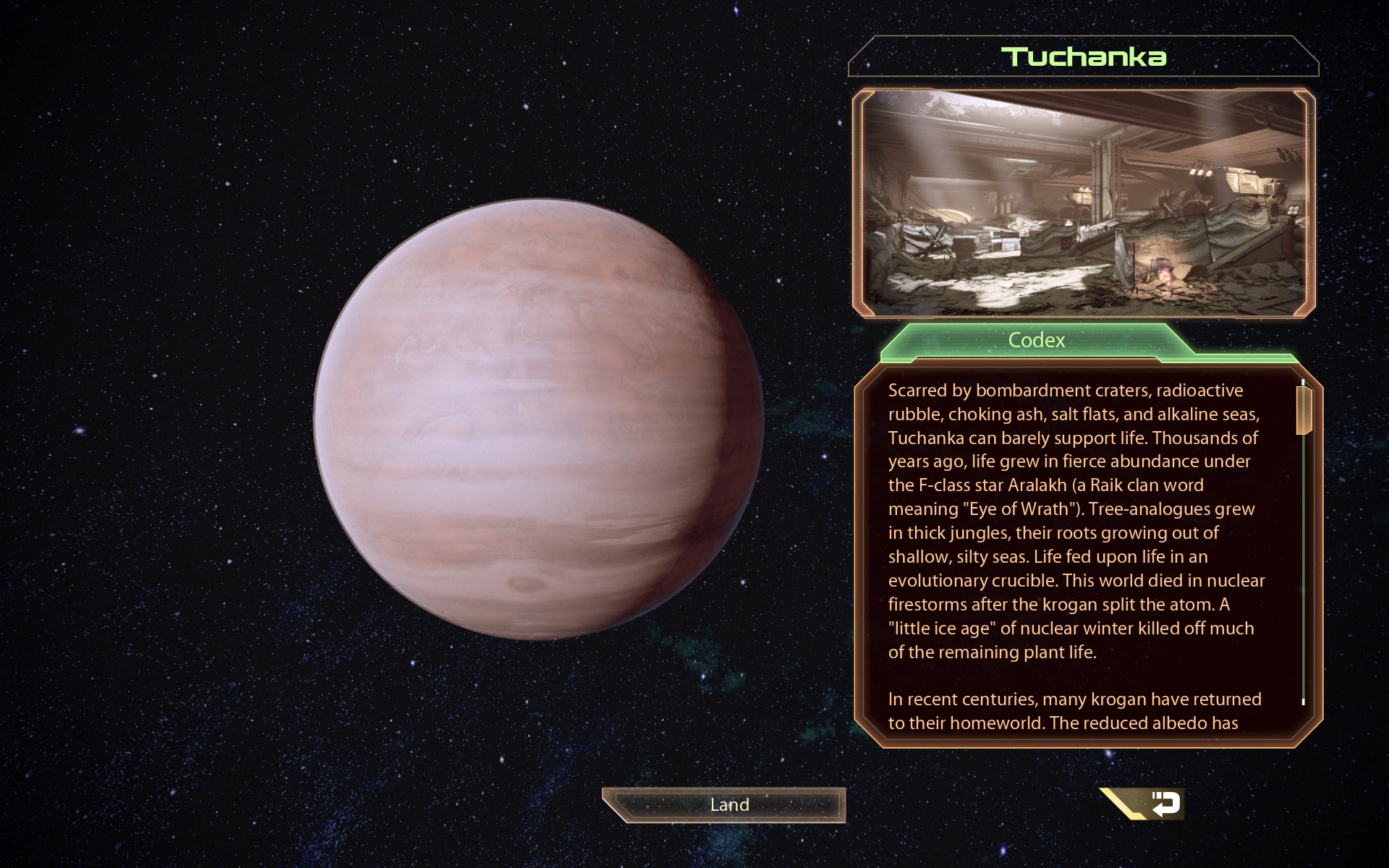
Scarred by bombardment craters, radioactive rubble, choking ash, salt flats, and alkaline seas, Tuchanka can barely support life. Thousands of years ago, life grew in fierce abundance under the F-class star Aralakh (a Raik clan word meaning “Eye of Wrath”). Tree-analogues grew in thick jungles, their roots growing out of shallow, silty seas. Life fed upon life in an evolutionary crucible. This world died in nuclear firestorms after the krogan split the atom. A “little ice age” of nuclear winter killed off much of the remaining plant life.
In recent centuries, many krogan have returned to their homeworld. The reduced albedo has caused global temperatures to rise. In order to maintain livable temperatures, a vast shroud was assembled at the L1 Lagrange point. It is maintained by the Council Demilitarization Enforcement Mission (CDEM), which is based on orbiting battlestations.
CDEM ADVISORY: Visitors to Tuchanka land at their own risk. The CDEM will not attempt to extract citizens threatened by clan warfare.
TRAVEL ADVISORY: The ecology of Tuchanka is deadly. Nearly every native species engages in some predatory behavior; even the remaining vegetation is carnivorous. Travel beyond guarded areas is strongly discouraged.
Population: 2.1 billion
Capital: currently Urdnot (since 2183)
CDEM Garrison: 2,400 (in orbital battlestations)
Orbital Distance: 5.3 AU
Orbital Period: 16.7 Earth Years
Radius: 8,293 km
Day Length: 21.4 Earth Hours
Atmospheric Pressure: 1.1 Earth Atmospheres
Surface Temperature: 72 Celsius (36 in shrouded areas)
Surface Gravity: 1.14 G
Vaul
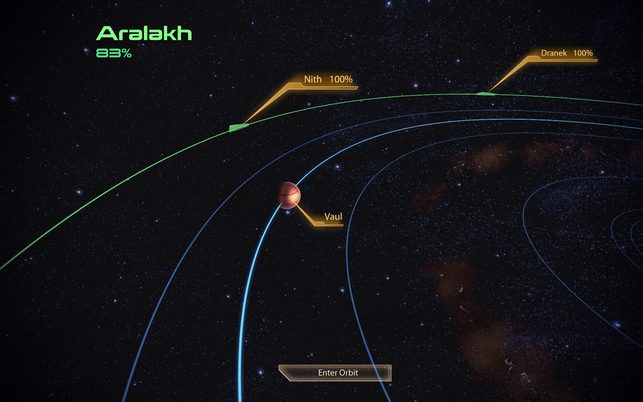
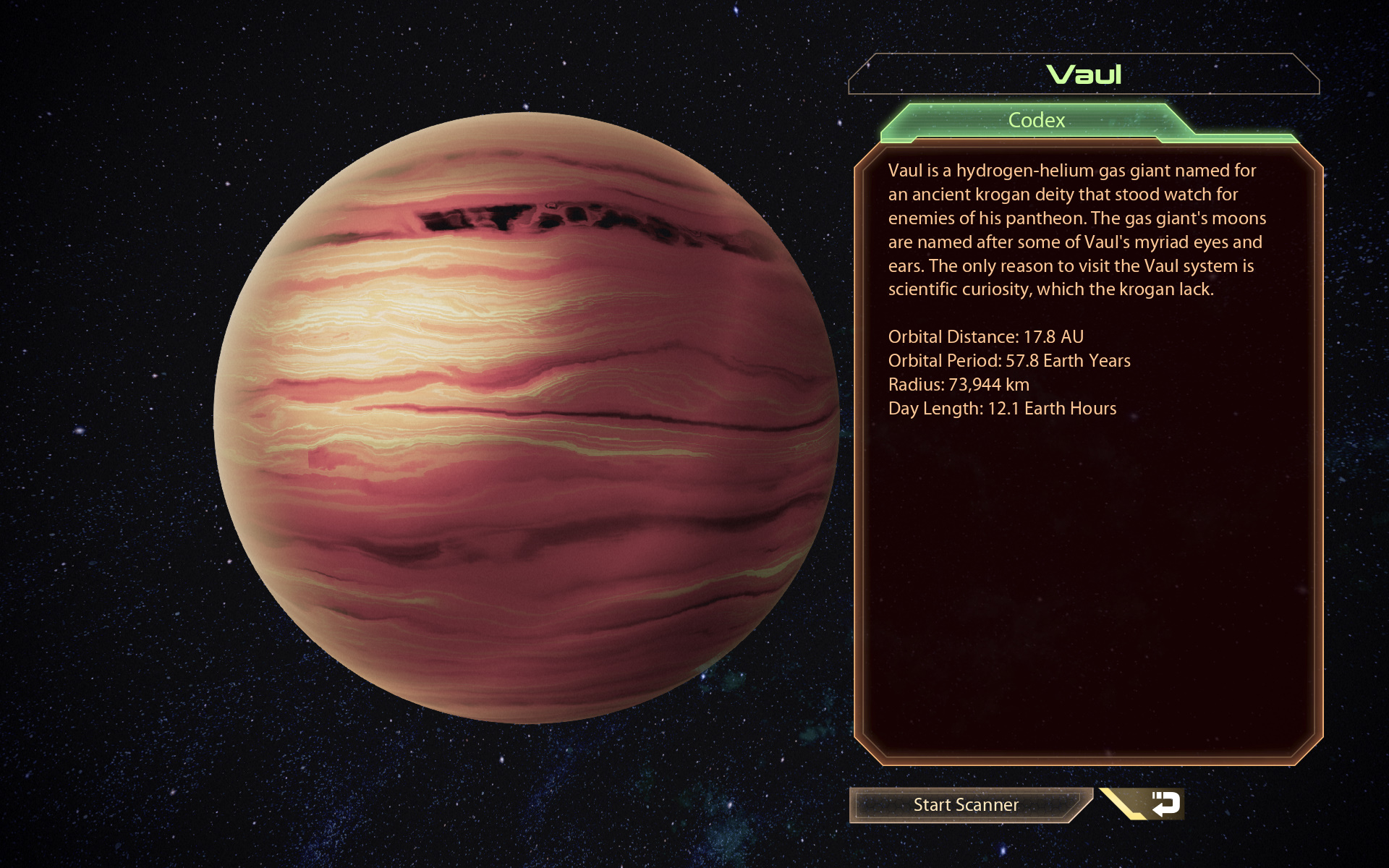
Vaul is a hydrogen-helium gas giant named for an ancient krogan deity that stood watch for enemies of his pantheon. The gas giant’s moons are named after some of Vaul’s myriad eyes and ears. The only reason to visit the Vaul system is scientific curiosity, which the krogan lack.
Orbital Distance: 17.8 AU
Orbital Period: 57.8 Earth Years
Radius: 73,944 km
Day Length: 12.1 Earth Hours
DRANEK
Dor
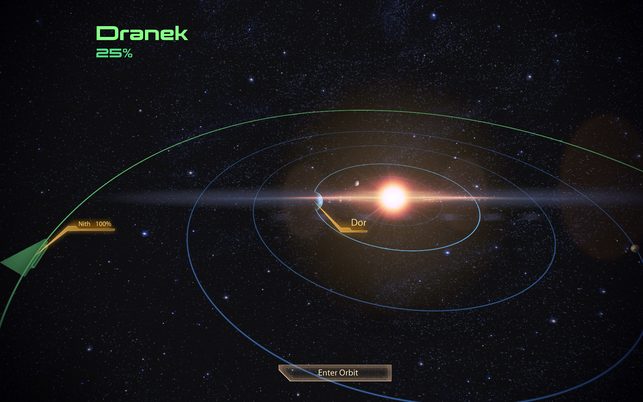
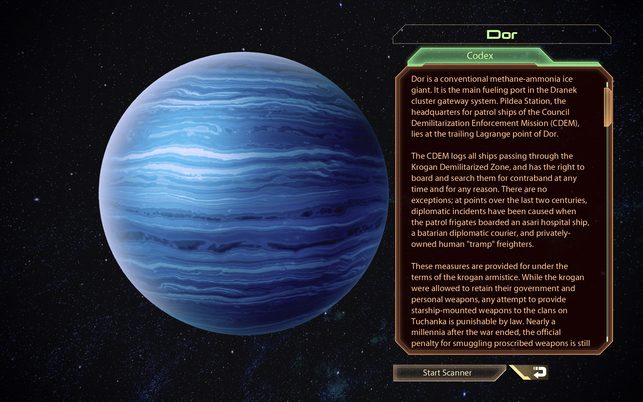
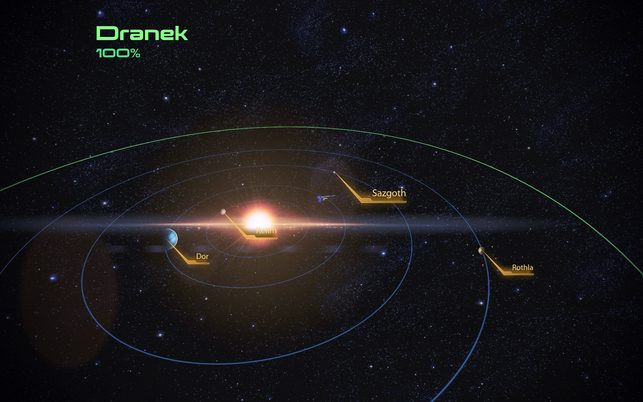
Dor is a conventional methane-ammonia ice giant. It is the main fueling port in the Dranek cluster gateway system. Pildea Station, the headquarters for patrol ships of the Council Demilitarization Enforcement Mission (CDEM), lies at the trailing Lagrange point of Dor.
The CDEM logs all ships passing through the Krogan Demilitarized Zone, and has the right to board and search them for contraband at any time and for any reason. There are no exceptions; at points over the last two centuries, diplomatic incidents have been caused when the patrol frigates boarded an asari hospital ship, a batarian diplomatic courier, and privately- owned human “tramp” freighters.
These measures are provided for under the terms of the krogan armistice. While the krogan were allowed to retain their government and personal weapons, any attempt to provide starship-mounted weapons to the clans on Tuchanka is punishable by law. Nearly a millennia after the war ended, the official
penalty for smuggling proscribed weapons is still death by spacing.
Population: 7,300
CDEM Garrison: 1,100 (not including patrol ship crews)
Orbital Distance: 0.36 AU
Orbital Period: 0.4 Earth Years
Radius: 25,588 km
Day Length: 18.4 Earth Hours
Kelim
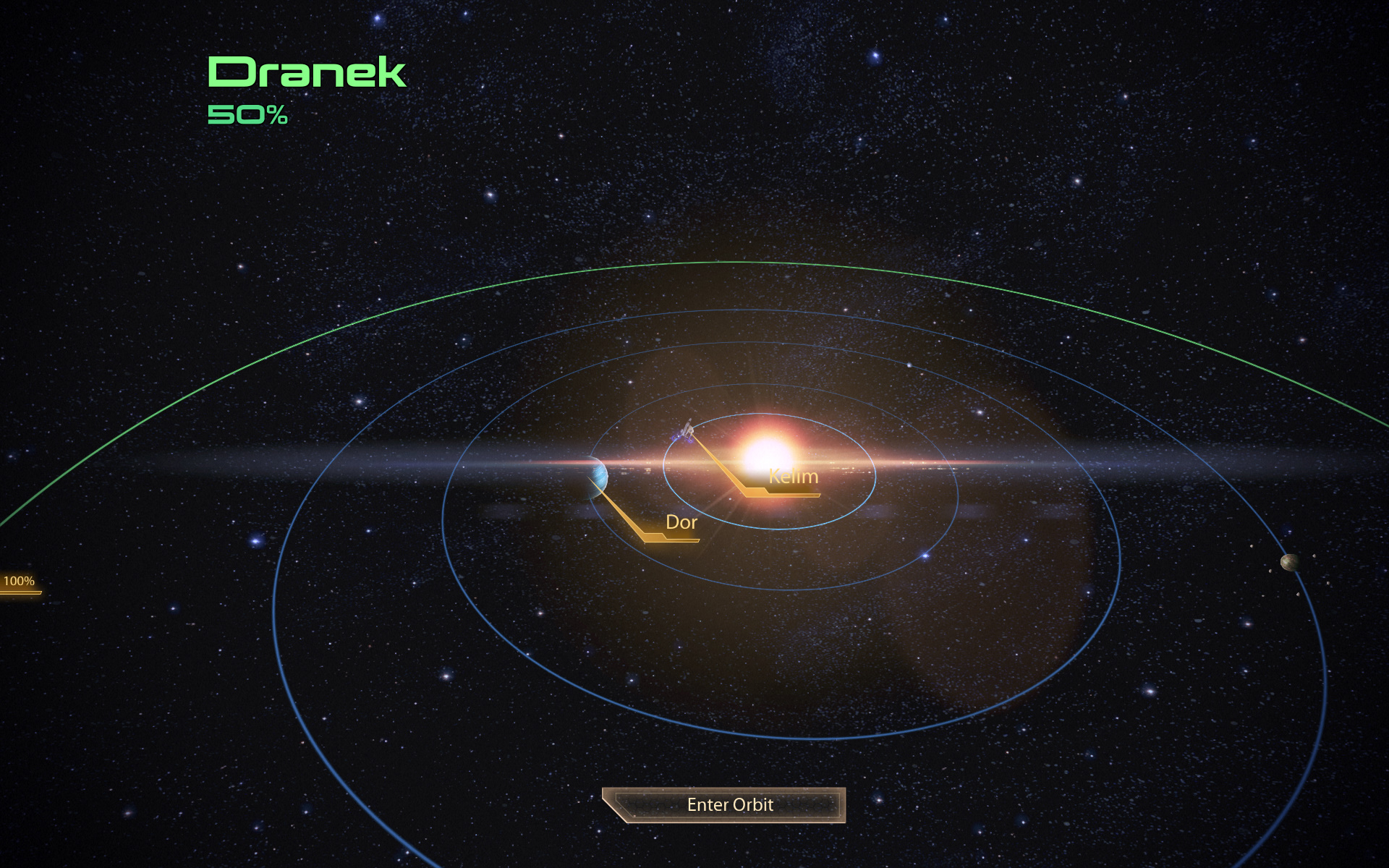
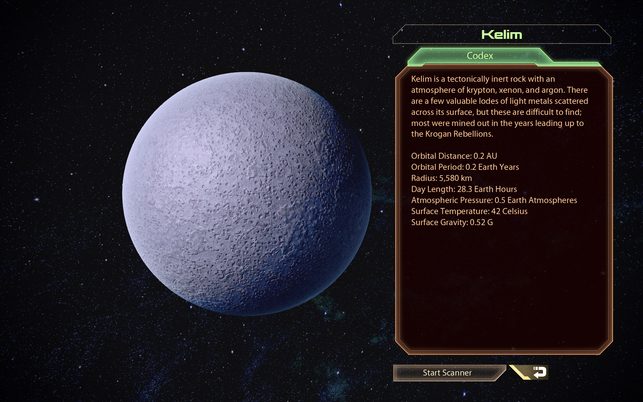
Kelim is a tectonically inert rock with an atmosphere of krypton, xenon, and argon. There are a few valuable lodes of light metals scattered across its surface, but these are difficult to find; most were mined out in the years leading up to the Krogan Rebellions.
Orbital Distance: 0.2 AU
Orbital Period: 0.2 Earth Years
Radius: 5,580 km
Day Length: 28.3 Earth Hours
Atmospheric Pressure: 0.5 Earth Atmospheres
Surface Temperature: 42
Celsius Surface Gravity: 0.52 G
Rothia
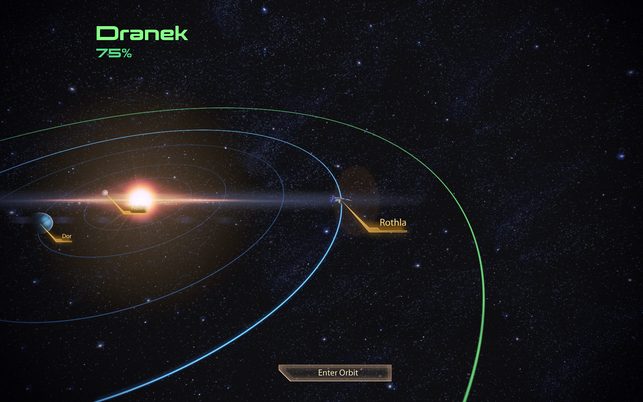
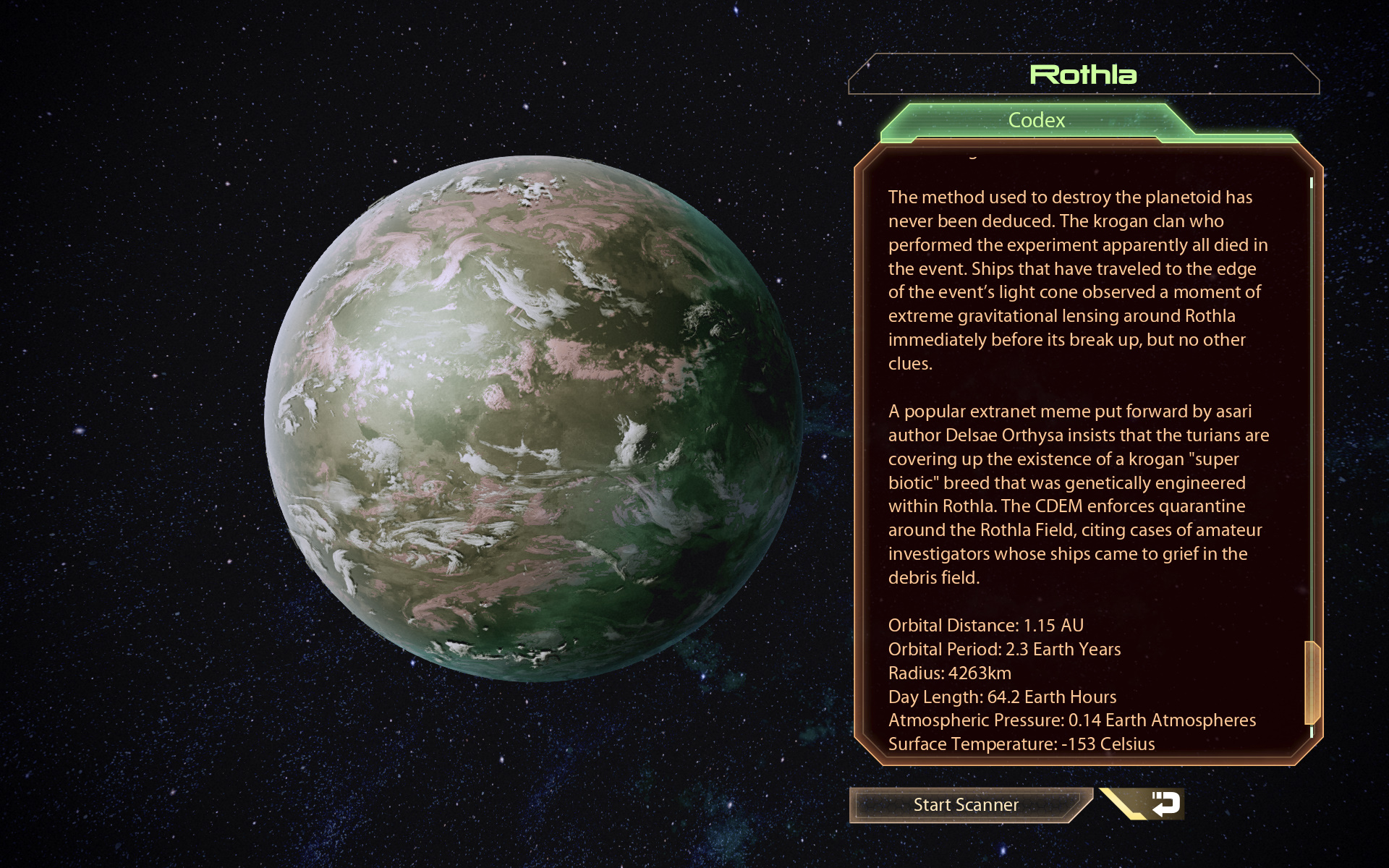
Once Rothla was a large ice dwarf with the statistics listed below. In the waning years of the Krogan Rebellions it was shattered into field of debris by what is assumed to have been the test of an exotic weapons system. In the wake of “the event,” the planetoid was reduced to a relatively contained field of thousands of tiny moonlets rotating around one another, colliding and ricocheting.
The method used to destroy the planetoid has never been deduced. The krogan clan who performed the experiment apparently all died in the event. Ships that have traveled to the edge of the event’s light cone observed a moment of extreme gravitational lensing around Rothla immediately before its break up, but no other clues.
A popular extranet meme put forward by asari author Delsae Orthysa insists that the turians are covering up the existence of a krogan “super biotic” breed that was genetically engineered within Rothla. The CDEM enforces quarantine around the Rothla Field, citing cases of amateur investigators whose ships came to grief in the debris field.
Orbital Distance: 1.15 AU
Orbital Period: 2.3 Earth Years
Radius: 4263km
Day Length: 64.2 Earth Hours
Atmospheric Pressure: 0.14 Earth Atmospheres
Surface Temperature: -153 Celsius
Sazgoth
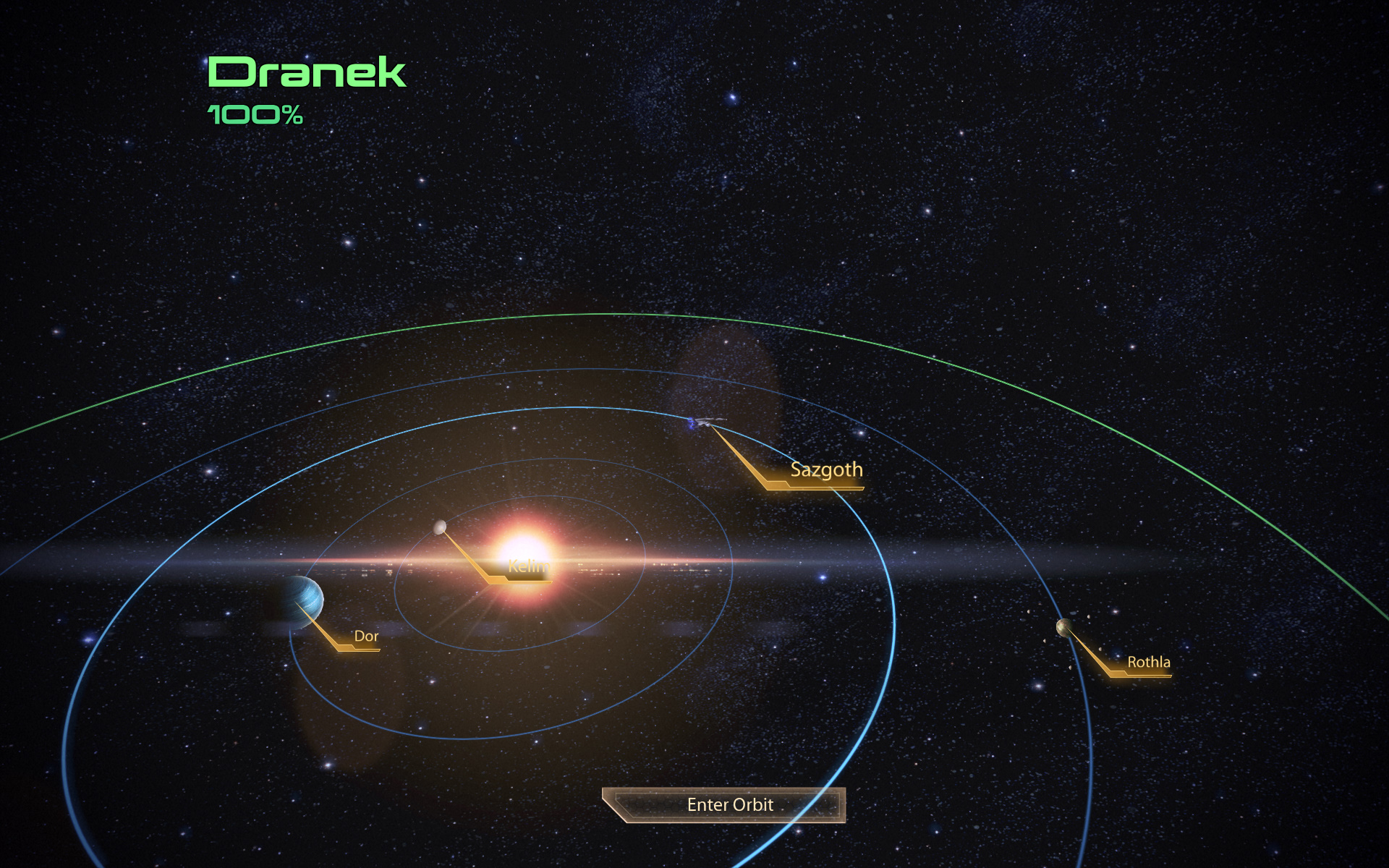
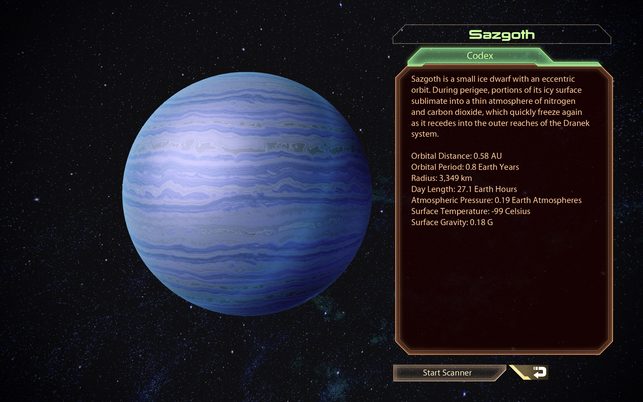
Sazgoth is a small ice dwarf with an eccentric orbit. During perigee, portions of its icy surface sublimate into a thin atmosphere of nitrogen and carbon dioxide, which quickly freeze again as it recedes into the outer reaches of the Dranek system.
Orbital Distance: 0.58 AU
Orbital Period: 0.8 Earth Years Radius: 3,349 km
Day Length: 27.1 Earth Hours
Atmospheric Pressure: 0.19 Earth Atmospheres
Surface Temperature: -99 Celsius
Surface Gravity: 0.18 G
NITH
Mantun
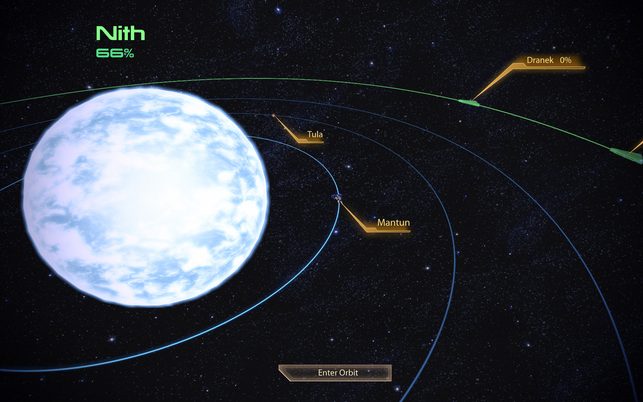
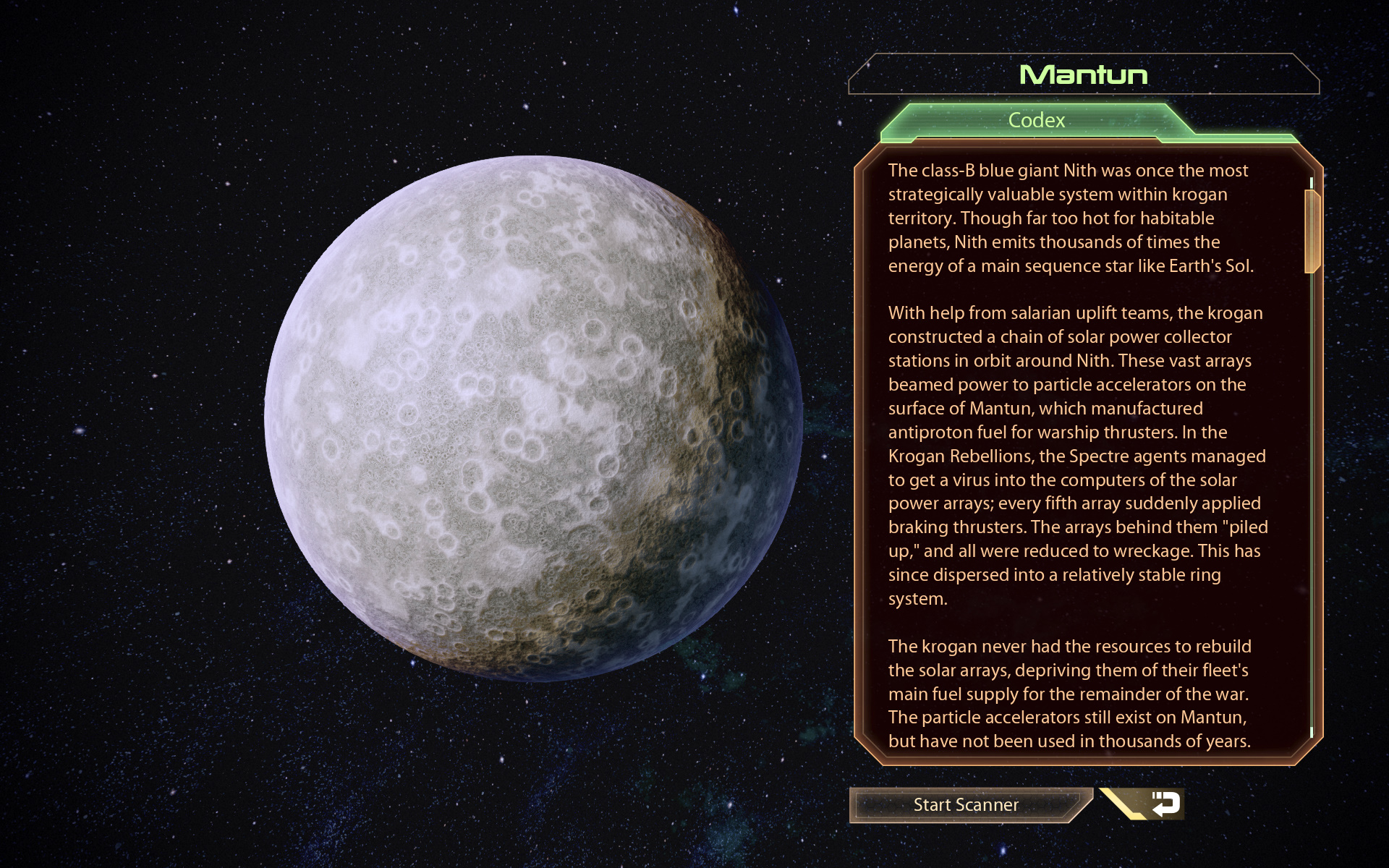
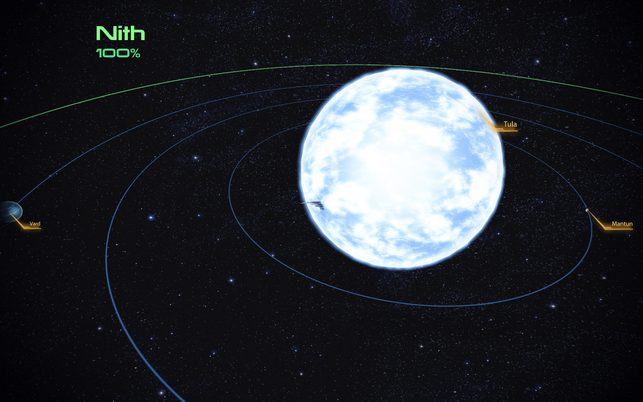
The class-B blue giant Nith was once the most strategically valuable system within krogan territory. Though far too hot for habitable planets, Nith emits thousands of times the energy of a main sequence star like Earth’s Sol.
With help from salarian uplift teams, the krogan constructed a chain of solar power collector stations in orbit around Nith. These vast arrays beamed power to particle accelerators on the surface of Mantun, which manufactured antiproton fuel for warship thrusters. In the Krogan Rebellions, the Spectre agents managed to get a virus into the computers of the solar power arrays; every fifth array suddenly applied braking thrusters. The arrays behind them “piled up,” and all were reduced to wreckage. This has since dispersed into a relatively stable ring system.
The krogan never had the resources to rebuild the solar arrays, depriving them of their fleet’s main fuel supply for the remainder of the war. The particle accelerators still exist on Mantun, but have not been used in thousands of years.
Orbital Distance: 57.2 AU
Orbital Period: 112.1 Earth Years
Radius: 2,150 km
Orbital Period: 112.1 Earth Years
Atmospheric Pressure: Trace
Surface Temperature: 641 Celsius
Tula
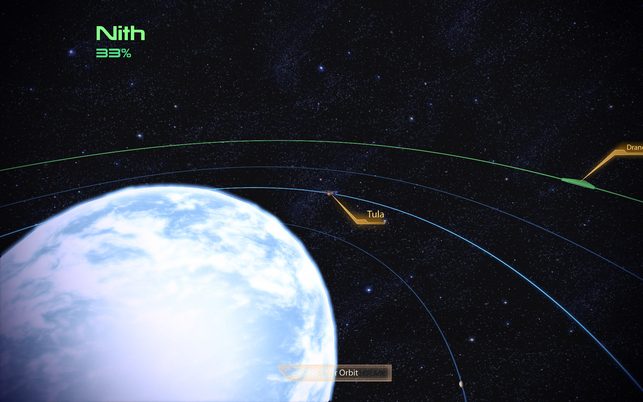
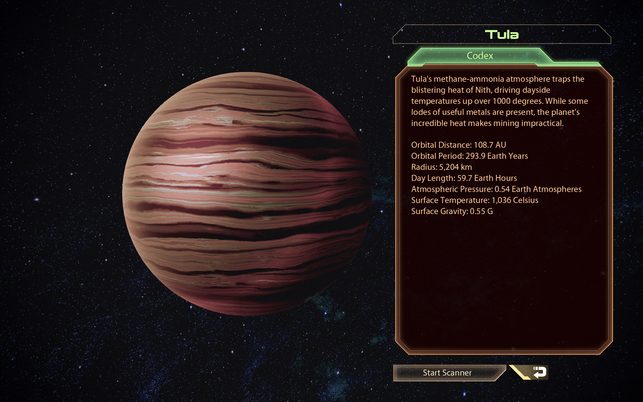
Tula’s methane-ammonia atmosphere traps the blistering heat of Nith, driving dayside
temperatures up over 1000 degrees. While some lodes of useful metals are present, the planet’s incredible heat makes mining impractical.
Orbital Distance: 108.7 AU
Orbital Period: 293.9 Earth Years
Radius: 5,204 km
Day Length: 59.7 Earth Hours
Atmospheric Pressure: 0.54 Earth Atmospheres
Surface Temperature: 1,036 Celsius
Surface Gravity: 0.55 G
Vard
Vard is a methane-ammonia ice giant. Until the Krogan Rebellions, it had a sizable helium-3 fuel refining infrastructure. Once the solar arrays orbiting Nith were destroyed, the constant flow of antiproton tankers visiting the system disappeared. There was little point to maintaining the facilities, so they were shut down and abandoned. Today the ancient stations are “squatted” by transients, criminals, and outcasts. Although few are safe for habitation, neither the krogan nor the Council Demilitarization Enforcement Mission (CDEM) patrols care if they take their chances.
Population: 2,072
Orbital Distance: 195.6 AU
Orbital Period: 709.6 Earth Years
Radius: 36,670 km
Day Length: 18.0 Earth Hours
SERPENT NEBULA
BOLTZMANN
Bekenstein
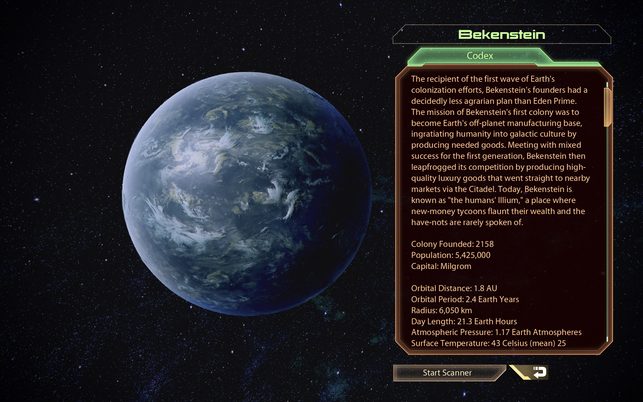
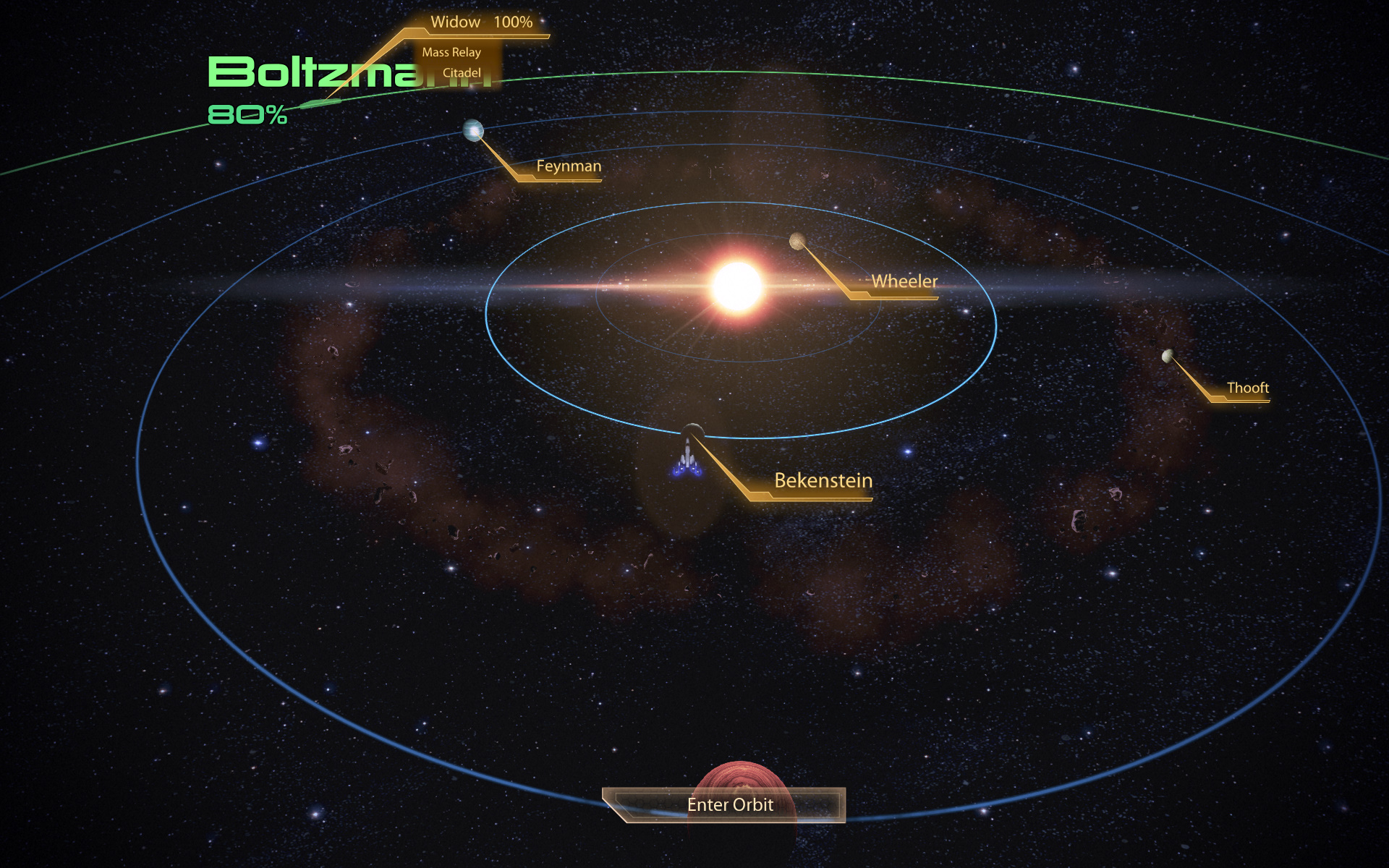
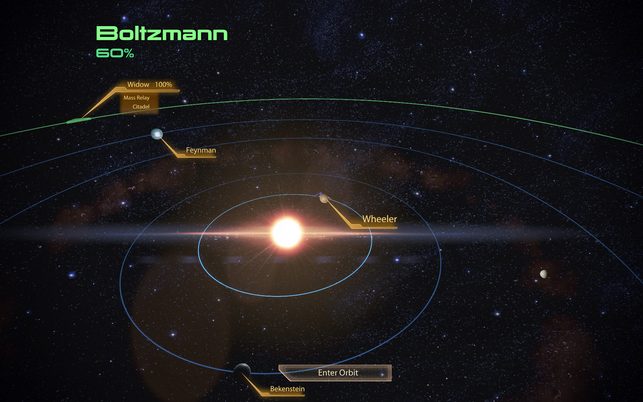
The recipient of the first wave of Earth’s colonization efforts, Bekenstein’s founders had a decidedly less agrarian plan than Eden Prime. The mission of Bekenstein’s first colony was to become Earth’s off-planet manufacturing base, ingratiating humanity into galactic culture by producing needed goods. Meeting with mixed success for the first generation, Bekenstein then leapfrogged its competition by producing high- quality luxury goods that went straight to nearby markets via the Citadel. Today, Bekenstein is known as “the humans’ Illium,” a place where new-money tycoons flaunt their wealth and the have-nots are rarely spoken of.
Colony Founded: 2158
Population: 5,425,000
Capital: Milgrom
Orbital Distance: 1.8 AU
Orbital Period: 2.4 Earth Years
Radius: 6,050 km
Day Length: 21.3 Earth Hours
Atmospheric Pressure: 1.17 Earth Atmospheres
Surface Temperature: 43 Celsius (mean) 25
Celsius (habitable zone)
Surface Gravity: 0.9 G
Feynman
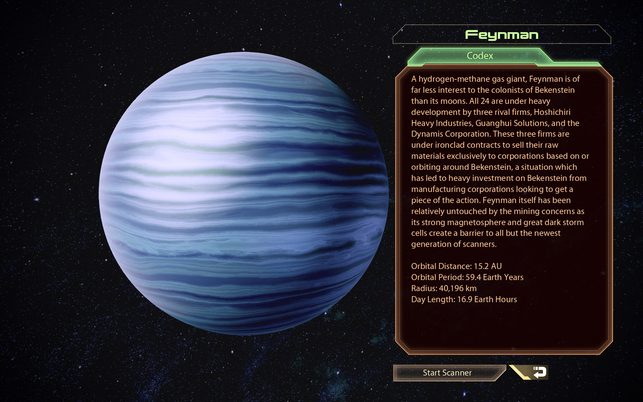
A hydrogen-methane gas giant, Feynman is of far less interest to the colonists of Bekenstein than its moons. All 24 are under heavy development by three rival firms, Hoshichiri Heavy Industries, Guanghui Solutions, and the Dynamis Corporation. These three firms are under ironclad contracts to sell their raw materials exclusively to corporations based on or orbiting around Bekenstein, a situation which has led to heavy investment on Bekenstein from manufacturing corporations looking to get a piece of the action. Feynman itself has been relatively untouched by the mining concerns as its strong magnetosphere and great dark storm cells create a barrier to all but the newest generation of scanners.
Orbital Distance: 15.2 AU
Orbital Period: 59.4 Earth Years
Radius: 40,196 km
Day Length: 16.9 Earth Hours
Thooft
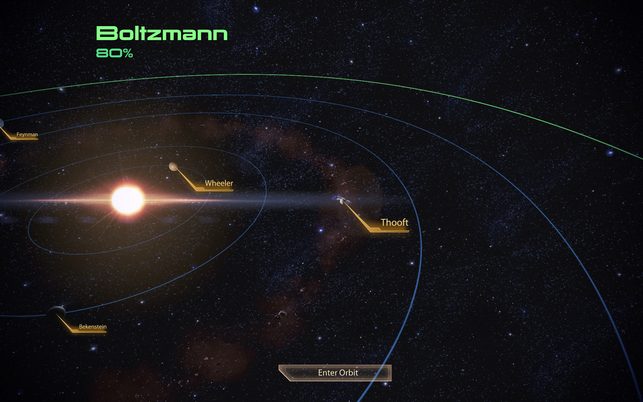
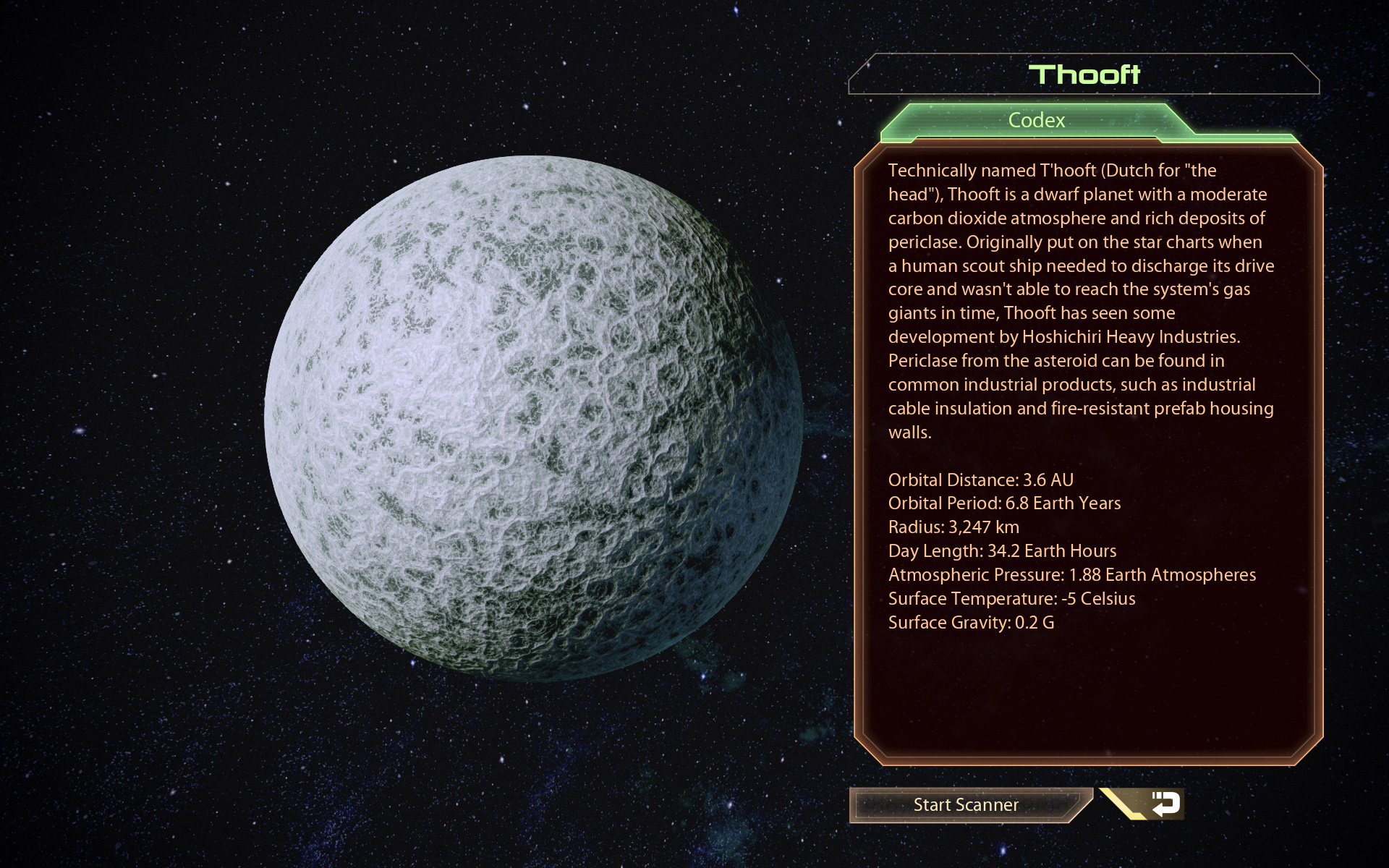
Technically named T’hooft (Dutch for “the head”), Thooft is a dwarf planet with a moderate carbon dioxide atmosphere and rich deposits of periclase. Originally put on the star charts when a human scout ship needed to discharge its drive core and wasn’t able to reach the system’s gas giants in time, Thooft has seen some development by Hoshichiri Heavy Industries. Periclase from the asteroid can be found in common industrial products, such as industrial cable insulation and fire-resistant prefab housing walls.
Orbital Distance: 3.6 AU
Orbital Period: 6.8 Earth Years Radius: 3,247 km
Day Length: 34.2 Earth Hours
Atmospheric Pressure: 1.88 Earth Atmospheres
Surface Temperature: -5 Celsius
Surface Gravity: 0.2 G
Veltman
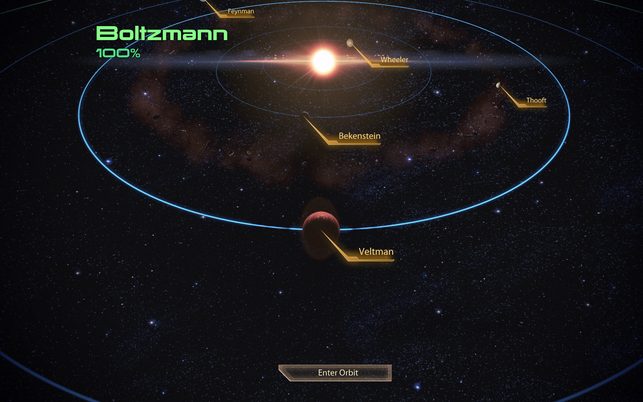
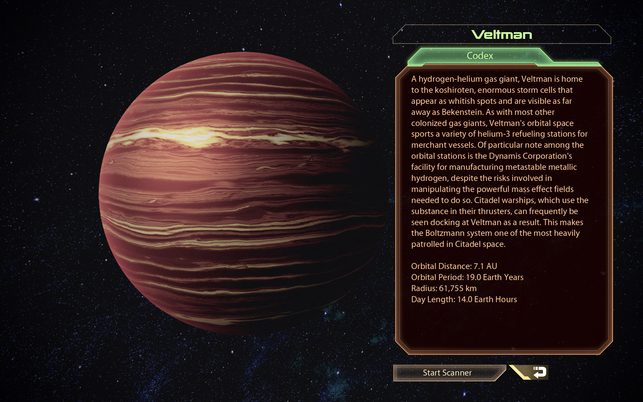
A hydrogen-helium gas giant, Veltman is home to the koshiroten, enormous storm cells that appear as whitish spots and are visible as far away as Bekenstein. As with most other colonized gas giants, Veltman’s orbital space sports a variety of helium-3 refueling stations for merchant vessels. Of particular note among the orbital stations is the Dynamis Corporation’s facility for manufacturing metastable metallic hydrogen, despite the risks involved in manipulating the powerful mass effect fields needed to do so. Citadel warships, which use the substance in their thrusters, can frequently be seen docking at Veltman as a result. This makes the Boltzmann system one of the most heavily patrolled in Citadel space.
Orbital Distance: 7.1 AU
Orbital Period: 19.0 Earth Years
Radius: 61,755 km
Day Length: 14.0 Earth Hours
Wheeler
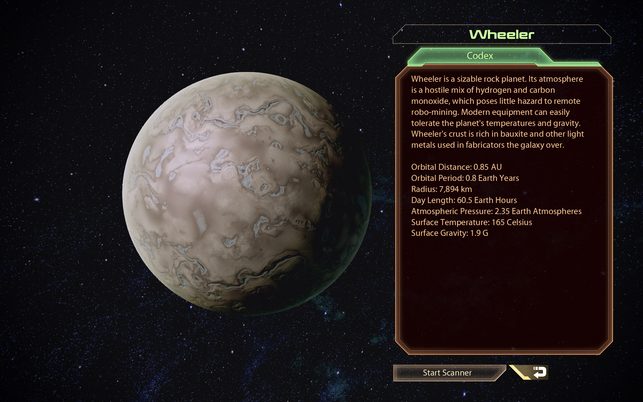
Wheeler is a sizable rock planet. Its atmosphere is a hostile mix of hydrogen and carbon
monoxide, which poses little hazard to remote robo-mining. Modern equipment can easily tolerate the planet’s temperatures and gravity. Wheeler’s crust is rich in bauxite and other light metals used in fabricators the galaxy over.
Orbital Distance: 0.85 AU
Orbital Period: 0.8 Earth Years
Radius: 7,894 km
Day Length: 60.5 Earth Hours
Atmospheric Pressure: 2.35 Earth Atmospheres
Surface Temperature: 165 Celsius
Surface Gravity: 1.9 G
WIDOW
Citadel
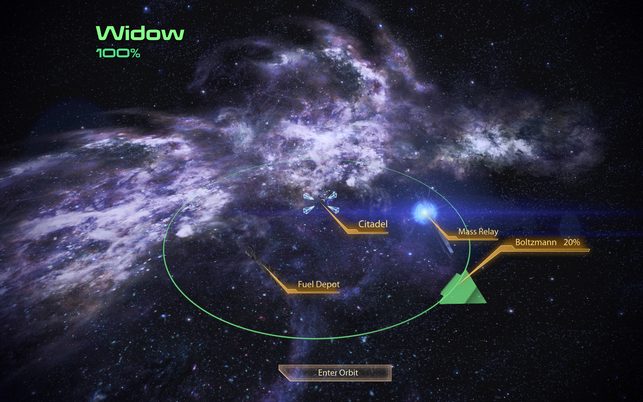
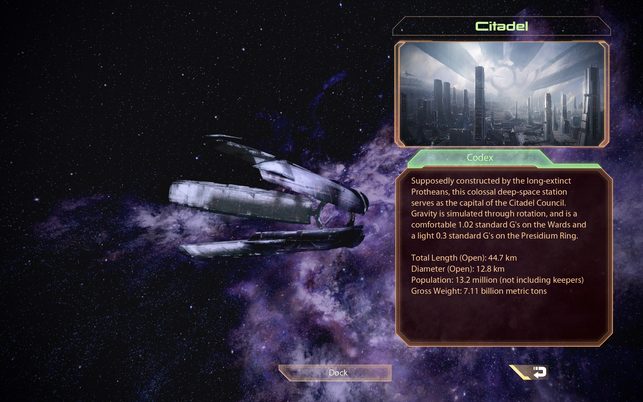
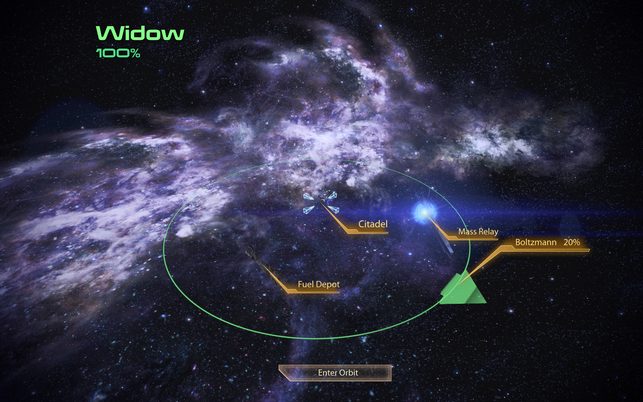
Supposedly constructed by the long-extinct Protheans, this colossal deep-space station serves as the capital of the Citadel Council. Gravity is simulated through rotation, and is a comfortable 1.02 standard G’s on the Wards and a light 0.3 standard G’s on the Presidium Ring.
Total Length (Open): 44.7 km
Diameter (Open): 12.8 km
Population: 13.2 million (not including keepers)
Gross Weight: 7.11 billion metric tons
CRESCENT NEBULA
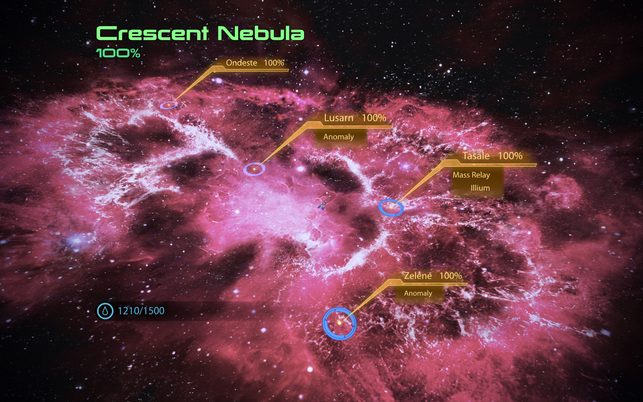
LUSARN
Doriae
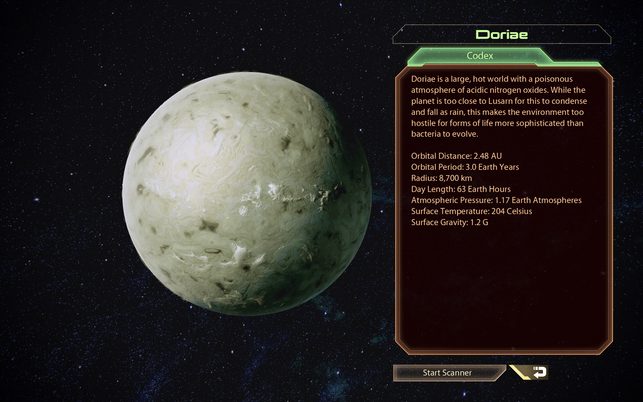
Doriae is a large, hot world with a poisonous atmosphere of acidic nitrogen oxides. While the planet is too close to Lusarn for this to condense and fall as rain, this makes the environment too hostile for forms of life more sophisticated than bacteria to evolve.
Orbital Distance: 2.48 AU
Orbital Period: 3.0 Earth Years
Radius: 8,700 km
Day Length: 63 Earth Hours
Atmospheric Pressure: 1.17 Earth Atmospheres
Surface Temperature: 204 Celsius
Surface Gravity: 1.2 G
Euntanta
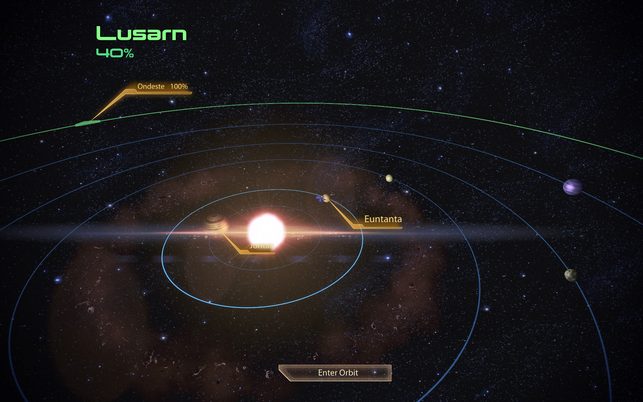
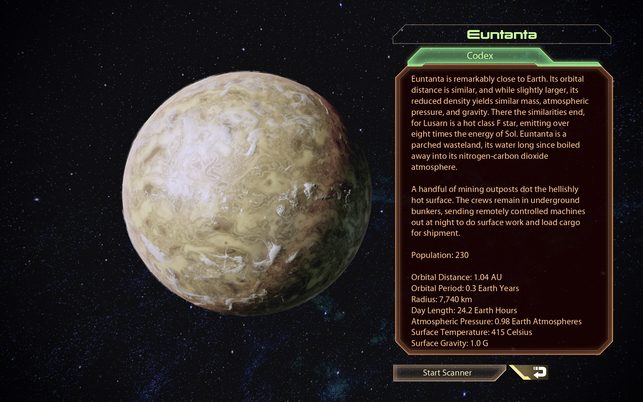
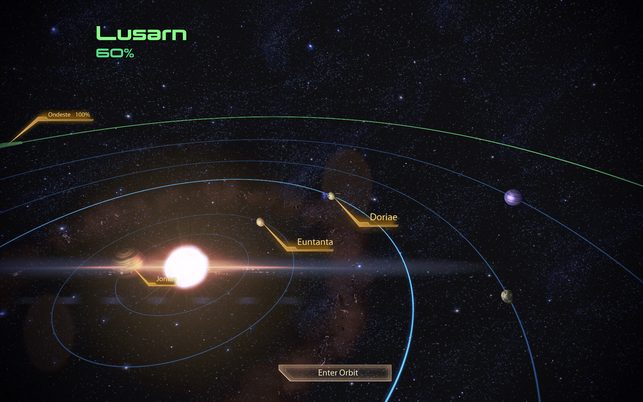
Euntanta is remarkably close to Earth. Its orbital distance is similar, and while slightly larger, its reduced density yields similar mass, atmospheric pressure, and gravity. There the similarities end, for Lusarn is a hot class F star, emitting over eight times the energy of Sol. Euntanta is a parched wasteland, its water long since boiled away into its nitrogen-carbon dioxide atmosphere.
A handful of mining outposts dot the hellishly hot surface. The crews remain in underground bunkers, sending remotely controlled machines out at night to do surface work and load cargo for shipment.
Population: 230
Orbital Distance: 1.04 AU
Orbital Period: 0.3 Earth Years
Radius: 7,740 km
Day Length: 24.2 Earth Hours
Atmospheric Pressure: 0.98 Earth Atmospheres
Surface Temperature: 415 Celsius
Surface Gravity: 1.0 G
Jontan
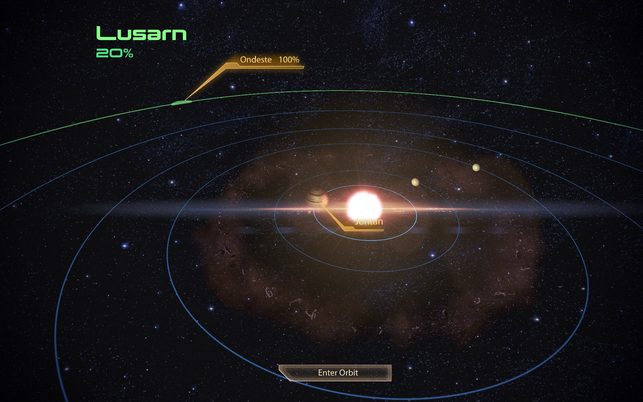
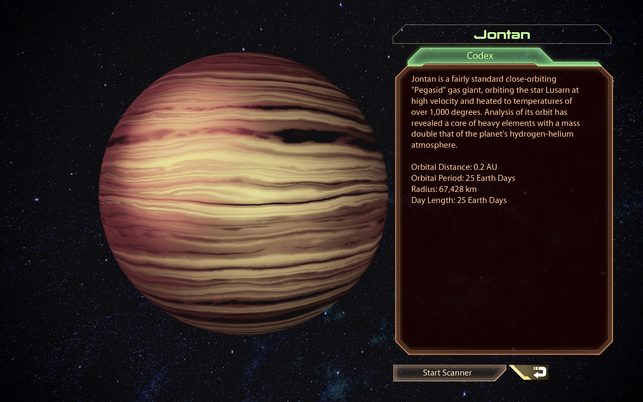
Jontan is a fairly standard close-orbiting “Pegasid” gas giant, orbiting the star Lusarn at high velocity and heated to temperatures of over 1,000 degrees. Analysis of its orbit has revealed a core of heavy elements with a mass double that of the planet’s hydrogen-helium atmosphere.
Orbital Distance: 0.2 AU
Orbital Period: 25 Earth Days
Radius: 67,428 km
Day Length: 25 Earth Days
Tarith
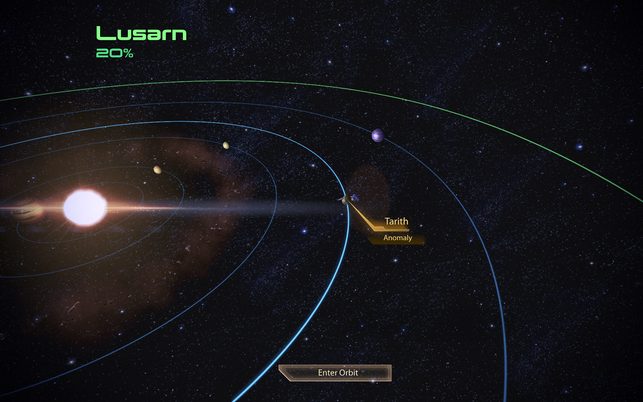
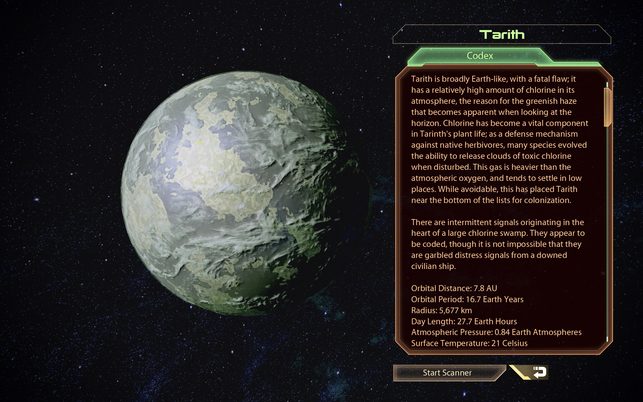
Tarith is broadly Earth-like, with a fatal flaw; it has a relatively high amount of chlorine in its atmosphere, the reason for the greenish haze that becomes apparent when looking at the horizon. Chlorine has become a vital component in Tarinth’s plant life; as a defense mechanism against native herbivores, many species evolved the ability to release clouds of toxic chlorine when disturbed. This gas is heavier than the atmospheric oxygen, and tends to settle in low places. While avoidable, this has placed Tarith near the bottom of the lists for colonization.
There are intermittent signals originating in the heart of a large chlorine swamp. They appear to be coded, though it is not impossible that they are garbled distress signals from a downed civilian ship.
Orbital Distance: 7.8 AU
Orbital Period: 16.7 Earth Years
Radius: 5,677 km
Day Length: 27.7 Earth Hours
Atmospheric Pressure: 0.84 Earth Atmospheres
Surface Temperature: 21 Celsius
Surface Gravity: 0.87 G
Xetic
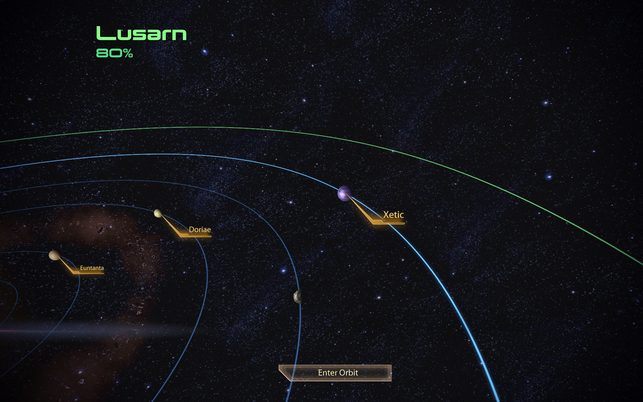
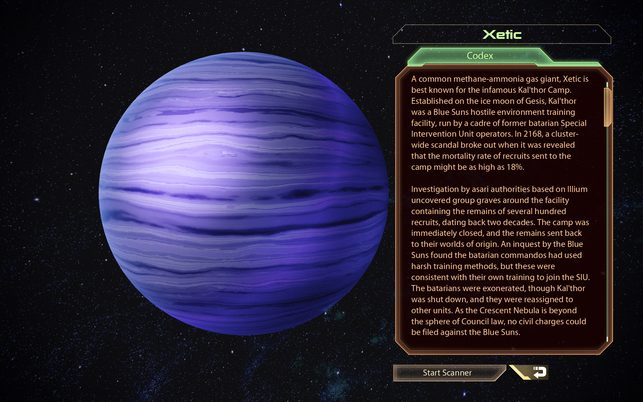
A common methane-ammonia gas giant, Xetic is best known for the infamous Kal’thor Camp. Established on the ice moon of Gesis, Kal’thor was a Blue Suns hostile environment training facility, run by a cadre of former batarian Special Intervention Unit operators. In 2168, a cluster- wide scandal broke out when it was revealed that the mortality rate of recruits sent to the camp might be as high as 18%.
Investigation by asari authorities based on Illium uncovered group graves around the facility containing the remains of several hundred recruits, dating back two decades. The camp was immediately closed, and the remains sent back to their worlds of origin. An inquest by the Blue Suns found the batarian commandos had used harsh training methods, but these were consistent with their own training to join the SIU. The batarians were exonerated, though Kal’thor was shut down, and they were reassigned to other units. As the Crescent Nebula is beyond the sphere of Council law, no civil charges could be filed against the Blue Suns.
Orbital Distance: 15.6 AU
Orbital Period: 47.4 Earth Years
Radius: 30,054 km
Day Length: 13.7 Earth Hours
ONDESTE
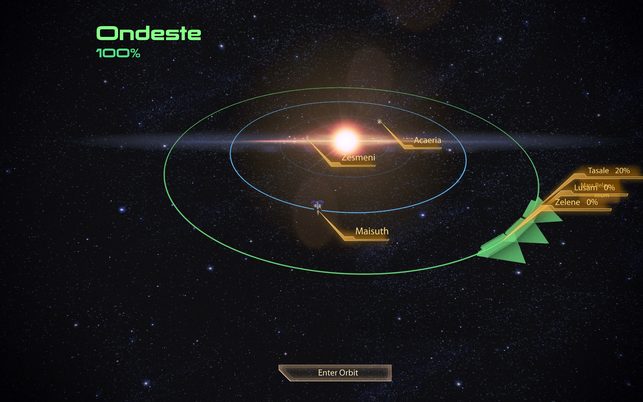
Acaeria
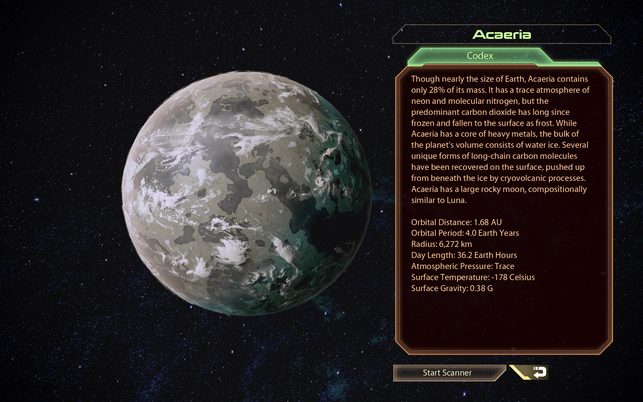
Though nearly the size of Earth, Acaeria contains only 28% of its mass. It has a trace atmosphere of neon and molecular nitrogen, but the
predominant carbon dioxide has long since frozen and fallen to the surface as frost. While Acaeria has a core of heavy metals, the bulk of the planet’s volume consists of water ice. Several unique forms of long-chain carbon molecules have been recovered on the surface, pushed up from beneath the ice by cryovolcanic processes. Acaeria has a large rocky moon, compositionally similar to Luna.
Orbital Distance: 1.68 AU
Orbital Period: 4.0 Earth Years
Radius: 6,272 km
Day Length: 36.2 Earth Hours
Atmospheric Pressure: Trace
Surface Temperature: -178 Celsius
Surface Gravity: 0.38 G
Maisuth
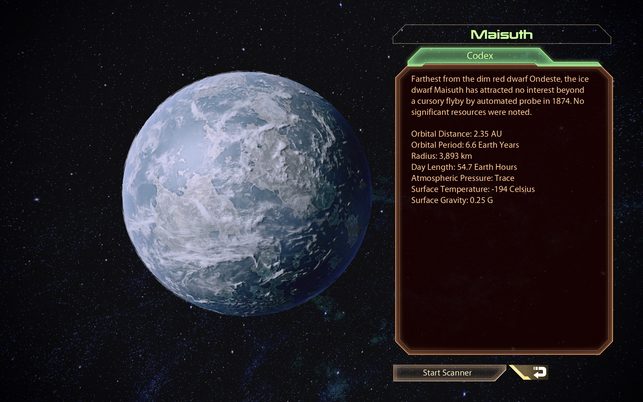
Farthest from the dim red dwarf Ondeste, the ice dwarf Maisuth has attracted no interest beyond a cursory flyby by automated probe in 1874. No significant resources were noted.
Orbital Distance: 2.35 AU
Orbital Period: 6.6 Earth Years
Radius: 3,893 km
Day Length: 54.7 Earth Hours
Atmospheric Pressure: Trace
Surface Temperature: -194 Celsius
Surface Gravity: 0.25 G
Zesmeni
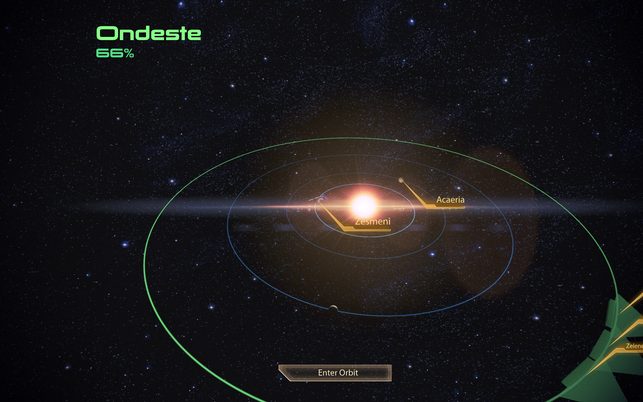
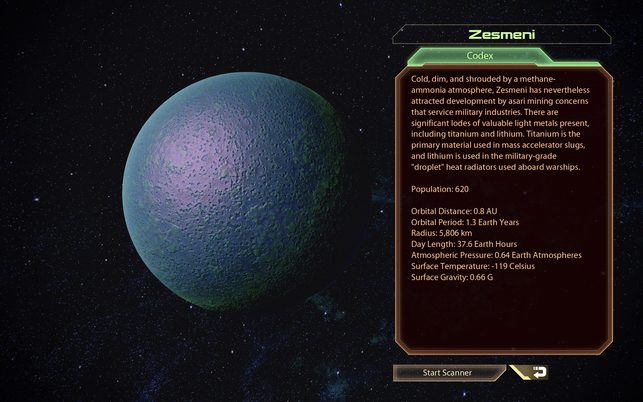
Cold, dim, and shrouded by a methane- ammonia atmosphere, Zesmeni has nevertheless attracted development by asari mining concerns that service military industries. There are significant lodes of valuable light metals present, including titanium and lithium. Titanium is the primary material used in mass accelerator slugs, and lithium is used in the military-grade “droplet” heat radiators used aboard warships.
Population: 620
Orbital Distance: 0.8 AU
Orbital Period: 1.3 Earth Years
Radius: 5,806 km
Day Length: 37.6 Earth Hours
Atmospheric Pressure: 0.64 Earth Atmospheres
Surface Temperature: -119 Celsius
Surface Gravity: 0.66 G
TASALE
Beregale
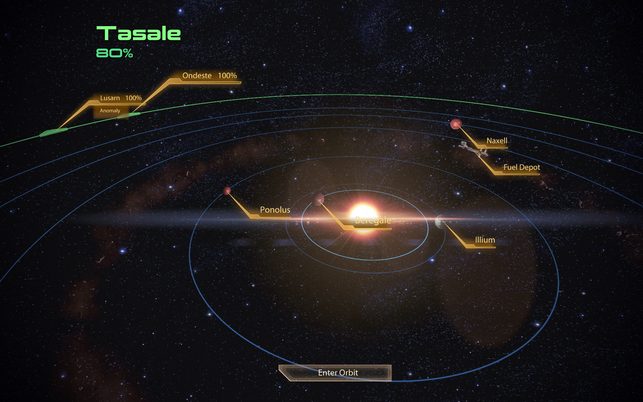
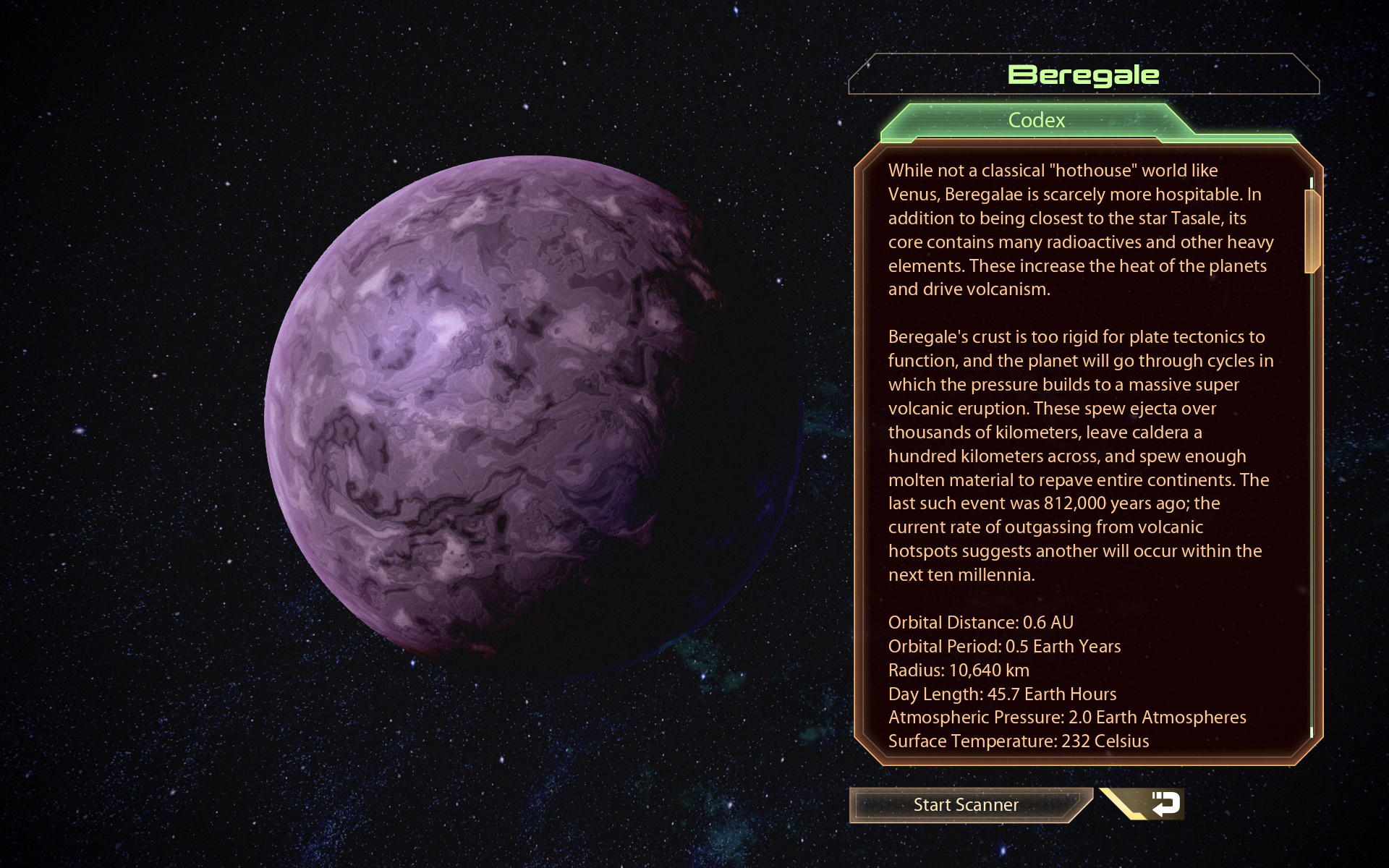
While not a classical “hothouse” world like Venus, Beregalae is scarcely more hospitable. In addition to being closest to the star Tasale, its core contains many radioactives and other heavy elements. These increase the heat of the planets and drive volcanism.
Beregale’s crust is too rigid for plate tectonics to function, and the planet will go through cycles in which the pressure builds to a massive super volcanic eruption. These spew ejecta over thousands of kilometers, leave caldera a hundred kilometers across, and spew enough molten material to repave entire continents. The last such event was 812,000 years ago; the current rate of outgassing from volcanic hotspots suggests another will occur within the next ten millennia.
Orbital Distance: 0.6 AU
Orbital Period: 0.5 Earth Years
Radius: 10,640 km
Day Length: 45.7 Earth Hours
Atmospheric Pressure: 2.0 Earth Atmospheres
Surface Temperature: 232 Celsius
Surface Gravity: 2.1 G
Illium
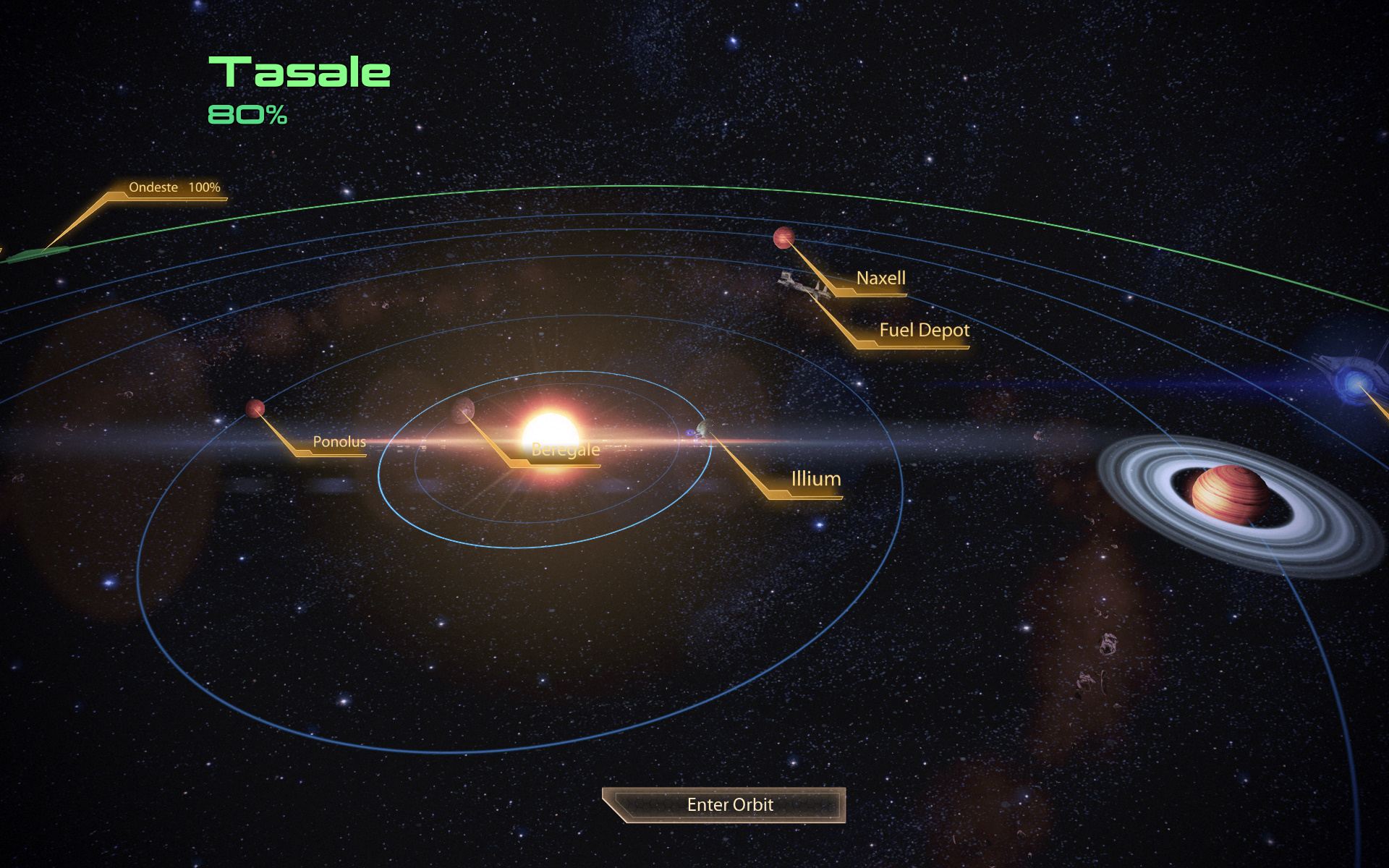
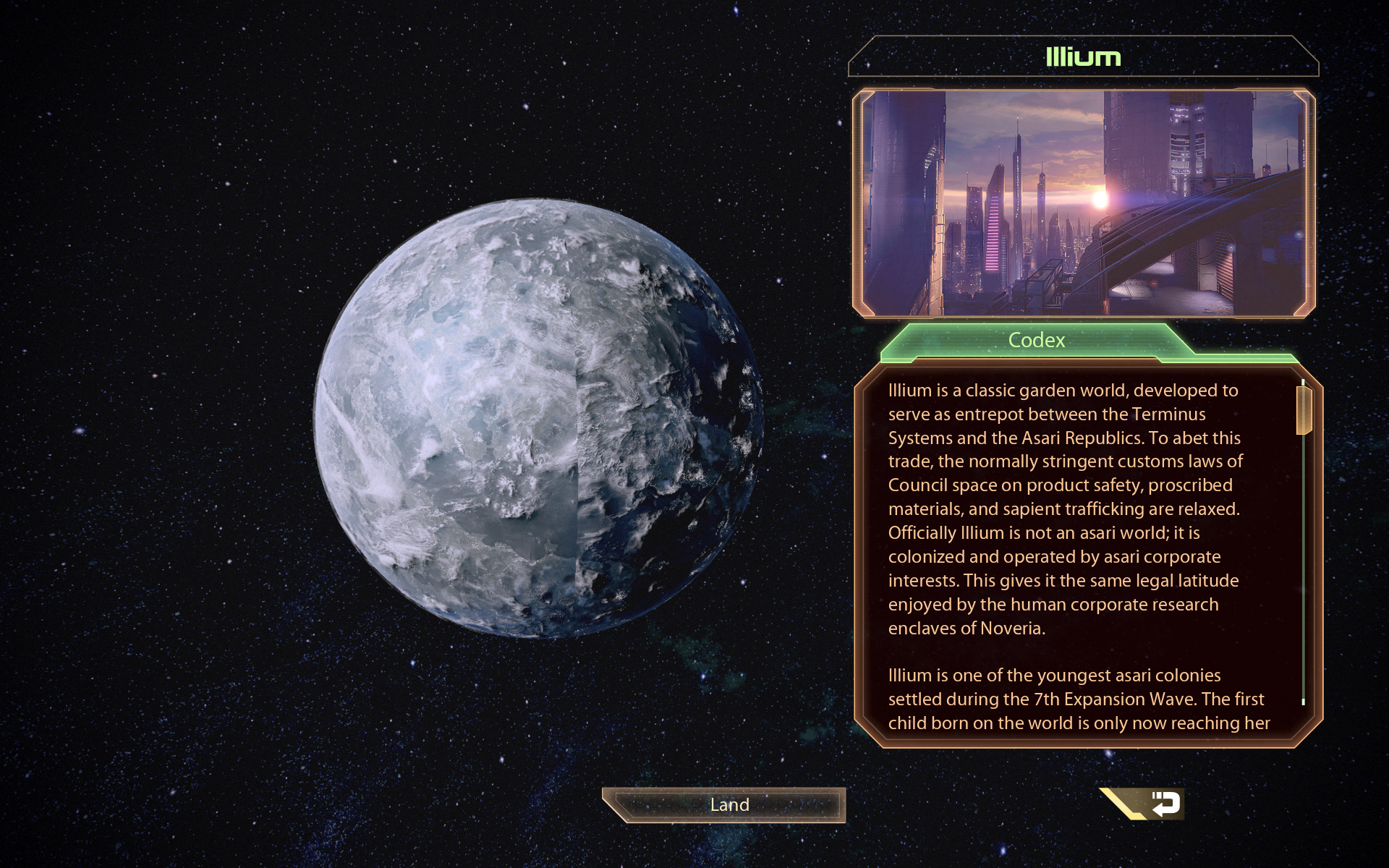
Illium is a classic garden world, developed to serve as entrepot between the Terminus Systems and the Asari Republics. To abet this trade, the normally stringent customs laws of Council space on product safety, proscribed materials, and sapient trafficking are relaxed. Officially Illium is not an asari world; it is colonized and operated by asari corporate interests. This gives it the same legal latitude enjoyed by the human corporate research enclaves of Noveria.
Illium is one of the youngest asari colonies settled during the 7th Expansion Wave. The first child born on the world is only now reaching her middle-age. The world is hot and massive; ground settlement is only possible at the higher polar latitudes. In more equatorial locations, the population is housed in arcology skyscrapers to escape the heat of the surface.
Colony Founded: 1617
Population (Surface): 84,900,000
Population (L4 and L5 stations): 80,300
Capital: Nos Astra
Orbital Distance: 1.3 AU
Orbital Period: 1.5 Earth Years
Radius: 7,431 km
Day Length: 25 Earth Hours
Atmospheric Pressure: 1.15 Earth Atmospheres
Surface Temperature: 63 Celsius
Surface Gravity: 1.2 G
Naxell
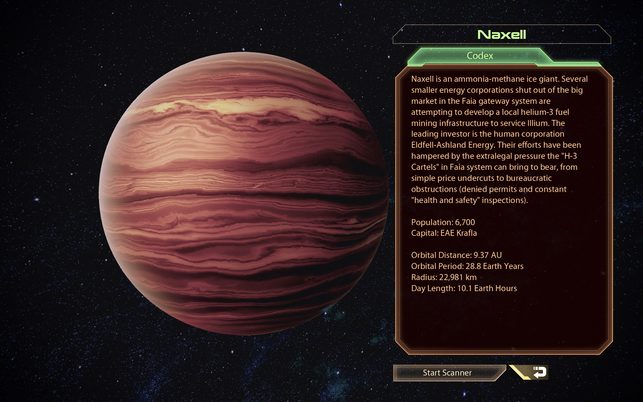
Naxell is an ammonia-methane ice giant. Several smaller energy corporations shut out of the big market in the Faia gateway system are attempting to develop a local helium-3 fuel mining infrastructure to service Illium. The leading investor is the human corporation Eldfell-Ashland Energy. Their efforts have been hampered by the extralegal pressure the “H-3 Cartels” in Faia system can bring to bear, from simple price undercuts to bureaucratic obstructions (denied permits and constant “health and safety” inspections).
Population: 6,700
Capital: EAE Krafla
Orbital Distance: 9.37 AU
Orbital Period: 28.8 Earth Years
Radius: 22,981 km
Day Length: 10.1 Earth Hours
Ponolus
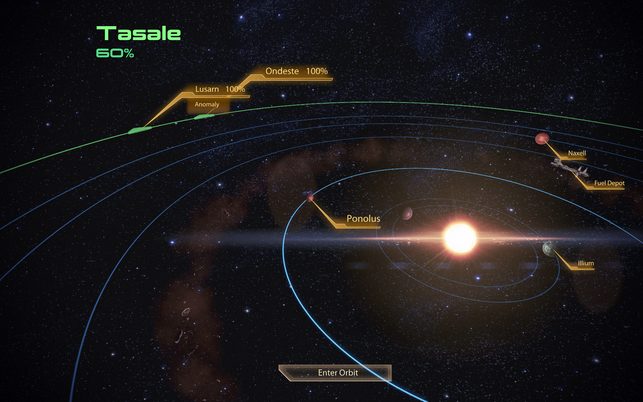
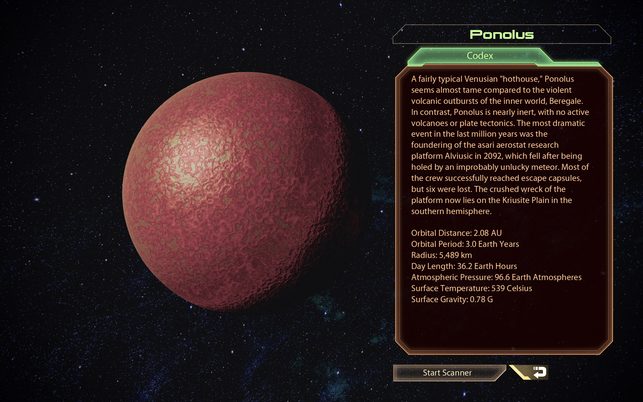
A fairly typical Venusian “hothouse,” Ponolus seems almost tame compared to the violent volcanic outbursts of the inner world, Beregale. In contrast, Ponolus is nearly inert, with no active volcanoes or plate tectonics. The most dramatic event in the last million years was the foundering of the asari aerostat research platform Alviusic in 2092, which fell after being holed by an improbably unlucky meteor. Most of the crew successfully reached escape capsules, but six were lost. The crushed wreck of the platform now lies on the Kriusite Plain in the southern hemisphere.
Orbital Distance: 2.08 AU
Orbital Period: 3.0 Earth Years
Radius: 5,489 km
Day Length: 36.2 Earth Hours
Atmospheric Pressure: 96.6 Earth Atmospheres
Surface Temperature: 539 Celsius
Surface Gravity: 0.78 G
Thail
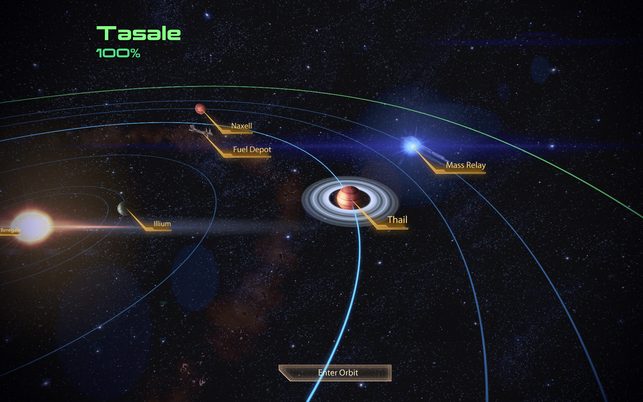
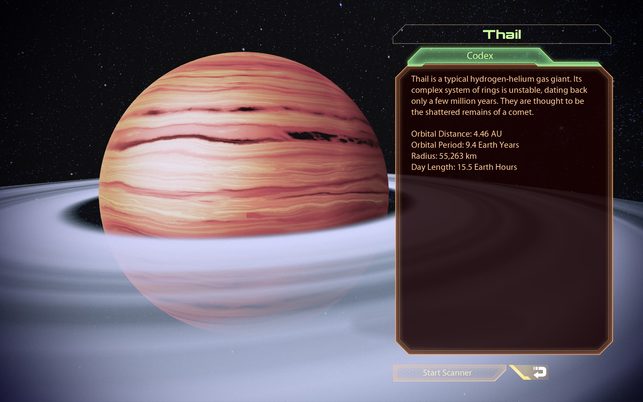
Thail is a typical hydrogen-helium gas giant. Its complex system of rings is unstable, dating back only a few million years. They are thought to be the shattered remains of a comet.
Orbital Distance: 4.46 AU
Orbital Period: 9.4 Earth Years
Radius: 55,263 km
Day Length: 15.5 Earth Hours
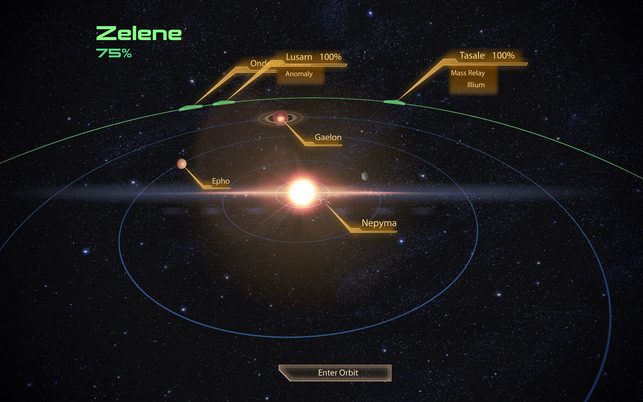
ZELENE
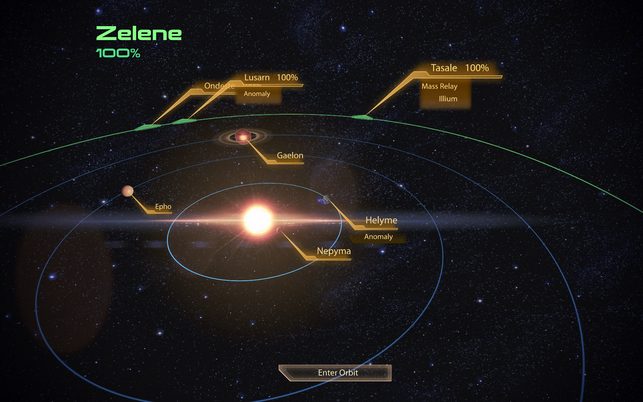
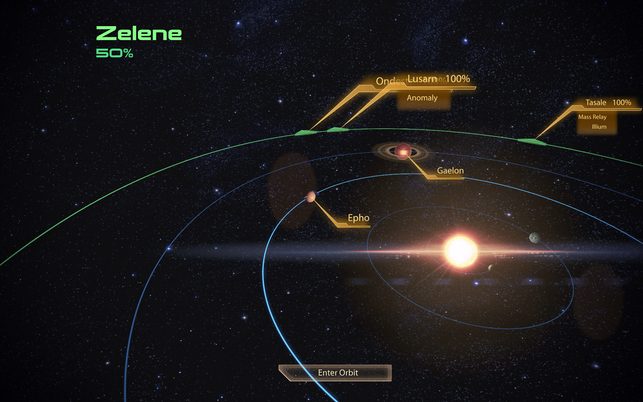
Epho
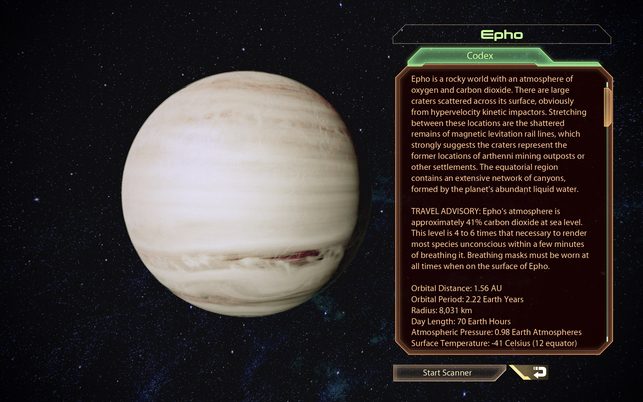
Epho is a rocky world with an atmosphere of oxygen and carbon dioxide. There are large craters scattered across its surface, obviously from hypervelocity kinetic impactors. Stretching between these locations are the shattered remains of magnetic levitation rail lines, which strongly suggests the craters represent the former locations of arthenni mining outposts or other settlements. The equatorial region contains an extensive network of canyons, formed by the planet’s abundant liquid water.
TRAVEL ADVISORY: Epho’s atmosphere is approximately 41% carbon dioxide at sea level. This level is 4 to 6 times that necessary to render most species unconscious within a few minutes of breathing it. Breathing masks must be worn at all times when on the surface of Epho.
Orbital Distance: 1.56 AU
Orbital Period: 2.22 Earth Years
Radius: 8,031 km
Day Length: 70 Earth Hours
Atmospheric Pressure: 0.98 Earth Atmospheres
Surface Temperature: -41 Celsius (12 equator)
Surface Gravity: 1.0 G
Gaelon
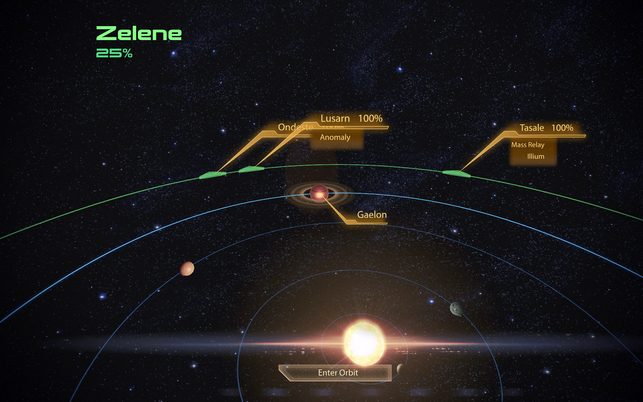
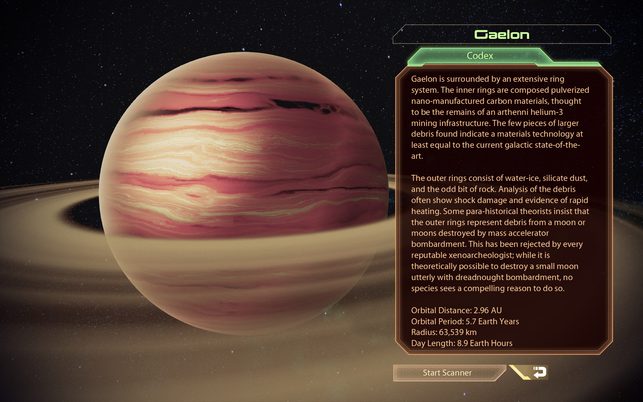
Gaelon is surrounded by an extensive ring system. The inner rings are composed pulverized nano-manufactured carbon materials, thought to be the remains of an arthenni helium-3 mining infrastructure. The few pieces of larger debris found indicate a materials technology at least equal to the current galactic state-of-the- art.
The outer rings consist of water-ice, silicate dust, and the odd bit of rock. Analysis of the debris often show shock damage and evidence of rapid heating. Some para-historical theorists insist that the outer rings represent debris from a moon or moons destroyed by mass accelerator bombardment. This has been rejected by every reputable xenoarcheologist; while it is theoretically possible to destroy a small moon utterly with dreadnought bombardment, no species sees a compelling reason to do so.
Orbital Distance: 2.96 AU
Orbital Period: 5.7 Earth Years
Radius: 63,539 km
Day Length: 8.9 Earth Hours
Helyme
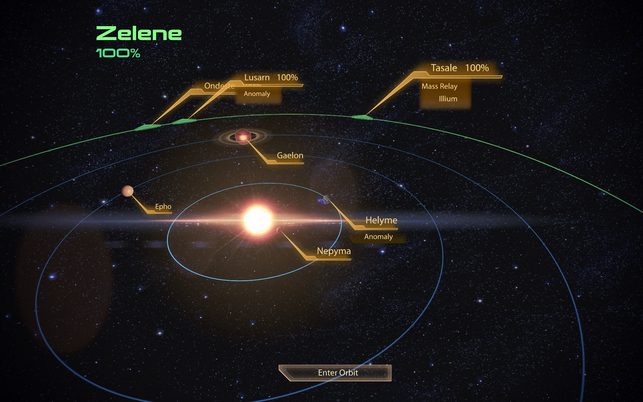
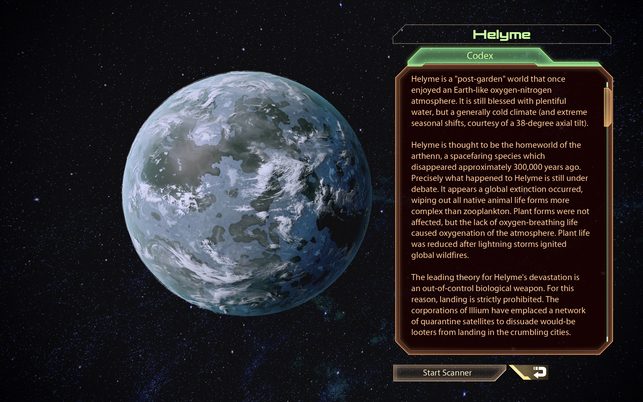
Helyme is a “post-garden” world that once enjoyed an Earth-like oxygen-nitrogen atmosphere. It is still blessed with plentiful water, but a generally cold climate (and extreme seasonal shifts, courtesy of a 38-degree axial tilt).
Helyme is thought to be the homeworld of the arthenn, a spacefaring species which disappeared approximately 300,000 years ago. Precisely what happened to Helyme is still under debate. It appears a global extinction occurred, wiping out all native animal life forms more complex than zooplankton. Plant forms were not affected, but the lack of oxygen-breathing life caused oxygenation of the atmosphere. Plant life was reduced after lightning storms ignited global wildfires.
The leading theory for Helyme’s devastation is an out-of-control biological weapon. For this reason, landing is strictly prohibited. The corporations of Illium have emplaced a network of quarantine satellites to dissuade would-be looters from landing in the crumbling cities.
Orbital Distance: 1.2 AU
Orbital Period: 1.5 Earth Years
Radius: 5,522 km
Day Length: 44.4 Earth Hours
Atmospheric Pressure: 0.84 Earth Atmospheres
Surface Temperature: -15 Celsius
Surface Gravity: 0.87 G
Nepyma
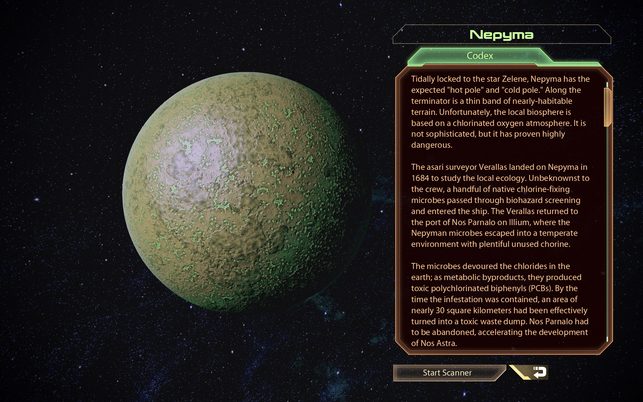
Tidally locked to the star Zelene, Nepyma has the expected “hot pole” and “cold pole.” Along the terminator is a thin band of nearly-habitable terrain. Unfortunately, the local biosphere is based on a chlorinated oxygen atmosphere. It is not sophisticated, but it has proven highly dangerous.
The asari surveyor Verallas landed on Nepyma in 1684 to study the local ecology. Unbeknownst to the crew, a handful of native chlorine-fixing microbes passed through biohazard screening and entered the ship. The Verallas returned to the port of Nos Parnalo on Illium, where the Nepyman microbes escaped into a temperate environment with plentiful unused chorine.
The microbes devoured the chlorides in the earth; as metabolic byproducts, they produced toxic polychlorinated biphenyls (PCBs). By the time the infestation was contained, an area of nearly 30 square kilometers had been effectively turned into a toxic waste dump. Nos Parnalo had to be abandoned, accelerating the development of Nos Astra.
Orbital Distance: 0.8 AU
Orbital Period: 0.8 Earth Years
Radius: 4,456 km
Day Length: 40.4 Earth Hours
Atmospheric Pressure: 0.55 Earth Atmospheres
Surface Temperature: 32 Celsius
Surface Gravity: 0.57 G