Here you’ll find the full Mass Effect 1 Galaxy Map. You’ll see the clusters with the systems and planets.
A planet that has an asterik (*) next to it means it can be scanned.
You can find the other Mass Effect Galaxy Maps here.
This page is long and full of images, it can take a few seconds before everything appears. It also looks better on computer than on mobile!
ARGOS RHO
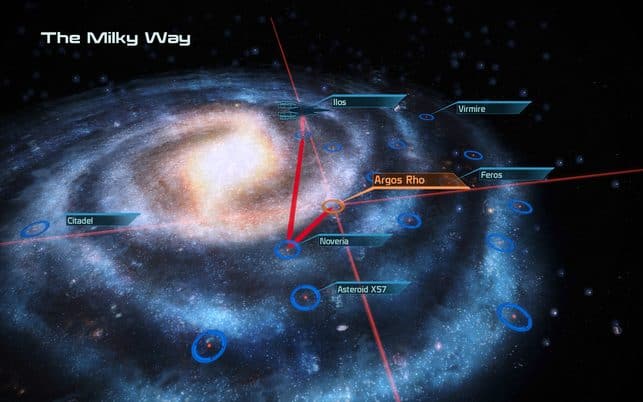
HYDRA
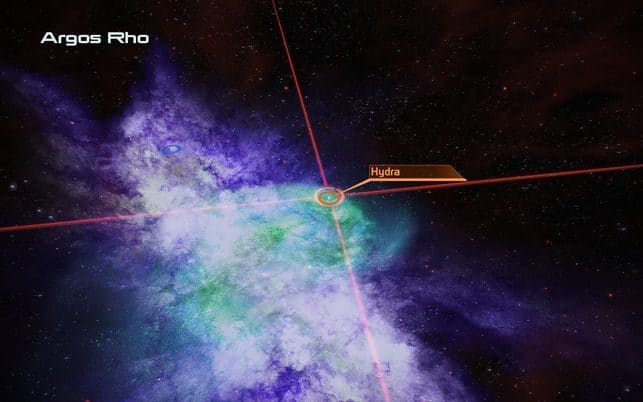
Canrum*
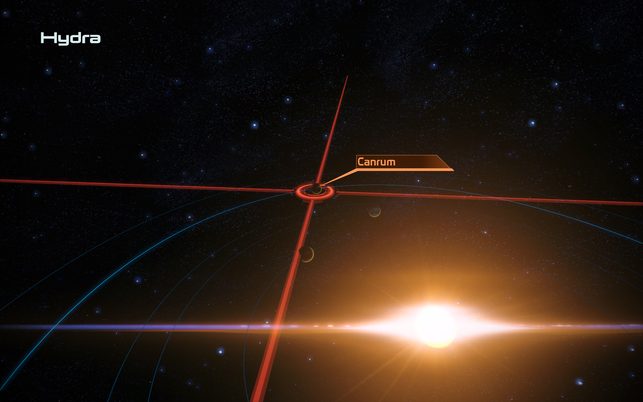
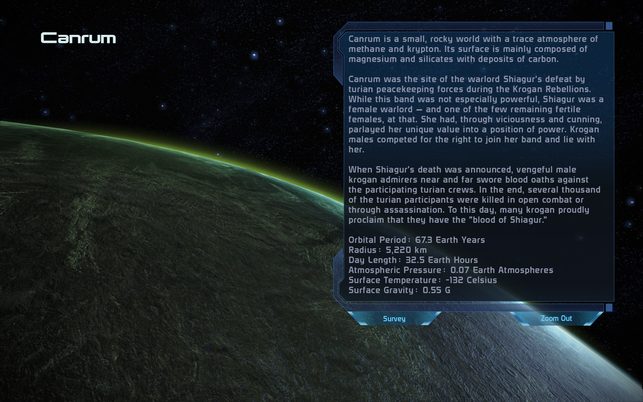
Canrum is a small, rocky world with a trace atmosphere of methane and krypton. Its surface is mainly composed of magnesium and silicates with deposits of carbon.
Canrum was the site of the warlord Shiagur’s defeat by turian peacekeeping forces during the Krogan Rebellions. While this band was not especially powerful, Shiagur was a female warlord and one of the few remaining fertile females, at that. She had, through viciousness and cunning, parlayed her unique value into a position of power. Krogan males competed for the right to join her band and lie with her.
When Shiagur’s death was announced, vengeful male krogan admirers near and far swore blood oaths against the participating turian crews. In the end, several thousand of the turian participants were killed in open combat or through assassination. To this day, many krogan proudly proclaim that they have the “blood of Shiagur.”
Orbital Period: 67.3 Earth Years
Radius: 5,220 km
Day Length: 32.5 Earth Hours
Atmospheric Pressure: 0.07 Earth Atmospheres
Surface Temperature: -132 Celsius
Surface Gravity: 0.55 G
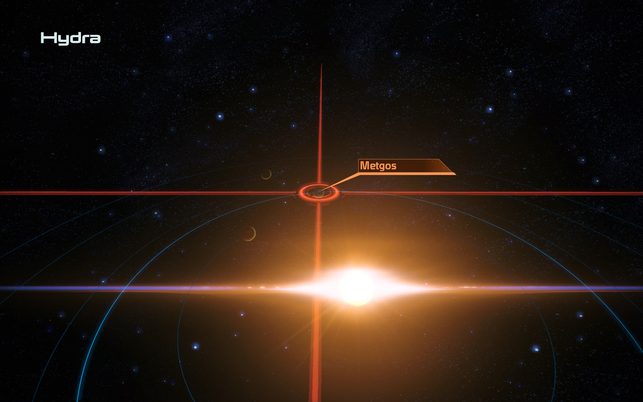
Metgos
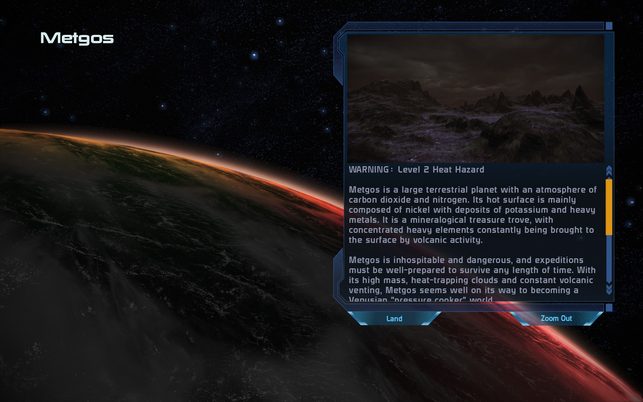
WARNING: Level 2 Heat Hazard
Metgos is a large terrestrial planet with an atmosphere of carbon dioxide and nitrogen. Its hot surface is mainly composed of nickel with deposits of potassium and heavy metals. It is a mineralogical treasure trove, with concentrated heavy elements constantly being brought to the surface by volcanic activity.
Metgos is inhospitable and dangerous, and expeditions must be well-prepared to survive any length of time. With its high mass, heat-trapping clouds and constant volcanic venting, Metgos seems well on its way to becoming a Venusian “pressure cooker” world.
Orbital Period: 2.8 Earth Years
Radius: 7301 km
Day Length: 47.2 Earth Hours
Atmospheric Pressure: 1.00 Earth Atmospheres
Surface Temperature: 169 Celsius
Surface Gravity: 1.1 G
Varmalus
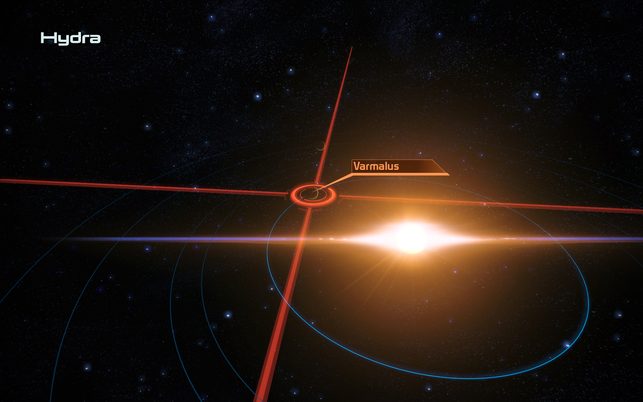
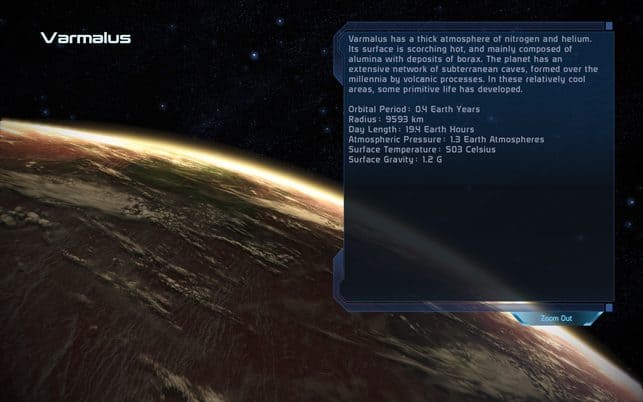
Varmalus has a thick atmosphere of nitrogen and helium. Its surface is scorching hot, and mainly composed of alumina with deposits of borax. The planet has an extensive network of subterranean caves, formed over the millennia by volcanic processes. In these relatively cool areas, some primitive life has developed.
Orbital Period: 0.4 Earth Years
Radius: 9593 km
Day Length: 19.4 Earth Hours
Atmospheric Pressure: 1.3 Earth Atmospheres
Surface Temperature: 503 Celsius
Surface Gravity: 1.2 G
Theyar
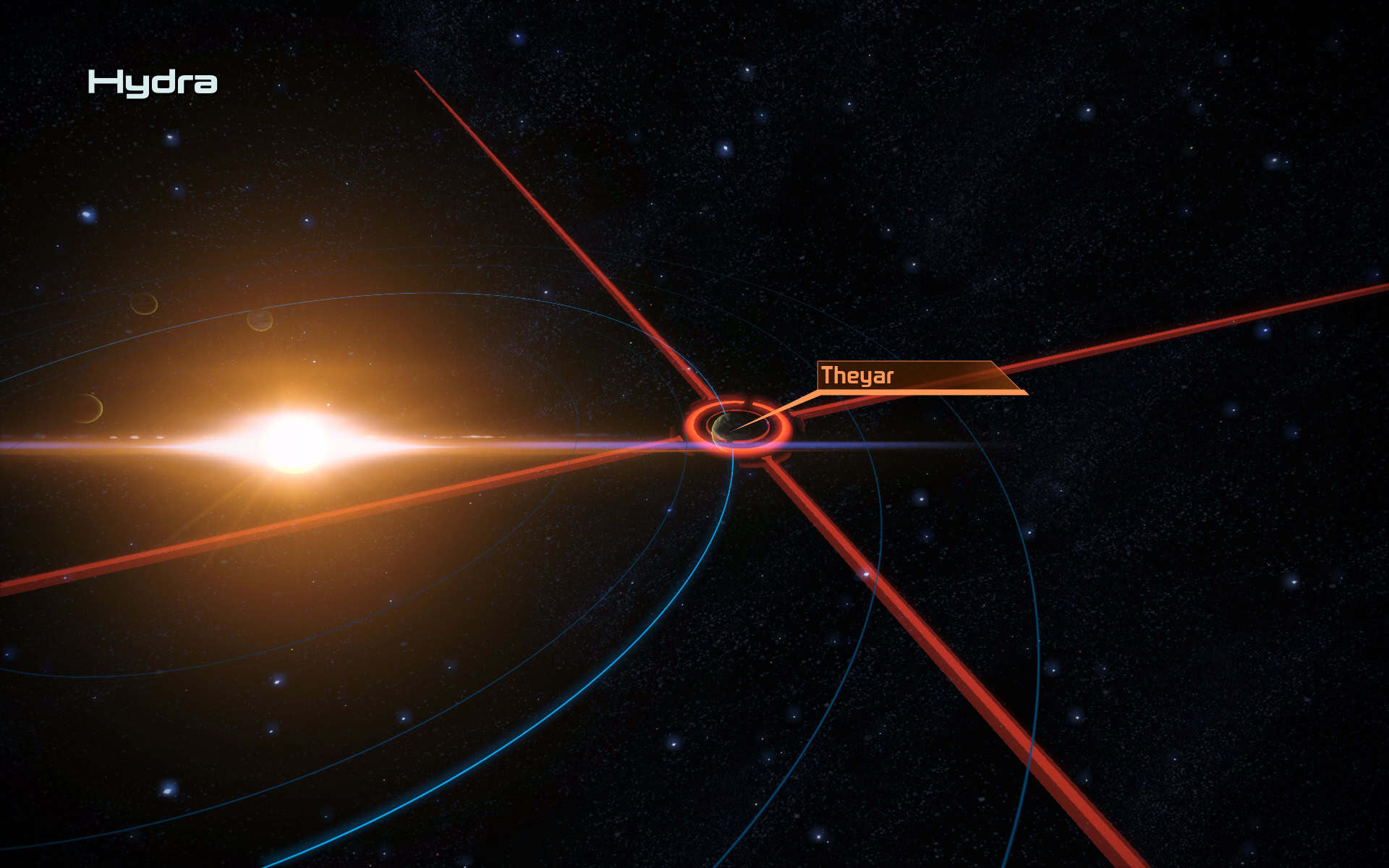
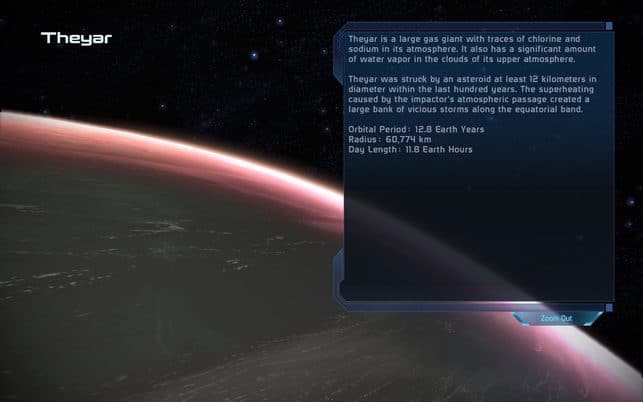
Theyar is a large gas giant with traces of chlorine and sodium in its atmosphere. It also has a significant amount of water vapor in the clouds of its upper atmosphere.
Theyar was struck by an asteroid at least 12 kilometers in diameter within the last hundred years. The superheating caused by the impactor’s atmospheric passage created a large bank of vicious storms along the equatorial band.
Orbital Period: 12.8 Earth Years
Radius: 60,774 km
Day Length: 11.8 Earth Hours
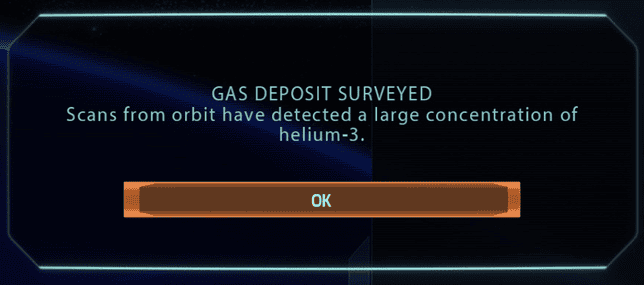
Syba*
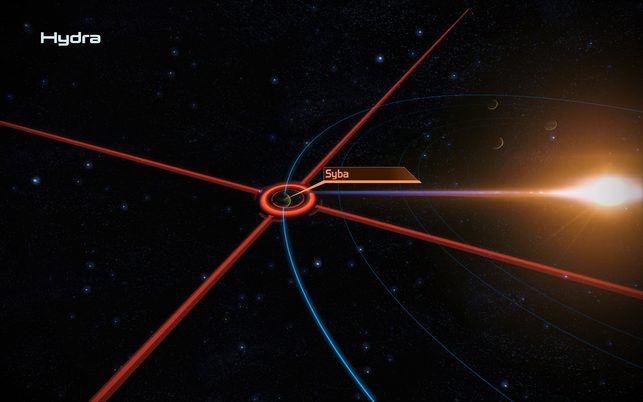
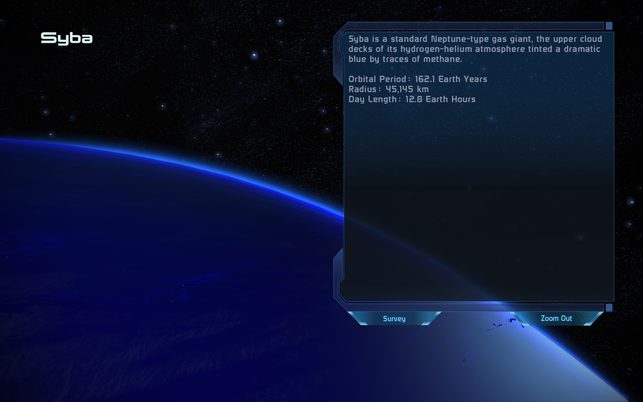
Syba is a standard Neptune-type gas giant, the upper cloud decks of its hydrogen-helium atmosphere tinted a dramatic blue by traces of methane.
Orbital Period: 162.1 Earth Years
Radius: 45,145 km
Day Length: 12.8 Earth Hours
PHOENIX
Patashi*
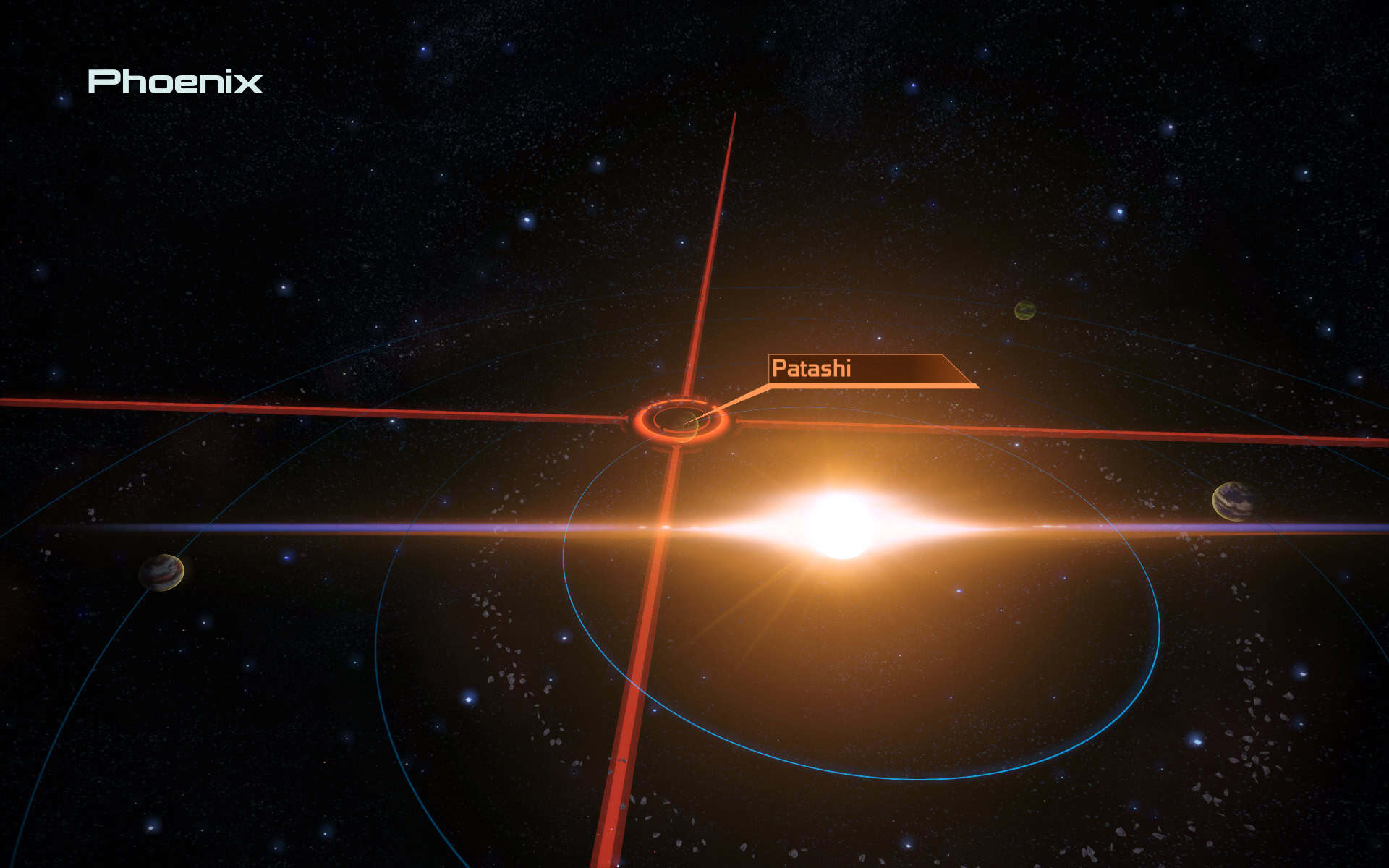
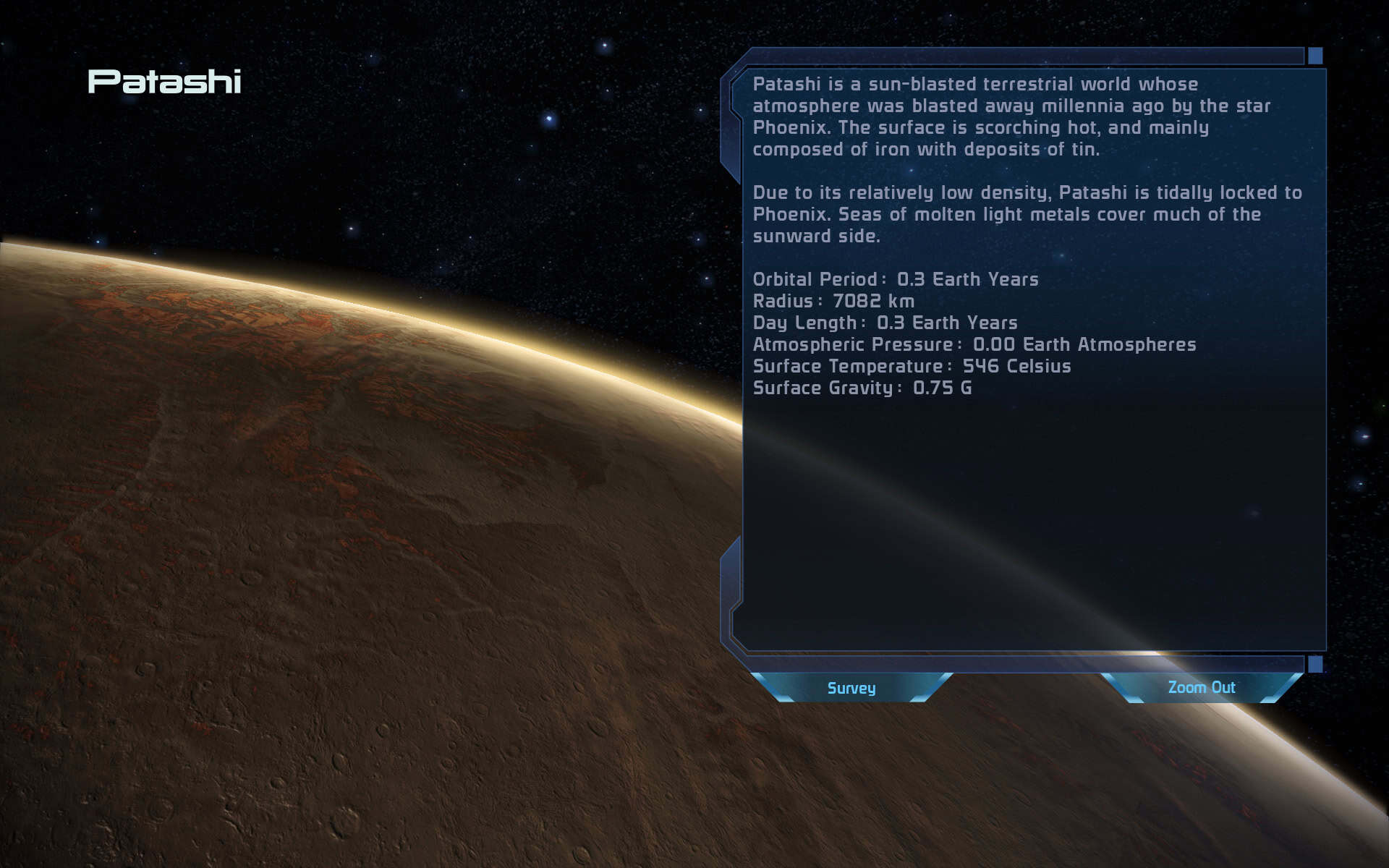
Patashi is a sun-blasted terrestrial world whose atmosphere was blasted away millennia ago by the star Phoenix. The surface is scorching hot, and mainly composed of iron with deposits of tin.
Due to its relatively low density, Patashi is tidally locked to Phoenix. Seas of molten light metals cover much of the sunward side.
Orbital Period: 0.3 Earth Years
Radius: 7082 km
Day Length: 0.3 Earth Years
Atmospheric Pressure: 0.00 Earth Atmospheres
Surface Temperature: 546 Celsius
Surface Gravity: 0.75 G
Vebinok*
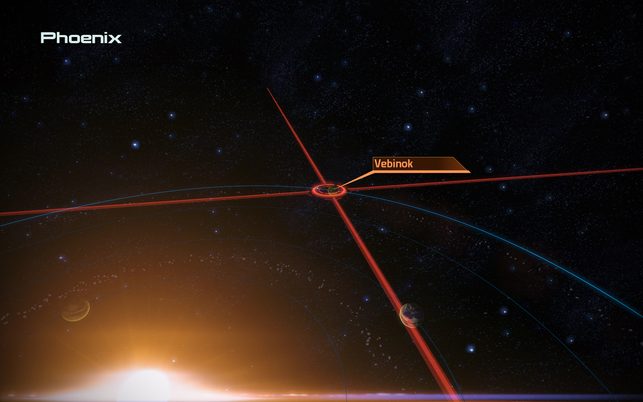
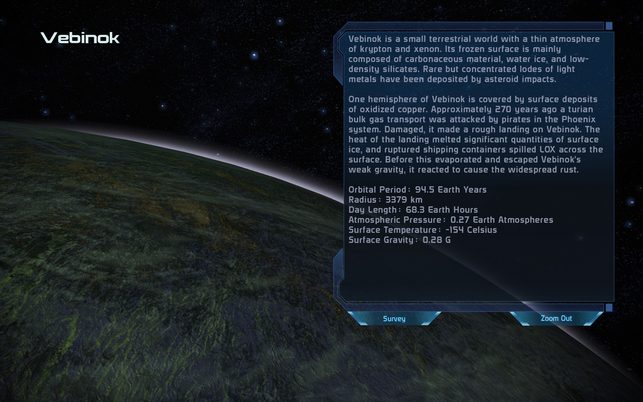
Vebinok is a small terrestrial world with a thin atmosphere of krypton and xenon. Its frozen surface is mainly composed of carbonaceous material, water ice, and low-density silicates. Rare but concentrated lodes of light metals have been deposited by asteroid impacts.
One hemisphere of Vebinok is covered by surface deposits of oxidized copper. Approximately 270 years ago a turian bulk gas transport was attacked by pirates in the Phoenix system. Damaged, it made a rough landing on Vebinok. The heat of the landing melted significant quantities of surface ice, and ruptured shipping containers spilled LOX across the surface. Before this evaporated and escaped Vebinok’s weak gravity, it reacted to cause the widespread rust.
Orbital Period: 94.5 Earth Years
Radius: 3379 km
Day Length: 68.3 Earth Hours
Atmospheric Pressure: 0.27 Earth Atmospheres
Surface Temperature: -154 Celsius
Surface Gravity: 0.28 G
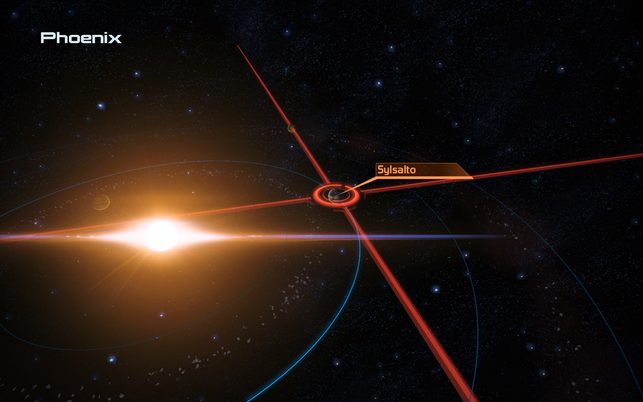
Sylsalto
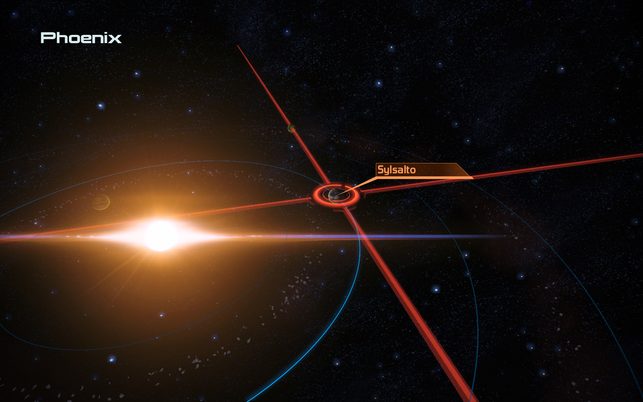
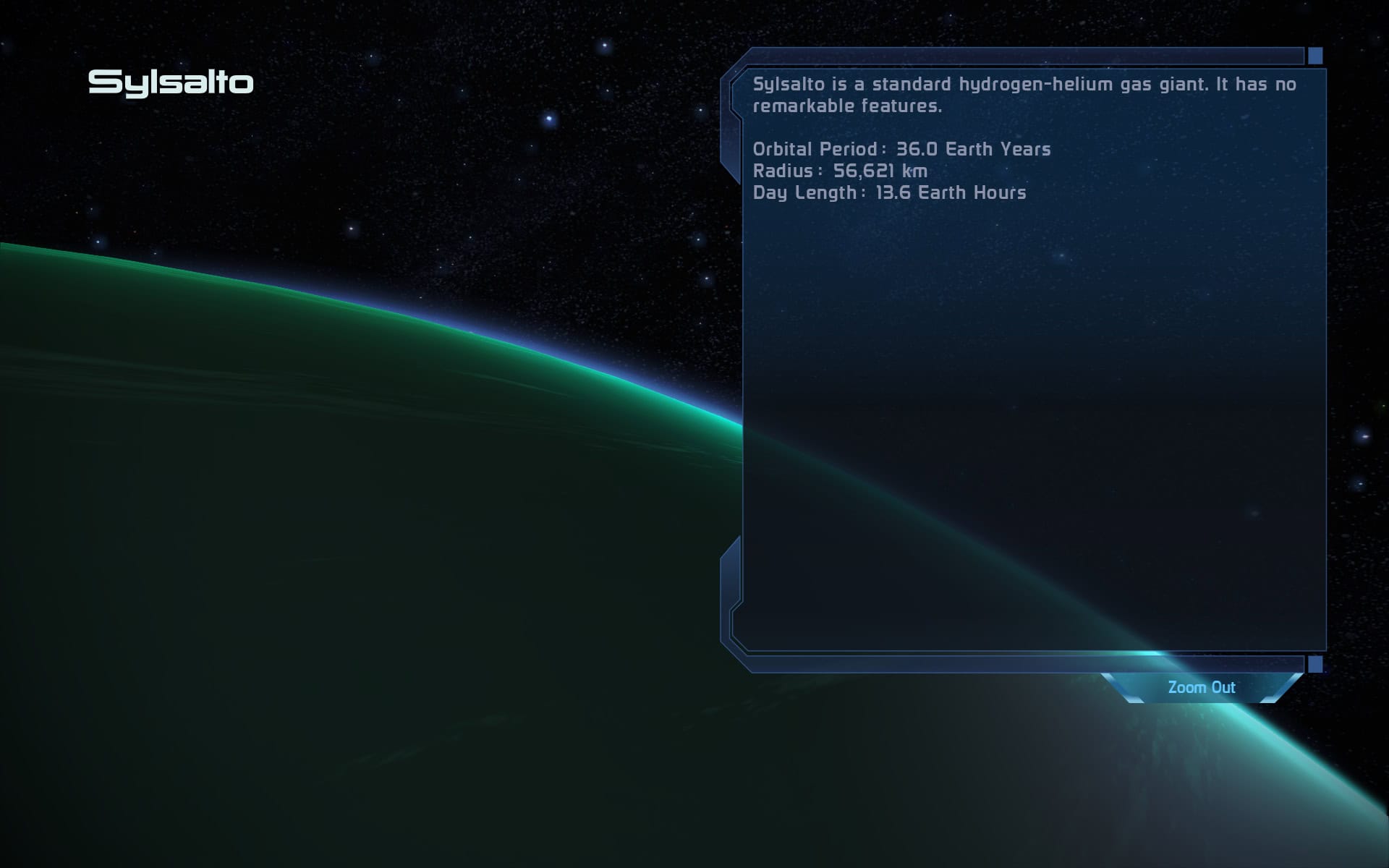
Sylsalto is a standard hydrogen-helium gas giant. It has no remarkable features.
Orbital Period: 36.0 Earth Years
Radius: 56,621 km
Day Length: 13.6 Earth Hours
Tuntau
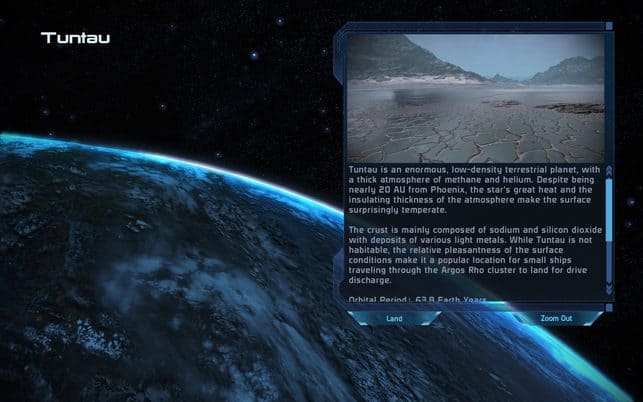
Tuntau is an enormous, low-density terrestrial planet, with a thick atmosphere of methane and helium. Despite being nearly 20 AU from Phoenix, the star’s great heat and the insulating thickness of the atmosphere make the surface surprisingly temperate.
The crust is mainly composed of sodium and silicon dioxide with deposits of various light metals. While Tuntau is not habitable, the relative pleasantness of the surface conditions make it a popular location for small ships traveling through the Argos Rho cluster to land for drive discharge.
Orbital Period: 63.8 Earth Years
Radius: 11,867 km
Day Length: 69.7 Earth Hours
Atmospheric Pressure: 3.12 Earth Atmospheres
Surface Temperature: 21 Celsius
Surface Gravity: 1.1 G
ARMSTRONG NEBULA
GAGARIN
Junthor*
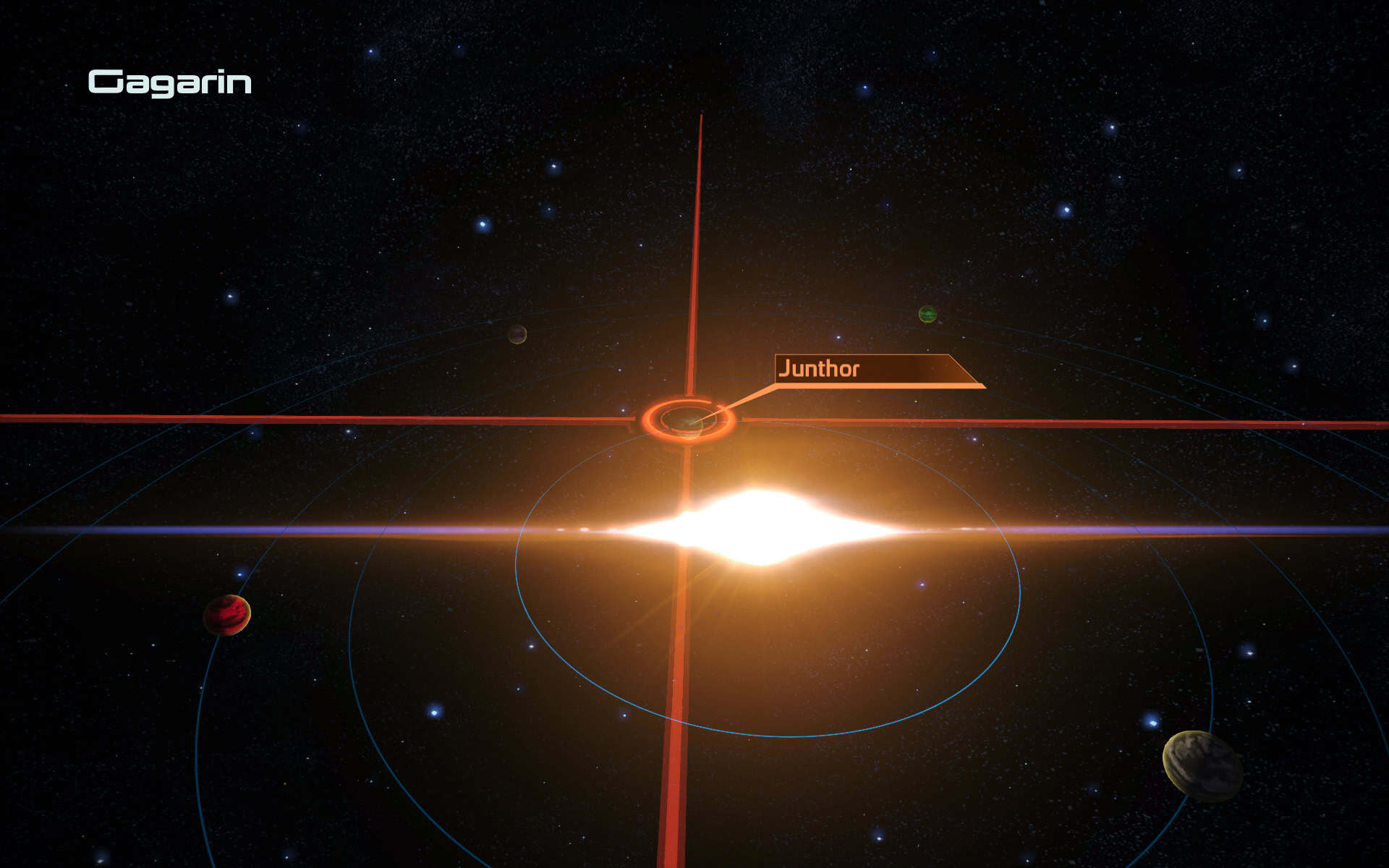
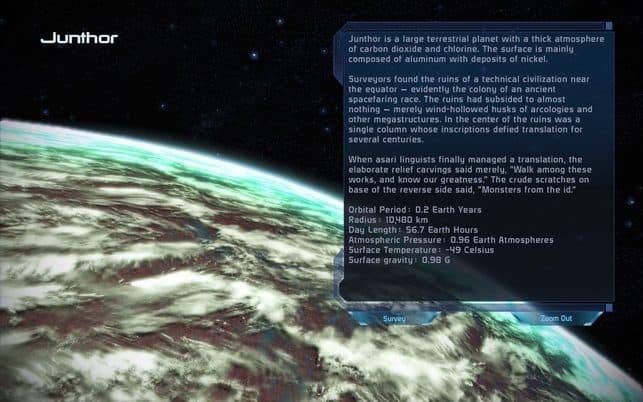
Junthor is a large terrestrial planet with a thick atmosphere of carbon dioxide and chlorine. The surface is mainly composed of aluminum with deposits of nickel.
Surveyors found the ruins of a technical civilization near the equator – evidently the colony of an ancient spacefaring race. The ruins had subsided to almost nothing – merely wind-hollowed husks of arcologies and other megastructures. In the center of the ruins was a single column whose inscriptions defied translation for several centuries.
When asari linguists finally managed a translation, the elaborate relief carvings said merely, “Walk among these works, and know our greatness.” The crude scratches on base of the reverse side said, “Monsters from the id.”
Orbital Period: 0.2 Earth Years
Radius: 10,480 km
Day Length: 56.7 Earth Hours
Atmospheric Pressure: 0.96 Earth Atmospheres
Surface Temperature: -49 Celsius
Surface gravity: 0.98 G
Antirumgon*
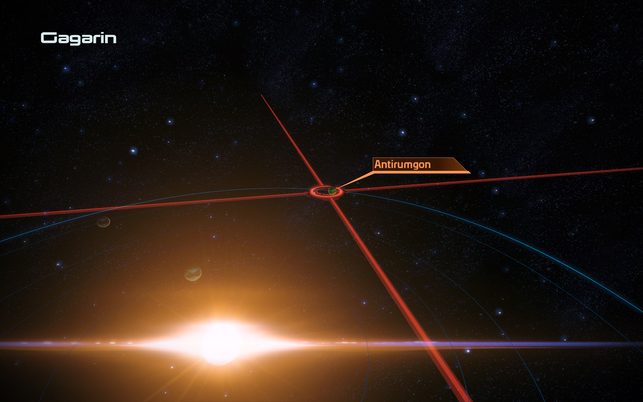
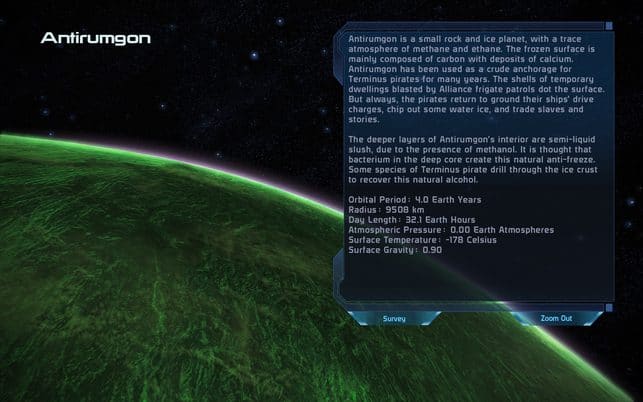
Antirumgon is a small rock and ice planet, with a trace atmosphere of methane and ethane. The frozen surface is mainly composed of carbon with deposits of calcium. Antirumgon has been used as a crude anchorage for Terminus pirates for many years. The shells of temporary dwellings blasted by Alliance frigate patrols dot the surface. But always, the pirates return to ground their ships’ drive charges, chip out some water ice, and trade slaves and stories.
The deeper layers of Antirumgon’s interior are semi-liquid slush, due to the presence of methanol. It is thought that bacterium in the deep core create this natural anti-freeze. Some species of Terminus pirate drill through the ice crust to recover this natural alcohol.
Orbital Period: 4.0 Earth Years Radius: 9508 km
Day Length: 32.1 Earth Hours
Atmospheric Pressure: 0.00 Earth Atmospheres
Surface Temperature: -178 Celsius
Surface Gravity: 0.90
Sogelrus
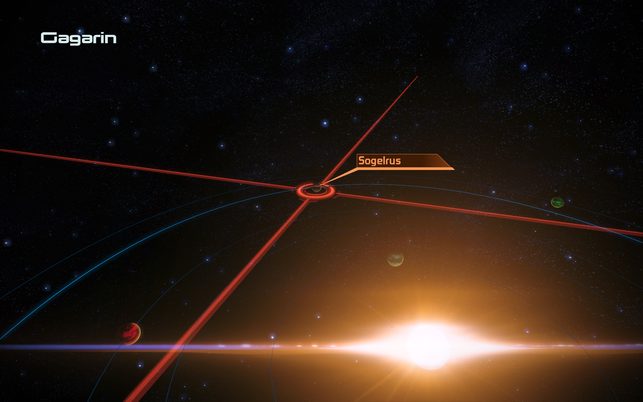
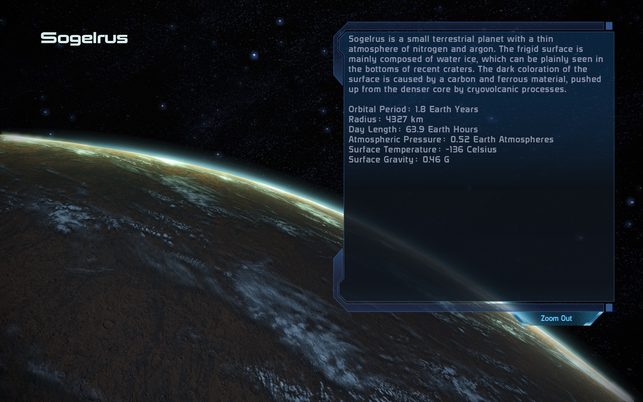
Sogelrus is a small terrestrial planet with a thin atmosphere of nitrogen and argon. The frigid surface is mainly composed of water ice, which can be plainly seen in the bottoms of recent craters. The dark coloration of the surface is caused by a carbon and ferrous material, pushed up from the denser core by cryovolcanic processes.
Orbital Period: 1.8 Earth Years
Radius: 4327 km
Day Length: 63.9 Earth Hours
Atmospheric Pressure: 0.52 Earth Atmospheres
Surface Temperature: -136 Celsius
Surface Gravity: 0.46
Rayingri
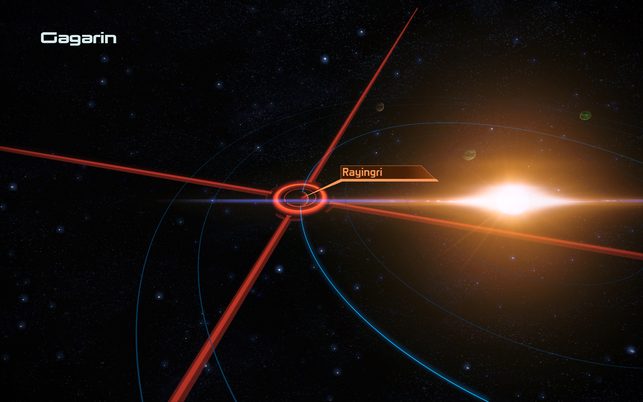
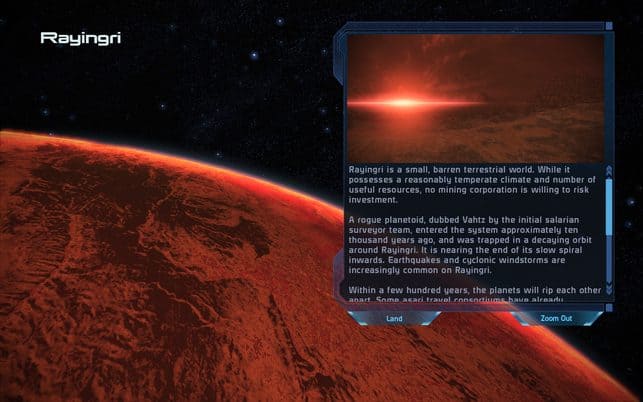
Rayingri is a small, barren terrestrial world. While it possesses a reasonably temperate climate and number of useful resources, no mining corporation is willing to risk investment.
A rogue planetoid, dubbed Vahtz by the initial salarian surveyor team, entered the system approximately ten thousand years ago, and was trapped in a decaying orbit around Rayingri. It is nearing the end of its slow spiral inwards. Earthquakes and cyclonic windstorms are increasingly common on Rayingri.
Within a few hundred years, the planets will rip each other apart. Some asari travel consortiums have already announced sponsorship of cruises to observe the spectacle.
Radius: 5171 km
Day Length: 60.5 Earth Hours
Atmospheric Pressure: 0.84 Earth Atmospheres
Surface Temperature: 46 Celsius
Surface Gravity: 0.87
Pressha
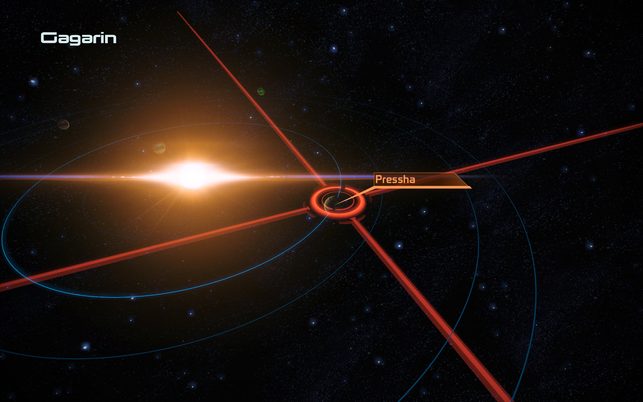
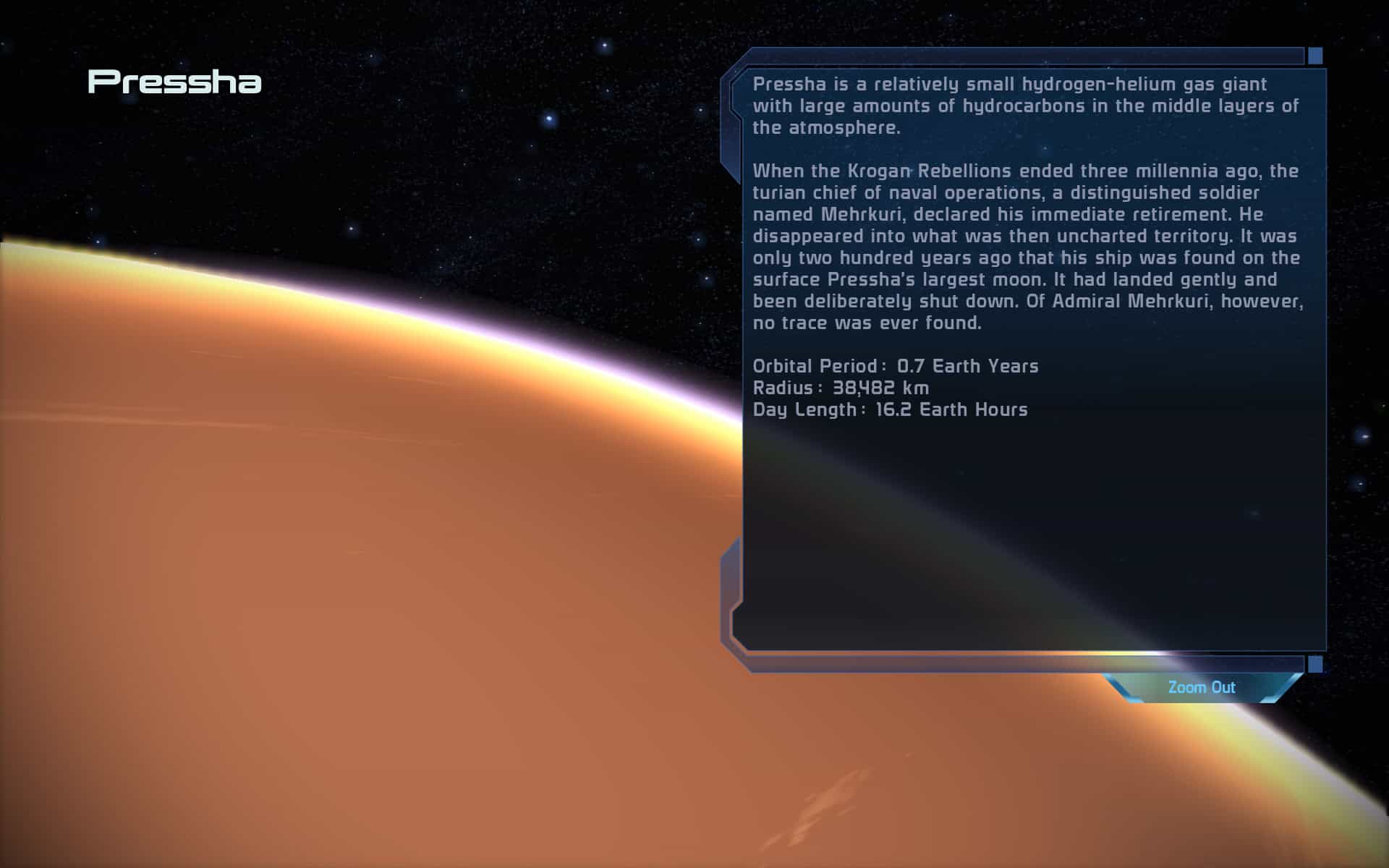
Pressha is a relatively small hydrogen-helium gas giant with large amounts of hydrocarbons in the middle layers of the atmosphere.
When the Krogan Rebellions ended three millennia ago, the turian chief of naval operations, a distinguished soldier named Mehrkuri, declared his immediate retirement. He disappeared into what was then uncharted territory. It was only two hundred years ago that his ship was found on the surface Pressha’s largest moon. It had landed gently and been deliberately shut down. Of Admiral Mehrkuri, however, no trace was ever found.
Orbital Period: 0.7 Earth Years
Radius: 38,482 km
Day Length: 16.2 Earth Hours
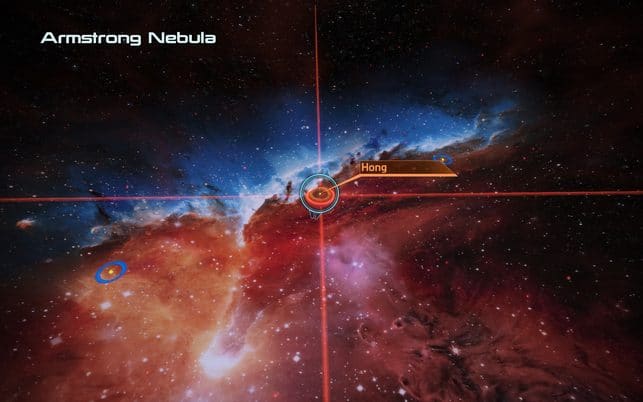
HONG
Pomal
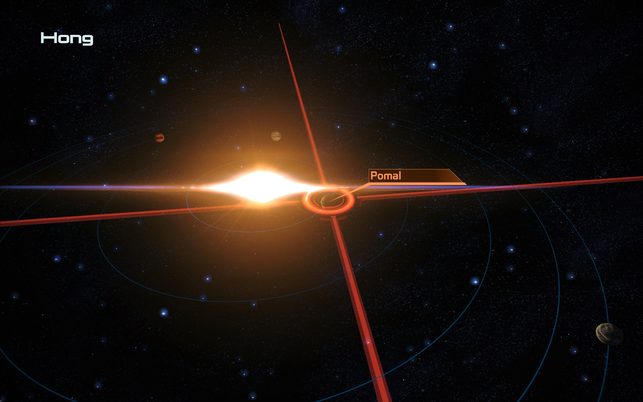
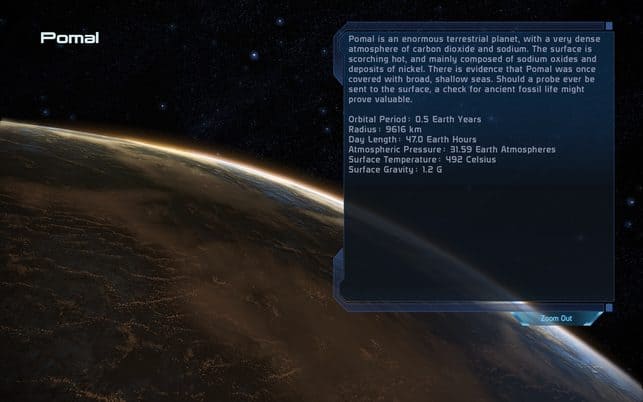
Pomal is an enormous terrestrial planet, with a very dense atmosphere of carbon dioxide and sodium. The surface is scorching hot, and mainly composed of sodium oxides and deposits of nickel. There is evidence that Pomal was once covered with broad, shallow seas. Should a probe ever be sent to the surface, a check for ancient fossil life might prove valuable.
Orbital Period: 0.5 Earth Years
Radius: 9616 km
Day Length: 47.0 Earth Hours
Atmospheric Pressure: 31.59 Earth Atmospheres
Surface Temperature: 492 Celsius
Surface Gravity: 1.2 G
Casbin
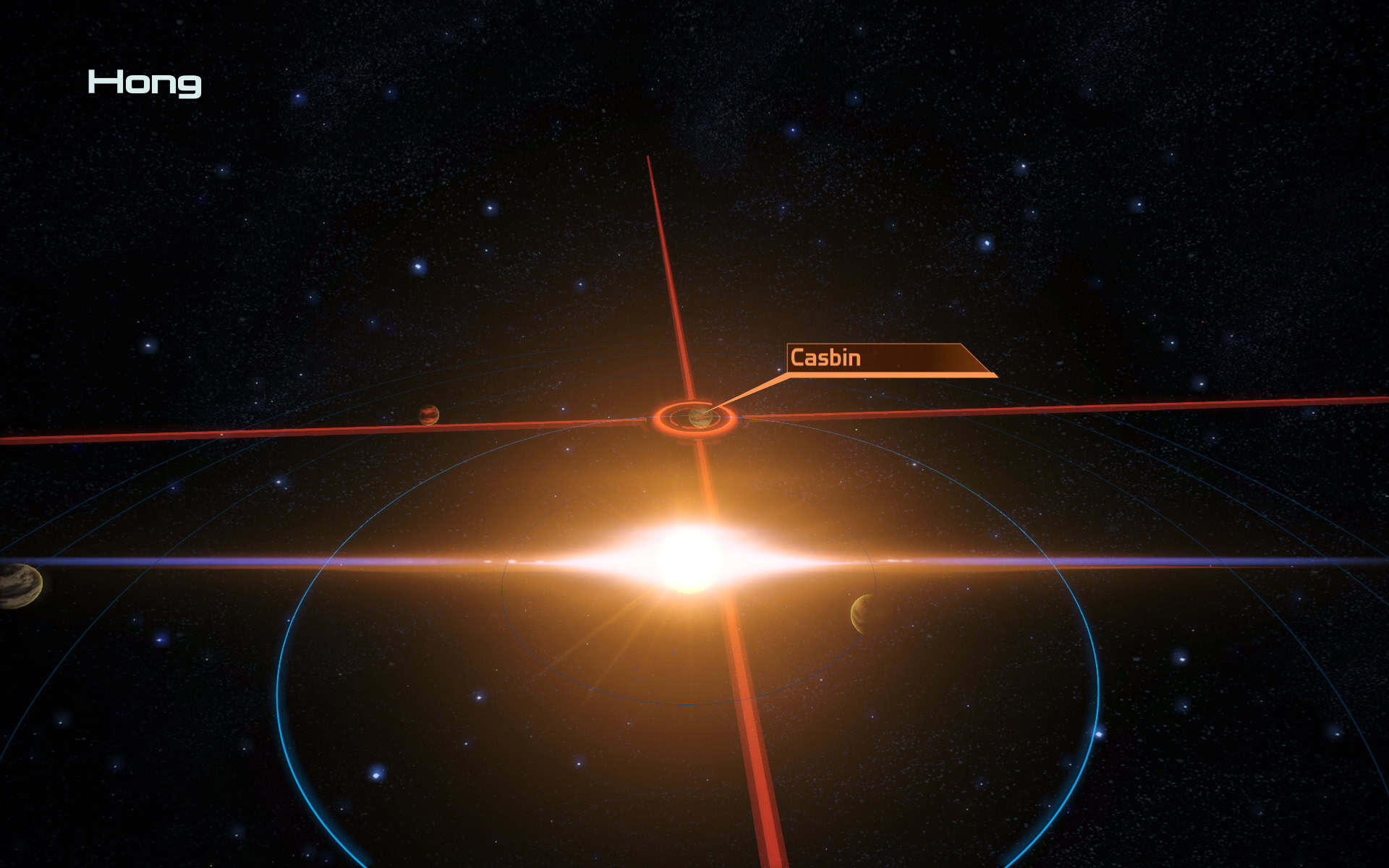
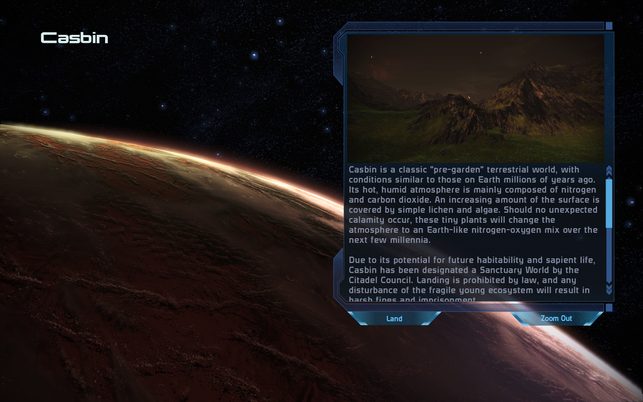
Casbin is a classic “pre-garden” terrestrial world, with conditions similar to those on Earth millions of years ago. Its hot, humid atmosphere is mainly composed of nitrogen and carbon dioxide. An increasing amount of the surface is covered by simple lichen and algae. Should no unexpected calamity occur, these tiny plants will change the atmosphere to an Earth-like nitrogen-oxygen mix over the next few millennia.
Due to its potential for future habitability and sapient life, Casbin has been designated a Sanctuary World by the Citadel Council. Landing is prohibited by law, and any disturbance of the fragile young ecosystem will result in harsh fines and imprisonment.
At present, the planet is passing through the debris trail of a long-period comet.
Orbital Period: 1.1 Earth Years
Radius: 7819 km
Day Length: 44.6 Earth Hours
Atmospheric Pressure: 1.1 Earth Atmospheres
Surface Temperature: 99 Celsius
Surface Gravity: 1.1 G
Matar*
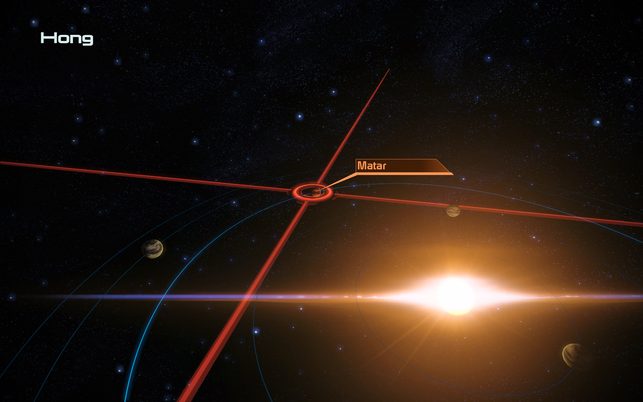
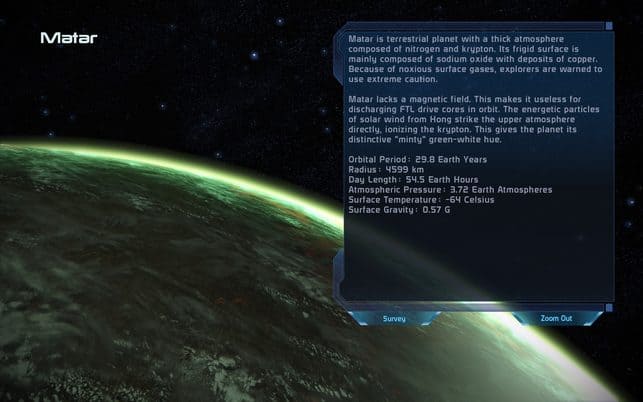
Matar is terrestrial planet with a thick atmosphere composed of nitrogen and krypton. Its frigid surface is mainly composed of sodium oxide with deposits of copper. Because of noxious surface gases, explorers are warned to use extreme caution.
Matar lacks a magnetic field. This makes it useless for discharging FTL drive cores in orbit. The energetic particles of solar wind from Hong strike the upper atmosphere directly, ionizing the krypton. This gives the planet its distinctive “minty” green-white hue.
Orbital Period: 29.8 Earth Years
Radius: 4599 km
Day Length: 54.5 Earth Hours
Atmospheric Pressure: 3.72 Earth Atmospheres
Surface Temperature: -64 Celsius
Surface Gravity: 0.57 G
Theshaca
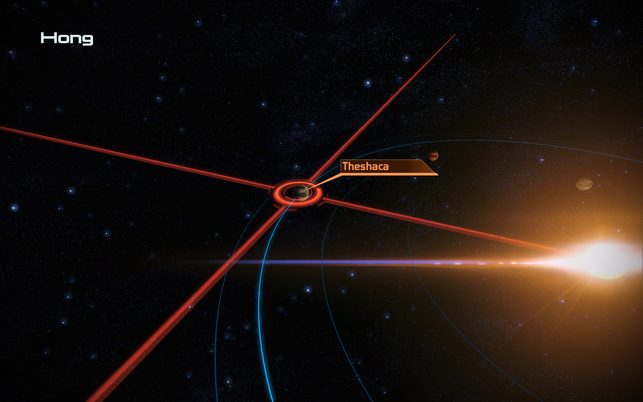
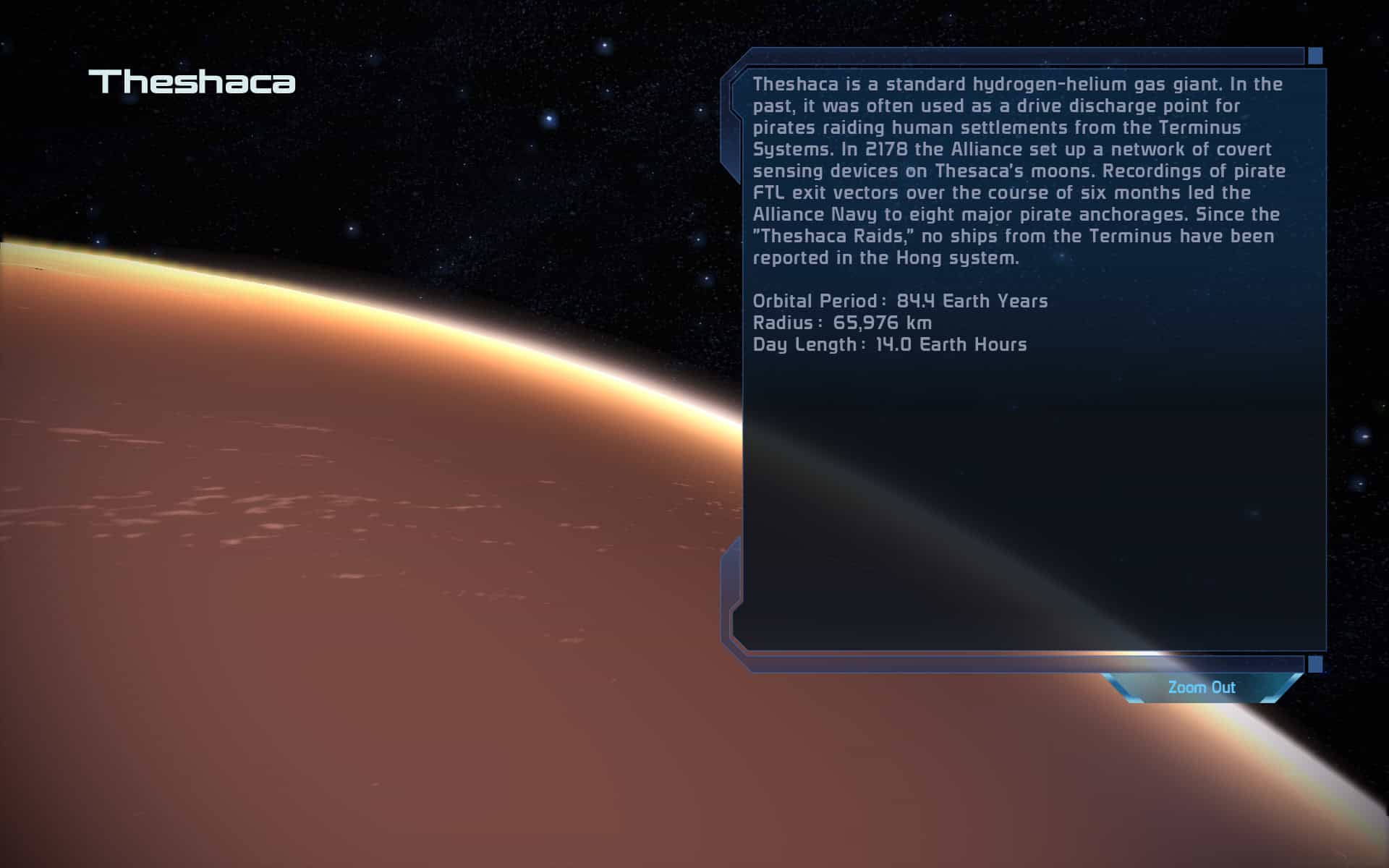
Theshaca is a standard hydrogen-helium gas giant. In the past, it was often used as a drive discharge point for pirates raiding human settlements from the Terminus Systems. In 2178 the Alliance set up a network of covert sensing devices on Thesaca’s moons. Recordings of pirate FTL exit vectors over the course of six months led the Alliance Navy to eight major pirate anchorages. Since the “Theshaca Raids,” no ships from the Terminus have been reported in the Hong system.
Orbital Period: 84.4 Earth Years
Radius: 65,976 km
Day Length: 14.0 Earth Hours
Treagir*
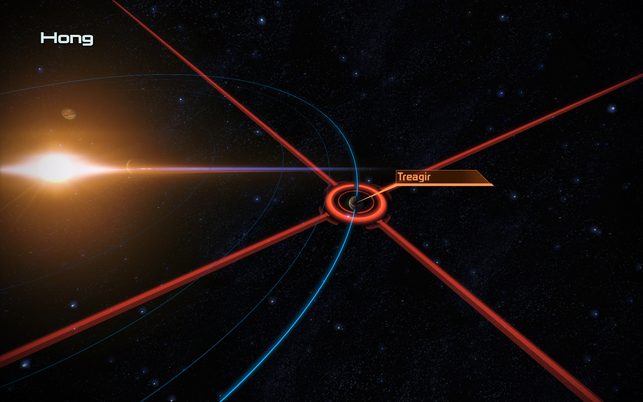
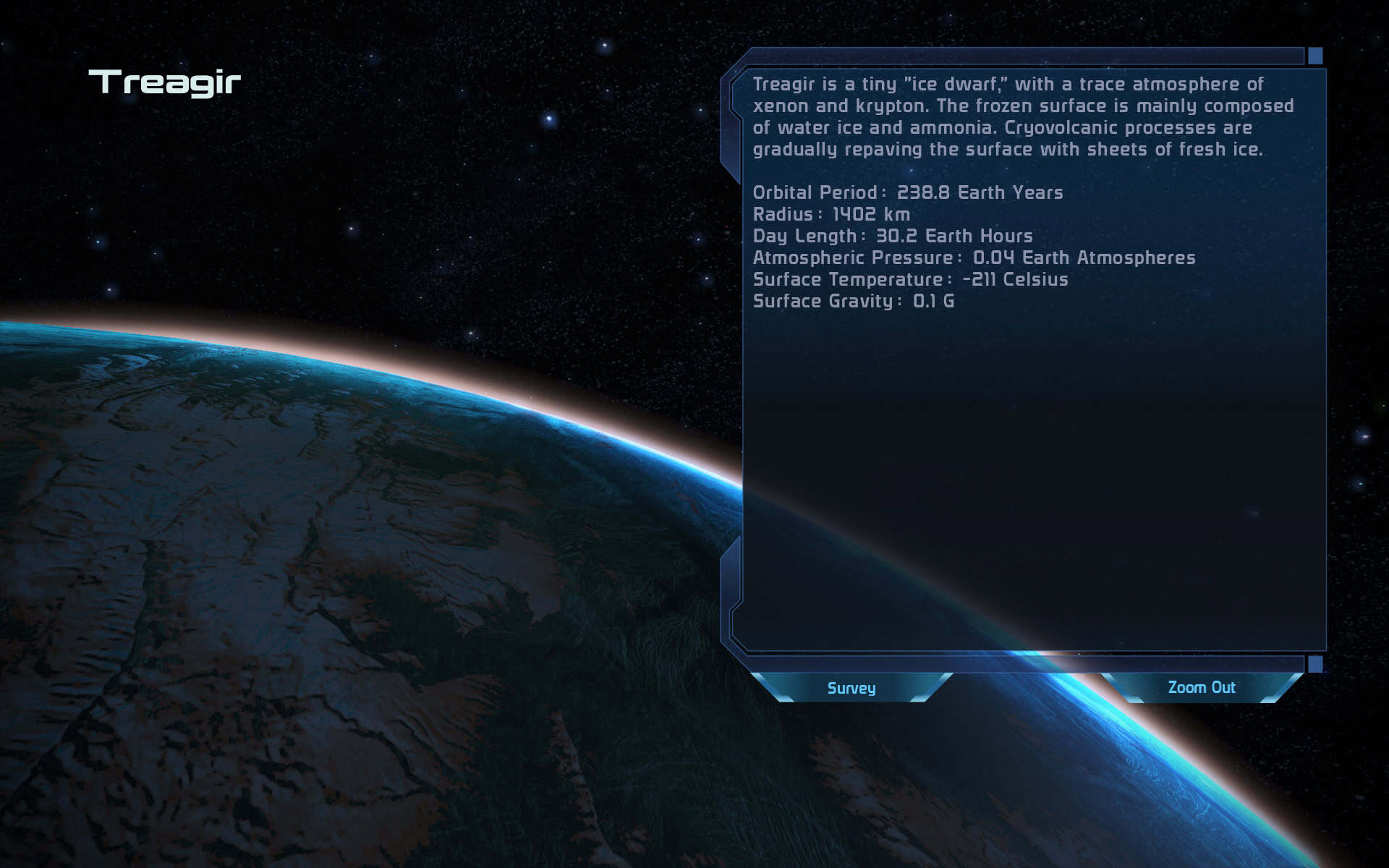
Treagir is a tiny “ice dwarf,” with a trace atmosphere of xenon and krypton. The frozen surface is mainly composed of water ice and ammonia. Cryovolcanic processes are gradually repaving the surface with sheets of fresh ice.
Orbital Period: 238.8 Earth Years
Radius: 1402 km
Day Length: 30.2 Earth Hours
Atmospheric Pressure: 0.04 Earth Atmospheres
Surface Temperature: -211 Celsius
Surface Gravity: 0.1 G
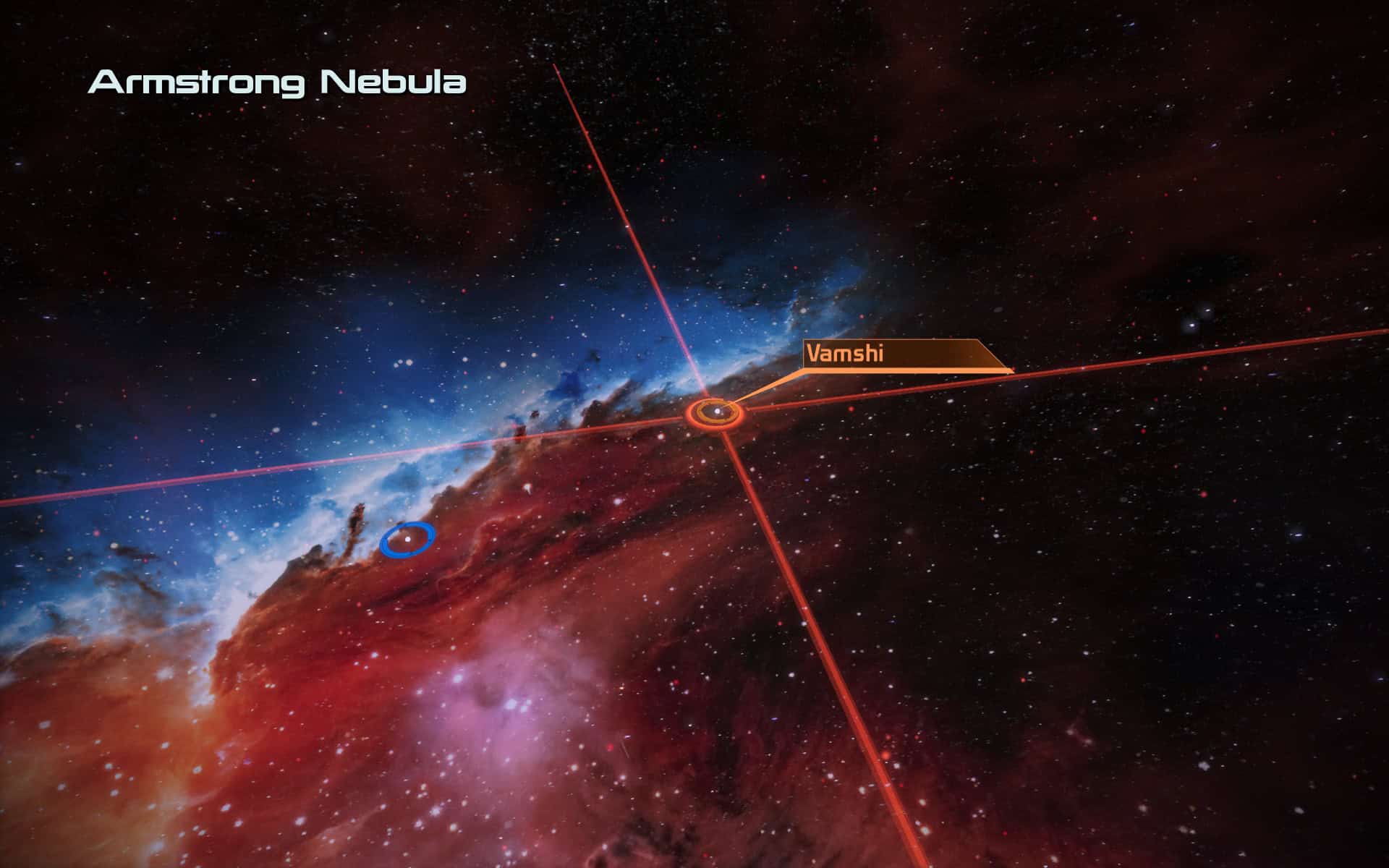
VAMSHI
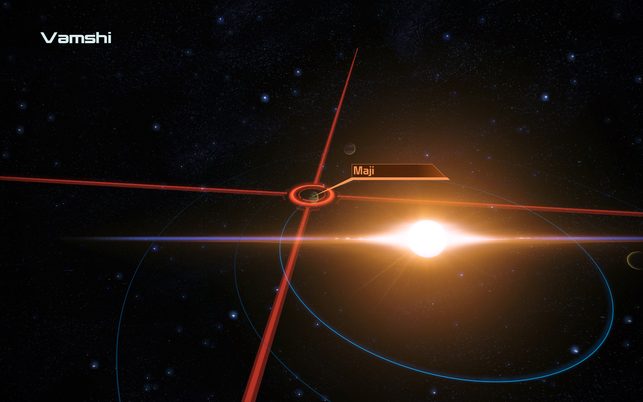
Maji
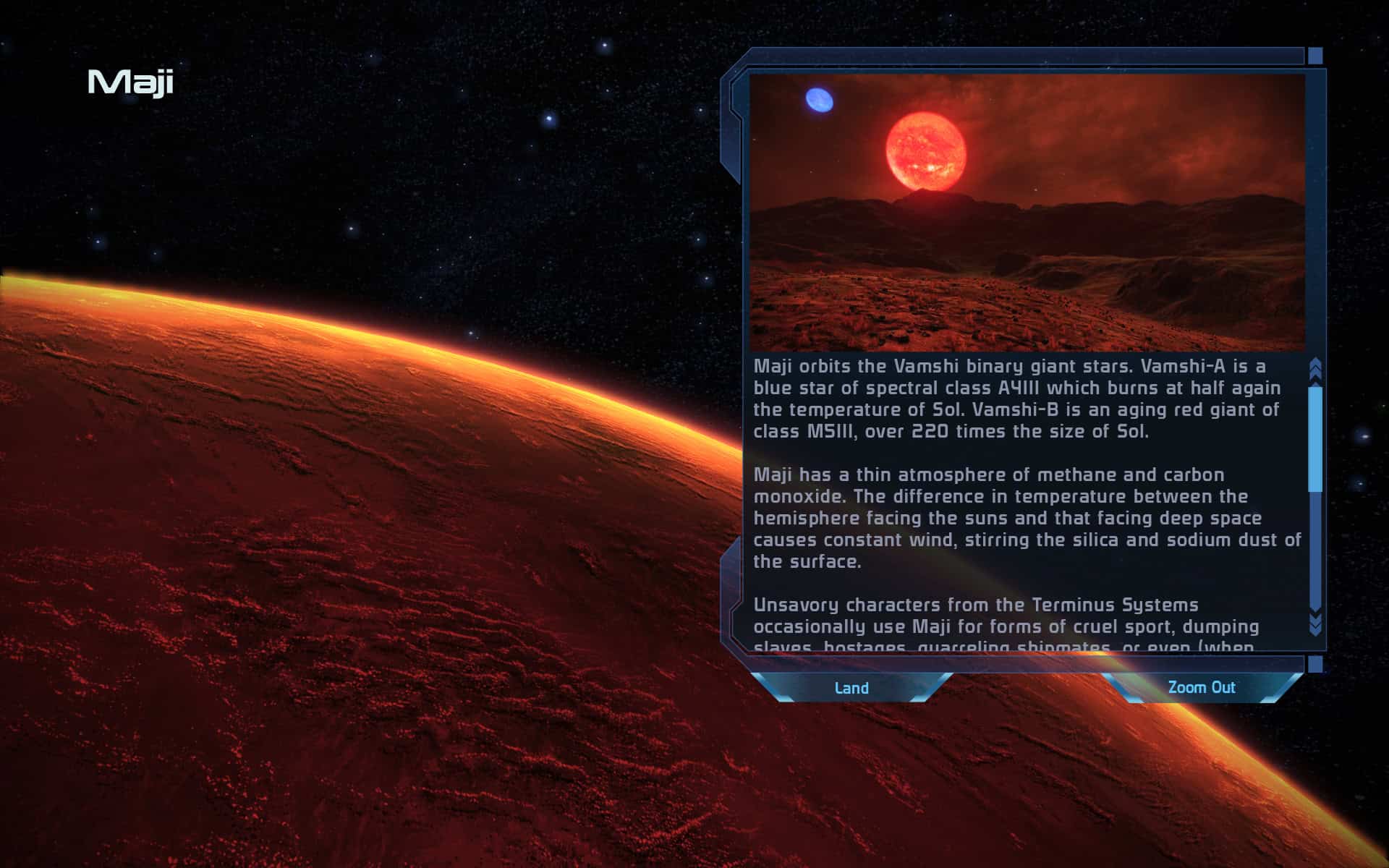
Maji orbits the Vamshi binary giant stars. Vamshi-A is a blue star of spectral class AчIII which burns at half again the temperature of Sol. Vamshi-B is an aging red giant of class MSIII, over 220 times the size of Sol.
Maji has a thin atmosphere of methane and carbon monoxide. The difference in temperature between the hemisphere facing the suns and that facing deep space causes constant wind, stirring the silica and sodium dust of the surface.
Unsavory characters from the Terminus Systems occasionally use Maji for forms of cruel sport, dumping slaves, hostages, quarreling shipmates, or even (when bored) vicious animals on the surface. One must kill the other before they will be rescued from the lethal radiation of the giant stars.
Orbital Period: 5.9 Earth Years
Radius: 5727 km
Day Length: 55.3 Earth Hours
Atmospheric Pressure: 0.42 Earth Atmospheres
Surface Temperature: -121 Celsius
Surface Gravity: 0.85 G
Almos
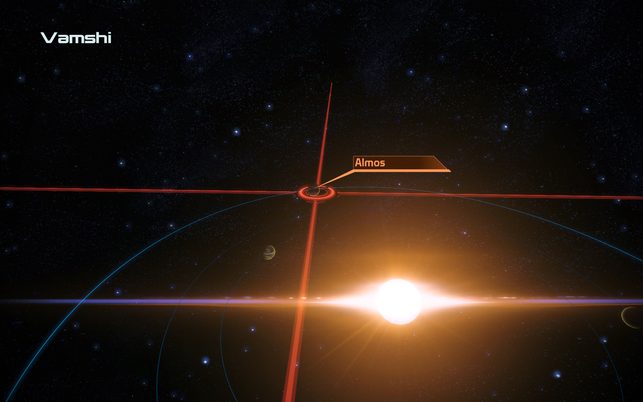
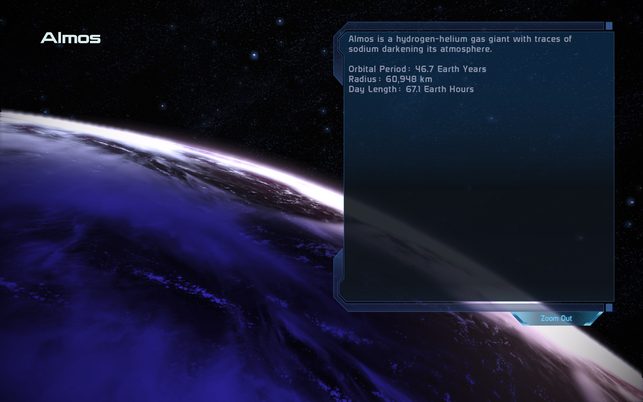
Almos is a hydrogen-helium gas giant with traces of sodium darkening its atmosphere.
Orbital Period: 46.7 Earth Years
Radius: 60,948 km
Day Length: 67.1 Earth Hours
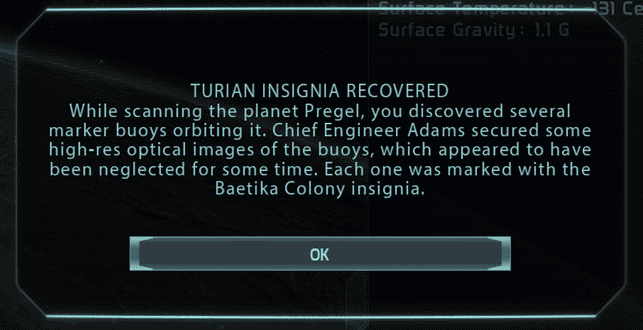
Pregel*
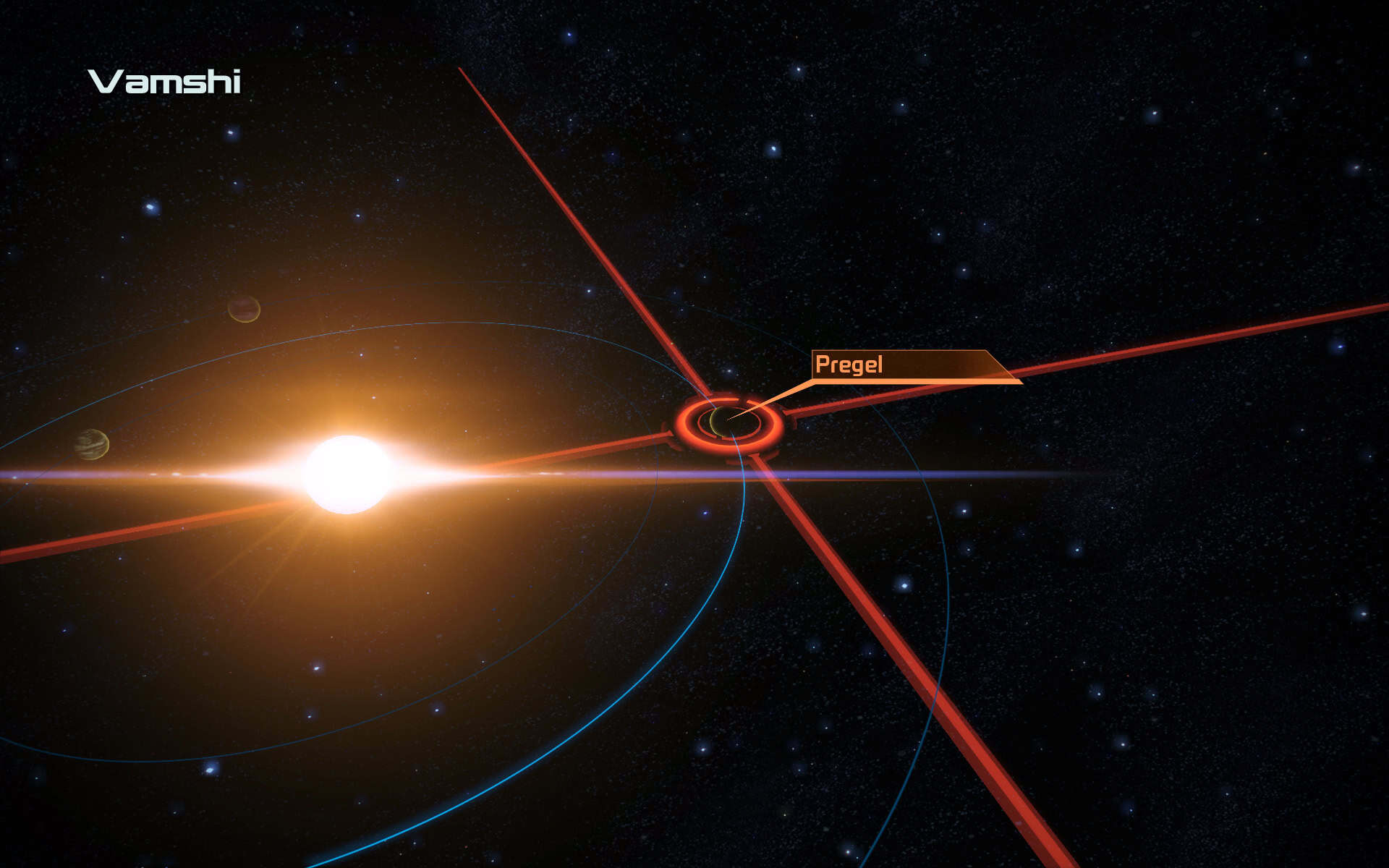
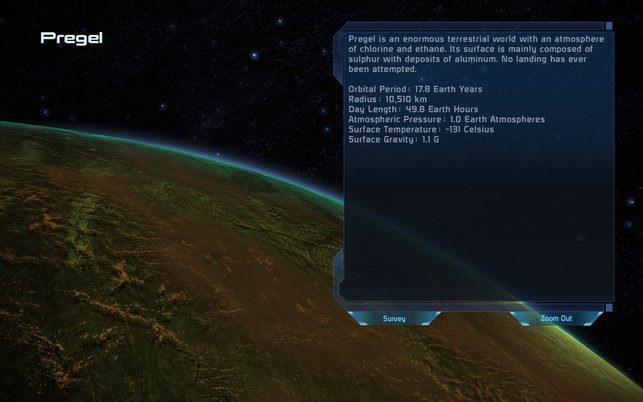
Pregel is an enormous terrestrial world with an atmosphere of chlorine and ethane. Its surface is mainly composed of sulphur with deposits of aluminum. No landing has ever been attempted.
Orbital Period: 17.8 Earth Years
Radius: 10,510 km
Day Length: 49.8 Earth Hours
Atmospheric Pressure: 1.0 Earth Atmospheres
Surface Temperature: -131 Celsius
Surface Gravity: 1.1 G
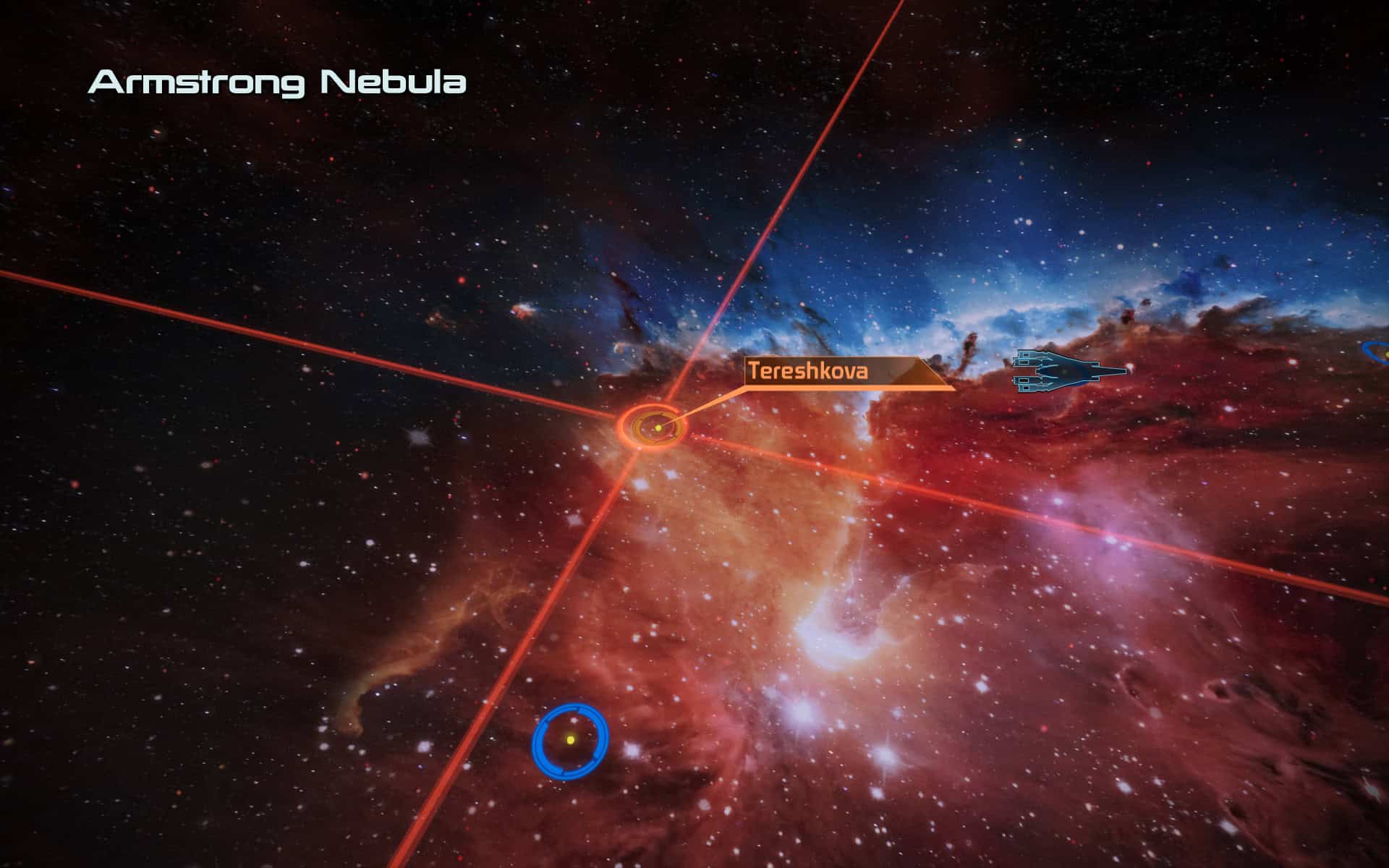
TERESHKOVA
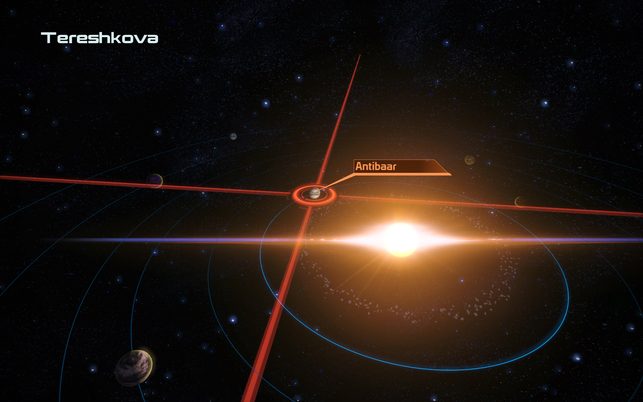
Antibaar
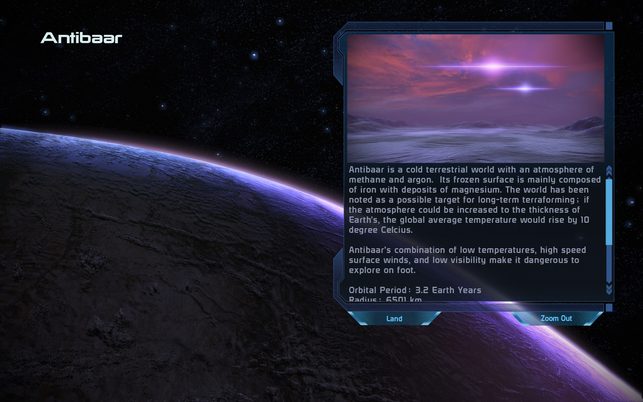
Antibaar is a cold terrestrial world with an atmosphere of methane and argon. Its frozen surface is mainly composed of iron with deposits of magnesium. The world has been noted as a possible target for long-term terraforming; if the atmosphere could be increased to the thickness of Earth’s, the global average temperature would rise by 10 degree Celcius.
Antibaar’s combination of low temperatures, high speed surface winds, and low visibility make it dangerous to explore on foot.
Orbital Period: 3.2 Earth Years Radius: 6501 km
Day Length: 54.1 Earth Hours
Atmospheric Pressure: 0.79 Earth Atmospheres
Surface Temperature: -34 Celsius
Surface Gravity: 1.1 G
Mawinor
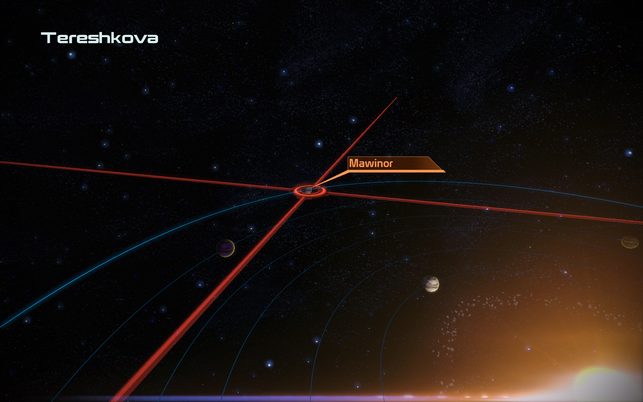
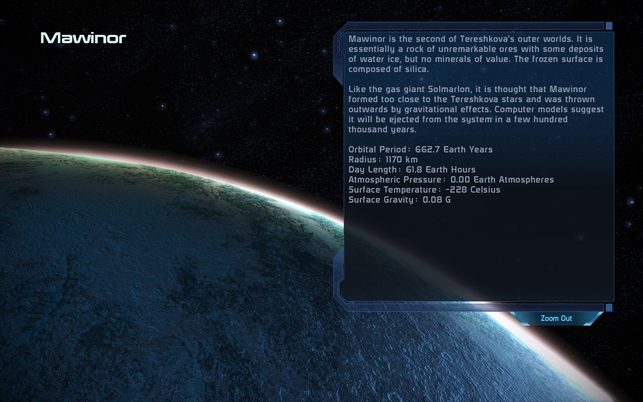
Mawinor is the second of Tereshkova’s outer worlds. It is essentially a rock of unremarkable ores with some deposits of water ice, but no minerals of value. The frozen surface is composed of silica.
Like the gas giant Solmarlon, it is thought that Mawinor formed too close to the Tereshkova stars and was thrown outwards by gravitational effects. Computer models suggest it will be ejected from the system in a few hundred thousand years.
Orbital Period: 662.7 Earth Years
Radius: 1170 km
Day Length: 61.8 Earth Hours
Atmospheric Pressure: 0.00 Earth Atmospheres
Surface Temperature: -228 Celsius
Surface Gravity: 0.08 G
Solmarlon
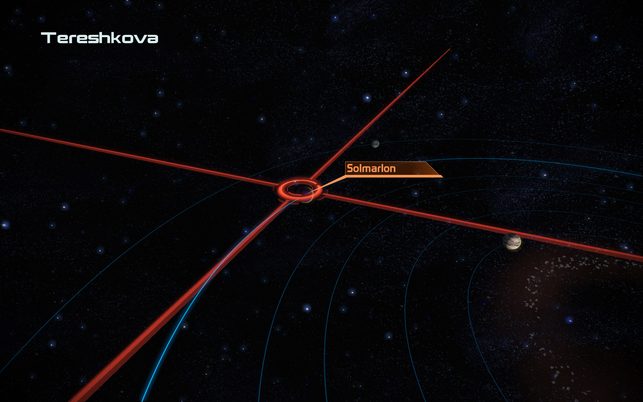
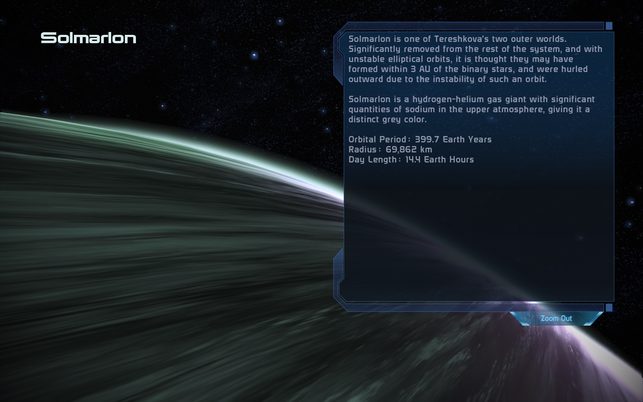
Solmarlon is one of Tereshkova’s two outer worlds. Significantly removed from the rest of the system, and with unstable elliptical orbits, it is thought they may have formed within 3 AU of the binary stars, and were hurled outward due to the instability of such an orbit.
Solmarlon is a hydrogen-helium gas giant with significant quantities of sodium in the upper atmosphere, giving it a distinct grey color.
Orbital Period: 399.7 Earth Years
Radius: 69,862 km
Day Length: 14.4 Earth Hours
Hunsalra
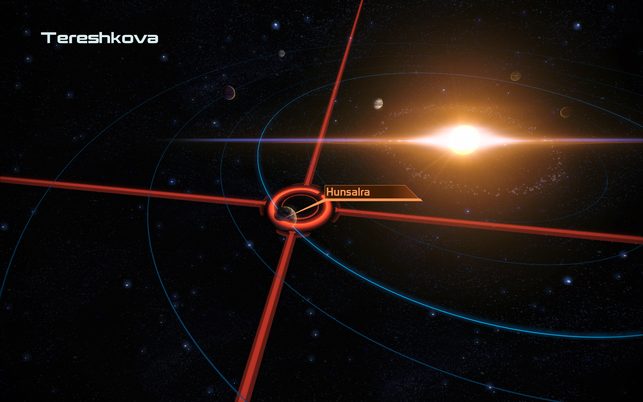
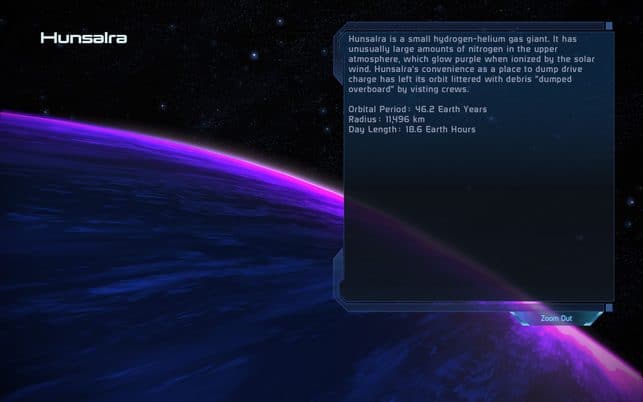
Hunsalra is a small hydrogen-helium gas giant. It has unusually large amounts of nitrogen in the upper atmosphere, which glow purple when ionized by the solar wind. Hunsalra’s convenience as a place to dump drive charge has left its orbit littered with debris “dumped overboard” by visiting crews.
Orbital Period: 46.2 Earth Years
Radius: 11,496 km
Day Length: 18.6 Earth Hours
Thegeuse*
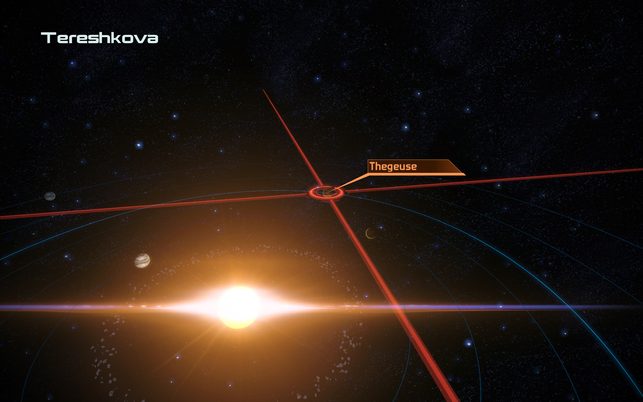
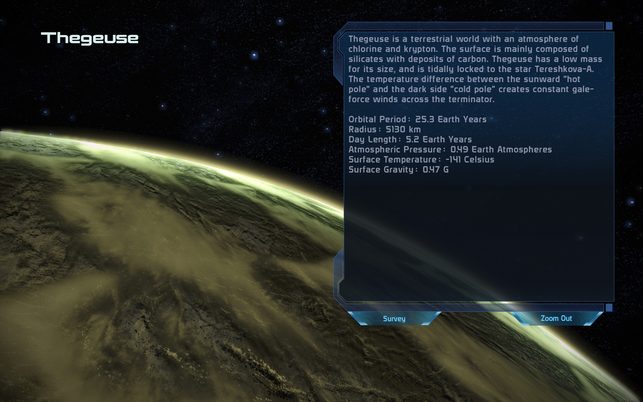
Thegeuse is a terrestrial world with an atmosphere of chlorine and krypton. The surface is mainly composed of silicates with deposits of carbon. Thegeuse has a low mass for its size, and is tidally locked to the star Tereshkova-A. The temperature difference between the sunward “hot pole” and the dark side “cold pole” creates constant gale-force winds across the terminator.
Orbital Period: 25.3 Earth Years
Radius: 5130 km
Day Length: 5.2 Earth Years
Atmospheric Pressure: 0.49 Earth Atmospheres
Surface Temperature: -141 Celsius
Surface Gravity: 0.47 G
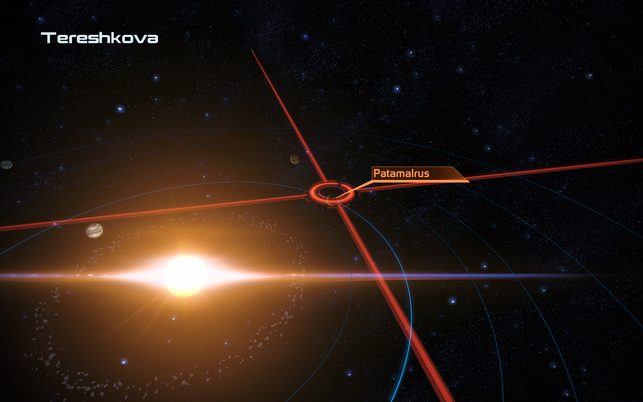
Patamalrus*
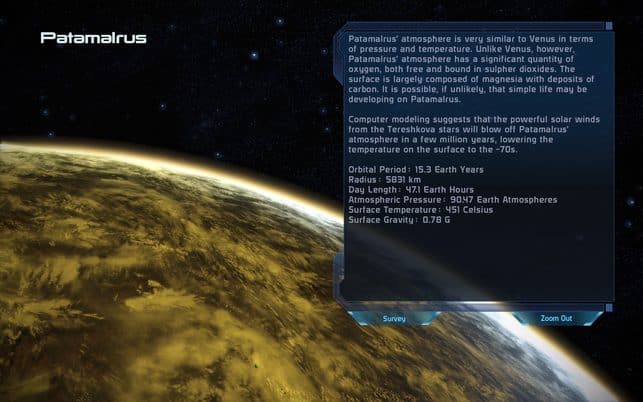
Patamalrus’ atmosphere is very similar to Venus in terms of pressure and temperature. Unlike Venus, however, Patamalrus’ atmosphere has a significant quantity of oxygen, both free and bound in sulpher dioxides. The surface is largely composed of magnesia with deposits of carbon. It is possible, if unlikely, that simple life may be developing on Patamalrus.
Computer modeling suggests that the powerful solar winds from the Tereshkova stars will blow off Patamalrus’ atmosphere in a few million years, lowering the temperature on the surface to the -70s.
Orbital Period: 15.3 Earth Years
Radius: 5831 km
Day Length: 47.1 Earth Hours
Atmospheric Pressure: 90.47 Earth Atmospheres
Surface Temperature: 451 Celsius
Surface Gravity: 0.78 G
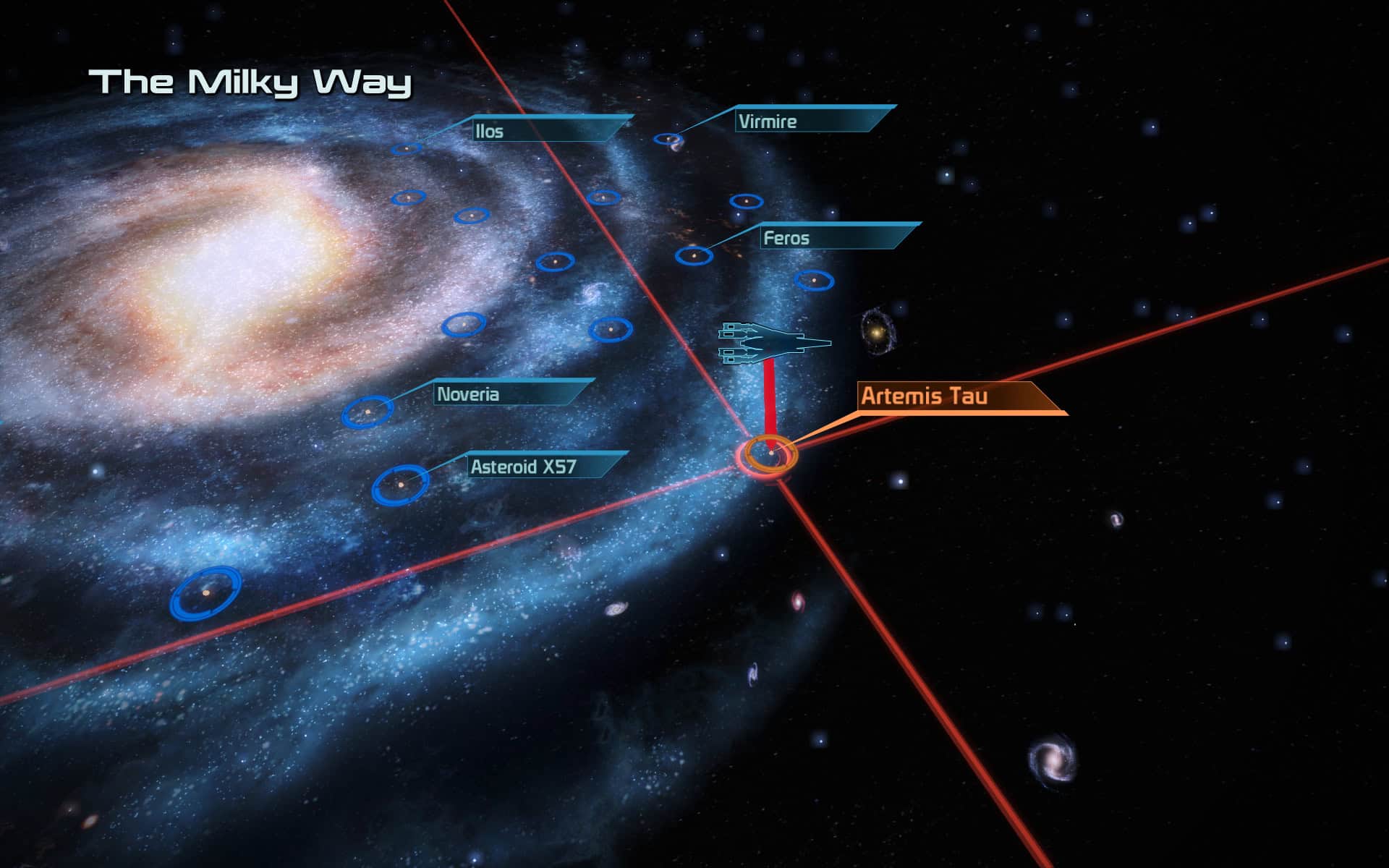
ARTEMIS TAU
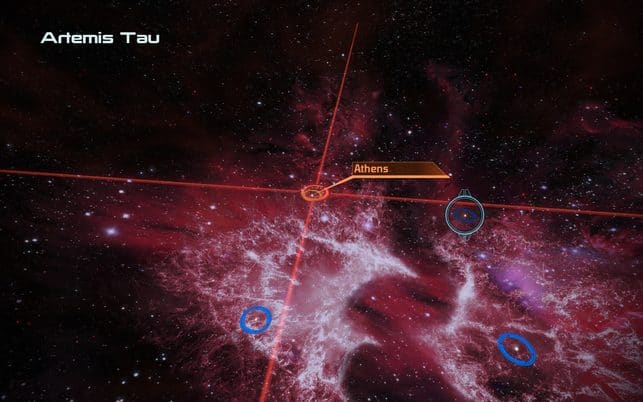
ATHENS
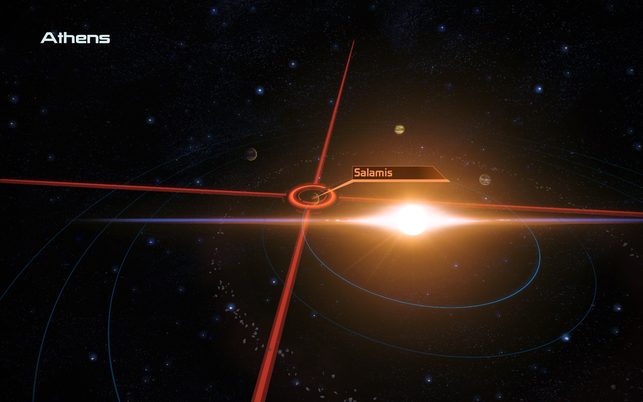
Salamis
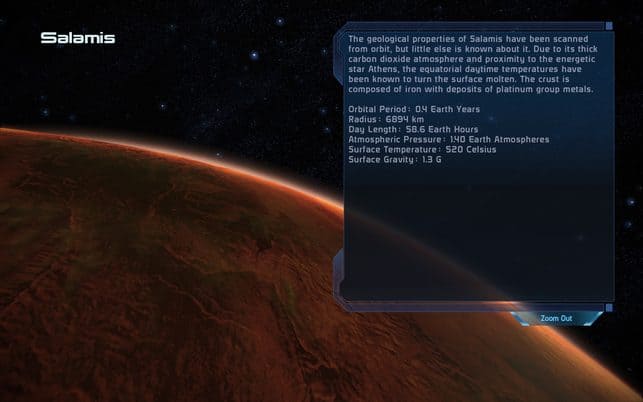
The geological properties of Salamis have been scanned from orbit, but little else is known about it. Due to its thick carbon dioxide atmosphere and proximity to the energetic star Athens, the equatorial daytime temperatures have been known to turn the surface molten. The crust is composed of iron with deposits of platinum group metals.
Orbital Period: 0.4 Earth Years
Radius: 6894 km
Day Length: 58.6 Earth Hours
Atmospheric Pressure: 1.40 Earth Atmospheres
Surface Temperature: 520 Celsius
Surface Gravity: 1.3 G
Nausicaa
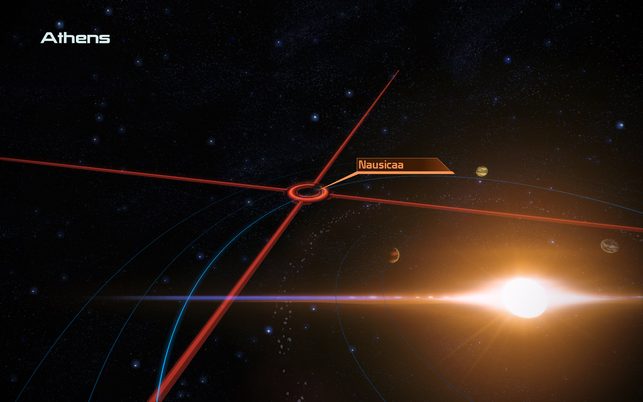
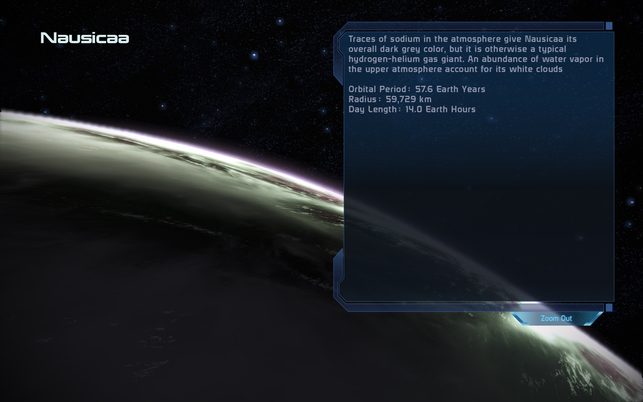
Traces of sodium in the atmosphere give Nausicaa its overall dark grey color, but it is otherwise a typical hydrogen-helium gas giant. An abundance of water vapor in the upper atmosphere account for its white clouds
Orbital Period: 57.6 Earth Years
Radius: 59,729 km
Day Length: 14.0 Earth Hours
Circe*
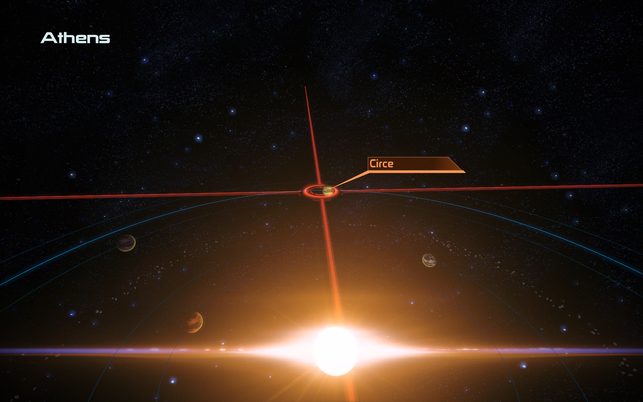
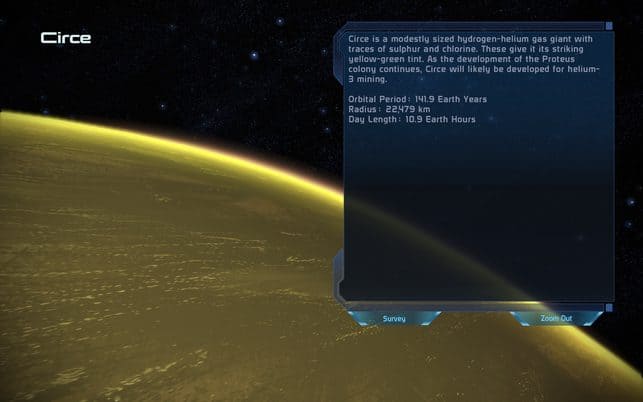
Circe is a modestly sized hydrogen-helium gas giant with traces of sulphur and chlorine. These give it its striking yellow-green tint. As the development of the Proteus colony continues, Circe will likely be developed for helium-3 mining.
Orbital Period: 141.9 Earth Years
Radius: 22,479 km
Day Length: 10.9 Earth Hours
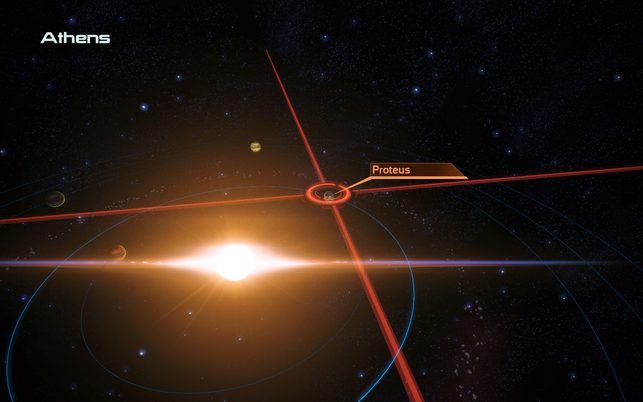
Protheus*
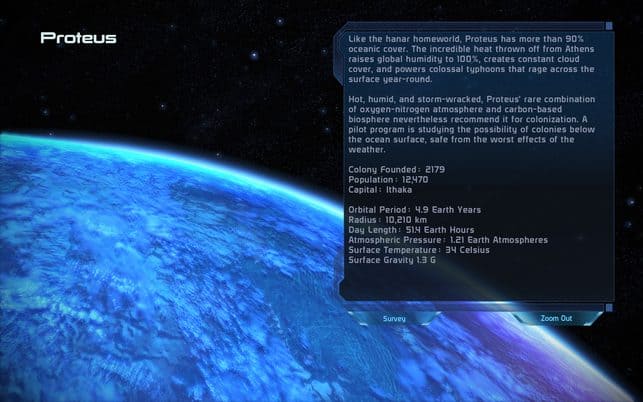
Like the hanar homeworld, Proteus has more than 90% oceanic cover. The incredible heat thrown off from Athens raises global humidity to 100%, creates constant cloud cover, and powers colossal typhoons that rage across the surface year-round.
Hot, humid, and storm-wracked, Proteus’ rare combination of oxygen-nitrogen atmosphere and carbon-based biosphere nevertheless recommend it for colonization. A pilot program is studying the possibility of colonies below the ocean surface, safe from the worst effects of the weather.
Colony Founded: 2179
Population: 12,470
Capital: Ithaka
Orbital Period: 4.9 Earth Years
Radius: 10,210 km
Day Length: 51.4 Earth Hours
Atmospheric Pressure: 1.21 Earth Atmospheres
Surface Temperature: 34 Celsius
Surface Gravity 1.3 G
Pharos*
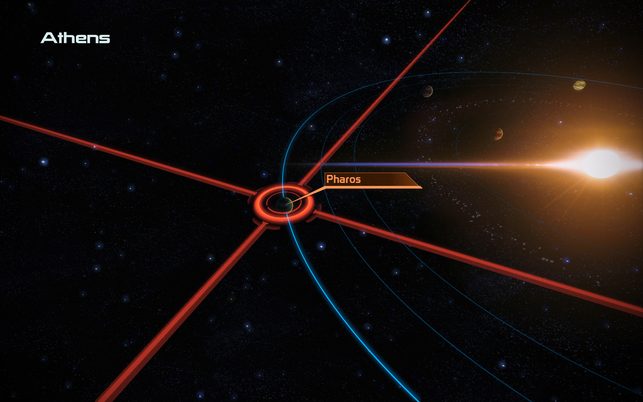
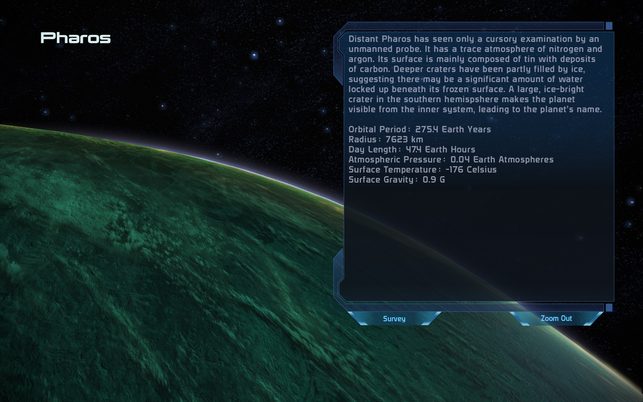
Distant Pharos has seen only a cursory examination by an unmanned probe. It has a trace atmosphere of nitrogen and argon. Its surface is mainly composed of tin with deposits of carbon. Deeper craters have been partly filled by ice, suggesting there may be a significant amount of water locked up beneath its frozen surface. A large, ice-bright crater in the southern hemisphere makes the planet visible from the inner system, leading to the planet’s name.
Orbital Period: 275.4 Earth Years
Radius 7623 km
Day Length: 474 Earth Hours
Atmospheric Pressure: 0.04 Earth Atmospheres
Surface Temperature: -176 Celsius
Surface Gravity: 0.9 G
KNOSSOS
Phaistos
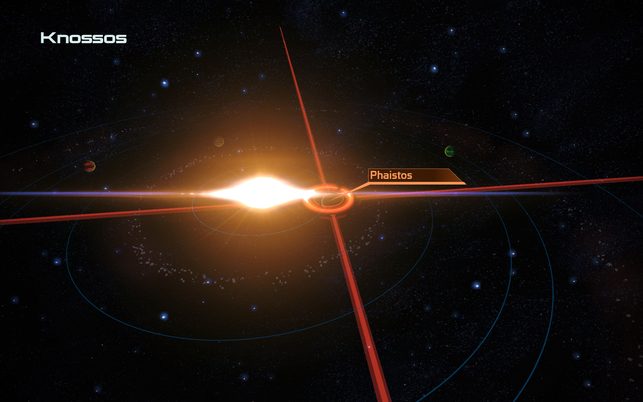
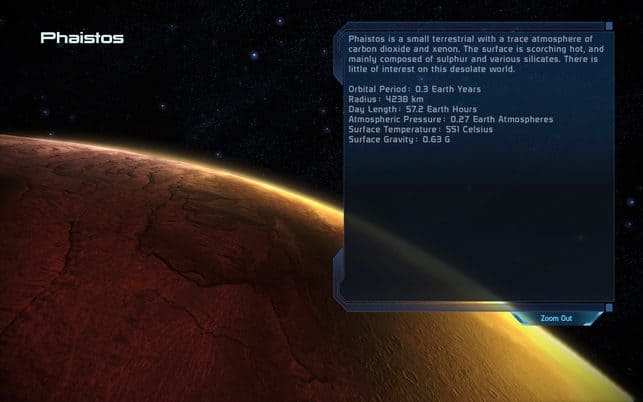
Phaistos is a small terrestrial with a trace atmosphere of carbon dioxide and xenon. The surface is scorching hot, and mainly composed of sulphur and various silicates. There is little of interest on this desolate world.
Orbital Period: 0.3 Earth Years
Radius: 4238 km
Day Length: 57.2 Earth Hours
Atmospheric Pressure: 0.27 Earth Atmospheres
Surface Temperature: 551 Celsius
Surface Gravity: 0.63 G
Armeni
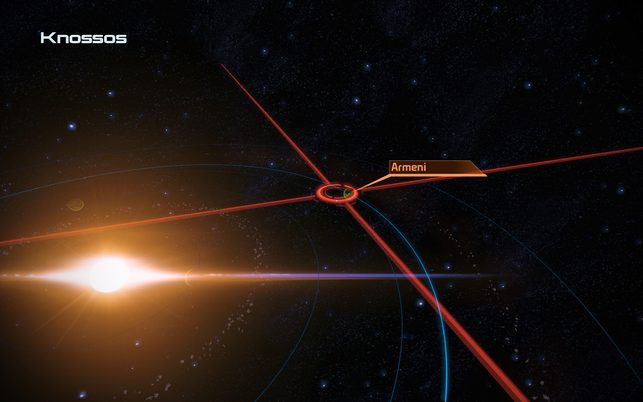
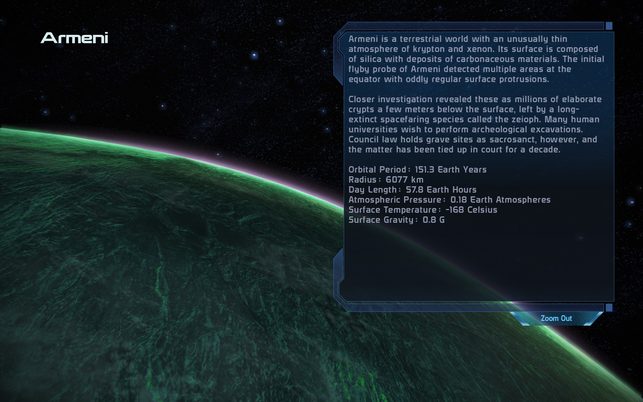
Armeni is a terrestrial world with an unusually thin atmosphere of krypton and xenon. Its surface is composed of silica with deposits of carbonaceous materials. The initial flyby probe of Armeni detected multiple areas at the equator with oddly regular surface protrusions.
Closer investigation revealed these as millions of elaborate crypts a few meters below the surface, left by a long-extinct spacefaring species called the zeioph. Many human universities wish to perform archeological excavations. Council law holds grave sites as sacrosanct, however, and the matter has been tied up in court for a decade.
Orbital Period: 151.3 Earth Years
Radius: 6077 km
Day Length: 57.8 Earth Hours
Atmospheric Pressure: 0.18 Earth Atmospheres
Surface Temperature: -168 Celsius
Surface Gravity: 0.8 G
Therum
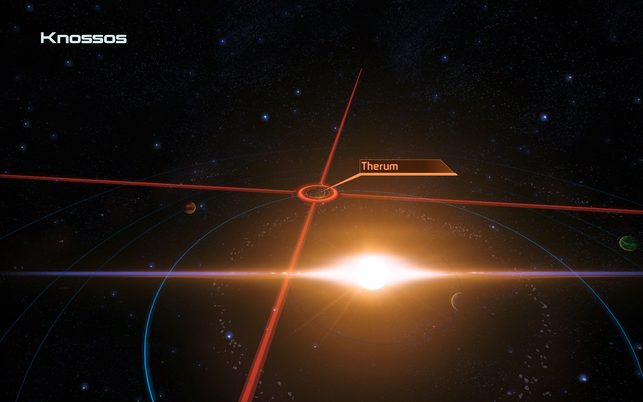
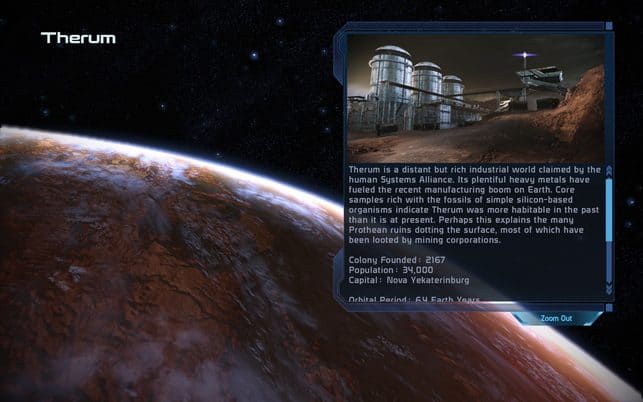
Therum is a distant but rich industrial world claimed by the human Systems Alliance. Its plentiful heavy metals have fueled the recent manufacturing boom on Earth. Core samples rich with the fossils of simple silicon-based organisms indicate Therum was more habitable in the past than it is at present. Perhaps this explains the many Prothean ruins dotting the surface, most of which have been looted by mining corporations.
Colony Founded: 2167
Population: 34,000
Capital: Nova Yekaterinburg
Orbital Period: 6.4 Earth Years
Radius: 6724 km
Day Length: 28.3 Earth Hours
Atmospheric Pressure: 0.68 Earth Atmospheres
Surface Temperature: 59 Celsius
Surface Gravity: 1.12 G
Zakros
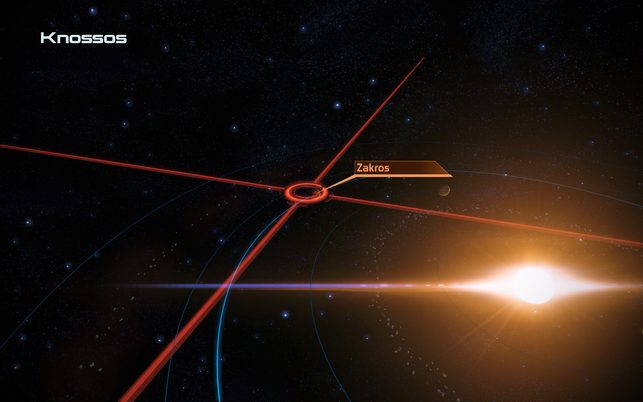
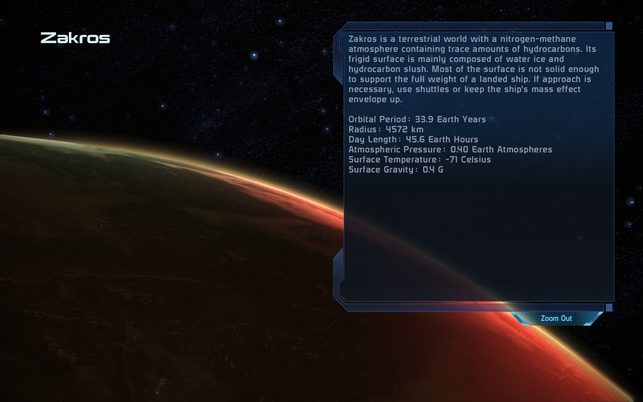
Zakros is a terrestrial world with a nitrogen-methane atmosphere containing trace amounts of hydrocarbons. Its frigid surface is mainly composed of water ice and
hydrocarbon slush. Most of the surface is not solid enough to support the full weight of a landed ship. If approach is necessary, use shuttles or keep the ship’s mass effect envelope up.
Orbital Period: 33.9 Earth Years
Radius: 4572 km
Day Length: 45.6 Earth Hours
Atmospheric Pressure: 0.40 Earth Atmospheres
Surface Temperature: -71 Celsius
Surface Gravity: 0.4 G
Archanes*
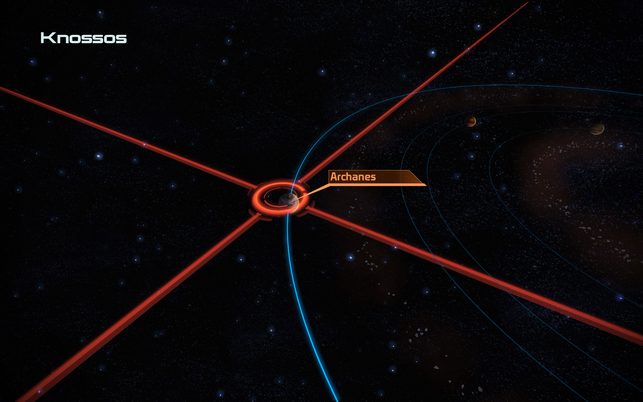
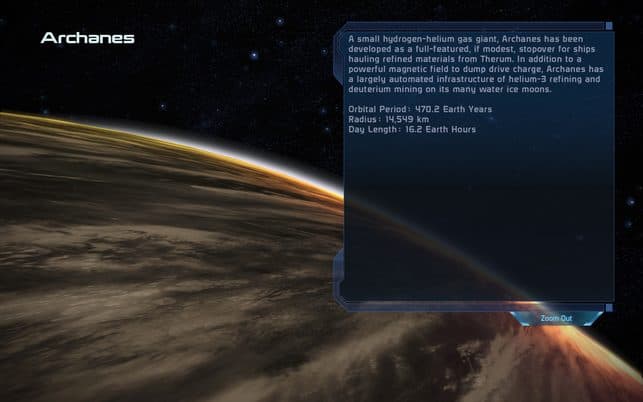
A small hydrogen-helium gas giant, Archanes has been developed as a full-featured, if modest, stopover for ships hauling refined materials from Therum. In addition to a powerful magnetic field to dump drive charge, Archanes has a largely automated infrastructure of helium-3 refining and deuterium mining on its many water ice moons.
Orbital Period: 470.2 Earth Years
Radius: 14,549 km
Day Length: 16.2 Earth Hours
MACEDON
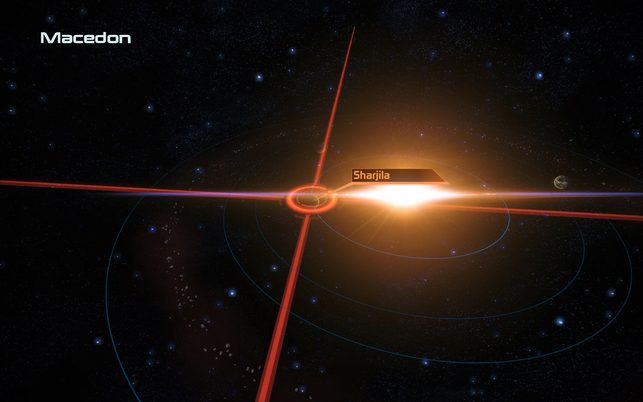
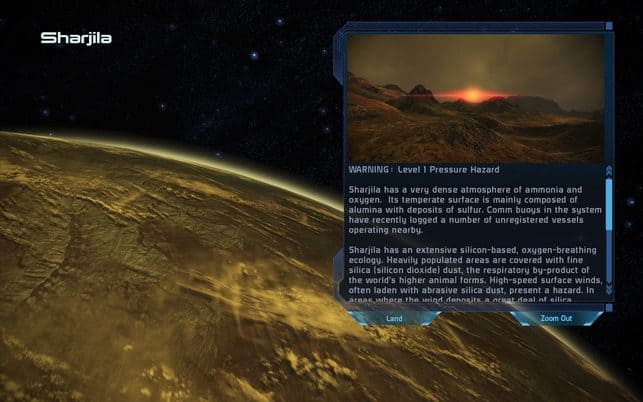
WARNING: Level 1 Pressure Hazard
Sharjila has a very dense atmosphere of ammonia and oxygen. Its temperate surface is mainly composed of alumina with deposits of sulfur. Comm buoys in the system have recently logged a number of unregistered vessels operating nearby.
Sharjila has an extensive silicon-based, oxygen-breathing ecology. Heavily populated areas are covered with fine silica (silicon dioxide) dust, the respiratory by-product of the world’s higher animal forms. High-speed surface winds, often laden with abrasive silica dust, present a hazard. In areas where the wind deposits a great deal of silica, footing can be treacherous. EVAs are discouraged.
Orbital Period: 1.0 Earth Years
Radius: 5693 km
Day Length: 40.6 Earth Hours
Atmospheric Pressure: 39.16 Earth Atmospheres
Surface Temperature: 25 Celsius
Surface Gravity: 0.9G
Porolan*
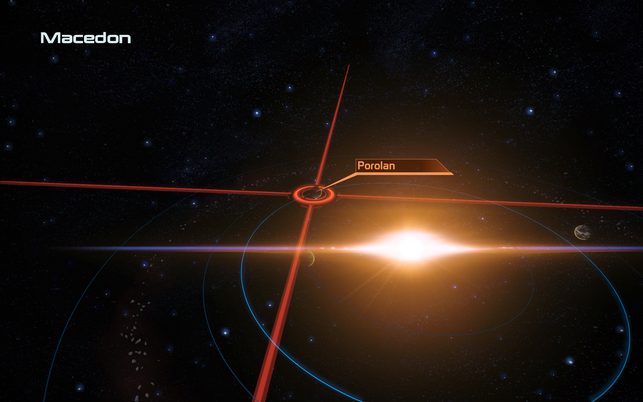
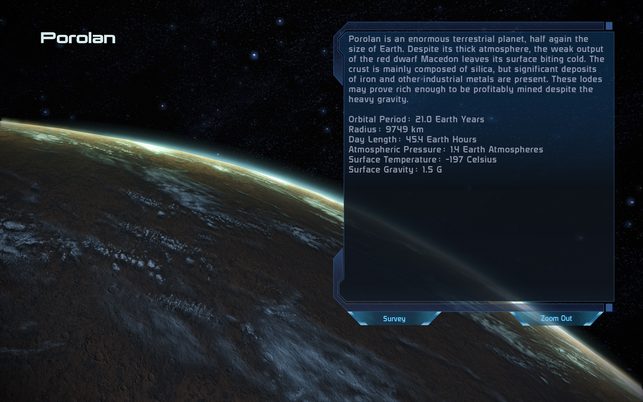
Porolan is an enormous terrestrial planet, half again the size of Earth. Despite its thick atmosphere, the weak output of the red dwarf Macedon leaves its surface biting cold. The crust is mainly composed of silica, but significant deposits of iron and other industrial metals are present. These lodes may prove rich enough to be profitably mined despite the heavy gravity.
Orbital Period: 21.0 Earth Years
Radius: 9749 km
Day Length: 45.4 Earth Hours
Atmospheric Pressure: 1.4 Earth Atmospheres
Surface Temperature: -197 Celsius
Surface Gravity: 1.5 G
Patavig
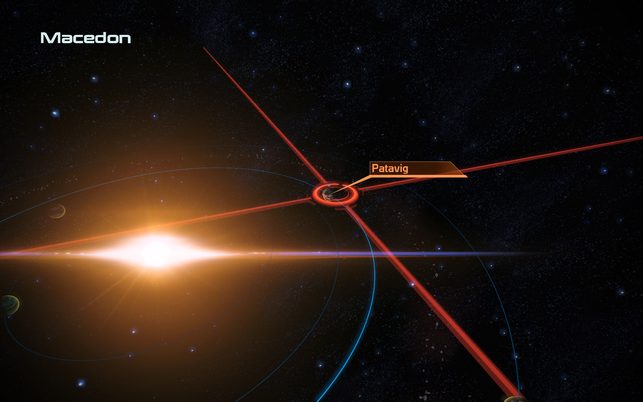
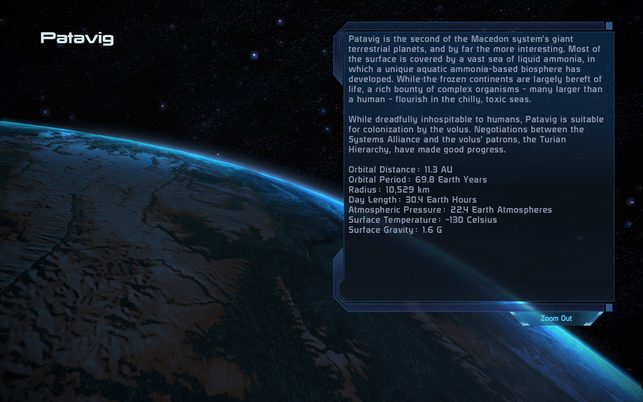
Patavig is the second of the Macedon system’s giant terrestrial planets, and by far the more interesting. Most of the surface is covered by a vast sea of liquid ammonia, in which a unique aquatic ammonia-based biosphere has developed. While the frozen continents are largely bereft of life, a rich bounty of complex organisms – many larger than a human – flourish in the chilly, toxic seas.
While dreadfully inhospitable to humans, Patavig is suitable for colonization by the volus. Negotiations between the Systems Alliance and the volus’ patrons, the Turian Hierarchy, have made good progress.
Orbital Distance: 11.3 AU
Orbital Period: 69.8 Earth Years
Radius: 10,529 km
Day Length: 30.4 Earth Hours
Atmospheric Pressure: 22.4 Earth Atmospheres
Surface Temperature: -130 Celsius
Surface Gravity: 1.6 G
Fargeluse*
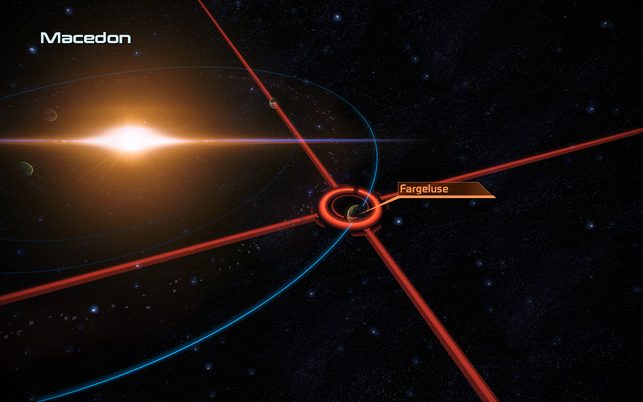
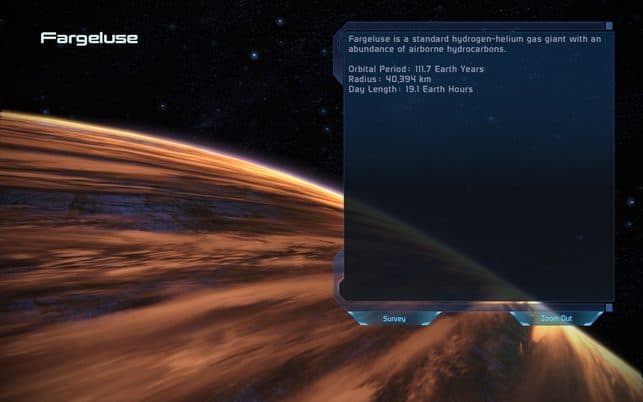
Fargeluse is a standard hydrogen-helium gas giant with an abundance of airborne hydrocarbons.
Orbital Period: 111.7 Earth Years
Radius: 40,394 km
Day Length: 19.1 Earth Hour’s
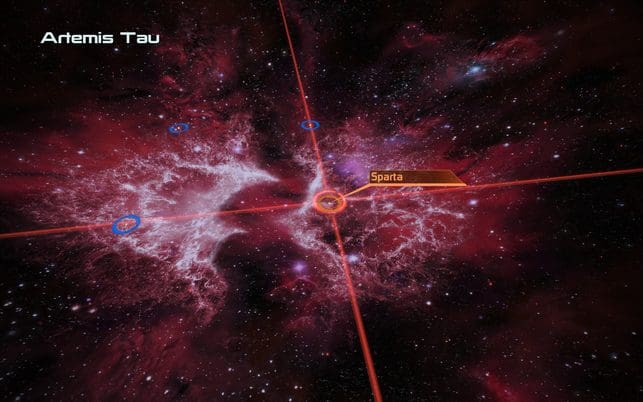
SPARTA
Tremanre
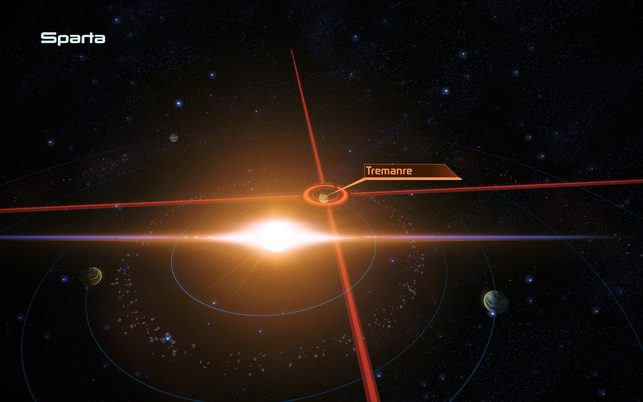
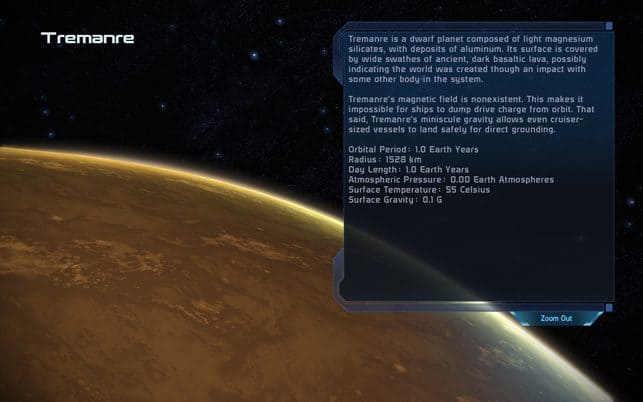
Tremanre is a dwarf planet composed of light magnesium silicates, with deposits of aluminum. Its surface is covered by wide swathes of ancient, dark basaltic lava, possibly indicating the world was created though an impact with some other body in the system.
Tremanre’s magnetic field is nonexistent. This makes it impossible for ships to dump drive charge from orbit. That said, Tremanre’s miniscule gravity allows even cruiser-sized vessels to land safely for direct grounding.
Orbital Period: 1.0 Earth Years
Radius: 1528 km
Day Length: 1.0 Earth Years
Atmospheric Pressure: 0.00 Earth Atmospheres
Surface Temperature: 55 Celsius
Surface Gravity: 0.1 G
Asteroid Cluster*
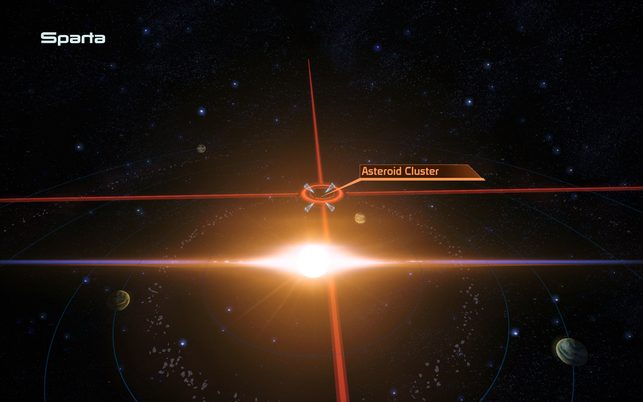
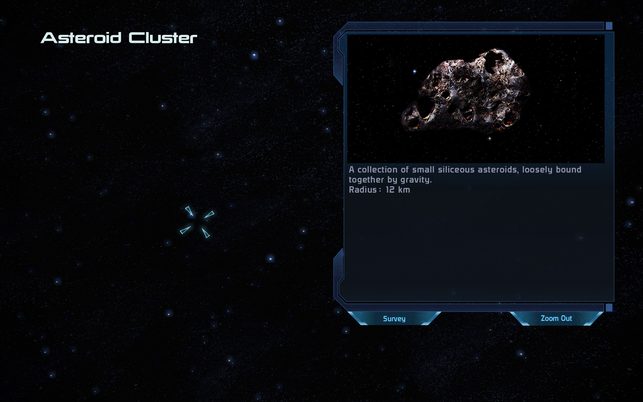
A collection of small siliceous asteroids, loosely bound together by gravity.
Radius: 12 km
Alsages*
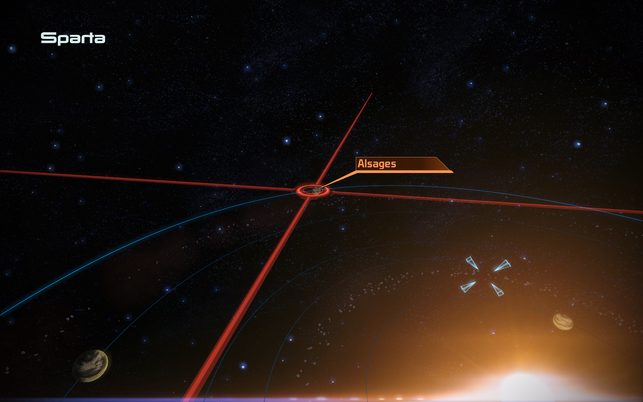
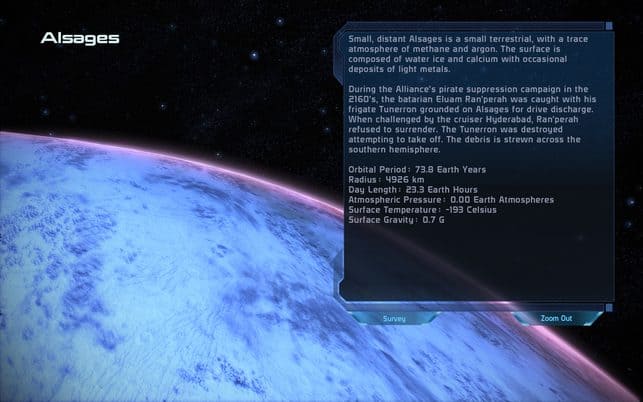
Small, distant Alsages is a small terrestrial, with a trace atmosphere of methane and argon. The surface is composed of water ice and calcium with occasional deposits of light metals.
During the Alliance’s pirate suppression campaign in the 2160’s, the batarian Eluam Ran’perah was caught with his frigate Tunerron grounded on Alsages for drive discharge. When challenged by the cruiser Hyderabad, Ran’perah refused to surrender. The Tunerron was destroyed attempting to take off. The debris is strewn across the southern hemisphere.
Orbital Period: 73.8 Earth Years Radius: 4926 km
Day Length: 23.3 Earth Hours
Atmospheric Pressure: 0.00 Earth Atmospheres
Surface Temperature: -193 Celsius
Surface Gravity: 0.7 G
Ontamalca*
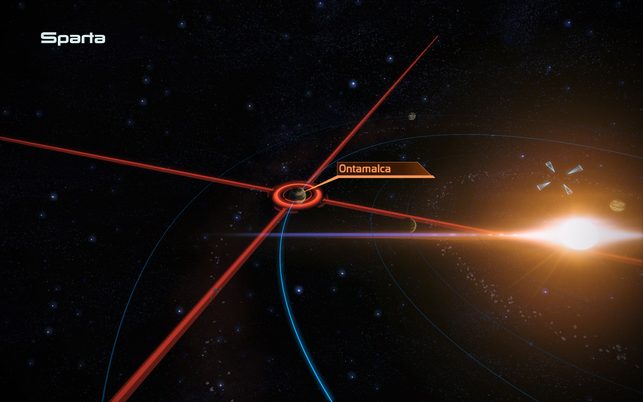
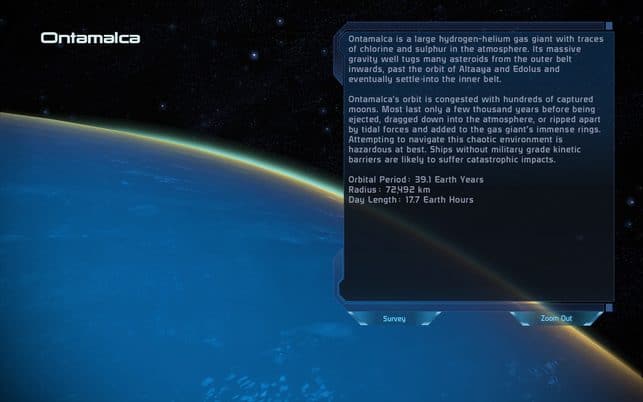
Ontamalca is a large hydrogen-helium gas giant with traces of chlorine and sulphur in the atmosphere. Its massive gravity well tugs many asteroids from the outer belt inwards, past the orbit of Altaaya and Edolus and eventually settle into the inner belt.
Ontamalca’s orbit is congested with hundreds of captured moons. Most last only a few thousand years before being ejected, dragged down into the atmosphere, or ripped apart by tidal forces and added to the gas giant’s immense rings. Attempting to navigate this chaotic environment is hazardous at best. Ships without military grade kinetic barriers are likely to suffer catastrophic impacts.
Orbital Period: 39.1 Earth Years
Radius: 72,492 km
Day Length: 17.7 Earth Hours
Edolus
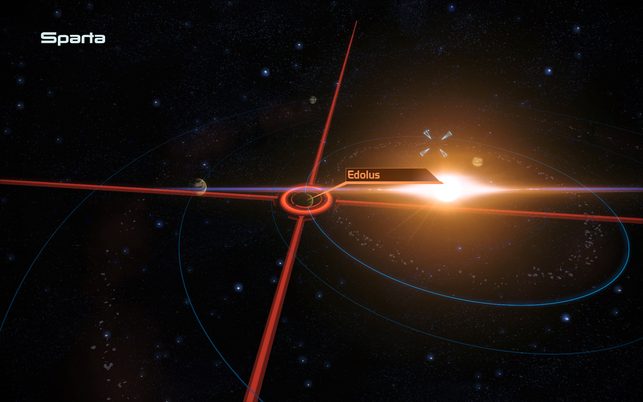
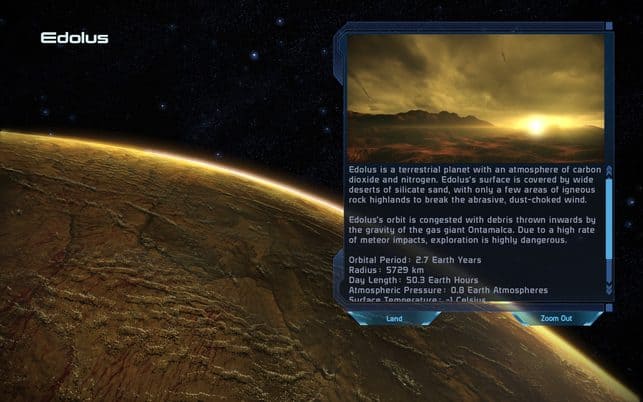
Edolus is a terrestrial planet with an atmosphere of carbon dioxide and nitrogen. Edolus’s surface is covered by wide deserts of silicate sand, with only a few areas of igneous rock highlands to break the abrasive, dust-choked wind.
Edolus’s orbit is congested with debris thrown inwards by the gravity of the gas giant Ontamalca. Due to a high rate of meteor impacts, exploration is highly dangerous.
Orbital Period: 2.7 Earth Years Radius: 5729 km
Day Length: 50.3 Earth Hours
Atmospheric Pressure: 0.8 Earth Atmospheres
Surface Temperature: -1 Celsius
Surface Gravity: 0.87 G
Altaaya
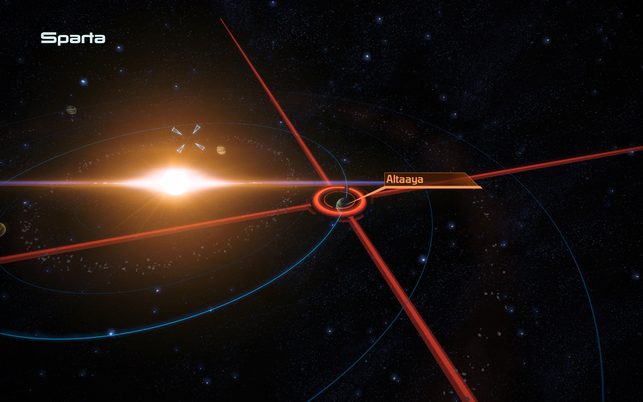
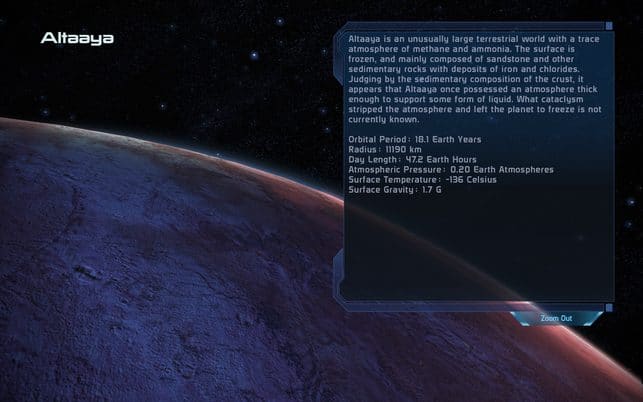
Altaaya is an unusually large terrestrial world with a trace atmosphere of methane and ammonia. The surface is frozen, and mainly composed of sandstone and other sedimentary rocks with deposits of iron and chlorides. Judging by the sedimentary composition of the crust, it appears that Altaaya once possessed an atmosphere thick enough to support some form of liquid. What cataclysm stripped the atmosphere and left the planet to freeze is not currently known.
Orbital Period: 18.1 Earth Years Radius: 11190 km
Day Length: 47.2 Earth Hours
Atmospheric Pressure: 0.20 Earth Atmospheres
Surface Temperature: -136 Celsius
Surface Gravity: 1.7 G
ATTICAN BETA
HERCULES
Xathorron
Xathorron is a small rock planet, with a thin atmosphere of carbon dioxide and hydrogen sulfide. The surface is scorching hot, and mainly composed of sulfur with deposits of boron.
Orbital Period: 9.5 Earth Years
Radius: 3537 km
Day Length: 64.9 Earth Hours
Atmospheric Pressure: 0.37 Earth Atmospheres
Surface Temperature: 388 Celsius
Surface Gravity: 0.39 G
Syided*
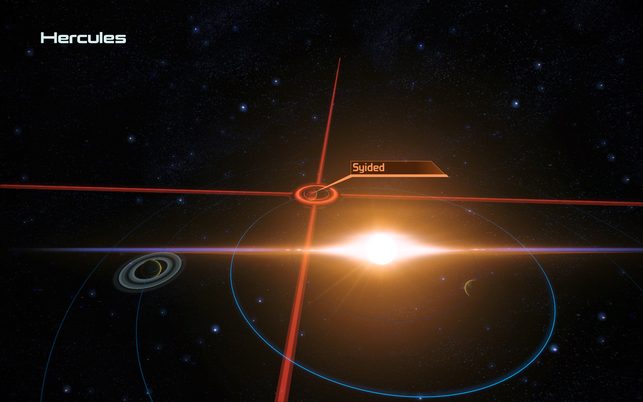
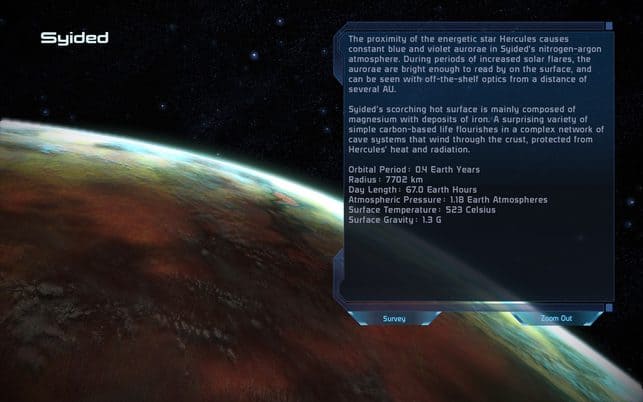
The proximity of the energetic star Hercules causes constant blue and violet aurorae in Syided’s nitrogen-argon atmosphere. During periods of increased solar flares, the aurorae are bright enough to read by on the surface, and can be seen with off-the-shelf optics from a distance of several AU.
Syided’s scorching hot surface is mainly composed of magnesium with deposits of iron. A surprising variety of simple carbon-based life flourishes in a complex network of cave systems that wind through the crust, protected from Hercules’ heat and radiation.
Orbital Period: 0.4 Earth Years
Radius: 7702 km
Day Length: 67.0 Earth Hours
Atmospheric Pressure: 1.18 Earth Atmospheres
Surface Temperature: 523 Celsius
Surface Gravity: 1.3 G
Eletania
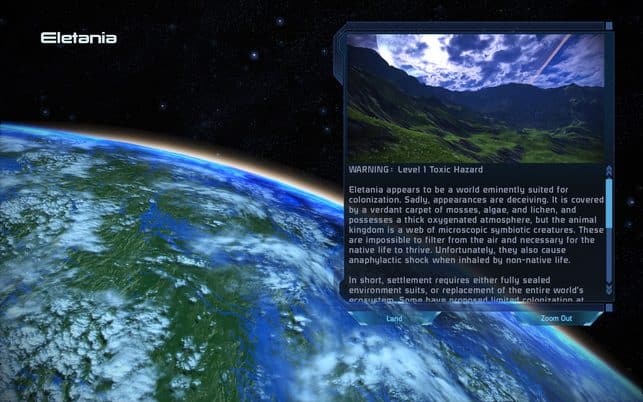
WARNING: Level 1 Toxic Hazard
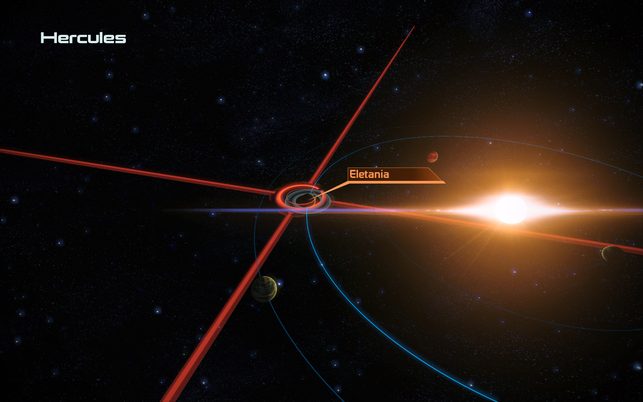
Eletania appears to be a world eminently suited for colonization. Sadly, appearances are deceiving. It is covered by a verdant carpet of mosses, algae, and lichen, and possesses a thick oxygenated atmosphere, but the animal kingdom is a web of microscopic symbiotic creatures. These are impossible to filter from the air and necessary for the native life to thrive. Unfortunately, they also cause anaphylactic shock when inhaled by non-native life.
In short, settlement requires either fully sealed environment suits, or replacement of the entire world’s ecosystem. Some have proposed limited colonization at altitudes above the symbiots’ range, or in areas where favorable winds keep the air clear.
Orbital Distance: 12.6 AU
Orbital Period: 34.4 Earth Years Radius: 8864 km
Day Length: 35.6 Earth Hours
Atmospheric Pressure: 2.1 Earth Atmospheres
Surface Temperature: 13 Celsius
Surface Gravity: 1.2 G
Zatorus*
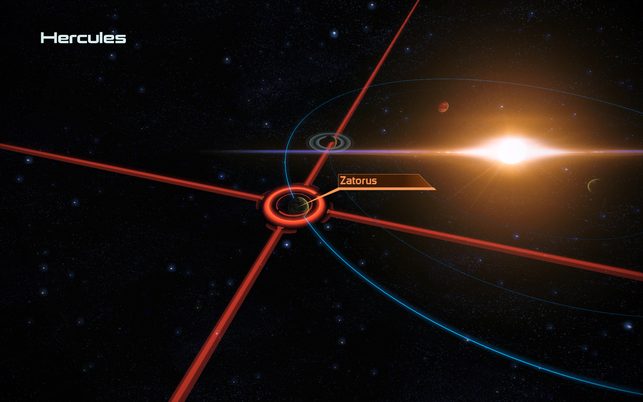
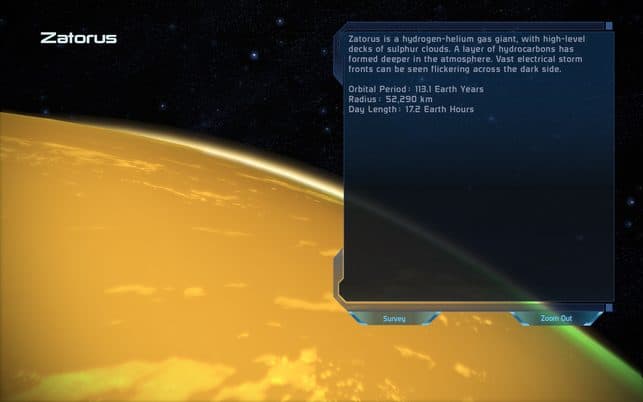
Zatorus is a hydrogen-helium gas giant, with high-level decks of sulphur clouds. A layer of hydrocarbons has formed deeper in the atmosphere. Vast electrical storm fronts can be seen flickering across the dark side.
Orbital Period: 113.1 Earth Years
Radius: 52,290 km
Day Length: 17.2 Earth Hours
THESEUS
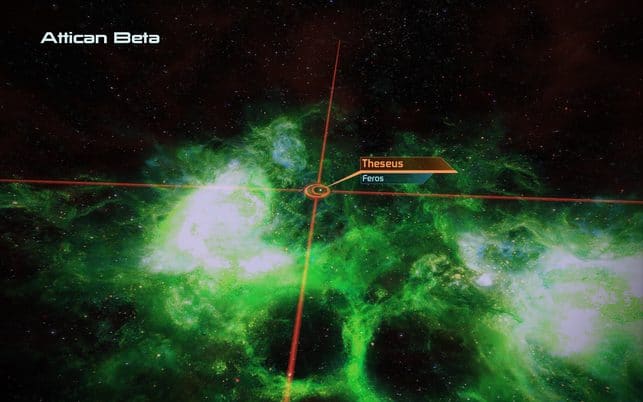
Sytau
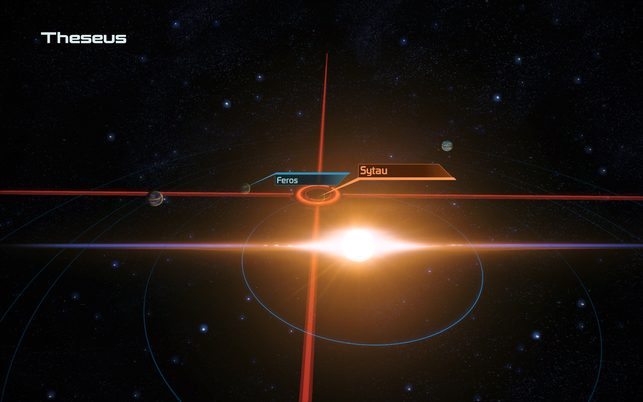
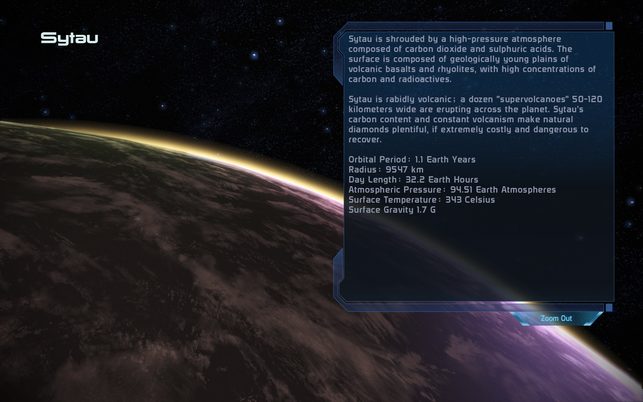
Sytau is shrouded by a high-pressure atmosphere composed of carbon dioxide and sulphuric acids. The surface is composed of geologically young plains of volcanic basalts and rhyolites, with high concentrations of carbon and radioactives.
Sytau is rabidly volcanic; a dozen “supervolcanoes” 50-120 kilometers wide are erupting across the planet. Sytau’s carbon content and constant volcanism make natural diamonds plentiful, if extremely costly and dangerous to recover.
Orbital Period: 1.1 Earth Years Radius 9547 km
Day Length: 32.2 Earth Hours
Atmospheric Pressure: 94.51 Earth Atmospheres
Surface Temperature: 343 Celsius
Surface Gravity 1.7 G
Feros
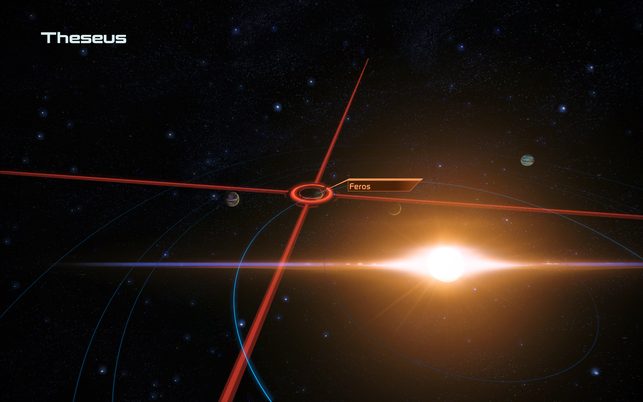
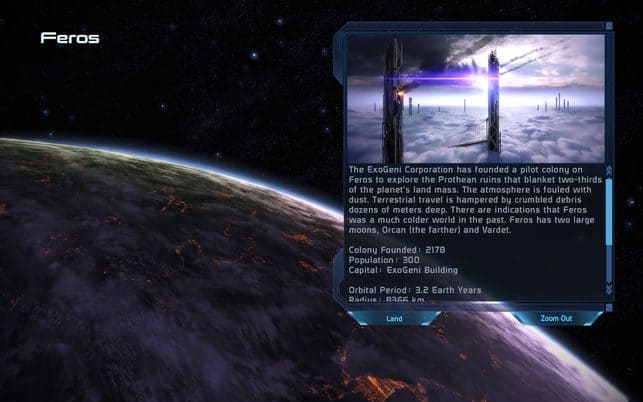
The ExoGeni Corporation has founded a pilot colony on Feros to explore the Prothean ruins that blanket two-thirds of the planet’s land mass. The atmosphere is fouled with dust. Terrestrial travel is hampered by crumbled debris dozens of meters deep. There are indications that Feros was a much colder world in the past. Feros has two large moons, Orcan (the farther) and Vardet.
Colony Founded: 2178 Population: 300
Capital: ExoGeni Building
Orbital Period: 3.2 Earth Years
Radius: 8366 km
Day Length: 30.3 Earth Hours
Atmospheric Pressure: 5.44 Earth Atmospheres
Surface Temperature: 10 Celsius
Surface Gravity: 1.1 G
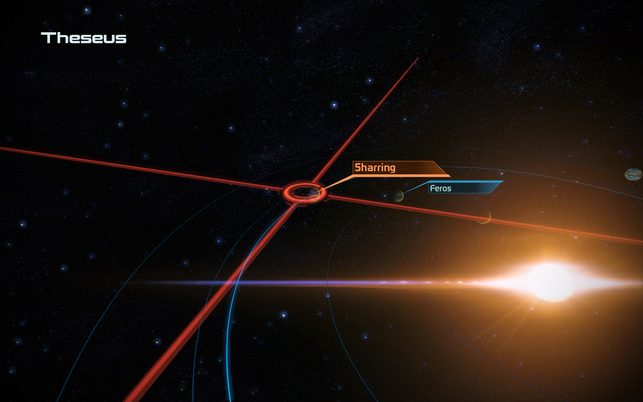
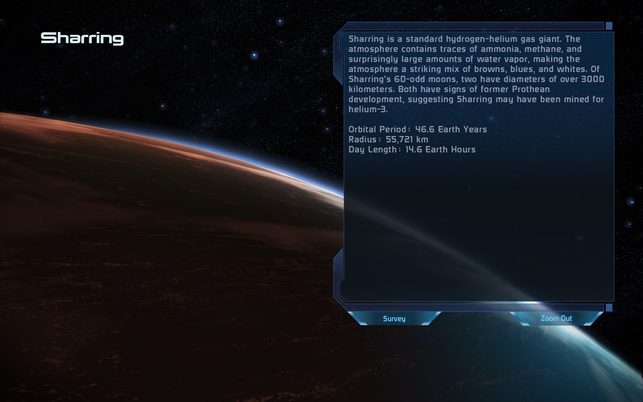
Sharring is a standard hydrogen-helium gas giant. The atmosphere contains traces of ammonia, methane, and surprisingly large amounts of water vapor, making the atmosphere a striking mix of browns, blues, and whites. Of Sharring’s 60-odd moons, two have diameters of over 3000 kilometers. Both have signs of former Prothean
development, suggesting Sharring may have been mined for helium-3.
Orbital Period: 46.6 Earth Years
Radius: 55,721 km
Day Length: 14.6 Earth Hours
Logan
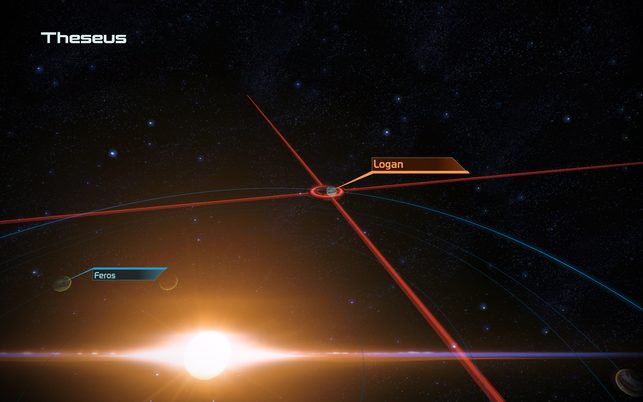
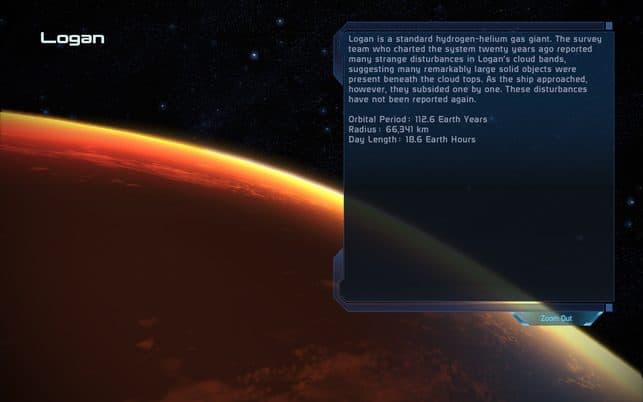
Logan is a standard hydrogen-helium gas giant. The survey team who charted the system twenty years ago reported many strange disturbances in Logan’s cloud bands, suggesting many remarkably large solid objects were present beneath the cloud tops. As the ship approached, however, they subsided one by one. These disturbances have not been reported again.
Orbital Period: 112.6 Earth Years
Radius: 66,341 km
Day Length: 18.6 Earth Hours
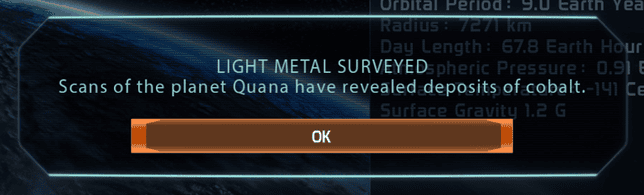
Quana*
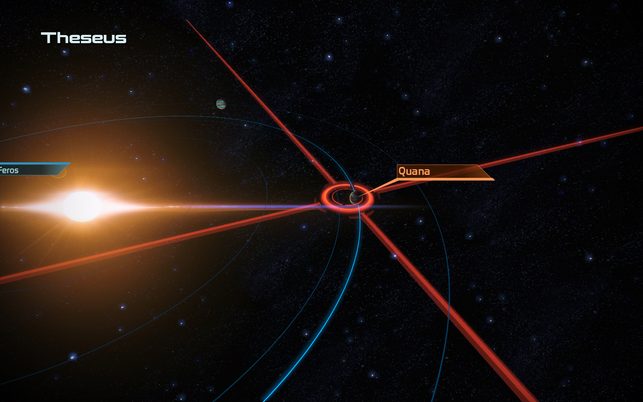
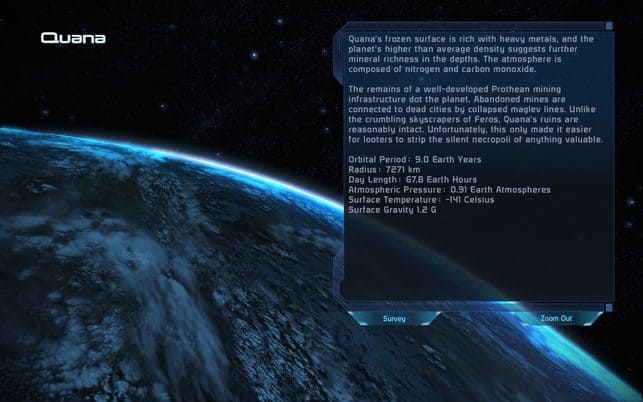
Quana’s frozen surface is rich with heavy metals, and the planet’s higher than average density suggests further mineral richness in the depths. The atmosphere is composed of nitrogen and carbon monoxide.
The remains of a well-developed Prothean mining infrastructure dot the planet. Abandoned mines are connected to dead cities by collapsed maglev lines. Unlike the crumbling skyscrapers of Feros, Quana’s ruins are reasonably intact. Unfortunately, this only made it easier for looters to strip the silent necropoli of anything valuable.
Orbital Period: 9.0 Earth Years
Radius: 7271 km
Day Length: 67.8 Earth Hours
Atmospheric Pressure: 0.91 Earth Atmospheres
Surface Temperature: -141 Celsius
Surface Gravity 1.2 G
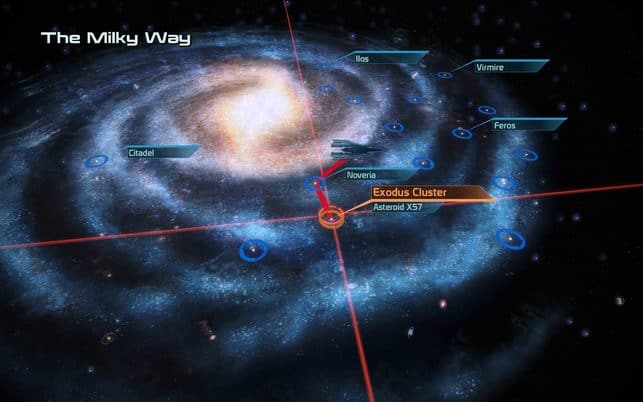
EXODUS CLUSTER
ASGARD
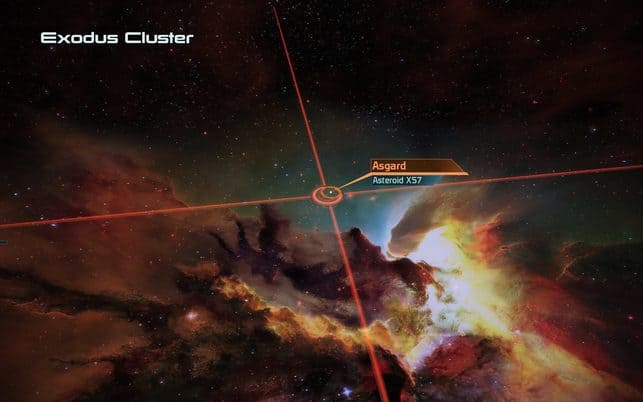
Asteroid X57
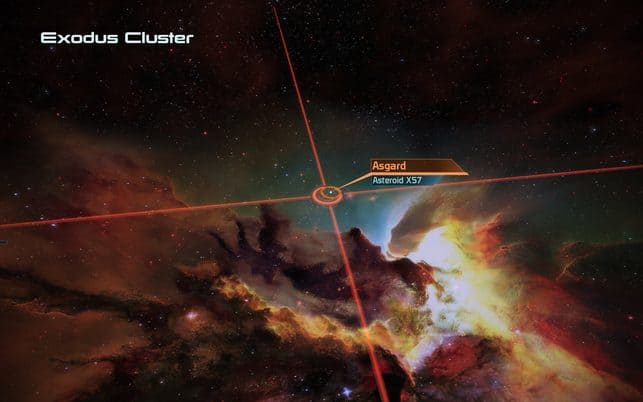
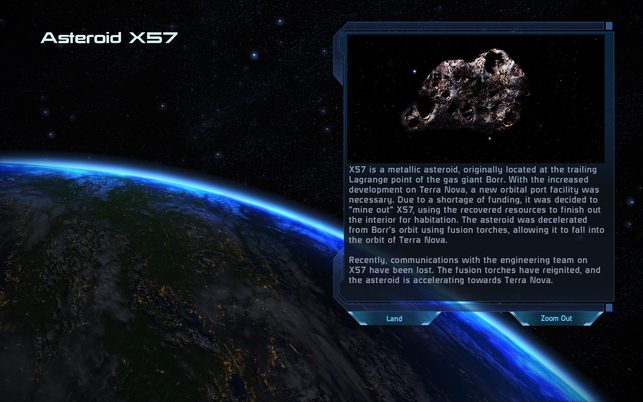
X57 is a metallic asteroid, originally located at the trailing Lagrange point of the gas giant Borr. With the increased development on Terra Nova, a new orbital port facility was necessary. Due to a shortage of funding, it was decided to “mine out” X57, using the recovered resources to finish out the interior for habitation. The asteroid was decelerated from Borr’s orbit using fusion torches, allowing it to fall into the orbit of Terra Nova.
Recently, communications with the engineering team on X57 have been lost. The fusion torches have reignited, and the asteroid is accelerating towards Terra Nova.
Borr
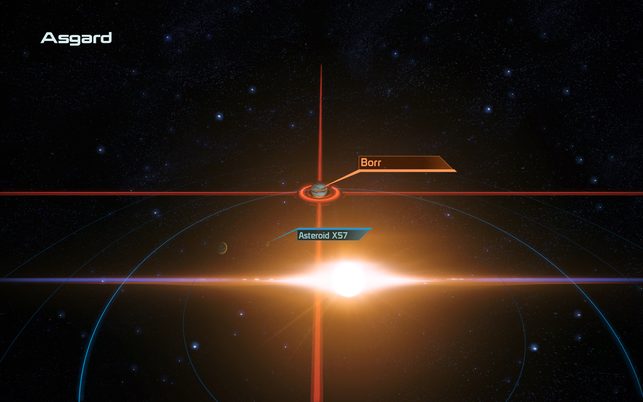
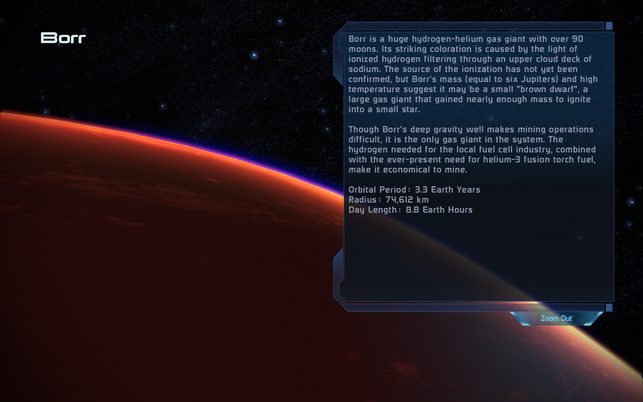
Borr is a huge hydrogen-helium gas giant with over 90 moons. Its striking coloration is caused by the light of ionized hydrogen filtering through an upper cloud deck of sodium. The source of the ionization has not yet been confirmed, but Borr’s mass (equal to six Jupiters) and high temperature suggest it may be a small “brown dwarf”, a large gas giant that gained nearly enough mass to ignite into a small star.
Though Borr’s deep gravity well makes mining operations difficult, it is the only gas giant in the system. The hydrogen needed for the local fuel cell industry, combined with the ever-present need for helium-3 fusion torch fuel, make it economical to mine.
Orbital Period: 3.3 Earth Years
Radius: 74,612 km
Day Length: 8.8 Earth Hours
Terra Nova
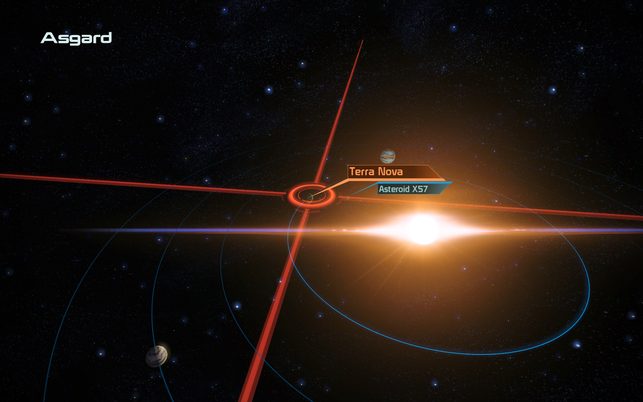
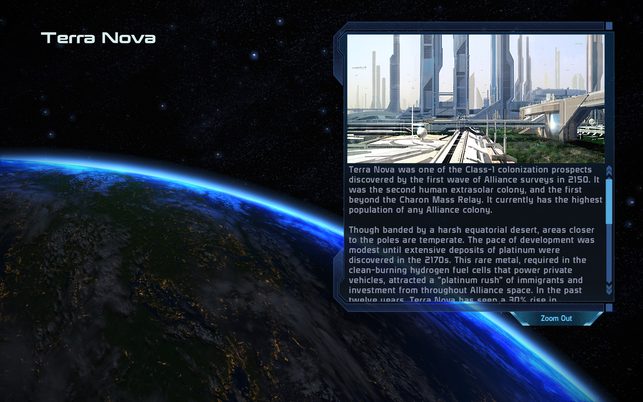
Terra Nova was one of the Class-1 colonization prospects discovered by the first wave of Alliance surveys in 2150. It was the second human extrasolar colony, and the first beyond the Charon Mass Relay. It currently has the highest population of any Alliance colony.
Though banded by a harsh equatorial desert, areas closer to the poles are temperate. The pace of development was modest until extensive deposits of platinum were discovered in the 2170s. This rare metal, required in the clean-burning hydrogen fuel cells that power private vehicles, attracted a “platinum rush” of immigrants and investment from throughout Alliance space. In the past twelve years, Terra Nova has seen a 30% rise in population, and growth does not appear to be slowing.
Colony Founded: 2152
Population: 4.4 million Capital: Scott
Orbital Period: 1.5 Earth Years
Radius: 5261 km
Day Length: 37.3 Earth Hours
Atmospheric Pressure: 0.91 Earth Atmospheres
Surface Temperature: 56 Celsius
Surface Gravity: 0.95 G
Tyr
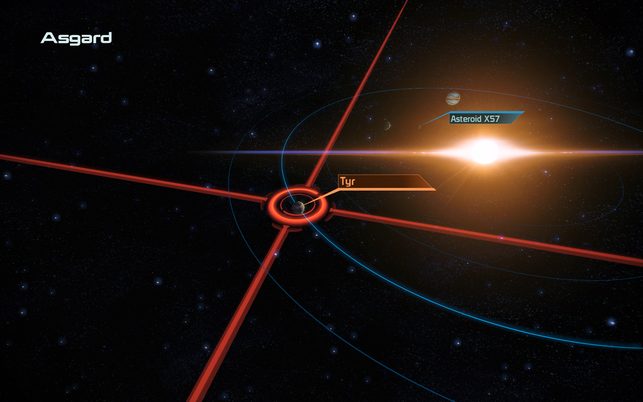
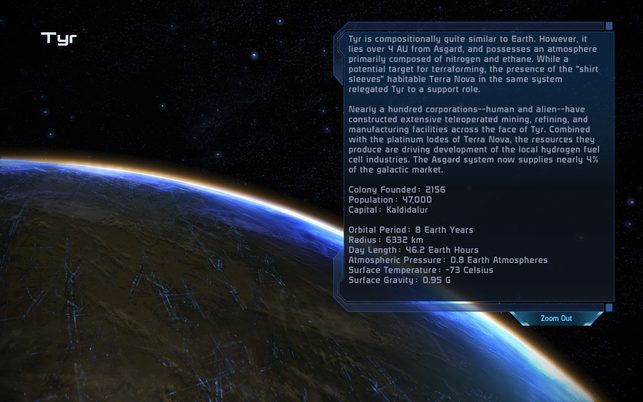
Tyr is compositionally quite similar to Earth. However, it lies over 4 AU from Asgard, and possesses an atmosphere primarily composed of nitrogen and ethane. While a potential target for terraforming, the presence of the “shirt sleeves” habitable Terra Nova in the same system relegated Tyr to a support role.
Nearly a hundred corporations–human and alien–have constructed extensive teleoperated mining, refining, and manufacturing facilities across the face of Tyr. Combined with the platinum lodes of Terra Nova, the resources they produce are driving development of the local hydrogen fuel cell industries. The Asgard system now supplies nearly 4% of the galactic market.
Colony Founded: 2156
Population: 47,000
Capital: Kaldidalur
Orbital Period: 8 Earth Years
Radius: 6332 km
Day Length: 46.2 Earth Hours
Atmospheric Pressure: 0.8 Earth Atmospheres
Surface Temperature: -73 Celsius
Surface Gravity: 0.95 G
Loki
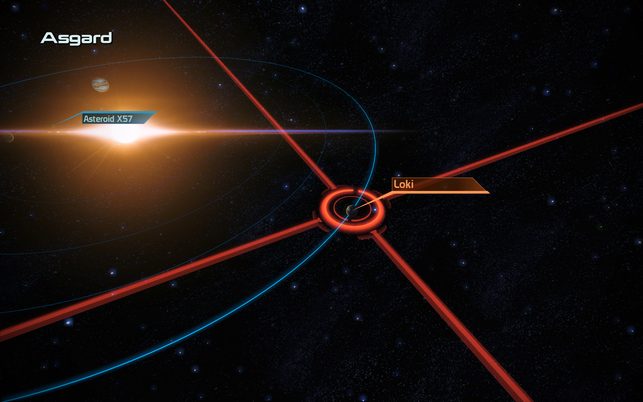
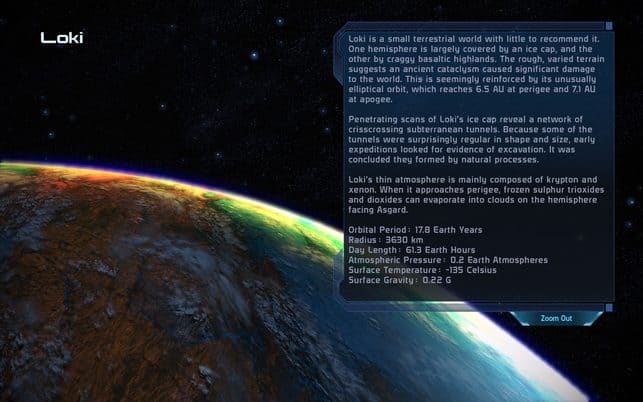
Loki is a small terrestrial world with little to recommend it. One hemisphere is largely covered by an ice cap, and the other by craggy basaltic highlands. The rough, varied terrain suggests an ancient cataclysm caused significant damage to the world. This is seemingly reinforced by its unusually elliptical orbit, which reaches 6.5 AU at perigee and 7.1 AU at apogee.
Penetrating scans of Loki’s ice cap reveal a network of crisscrossing subterranean tunnels. Because some of the tunnels were surprisingly regular in shape and size, early expeditions looked for evidence of excavation. It was concluded they formed by natural processes.
Loki’s thin atmosphere is mainly composed of krypton and xenon. When it approaches perigee, frozen sulphur trioxides and dioxides can evaporate into clouds on the hemisphere facing Asgard.
Orbital Period: 17.8 Earth Years
Radius: 3630 km
Day Length: 61.3 Earth Hours
Atmospheric Pressure: 0.2 Earth Atmospheres
Surface Temperature: -135 Celsius
Surface Gravity: 0.22 G
UTOPIA
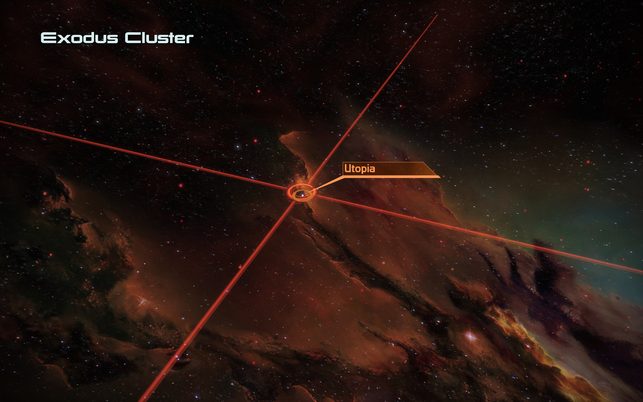
Arcadia
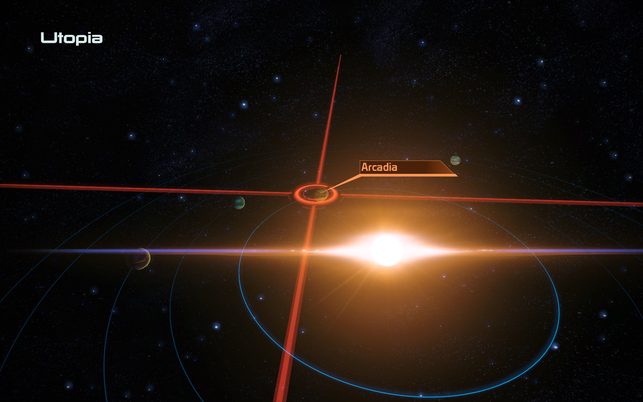
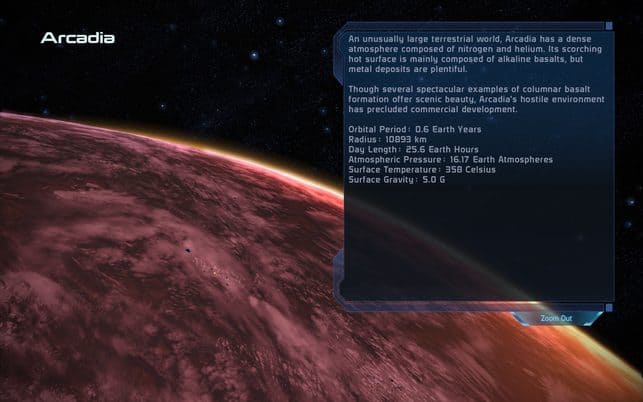
An unusually large terrestrial world, Arcadia has a dense atmosphere composed of nitrogen and helium. Its scorching hot surface is mainly composed of alkaline basalts, but metal deposits are plentiful.
Though several spectacular examples of columnar basalt formation offer scenic beauty, Arcadia’s hostile environment has precluded commercial development.
Orbital Period: 0.6 Earth Years
Radius: 10893 km
Day Length: 25.6 Earth Hours
Atmospheric Pressure: 16.17 Earth Atmospheres
Surface Temperature: 358 Celsius
Surface Gravity: 5.0 G
Eden Prime
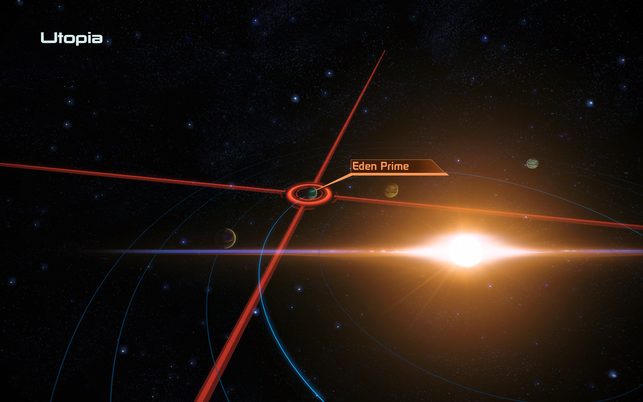
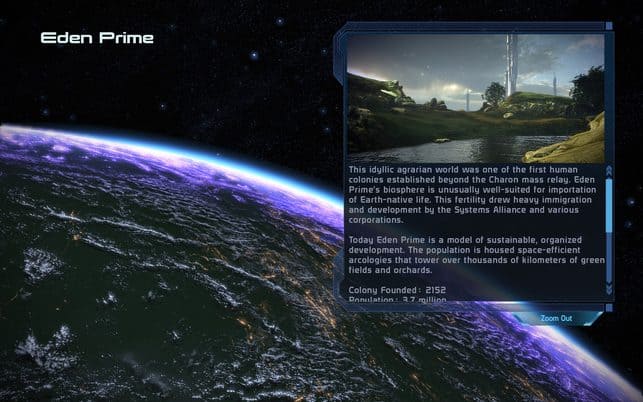
This idyllic agrarian world was one of the first human colonies established beyond the Charon mass relay. Eden Prime’s biosphere is unusually well-suited for importation of Earth-native life. This fertility drew heavy immigration and development by the Systems Alliance and various corporations.
Today Eden Prime is a model of sustainable, organized development. The population is housed space-efficient arcologies that tower over thousands of kilometers of green fields and orchards.
Colony Founded: 2152
Population: 3.7 million
Capital: Constant
Orbital Period: 2.5 Earth Years
Radius: 7026 km
Day Length: 64.1 Earth Hours
Atmospheric Pressure: 1.45 Earth Atmospheres
Surface Temperature: 23 Celsius
Surface Gravity: 1.04 G
Zion
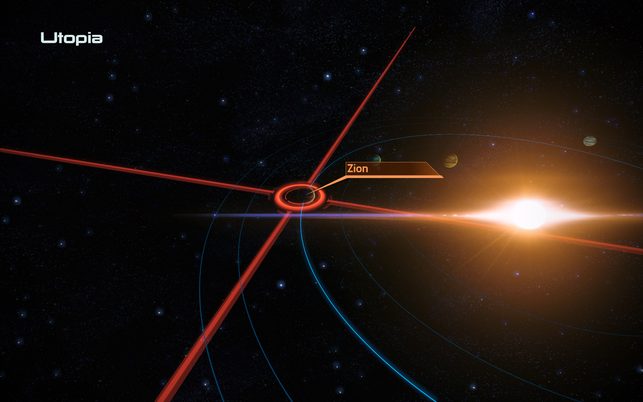
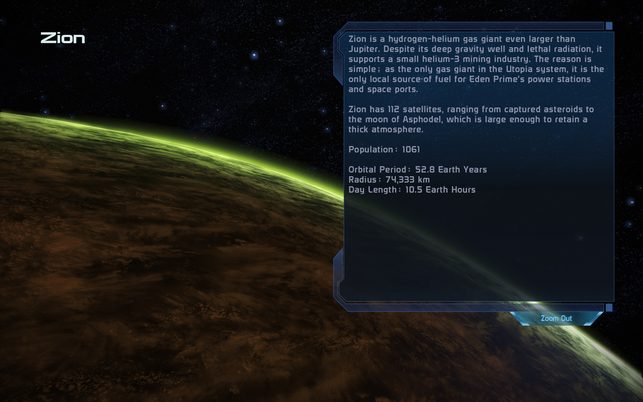
Zion is a hydrogen-helium gas giant even larger than Jupiter. Despite its deep gravity well and lethal radiation, it supports a small helium-3 mining industry. The reason is simple; as the only gas giant in the Utopia system, it is the only local source of fuel for Eden Prime’s power stations and space ports.
Zion has 112 satellites, ranging from captured asteroids to the moon of Asphodel, which is large enough to retain a thick atmosphere.
Population: 1061
Orbital Period: 52.8 Earth Years
Radius: 74,333 km
Day Length: 10.5 Earth Hours
Nirvana
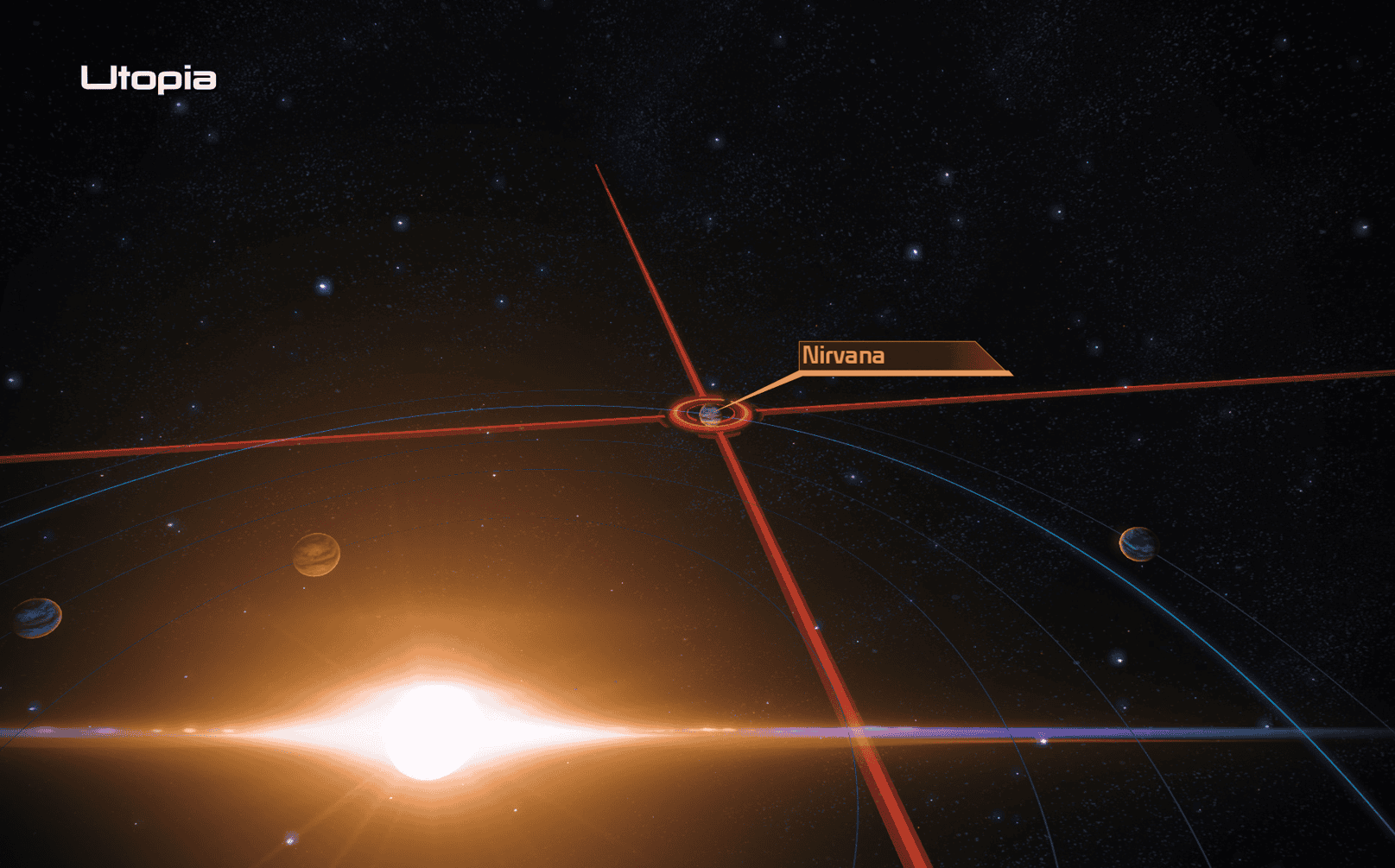
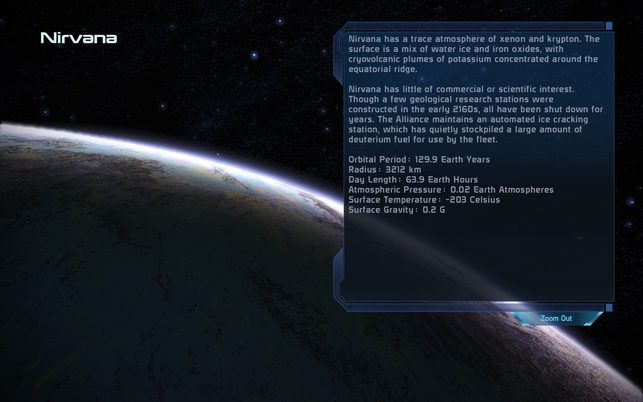
Nirvana has a trace atmosphere of xenon and krypton. The surface is a mix of water ice and iron oxides, with cryovolcanic plumes of potassium concentrated around the equatorial ridge.
Nirvana has little of commercial or scientific interest. Though a few geological research stations were constructed in the early 2160s, all have been shut down for years. The Alliance maintains an automated ice cracking station, which has quietly stockpiled a large amount of deuterium fuel for use by the fleet.
Orbital Period: 129.9 Earth Years
Radius: 3212 km
Day Length: 63.9 Earth Hours
Atmospheric Pressure: 0.02 Earth Atmospheres
Surface Temperature: -203 Celsius
Surface Gravity: 0.2 G
Xanada
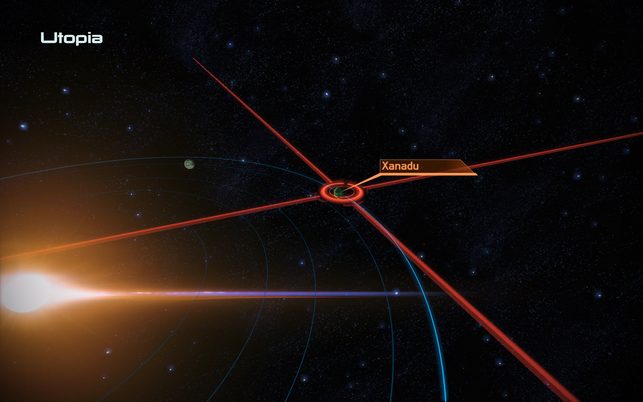
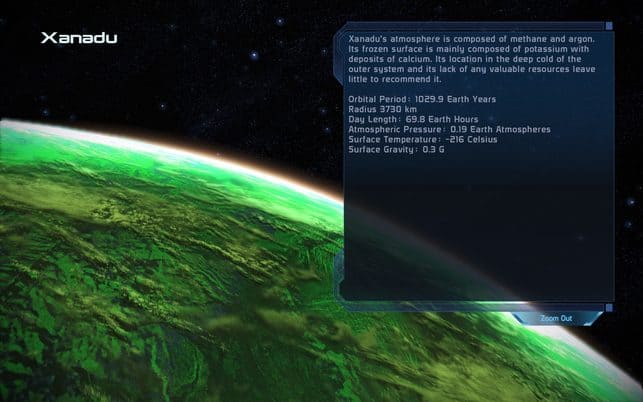
Xanadu’s atmosphere is composed of methane and argon. Its frozen surface is mainly composed of potassium with deposits of calcium. Its location in the deep cold of the outer system and its lack of any valuable resources leave little to recommend it.
Orbital Period: 1029.9 Earth Years
Radius 3730 km
Day Length: 69.8 Earth Hours
Atmospheric Pressure: 0.19 Earth Atmospheres
Surface Temperature: -216 Celsius
Surface Gravity: 0.3 G
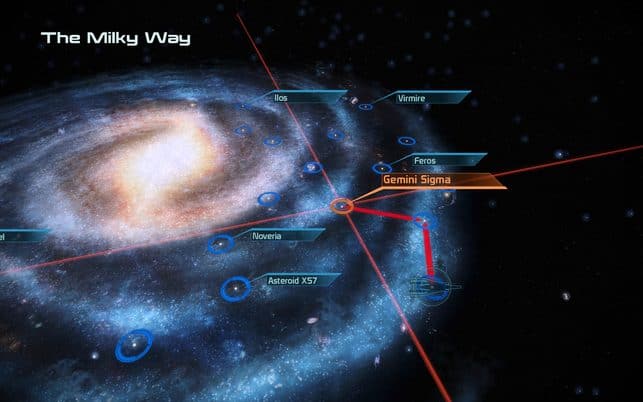
GEMINI SIGMA
HAN
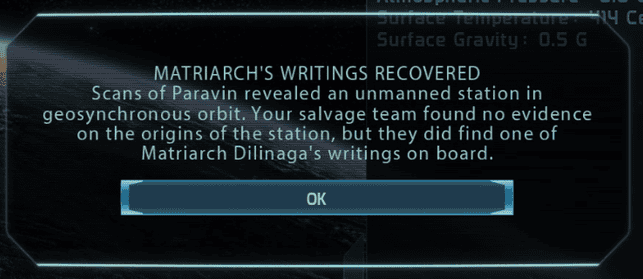
Paravin*
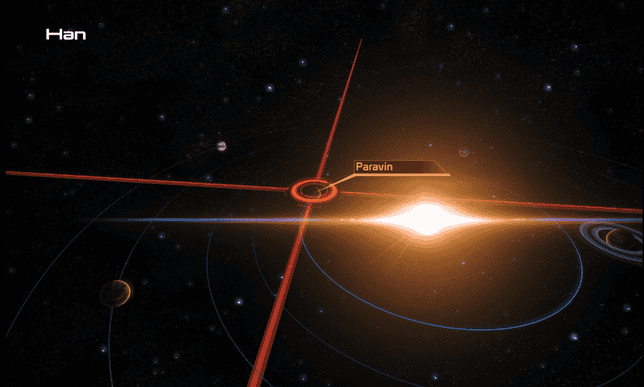
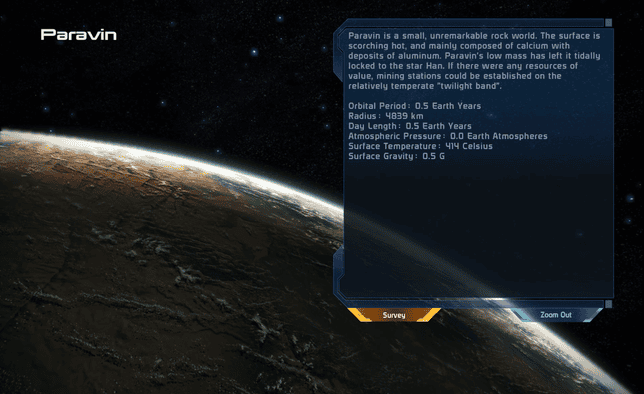
Paravin is a small, unremarkable rock world. The surface is scorching hot, and mainly composed of calcium with deposits of aluminum. Paravin’s low mass has left it tidally locked to the star Han. If there were any resources of value, mining stations could be established on the relatively temperate “twilight band”.
Orbital Period: 0.5 Earth Years
Radius: 4839 km
Day Length: 0.5 Earth Years
Atmospheric Pressure: 0.0 Earth Atmospheres
Surface Temperature: 414 Celsius
Surface Gravity: 0.5 G
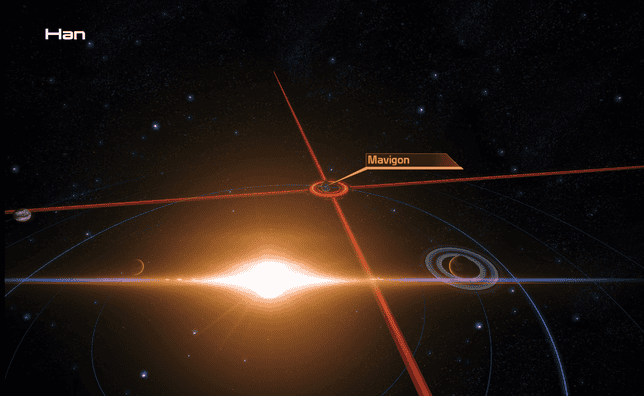
Mavigon
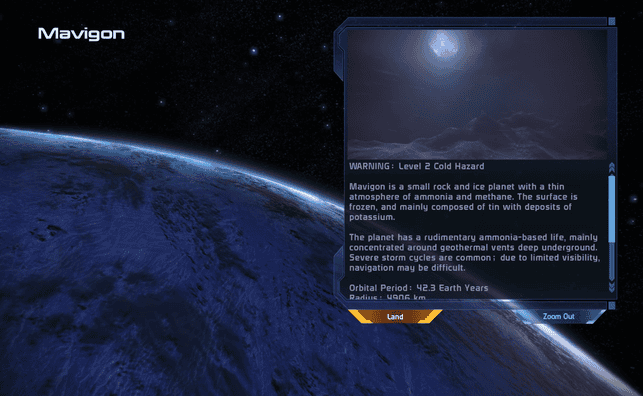
WARNING: Level 2 Cold Hazard
Mavigon is a small rock and ice planet with a thin atmosphere of ammonia and methane. The surface is frozen, and mainly composed of tin with deposits of potassium.
The planet has a rudimentary ammonia-based life, mainly concentrated around geothermal vents deep underground. Severe storm cycles are common; due to limited visibility, navigation may be difficult.
Orbital Period: 42.3 Earth Years
Radius: 4906 km
Day Length: 52.0 Earth Hours
Atmospheric Pressure: 0.82 Earth Atmospheres
Surface Temperature: -124 Celsius
Surface Gravity: 0.8 G
Patatanlis*
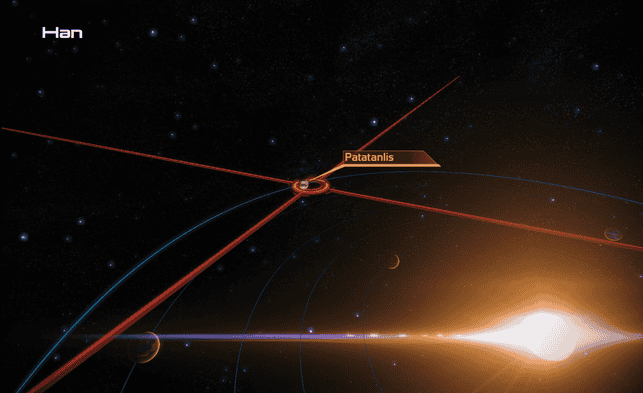
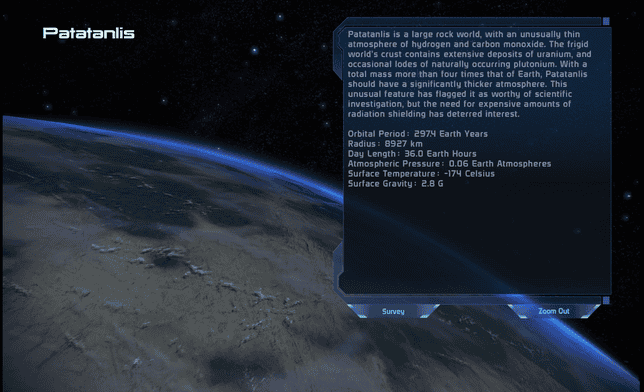
Patatanlis is a large rock world, with an unusually thin atmosphere of hydrogen and carbon monoxide. The frigid world’s crust contains extensive deposits of uranium, and occasional lodes of naturally occurring plutonium. With a total mass more than four times that of Earth, Patatanlis should have a significantly thicker atmosphere. This unusual feature has flagged it as worthy of scientific investigation, but the need for expensive amounts of radiation shielding has deterred interest.
Orbital Period: 2974 Earth Years
Radius: 8927 km
Day Length: 36.0 Earth Hours
Atmospheric Pressure: 0.06 Earth Atmospheres
Surface Temperature: -174 Celsius
Surface Gravity: 2.8 G
Farcrothu
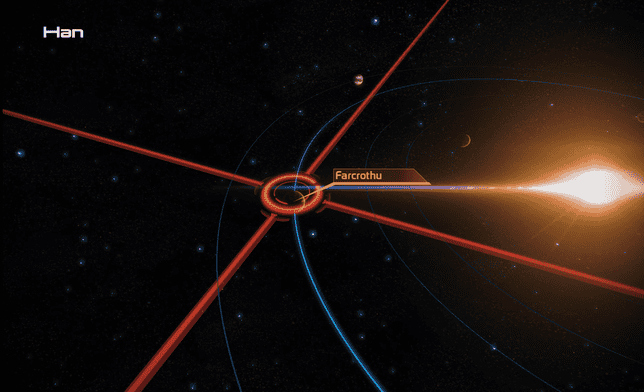
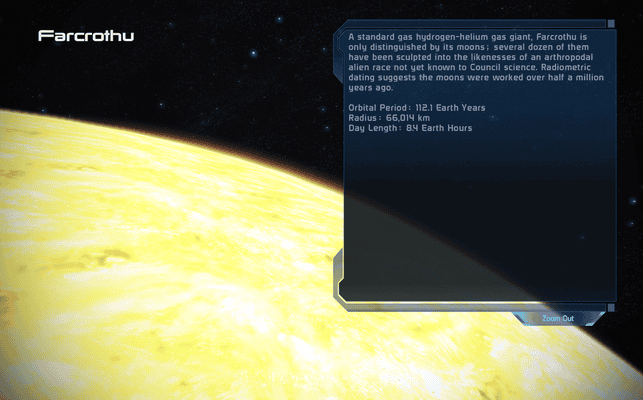
A standard gas hydrogen-helium gas giant, Farcrothu is only distinguished by its moons; several dozen of them have been sculpted into the likenesses of an arthropodal alien race not yet known to Council science. Radiometric dating suggests the moons were worked over half a million years ago.
Orbital Period: 112.1 Earth Years
Radius: 66,014 km
Day Length: 8.4 Earth Hours
Huningto
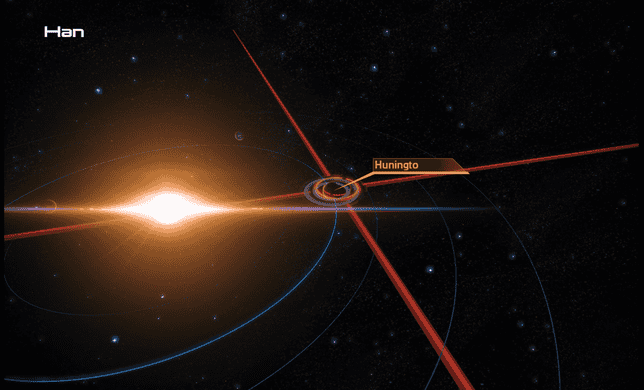
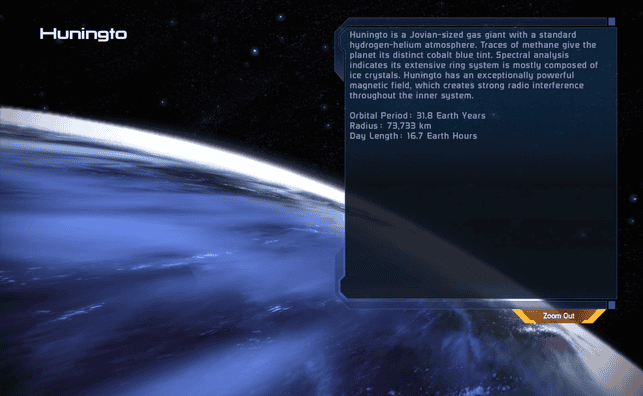
Huningto is a Jovian-sized gas giant with a standard hydrogen-helium atmosphere. Traces of methane give the planet its distinct cobalt blue tint. Spectral analysis indicates its extensive ring system is mostly composed of ice crystals. Huningto has an exceptionally powerful magnetic field, which creates strong radio interference throughout the inner system.
Orbital Period: 31.8 Earth Years
Radius: 73,733 km
Day Length: 16.7 Earth Hours
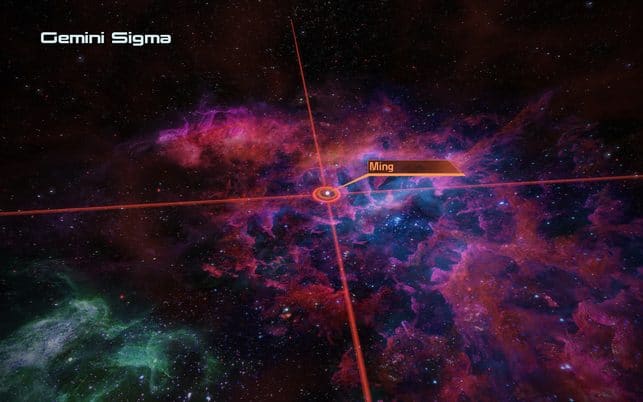
MING
Antiroprus
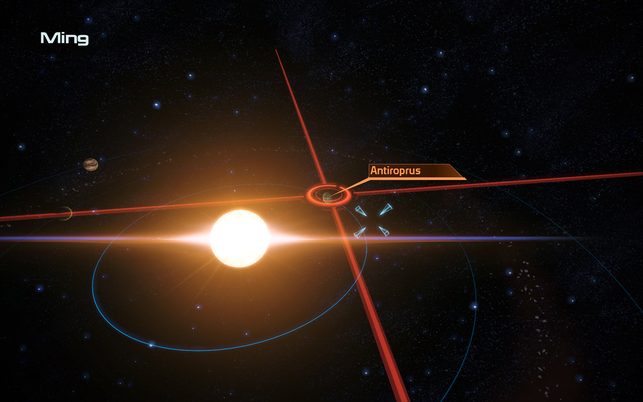
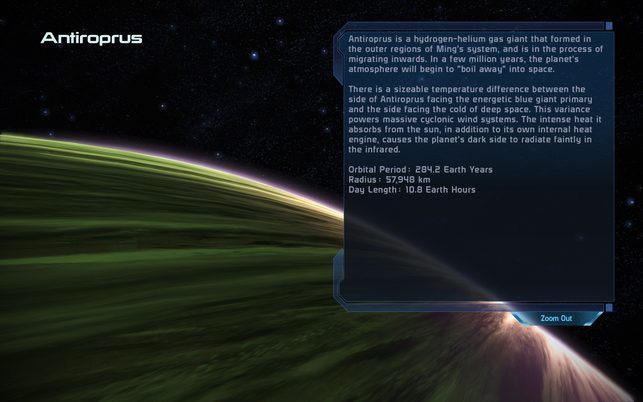
Antiroprus is a hydrogen-helium gas giant that formed in the outer regions of Ming’s system, and is in the process of migrating inwards. In a few million years, the planet’s atmosphere will begin to “boil away” into space.
There is a sizeable temperature difference between the side of Antiroprus facing the energetic blue giant primary and the side facing the cold of deep space. This variance powers massive cyclonic wind systems. The intense heat it absorbs from the sun, in addition to its own internal heat engine, causes the planet’s dark side to radiate faintly in the infrared.
Orbital Period: 284.2 Earth Years
Radius: 57,948 km
Day Length: 10.8 Earth Hours
MSV Worthington
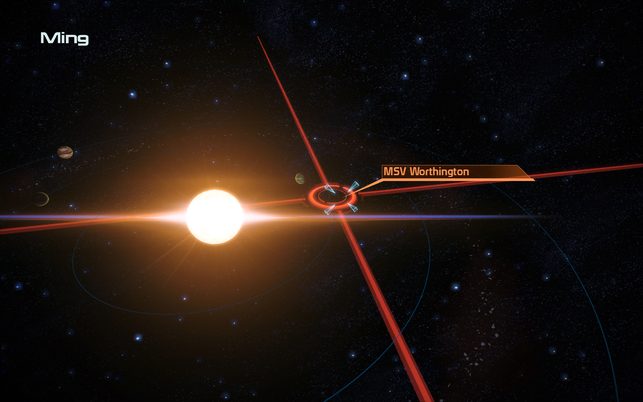
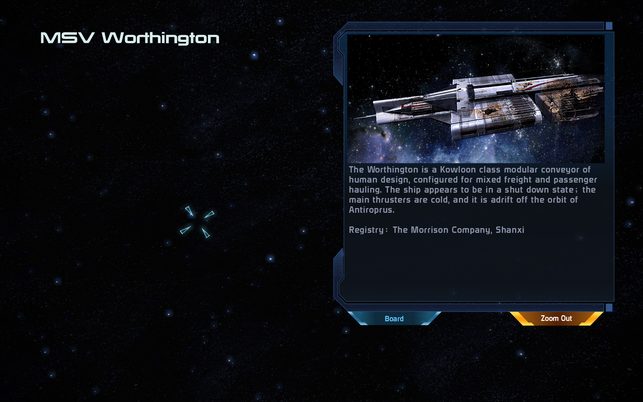
The Worthington is a Kowloon class modular conveyor of human design, configured for mixed freight and passenger hauling. The ship appears to be in a shut down state; the main thrusters are cold, and it is adrift off the orbit of Antiroprus.
Registry: The Morrison Company, Shanxi
Altanorch*
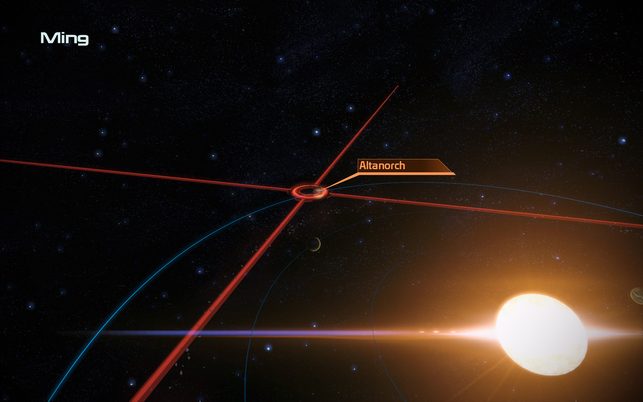
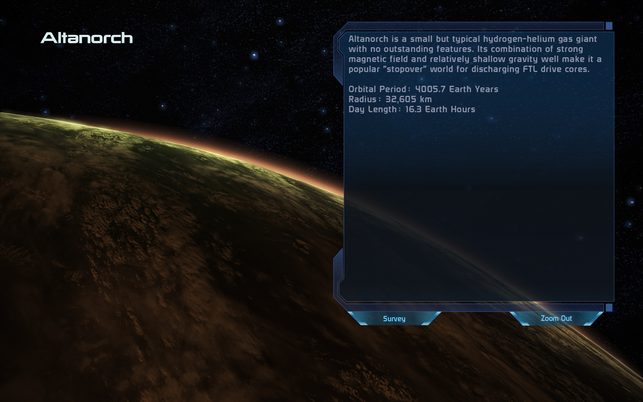
Altanorch is a small but typical hydrogen-helium gas giant with no outstanding features. Its combination of strong magnetic field and relatively shallow gravity well make it a popular “stopover” world for discharging FTL drive cores.
Orbital Period: 4005.7 Earth Years
Radius: 32,605 km
Day Length: 16.3 Earth Hours
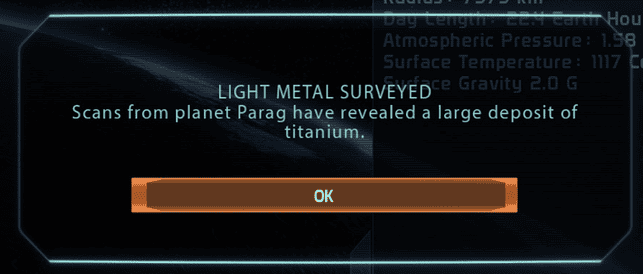
Parag*
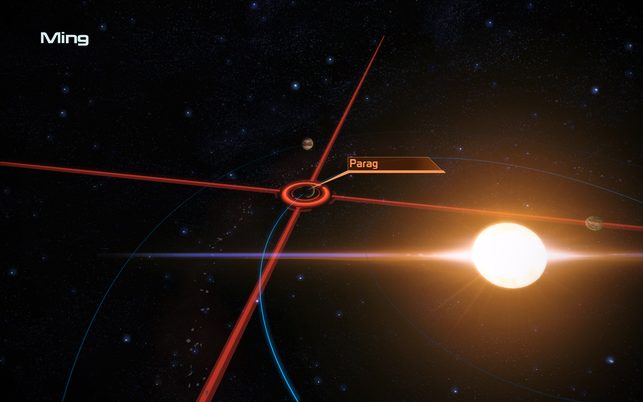
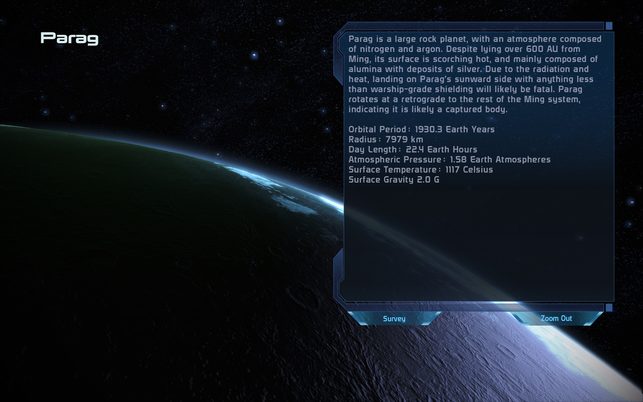
Parag is a large rock planet, with an atmosphere composed of nitrogen and argon. Despite lying over 600 AU from Ming, its surface is scorching hot, and mainly composed of alumina with deposits of silver. Due to the radiation and heat, landing on Parag’s sunward side with anything less than warship-grade shielding will likely be fatal. Parag rotates at a retrograde to the rest of the Ming system, indicating it is likely a captured body.
Orbital Period: 1930.3 Earth Years
Radius: 7979 km
Day Length: 22.4 Earth Hours
Atmospheric Pressure: 1.58 Earth Atmospheres
Surface Temperature: 1117 Celsius
Surface Gravity 2.0 G
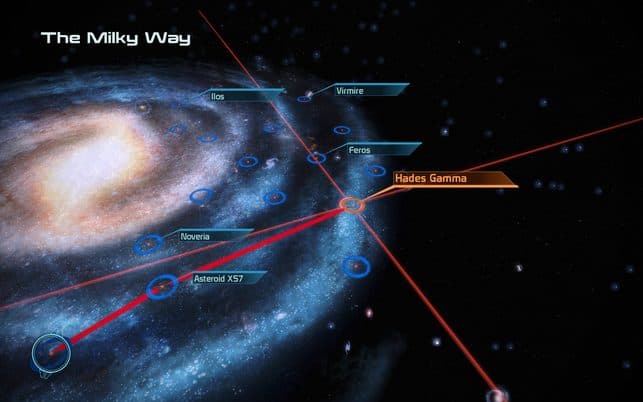
HADES GEMMA
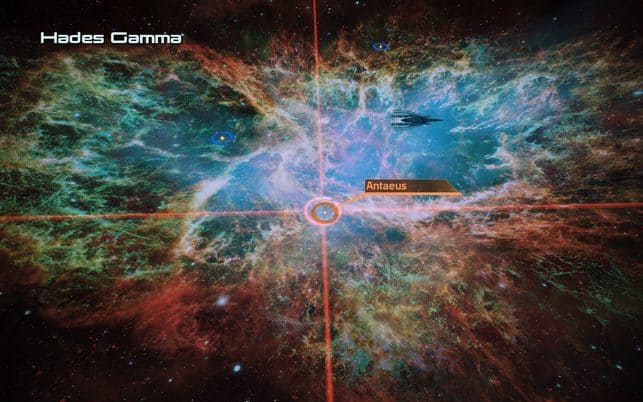
ANTEUS
Ageko
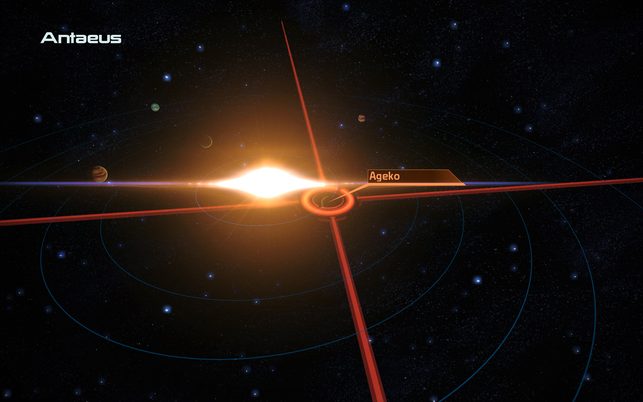
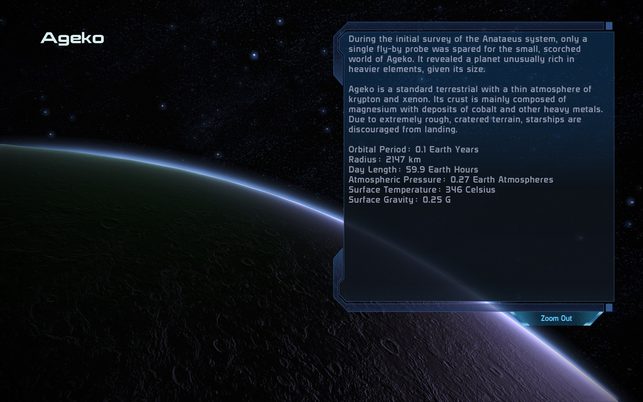
During the initial survey of the Anataeus system, only a single fly-by probe was spared for the small, scorched world of Ageko. It revealed a planet unusually rich in heavier elements, given its size:
Ageko is a standard terrestrial with a thin atmosphere of krypton and xenon. Its crust is mainly composed of magnesium with deposits of cobalt and other heavy metals. Due to extremely rough, cratered terrain, starships are discouraged from landing.
Orbital Period: 0.1 Earth Years
Radius: 2147 km
Day Length: 59.9 Earth Hours
Atmospheric Pressure: 0.27 Earth Atmospheres
Surface Temperature: 346 Celsius
Surface Gravity: 0.25 G
Trebin
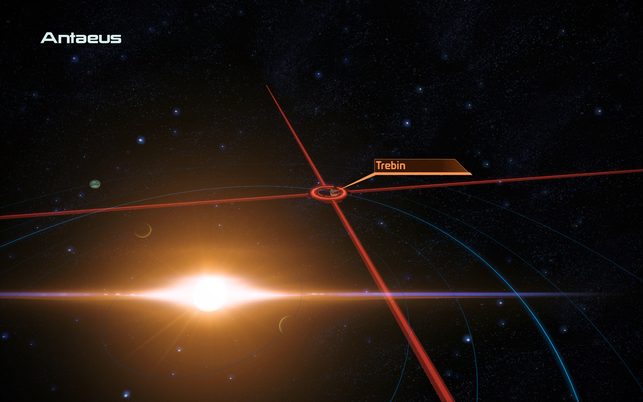
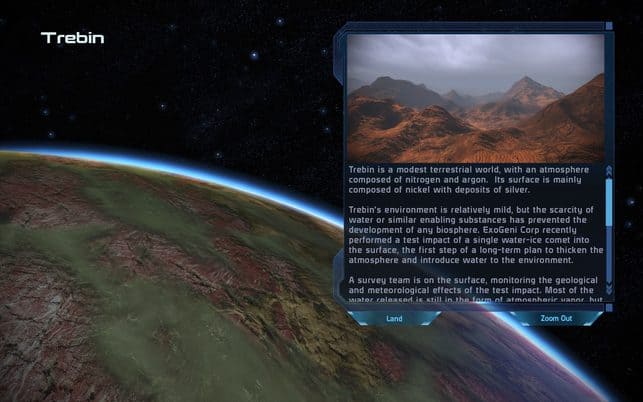
Trebin is a modest terrestrial world, with an atmosphere composed of nitrogen and argon. Its surface is mainly composed of nickel with deposits of silver.
Trebin’s environment is relatively mild, but the scarcity of water or similar enabling substances has prevented the development of any biosphere. ExoGeni Corp recently performed a test impact of a single water-ice comet into the surface, the first step of a long-term plan to thicken the atmosphere and introduce water to the environment.
A survey team is on the surface, monitoring the geological and meteorological effects of the test impact. Most of the water released is still in the form of atmospheric vapor, but thick cloud banks have formed. There is every indication that this arid world will soon see its first rain. The survey team’s progress has been hampered by frequent mechanical or computer failures in their GPS satellites.
Orbital Period: 1.1 Earth Years
Radius: 5489 km
Day Length: 41.8 Earth Hours
Atmospheric Pressure: 0.84 Earth Atmospheres
Surface Temperature: 8 Celsius
Surface Gravity: 0.86 G
Edmos*
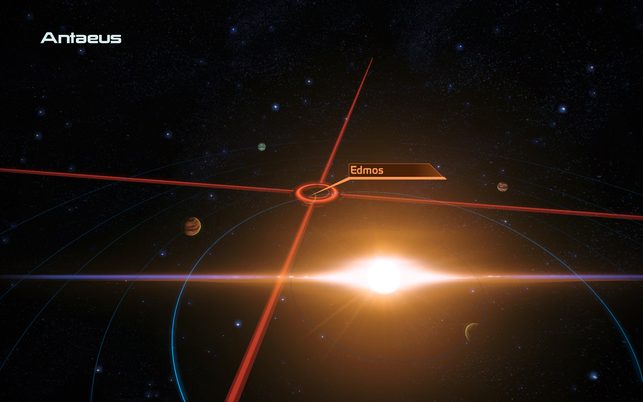
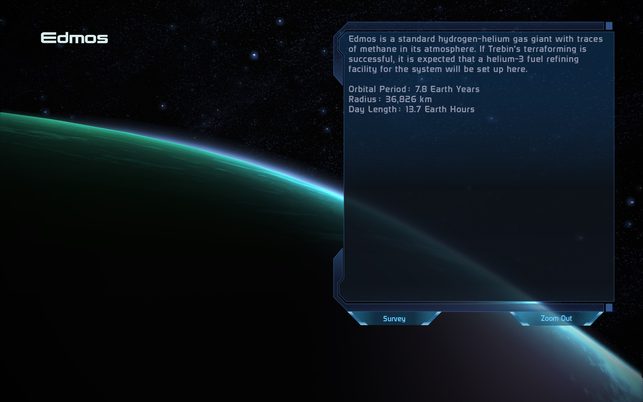
Edmos is a standard hydrogen-helium gas giant with traces of methane in its atmosphere. If Trebin’s terraforming is successful, it is expected that a helium-3 fuel refining facility for the system will be set up here.
Orbital Period: 7.8 Earth Years
Radius: 36,826 km
Day Length: 13.7 Earth Hours
Hunidor
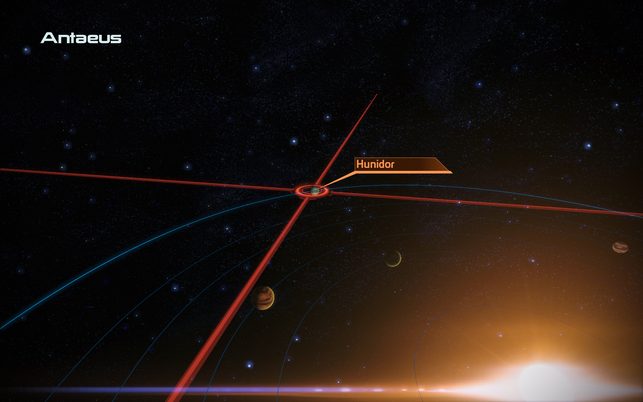
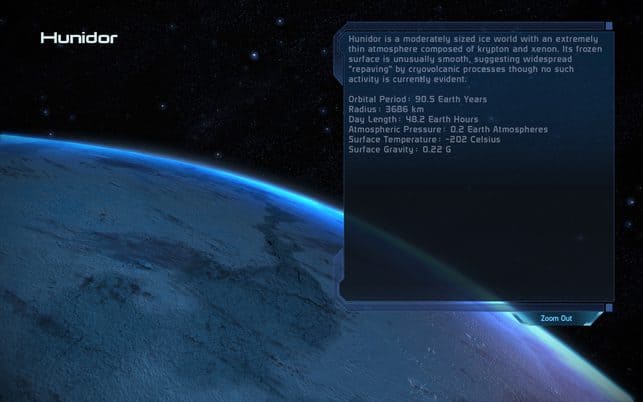
Hunidor is a moderately sized ice world with an extremely thin atmosphere composed of krypton and xenon. Its frozen surface is unusually smooth, suggesting widespread “repaving” by cryovolcanic processes though no such activity is currently evident.
Orbital Period: 90.5 Earth Years
Radius: 3686 km
Day Length: 48.2 Earth Hours
Atmospheric Pressure: 0.2 Earth Atmospheres
Surface Temperature: -202 Celsius
Surface Gravity: 0.22 G
Ploba*
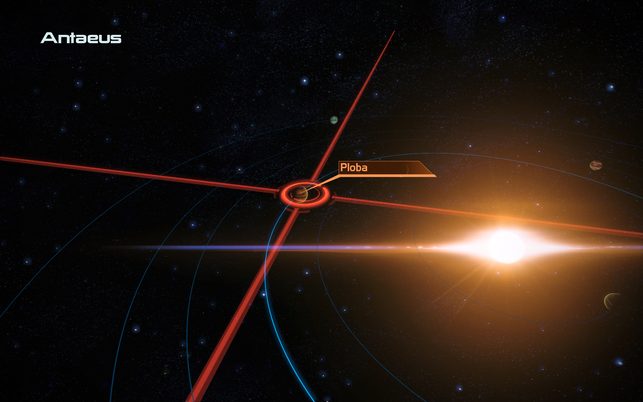
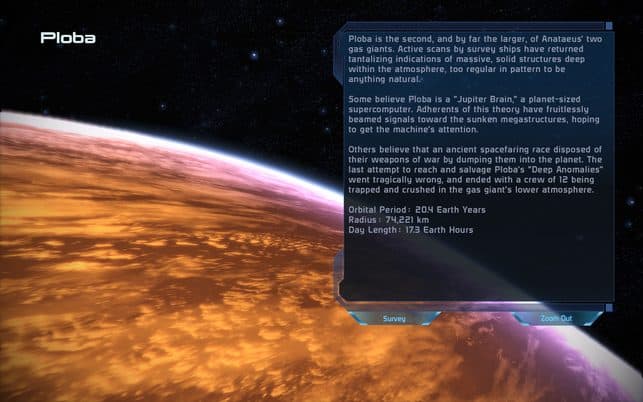
Ploba is the second, and by far the larger, of Anataeus’ two gas giants. Active scans by survey ships have returned tantalizing indications of massive, solid structures deep within the atmosphere, too regular in pattern to be anything natural.
Some believe Ploba is a “Jupiter Brain,” a planet-sized supercomputer. Adherents of this theory have fruitlessly beamed signals toward the sunken megastructures, hoping to get the machine’s attention.
Others believe that an ancient spacefaring race disposed of their weapons of war by dumping them into the planet. The last attempt to reach and salvage Ploba’s “Deep Anomalies” went tragically wrong, and ended with a crew of 12 being trapped and crushed in the gas giant’s lower atmosphere.
Orbital Period: 20.4 Earth Years
Radius: 74,221 km
Day Length: 17.3 Earth Hours
Vemal*
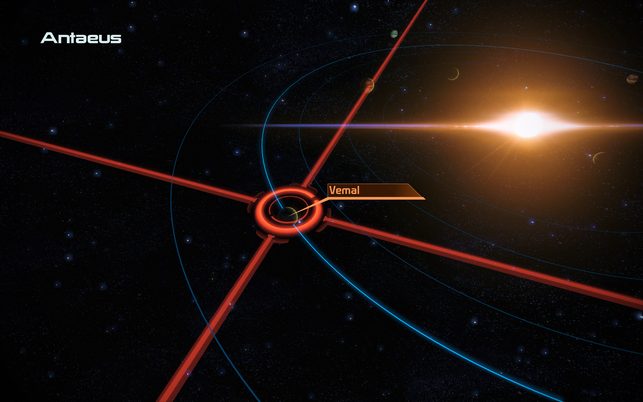
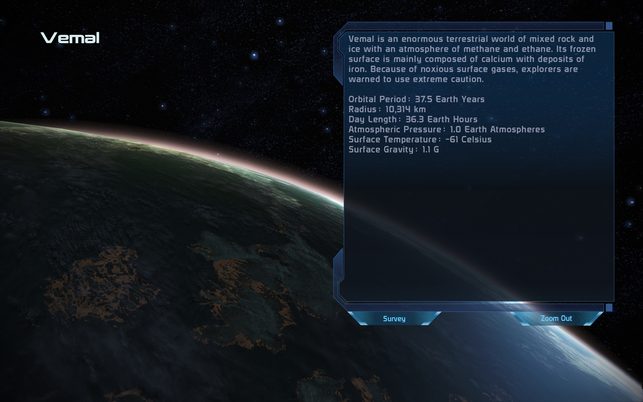
Vemal is an enormous terrestrial world of mixed rock and ice with an atmosphere of methane and ethane. Its frozen surface is mainly composed of calcium with deposits of iron. Because of noxious surface gases, explorers are warned to use extreme caution.
Orbital Period: 37.5 Earth Years
Radius: 10,314 km
Day Length: 36.3 Earth Hours
Atmospheric Pressure: 1.0 Earth Atmospheres
Surface Temperature: -61 Celsius
Surface Gravity: 1.1 G
CACUS
Chohe
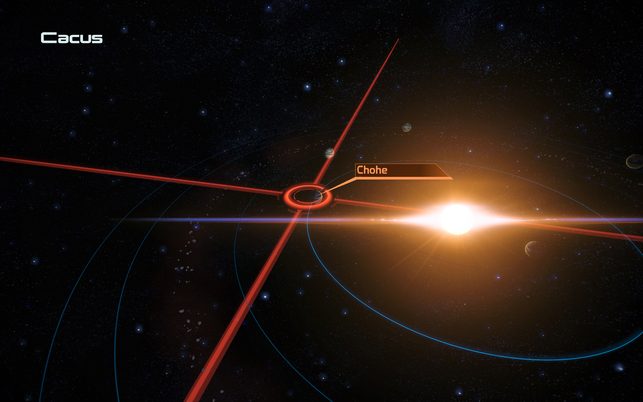
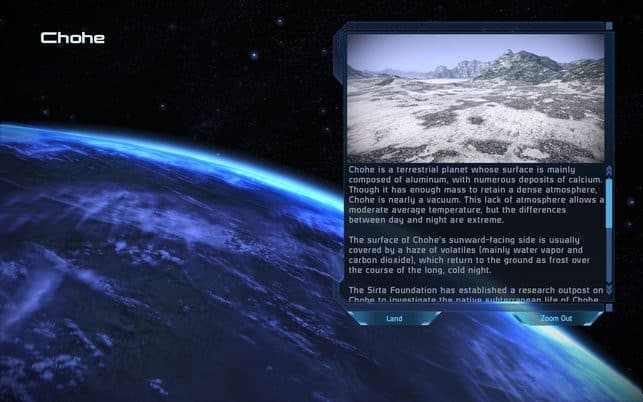
Chohe is a terrestrial planet whose surface is mainly composed of aluminum, with numerous deposits of calcium. Though it has enough mass to retain a dense atmosphere, Chohe is nearly a vacuum. This lack of atmosphere allows a moderate average temperature, but the differences between day and night are extreme.
The surface of Chohe’s sunward-facing side is usually covered by a haze of volatiles (mainly water vapor and carbon dioxide), which return to the ground as frost over the course of the long, cold night.
The Sirta Foundation has established a research outpost on Chohe to investigate the native subterranean life of Chohe, which shows incredible resilience to extremes of heat and cold.
Orbital Distance: 3.7 AU
Orbital Period: 5.4 Earth Years
Radius: 8000 km
Day Length: 54.5 Earth Hours
Atmospheric Pressure: 0.00 Earth Atmospheres
Surface Temperature: 11 Celsius
Surface Gravity: 1.0 G
Xamarri
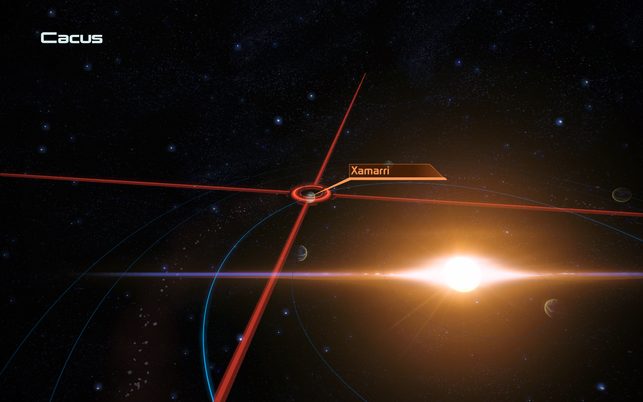
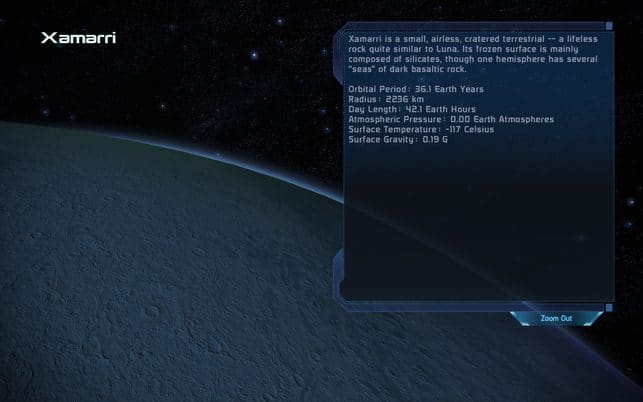
Xamarri is a small, airless, cratered terrestrial — a lifeless rock quite similar to Luna. Its frozen surface is mainly composed of silicates, though one hemisphere has several “seas” of dark basaltic rock.
Orbital Period: 36.1 Earth Years
Radius: 2236 km
Day Length: 42.1 Earth Hours
Atmospheric Pressure: 0.00 Earth Atmospheres
Surface Temperature: -117 Celsius
Surface Gravity: 0.19 G
Faringor*
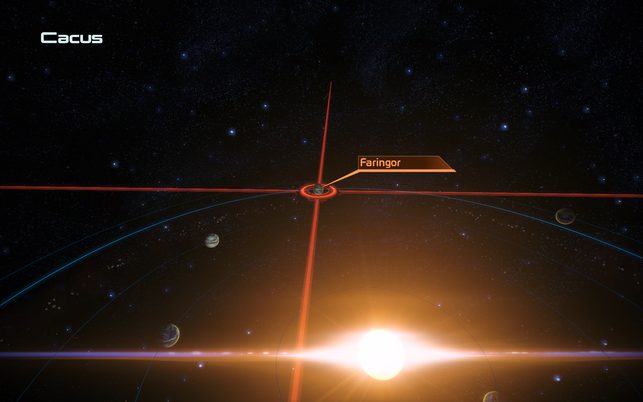
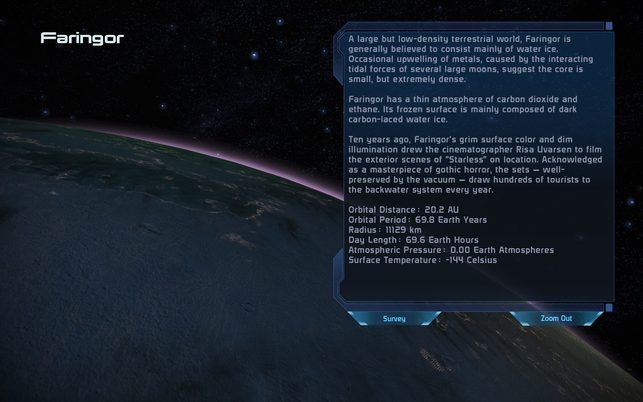
A large but low-density terrestrial world, Faringor is generally believed to consist mainly of water ice. Occasional upwelling of metals, caused by the interacting tidal forces of several large moons, suggest the core is small, but extremely dense.
Faringor has a thin atmosphere of carbon dioxide and ethane. Its frozen surface is mainly composed of dark carbon-laced water ice.
Ten years ago, Faringor’s grim surface color and dim illumination drew the cinematographer Risa Uvarsen to film the exterior scenes of “Starless” on location. Acknowledged as a masterpiece of gothic horror, the sets – well- preserved by the vacuum- draw hundreds of tourists to the backwater system every year.
Orbital Distance: 20.2 AU
Orbital Period: 69.8 Earth Years
Radius: 11129 km
Day Length: 69.6 Earth Hours
Atmospheric Pressure: 0.00 Earth Atmospheres
Surface Temperature: -144 Celsius
Treyarmus
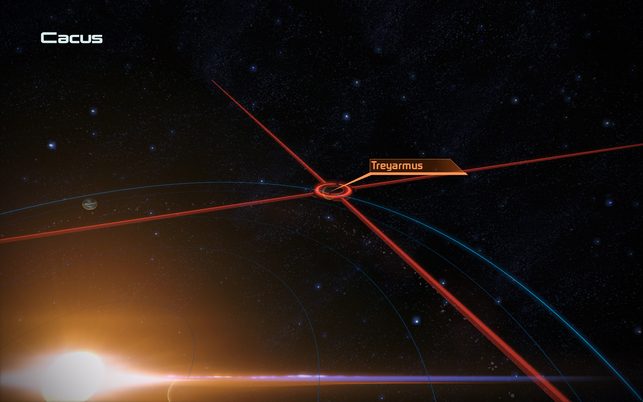
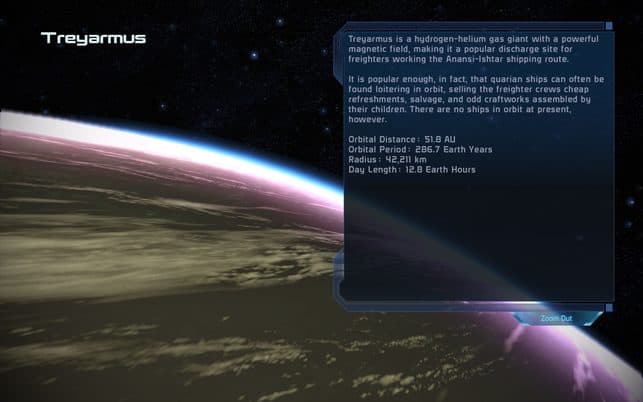
Treyarmus is a hydrogen-helium gas giant with a powerful magnetic field, making it a popular discharge site for freighters working the Anansi-Ishtar shipping route.
It is popular enough, in fact, that quarian ships can often be found loitering in orbit, selling the freighter crews cheap refreshments, salvage, and odd craftworks assembled by their children. There are no ships in orbit at present, however.
Orbital Distance: 51.8 AU
Orbital Period: 286.7 Earth Years
Radius: 42,211 km
Day Length: 12.8 Earth Hours
Zayarter*
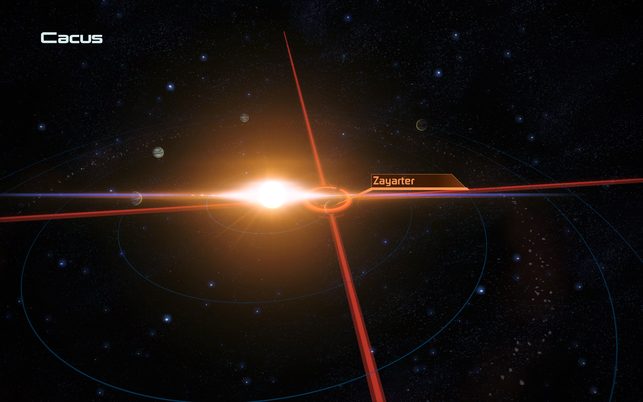
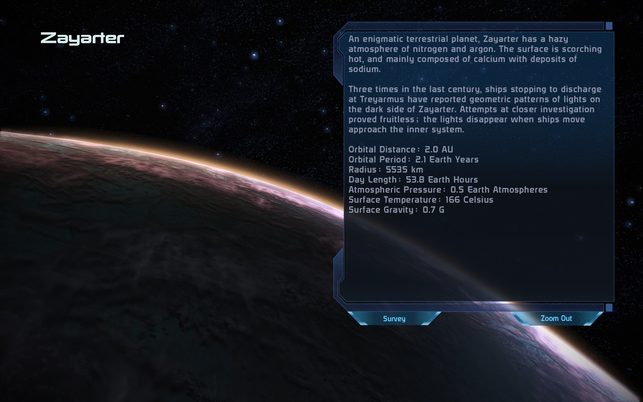
An enigmatic terrestrial planet, Zayarter has a hazy atmosphere of nitrogen and argon. The surface is scorching hot, and mainly composed of calcium with deposits of sodium.
Three times in the last century, ships stopping to discharge at Treyarmus have reported geometric patterns of lights on the dark side of Zayarter. Attempts at closer investigation proved fruitless; the lights disappear when ships move approach the inner system.
Orbital Distance: 2.0 AU
Orbital Period: 2.1 Earth Years
Radius: 5535 km
Day Length: 53.8 Earth Hours
Atmospheric Pressure: 0.5 Earth Atmospheres
Surface Temperature: 166 Celsius
Surface Gravity: 0.7 G
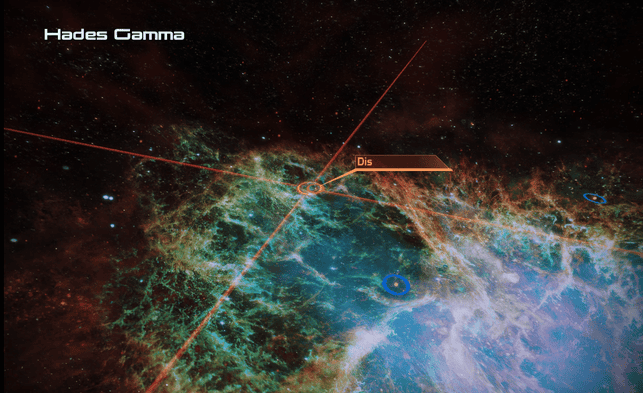
DIS
Jartar*
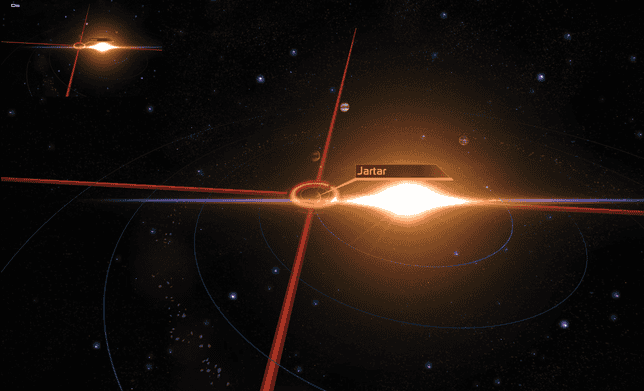
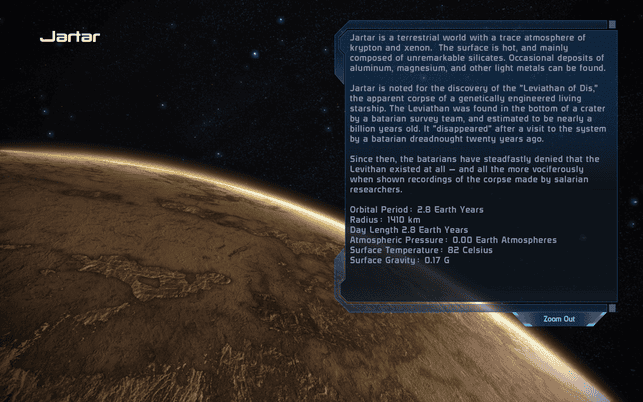
Jartar is a terrestrial world with a trace atmosphere of krypton and xenon. The surface is hot, and mainly composed of unremarkable silicates. Occasional deposits of aluminum, magnesium, and other light metals can be found.
Jartar is noted for the discovery of the “Leviathan of Dis,” the apparent corpse of a genetically engineered living starship. The Leviathan was found in the bottom of a crater by a batarian survey team, and estimated to be nearly a billion years old. It “disappeared” after a visit to the system by a batarian dreadnought twenty years ago.
Since then, the batarians have steadfastly denied that the Levithan existed at all – and all the more vociferously when shown recordings of the corpse made by salarian researchers.
Orbital Period: 2.8 Earth Years
Radius: 1410 km
Day Length 2.8 Earth Years
Atmospheric Pressure: 0.00 Earth Atmospheres
Surface Temperature: 82 Celsius
Surface Gravity: 0.17 G
Nearrum
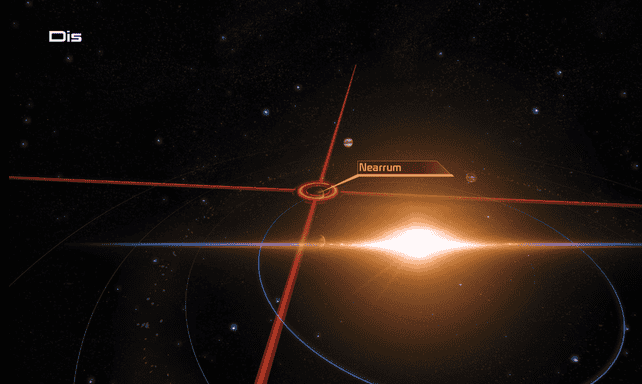
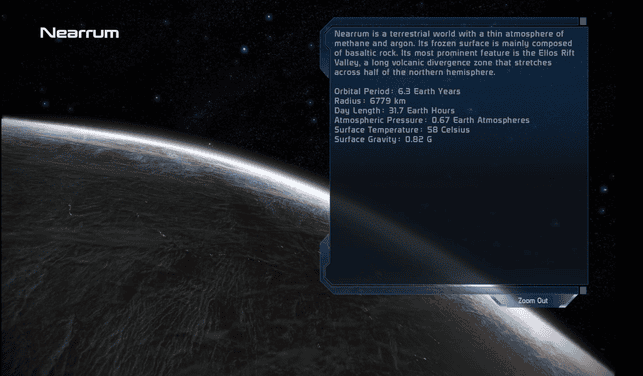
Nearrum is a terrestrial world with a thin atmosphere of methane and argon. Its frozen surface is mainly composed of basaltic rock. Its most prominent feature is the Ellos Rift Valley, a long volcanic divergence zone that stretches across half of the northern hemisphere.
Orbital Period: 6.3 Earth Years
Radius: 6779 km
Day Length: 31.7 Earth Hours
Atmospheric Pressure: 0.67 Earth Atmospheres
Surface Temperature: 58 Celsius
Surface Gravity: 0.82 G
Raysha*
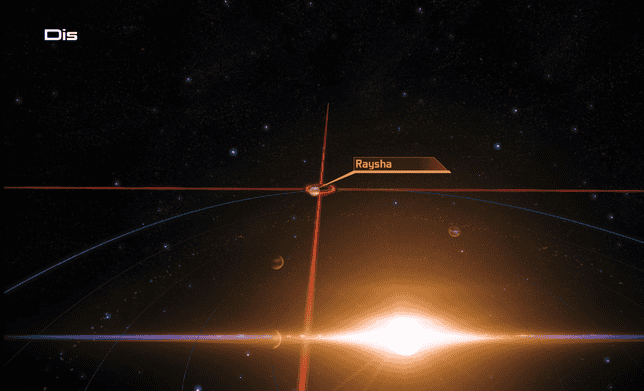
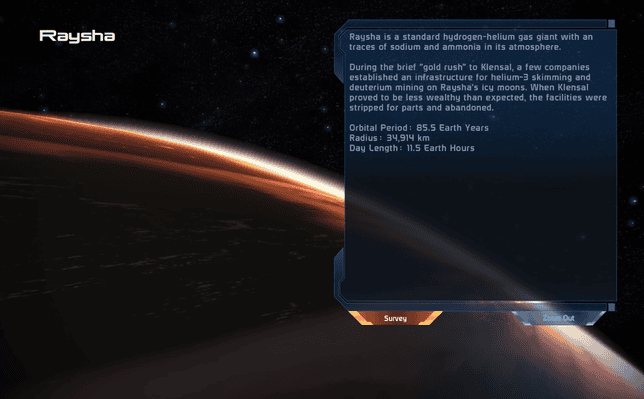
Raysha is a standard hydrogen-helium gas giant with an traces of sodium and ammonia in its atmosphere.
During the brief “gold rush” to Klensal, a few companies established an infrastructure for helium-3 skimming and deuterium mining on Raysha’s icy moons. When Klensal proved to be less wealthy than expected, the facilities were stripped for parts and abandoned.
Orbital Period: 85.5 Earth Years
Radius: 34,914 km
Day Length: 11.5 Earth Hours
Klensal
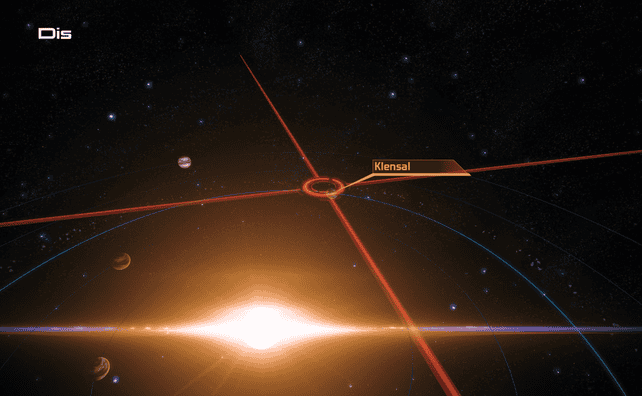
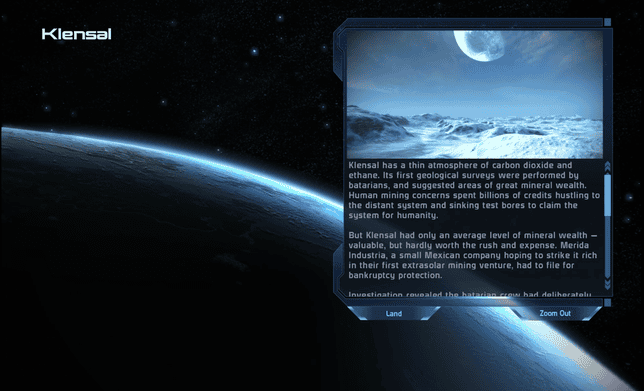
Klensal has a thin atmosphere of carbon dioxide and ethane. Its first geological surveys were performed by batarians, and suggested areas of great mineral wealth. Human mining concerns spent billions of credits hustling to the distant system and sinking test bores to claim the system for humanity.
But Klensal had only an average level of mineral wealth – valuable, but hardly worth the rush and expense. Merida Industria, a small Mexican company hoping to strike it rich in their first extrasolar mining venture, had to file for bankruptcy protection.
Investigation revealed the batarian crew had deliberately falsified their surveys, hoping it would encourage human rivals to invest in a costly boondoggle. While unethical, this was not technically illegal, and the batarian government disavowed the “personal actions of a few misguided patriots.” The planet is still littered with abandoned mining bases, which are often used as temporary meeting places for criminals
Orbital Period: 21.4 Earth Years
Radius: 5447 km
Day Length: 37.2 Earth Hours
Atmospheric Pressure: 0.58 Earth Atmospheres
Surface Temperature: -35 Celsius
Surface Gravity: 0.86 G
Gremar
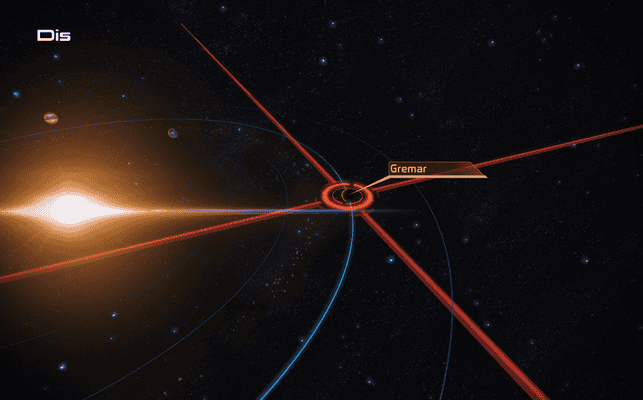
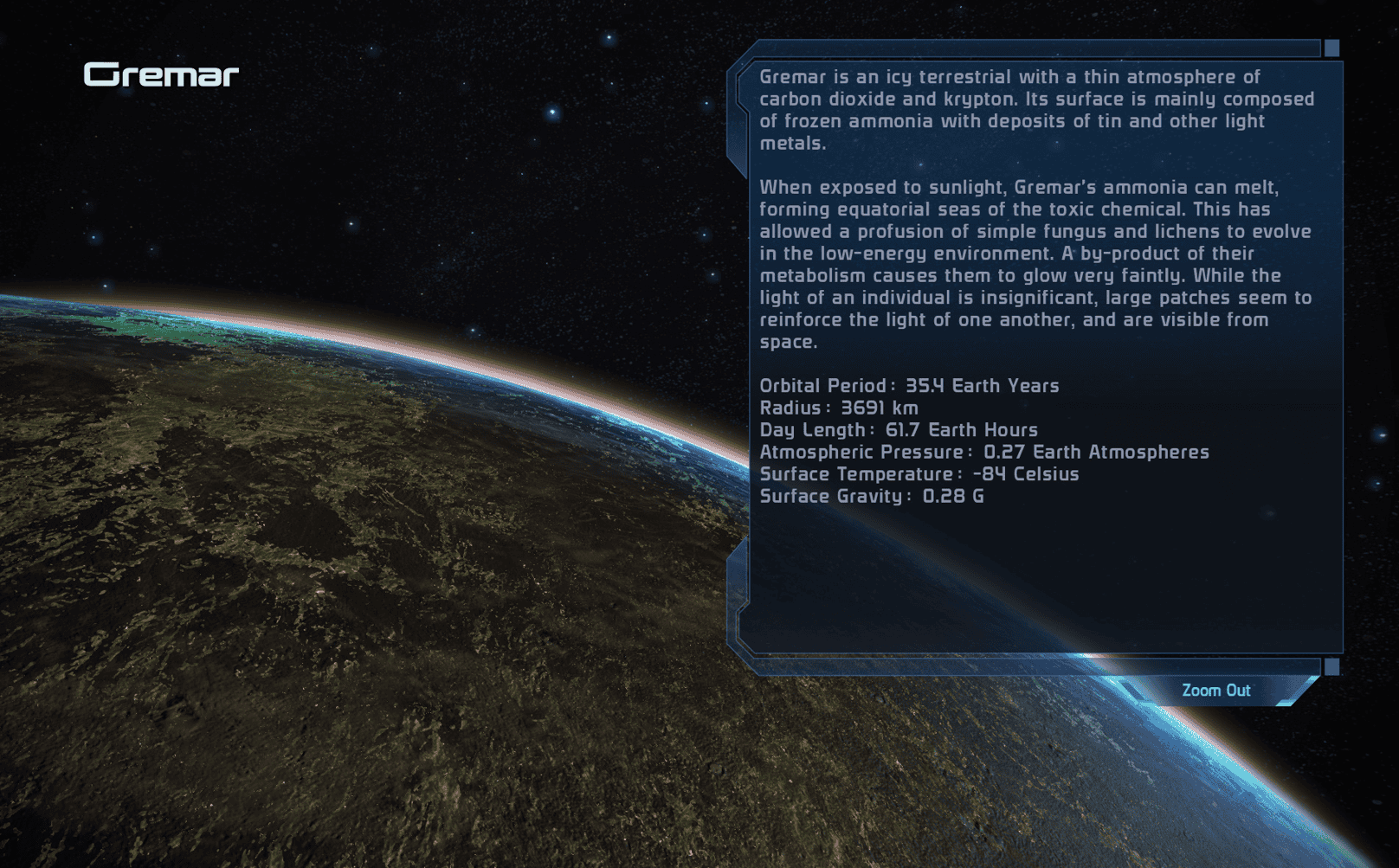
Gremar is an icy terrestrial with a thin atmosphere of carbon dioxide and krypton. Its surface is mainly composed of frozen ammonia with deposits of tin and other light metals.
When exposed to sunlight, Gremar’s ammonia can melt, forming equatorial seas of the toxic chemical. This has allowed a profusion of simple fungus and lichens to evolve in the low-energy environment. A by-product of their metabolism causes them to glow very faintly. While the light of an individual is insignificant, large patches seem to reinforce the light of one another, and are visible from space.
Orbital Period: 35.4 Earth Years
Radius: 3691 km
Day Length: 61.7 Earth Hours
Atmospheric Pressure: 0.27 Earth Atmospheres
Surface Temperature: -84 Celsius
Surface Gravity: 0.28 G
FARINATA
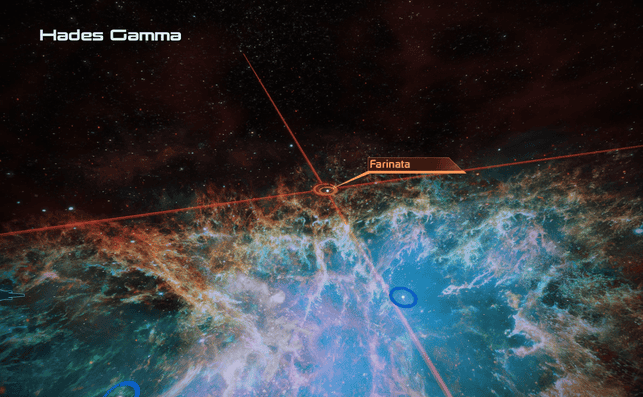
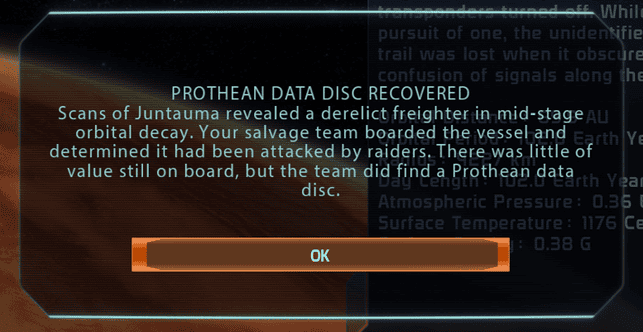
Juntauma*
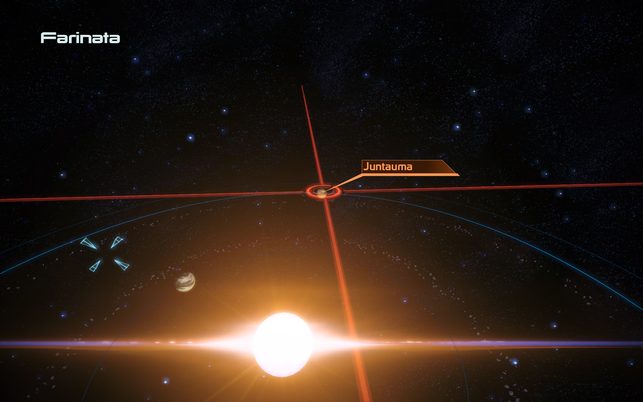
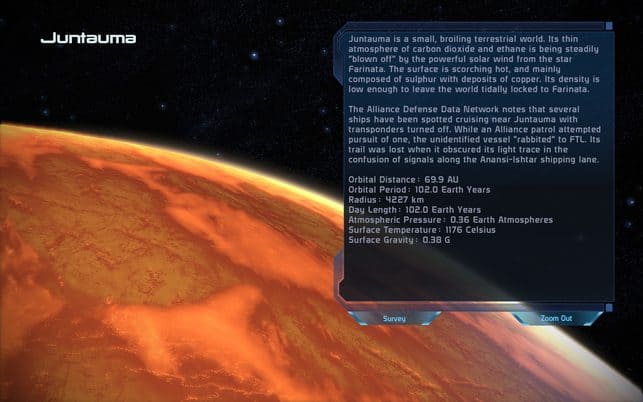
Juntauma is a small, broiling terrestrial world. Its thin atmosphere of carbon dioxide and ethane is being steadily “blown off” by the powerful solar wind from the star Farinata. The surface is scorching hot, and mainly composed of sulphur with deposits of copper. Its density is low enough to leave the world tidally locked to Farinata.
The Alliance Defense Data Network notes that several ships have been spotted cruising near Juntauma with transponders turned off. While an Alliance patrol attempted pursuit of one, the unidentified vessel “rabbited” to FTL. Its trail was lost when it obscured its light trace in the confusion of signals along the Anansi-Ishtar shipping lane.
Orbital Distance: 69.9 AU
Orbital Period: 102.0 Earth Years
Radius: 4227 km
Day Length: 102.0 Earth Years
Atmospheric Pressure: 0.36 Earth Atmospheres
Surface Temperature: 1176 Celsius
Surface Gravity: 0.38 G
Tunshagon
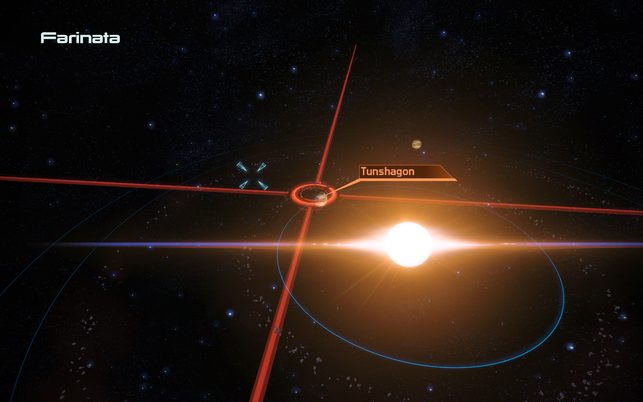
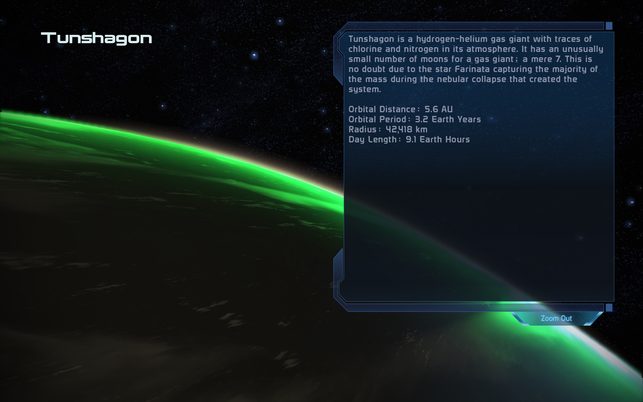
Tunshagon is a hydrogen-helium gas giant with traces of chlorine and nitrogen in its atmosphere. It has an unusually small number of moons for a gas giant; a mere 7. This is no doubt due to the star Farinata capturing the majority of the mass during the nebular collapse that created the system.
Orbital Distance: 5.6 AU
Orbital Period: 3.2 Earth Years
Radius: 42,418 km
Day Length: 9.1 Earth Hours
MSV Ontario
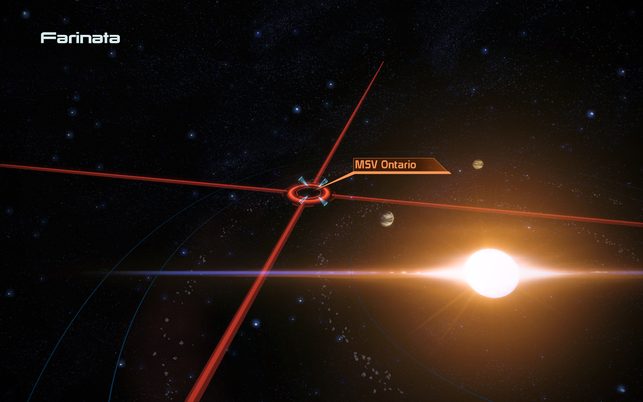
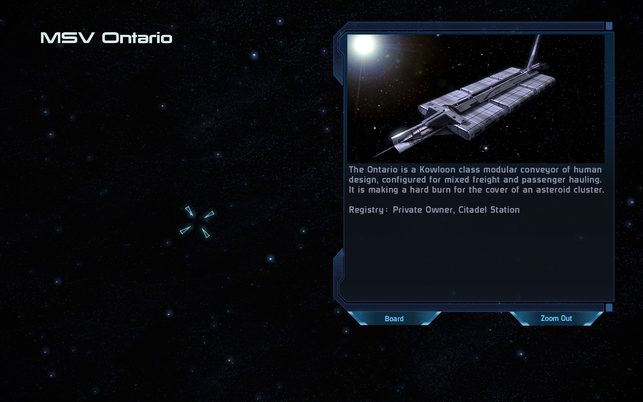
The Ontario is a Kowloon class modular conveyor of human design, configured for mixed freight and passenger hauling. It is making a hard burn for the cover of an asteroid cluster.
Registry: Private Owner, Citadel Station
Nepneu*
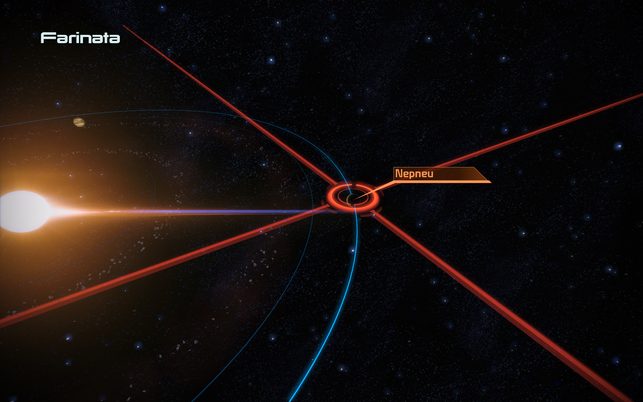
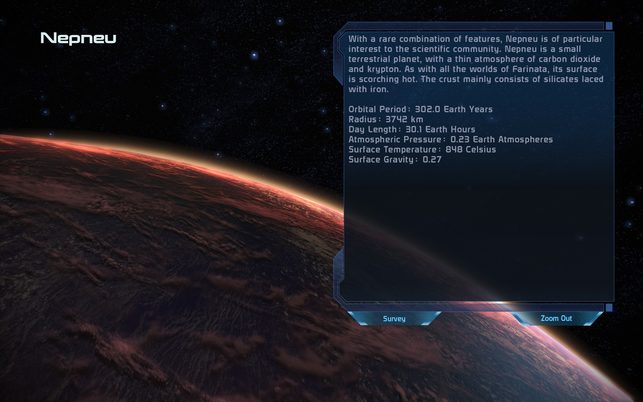
With a rare combination of features, Nepneu is of particular interest to the scientific community. Nepneu is a small terrestrial planet, with a thin atmosphere of carbon dioxide and krypton. As with all the worlds of Farinata, its surface is scorching hot. The crust mainly consists of silicates laced with iron.
Orbital Period: 302.0 Earth Years
Radius: 3742 km
Day Length: 30.1 Earth Hours
Atmospheric Pressure: 0.23 Earth Atmospheres
Surface Temperature: 848 Celsius
Surface Gravity: 0.27
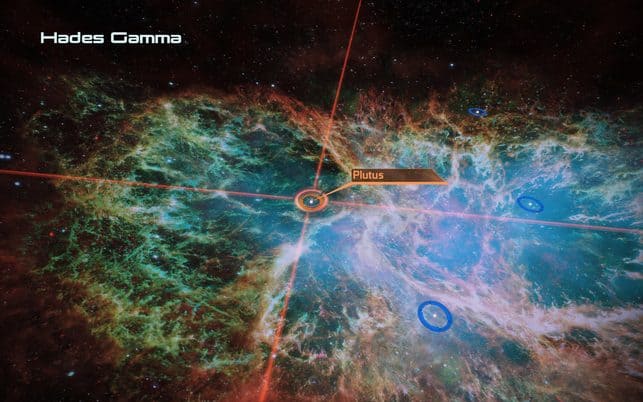
PLUTUS
Mingito*
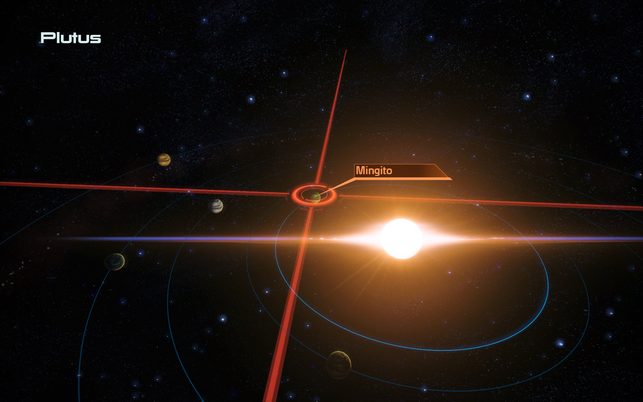
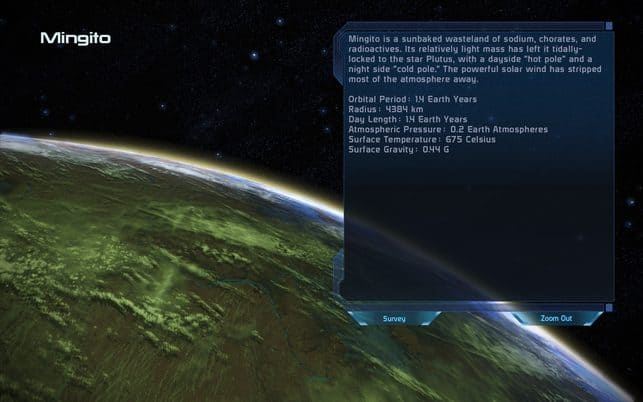
Mingito is a sunbaked wasteland of sodium, chorates, and radioactives. Its relatively light mass has left it tidally-locked to the star Plutus, with a dayside “hot pole” and a night side “cold pole.” The powerful solar wind has stripped most of the atmosphere away.
Orbital Period: 1.4 Earth Years
Radius: 4384 km
Day Length: 1.4 Earth Years
Atmospheric Pressure: 0.2 Earth Atmospheres
Surface Temperature: 675 Celsius
Surface Gravity: 0.44 G
Clocrolis*
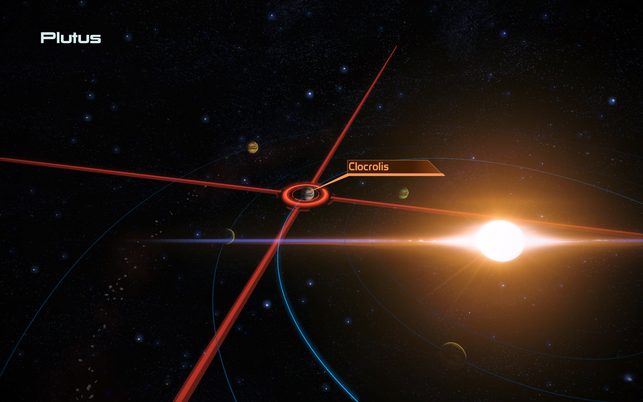
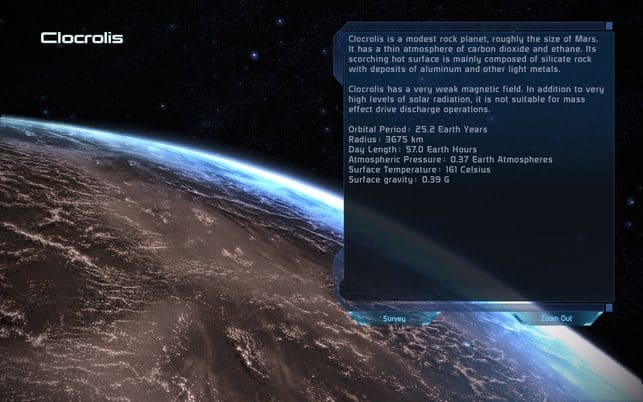
Clocrolis is a modest rock planet, roughly the size of Mars. It has a thin atmosphere of carbon dioxide and ethane. Its scorching hot surface is mainly composed of silicate rock with deposits of aluminum and other light metals.
Clocrolis has a very weak magnetic field. In addition to very high levels of solar radiation, it is not suitable for mass effect drive discharge operations.
Orbital Period: 25.2 Earth Years
Radius: 3675 km
Day Length: 57.0 Earth Hours
Atmospheric Pressure: 0.37 Earth Atmospheres
Surface Temperature: 161 Celsius
Surface gravity: 0.39 G
Veyaria
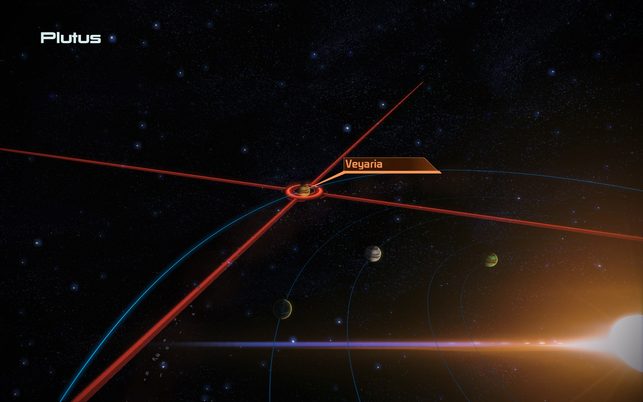
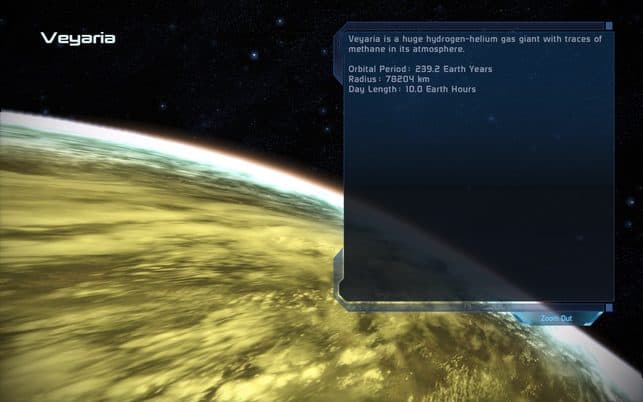
Veyaria is a huge hydrogen-helium gas giant with traces of methane in its atmosphere.
Orbital Period: 239.2 Earth Years
Radius: 78204 km
Day Length: 10.0 Earth Hours
Nonuel
WARNING: Level 1 Heat Hazard
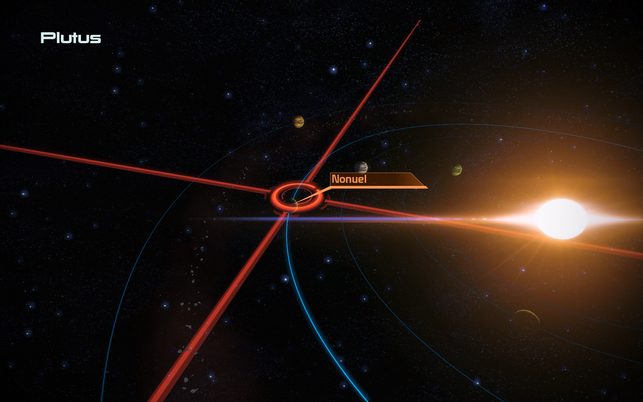
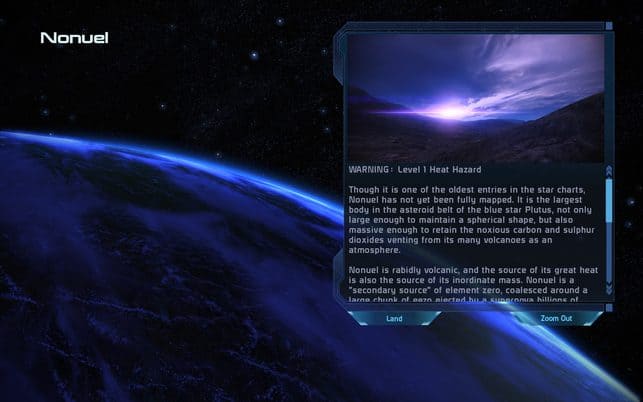
Though it is one of the oldest entries in the star charts, Nonuel has not yet been fully mapped. It is the largest body in the asteroid belt of the blue star Plutus, not only large enough to maintain a spherical shape, but also massive enough to retain the noxious carbon and sulphur dioxides venting from its many volcanoes as an atmosphere.
Nonuel is rabidly volcanic, and the source of its great heat is also the source of its inordinate mass. Nonuel is a “secondary source” of element zero, coalesced around a large chunk of eezo ejected by a supernova billions of years ago.
Surface conditions are extremely hazardous. In addition to the thin crust and numerous magma flows, wide stretches of the landscape are coated with slippery ash and cinders ejected from the volcanoes.
Orbital Period: 94.0 Earth Years Radius: 4439 km
Day Length: 46.9 Earth Hours
Atmospheric Pressure: 0.88 Earth Atmospheres
Surface Temperature: 127 Celsius
Surface Gravity: 0.85 G
Maidla
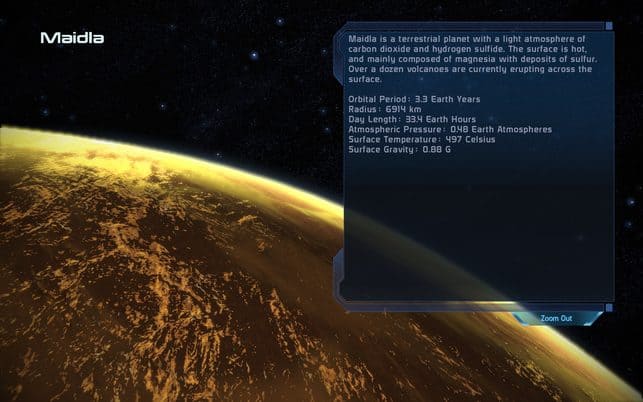
Maidla is a terrestrial planet with a light atmosphere of carbon dioxide and hydrogen sulfide. The surface is hot, and mainly composed of magnesia with deposits of sulfur. Over a dozen volcanoes are currently erupting across the surface.
Orbital Period: 3.3 Earth Years
Radius: 6914 km
Day Length: 33.4 Earth Hours
Atmospheric Pressure: 0.48 Earth Atmospheres
Surface Temperature: 497 Celsius
Surface Gravity: 0.88 G
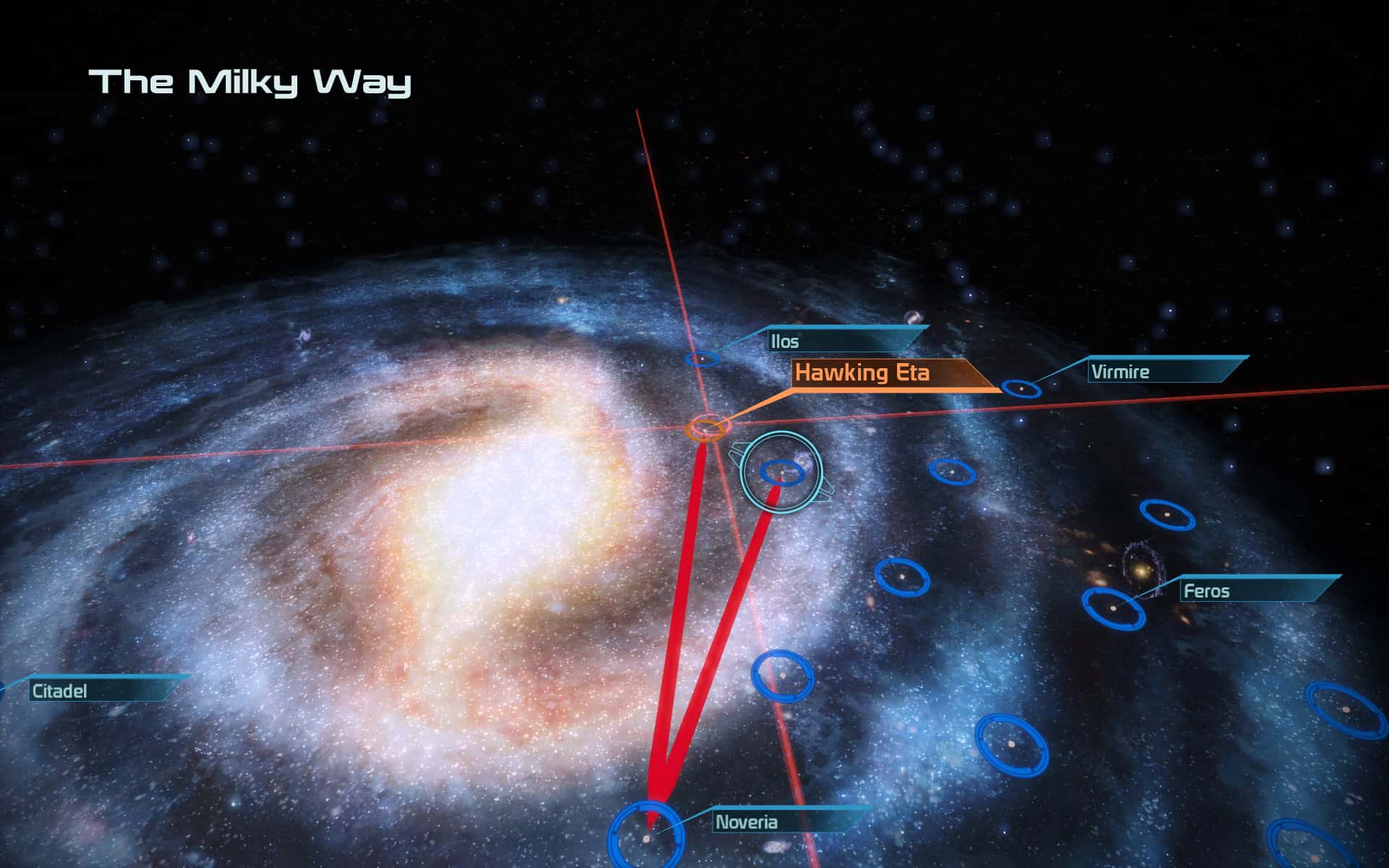
HAWKING ETA
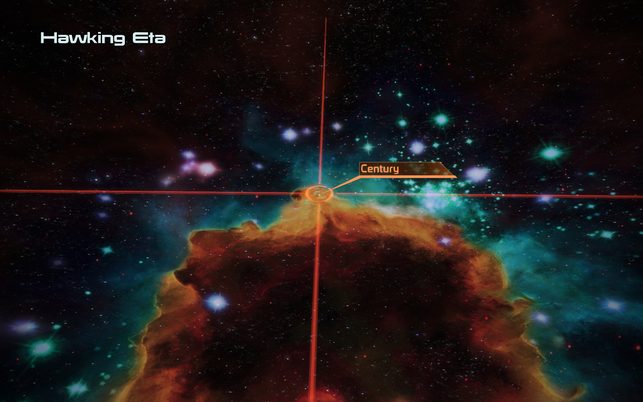
CENTURY
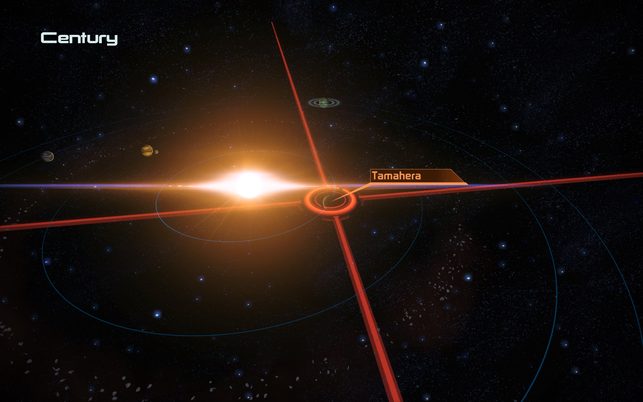
Tamahera
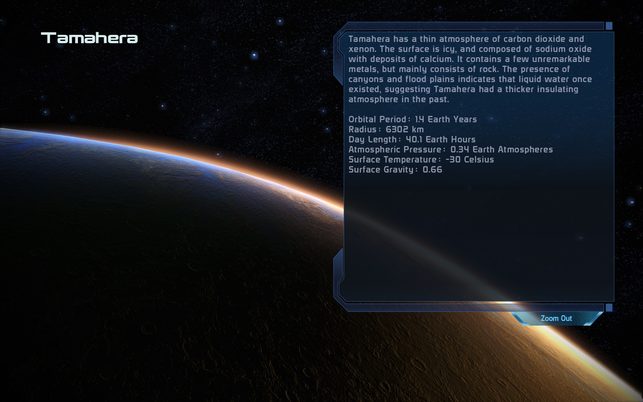
Tamahera has a thin atmosphere of carbon dioxide and xenon. The surface is icy, and composed of sodium oxide with deposits of calcium. It contains a few unremarkable metals, but mainly consists of rock. The presence of canyons and flood plains indicates that liquid water once existed, suggesting Tamahera had a thicker insulating atmosphere in the past.
Orbital Period: 1.4 Earth Years
Radius: 6302 km
Day Length: 40.1 Earth Hours
Atmospheric Pressure: 0.34 Earth Atmospheres
Surface Temperature: -30 Celsius
Surface Gravity: 0.66
Tharopto*
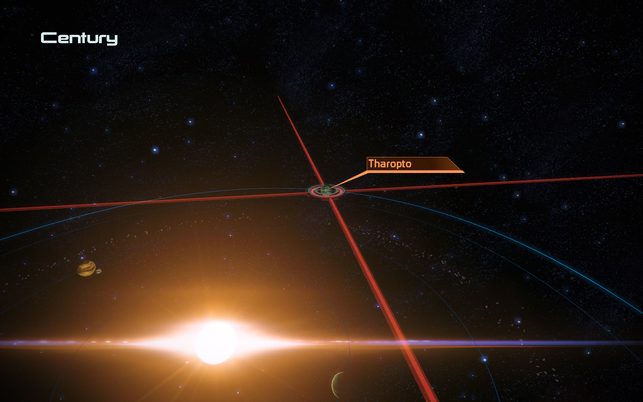
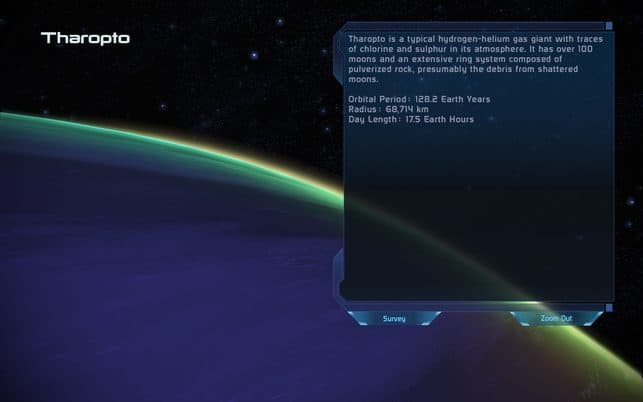
Tharopto is a typical hydrogen-helium gas giant with traces of chlorine and sulphur in its atmosphere. It has over 100 moons and an extensive ring system composed of pulverized rock, presumably the debris from shattered
Moons.
Orbital Period: 128.2 Earth Years
Radius: 68,714 km
Day Length: 17.5 Earth Hours
Presrop
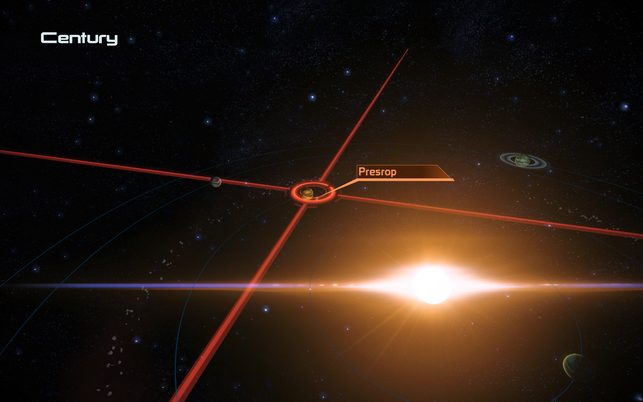
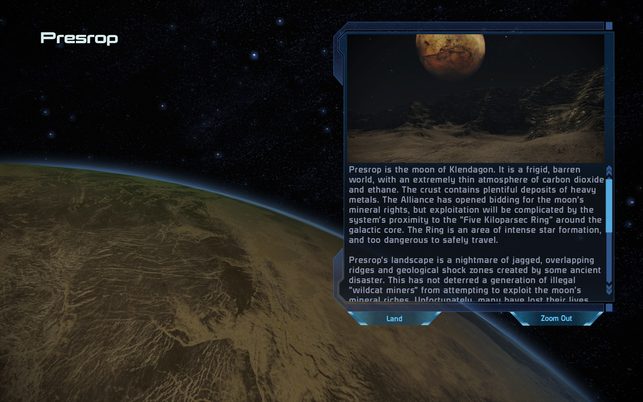
Presrop is the moon of Klendagon. It is a frigid, barren world, with an extremely thin atmosphere of carbon dioxide and ethane. The crust contains plentiful deposits of heavy metals. The Alliance has opened bidding for the moon’s mineral rights, but exploitation will be complicated by the system’s proximity to the “Five Kiloparsec Ring” around the galactic core. The Ring is an area of intense star formation, and too dangerous to safely travel.
Presrop’s landscape is a nightmare of jagged, overlapping ridges and geological shock zones created by some ancient disaster. This has not deterred a generation of illegal “wildcat miners” from attempting to exploit the moon’s mineral riches. Unfortunately, many have lost their lives.
Orbital Distance: 168,500 km (from Klendagon) Orbital Period: 10.8 Earth Days
Radius: 4113 km
Day Length: 10.8 Earth Days
Atmospheric Pressure: 0.1 Earth Atmospheres
Surface Temperature: -73 Celsius
Surface Gravity: 0.88 G
Klendagon
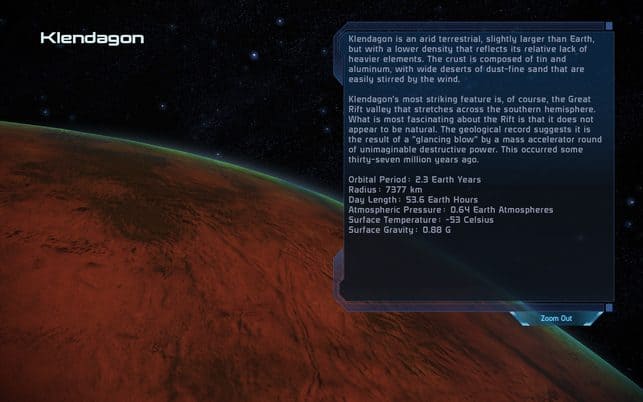
Klendagon is an arid terrestrial, slightly larger than Earth, but with a lower density that reflects its relative lack of heavier elements. The crust is composed of tin and aluminum, with wide deserts of dust-fine sand that are easily stirred by the wind.
Klendagon’s most striking feature is, of course, the Great Rift valley that stretches across the southern hemisphere. What is most fascinating about the Rift is that it does not appear to be natural. The geological record suggests it is the result of a “glancing blow” by a mass accelerator round of unimaginable destructive power. This occurred some thirty-seven million years ago.
Orbital Period: 2.3 Earth Years
Radius: 7377 km
Day Length: 53.6 Earth Hours
Atmospheric Pressure: 0.64 Earth Atmospheres
Surface Temperature: -53 Celsius
Surface Gravity: 0.88 G
Canctra*
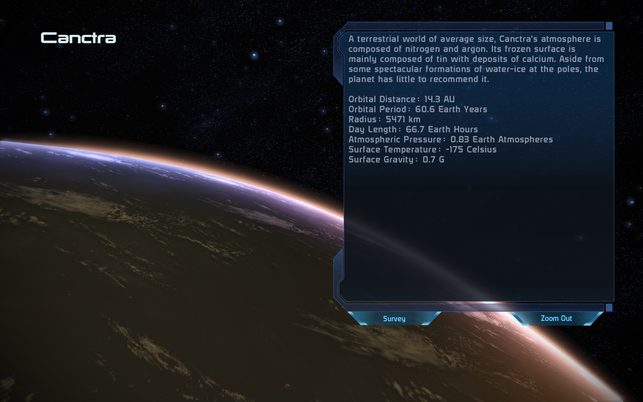
A terrestrial world of average size, Canctra’s atmosphere is composed of nitrogen and argon. Its frozen surface is mainly composed of tin with deposits of calcium. Aside from some spectacular formations of water-ice at the poles, the planet has little to recommend it.
Orbital Distance: 14.3 AU
Orbital Period: 60.6 Earth Years
Radius: 5471 km
Day Length: 66.7 Earth Hours
Atmospheric Pressure: 0.83 Earth Atmospheres
Surface Temperature: -175 Celsius
Surface Gravity: 0.7 G
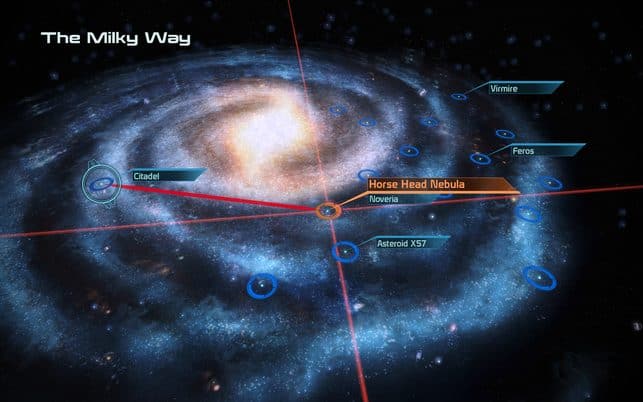
HORSE HEAD NEBULA
PAX
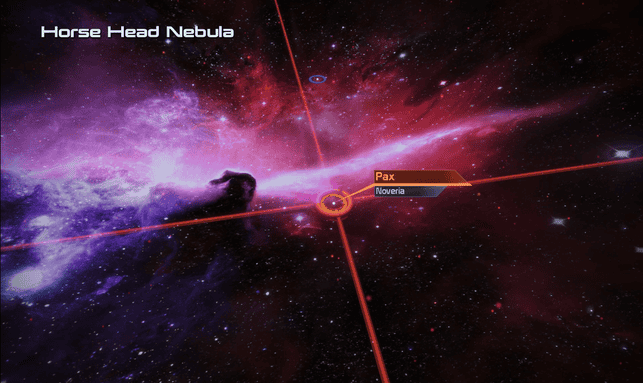
Noveria
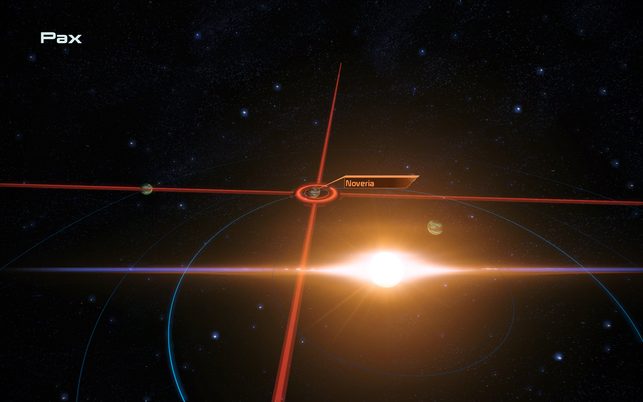
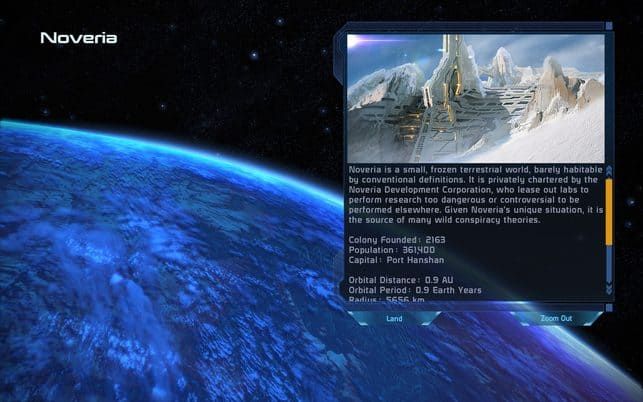
Noveria is a small, frozen terrestrial world, barely habitable by conventional definitions. It is privately chartered by the Noveria Development Corporation, who lease out labs to perform research too dangerous or controversial to be performed elsewhere. Given Noveria’s unique situation, it is the source of many wild conspiracy theories.
Colony Founded: 2163
Population: 361,400
Capital: Port Hanshan
Orbital Distance: 0.9 AU
Orbital Period: 0.9 Earth Years
Radius: 5656 km
Day Length: 52.0 Earth Hours
Atmospheric Pressure: 0.87 Earth Atmospheres
Surface Temperature: -1 Celsius
Surface Gravity: 0.81
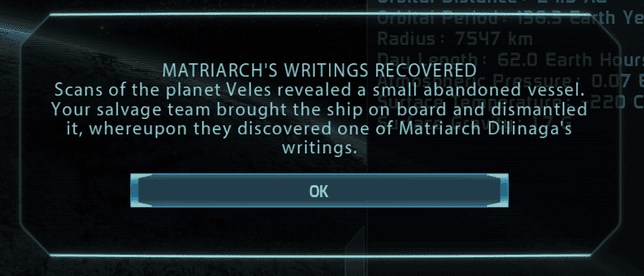
Veles*
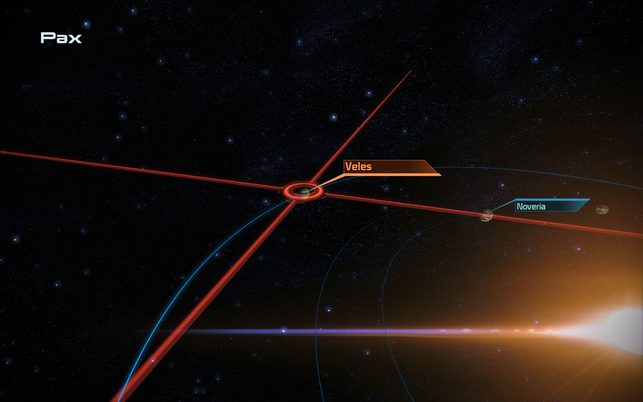
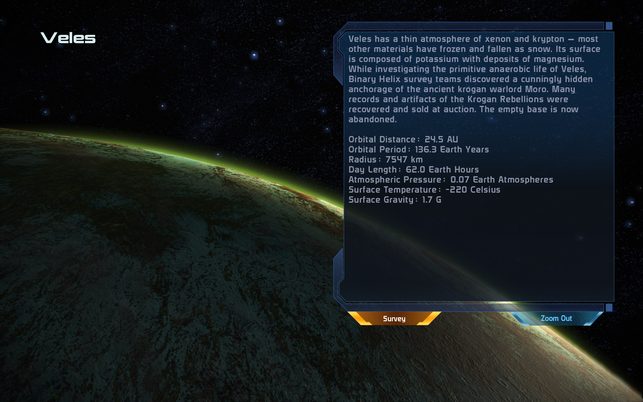
Veles has a thin atmosphere of xenon and krypton – most other materials have frozen and fallen as snow. Its surface is composed of potassium with deposits of magnesium. While investigating the primitive anaerobic life of Veles, Binary Helix survey teams discovered a cunningly hidden anchorage of the ancient krogan warlord Moro. Many records and artifacts of the Krogan Rebellions were recovered and sold at auction. The empty base is now abandoned.
Orbital Distance: 24.5 AU
Orbital Period: 136.3 Earth Years
Radius: 7547 km
Day Length: 62.0 Earth Hours
Atmospheric Pressure: 0.07 Earth Atmospheres
Surface Temperature: -220 Celsius
Surface Gravity: 1.7 G
Morana
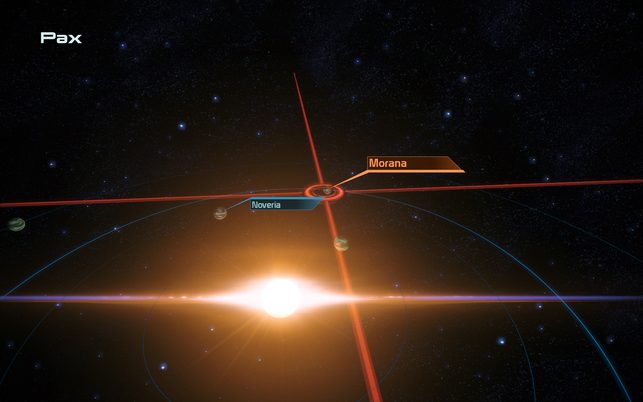
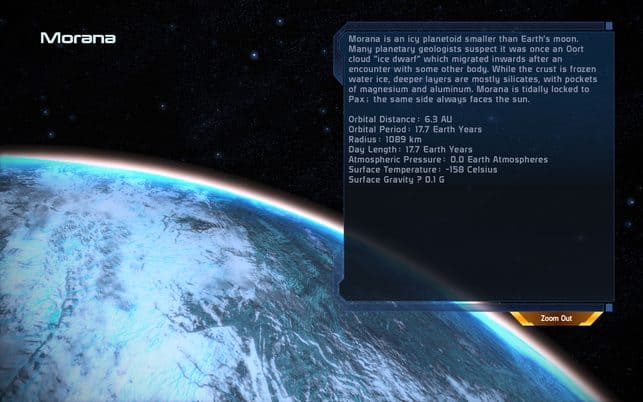
Morana is an icy planetoid smaller than Earth’s moon. Many planetary geologists suspect it was once an Oort cloud “ice dwarf” which migrated inwards after an encounter with some other body. While the crust is frozen water ice, deeper layers are mostly silicates, with pockets of magnesium and aluminum. Morana is tidally locked to Pax; the same side always faces the sun.
Orbital Distance: 6.3 AU
Orbital Period: 17.7 Earth Years
Radius: 1089 km
Day Length: 17.7 Earth Years
Atmospheric Pressure: 0.0 Earth Atmospheres
Surface Temperature: -158 Celsius
Surface Gravity ? 0.1 G
Svarog
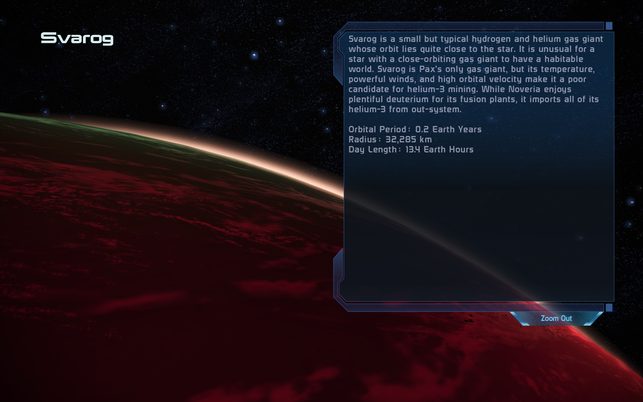
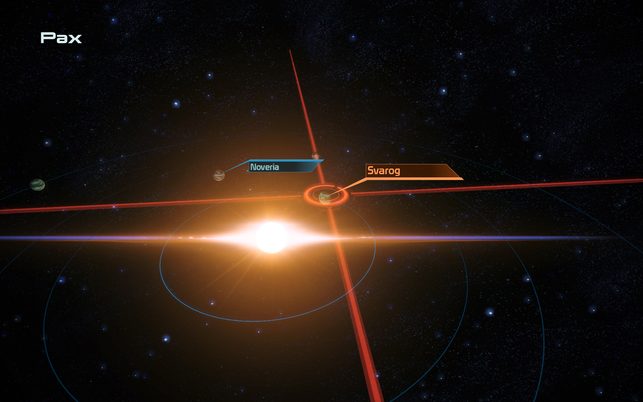
Svarog is a small but typical hydrogen and helium gas giant whose orbit lies quite close to the star. It is unusual for a star with a close-orbiting gas giant to have a habitable world. Svarog is Pax’s only gas giant, but its temperature, powerful winds, and high orbital velocity make it a poor candidate for helium-3 mining. While Noveria enjoys plentiful deuterium for its fusion plants, it imports all of its helium-3 from out-system.
Orbital Period: 0.2 Earth Years
Radius: 32,285 km
Day Length: 13.4 Earth Hours
STRENUUS
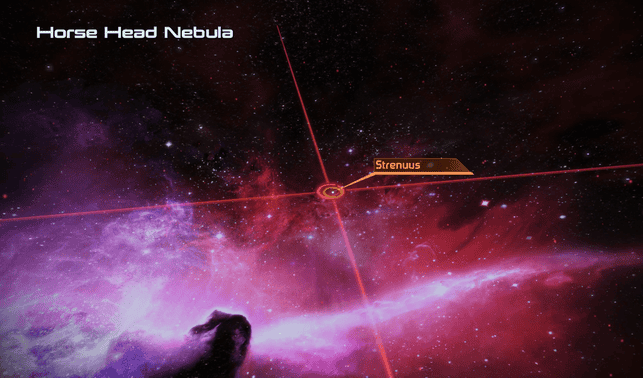
Antitarra*
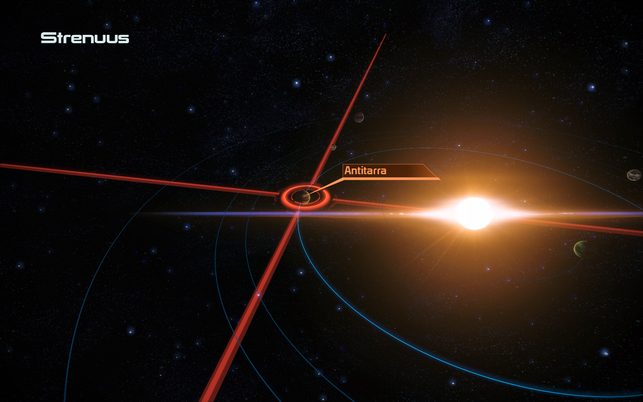
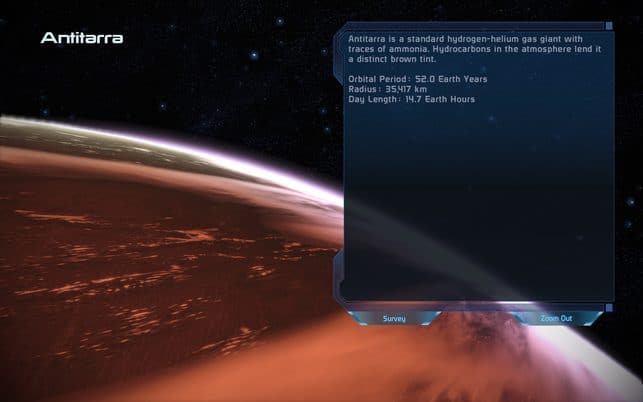
Antitarra is a standard hydrogen-helium gas giant with traces of ammonia. Hydrocarbons in the atmosphere lend it a distinct brown tint.
Orbital Period: 52.0 Earth Years
Radius: 35,417 km
Day Length: 14.7 Earth Hours
Trelyn
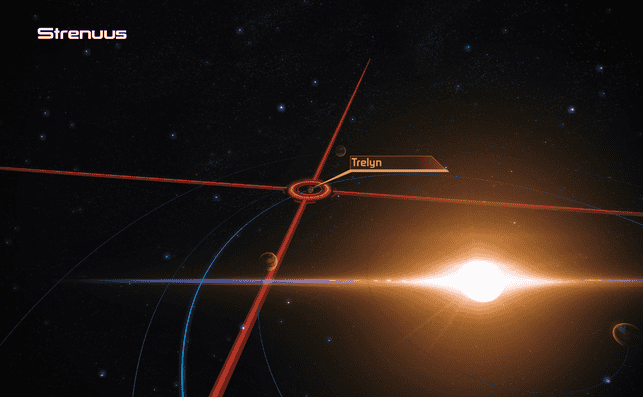
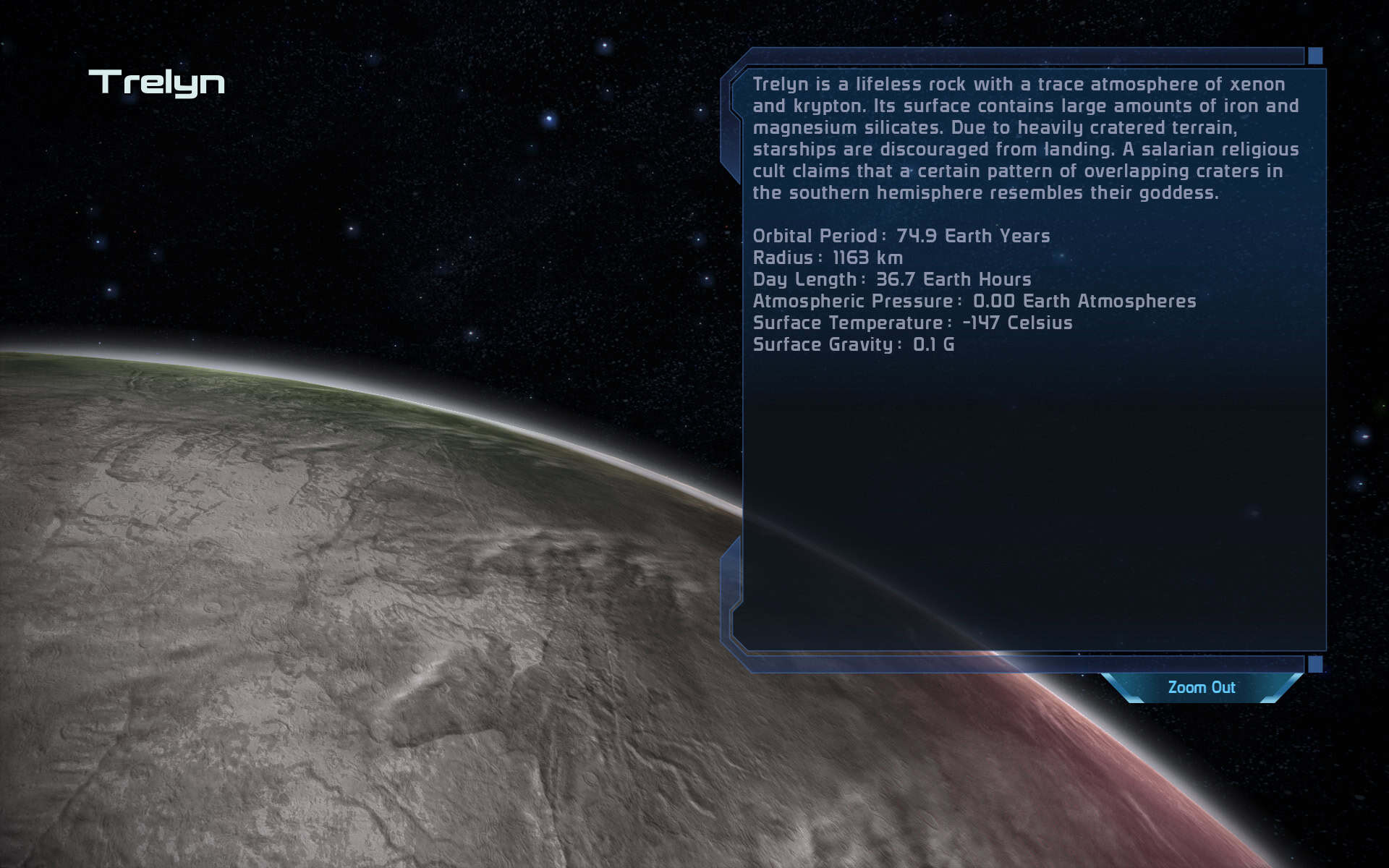
Trelyn is a lifeless rock with a trace atmosphere of xenon and krypton. Its surface contains large amounts of iron and magnesium silicates. Due to heavily cratered terrain, starships are discouraged from landing. A salarian religious cult claims that a certain pattern of overlapping craters in the southern hemisphere resembles their goddess.
Orbital Period: 74.9 Earth Years
Radius: 1163 km
Day Length: 36.7 Earth Hours
Atmospheric Pressure: 0.00 Earth Atmospheres
Surface Temperature: -147 Celsius
Surface Gravity: 0.1 G
Thesalgon
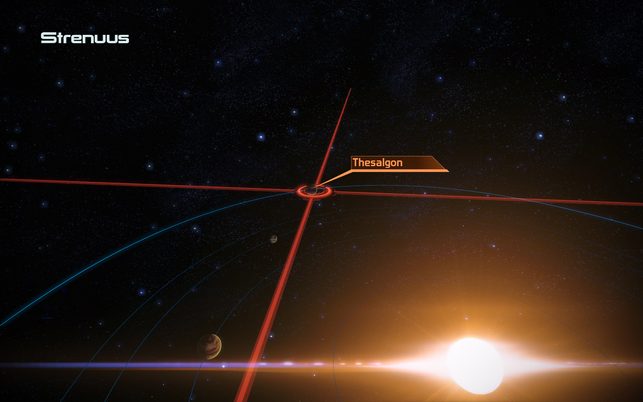
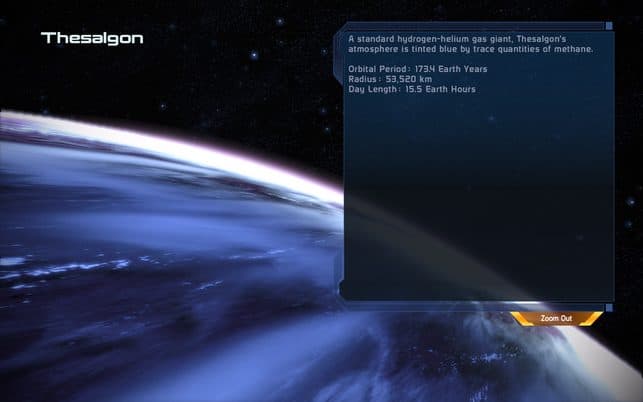
A standard hydrogen-helium gas giant, Thesalgon’s atmosphere is tinted blue by trace quantities of methane.
Orbital Period: 173.4 Earth Years
Radius: 53,520 km
Day Length: 15.5 Earth Hours
Xawin
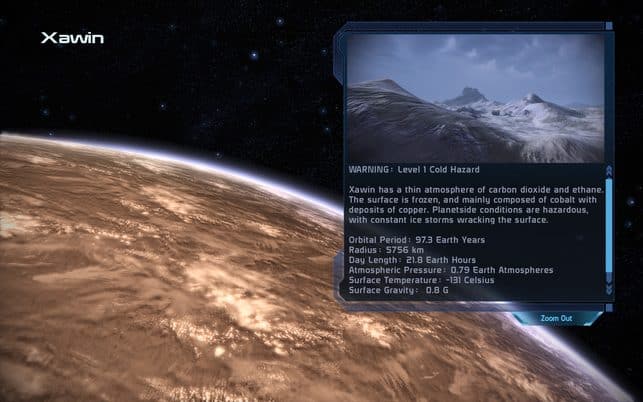
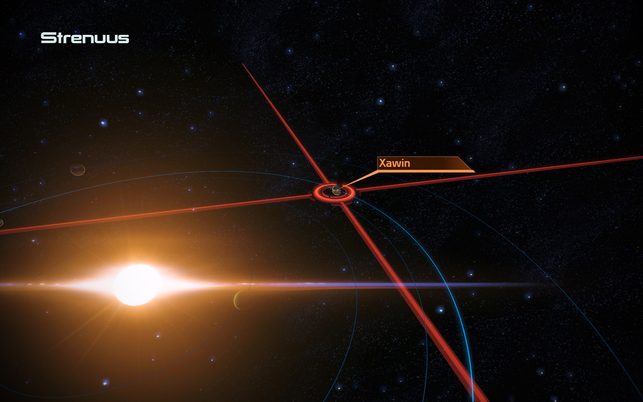
WARNING: Level 1 Cold Hazard
Xawin has a thin atmosphere of carbon dioxide and ethane. The surface is frozen, and mainly composed of cobalt with deposits of copper. Planetside conditions are hazardous, with constant ice storms wracking the surface.
Orbital Period: 97.3 Earth Years
Radius: 5756 km
Day Length: 21.8 Earth Hours
Atmospheric Pressure: 0.79 Earth Atmospheres
Surface Temperature: -131 Celsius
Surface Gravity: 0.8 G
Yunthorl*
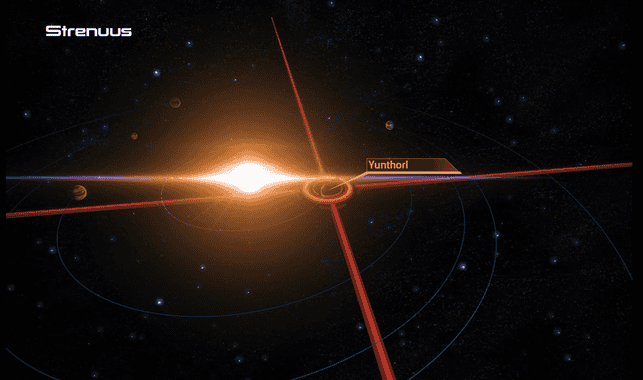
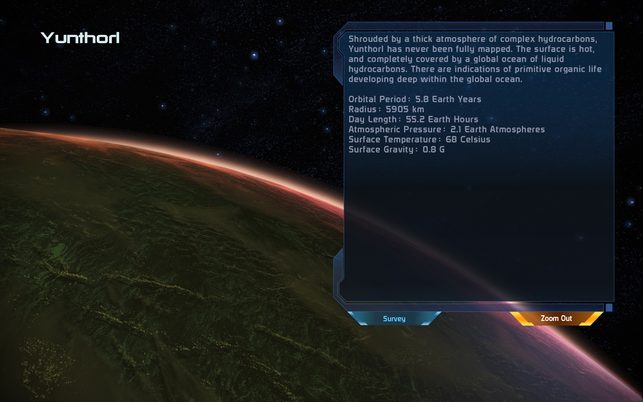
Shrouded by a thick atmosphere of complex hydrocarbons, Yunthorl has never been fully mapped. The surface is hot, and completely covered by a global ocean of liquid hydrocarbons. There are indications of primitive organic life developing deep within the global ocean.
Orbital Period: 5.8 Earth Years
Radius: 5905 km
Day Length: 55.2 Earth Hours
Atmospheric Pressure: 2.1 Earth Atmospheres
Surface Temperature: 68 Celsius
Surface Gravity: 0.8 G
KEPLER VERGE
NEWTON
Ontarom
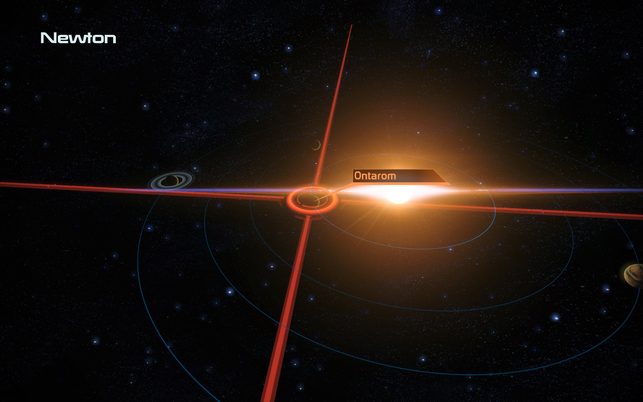
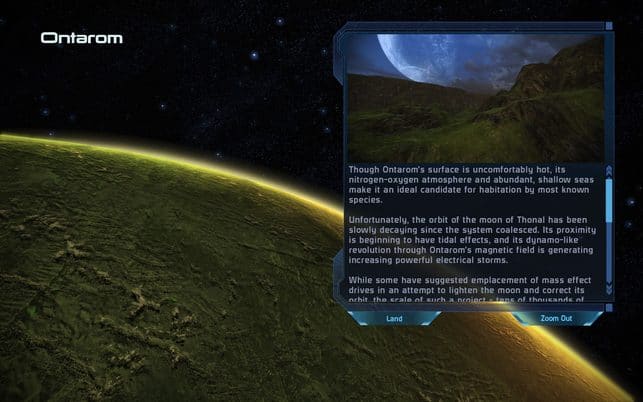
Though Ontarom’s surface is uncomfortably hot, its nitrogen-oxygen atmosphere and abundant, shallow seas make it an ideal candidate for habitation by most known species.
Unfortunately, the orbit of the moon of Thonal has been slowly decaying since the system coalesced. Its proximity is beginning to have tidal effects, and its dynamo-like revolution through Ontarom’s magnetic field is generating increasing powerful electrical storms.
While some have suggested emplacement of mass effect drives in an attempt to lighten the moon and correct its orbit, the scale of such a project – tens of thousands of drives, costing enough to bankrupt the governments of all the Citadel races – make it a pipe dream. A multi-racial effort is underway to catalogue and preserve the unique genetic diversity of Ontarom’s vibrant young biosphere. ExoGeni Corp. and Heyuan Genomics represent the Alliance’s share of the effort.
Orbital Period: 1.2 Earth Years Radius: 6443 km
Day Length: 39.1 Earth Hours
Atmospheric Pressure: 0.79 Earth Atmospheres
Surface Temperature: 58 Celsius
Surface Gravity: 0.82 G
Klencory*
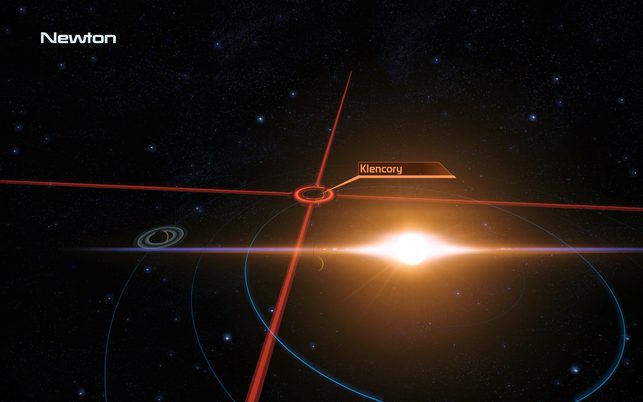
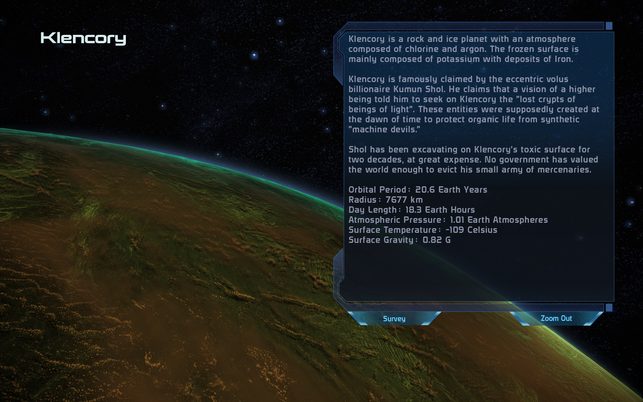
Klencory is a rock and ice planet with an atmosphere composed of chlorine and argon. The frozen surface is mainly composed of potassium with deposits of Iron.
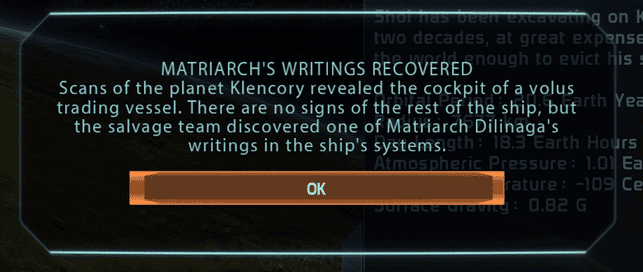
Klencory is famously claimed by the eccentric volus billionaire Kumun Shol. He claims that a vision of a higher being told him to seek on Klencory the “lost crypts of beings of light”. These entities were supposedly created at the dawn of time to protect organic life from synthetic “machine devils.”
Shol has been excavating on Klencory’s toxic surface for two decades, at great expense. No government has valued the world enough to evict his small army of mercenaries.
Orbital Period: 20.6 Earth Years
Radius : 7677 km
Day Length: 18.3 Earth Hours
Atmospheric Pressure: 1.01 Earth Atmospheres
Surface Temperature: -109 Celsius
Surface Gravity: 0.82 G
Sesmose
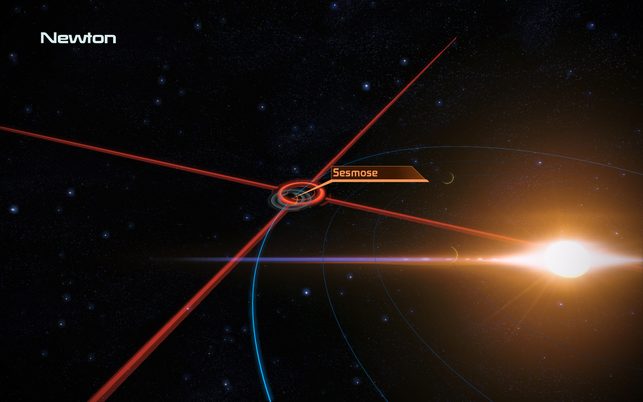
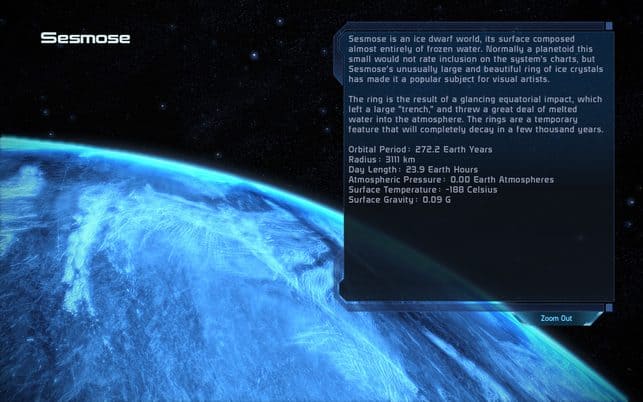
Sesmose is an ice dwarf world, its surface composed almost entirely of frozen water. Normally a planetoid this small would not rate inclusion on the system’s charts, but Sesmose’s unusually large and beautiful ring of ice crystals has made it a popular subject for visual artists.
The ring is the result of a glancing equatorial impact, which left a large “trench,” and threw a great deal of melted water into the atmosphere. The rings are a temporary feature that will completely decay in a few thousand years.
Orbital Period: 272.2 Earth Years
Radius: 3111 km
Day Length: 23.9 Earth Hours
Atmospheric Pressure: 0.00 Earth Atmospheres
Surface Temperature: -188 Celsius
Surface Gravity: 0.09 G
Juncro*
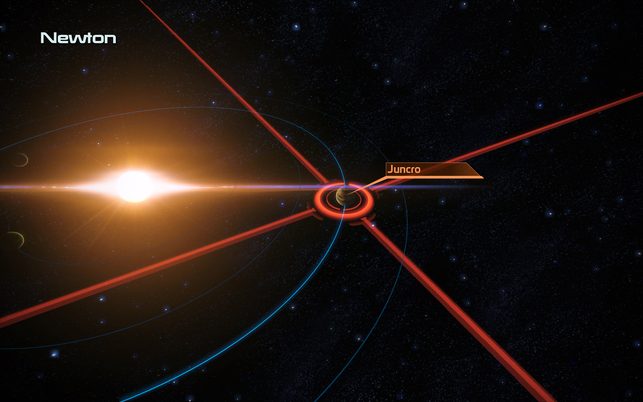
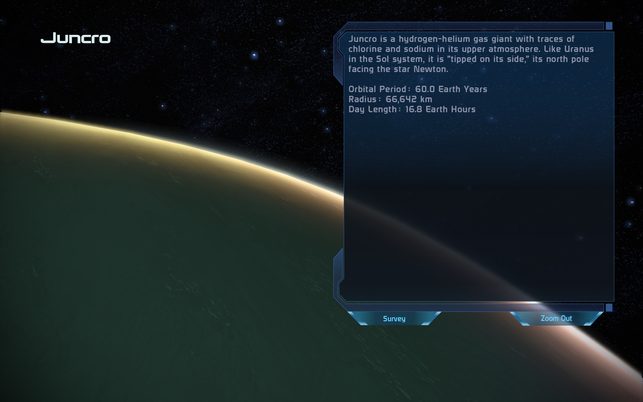
Juncro is a hydrogen-helium gas giant with traces of chlorine and sodium in its upper atmosphere. Like Uranus in the Sol system, it is “tipped on its side,” its north pole facing the star Newton.
Orbital Period: 60.0 Earth Years
Radius: 66,642 km
Day Length: 16.8 Earth Hours
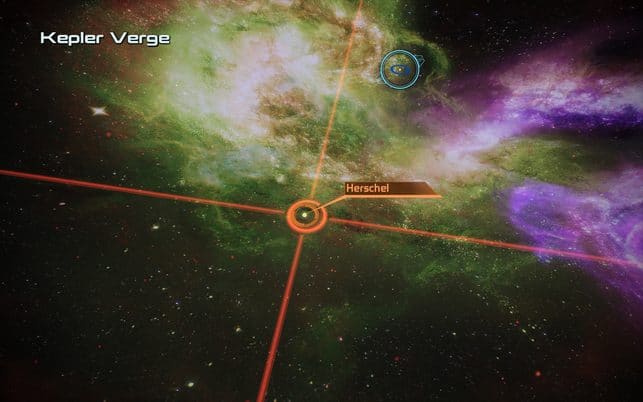
HERSCHEL
Tungel
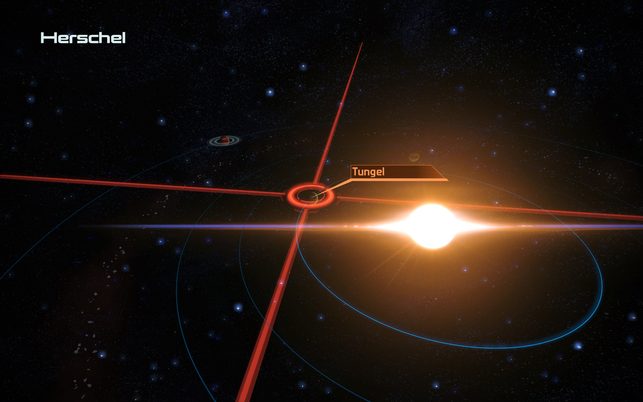
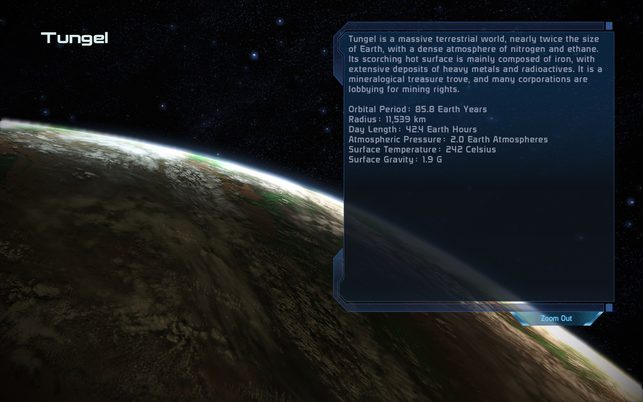
Tungel is a massive terrestrial world, nearly twice the size of Earth, with a dense atmosphere of nitrogen and ethane. Its scorching hot surface is mainly composed of iron, with extensive deposits of heavy metals and radioactives. It is a mineralogical treasure trove, and many corporations are lobbying for mining rights.
Orbital Period: 85.8 Earth Years
Radius: 11,539 km
Day Length: 42.4 Earth Hours
Atmospheric Pressure: 2.0 Earth Atmospheres
Surface Temperature: 242 Celsius
Surface Gravity: 1.9 G
Matol
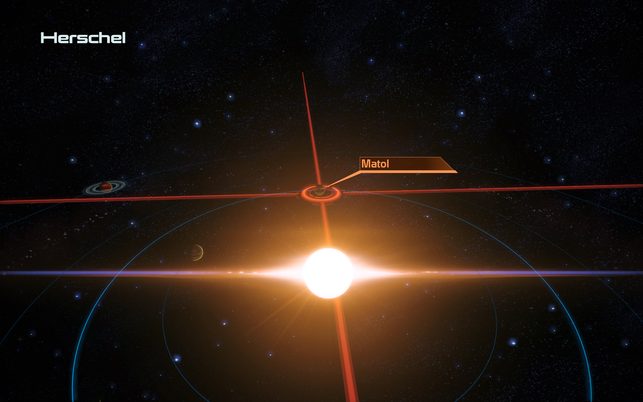
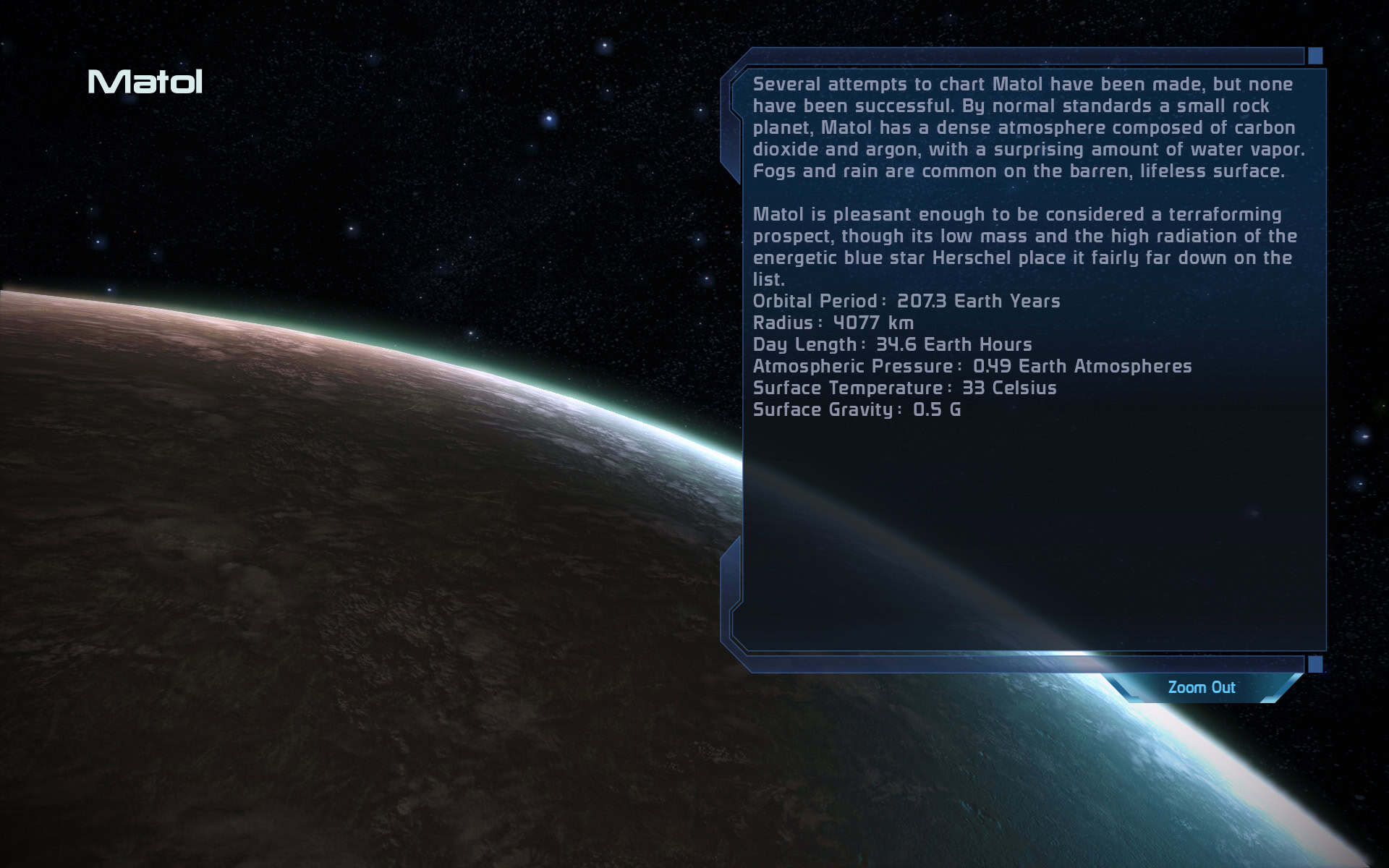
Several attempts to chart Matol have been made, but none have been successful. By normal standards a small rock planet, Matol has a dense atmosphere composed of carbon dioxide and argon, with a surprising amount of water vapor. Fogs and rain are common on the barren, lifeless surface.
Matol is pleasant enough to be considered a terraforming prospect, though its low mass and the high radiation of the energetic blue star Herschel place it fairly far down on the list.
Orbital Period: 2073 Earth Years
Radius: 4077 km
Day Length: 34.6 Earth Hours
Atmospheric Pressure: 0.49 Earth Atmospheres
Surface Temperature: 33 Celsius
Surface Gravity: 0.5 G
Clobaka
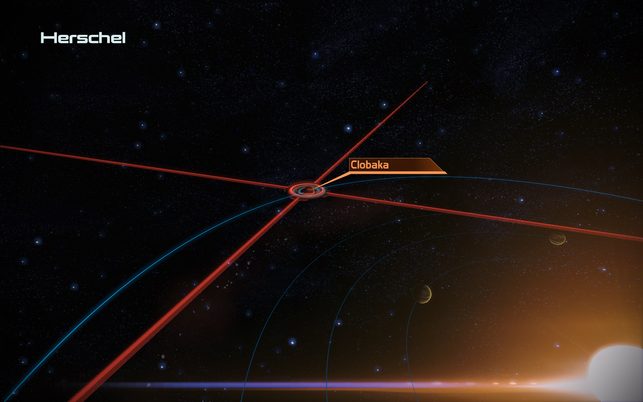
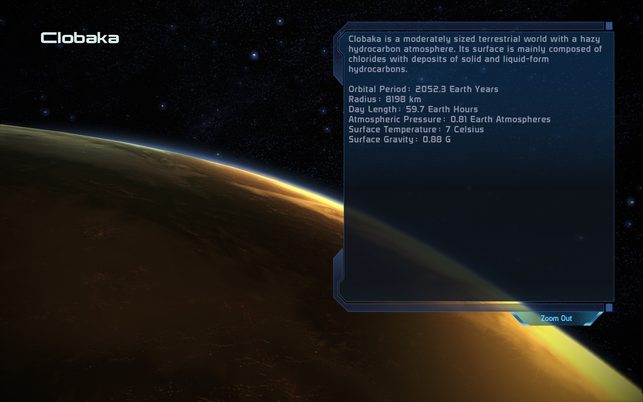
Clobaka is a moderately sized terrestrial world with a hazy hydrocarbon atmosphere. Its surface is mainly composed of chlorides with deposits of solid and liquid-form
Hydrocarbons.
Orbital Period: 2052.3 Earth Years
Radius: 8198 km
Day Length: 59.7 Earth Hours
Atmospheric Pressure: 0.81 Earth Atmospheres
Surface Temperature: 7 Celsius
Surface Gravity: 0.88 G
MSV Fedele
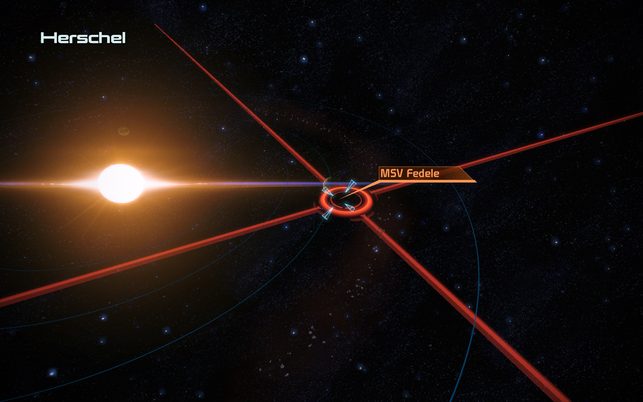
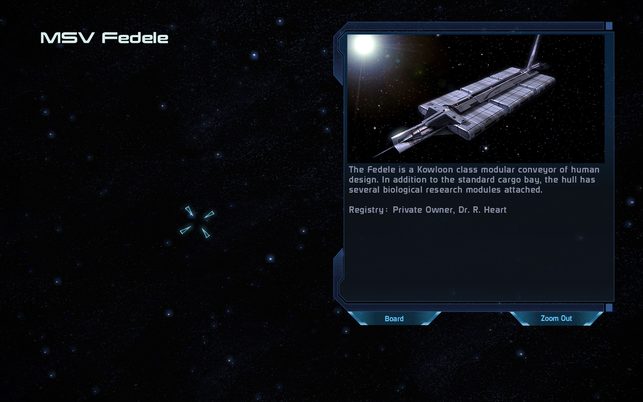
The Fedele is a Kowloon class modular conveyor of human design. In addition to the standard cargo bay, the hull has several biological research modules attached.
Registry: Private Owner, Dr. R. Heart
Clugon
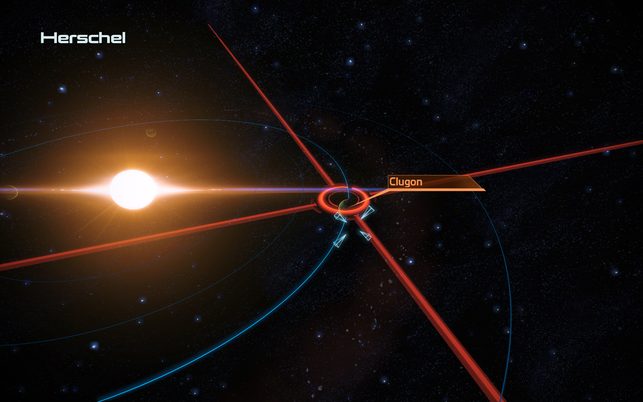
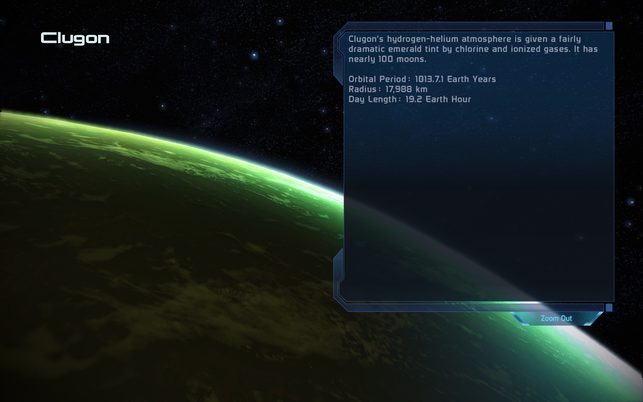
Clugon’s hydrogen-helium atmosphere is given a fairly dramatic emerald tint by chlorine and ionized gases. It has nearly 100 moons.
Orbital Period: 1013.7.1 Earth Years
Radius: 17,988 km
Day Length: 19.2 Earth Hour
LOCAL CLUSTER
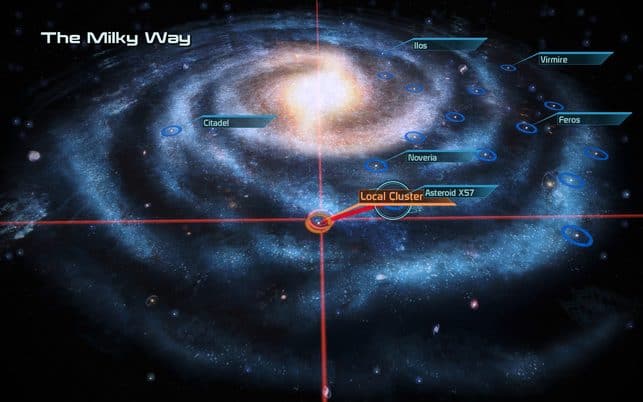
SOL
Mercury
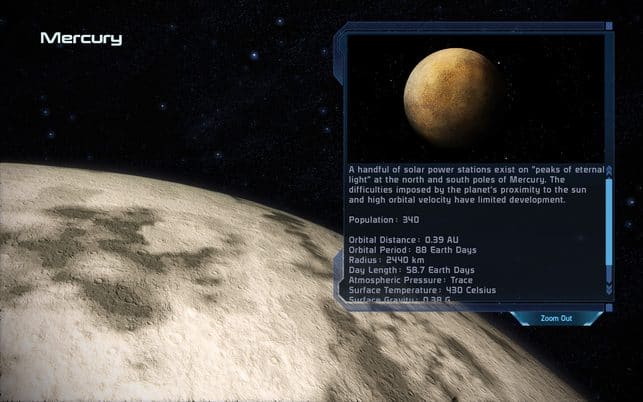
A handful of solar power stations exist on “peaks of eternal light” at the north and south poles of Mercury. The difficulties imposed by the planet’s proximity to the sun and high orbital velocity have limited development.
Population: 340
Orbital Distance: 0.39 AU
Orbital Period: 88 Earth Days
Radius: 2440 km
Day Length: 58.7 Earth Days
Atmospheric Pressure: Trace
Surface Temperature: 430 Celsius
Surface Gravity: 0.38 G
Earth
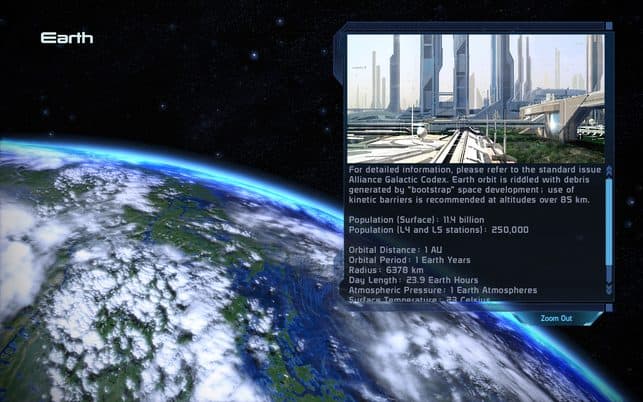
For detailed information, please refer to the standard issue Alliance Galactic Codex. Earth orbit is riddled with debris generated by “bootstrap” space development; use of kinetic barriers is recommended at altitudes over 85 km.
Population (Surface): 11.4 billion
Population (LY and LS stations): 250,000
Orbital Distance: 1 AU
Orbital Period: 1 Earth Years
Radius: 6378 km
Day Length: 23.9 Earth Hours
Atmospheric Pressure: 1 Earth Atmospheres
Surface Temperature: 23 Celcius
Luna
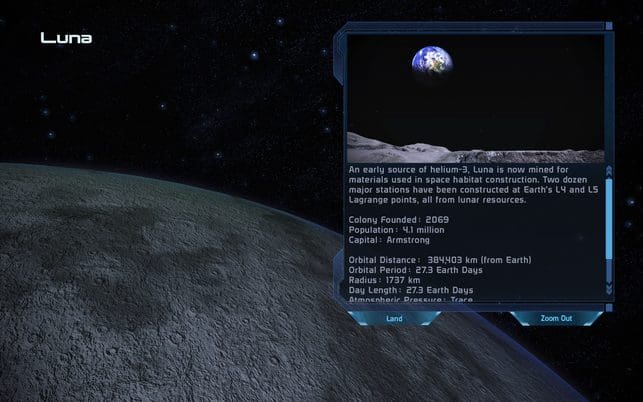
An early source of helium-3, Luna is now mined for materials used in space habitat construction. Two dozen major stations have been constructed at Earth’s L4 and LS Lagrange points, all from lunar resources.
Colony Founded: 2069
Population: 4.1 million
Capital: Armstrong
Orbital Distance: 384,403 km (from Earth)
Orbital Period: 27.3 Earth Days
Radius: 1737 km
Day Length: 27.3 Earth Days
Atmospheric Pressure: Trace
Surface Temperature: -53 Celsius
Venus
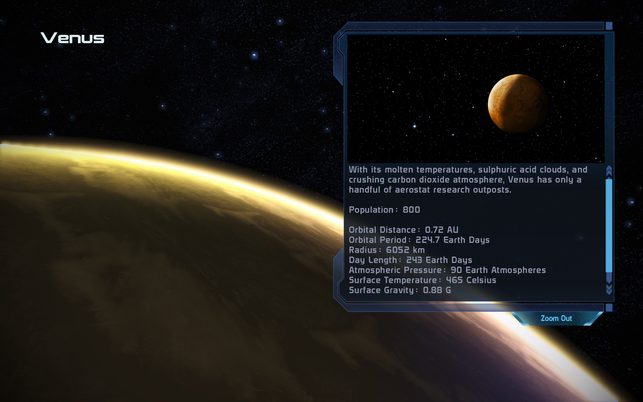
With its molten temperatures, sulphuric acid clouds, and crushing carbon dioxide atmosphere, Venus has only a handful of aerostat research outposts.
Population: 800
Orbital Distance: 0.72 AU
Orbital Period: 224.7 Earth Days
Radius: 6052 km
Day Length: 243 Earth Days
Atmospheric Pressure: 90 Earth Atmospheres
Surface Temperature: 465 Celsius
Surface Gravity: 0.88 G
Mars
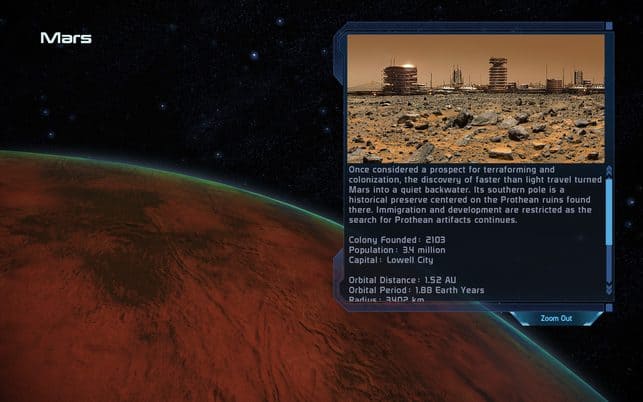
Once considered a prospect for terraforming and colonization, the discovery of faster than light travel turned Mars into a quiet backwater. Its southern pole is a historical preserve centered on the Prothean ruins found there. Immigration and development are restricted as the search for Prothean artifacts continues.
Colony Founded: 2103
Population 3.4 million
Capital: Lowell City
Orbital Distance: 1.52 AU
Orbital Period: 1.88 Earth Years
Radius: 3402 km
Day Length: 24.6 Earth Hours
Atmospheric Pressure: 0.06 Earth Atmospheres
Surface Temperature: -138 Celsius
Surface Gravity: 0.38 G
Uranus
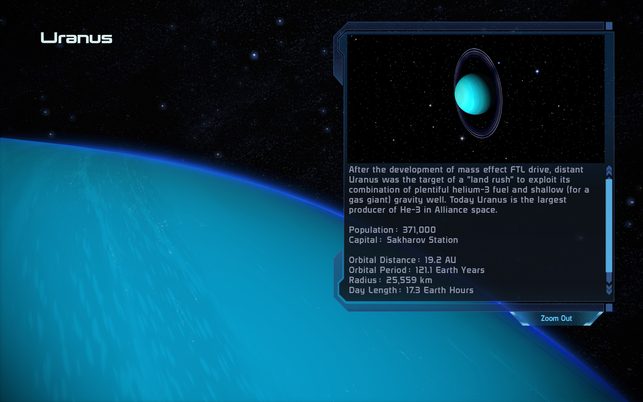
After the development of mass effect FTL drive, distant Uranus was the target of a “land rush” to exploit its combination of plentiful helium-3 fuel and shallow (for a gas giant) gravity well. Today Uranus is the largest producer of He-3 in Alliance space.
Population: 371,000
Capital: Sakharov Station
Orbital Distance: 19.2 AU
Orbital Period: 121.1 Earth Years
Radius: 25,559 km
Day Length: 17.3 Earth Hours
Neptune
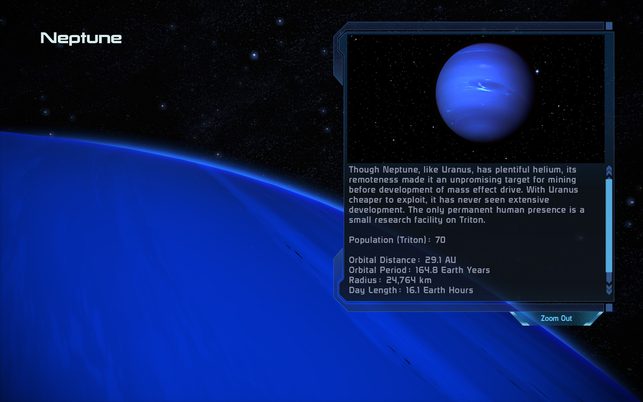
Though Neptune, like Uranus, has plentiful helium, its remoteness made it an unpromising target for mining before development of mass effect drive. With Uranus cheaper to exploit, it has never seen extensive development. The only permanent human presence is a small research facility on Triton.
Population (Triton): 70
Orbital Distance: 29.1 AU
Orbital Period: 164.8 Earth Years
Radius: 24,764 km
Day Length: 16.1 Earth Hours
Jupiter
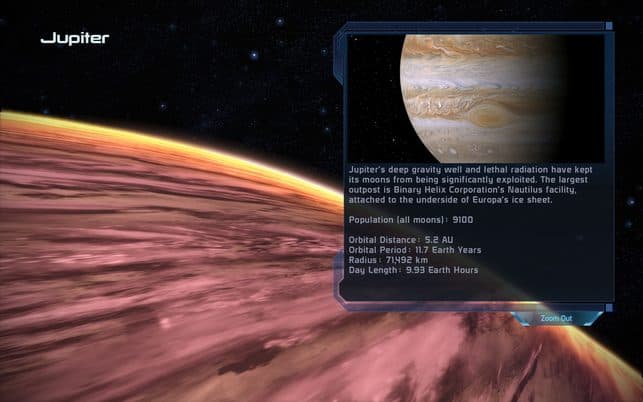
Jupiter’s deep gravity well and lethal radiation have kept its moons from being significantly exploited. The largest outpost is Binary Helix Corporation’s Nautilus facility, attached to the underside of Europa’s ice sheet.
Population (all moons): 9100
Orbital Distance: 5.2 AU
Orbital Period: 11.7 Earth Years
Radius: 71,492 km
Day Length: 9.93 Earth Hours
Saturn
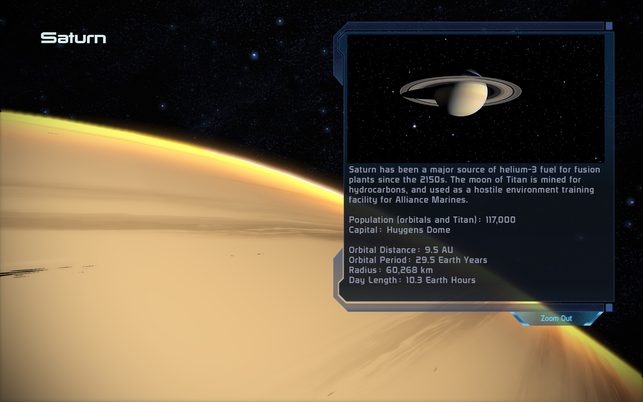
Saturn has been a major source of helium-3 fuel for fusion plants since the 2150s. The moon of Titan is mined for hydrocarbons, and used as a hostile environment training facility for Alliance Marines.
Population (orbitals and Titan): 117,000
Capital: Huygens Dome
Orbital Distance: 9.5 AU
Orbital Period: 29.5 Earth Years
Radius: 60,268 km
Day Length: 10.3 Earth Hours
Pluto
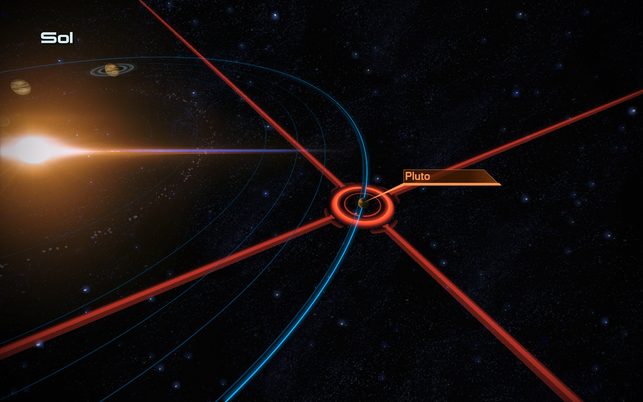
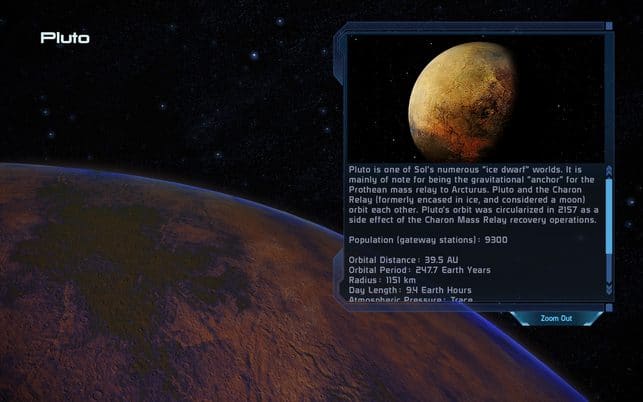
Pluto is one of Sol’s numerous “ice dwarf” worlds. It is mainly of note for being the gravitational “anchor” for the Mass Relay to Arcturus. Pluto and the Charon Relay (formerly encased in ice, and considered a moon) orbit each other. Pluto’s orbit was circularized in 2157 as a side effect of the Charon Mass Relay recovery operations.
Population (gateway stations): 9300
Orbital Distance: 39.5 AU
Orbital Period: 247.7 Earth Years
Radius: 1151 km
Day Length: 9.4 Earth Hours
Atmospheric Pressure: Trace
Surface Temperature: -229 Celsius
Surface Gravity: 0.06 G
MAROON SEA
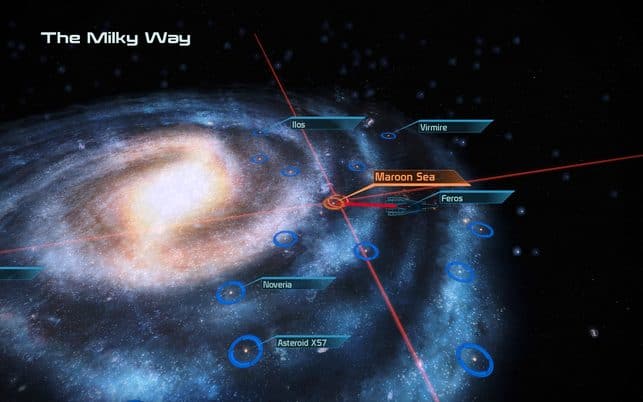
CASPIAN
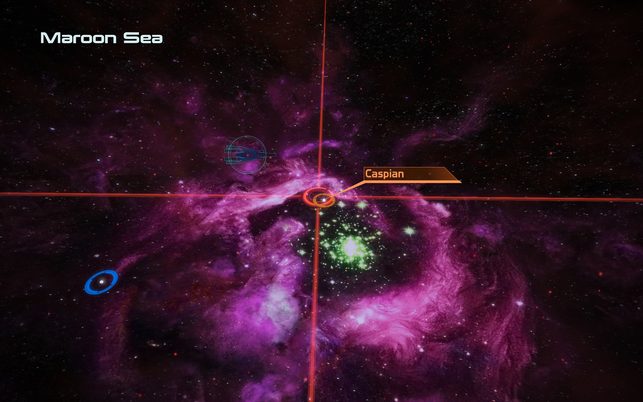
MSV Cornucopia
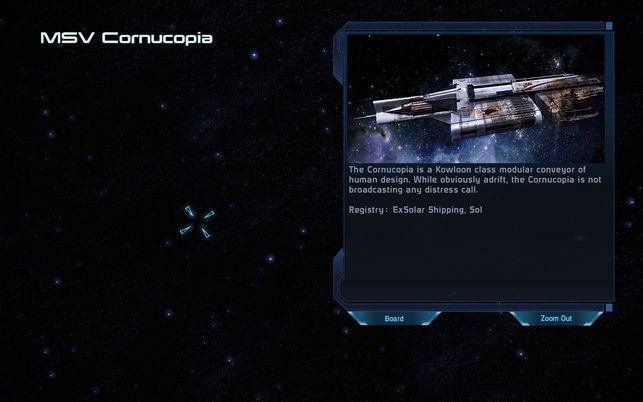
The Cornucopia is a Kowloon class modular conveyor of human design. While obviously adrift, the Cornucopia is not broadcasting any distress call.
Registry: ExSolar Shipping, Sol
Antida*
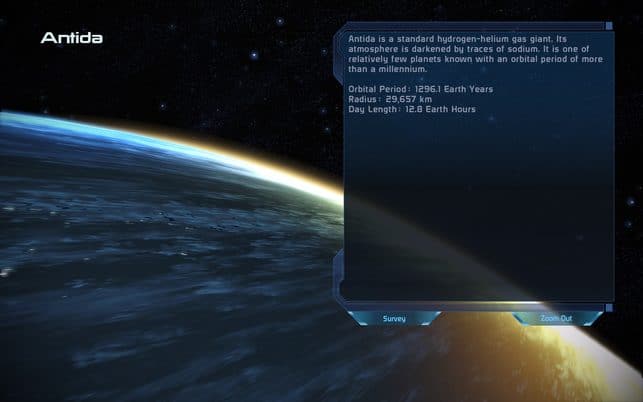
Antida is a standard hydrogen-helium gas giant. Its atmosphere is darkened by traces of sodium. It is one of relatively few planets known with an orbital period of more than a millennium.
Orbital Period: 1296.1 Earth Years
Radius: 29,657 km
Day Length: 12.8 Earth Hours
Almarcrux
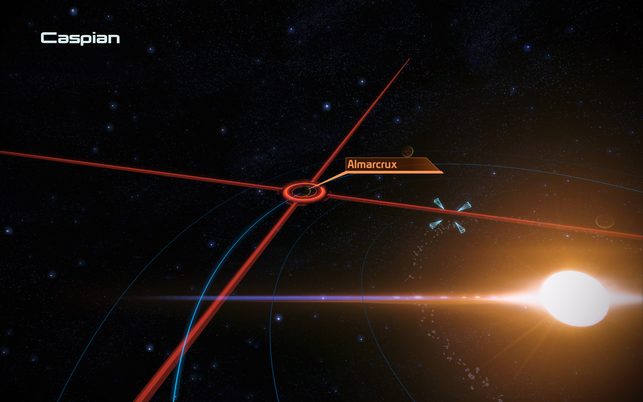
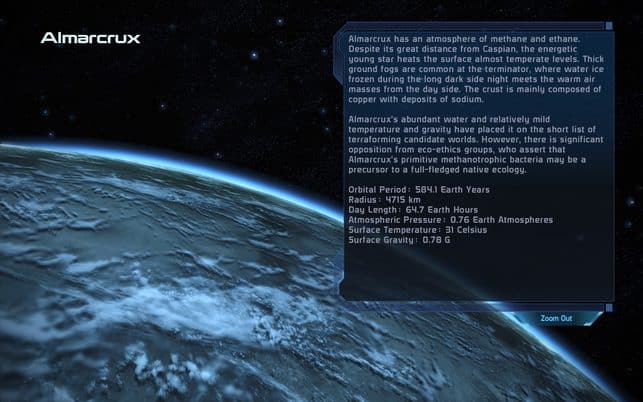
Almarcrux has an atmosphere of methane and ethane. Despite its great distance from Caspian, the energetic young star heats the surface almost temperate levels. Thick ground fogs are common at the terminator, where water ice frozen during the long dark side night meets the warm air masses from the day side. The crust is mainly composed of copper with deposits of sodium.
Almarcrux’s abundant water and relatively mild temperature and gravity have placed it on the short list of terraforming candidate worlds. However, there is significant opposition from eco-ethics groups, who assert that Almarcrux’s primitive methanotrophic bacteria may be a precursor to a full-fledged native ecology.
Orbital Period: 584.1 Earth Years
Radius: 4715 km
Day Length: 64.7 Earth Hours
Atmospheric Pressure: 0.76 Earth Atmospheres
Surface Temperature: 31 Celsius
Surface Gravity: 0.78 G
Clotanco*
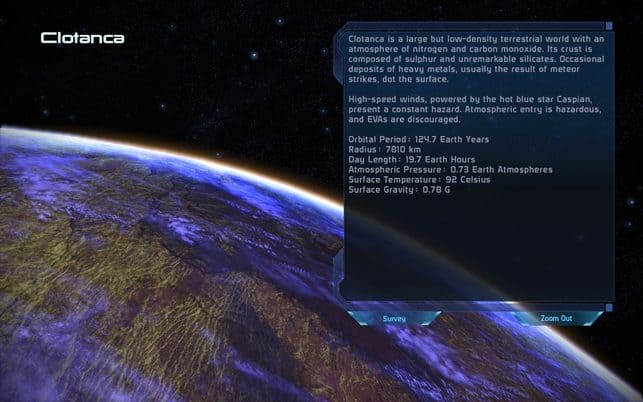
Clotanca is a large but low-density terrestrial world with an atmosphere of nitrogen and carbon monoxide. Its crust is composed of sulphur and unremarkable silicates. Occasional deposits of heavy metals, usually the result of meteor strikes, dot the surface.
High-speed winds, powered by the hot blue star Caspian, present a constant hazard. Atmospheric entry is hazardous, and EVAS are discouraged.
Orbital Period: 124.7 Earth Years
Radius: 7810 km
Day Length: 19.7 Earth Hours
Atmospheric Pressure: 0.73 Earth Atmospheres
Surface Temperature: 92 Celsius
Surface Gravity: 0.78 G
Farnuri*
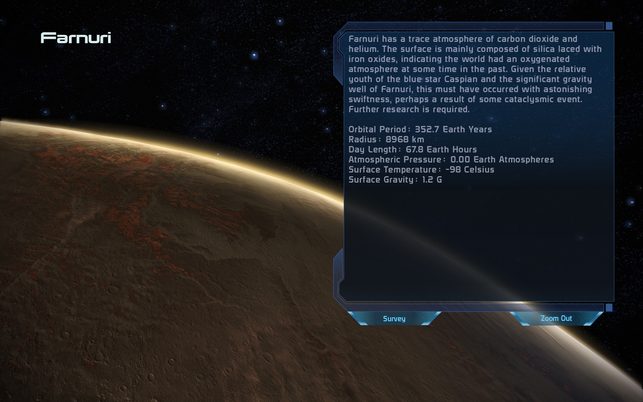
Farnuri has a trace atmosphere of carbon dioxide and helium. The surface is mainly composed of silica laced with iron oxides, indicating the world had an oxygenated atmosphere at some time in the past. Given the relative youth of the blue star Caspian and the significant gravity well of Farnuri, this must have occurred with astonishing swiftness, perhaps a result of some cataclysmic event. Further research is required.
Orbital Period: 352.7 Earth Years
Radius: 8968 km
Day Length: 67.8 Earth Hours
Atmospheric Pressure: 0.00 Earth Atmospheres
Surface Temperature: -98 Celsius
Surface Gravity: 1.2 G
MATANO
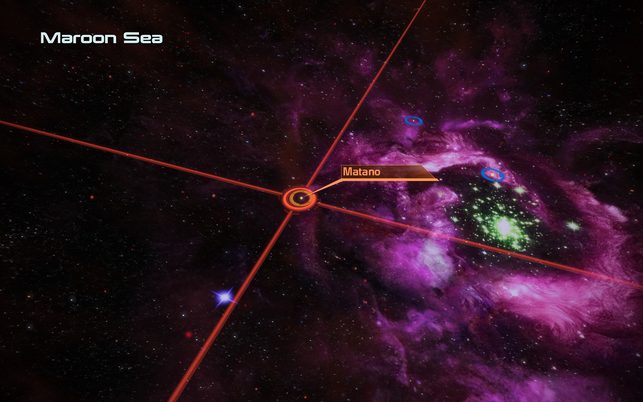
Inti
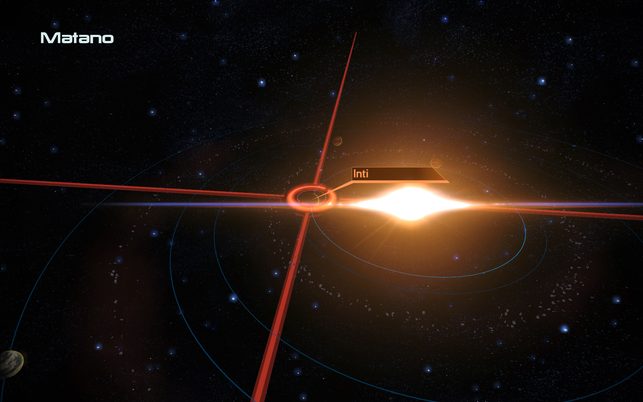
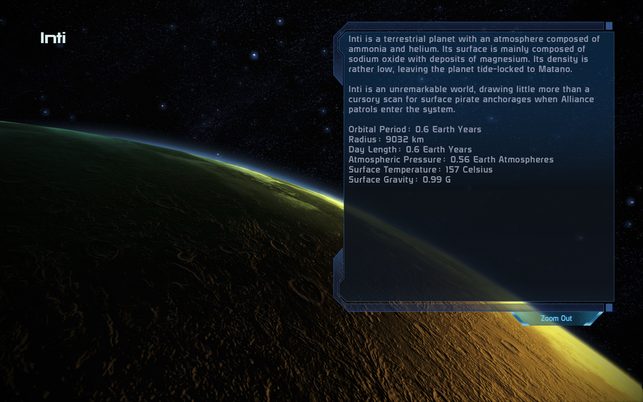
Inti is a terrestrial planet with an atmosphere composed of ammonia and helium. Its surface is mainly composed of sodium oxide with deposits of magnesium. Its density is rather low, leaving the planet tide-locked to Matano.
Inti is an unremarkable world, drawing little more than a cursory scan for surface pirate anchorages when Alliance patrols enter the system.
Orbital Period: 0.6 Earth Years
Radius: 9032 km
Day Length: 0.6 Earth Years
Atmospheric Pressure: 0.56 Earth Atmospheres
Surface Temperature: 157 Celsius
Surface Gravity: 0.99 G
Apo
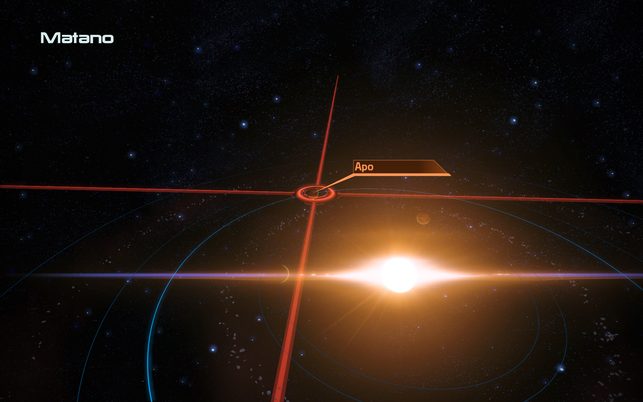
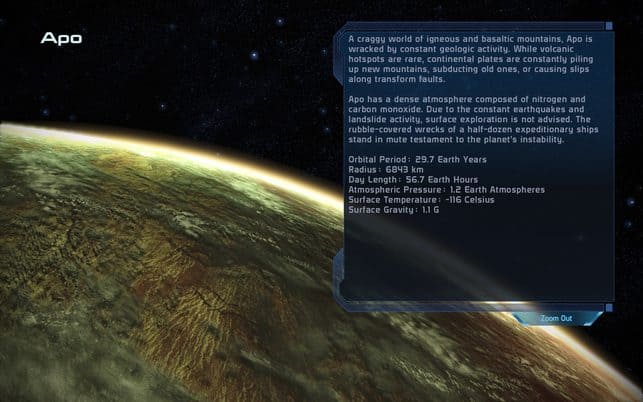
A craggy world of igneous and basaltic mountains, Apo is wracked by constant geologic activity. While volcanic hotspots are rare, continental plates are constantly piling up new mountains, subducting old ones, or causing slips along transform faults.
Apo has a dense atmosphere composed of nitrogen and carbon monoxide. Due to the constant earthquakes and landslide activity, surface exploration is not advised. The rubble-covered wrecks of a half-dozen expeditionary ships stand in mute testament to the planet’s instability.
Orbital Period: 29.7 Earth Years
Radius: 6843 km
Day Length: 56.7 Earth Hours
Atmospheric Pressure: 1.2 Earth Atmospheres
Surface Temperature: -116 Celsius
Surface Gravity: 1.1 G
Chasca
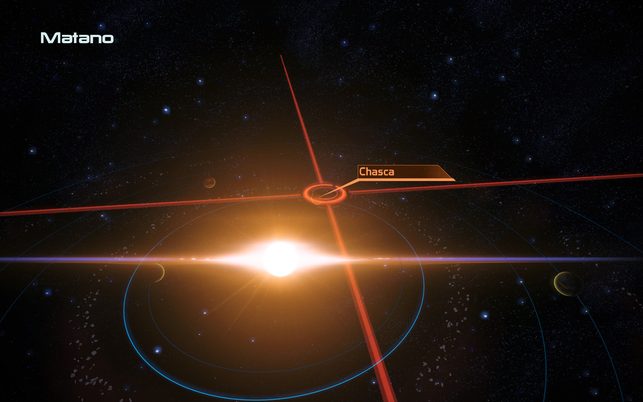
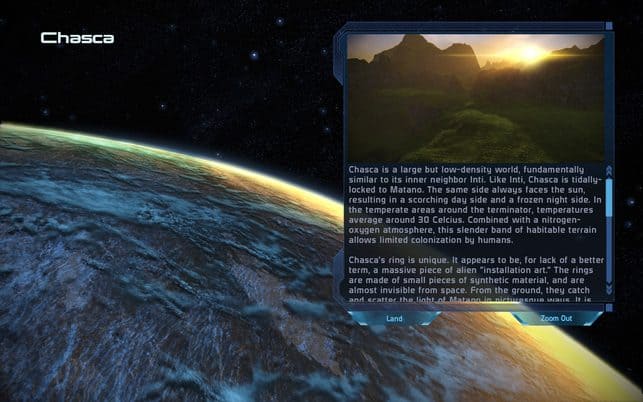
Chasca is a large but low-density world, fundamentally similar to its inner neighbor Inti. Like Inti, Chasca is tidally-locked to Matano. The same side always faces the sun, resulting in a scorching day side and a frozen night side. In the temperate areas around the terminator, temperatures average around 30 Celcius. Combined with a nitrogen-oxygen atmosphere, this slender band of habitable terrain allows limited colonization by humans.
Chasca’s ring is unique. It appears to be, for lack of a better term, a massive piece of alien “installation art.” The rings are made of small pieces of synthetic material, and are almost invisible from space. From the ground, they catch and scatter the light of Matano in picturesque ways. It is not known who created the ring, or when.
Chasca is very early development, with little more than a few pioneer teams scattered across the surface. Information is being collated about native hazards and ecology, while a massive colonist recruiting drive is gearing up back on Earth.
Colony Founded: 2183
Population: 150
Orbital Period: 1.3 Earth Years
Radius: 8059 km
Day Length: 1.3 Earth Years
Atmospheric Pressure: 0.86 Earth Atmospheres
Surface Temperature: 67 Celsius
Surface Gravity: 0.88 G
Metallic Asteroid*
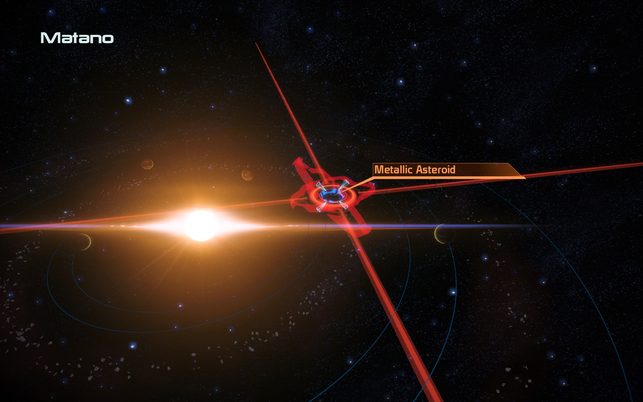
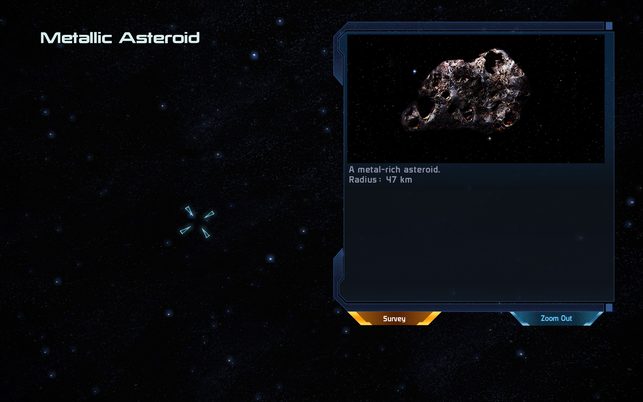
A metal-rich asteroid.
Radius: 47 km
Illapa
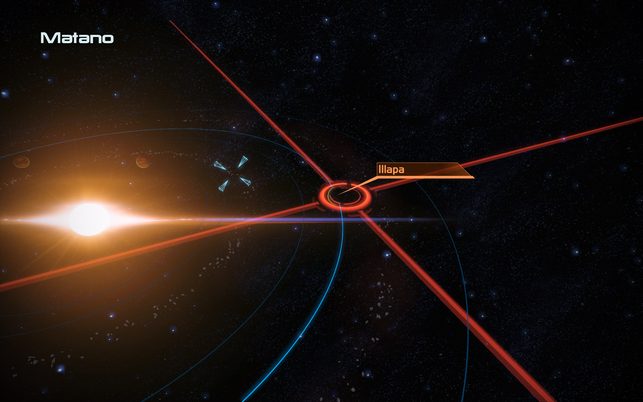
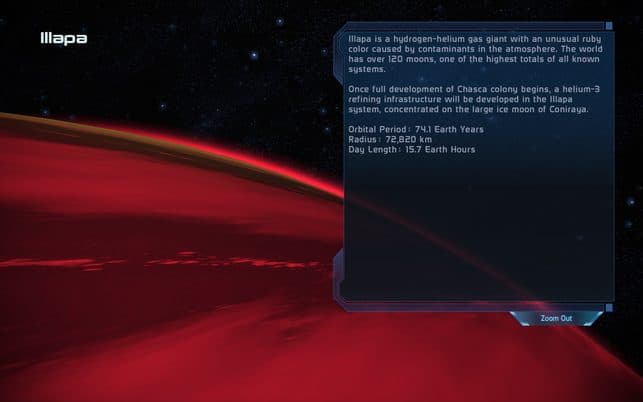
Illapa is a hydrogen-helium gas giant with an unusual ruby color caused by contaminants in the atmosphere. The world has over 120 moons, one of the highest totals of all known systems.
Once full development of Chasca colony begins, a helium-3 refining infrastructure will be developed in the Illapa system, concentrated on the large ice moon of Coniraya.
Orbital Period: 74.1 Earth Years
Radius: 72,820 km
Day Length: 15.7 Earth Hours
Supay*
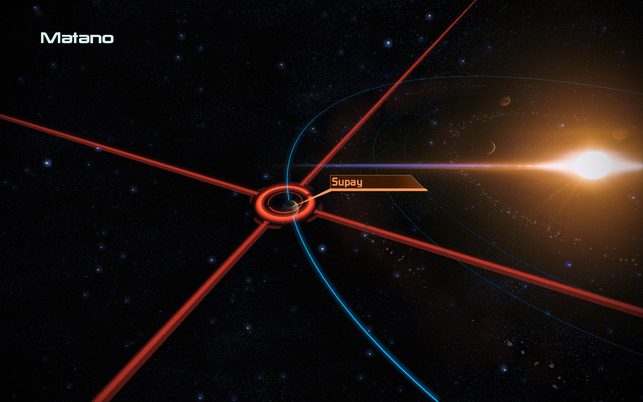
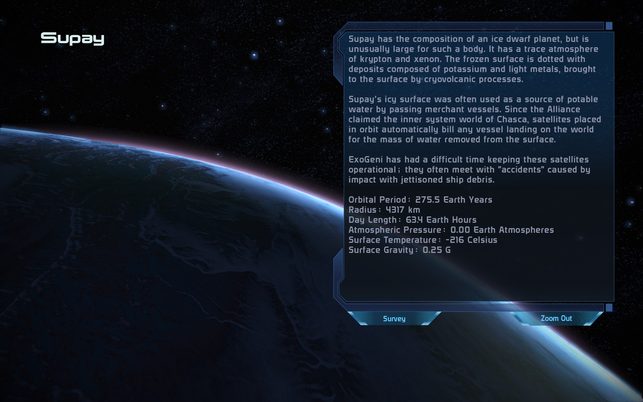
Supay has the composition of an ice dwarf planet, but is unusually large for such a body. It has a trace atmosphere of krypton and xenon. The frozen surface is dotted with deposits composed of potassium and light metals, brought to the surface by cryovolcanic processes.
Supay’s icy surface was often used as a source of potable water by passing merchant vessels. Since the Alliance claimed the inner system world of Chasca, satellites placed in orbit automatically bill any vessel landing on the world for the mass of water removed from the surface.
ExoGeni has had a difficult time keeping these satellites operational; they often meet with “accidents” caused by impact with jettisoned ship debris.
Orbital Period: 275.5 Earth Years
Radius: 4317 km
Day Length: 63.4 Earth Hours
Atmospheric Pressure: 0.00 Earth Atmospheres
Surface Temperature: -216 Celsius
Surface Gravity: 0.25 G
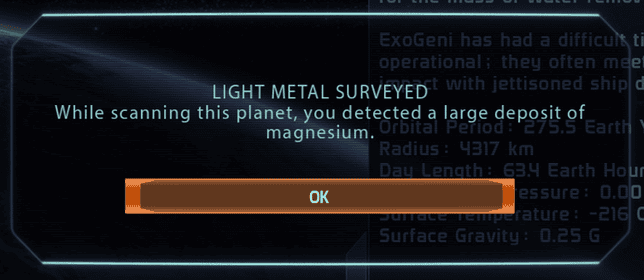
VOSTOK
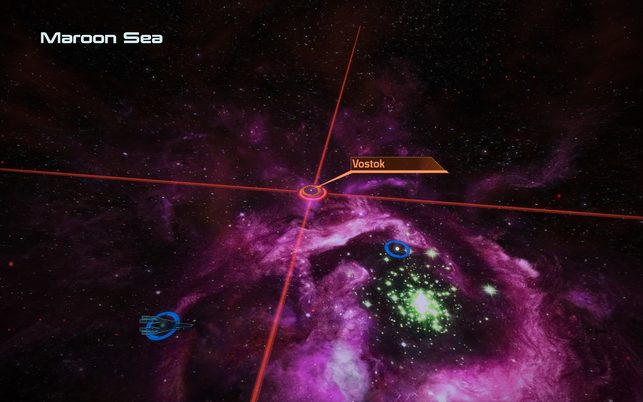
Clomarthu
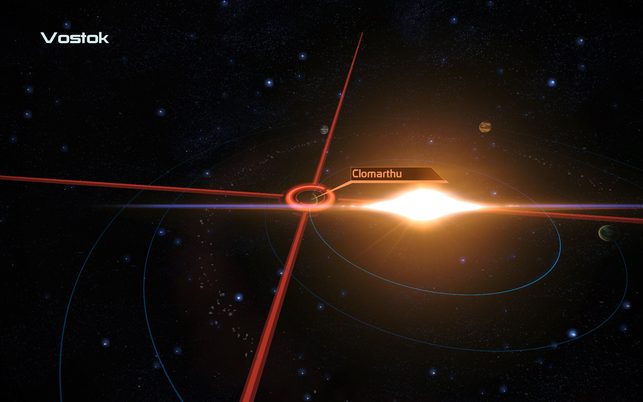
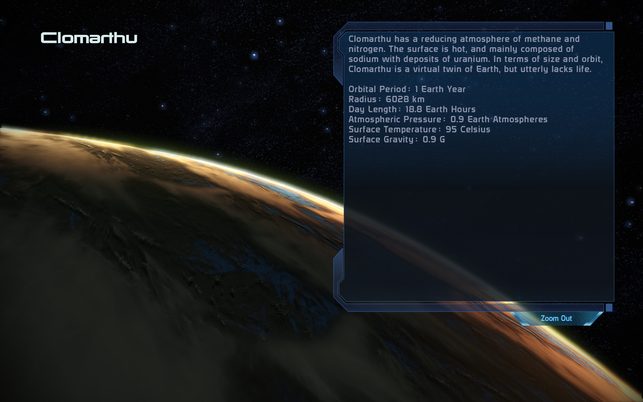
Clomarthu has a reducing atmosphere of methane and nitrogen. The surface is hot, and mainly composed of sodium with deposits of uranium. In terms of size and orbit, Clomarthu is a virtual twin of Earth, but utterly lacks life.
Orbital Period: 1 Earth Year
Radius: 6028 km
Day Length: 18.8 Earth Hours
Atmospheric Pressure: 0.9 Earth Atmospheres
Surface Temperature: 95 Celsius
Surface Gravity: 0.9 G
Alko
The geological properties of Alko have been scanned from orbit, but little else is known about it. A fairly typical mix outer system terrestrial of rock and ice, Alko has a trace atmosphere of krypton and xenon. Its crust is composed of silicates and water ice with deposits of aluminum. Unregistered starship traffic has been recorded in the vicinity of this planet. Travel is not advised.
Orbital Period: 28.7 Earth Years
Radius: 4949 km
Day Length: 45.2 Earth Hours
Atmospheric Pressure: 0.00 Earth Atmospheres
Surface Temperature: -167 Celsius
Surface Gravity: 0.5 G
Pataiton*
A rather small hydrogen-helium gas giant, Pataiton’s atmosphere contains large quantities of chlorine.
Orbital Period: 110.2 Earth Years
Radius: 16,622 km
Day Length: 18.6 Earth Hours
Metallic Asteroid*
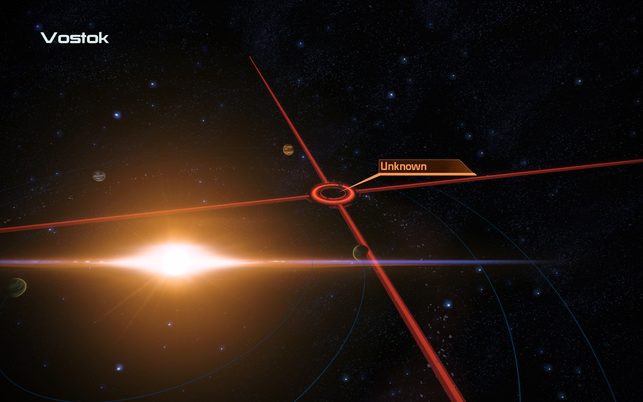
A metal-rich asteroid.
Radius: 139 km
Nodacrux
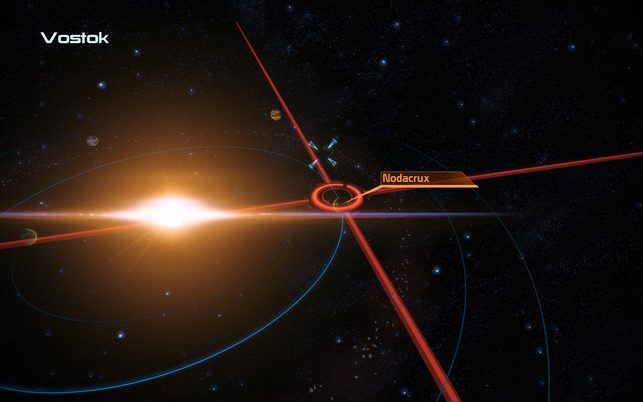
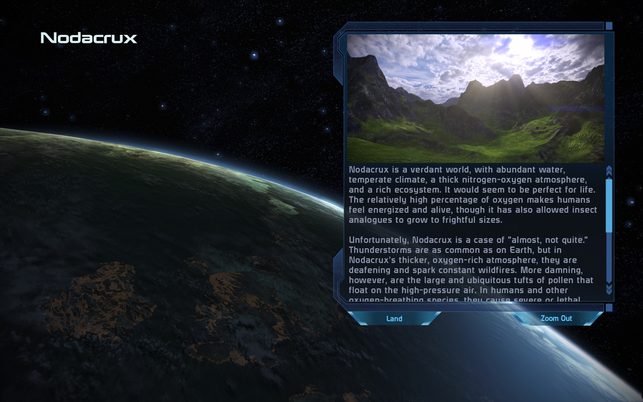
Nodacrux is a verdant world, with abundant water, temperate climate, a thick nitrogen-oxygen atmosphere, and a rich ecosystem. It would seem to be perfect for life. The relatively high percentage of oxygen makes humans feel energized and alive, though it has also allowed insect analogues to grow to frightful sizes.
Unfortunately, Nodacrux is a case of “almost, not quite.” Thunderstorms are as common as on Earth, but in Nodacrux’s thicker, oxygen-rich atmosphere, they are deafening and spark constant wildfires. More damning, however, are the large and ubiquitous tufts of pollen that float on the high-pressure air. In humans and other oxygen-breathing species, they cause severe or lethal allergic reactions.
Orbital Period: 3.6 Earth Years
Radius: 5988 km
Day Length: 22.2 Earth Hours
Atmospheric Pressure: 2.63 Earth Atmospheres
Surface Temperature: 23 Celsius
Surface Gravity: 0.9 G
PANGAEA EXPANSE
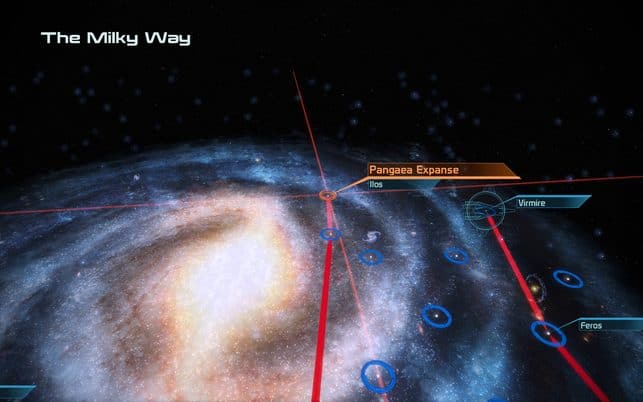
REFUGE
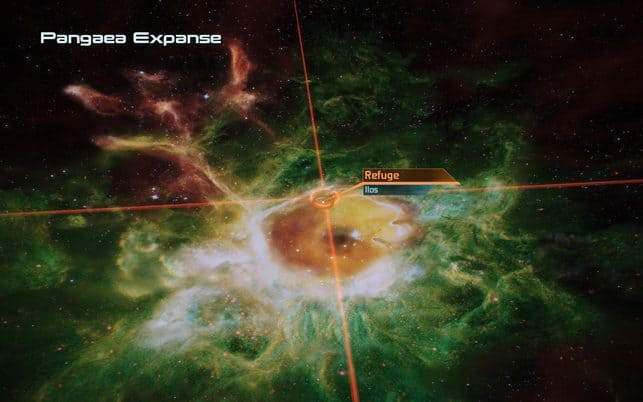
Agetoton
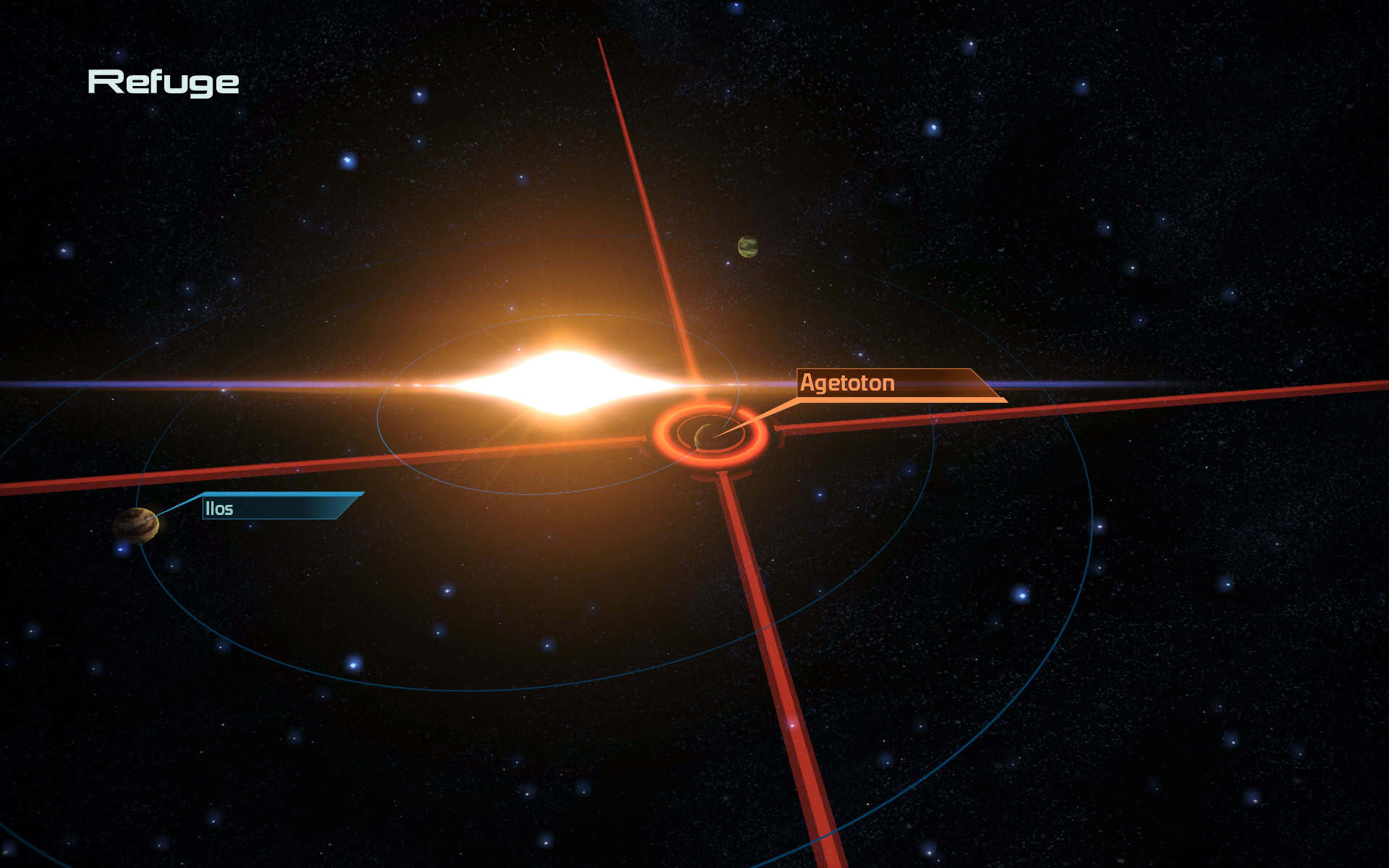
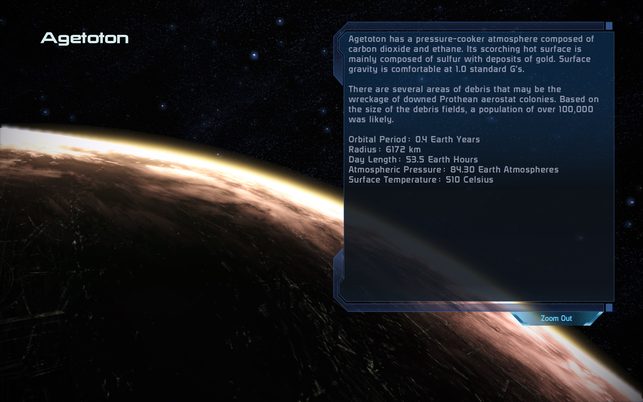
Agetoton has a pressure-cooker atmosphere composed of carbon dioxide and ethane. Its scorching hot surface is mainly composed of sulfur with deposits of gold. Surface gravity is comfortable at 1.0 standard G’s.
There are several areas of debris that may be the wreckage of downed Prothean aerostat colonies. Based on the size of the debris fields, a population of over 100,000 was likely.
Orbital Period: 0.4 Earth Years
Radius: 6172 km
Day Length: 53.5 Earth Hours
Atmospheric Pressure: 84.30 Earth Atmospheres
Surface Temperature: 510 Celsius
Ilos
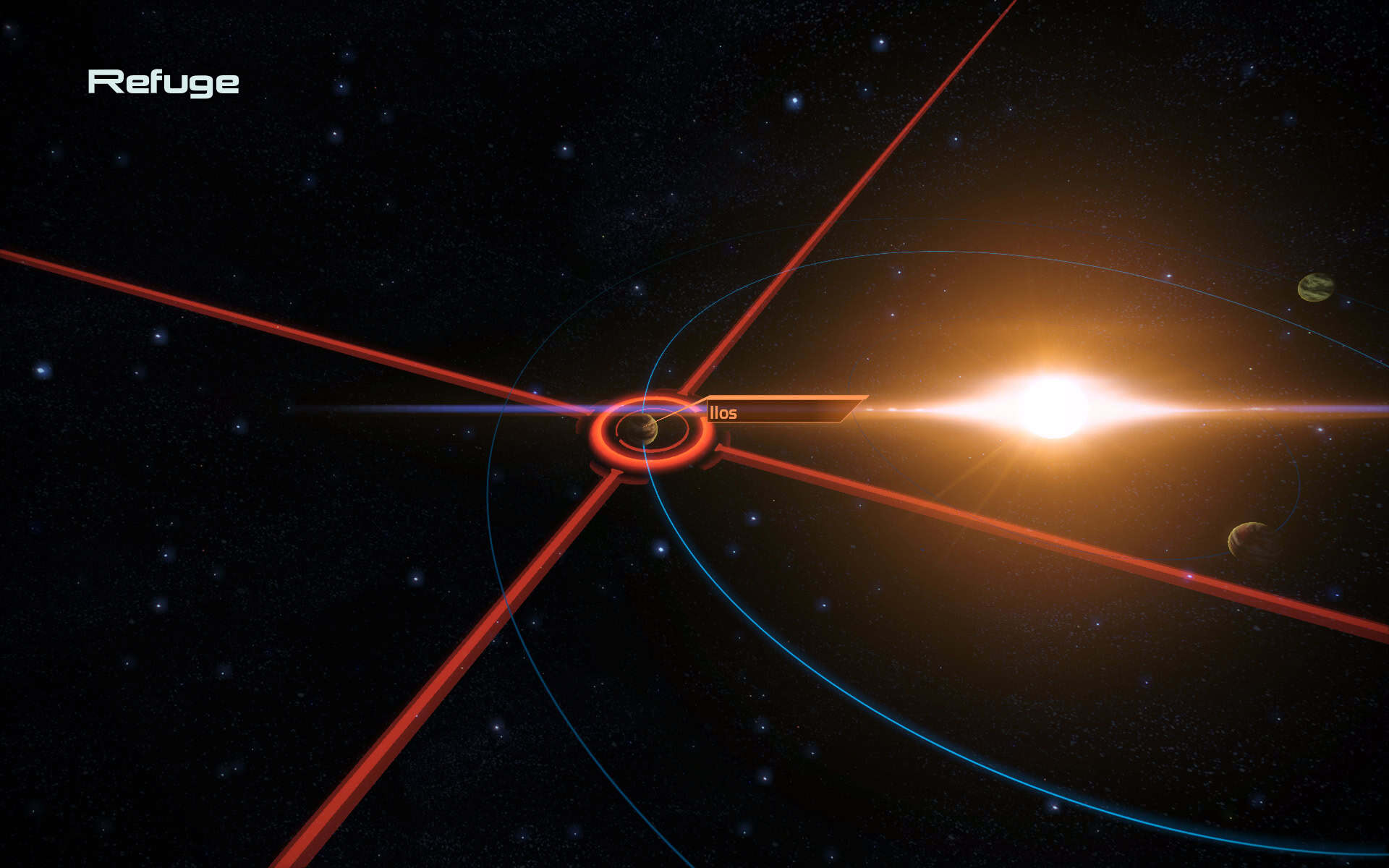
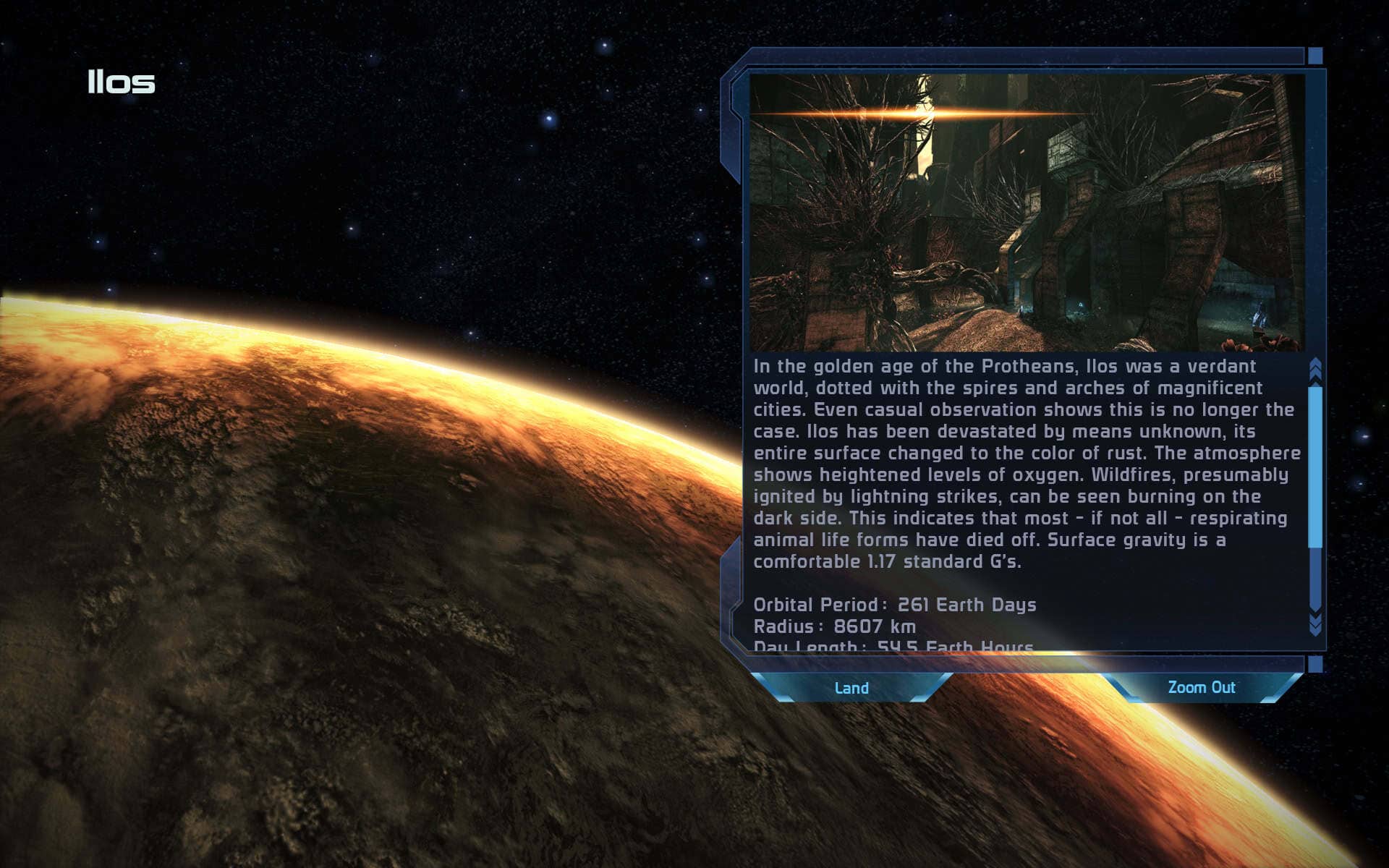
In the golden age of the Protheans, llos was a verdant world, dotted with the spires and arches of magnificent cities. Even casual observation shows this is no longer the case. Ilos has been devastated by means unknown, its entire surface changed to the color of rust. The atmosphere shows heightened levels of oxygen. Wildfires, presumably ignited by lightning strikes, can be seen burning on the dark side. This indicates that most – if not all – respirating animal life forms have died off. Surface gravity is a comfortable 1.17 standard G’s.
Orbital Period: 261 Earth Days
Radius: 8607 km
Day Length: 54.5 Earth Hours
Atmospheric Pressure: 11.26 Earth Atmospheres
Surface Temperature: 38 Celsius
Zafe
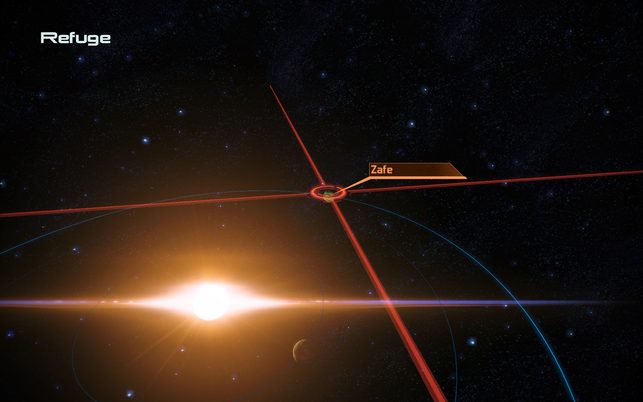
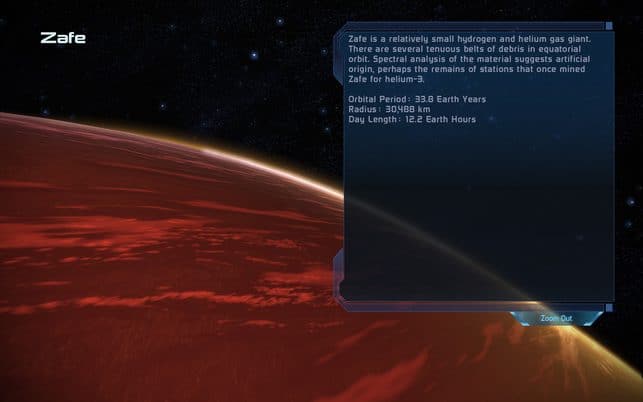
Zafe is a relatively small hydrogen and helium gas giant. There are several tenuous belts of debris in equatorial orbit. Spectral analysis of the material suggests artificial origin, perhaps the remains of stations that once mined Zafe for helium-3.
Orbital Period: 33.8 Earth Years
Radius: 30,488 km
Day Length: 12.2 Earth Hours
SENTRY OMEGA
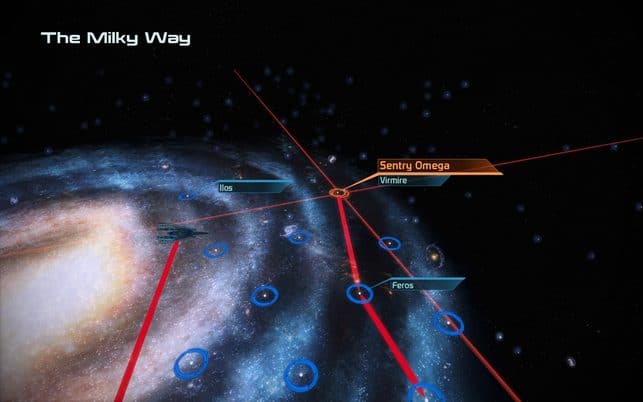
HOC
Jarfor
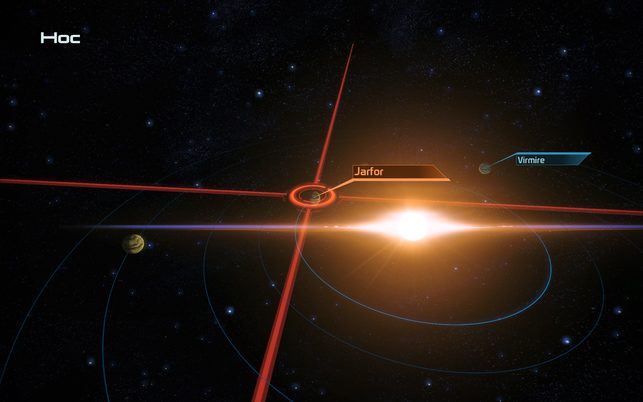
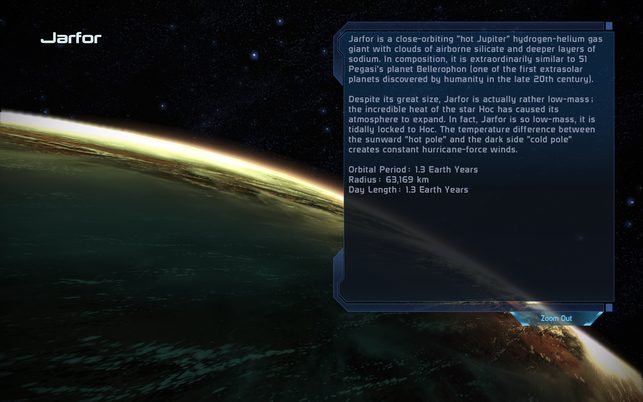
Jarfor is a close-orbiting “hot Jupiter” hydrogen-helium gas giant with clouds of airborne silicate and deeper layers of sodium. In composition, it is extraordinarily similar to 51 Pegasi’s planet Bellerophon (one of the first extrasolar planets discovered by humanity in the late 20th century).
Despite its great size, Jarfor is actually rather low-mass; the incredible heat of the star Hoc has caused its atmosphere to expand. In fact, Jarfor is so low-mass, it is tidally locked to Hoc. The temperature difference between the sunward “hot pole” and the dark side “cold pole” creates constant hurricane-force winds.
Orbital Period: 1.3 Earth Years
Radius: 63,169 km
Day Length: 1.3 Earth Years
Nemata
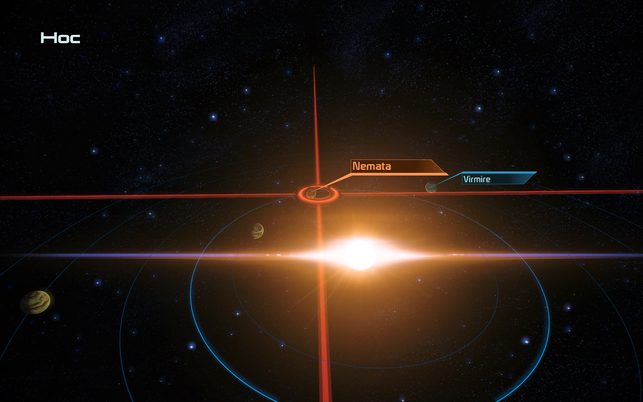
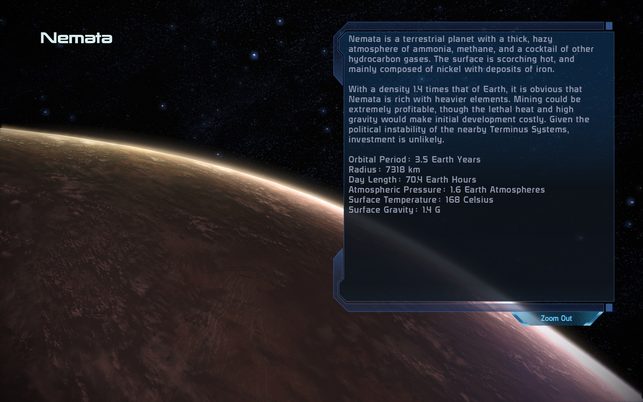
Nemata is a terrestrial planet with a thick, hazy atmosphere of ammonia, methane, and a cocktail of other hydrocarbon gases. The surface is scorching hot, and mainly composed of nickel with deposits of iron.
With a density 1.4 times that of Earth, it is obvious that Nemata is rich with heavier elements. Mining could be extremely profitable, though the lethal heat and high gravity would make initial development costly. Given the political instability of the nearby Terminus Systems, investment is unlikely.
Orbital Period: 3.5 Earth Years
Radius: 7318 km
Day Length: 70.4 Earth Hours
Atmospheric Pressure: 1.6 Earth Atmospheres
Surface Temperature: 168 Celsius
Surface Gravity: 1.4 G
Cloroplon
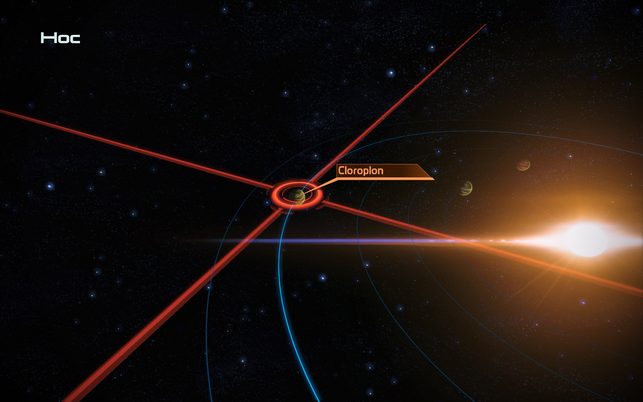
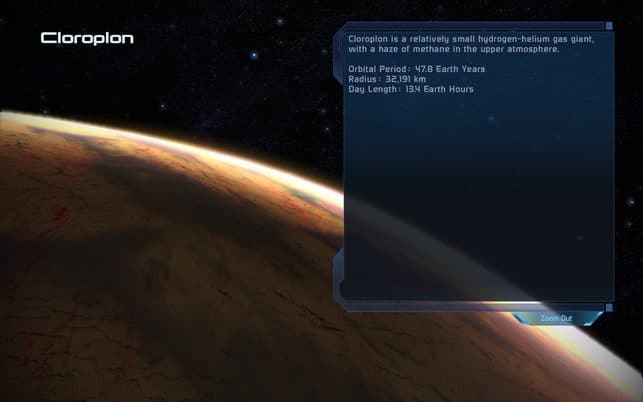
Cloroplon is a relatively small hydrogen-helium gas giant, with a haze of methane in the upper atmosphere.
Orbital Period: 47.8 Earth Years
Radius: 32,191 km
Day Length: 13.4 Earth Hours
Virmire
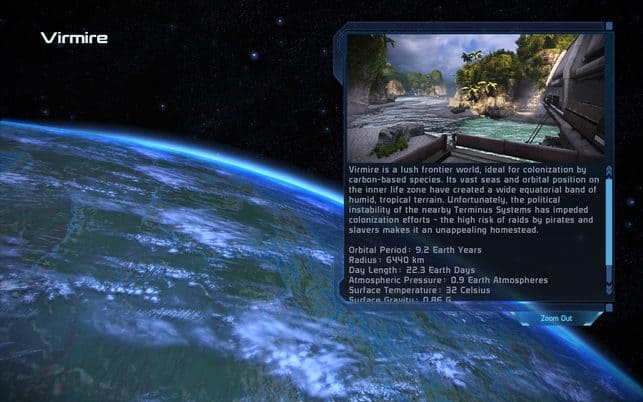
Virmire is a lush frontier world, ideal for colonization by carbon-based species. Its vast seas and orbital position on the inner life zone have created a wide equatorial band of humid, tropical terrain. Unfortunately, the political instability of the nearby Terminus Systems has impeded colonization efforts – the high risk of raids by pirates and slavers makes it an unappealing homestead.
Orbital Period: 9.2 Earth Years
Radius: 6440 km
Day Length: 22.3 Earth Days
Atmospheric Pressure: 0.9 Earth Atmospheres
Surface Temperature: 32 Celsius
Surface Gravity: 0.86 G
Prescyla
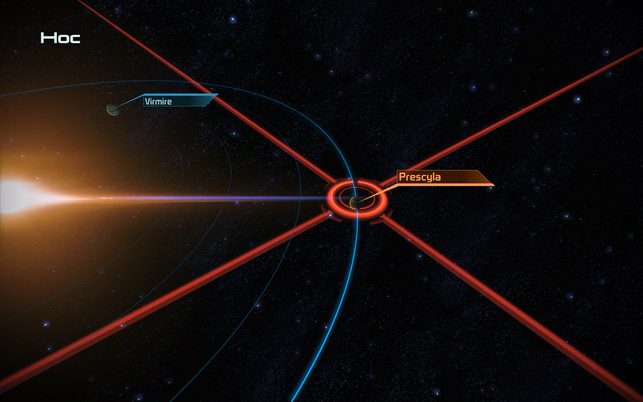
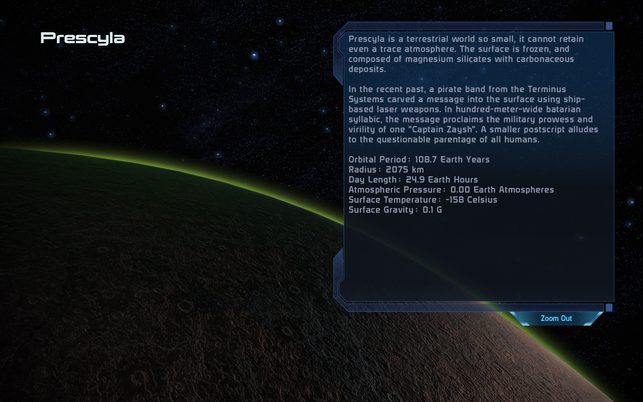
Prescyla is a terrestrial world so small, it cannot retain even a trace atmosphere. The surface is frozen, and composed of magnesium silicates with carbonaceous deposits.
In the recent past, a pirate band from the Terminus Systems carved a message into the surface using ship-based laser weapons. In hundred-meter-wide batarian syllabic, the message proclaims the military prowess and virility of one “Captain Zaysh”. A smaller postscript alludes to the questionable parentage of all humans.
Orbital Period: 108.7 Earth Years
Radius: 2075 km
Day Length: 24.9 Earth Hours
Atmospheric Pressure: 0.00 Earth Atmospheres
Surface Temperature: -158 Celsius
Surface Gravity: 0.1 G
SERPENT NEBULA
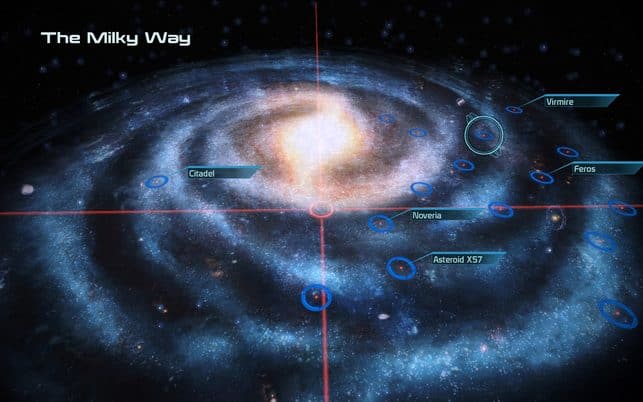
WIDOW
Citadel
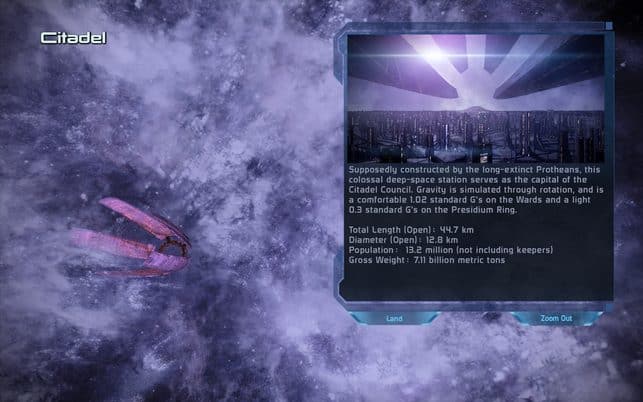
Supposedly constructed by the long-extinct Protheans, this colossal deep-space station serves as the capital of the Citadel Council. Gravity is simulated through rotation, and is a comfortable 1.02 standard G’s on the Wards and a light 0.3 standard G’s on the Presidium Ring.
Total Length (Open): 44.7 km
Diameter (Open): 12.8 km
Population: 13.2 million (not including keepers)
Gross Weight: 7.11 billion metric tons
STYX THETA
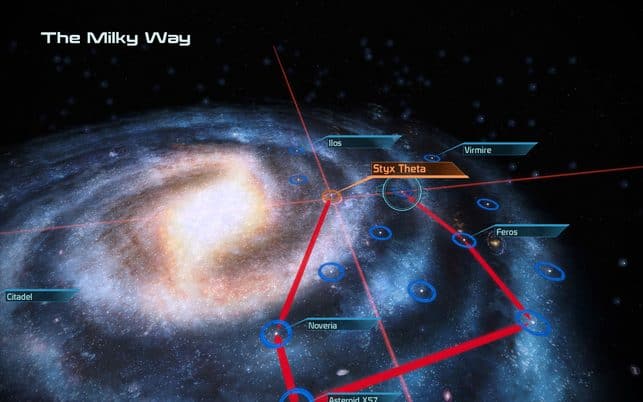
ACHERON
Farthorl
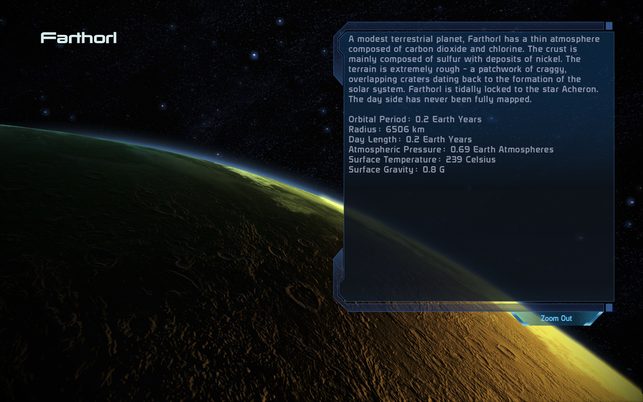
A modest terrestrial planet, Farthorl has a thin atmosphere composed of carbon dioxide and chlorine. The crust is mainly composed of sulfur with deposits of nickel. The terrain is extremely rough – a patchwork of craggy, overlapping craters dating back to the formation of the solar system. Farthorl is tidally locked to the star Acheron. The day side has never been fully mapped.
Orbital Period: 0.2 Earth Years
Radius: 6506 km
Day Length: 0.2 Earth Years
Atmospheric Pressure: 0.69 Earth Atmospheres
Surface Temperature: 239 Celsius
Surface Gravity: 0.8 G
Imaneya
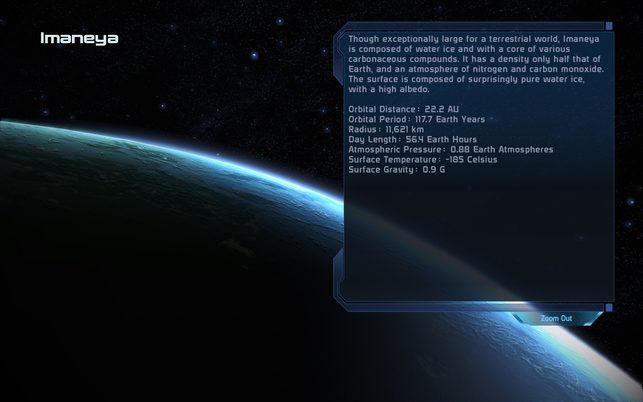
Though exceptionally large for a terrestrial world, Imaneya is composed of water ice and with a core of various carbonaceous compounds. It has a density only half that of Earth, and an atmosphere of nitrogen and carbon monoxide. The surface is composed of surprisingly pure water ice, with a high albedo.
Orbital Distance: 22.2 AU
Orbital Period: 117.7 Earth Years
Radius: 11,621 km
Day Length: 56.4 Earth Hours
Atmospheric Pressure: 0.88 Earth Atmospheres
Surface Temperature: -185 Celsius
Surface Gravity: 0.9 G
Altahe
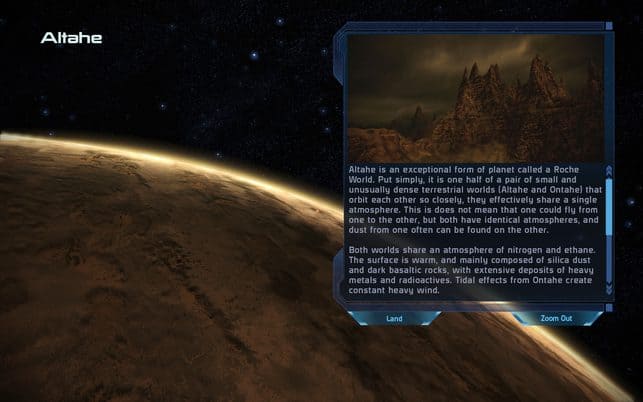
Altahe is an exceptional form of planet called a Roche World. Put simply, it is one half of a pair of small and unusually dense terrestrial worlds (Altahe and Ontahe) that orbit each other so closely, they effectively share a single atmosphere. This is does not mean that one could fly from one to the other, but both have identical atmospheres, and dust from one often can be found on the other.
Both worlds share an atmosphere of nitrogen and ethane. The surface is warm, and mainly composed of silica dust and dark basaltic rocks, with extensive deposits of heavy metals and radioactives. Tidal effects from Ontahe create constant heavy wind.
Orbital Distance: 0.8 AU
Orbital Period: 0.8 Earth Years
Radius: 4404 km
Day Length: 53.8 Earth Hours
Atmospheric Pressure: 0.98 Earth Atmospheres
Surface Temperature: 36 Celsius
Surface Gravity: 1.1G
Grosalgen*
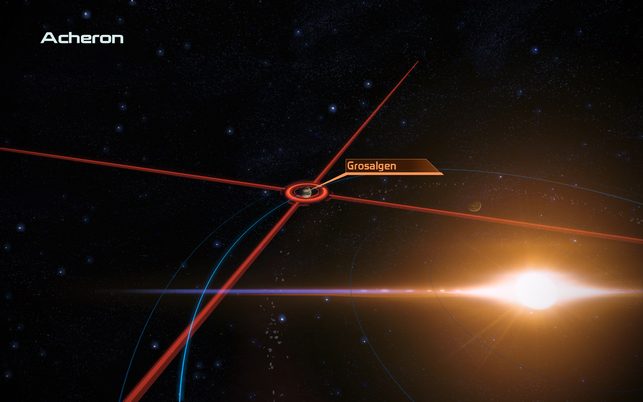
An enigmatic rock and ice planet, Grosalgen has a thin atmosphere of carbon dioxide and ethane. The surface is composed of frozen water and chlorine.
Orbital Period: 41.5 Earth Years
Radius: 5198 km
Day Length: 28.9 Earth Hours
Atmospheric Pressure: 0.53 Earth Atmospheres
Surface Temperature: -175 Celsius
Surface Gravity: 0.6 G
EREBUS
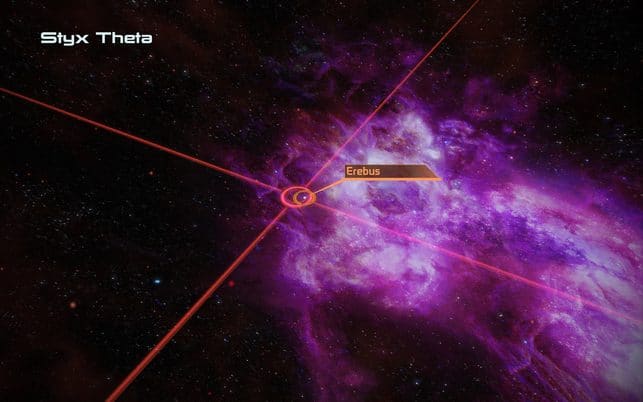
Nepmos
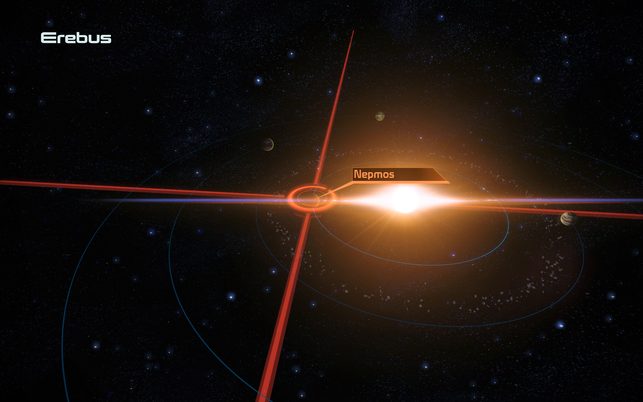
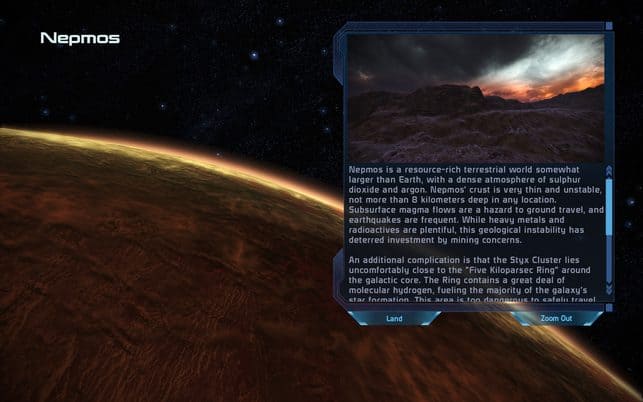
Nepmos is a resource-rich terrestrial world somewhat larger than Earth, with a dense atmosphere of sulphur dioxide and argon. Nepmos’ crust is very thin and unstable, not more than 8 kilometers deep in any location.
Subsurface magma flows are a hazard to ground travel, and earthquakes are frequent. While heavy metals and radioactives are plentiful, this geological instability has deterred investment by mining concerns.
An additional complication is that the Styx Cluster lies uncomfortably close to the “Five Kiloparsec Ring” around the galactic core. The Ring contains a great deal of molecular hydrogen, fueling the majority of the galaxy’s star formation. This area is too dangerous to safely travel.
Orbital Period: 0.7 Earth Years
Radius: 7593 km
Day Length: 68.1 Earth Hours
Atmospheric Pressure: 1.12 Earth Atmospheres
Surface Temperature: 68 Celsius
Surface Gravity: 1.2 G
Wermani*
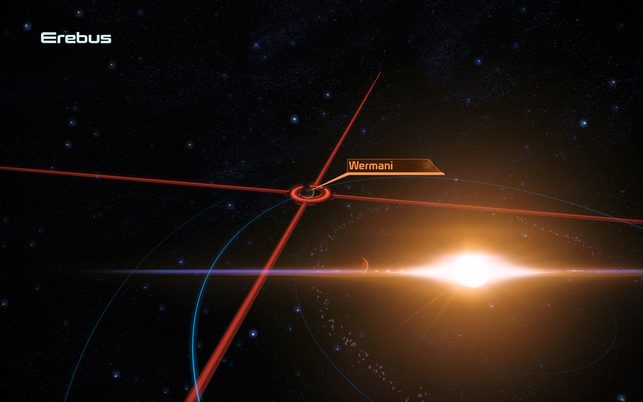
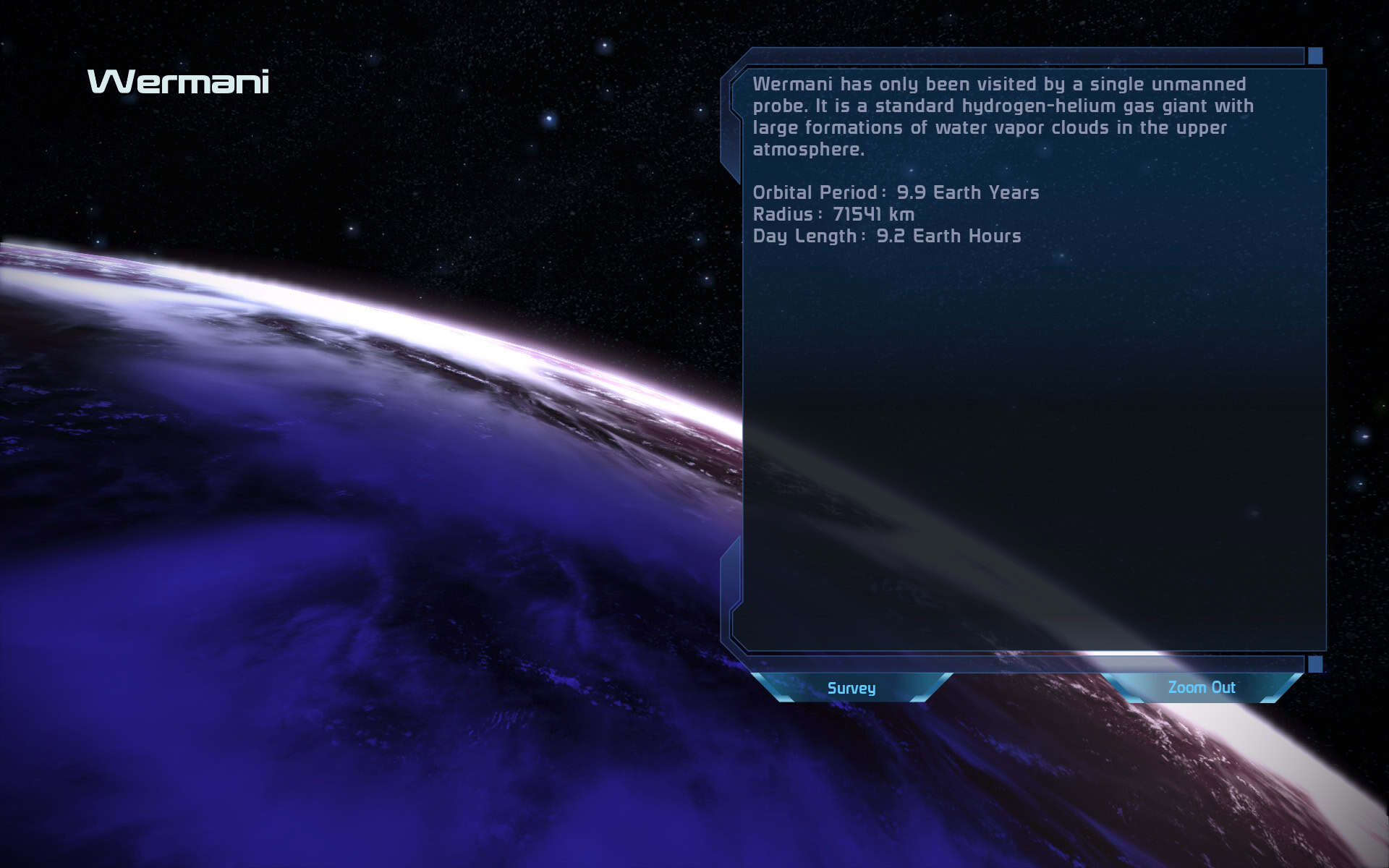
Wermani has only been visited by a single unmanned probe. It is a standard hydrogen-helium gas giant with large formations of water vapor clouds in the upper atmosphere.
Orbital Period: 9.9 Earth Years
Radius: 71541 km
Day Length: 9.2 Earth Hours
Chofen
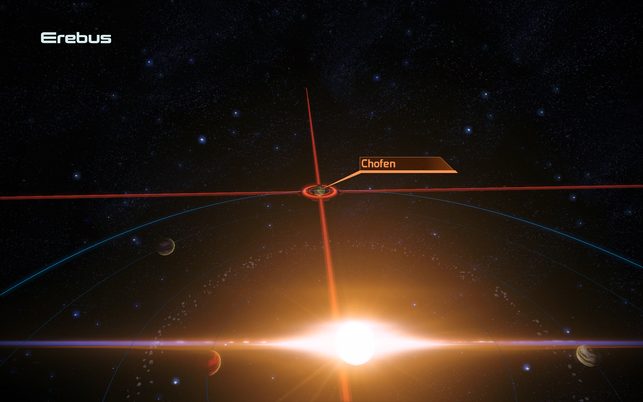
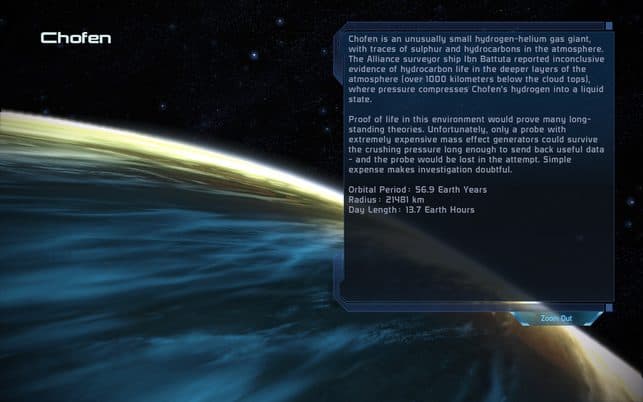
Chofen is an unusually small hydrogen-helium gas giant, with traces of sulphur and hydrocarbons in the atmosphere. The Alliance surveyor ship Ibn Battuta reported inconclusive evidence of hydrocarbon life in the deeper layers of the atmosphere (over 1000 kilometers below the cloud tops), where pressure compresses Chofen’s hydrogen into a liquid state.
Proof of life in this environment would prove many long- standing theories. Unfortunately, only a probe with extremely expensive mass effect generators could survive the crushing pressure long enough to send back useful data – and the probe would be lost in the attempt. Simple expense makes investigation doubtful.
Orbital Period: 56.9 Earth Years
Radius: 21481 km
Day Length: 13.7 Earth Hours
Quaji*
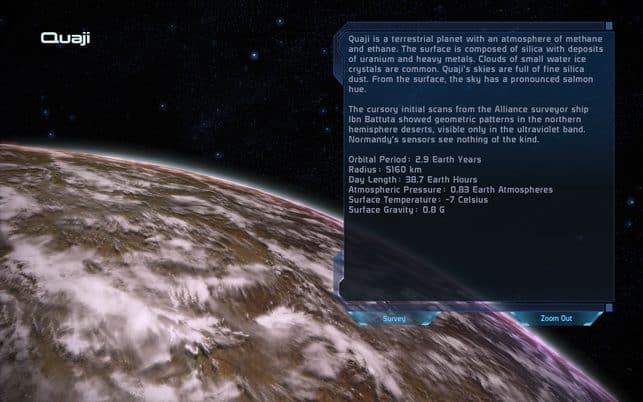
Quaji is a terrestrial planet with an atmosphere of methane and ethane. The surface is composed of silica with deposits of uranium and heavy metals. Clouds of small water ice crystals are common. Quaji’s skies are full of fine silica dust. From the surface, the sky has a pronounced salmon hue.
The cursory initial scans from the Alliance surveyor ship Ibn Battuta showed geometric patterns in the northern hemisphere deserts, visible only in the ultraviolet band. Normandy’s sensors see nothing of the kind.
Orbital Period: 2.9 Earth Years
Radius: 5160 km
Day Length: 38.7 Earth Hours
Atmospheric Pressure: 0.83 Earth Atmospheres
Surface Temperature: -7 Celsius
Surface Gravity: 0.8 G
VOYAGER CLUSTER
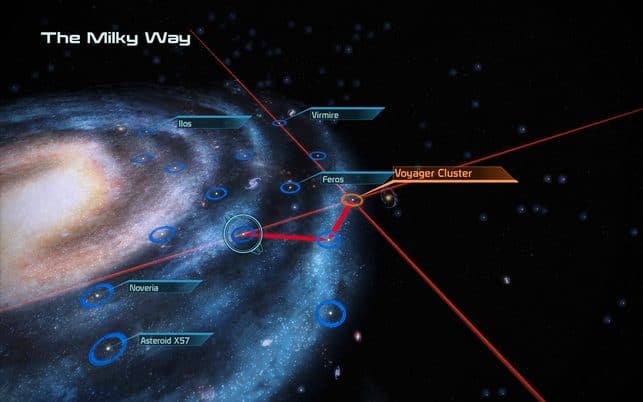
AMAZON
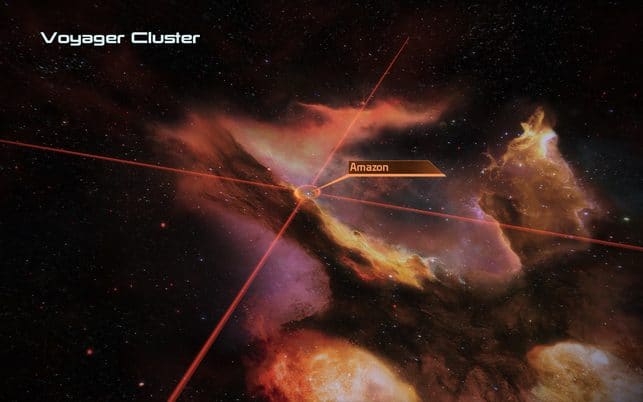
Agebinium
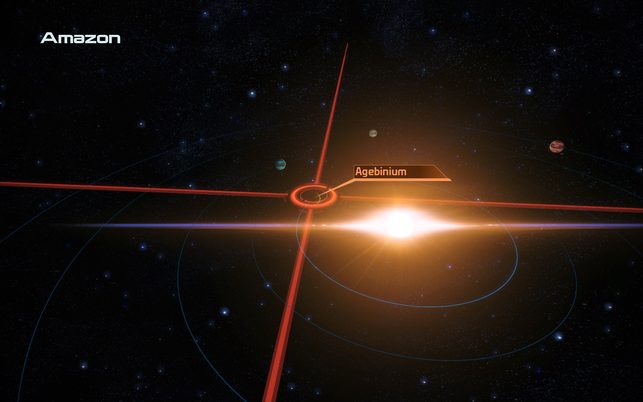
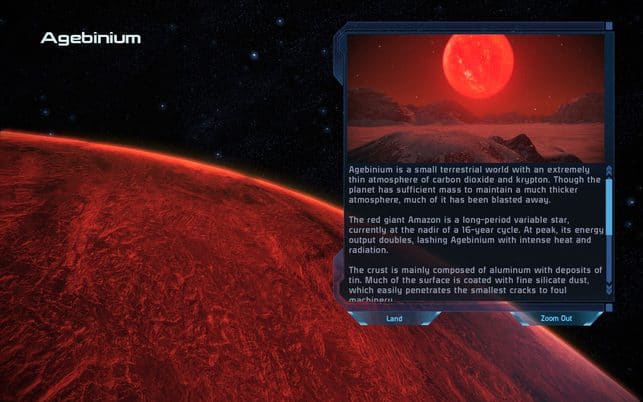
Agebinium is a small terrestrial world with an extremely thin atmosphere of carbon dioxide and krypton. Though the planet has sufficient mass to maintain a much thicker atmosphere, much of it has been blasted away.
The red giant Amazon is a long-period variable star, currently at the nadir of a 16-year cycle. At peak, its energy output doubles, lashing Agebinium with intense heat and radiation.
The crust is mainly composed of aluminum with deposits of tin. Much of the surface is coated with fine silicate dust, which easily penetrates the smallest cracks to foul machinery.
Orbital Period: 1.8 Earth Years
Radius: 4910 km
Day Length: 42.1 Earth Hours
Atmospheric Pressure: 0.17 Earth Atmospheres
Surface Temperature: -72 Celsius
Surface Gravity: 0.79 G
Sonedma*
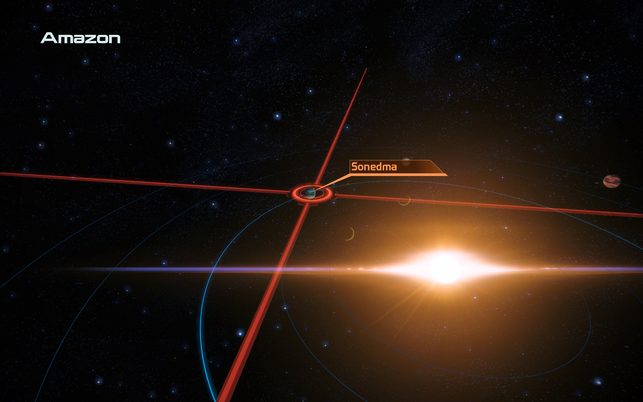
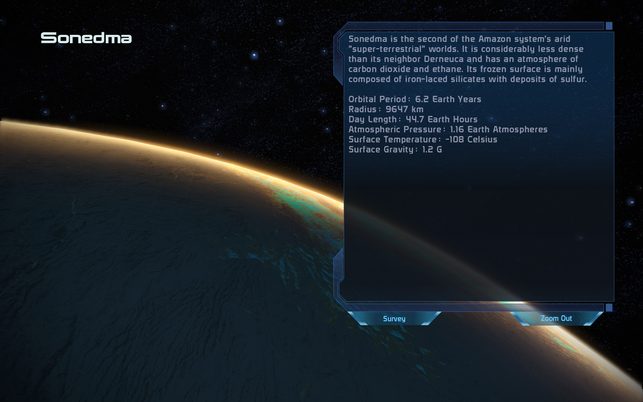
Sonedma is the second of the Amazon system’s arid “super-terrestrial” worlds. It is considerably less dense than its neighbor Derneuca and has an atmosphere of carbon dioxide and ethane. Its frozen surface is mainly composed of iron-laced silicates with deposits of sulfur.
Orbital Period: 6.2 Earth Years
Radius: 9647 km
Day Length: 44.7 Earth Hours
Atmospheric Pressure: 1.16 Earth Atmospheres
Surface Temperature: -108 Celsius
Surface Gravity: 1.2 G
Sybin*
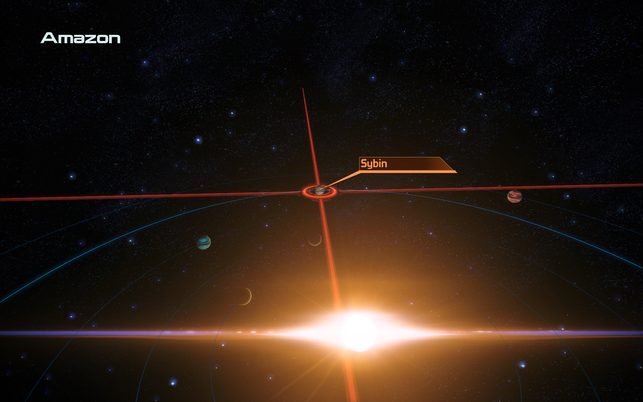
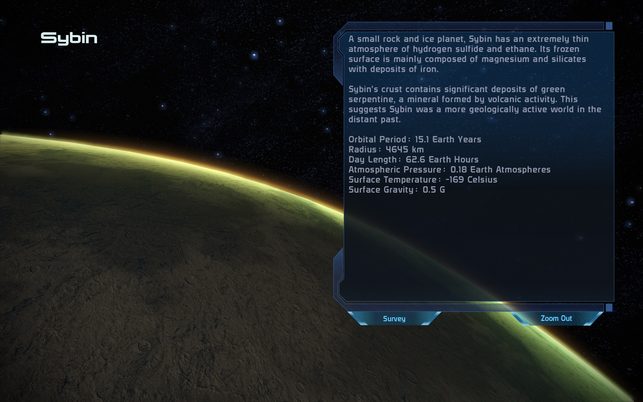
A small rock and ice planet, Sybin has an extremely thin atmosphere of hydrogen sulfide and ethane. Its frozen surface is mainly composed of magnesium and silicates with deposits of iron.
Sybin’s crust contains significant deposits of green serpentine, a mineral formed by volcanic activity. This suggests Sybin was a more geologically active world in the distant past.
Orbital Period: 15.1 Earth Years
Radius: 4645 km
Day Length: 62.6 Earth Hours
Atmospheric Pressure: 0.18 Earth Atmospheres
Surface Temperature: -169 Celsius
Surface Gravity: 0.5 G
Derneuca
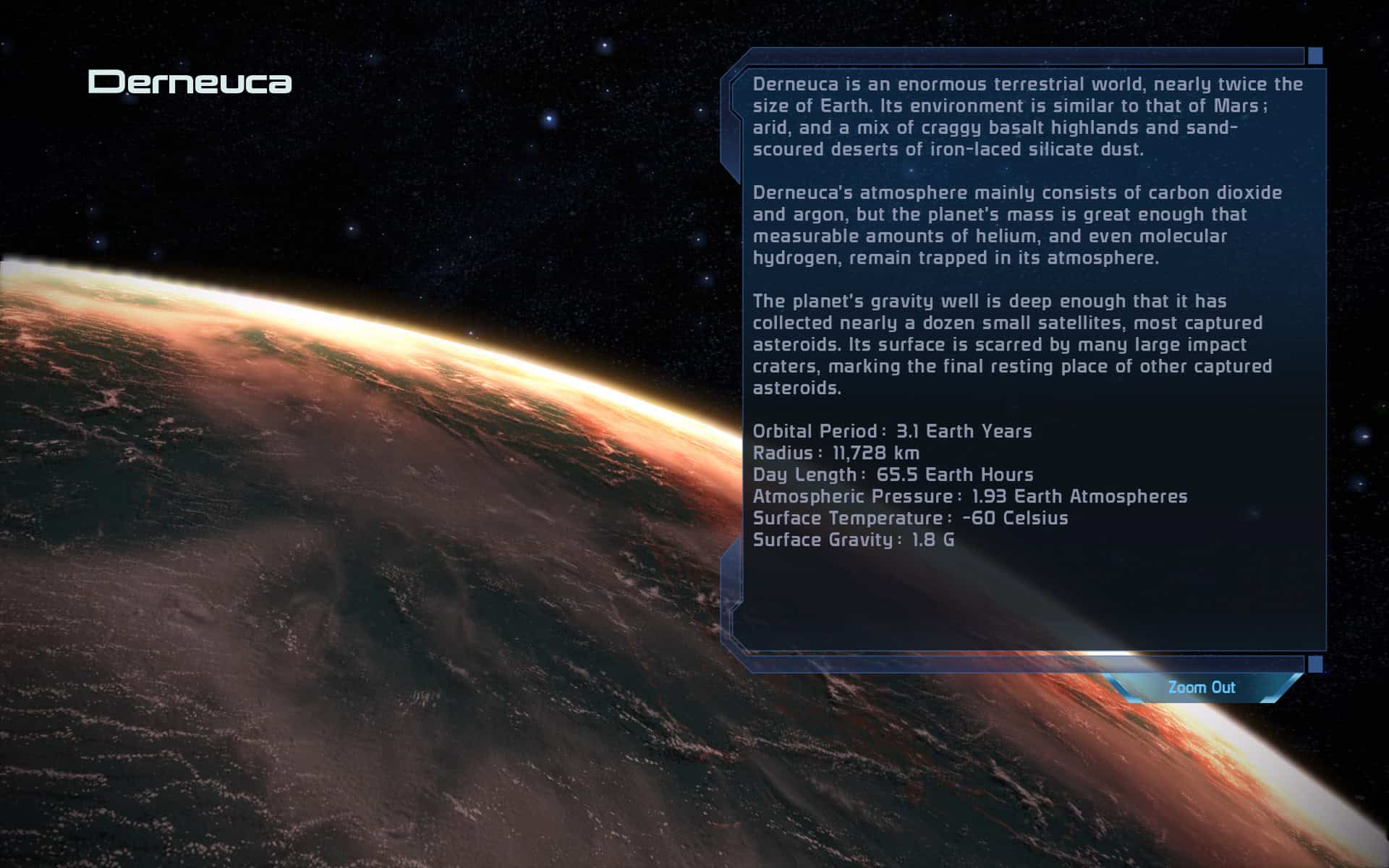
Derneuca is an enormous terrestrial world, nearly twice the size of Earth. Its environment is similar to that of Mars; arid, and a mix of craggy basalt highlands and sand- scoured deserts of iron-laced silicate dust.
Derneuca’s atmosphere mainly consists of carbon dioxide and argon, but the planet’s mass is great enough that measurable amounts of helium, and even molecular hydrogen, remain trapped in its atmosphere.
The planet’s gravity well is deep enough that it has collected nearly a dozen small satellites, most captured asteroids. Its surface is scarred by many large impact craters, marking the final resting place of other captured asteroids.
Orbital Period: 3.1 Earth Years
Radius: 11,728 km
Day Length: 65.5 Earth Hours
Atmospheric Pressure: 1.93 Earth Atmospheres
Surface Temperature: -60 Celsius
Surface Gravity: 1.8 G
Tremar*
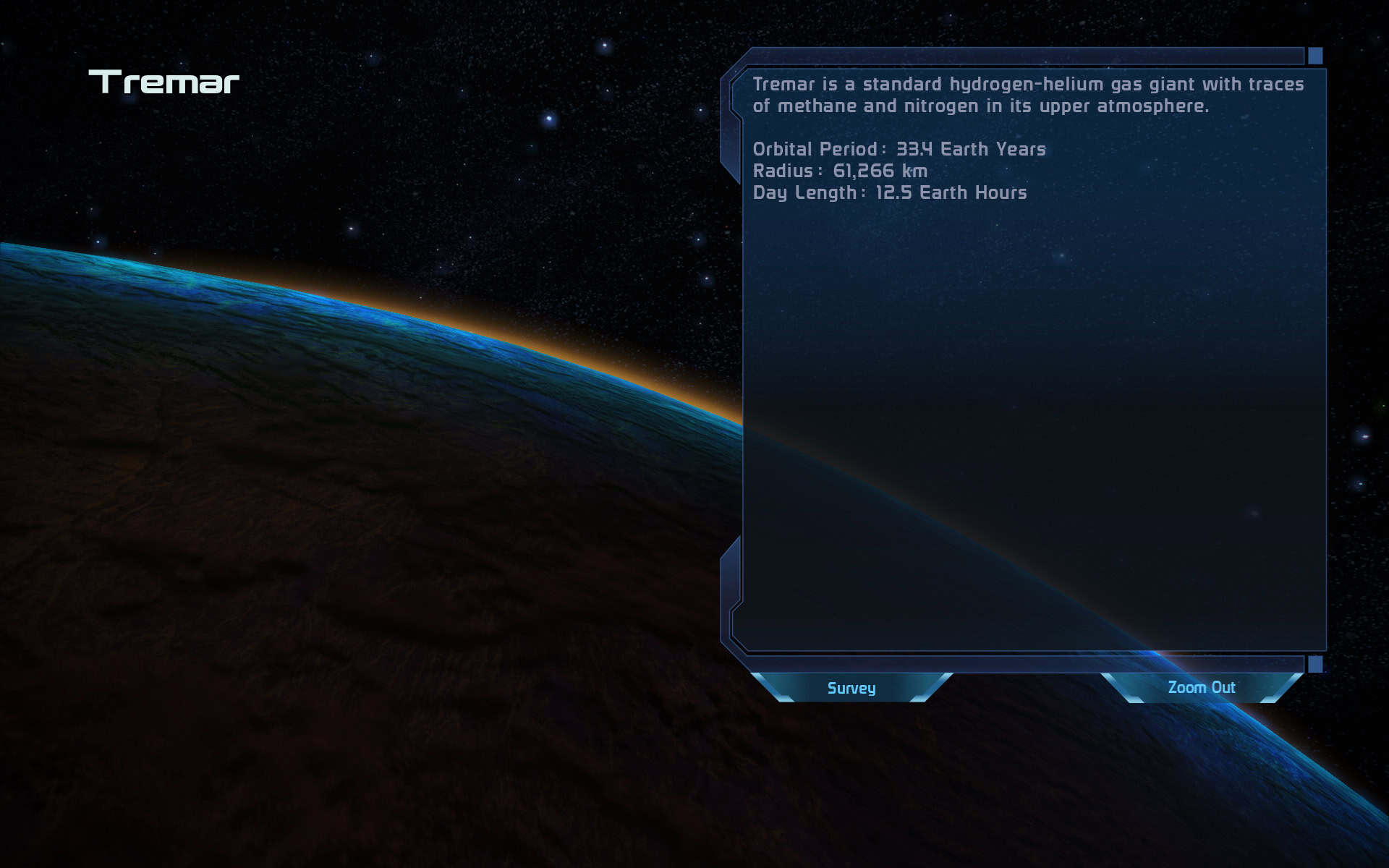
Tremar is a standard hydrogen-helium gas giant with traces of methane and nitrogen in its upper atmosphere.
Orbital Period: 33.4 Earth Years
Radius: 61,266 km
Day Length: 12.5 Earth Hours