Here you’ll find the full Mass Effect 2 Galaxy Map. You’ll see the clusters with the systems and planets.
A planet that has an asterik (*) next to it means it can be scanned.
You can find the other Mass Effect Galaxy Maps here.
This page is long and full of images, it can take a few seconds before everything appears. It also looks better on computer than on mobile!
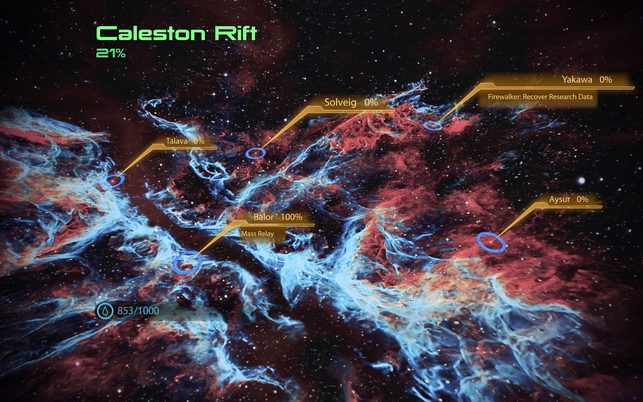
CALESTON RIFT
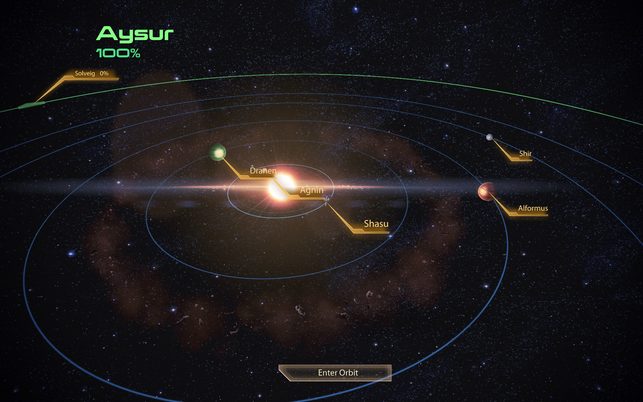
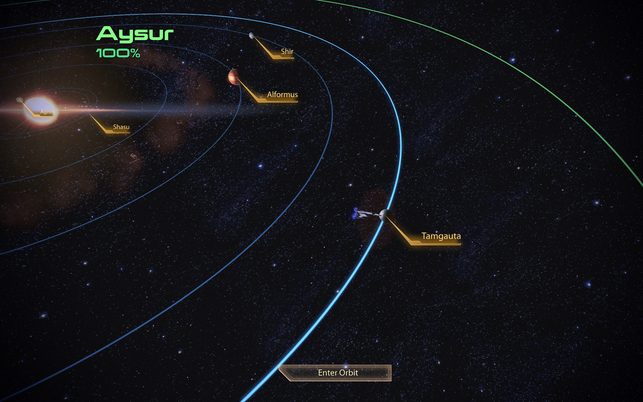
AYSUR
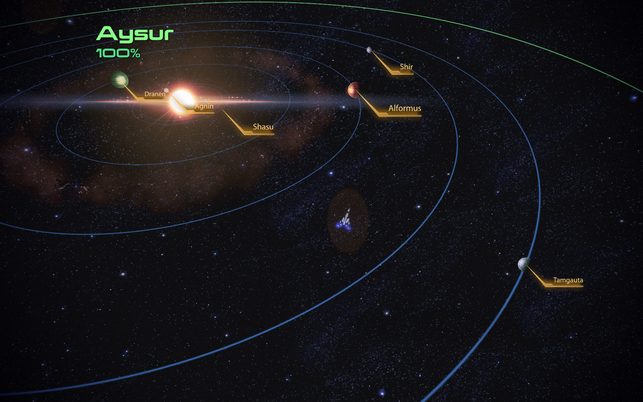
Agnin
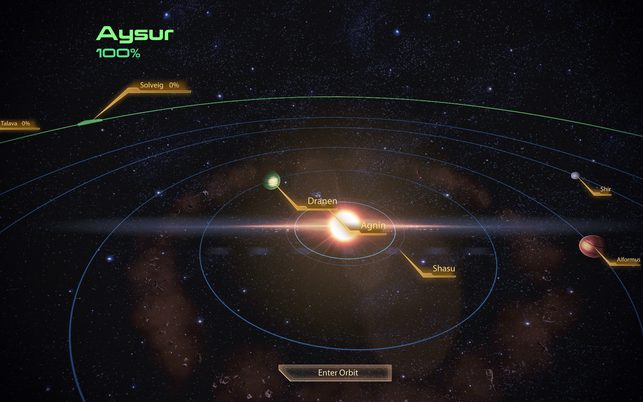
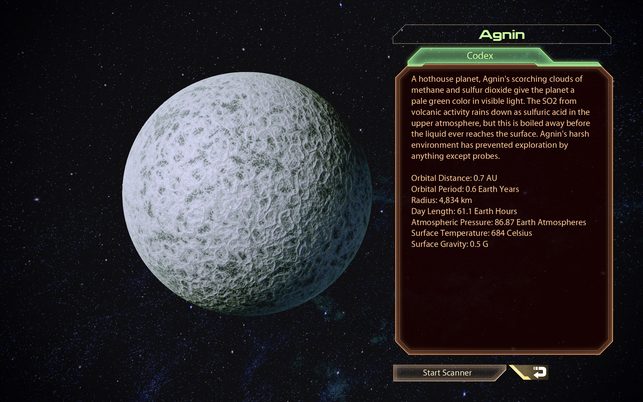
A hothouse planet, Agnin’s scorching clouds of methane and sulfur dioxide give the planet a pale green color in visible light. The SO2 from volcanic activity rains down as sulfuric acid in the upper atmosphere, but this is boiled away before the liquid ever reaches the surface. Agnin’s harsh environment has prevented exploration by anything except probes.
Orbital Distance: 0.7 AU
Orbital Period: 0.6 Earth Years
Radius: 4,834 km
Day Length: 61.1 Earth Hours
Atmospheric Pressure: 86.87 Earth Atmospheres
Surface Temperature: 684 Celsius
Surface Gravity: 0.5 G
Alformus
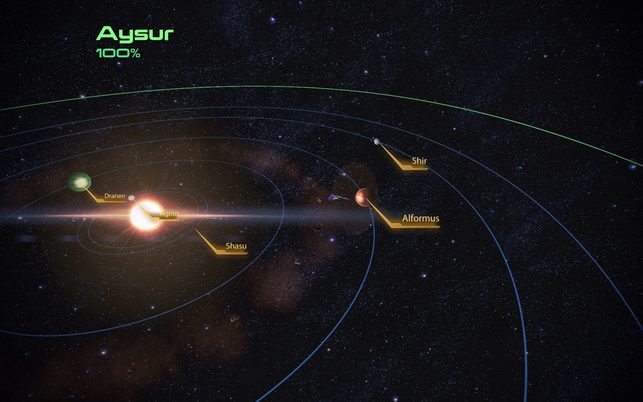
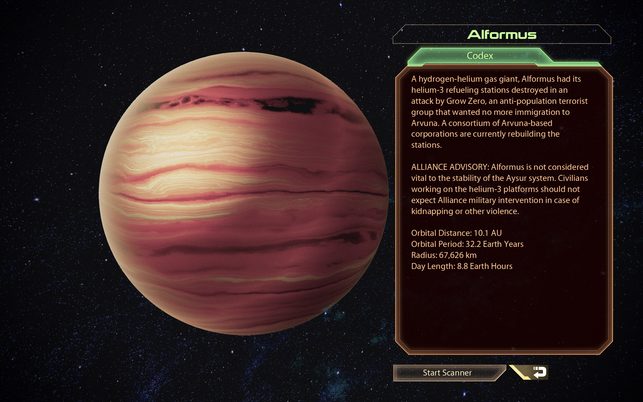
A hydrogen-helium gas giant, Alformus had its helium-3 refueling stations destroyed in an attack by Grow Zero, an anti-population terrorist group that wanted no more immigration to Arvuna. A consortium of Arvuna-based corporations are currently rebuilding the stations.
ALLIANCE ADVISORY: Alformus is not considered vital to the stability of the Aysur system. Civilians working on the helium-3 platforms should not expect Alliance military intervention in case of kidnapping or other violence.
Orbital Distance: 10.1 AU
Orbital Period: 32.2 Earth Years
Radius: 67,626 km
Day Length: 8.8 Earth Hours
Dranen
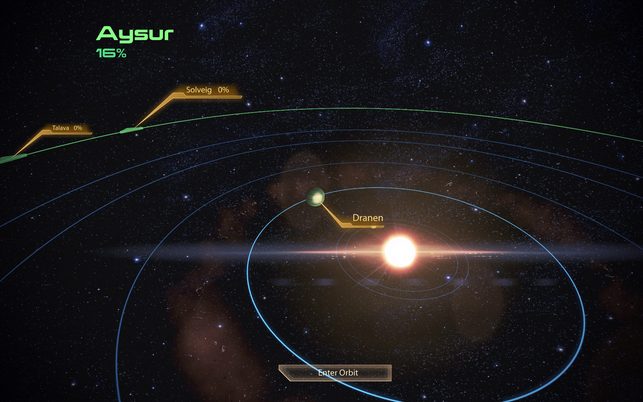
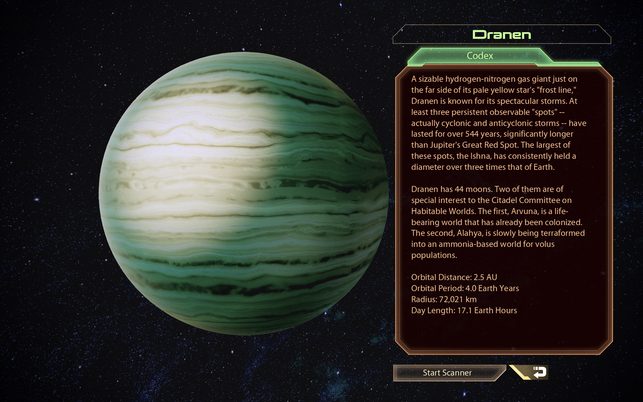
A sizable hydrogen-nitrogen gas giant just on the far side of its pale yellow star’s “frost line,” Dranen is known for its spectacular storms. At least three persistent observable “spots” — actually cyclonic and anticyclonic storms — have lasted for over 544 years, significantly longer than Jupiter’s Great Red Spot. The largest of these spots, the Ishna, has consistently held a diameter over three times that of Earth.
Dranen has 44 moons. Two of them are of special interest to the Citadel Committee on Habitable Worlds. The first, Arvuna, is a life-bearing world that has already been colonized. The second, Alahya, is slowly being terraformed into an ammonia-based world for volus populations.
Orbital Distance: 2.5 AU
Orbital Period: 4.0 Earth Years
Radius: 72,021 km
Day Length: 17.1 Earth Hours
Shasu
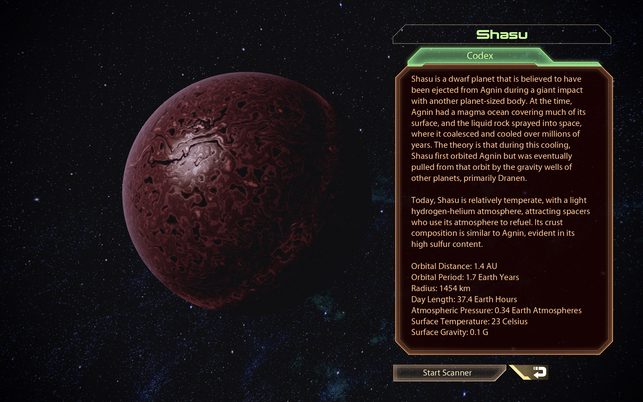
Shasu is a dwarf planet that is believed to have been ejected from Agnin during a giant impact with another planet-sized body. At the time, Agnin had a magma ocean covering much of its surface, and the liquid rock sprayed into space, where it coalesced and cooled over millions of years. The theory is that during this cooling, Shasu first orbited Agnin but was eventually pulled from that orbit by the gravity wells of other planets, primarily Dranen.
Today, Shasu is relatively temperate, with a light hydrogen-helium atmosphere, attracting spacers who use its atmosphere to refuel. Its crust composition is similar to Agnin, evident in its high sulfur content.
Orbital Distance: 1.4 AU
Orbital Period: 1.7 Earth Years
Radius: 1454 km
Day Length: 37.4 Earth Hours
Atmospheric Pressure: 0.34 Earth Atmospheres
Surface Temperature: 23 Celsius
Surface Gravity: 0.1 G
Shir
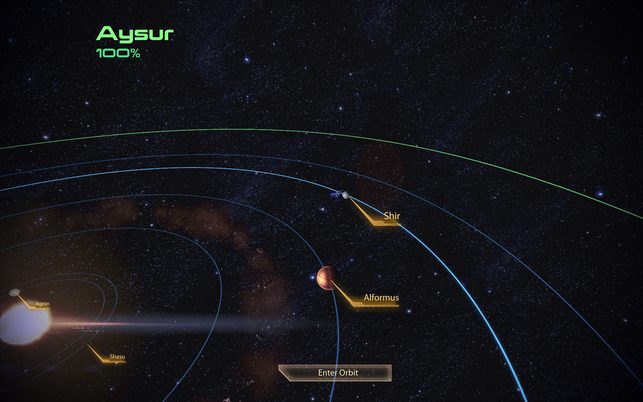
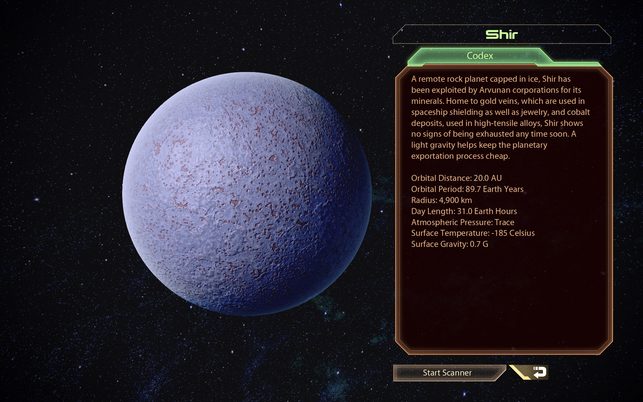
A remote rock planet capped in ice, Shir has been exploited by Arvunan corporations for its minerals. Home to gold veins, which are used in spaceship shielding as well as jewelry, and cobalt deposits, used in high-tensile alloys, Shir shows no signs of being exhausted any time soon. A light gravity helps keep the planetary exportation process cheap.
Orbital Distance: 20.0 AU
Orbital Period: 89.7 Earth Years
Radius: 4,900 km
Day Length: 31.0 Earth Hours
Atmospheric Pressure: Trace
Surface Temperature: -185 Celsius
Surface Gravity: 0.7 G
Tamgauta
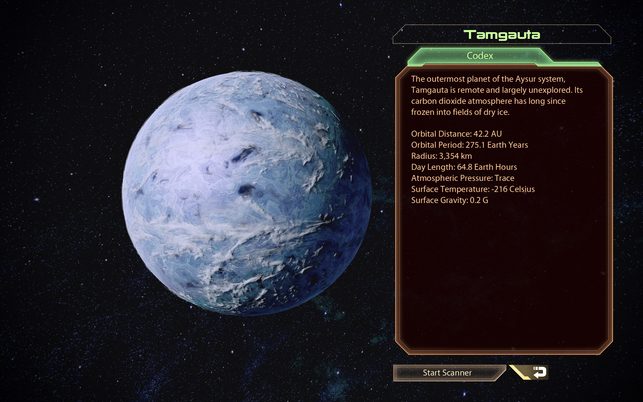
The outermost planet of the Aysur system, Tamgauta is remote and largely unexplored. Its carbon dioxide atmosphere has long since frozen into fields of dry ice.
Orbital Distance: 42.2 AU
Orbital Period: 275.1 Earth Years
Radius: 3,354 km
Day Length: 64.8 Earth Hours
Atmospheric Pressure: Trace
Surface Temperature: -216
Celsius Surface Gravity: 0.2 G
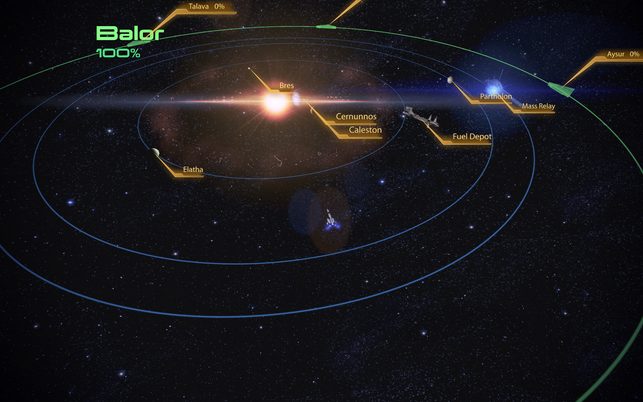
BALOR
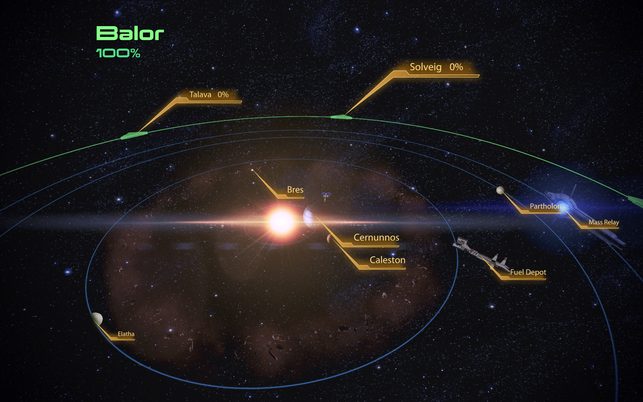
Bres
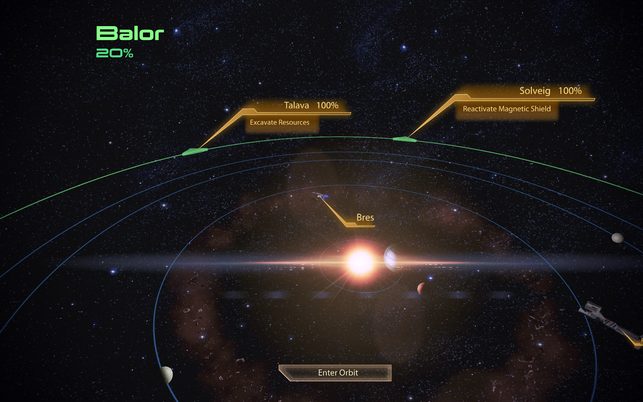
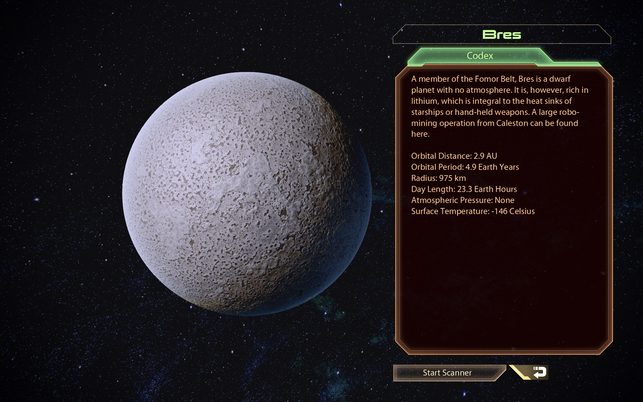
A member of the Fomor Belt, Bres is a dwarf planet with no atmosphere. It is, however, rich in lithium, which is integral to the heat sinks of starships or hand-held weapons. A large robo-mining operation from Caleston can be found here.
Orbital Distance: 2.9 AU
Orbital Period: 4.9 Earth Years
Radius: 975 km
Day Length: 23.3 Earth Hours
Atmospheric Pressure: None
Surface Temperature: -146 Celsius
Caleston
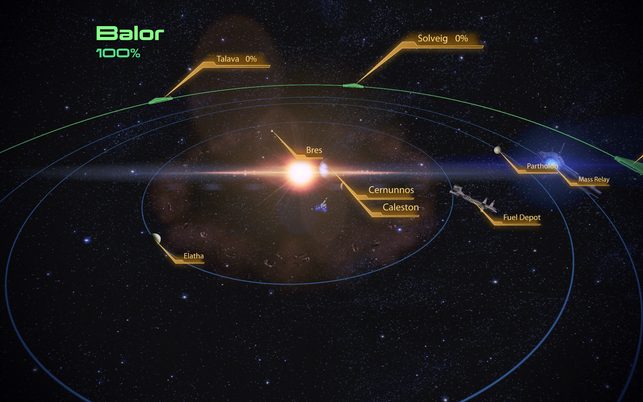
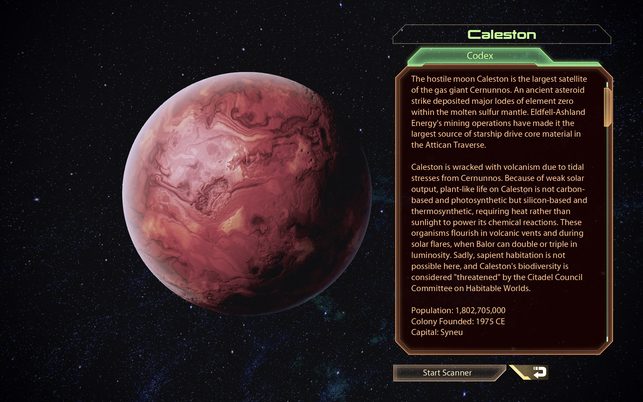
The hostile moon Caleston is the largest satellite of the gas giant Cernunnos. An ancient asteroid strike deposited major lodes of element zero within the molten sulfur mantle. Eldfell-Ashland Energy’s mining operations have made it the largest source of starship drive core material in the Attican Traverse.
Caleston is wracked with volcanism due to tidal stresses from Cernunnos. Because of weak solar output, plant-like life on Caleston is not carbon-based and photosynthetic but silicon-based and thermosynthetic, requiring heat rather than sunlight to power its chemical reactions. These organisms flourish in volcanic vents and during solar flares, when Balor can double or triple in luminosity. Sadly, sapient habitation is not possible here, and Caleston’s biodiversity is considered “threatened” by the Citadel Council Committee on Habitable Worlds.
Population: 1,802,705,000
Colony Founded: 1975 CE
Capital: Syneu
Orbital Distance: 0.07 AU (orbits Cerunnos)
Orbital Period: 21.5 Earth Hours (around
Cerunnos)
Radius: 6,600 km
Day Length: 21.5 Earth Hours
Atmospheric Pressure: 0.9 Earth Atmospheres
Surface Temperature: 30 Celsius
Surface Gravity: 1.2 G
Cernunnos
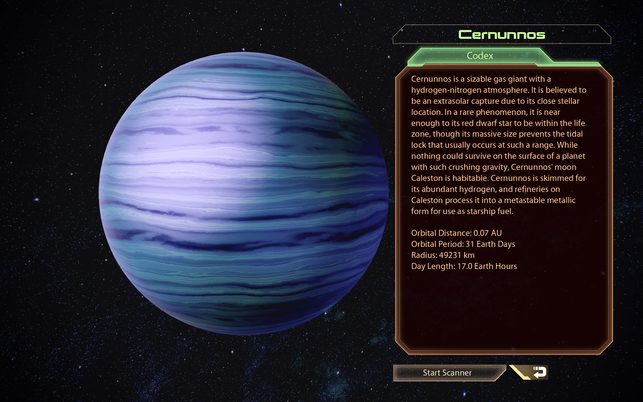
Cernunnos is a sizable gas giant with a hydrogen-nitrogen atmosphere. It is believed to be an extrasolar capture due to its close stellar location. In a rare phenomenon, it is near enough to its red dwarf star to be within the life zone, though its massive size prevents the tidal lock that usually occurs at such a range. While nothing could survive on the surface of a planet with such crushing gravity, Cernunnos’ moon Caleston is habitable. Cernunnos is skimmed for its abundant hydrogen, and refineries on Caleston process it into a metastable metallic form for use as starship fuel.
Orbital Distance: 0.07 AU
Orbital Period: 31 Earth Days
Radius: 49231 km
Day Length: 17.0 Earth Hours
Elatha
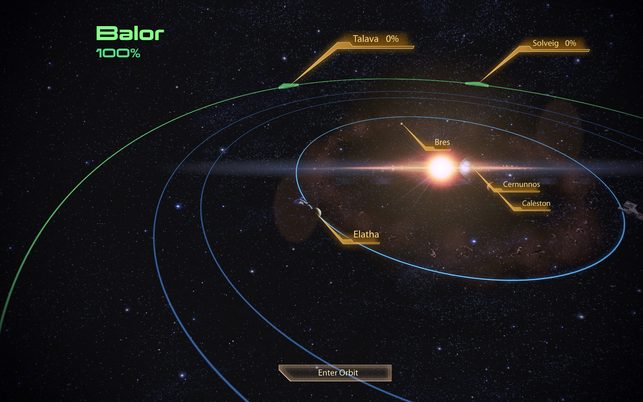
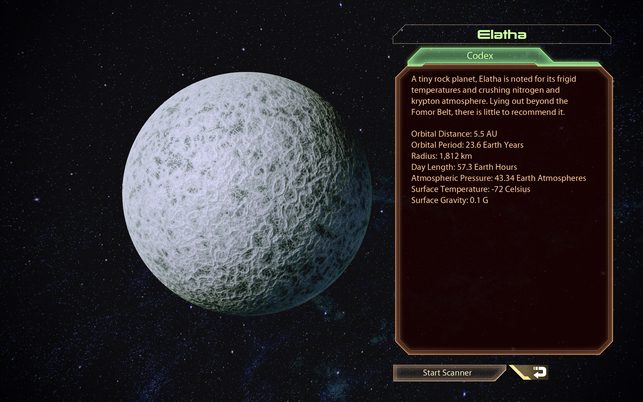
A tiny rock planet, Elatha is noted for its frigid temperatures and crushing nitrogen and krypton atmosphere. Lying out beyond the Fomor Belt, there is little to recommend it.
Orbital Distance: 5.5 AU
Orbital Period: 23.6 Earth Years
Radius: 1,812 km
Day Length: 57.3 Earth Hours
Atmospheric Pressure: 43.34 Earth Atmospheres
Surface Temperature: -72 Celsius
Surface Gravity: 0.1 G
Partholon
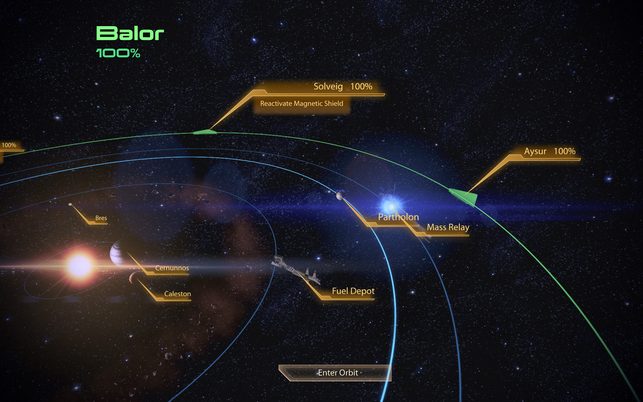
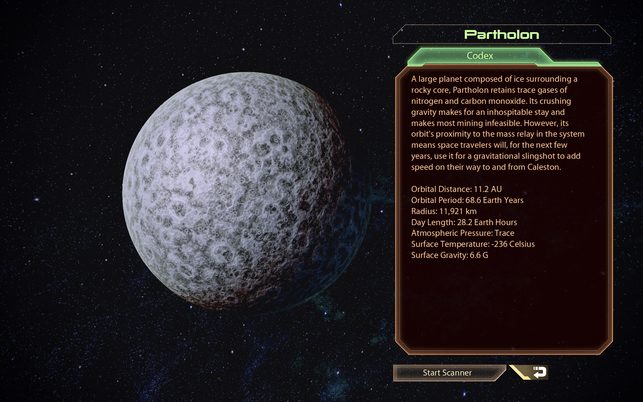
A large planet composed of ice surrounding a rocky core, Partholon retains trace gases of nitrogen and carbon monoxide. Its crushing gravity makes for an inhospitable stay and makes most mining infeasible. However, its orbit’s proximity to the mass relay in the system means space travelers will, for the next few years, use it for a gravitational slingshot to add speed on their way to and from Caleston.
Orbital Distance: 11.2 AU
Orbital Period: 68.6 Earth Years
Radius: 11,921 km
Day Length: 28.2 Earth Hours
Atmospheric Pressure: Trace
Surface Temperature: -236
Celsius Surface Gravity: 6.6 G
SOLVEIG
Sinmara*
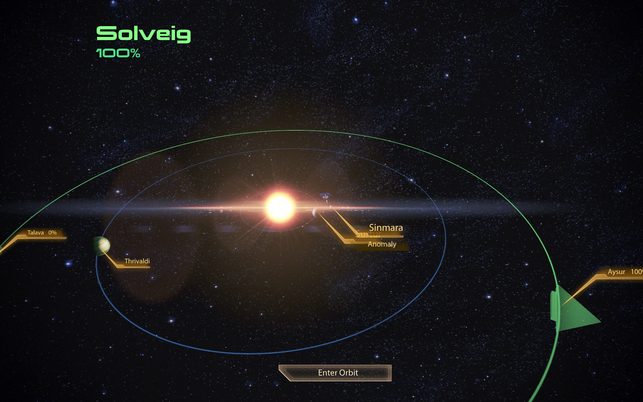
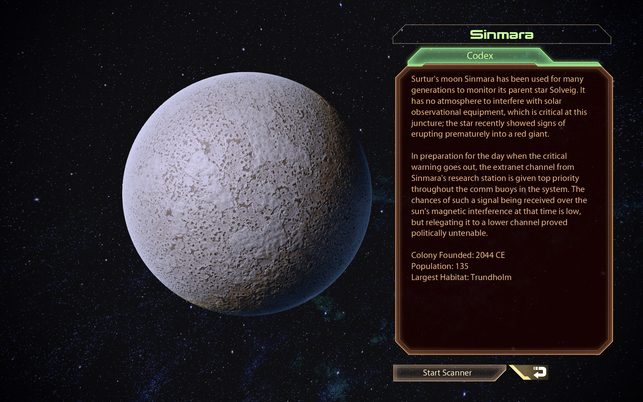
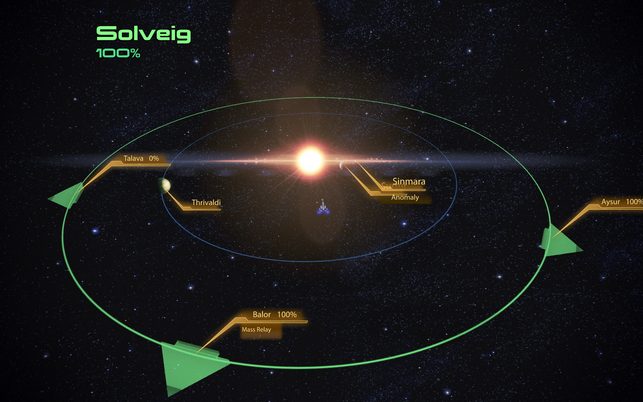
Surtur’s moon Sinmara has been used for many generations to monitor its parent star Solveig. It has no atmosphere to interfere with solar observational equipment, which is critical at this juncture; the star recently showed signs of erupting prematurely into a red giant.
In preparation for the day when the critical warning goes out, the extranet channel from Sinmara’s research station is given top priority throughout the comm buoys in the system. The chances of such a signal being received over the sun’s magnetic interference at that time is low, but relegating it to a lower channel proved politically untenable.
Colony Founded: 2044 CE
Population: 135
Largest Habitat: Trundholm
Surtur
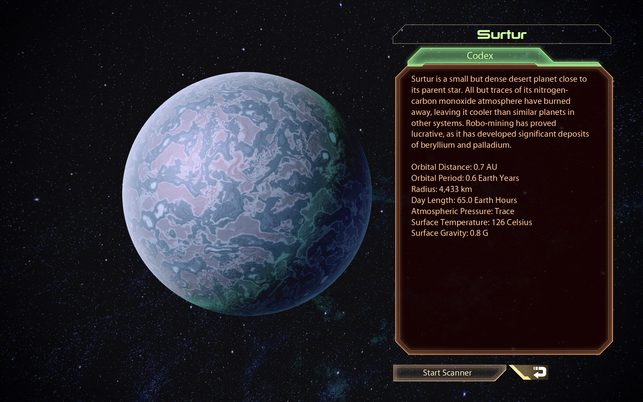
Surtur is a small but dense desert planet close to its parent star. All but traces of its nitrogen-carbon monoxide atmosphere have burned away, leaving it cooler than similar planets in other systems. Robo-mining has proved lucrative, as it has developed significant deposits of beryllium and palladium.
Orbital Distance: 0.7 AU
Orbital Period: 0.6 Earth Years
Radius: 4,433 km
Day Length: 65.0 Earth Hours
Atmospheric Pressure: Trace
Surface Temperature: 126 Celsius
Surface Gravity: 0.8 G
Thrivaldi
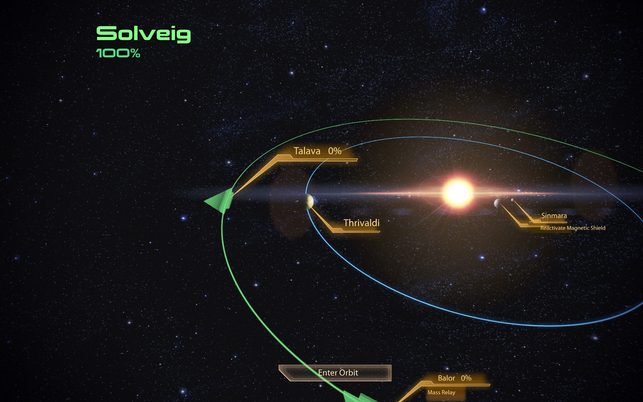
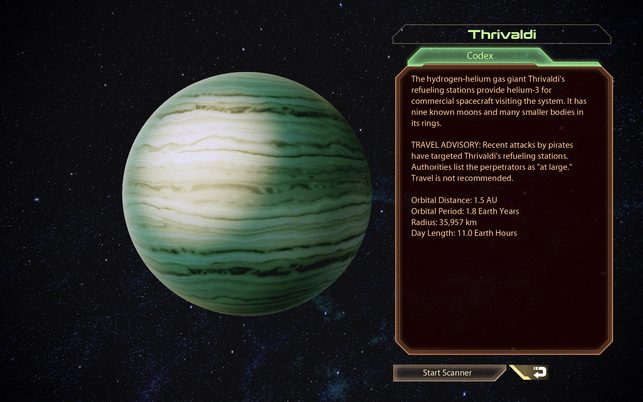
The hydrogen-helium gas giant Thrivaldi’s refueling stations provide helium-3 for commercial spacecraft visiting the system. It has nine known moons and many smaller bodies in its rings.
TRAVEL ADVISORY: Recent attacks by pirates have targeted Thrivaldi’s refueling stations. Authorities list the perpetrators as “at large.” Travel is not recommended.
Orbital Distance: 1.5 AU
Orbital Period: 1.8 Earth Years
Radius: 35,957 km
Day Length: 11.0 Earth Hours
TALAVA
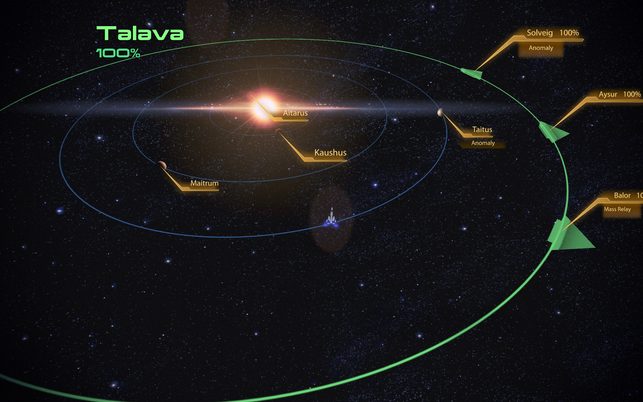
Aitarus
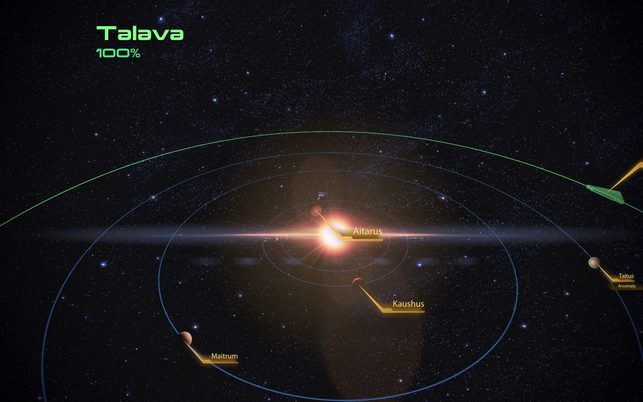
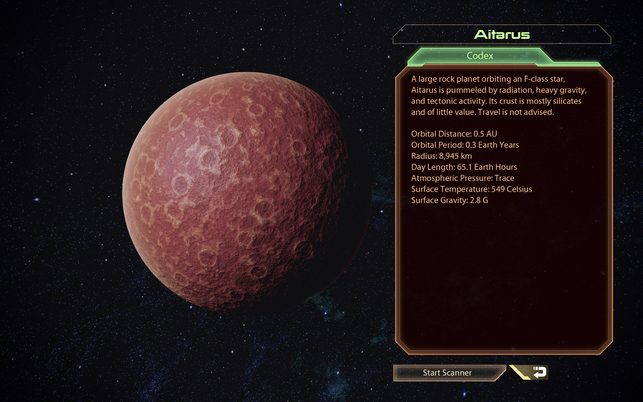
A large rock planet orbiting an F-class star, Aitarus is pummeled by radiation, heavy gravity, and tectonic activity. Its crust is mostly silicates
and of little value. Travel is not advised.
Orbital Distance: 0.5 AU
Orbital Period: 0.3 Earth Years
Radius: 8,945 km
Day Length: 65.1 Earth Hours
Atmospheric Pressure: Trace
Surface Temperature: 549 Celsius
Surface Gravity: 2.8 G
Kaushus
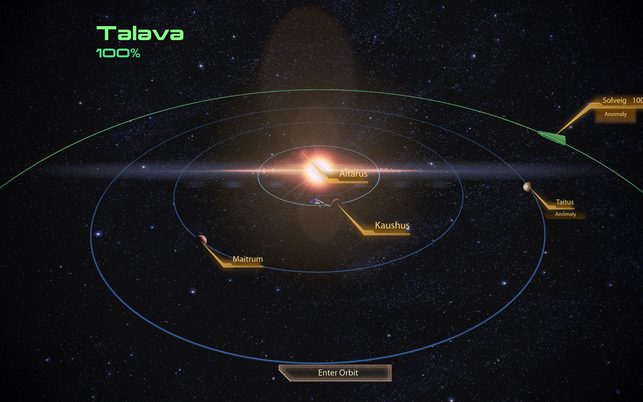
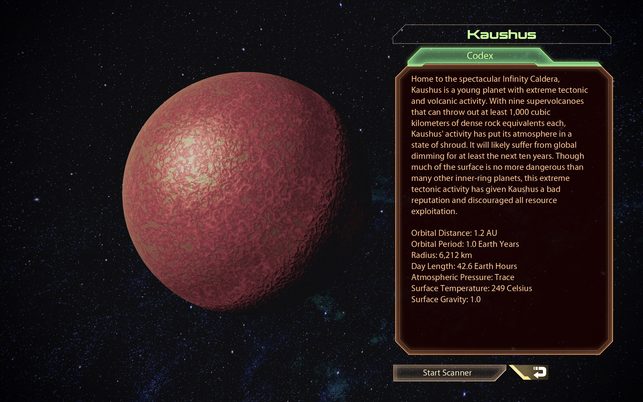
Home to the spectacular Infinity Caldera, Kaushus is a young planet with extreme tectonic and volcanic activity. With nine supervolcanoes that can throw out at least 1,000 cubic kilometers of dense rock equivalents each, Kaushus’ activity has put its atmosphere in a state of shroud. It will likely suffer from global dimming for at least the next ten years. Though much of the surface is no more dangerous than many other inner-ring planets, this extreme tectonic activity has given Kaushus a bad reputation and discouraged all resource exploitation.
Orbital Distance: 1.2 AU
Orbital Period: 1.0 Earth Years
Radius: 6,212 km
Day Length: 42.6 Earth Hours
Atmospheric Pressure: Trace
Surface Temperature: 249 Celsius
Surface Gravity: 1.0
Maitrum
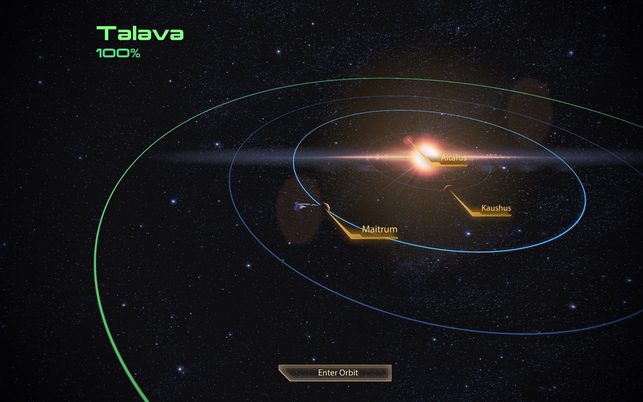
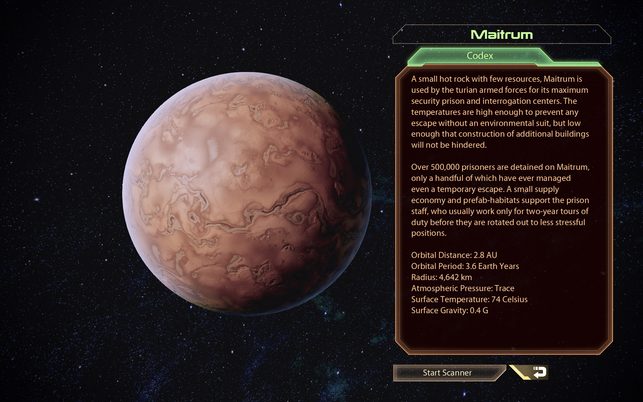
A small hot rock with few resources, Maitrum is used by the turian armed forces for its maximum security prison and interrogation centers. The temperatures are high enough to prevent any escape without an environmental suit, but low enough that construction of additional buildings will not be hindered.
Over 500,000 prisoners are detained on Maitrum, only a handful of which have ever managed even a temporary escape. A small supply
economy and prefab-habitats support the prison staff, who usually work only for two-year tours of duty before they are rotated out to less stressful positions.
Orbital Distance: 2.8 AU
Orbital Period: 3.6 Earth Years
Radius: 4,642 km
Atmospheric Pressure: Trace
Surface Temperature: 74 Celsius
Surface Gravity: 0.4 G
Taitus*
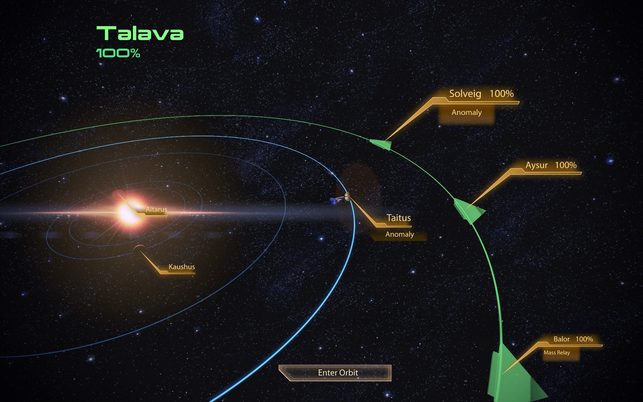
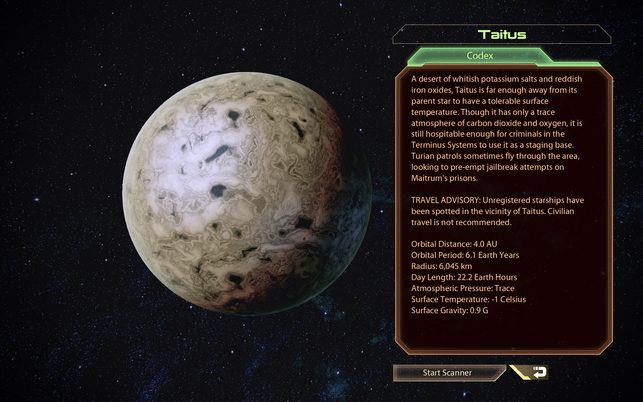
A desert of whitish potassium salts and reddish iron oxides, Taitus is far enough away from its parent star to have a tolerable surface temperature. Though it has only a trace atmosphere of carbon dioxide and oxygen, it is still hospitable enough for criminals in the Terminus Systems to use it as a staging base. Turian patrols sometimes fly through the area, looking to pre-empt jailbreak attempts on Maitrum’s prisons.
TRAVEL ADVISORY: Unregistered starships have been spotted in the vicinity of Taitus. Civilian travel is not recommended.
Orbital Distance: 4.0 AU
Orbital Period: 6.1 Earth Years
Radius: 6,045 km
Day Length: 22.2 Earth Hours
Atmospheric Pressure: Trace
Surface Temperature: -1 Celsius
Surface Gravity: 0.9 G
YAKAWA
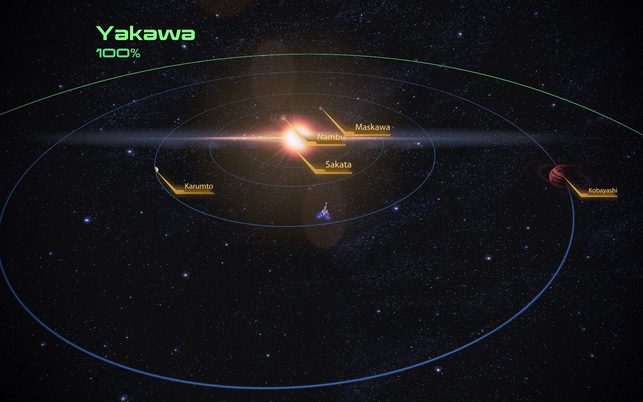
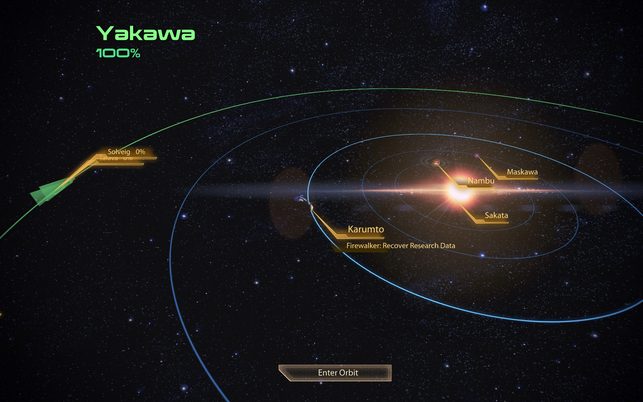
Karumto*
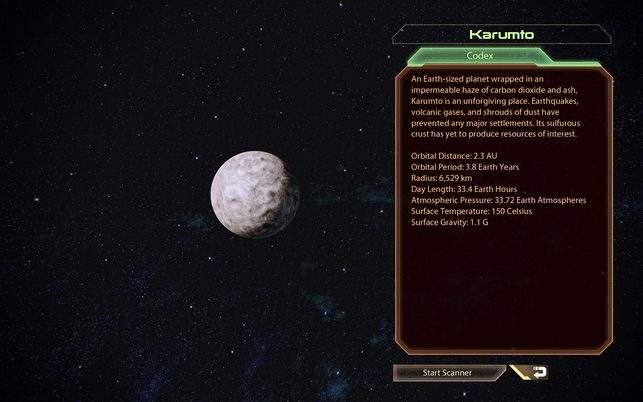
An Earth-sized planet wrapped in an impermeable haze of carbon dioxide and ash, Karumto is an unforgiving place. Earthquakes, volcanic gases, and shrouds of dust have prevented any major settlements. Its sulfurous crust has yet to produce resources of interest.
Orbital Distance: 2.3 AU
Orbital Period: 3.8 Earth Years
Radius: 6,529 km
Day Length: 33.4 Earth Hours
Atmospheric Pressure: 33.72 Earth Atmospheres
Surface Temperature: 150 Celsius
Surface Gravity: 1.1 G
Kobayashi
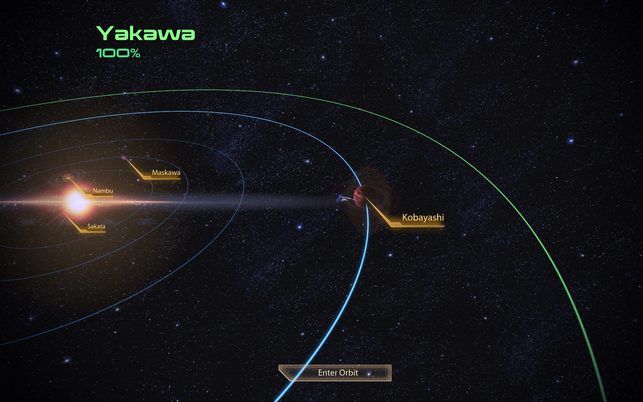
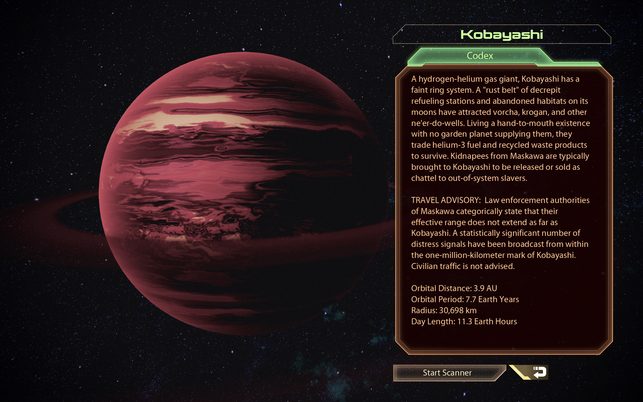
A hydrogen-helium gas giant, Kobayashi has a faint ring system. A “rust belt” of decrepit refueling stations and abandoned habitats on its moons have attracted vorcha, krogan, and other ne’er-do-wells. Living a hand-to-mouth existence with no garden planet supplying them, they trade helium-3 fuel and recycled waste products to survive. Kidnapees from Maskawa are typically brought to Kobayashi to be released or sold as chattel to out-of-system slavers.
TRAVEL ADVISORY: Law enforcement authorities of Maskawa categorically state that their effective range does not extend as far as Kobayashi. A statistically significant number of distress signals have been broadcast from within the one-million-kilometer mark of Kobayashi. Civilian traffic is not advised.
Orbital Distance: 3.9 AU
Orbital Period: 7.7 Earth Years
Radius: 30,698 km
Day Length: 11.3 Earth Hours
Maskawa
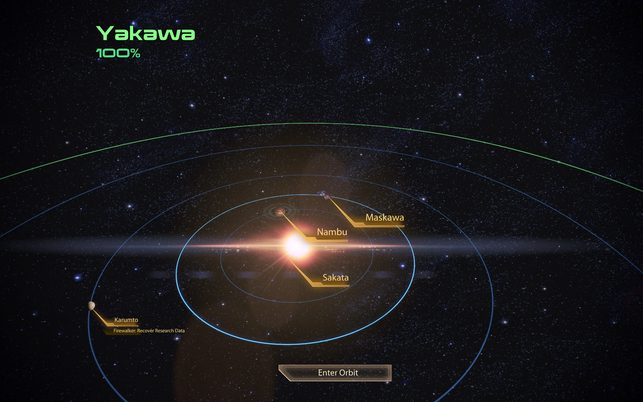
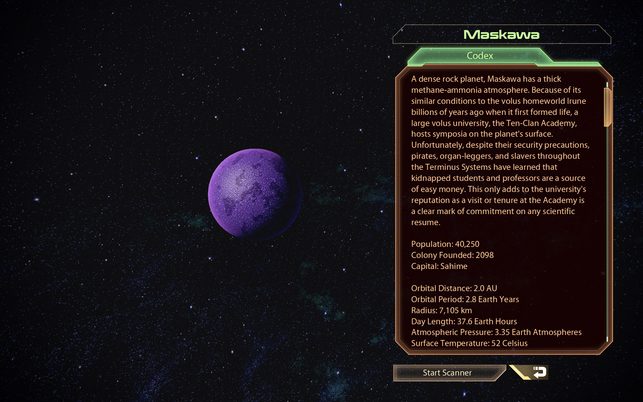
A dense rock planet, Maskawa has a thick methane-ammonia atmosphere. Because of its similar conditions to the volus homeworld Irune billions of years ago when it first formed life, a large volus university, the Ten-Clan Academy, hosts symposia on the planet’s surface. Unfortunately, despite their security precautions, pirates, organ-leggers, and slavers throughout the Terminus Systems have learned that kidnapped students and professors are a source of easy money. This only adds to the university’s reputation as a visit or tenure at the Academy is a clear mark of commitment on any scientific resume.
Population: 40,250
Colony Founded: 2098
Capital: Sahime
Orbital Distance: 2.0 AU
Orbital Period: 2.8 Earth Years
Radius: 7,105 km
Day Length: 37.6 Earth Hours
Atmospheric Pressure: 3.35 Earth Atmospheres
Surface Temperature: 52 Celsius
Surface Gravity: 1.4 G
Nambu
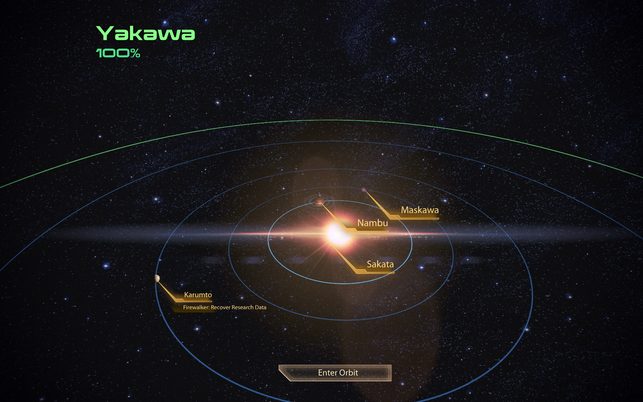
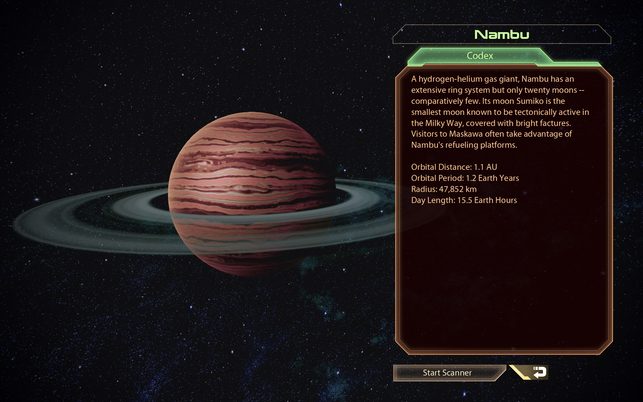
A hydrogen-helium gas giant, Nambu has an extensive ring system but only twenty moons — comparatively few. Its moon Sumiko is the smallest moon known to be tectonically active in the Milky Way, covered with bright factures. Visitors to Maskawa often take advantage of Nambu’s refueling platforms.
Orbital Distance: 1.1 AU
Orbital Period: 1.2 Earth Years
Radius: 47,852 km
Day Length: 15.5 Earth Hours
Sakata
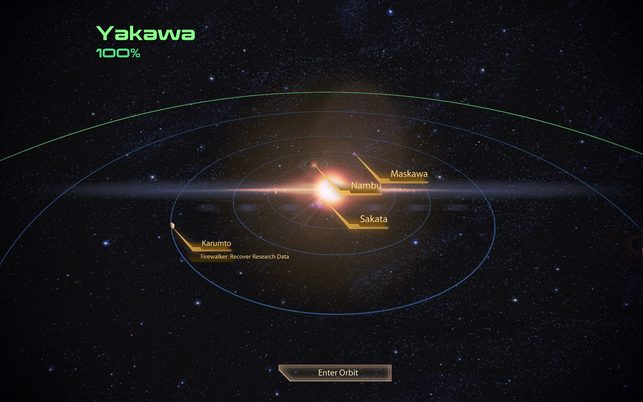
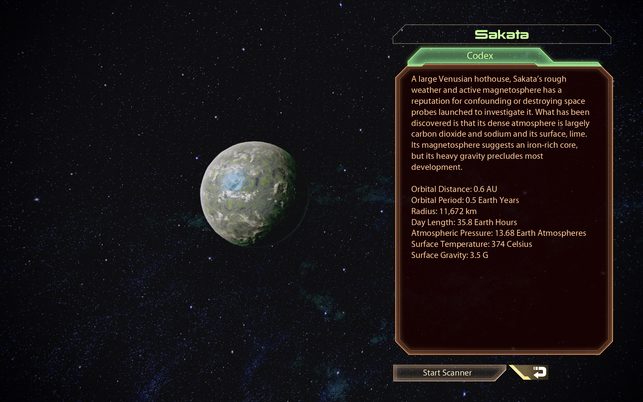
A large Venusian hothouse, Sakata’s rough weather and active magnetosphere has a reputation for confounding or destroying space probes launched to investigate it. What has been discovered is that its dense atmosphere is largely carbon dioxide and sodium and its surface, lime. Its magnetosphere suggests an iron-rich core, but its heavy gravity precludes most development.
Orbital Distance: 0.6 AU
Orbital Period: 0.5 Earth Years
Radius: 11,672 km
Day Length: 35.8 Earth Hours
Atmospheric Pressure: 13.68 Earth Atmospheres
Surface Temperature: 374 Celsius
Surface Gravity: 3.5 G
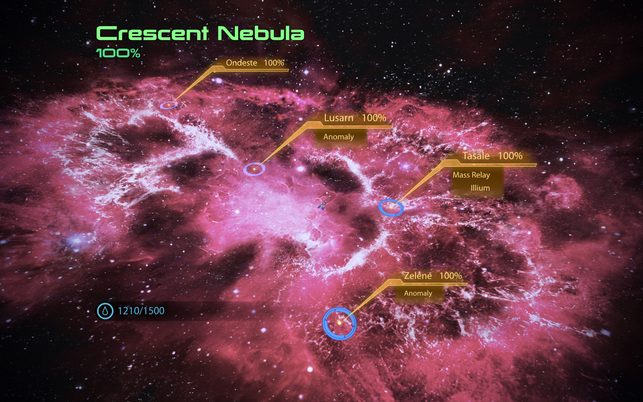
CRESCENT NEBULA
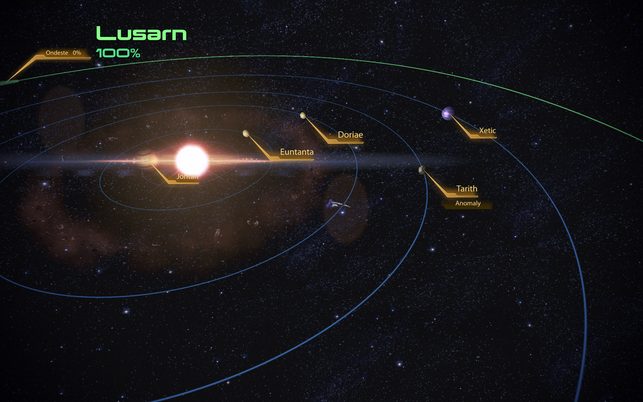
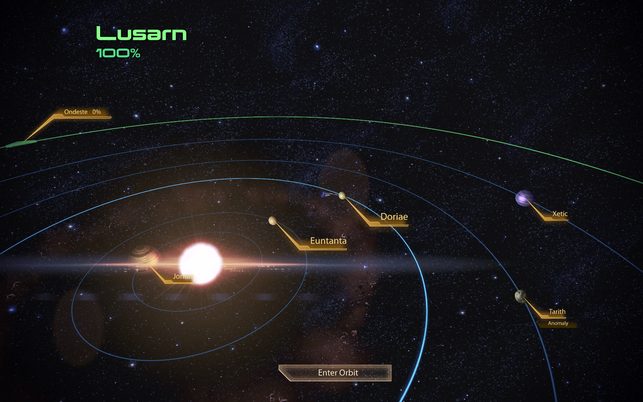
LUSARN
Doriae
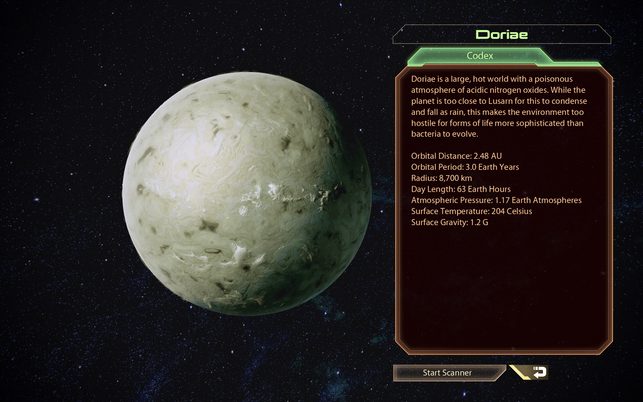
Doriae is a large, hot world with a poisonous atmosphere of acidic nitrogen oxides. While the planet is too close to Lusarn for this to condense and fall as rain, this makes the environment too hostile for forms of life more sophisticated than bacteria to evolve.
Orbital Distance: 2.48 AU
Orbital Period: 3.0 Earth Years
Radius: 8,700 km
Day Length: 63 Earth Hours
Atmospheric Pressure: 1.17 Earth Atmospheres
Surface Temperature: 204 Celsius
Surface Gravity: 1.2 G
Euntanta
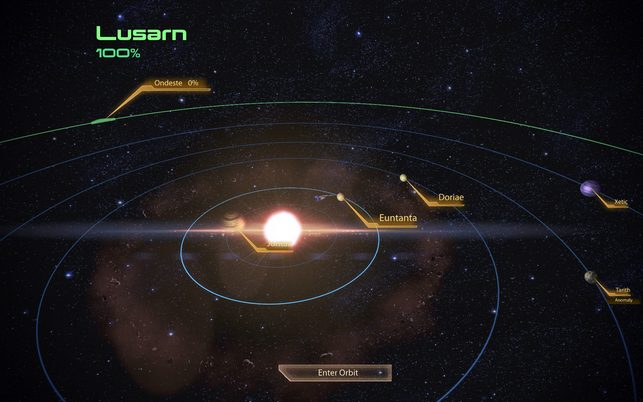
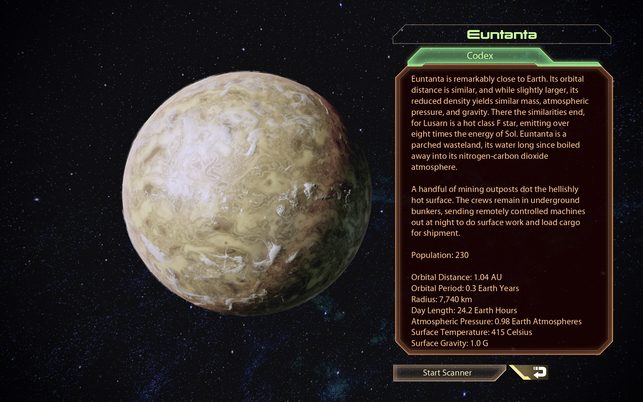
Euntanta is remarkably close to Earth. Its orbital distance is similar, and while slightly larger, its reduced density yields similar mass, atmospheric pressure, and gravity. There the similarities end, for Lusarn is a hot class F star, emitting over eight times the energy of Sol. Euntanta is a parched wasteland, its water long since boiled away into its nitrogen-carbon dioxide atmosphere.
A handful of mining outposts dot the hellishly hot surface. The crews remain in underground bunkers, sending remotely controlled machines out at night to do surface work and load cargo for shipment.
Population: 230
Orbital Distance: 1.04 AU
Orbital Period: 0.3 Earth Years
Radius: 7,740 km
Day Length: 24.2 Earth Hours
Atmospheric Pressure: 0.98 Earth Atmospheres
Surface Temperature: 415 Celsius
Surface Gravity: 1.0 G
Jontan
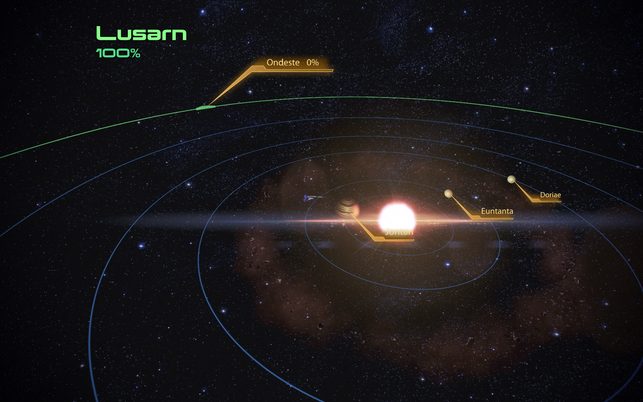
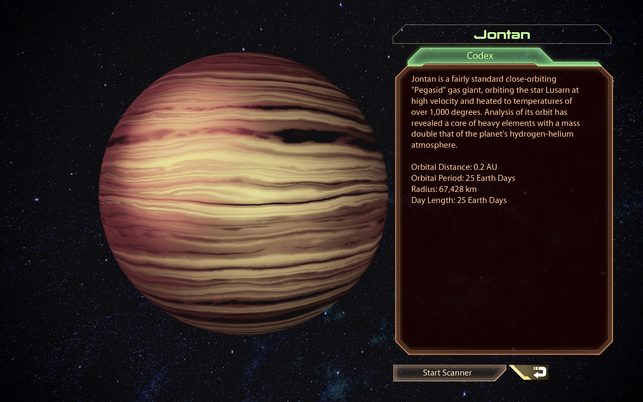
Jontan is a fairly standard close-orbiting “Pegasid” gas giant, orbiting the star Lusarn at high velocity and heated to temperatures of over 1,000 degrees. Analysis of its orbit has revealed a core of heavy elements with a mass double that of the planet’s hydrogen-helium atmosphere.
Orbital Distance: 0.2 AU
Orbital Period: 25 Earth Days
Radius: 67,428 km
Day Length: 25 Earth Days
Tarith*
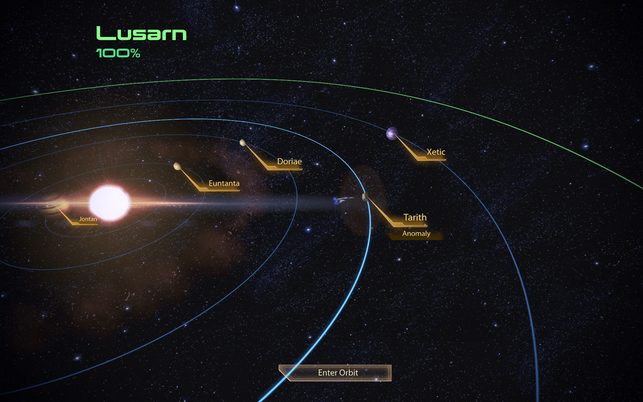
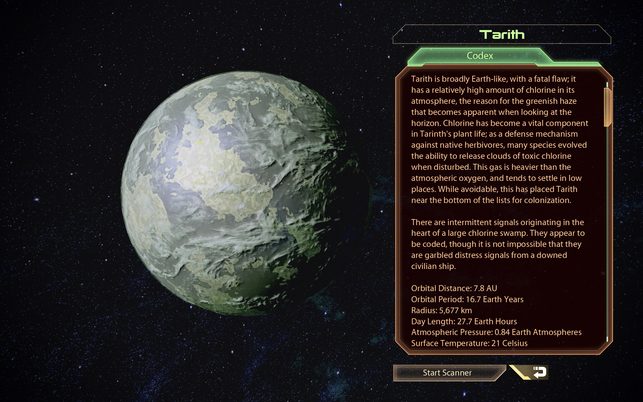
Tarith is broadly Earth-like, with a fatal flaw; it has a relatively high amount of chlorine in its atmosphere, the reason for the greenish haze that becomes apparent when looking at the horizon. Chlorine has become a vital component in Tarinth’s plant life; as a defense mechanism against native herbivores, many species evolved the ability to release clouds of toxic chlorine when disturbed. This gas is heavier than the atmospheric oxygen, and tends to settle in low places. While avoidable, this has placed Tarith near the bottom of the lists for colonization.
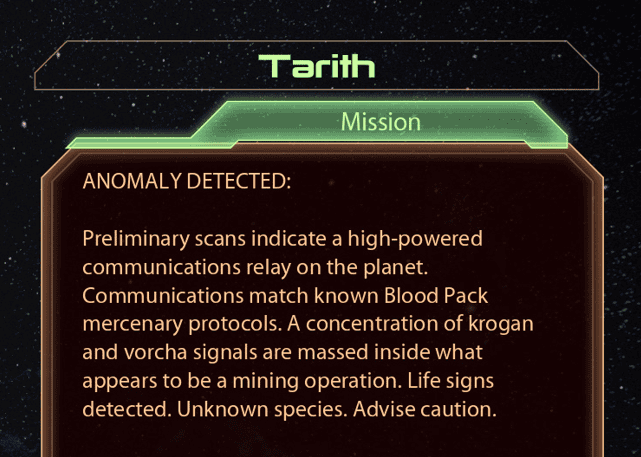
There are intermittent signals originating in the heart of a large chlorine swamp. They appear to be coded, though it is not impossible that they are garbled distress signals from a downed civilian ship.
Orbital Distance: 7.8 AU
Orbital Period: 16.7 Earth Years
Radius: 5,677 km
Day Length: 27.7 Earth Hours
Atmospheric Pressure: 0.84 Earth Atmospheres
Surface Temperature: 21 Celsius
Surface Gravity: 0.87 G
Xetic
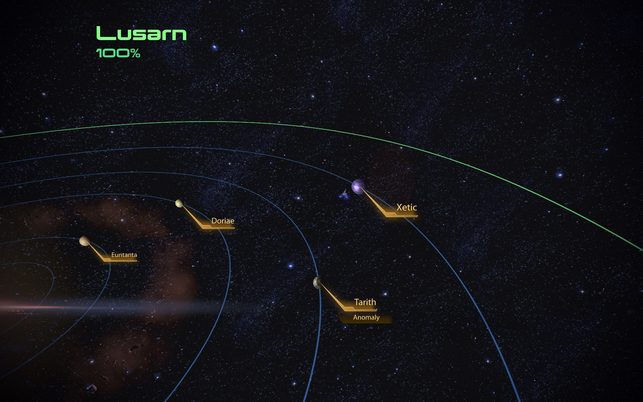
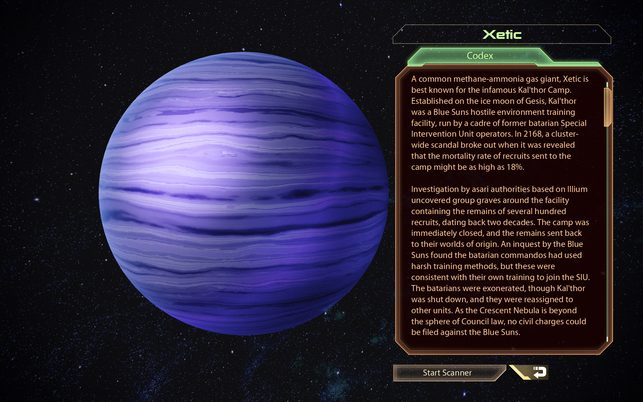
A common methane-ammonia gas giant, Xetic is best known for the infamous Kal’thor Camp. Established on the ice moon of Gesis, Kal’thor was a Blue Suns hostile environment training facility, run by a cadre of former batarian Special Intervention Unit operators. In 2168, a cluster-wide scandal broke out when it was revealed that the mortality rate of recruits sent to the camp might be as high as 18%.
Investigation by asari authorities based on Illium uncovered group graves around the facility containing the remains of several hundred recruits, dating back two decades. The camp was immediately closed, and the remains sent back to their worlds of origin. An inquest by the Blue Suns found the batarian commandos had used harsh training methods, but these were consistent with their own training to join the SIU. The batarians were exonerated, though Kal’thor was shut down, and they were reassigned to other units. As the Crescent Nebula is beyond the sphere of Council law, no civil charges could be filed against the Blue Suns.
Orbital Distance: 15.6 AU
Orbital Period: 47.4 Earth Years
Radius: 30,054 km
Day Length: 13.7 Earth Hours
ONDESTE
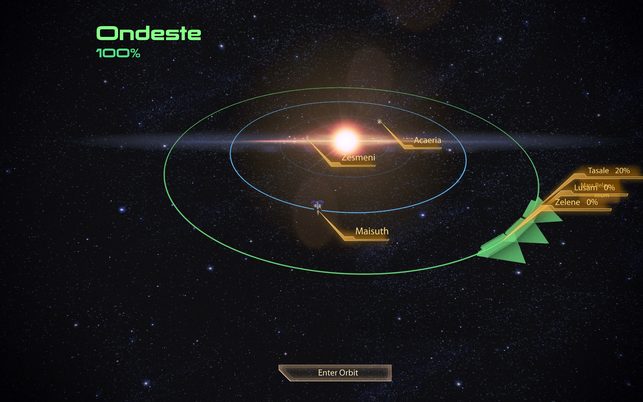
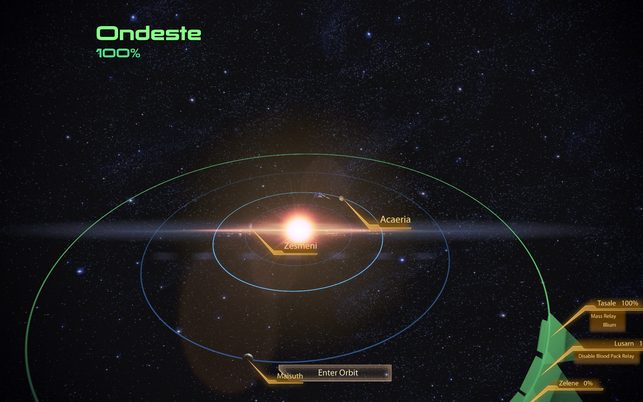
Acaeria
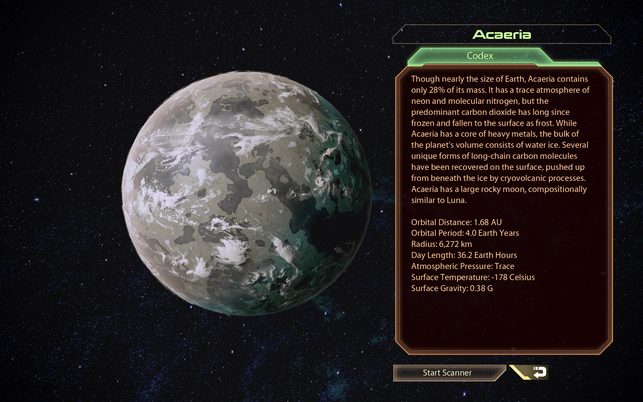
Though nearly the size of Earth, Acaeria contains only 28% of its mass. It has a trace atmosphere of neon and molecular nitrogen, but the
predominant carbon dioxide has long since frozen and fallen to the surface as frost. While Acaeria has a core of heavy metals, the bulk of the planet’s volume consists of water ice. Several unique forms of long-chain carbon molecules have been recovered on the surface, pushed up from beneath the ice by cryovolcanic processes. Acaeria has a large rocky moon, compositionally similar to Luna.
Orbital Distance: 1.68 AU
Orbital Period: 4.0 Earth Years
Radius: 6,272 km
Day Length: 36.2 Earth Hours
Atmospheric Pressure: Trace
Surface Temperature: -178 Celsius
Surface Gravity: 0.38 G
Maisuth
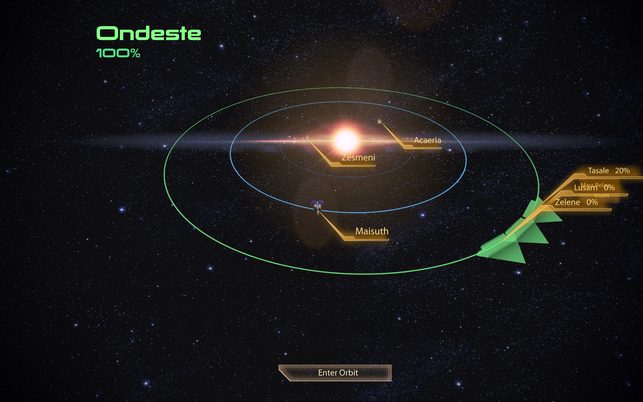
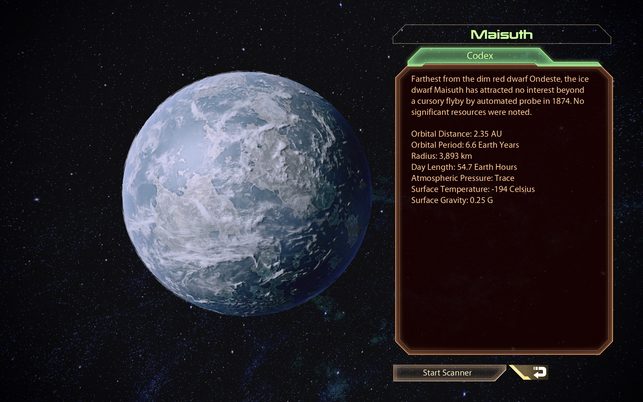
Farthest from the dim red dwarf Ondeste, the ice dwarf Maisuth has attracted no interest beyond a cursory flyby by automated probe in 1874. No significant resources were noted.
Orbital Distance: 2.35 AU
Orbital Period: 6.6 Earth Years
Radius: 3,893 km
Day Length: 54.7 Earth Hours
Atmospheric Pressure: Trace
Surface Temperature: -194 Celsius
Surface Gravity: 0.25 G
Zesmeni
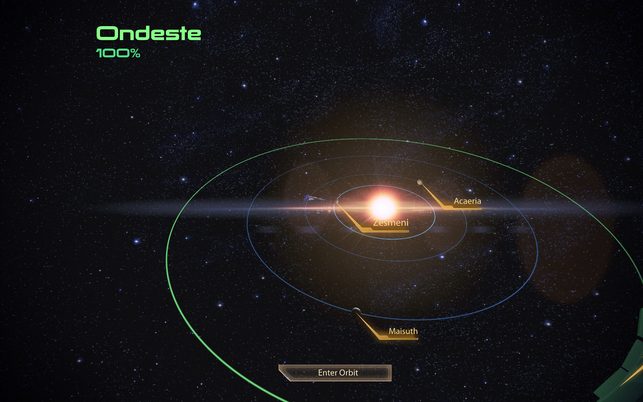
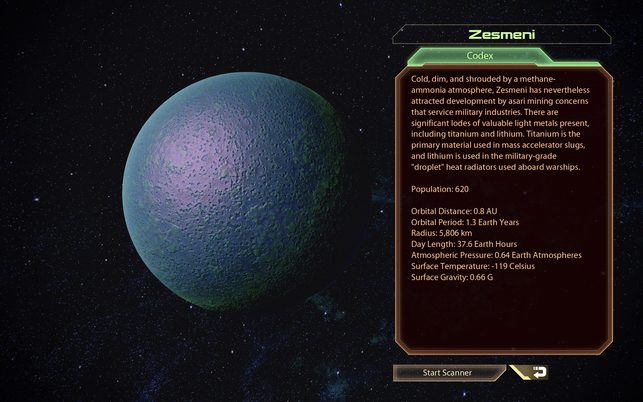
Cold, dim, and shrouded by a methane-ammonia atmosphere, Zesmeni has nevertheless attracted development by asari mining concerns that service military industries. There are significant lodes of valuable light metals present, including titanium and lithium. Titanium is the primary material used in mass accelerator slugs, and lithium is used in the military-grade “droplet” heat radiators used aboard warships.
Population: 620
Orbital Distance: 0.8 AU
Orbital Period: 1.3 Earth Years
Radius: 5,806 km
Day Length: 37.6 Earth Hours
Atmospheric Pressure: 0.64 Earth Atmospheres
Surface Temperature: -119 Celsius
Surface Gravity: 0.66 G
TASALE
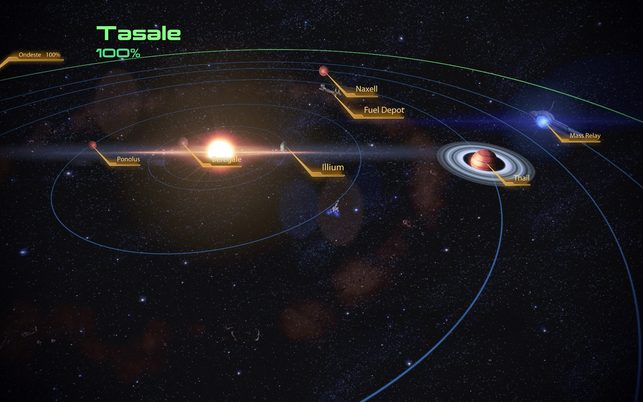
Beregale
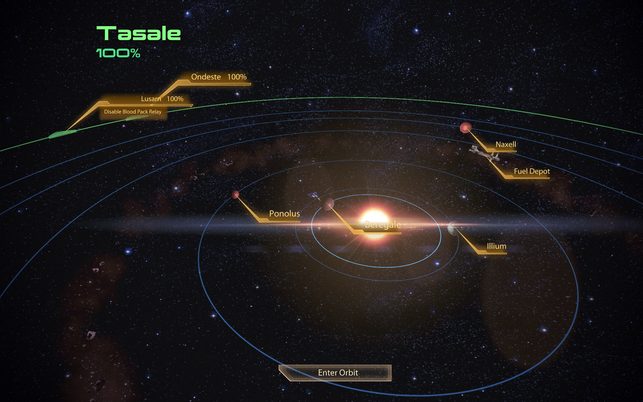
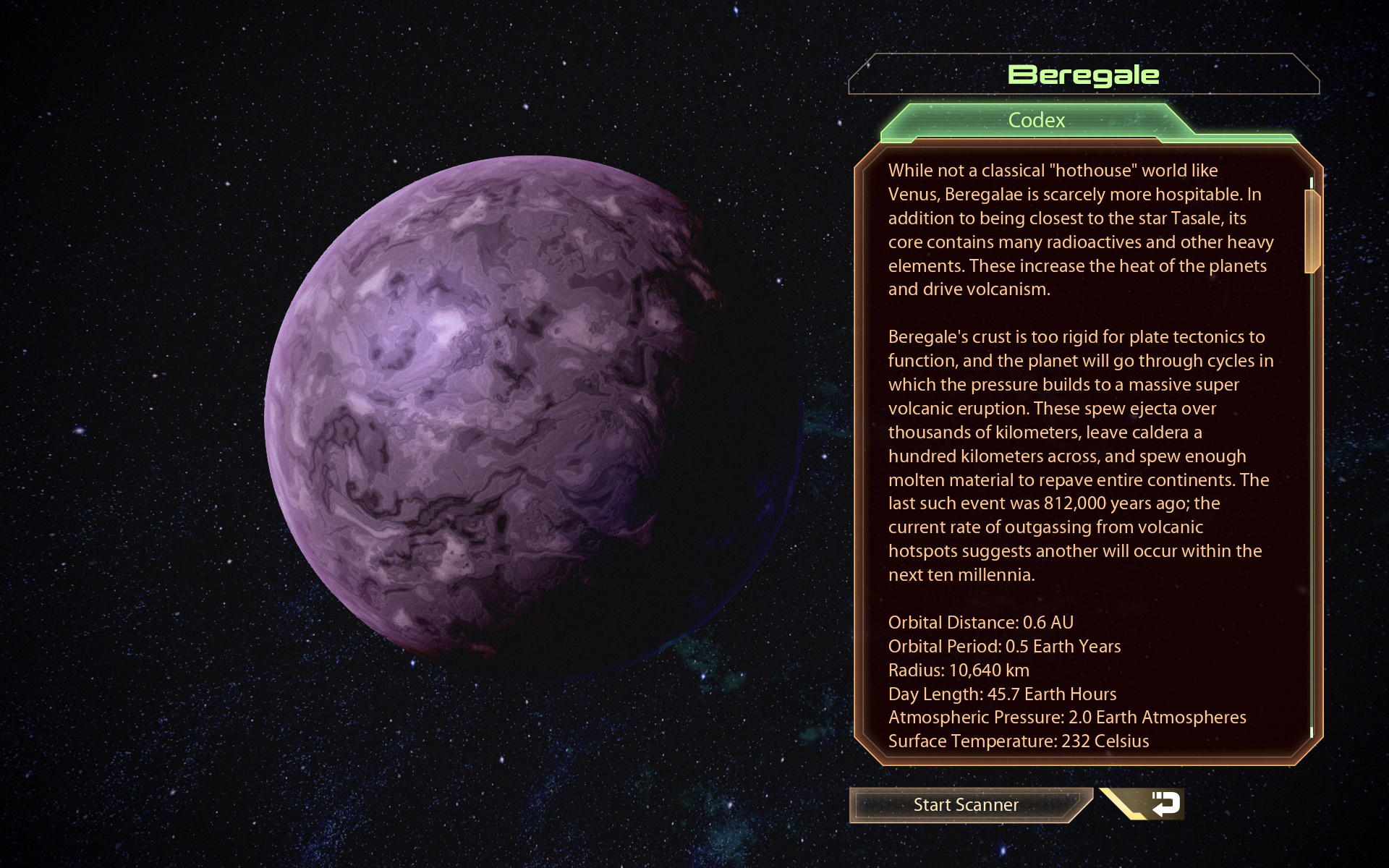
While not a classical “hothouse” world like Venus, Beregalae is scarcely more hospitable. In addition to being closest to the star Tasale, its core contains many radioactives and other heavy elements. These increase the heat of the planets and drive volcanism.
Beregale’s crust is too rigid for plate tectonics to function, and the planet will go through cycles in which the pressure builds to a massive super volcanic eruption. These spew ejecta over thousands of kilometers, leave caldera a hundred kilometers across, and spew enough molten material to repave entire continents. The last such event was 812,000 years ago; the current rate of outgassing from volcanic hotspots suggests another will occur within the next ten millennia.
Orbital Distance: 0.6 AU
Orbital Period: 0.5 Earth Years
Radius: 10,640 km
Day Length: 45.7 Earth Hours
Atmospheric Pressure: 2.0 Earth Atmospheres
Surface Temperature: 232 Celsius
Surface Gravity: 2.1 G
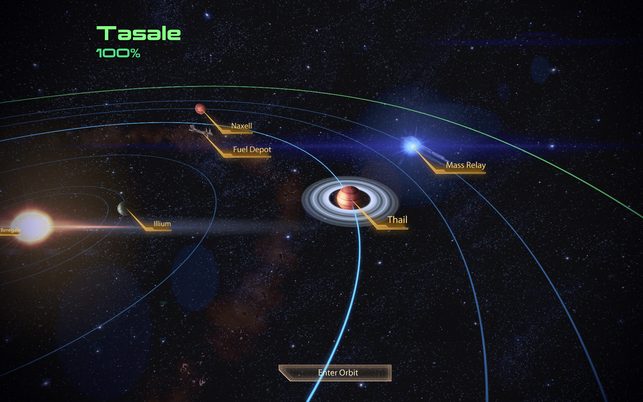
Illium
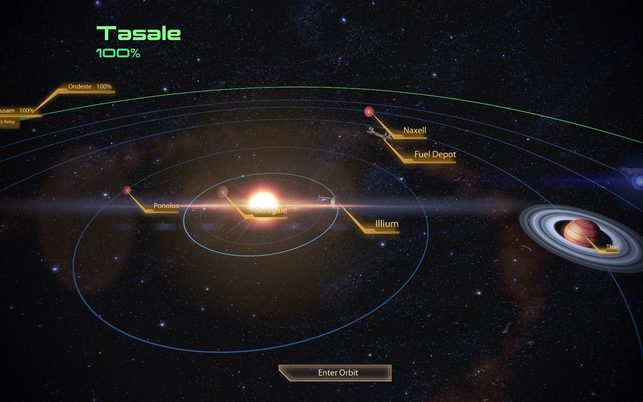
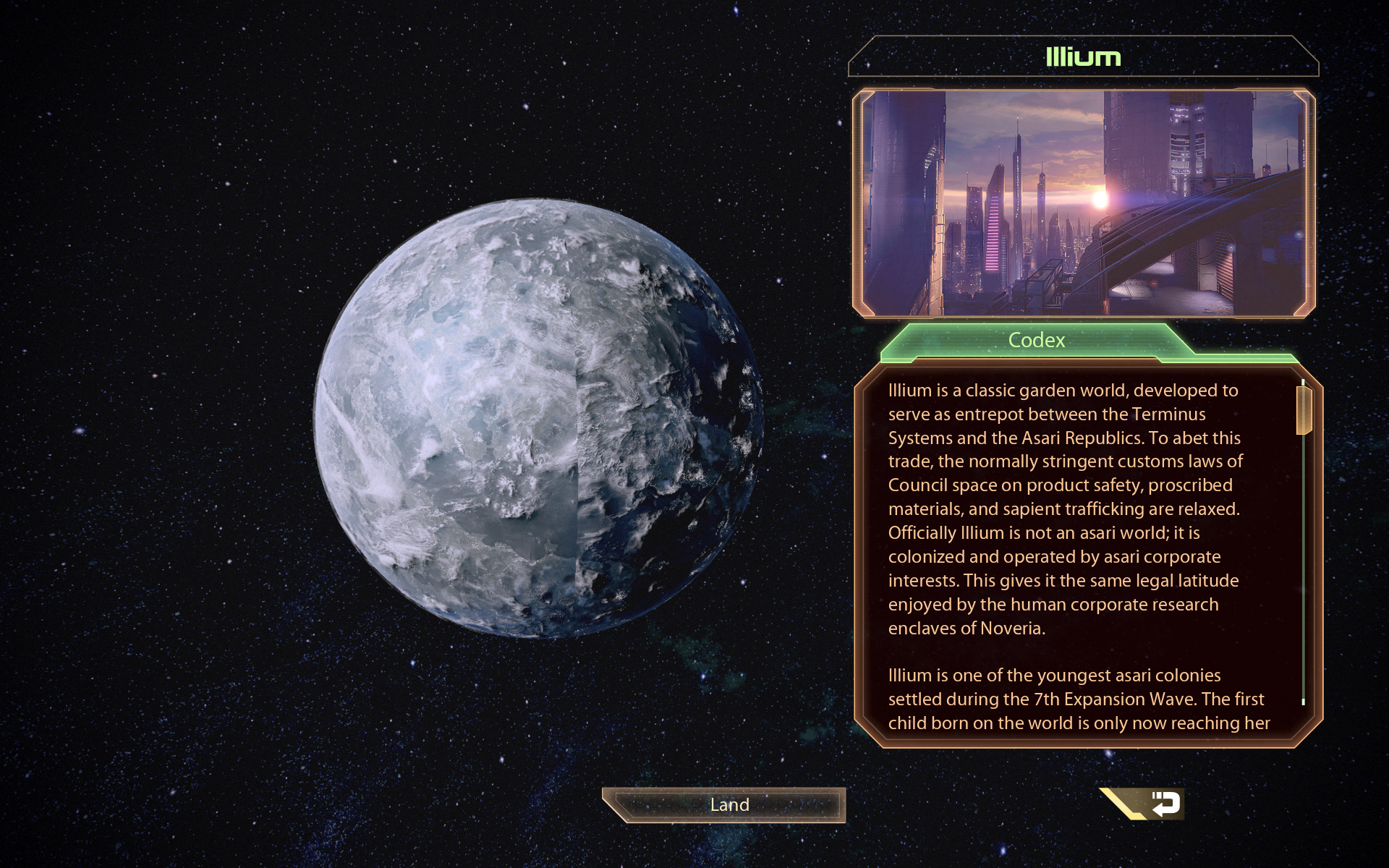
Illium is a classic garden world, developed to serve as entrepot between the Terminus Systems and the Asari Republics. To abet this trade, the normally stringent customs laws of Council space on product safety, proscribed materials, and sapient trafficking are relaxed. Officially Illium is not an asari world; it is colonized and operated by asari corporate interests. This gives it the same legal latitude enjoyed by the human corporate research enclaves of Noveria.
Illium is one of the youngest asari colonies settled during the 7th Expansion Wave. The first child born on the world is only now reaching her middle-age. The world is hot and massive; ground settlement is only possible at the higher polar latitudes. In more equatorial locations, the population is housed in arcology skyscrapers to escape the heat of the surface.
Colony Founded: 1617
Population (Surface): 84,900,000
Population (L4 and L5 stations): 80,300
Capital: Nos Astra
Orbital Distance: 1.3 AU
Orbital Period: 1.5 Earth Years
Radius: 7,431 km
Day Length: 25 Earth Hours
Atmospheric Pressure: 1.15 Earth Atmospheres
Surface Temperature: 63 Celsius
Surface Gravity: 1.2 G
Naxell
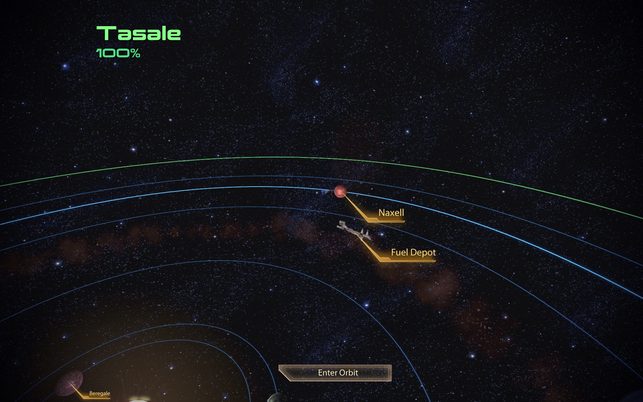
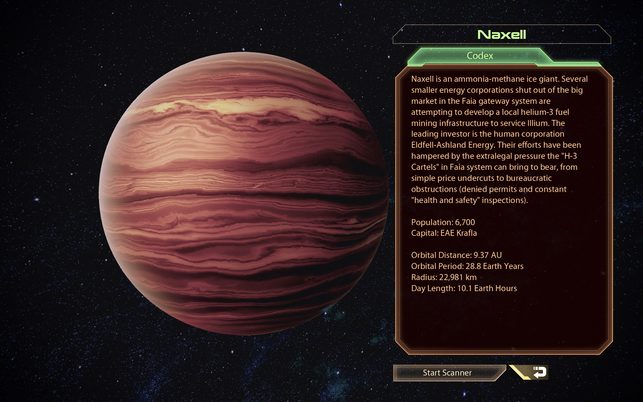
Naxell is an ammonia-methane ice giant. Several smaller energy corporations shut out of the big market in the Faia gateway system are attempting to develop a local helium-3 fuel mining infrastructure to service Illium. The leading investor is the human corporation Eldfell-Ashland Energy. Their efforts have been hampered by the extralegal pressure the “H-3 Cartels” in Faia system can bring to bear, from simple price undercuts to bureaucratic obstructions (denied permits and constant “health and safety” inspections).
Population: 6,700
Capital: EAE Krafla
Orbital Distance: 9.37 AU
Orbital Period: 28.8 Earth Years
Radius: 22,981 km
Day Length: 10.1 Earth Hours
Ponolus
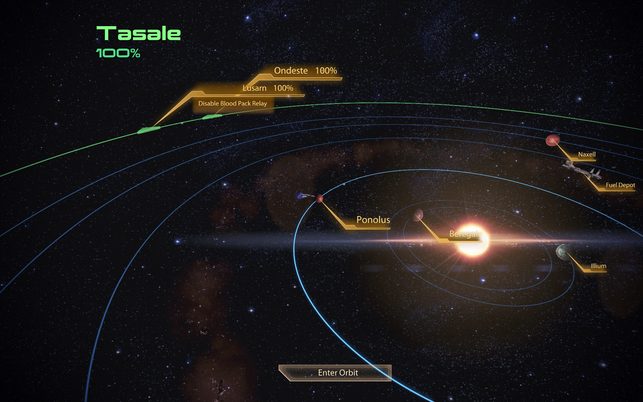
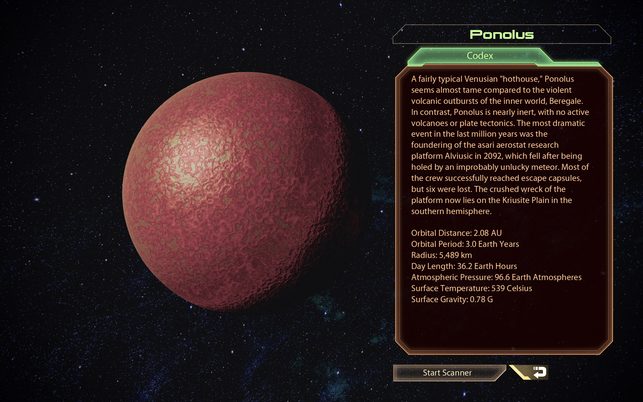
A fairly typical Venusian “hothouse,” Ponolus seems almost tame compared to the violent volcanic outbursts of the inner world, Beregale. In contrast, Ponolus is nearly inert, with no active volcanoes or plate tectonics. The most dramatic event in the last million years was the foundering of the asari aerostat research platform Alviusic in 2092, which fell after being holed by an improbably unlucky meteor. Most of the crew successfully reached escape capsules, but six were lost. The crushed wreck of the platform now lies on the Kriusite Plain in the southern hemisphere.
Orbital Distance: 2.08 AU
Orbital Period: 3.0 Earth Years
Radius: 5,489 km
Day Length: 36.2 Earth Hours
Atmospheric Pressure: 96.6 Earth Atmospheres
Surface Temperature: 539 Celsius
Surface Gravity: 0.78 G
Thail
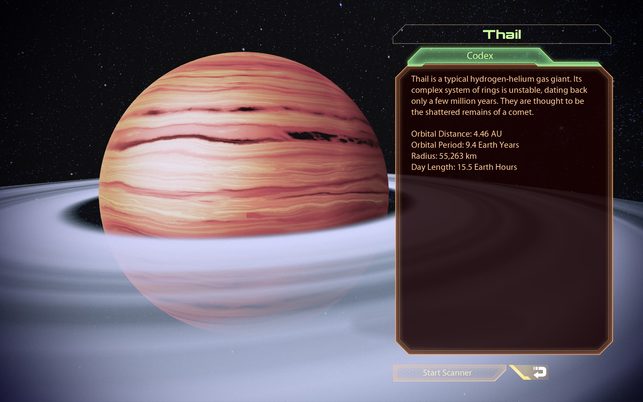
Thail is a typical hydrogen-helium gas giant. Its complex system of rings is unstable, dating back only a few million years. They are thought to be the shattered remains of a comet.
Orbital Distance: 4.46 AU
Orbital Period: 9.4 Earth Years
Radius: 55,263 km
Day Length: 15.5 Earth Hours
ZELENE
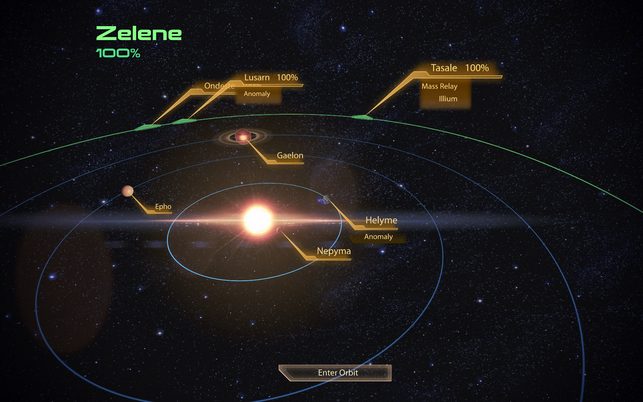
Epho
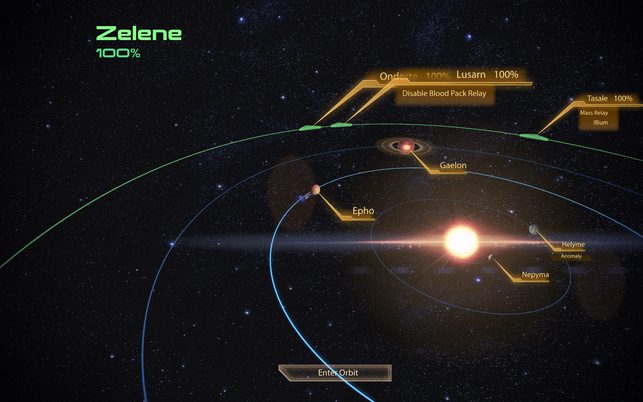
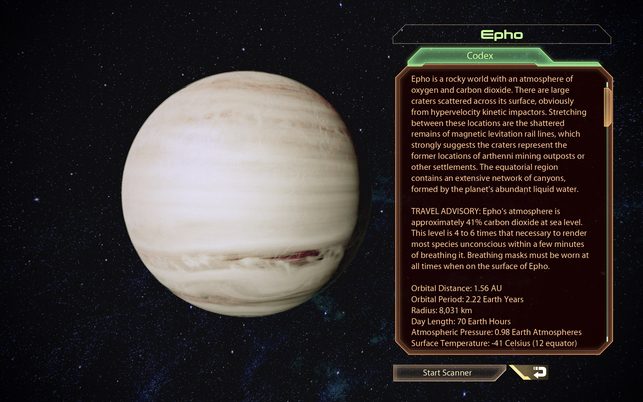
Epho is a rocky world with an atmosphere of oxygen and carbon dioxide. There are large craters scattered across its surface, obviously from hypervelocity kinetic impactors. Stretching between these locations are the shattered remains of magnetic levitation rail lines, which strongly suggests the craters represent the former locations of arthenni mining outposts or other settlements. The equatorial region contains an extensive network of canyons, formed by the planet’s abundant liquid water.
TRAVEL ADVISORY: Epho’s atmosphere is approximately 41% carbon dioxide at sea level. This level is 4 to 6 times that necessary to render most species unconscious within a few minutes of breathing it. Breathing masks must be worn at all times when on the surface of Epho.
Orbital Distance: 1.56 AU
Orbital Period: 2.22 Earth Years
Radius: 8,031 km
Day Length: 70 Earth Hours
Atmospheric Pressure: 0.98 Earth Atmospheres
Surface Temperature: -41 Celsius (12 equator)
Surface Gravity: 1.0 G
Gaelon
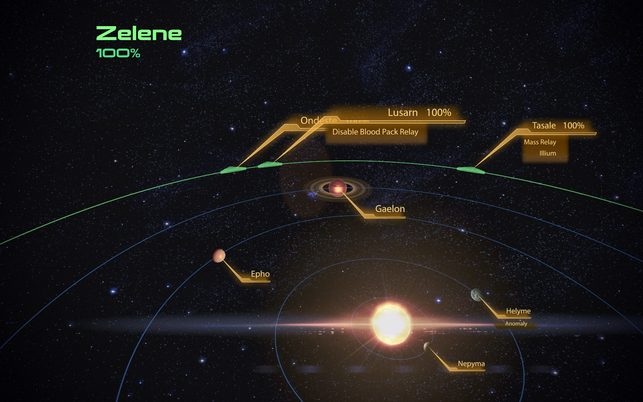
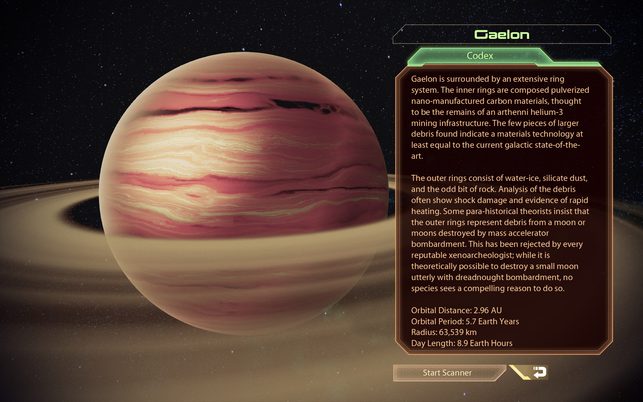
Gaelon is surrounded by an extensive ring system. The inner rings are composed pulverized nano-manufactured carbon materials, thought to be the remains of an arthenni helium-3 mining infrastructure. The few pieces of larger debris found indicate a materials technology at least equal to the current galactic state-of-the-art.
The outer rings consist of water-ice, silicate dust, and the odd bit of rock. Analysis of the debris often show shock damage and evidence of rapid heating. Some para-historical theorists insist that the outer rings represent debris from a moon or moons destroyed by mass accelerator bombardment. This has been rejected by every reputable xenoarcheologist; while it is theoretically possible to destroy a small moon utterly with dreadnought bombardment, no species sees a compelling reason to do so.
Orbital Distance: 2.96 AU
Orbital Period: 5.7 Earth Years
Radius: 63,539 km
Day Length: 8.9 Earth Hours
Helyme*
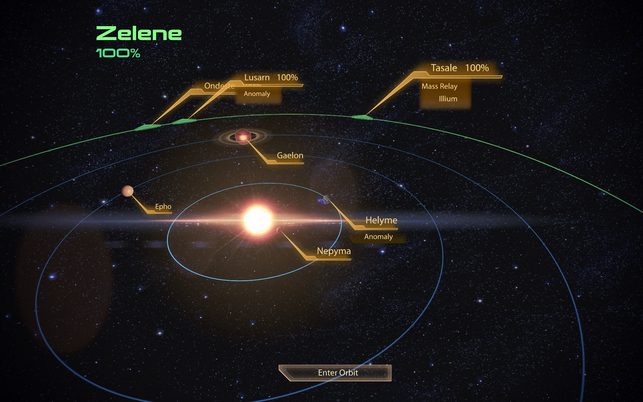
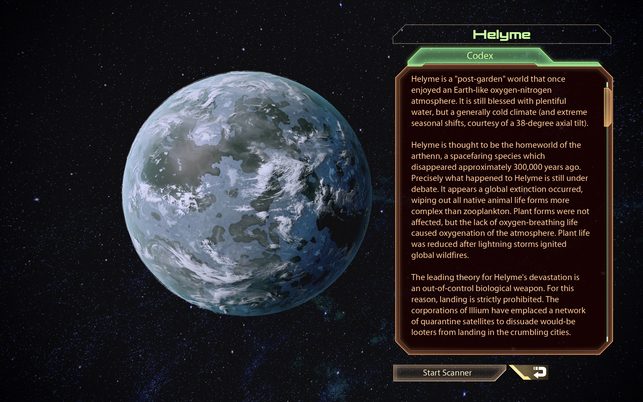
Helyme is a “post-garden” world that once enjoyed an Earth-like oxygen-nitrogen atmosphere. It is still blessed with plentiful water, but a generally cold climate (and extreme seasonal shifts, courtesy of a 38-degree axial tilt).
Helyme is thought to be the homeworld of the arthenn, a spacefaring species which disappeared approximately 300,000 years ago. Precisely what happened to Helyme is still under debate. It appears a global extinction occurred, wiping out all native animal life forms more complex than zooplankton. Plant forms were not affected, but the lack of oxygen-breathing life caused oxygenation of the atmosphere. Plant life was reduced after lightning storms ignited global wildfires.
The leading theory for Helyme’s devastation is an out-of-control biological weapon. For this reason, landing is strictly prohibited. The corporations of Illium have emplaced a network of quarantine satellites to dissuade would-be looters from landing in the crumbling cities.
Orbital Distance: 1.2 AU
Orbital Period: 1.5 Earth Years
Radius: 5,522 km
Day Length: 44.4 Earth Hours
Atmospheric Pressure: 0.84 Earth Atmospheres
Surface Temperature: -15 Celsius
Surface Gravity: 0.87 G
Nepyma
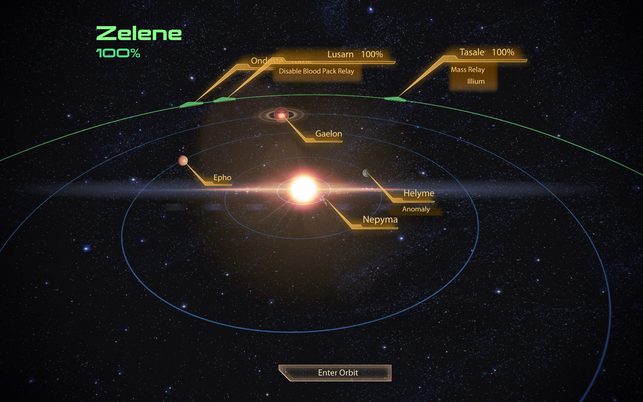
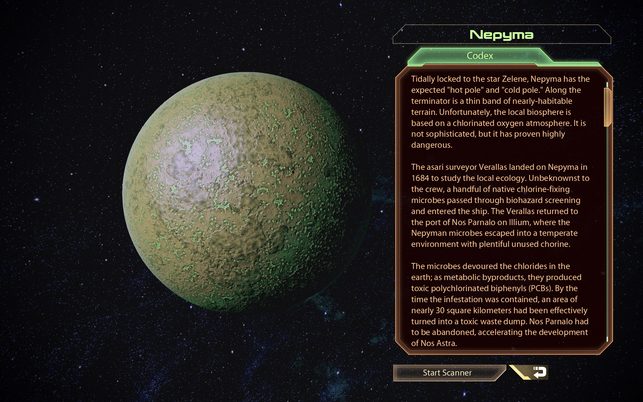
Tidally locked to the star Zelene, Nepyma has the expected “hot pole” and “cold pole.” Along the terminator is a thin band of nearly-habitable terrain. Unfortunately, the local biosphere is based on a chlorinated oxygen atmosphere. It is not sophisticated, but it has proven highly dangerous.
The asari surveyor Verallas landed on Nepyma in 1684 to study the local ecology. Unbeknownst to the crew, a handful of native chlorine-fixing microbes passed through biohazard screening and entered the ship. The Verallas returned to the port of Nos Parnalo on Illium, where the Nepyman microbes escaped into a temperate environment with plentiful unused chorine.
The microbes devoured the chlorides in the earth; as metabolic byproducts, they produced toxic polychlorinated biphenyls (PCBs). By the time the infestation was contained, an area of nearly 30 square kilometers had been effectively turned into a toxic waste dump. Nos Parnalo had to be abandoned, accelerating the development of Nos Astra.
Orbital Distance: 0.8 AU
Orbital Period: 0.8 Earth Years
Radius: 4,456 km
Day Length: 40.4 Earth Hours
Atmospheric Pressure: 0.55 Earth Atmospheres
Surface Temperature: 32 Celsius
Surface Gravity: 0.57 G
EAGLE NEBULA
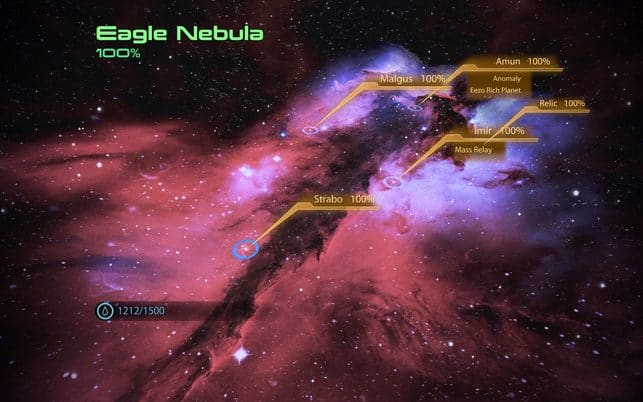
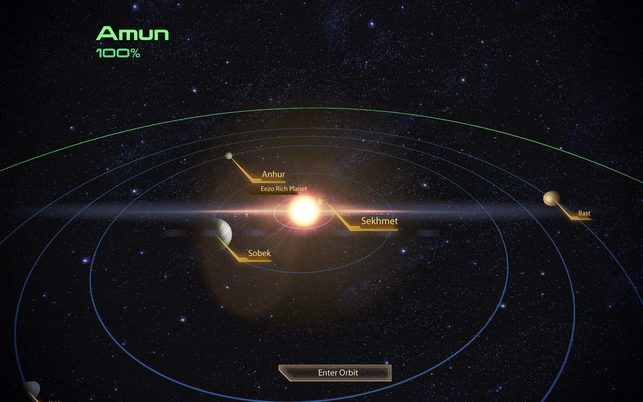
AMUN
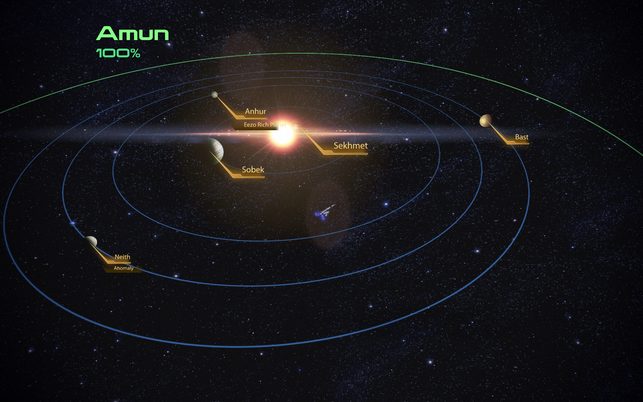
Anhur
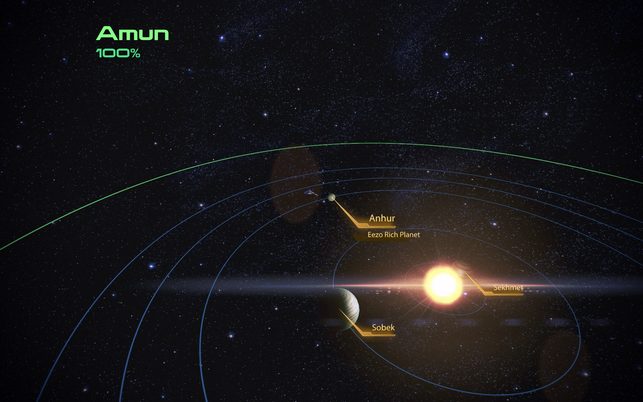
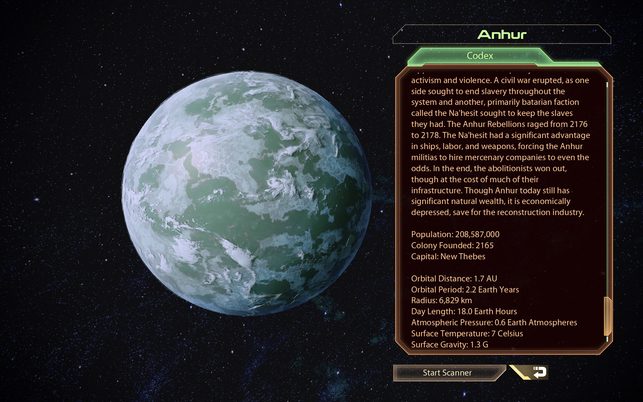
A garden world with heavy populations of humans and batarians, Anhur was home to one of the ugliest violations of sapient rights in modern human history. A consortium of corporations and corrupt politicians, fearing batarian economic competition due to their custom of legal slavery, passed a resolution that abolished the minimum wage — effectively relegalizing slavery on a human-dominated world.
Opponents of the motion quickly turned to activism and violence. A civil war erupted, as one side sought to end slavery throughout the system and another, primarily batarian faction called the Na’hesit sought to keep the slaves they had. The Anhur Rebellions raged from 2176 to 2178. The Na’hesit had a significant advantage in ships, labor, and weapons, forcing the Anhur militias to hire mercenary companies to even the odds. In the end, the abolitionists won out, though at the cost of much of their infrastructure. Though Anhur today still has significant natural wealth, it is economically depressed, save for the reconstruction industry.
Population: 208,587,000 Colony Founded: 2165
Capital: New Thebes
Orbital Distance: 1.7 AU
Orbital Period: 2.2 Earth Years
Radius: 6,829 km
Day Length: 18.0 Earth Hours
Atmospheric Pressure: 0.6 Earth Atmospheres
Surface Temperature: 7 Celsius
Surface Gravity: 1.3 G
Bast
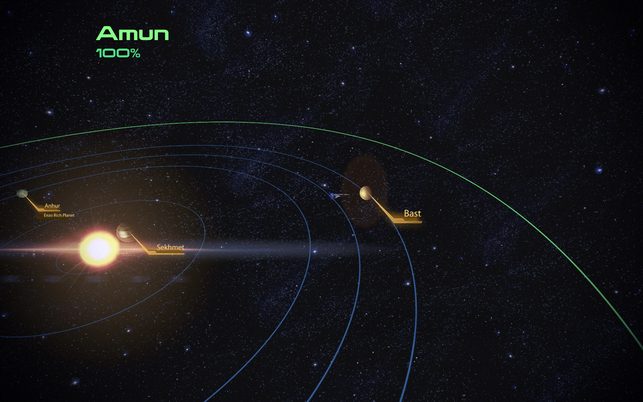
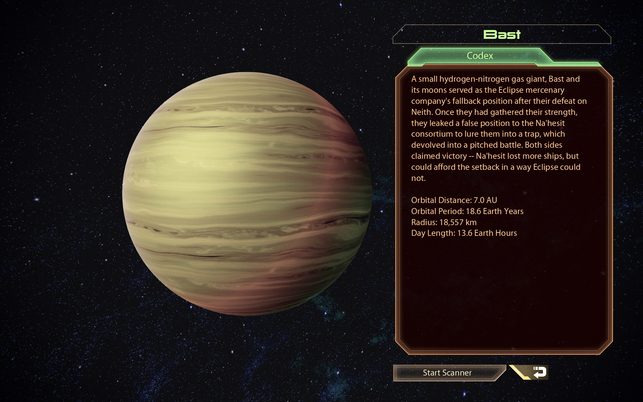
A small hydrogen-nitrogen gas giant, Bast and its moons served as the Eclipse mercenary company’s fallback position after their defeat on Neith. Once they had gathered their strength, they leaked a false position to the Na’hesit consortium to lure them into a trap, which devolved into a pitched battle. Both sides claimed victory — Na’hesit lost more ships, but could afford the setback in a way Eclipse could not.
Orbital Distance: 7.0 AU
Orbital Period: 18.6 Earth Years
Radius: 18,557 km
Day Length: 13.6 Earth Hours
Neith*
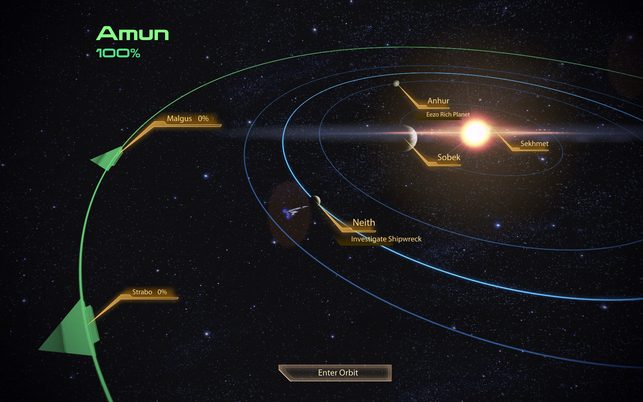
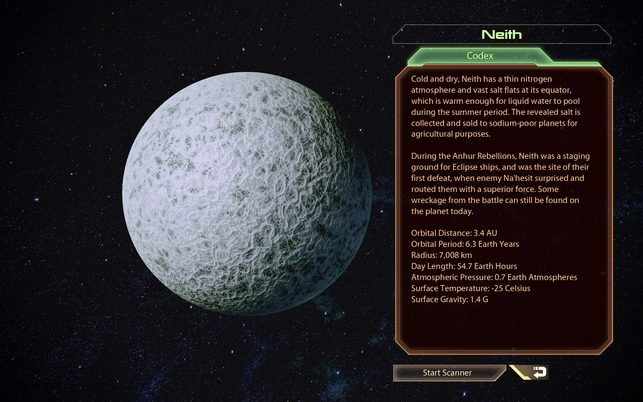
Cold and dry, Neith has a thin nitrogen atmosphere and vast salt flats at its equator, which is warm enough for liquid water to pool during the summer period. The revealed salt is collected and sold to sodium-poor planets for agricultural purposes.
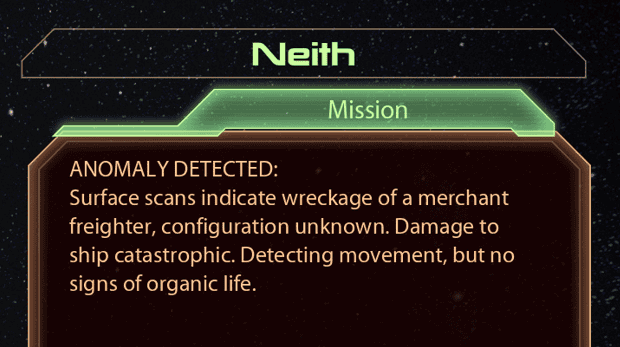
During the Anhur Rebellions, Neith was a staging ground for Eclipse ships, and was the site of their first defeat, when enemy Na’hesit surprised and routed them with a superior force. Some wreckage from the battle can still be found on the planet today.
Orbital Distance: 3.4 AU
Orbital Period: 6.3 Earth Years
Radius: 7,008 km
Day Length: 54.7 Earth Hours
Atmospheric Pressure: 0.7 Earth Atmospheres
Surface Temperature: -25 Celsius
Surface Gravity: 1.4G
Sekhmet
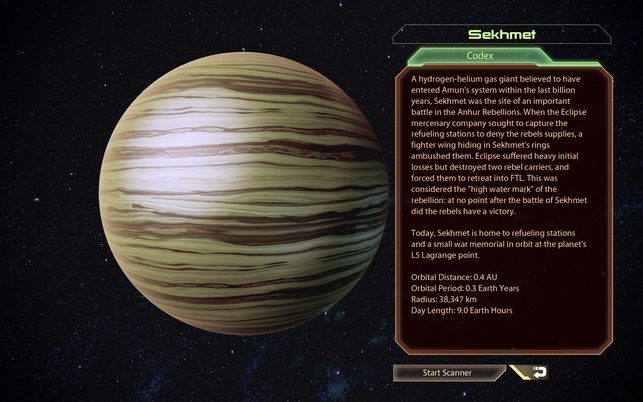
A hydrogen-helium gas giant believed to have entered Amun’s system within the last billion years, Sekhmet was the site of an important battle in the Anhur Rebellions. When the Eclipse mercenary company sought to capture the refueling stations to deny the rebels supplies, a fighter wing hiding in Sekhmet’s rings ambushed them. Eclipse suffered heavy initial losses but destroyed two rebel carriers, and forced them to retreat into FTL. This was considered the “high water mark” of the rebellion: at no point after the battle of Sekhmet did the rebels have a victory.
Today, Sekhmet is home to refueling stations and a small war memorial in orbit at the planet’s L5 Lagrange point.
Orbital Distance: 0.4 AU
Orbital Period: 0.3 Earth Years
Radius: 38,347 km
Day Length: 9.0 Earth Hours
Sobek
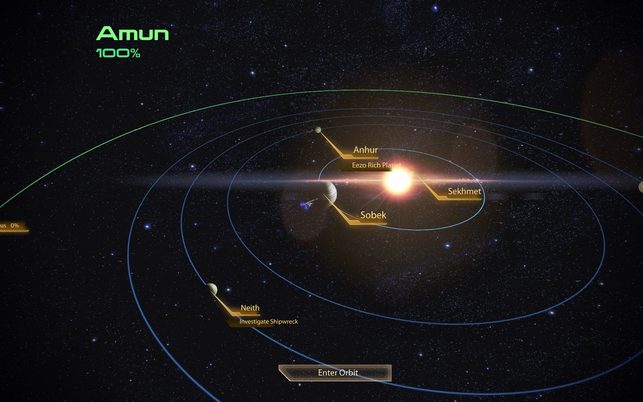
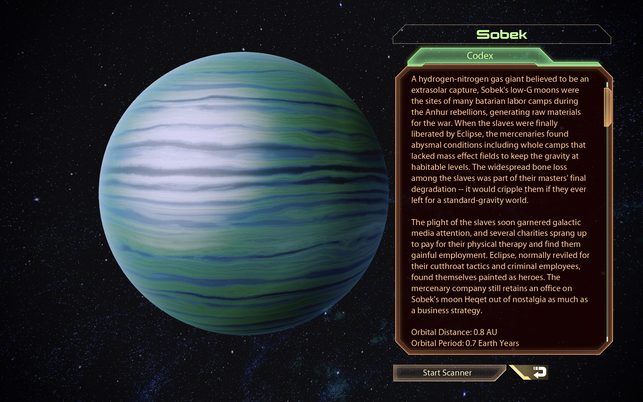
A hydrogen-nitrogen gas giant believed to be an extrasolar capture, Sobek’s low-G moons were the sites of many batarian labor camps during the Anhur rebellions, generating raw materials for the war. When the slaves were finally liberated by Eclipse, the mercenaries found abysmal conditions including whole camps that lacked mass effect fields to keep the gravity at habitable levels. The widespread bone loss among the slaves was part of their masters’ final degradation — it would cripple them if they ever left for a standard-gravity world.
The plight of the slaves soon garnered galactic media attention, and several charities sprang up to pay for their physical therapy and find them gainful employment. Eclipse, normally reviled for their cutthroat tactics and criminal employees, found themselves painted as heroes. The mercenary company still retains an office on Sobek’s moon Heqet out of nostalgia as much as a business strategy.
Orbital Distance: 0.8 AU
Orbital Period: 0.7 Earth Years
Radius: 72,530 km
Day Length: 12.4 Earth Hours
IMIR
Gregas
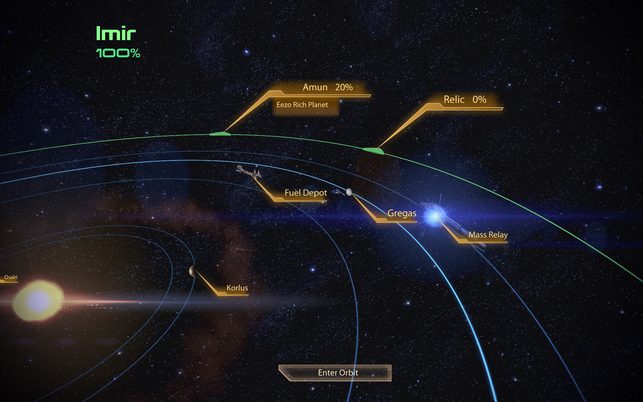
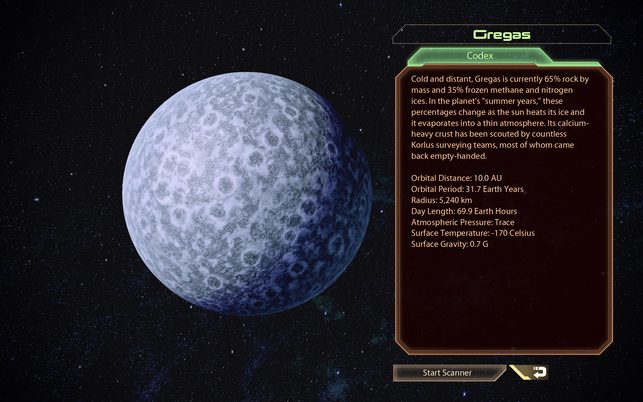
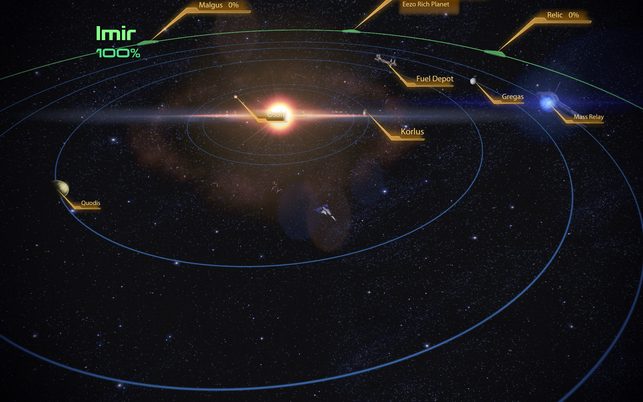
Cold and distant, Gregas is currently 65% rock by mass and 35% frozen methane and nitrogen ices. In the planet’s “summer years,” these percentages change as the sun heats its ice and it evaporates into a thin atmosphere. Its calcium-heavy crust has been scouted by countless Korlus surveying teams, most of whom came back empty-handed.
Orbital Distance: 10.0 AU
Orbital Period: 31.7 Earth Years
Radius: 5,240 km
Day Length: 69.9 Earth Hours
Atmospheric Pressure: Trace
Surface Temperature: -170
Celsius Surface Gravity: 0.7 G
Korlus
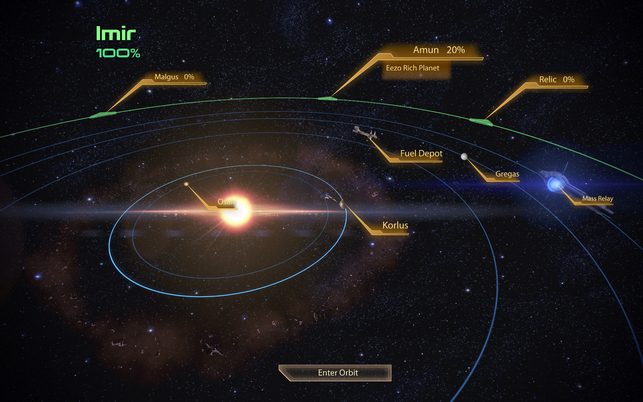
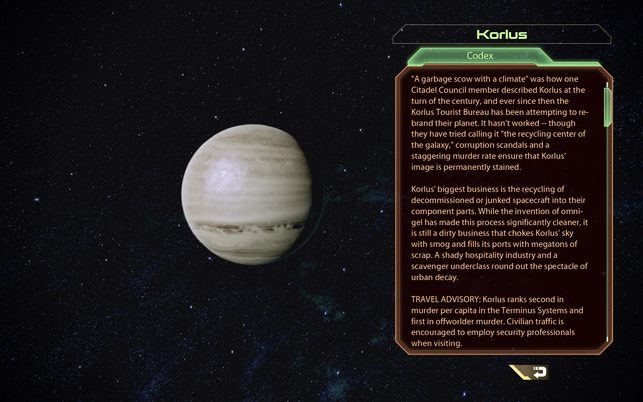
“A garbage scow with a climate” was how one Citadel Council member described Korlus at the turn of the century, and ever since then the Korlus Tourist Bureau has been attempting to re- brand their planet. It hasn’t worked — though they have tried calling it “the recycling center of the galaxy,” corruption scandals and a staggering murder rate ensure that Korlus’ image is permanently stained.
Korlus’ biggest business is the recycling of decommissioned or junked spacecraft into their component parts. While the invention of omni-gel has made this process significantly cleaner, it is still a dirty business that chokes Korlus’ sky with smog and fills its ports with megatons of scrap. A shady hospitality industry and a scavenger underclass round out the spectacle of urban decay.
TRAVEL ADVISORY: Korlus ranks second in murder per capita in the Terminus Systems and first in offworlder murder. Civilian traffic is encouraged to employ security professionals when visiting.
Population: 3,800,000,000 (est.)
Colony Founded: 1781 CE
Capital: Choquo (disputed)
Orbital Distance: 1.3 AU
Orbital Period: 1.5 Earth Years
Radius: 6,850 km
Day Length: 28.9 Earth Hours
Atmospheric Pressure: 1.5 Earth Atmospheres
Surface Temperature: 28 Celsius
Surface Gravity: 1.3 G
Osalri
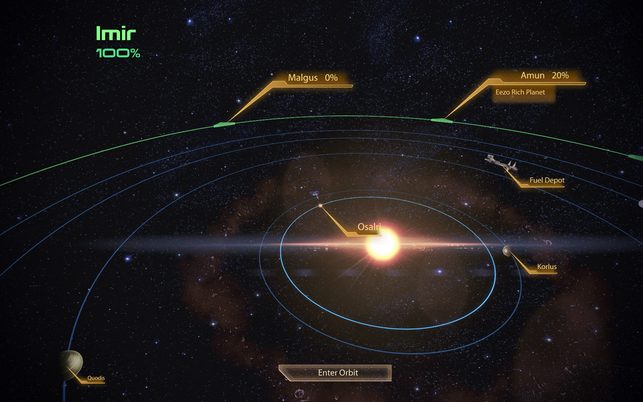
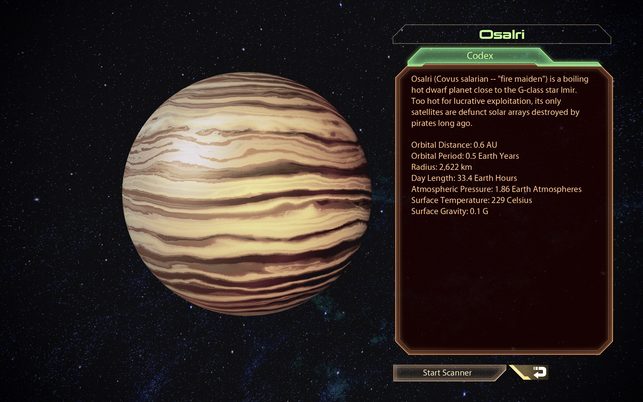
Osalri (Covus salarian — “fire maiden”) is a boiling hot dwarf planet close to the G-class star Imir. Too hot for lucrative exploitation, its only satellites are defunct solar arrays destroyed by pirates long ago.
Orbital Distance: 0.6 AU
Orbital Period: 0.5 Earth Years
Radius: 2,622 km
Day Length: 33.4 Earth Hours
Atmospheric Pressure: 1.86 Earth Atmospheres
Surface Temperature: 229
Celsius Surface Gravity: 0.1 G
Quodis
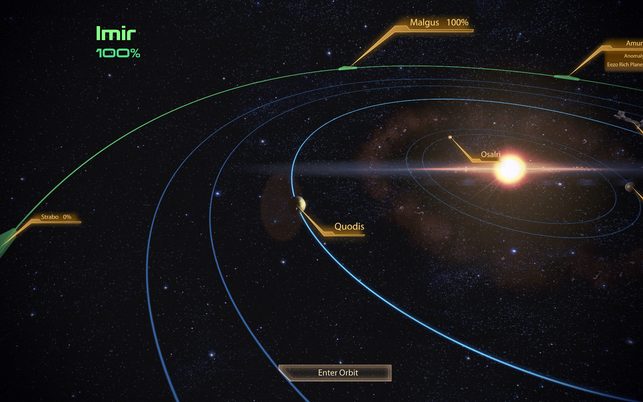
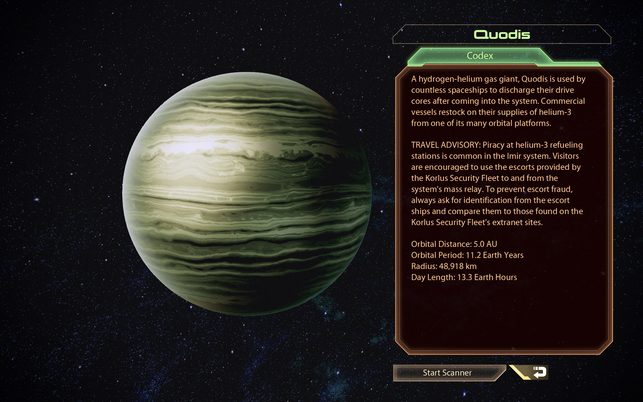
A hydrogen-helium gas giant, Quodis is used by countless spaceships to discharge their drive cores after coming into the system. Commercial vessels restock on their supplies of helium-3 from one of its many orbital platforms.
TRAVEL ADVISORY: Piracy at helium-3 refueling stations is common in the Imir system. Visitors are encouraged to use the escorts provided by the Korlus Security Fleet to and from the system’s mass relay. To prevent escort fraud, always ask for identification from the escort ships and compare them to those found on the Korlus Security Fleet’s extranet sites.
Orbital Distance: 5.0 AU
Orbital Period: 11.2 Earth Years
Radius: 48,918 km
Day Length: 13.3 Earth Hours
MALGUS
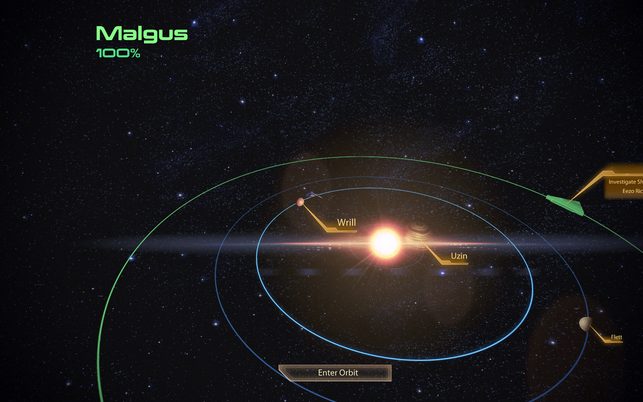
Flett
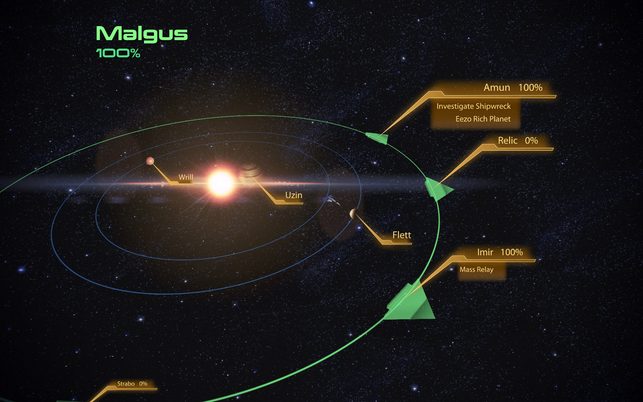
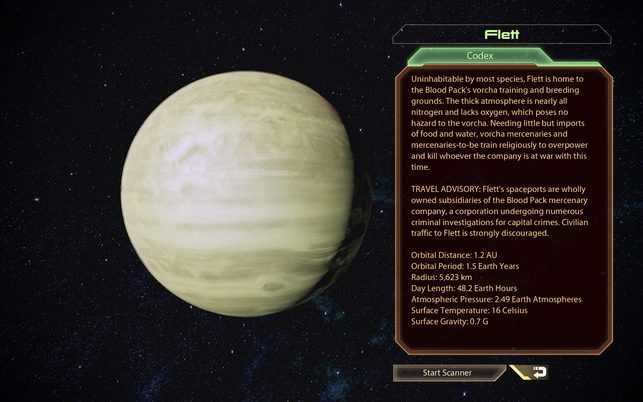
Uninhabitable by most species, Flett is home to the Blood Pack’s vorcha training and breeding grounds. The thick atmosphere is nearly all nitrogen and lacks oxygen, which poses no hazard to the vorcha. Needing little but imports of food and water, vorcha mercenaries and mercenaries-to-be train religiously to overpower and kill whoever the company is at war with this time.
TRAVEL ADVISORY: Flett’s spaceports are wholly owned subsidiaries of the Blood Pack mercenary company, a corporation undergoing numerous criminal investigations for capital crimes. Civilian traffic to Flett is strongly discouraged.
Orbital Distance: 1.2 AU
Orbital Period: 1.5 Earth Years
Radius: 5,623 km
Day Length: 48.2 Earth Hours
Atmospheric Pressure: 2.49 Earth Atmospheres
Surface Temperature: 16 Celsius
Surface Gravity: 0.7 G
Uzin
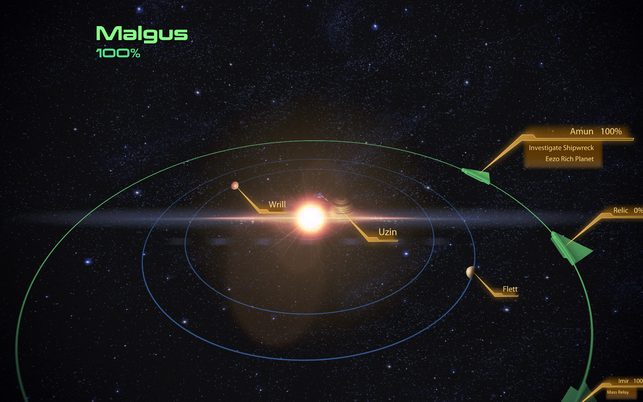
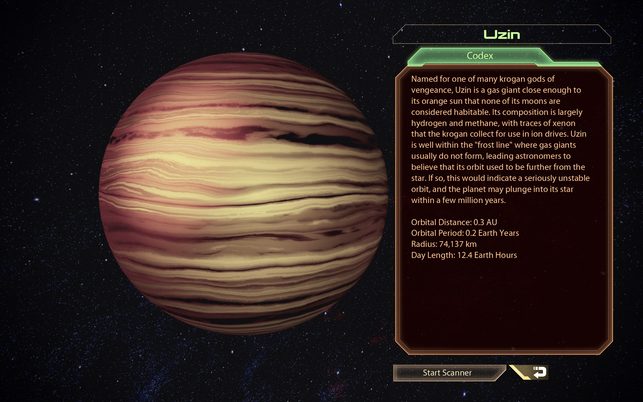
Named for one of many krogan gods of vengeance, Uzin is a gas giant close enough to its orange sun that none of its moons are considered habitable. Its composition is largely hydrogen and methane, with traces of xenon that the krogan collect for use in ion drives. Uzin is well within the “frost line” where gas giants usually do not form, leading astronomers to believe that its orbit used to be further from the star. If so, this would indicate a seriously unstable orbit, and the planet may plunge into its star within a few million years.
Orbital Distance: 0.3 AU
Orbital Period: 0.2 Earth Years
Radius: 74,137 km
Day Length: 12.4 Earth Hours
Wrill
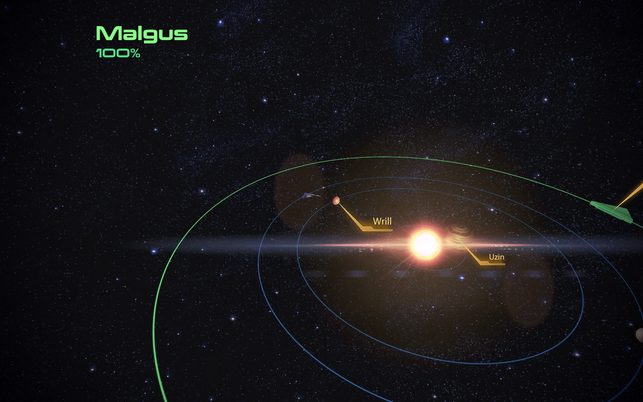
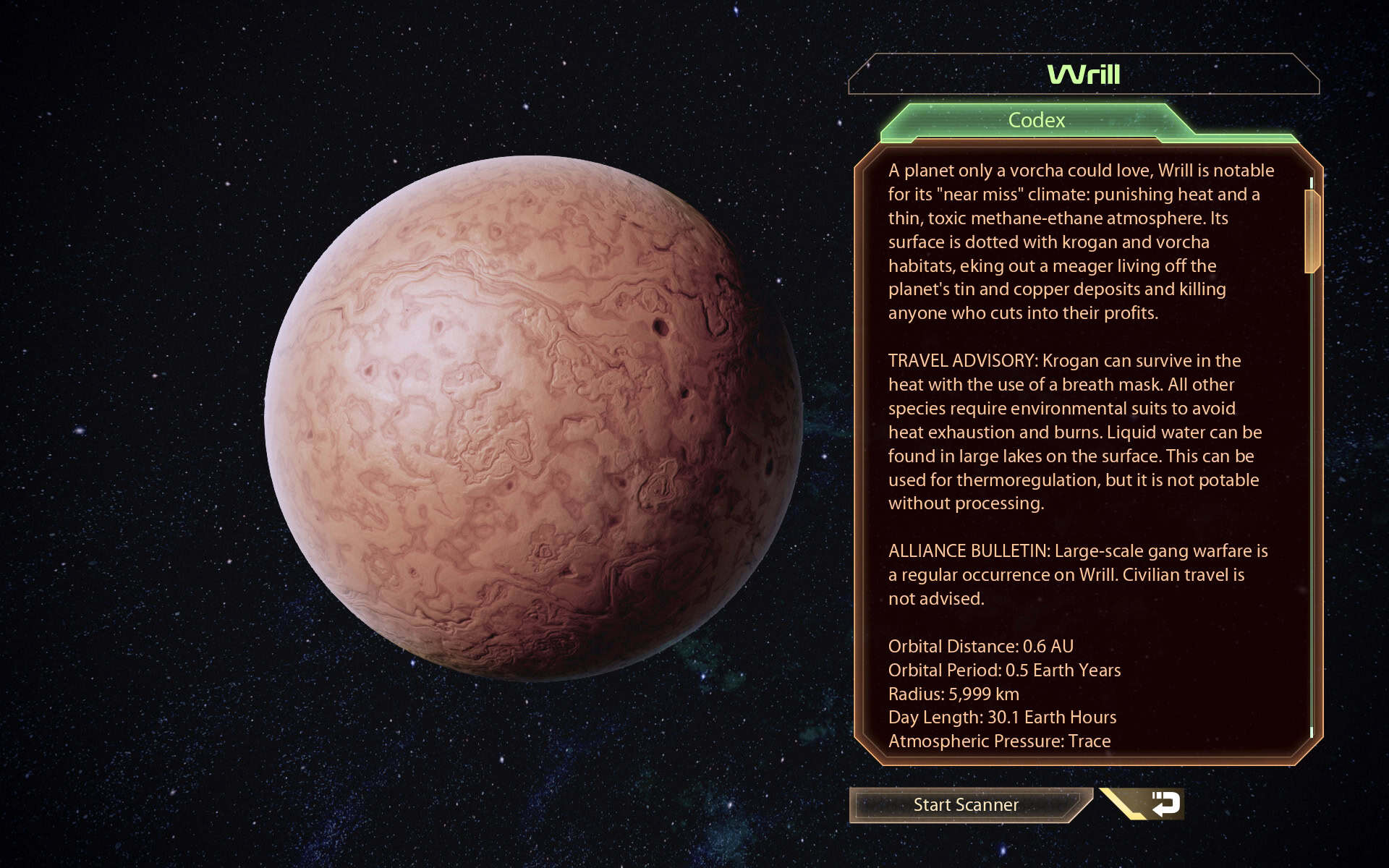
A planet only a vorcha could love, Wrill is notable for its “near miss” climate: punishing heat and a thin, toxic methane-ethane atmosphere. Its surface is dotted with krogan and vorcha habitats, eking out a meager living off the planet’s tin and copper deposits and killing anyone who cuts into their profits.
TRAVEL ADVISORY: Krogan can survive in the heat with the use of a breath mask. All other species require environmental suits to avoid heat exhaustion and burns. Liquid water can be found in large lakes on the surface. This can be used for thermoregulation, but it is not potable without processing.
ALLIANCE BULLETIN: Large-scale gang warfare is a regular occurrence on Wrill. Civilian travel is not advised.
Orbital Distance: 0.6 AU
Orbital Period: 0.5 Earth Years
Radius: 5,999 km
Day Length: 30.1 Earth Hours
Atmospheric Pressure: Trace
Surface Temperature: 56 Celsius
Surface Gravity: 0.9 G
RELIC
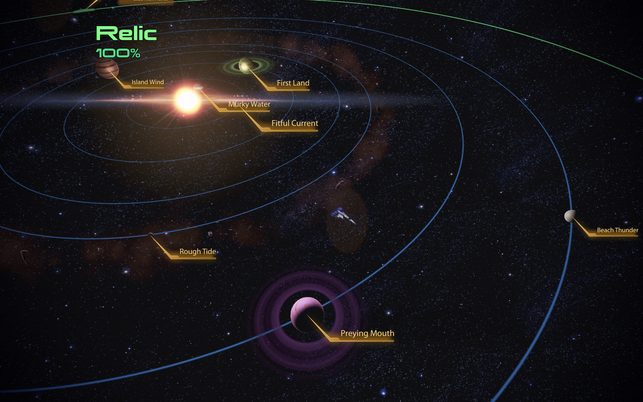
Beach Tunder
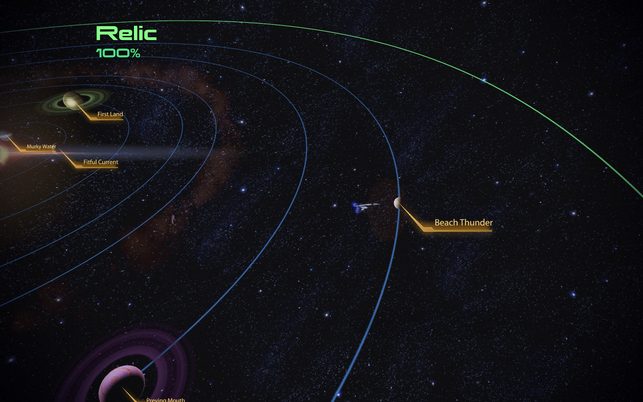
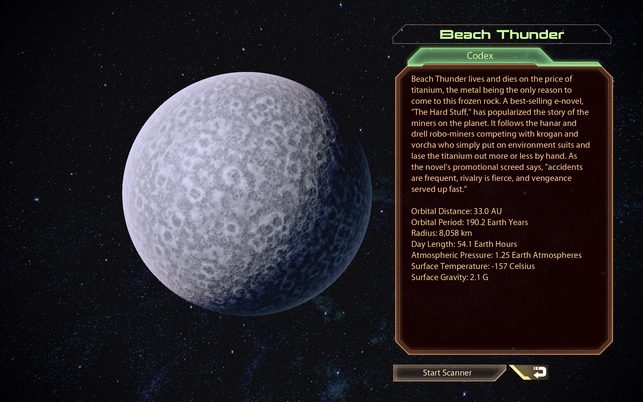
Beach Thunder lives and dies on the price of titanium, the metal being the only reason to come to this frozen rock. A best-selling e-novel, “The Hard Stuff,” has popularized the story of the miners on the planet. It follows the hanar and drell robo-miners competing with krogan and vorcha who simply put on environment suits and lase the titanium out more or less by hand. As the novel’s promotional screed says, “accidents are frequent, rivalry is fierce, and vengeance served up fast.”
Orbital Distance: 33.0 AU
Orbital Period: 190.2 Earth Years
Radius: 8,058 km
Day Length: 54.1 Earth Hours
Atmospheric Pressure: 1.25 Earth Atmospheres
Surface Temperature: -157 Celsius
Surface Gravity: 2.1 G
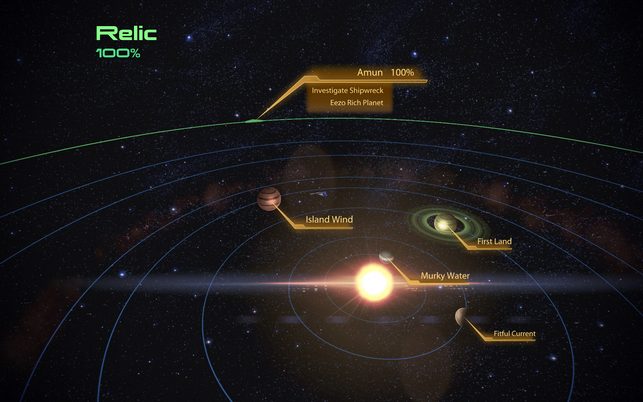
First Land
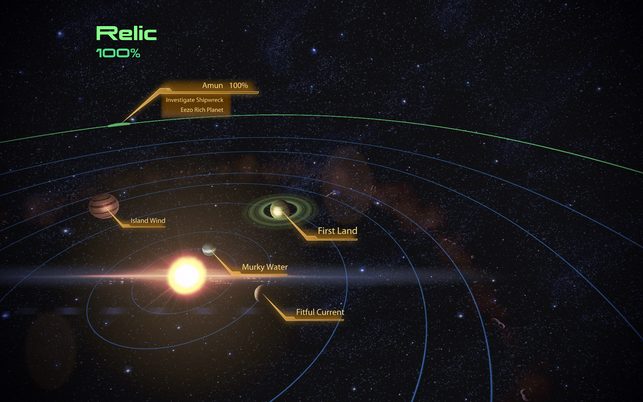
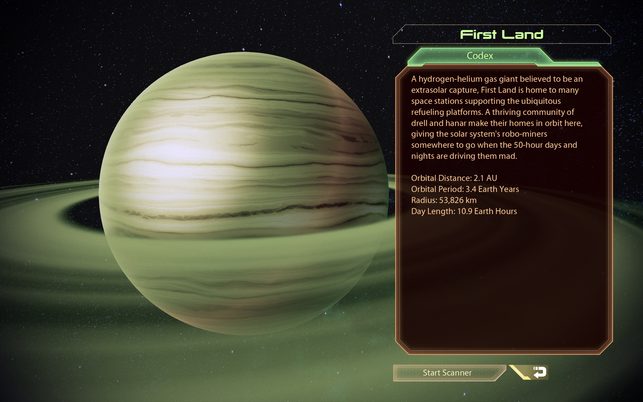
A hydrogen-helium gas giant believed to be an extrasolar capture, First Land is home to many space stations supporting the ubiquitous refueling platforms. A thriving community of drell and hanar make their homes in orbit here, giving the solar system’s robo-miners somewhere to go when the 50-hour days and nights are driving them mad.
Orbital Distance: 2.1 AU
Orbital Period: 3.4 Earth Years
Radius: 53,826 km
Day Length: 10.9 Earth Hours
Fitful Current
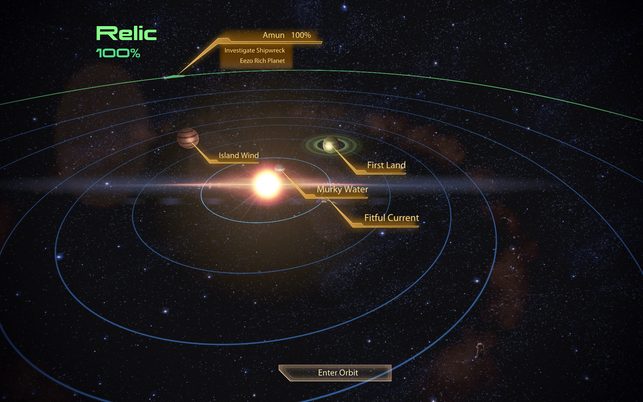
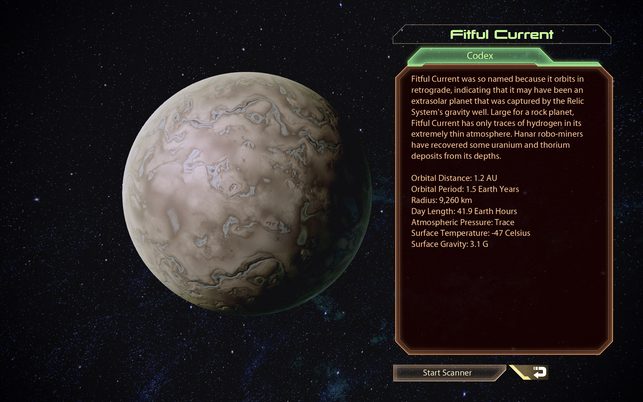
Fitful Current was so named because it orbits in retrograde, indicating that it may have been an extrasolar planet that was captured by the Relic System’s gravity well. Large for a rock planet, Fitful Current has only traces of hydrogen in its extremely thin atmosphere. Hanar robo-miners have recovered some uranium and thorium deposits from its depths.
Orbital Distance: 1.2 AU
Orbital Period: 1.5 Earth Years
Radius: 9,260 km
Day Length: 41.9 Earth Hours
Atmospheric Pressure: Trace
Surface Temperature: -47 Celsius
Surface Gravity: 3.1 G
Island Wind
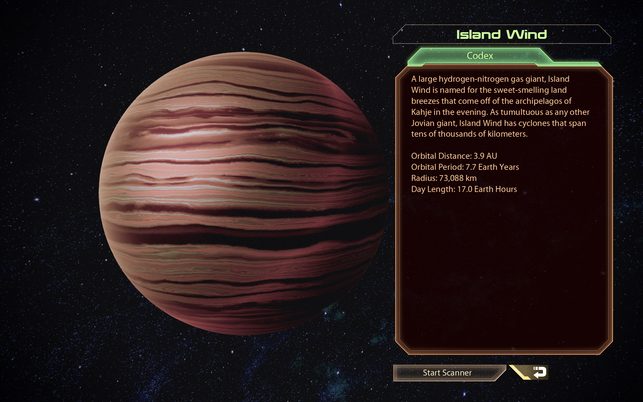
A large hydrogen-nitrogen gas giant, Island Wind is named for the sweet-smelling land breezes that come off of the archipelagos of Kahje in the evening. As tumultuous as any other Jovian giant, Island Wind has cyclones that span tens of thousands of kilometers.
Orbital Distance: 3.9 AU
Orbital Period: 7.7 Earth Years
Radius: 73,088 km
Day Length: 17.0 Earth Hours
Murky Water
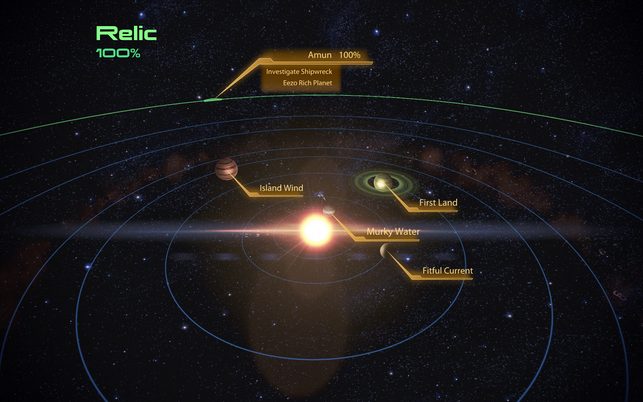
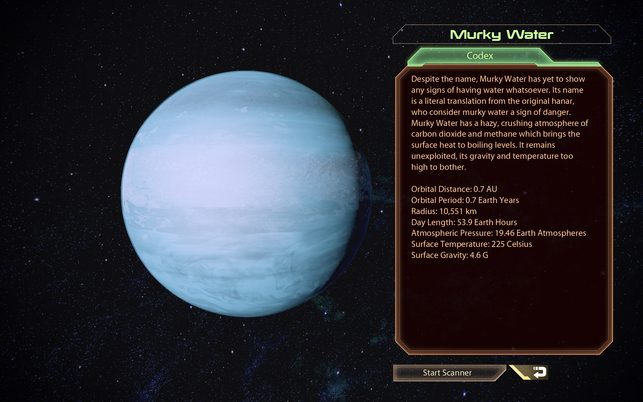
Despite the name, Murky Water has yet to show any signs of having water whatsoever. Its name is a literal translation from the original hanar, who consider murky water a sign of danger. Murky Water has a hazy, crushing atmosphere of carbon dioxide and methane which brings the surface heat to boiling levels. It remains unexploited, its gravity and temperature too high to bother.
Orbital Distance: 0.7 AU
Orbital Period: 0.7 Earth Years
Radius: 10,551 km
Day Length: 53.9 Earth Hours
Atmospheric Pressure: 19.46 Earth Atmospheres
Surface Temperature: 225 Celsius
Surface Gravity: 4.6 G
Preying Mouth
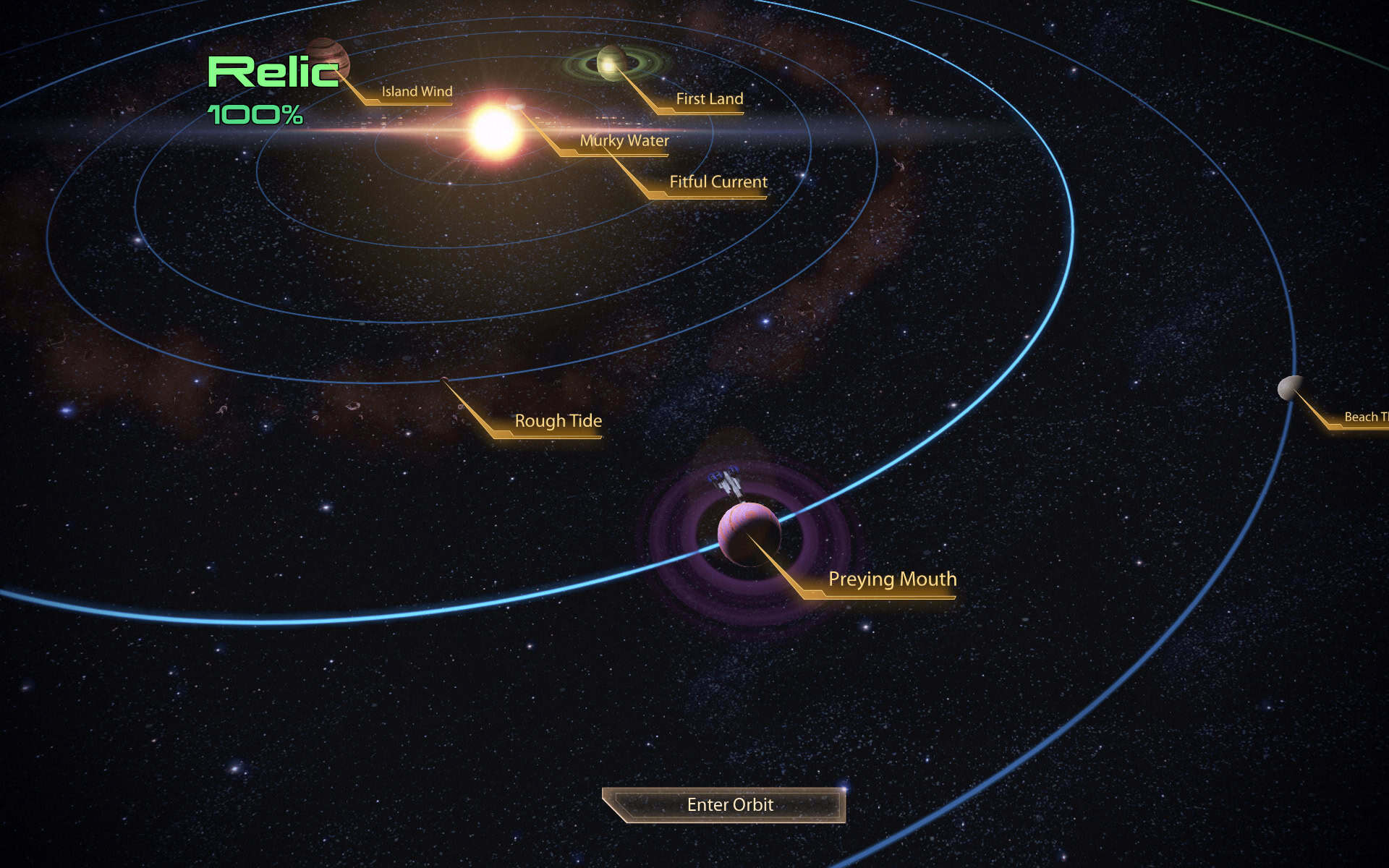
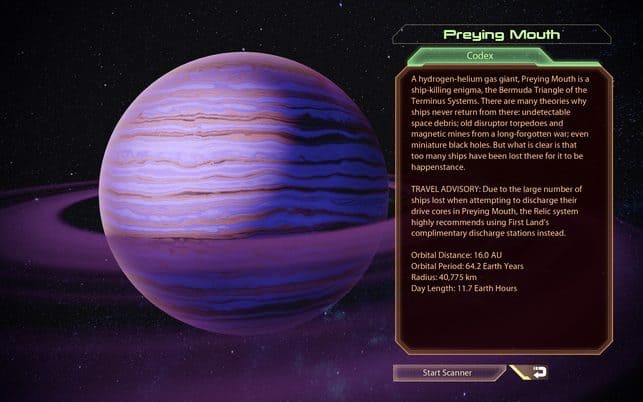
A hydrogen-helium gas giant, Preying Mouth is a ship-killing enigma, the Bermuda Triangle of the Terminus Systems. There are many theories why ships never return from there: undetectable space debris; old disruptor torpedoes and magnetic mines from a long-forgotten war; even miniature black holes. But what is clear is that too many ships have been lost there for it to be happenstance.
TRAVEL ADVISORY: Due to the large number of ships lost when attempting to discharge their drive cores in Preying Mouth, the Relic system highly recommends using First Land’s complimentary discharge stations instead.
Orbital Distance: 16.0 AU
Orbital Period: 64.2 Earth Years
Radius: 40,775 km
Day Length: 11.7 Earth Hours
Rough Tide
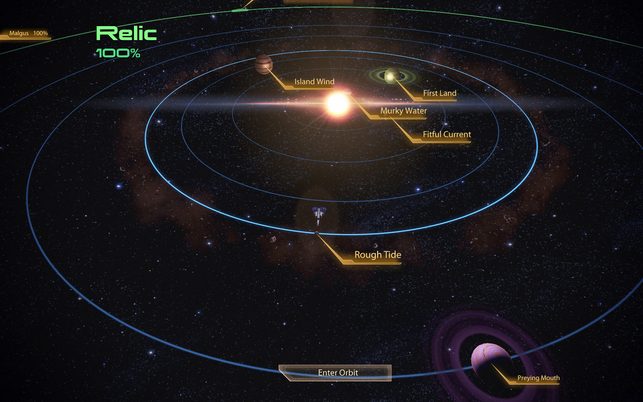
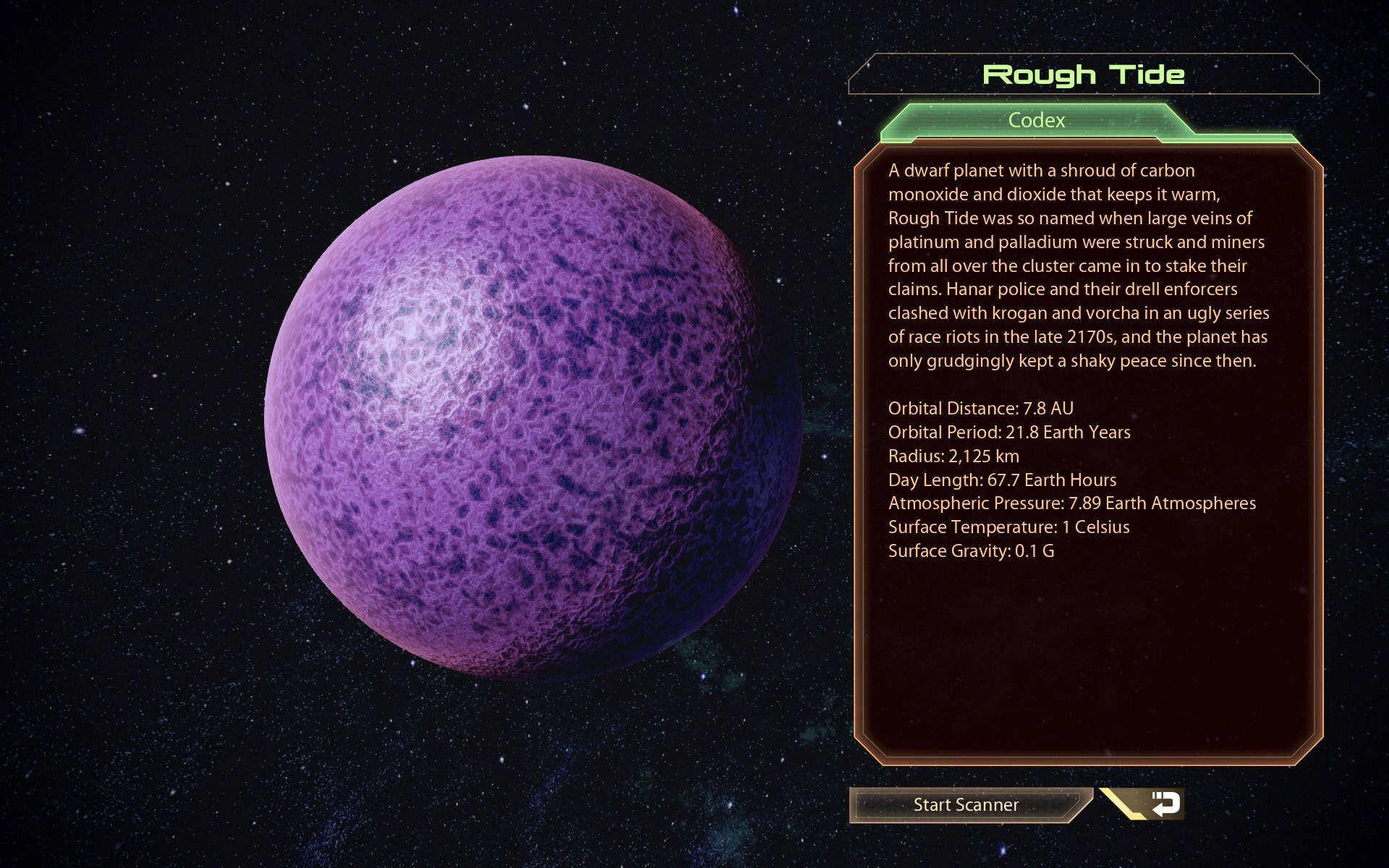
A dwarf planet with a shroud of carbon monoxide and dioxide that keeps it warm, Rough Tide was so named when large veins of platinum and palladium were struck and miners from all over the cluster came in to stake their claims. Hanar police and their drell enforcers clashed with krogan and vorcha in an ugly series of race riots in the late 2170s, and the planet has only grudgingly kept a shaky peace since then.
Orbital Distance: 7.8 AU
Orbital Period: 21.8 Earth Years
Radius: 2,125 km
Day Length: 67.7 Earth Hours
Atmospheric Pressure: 7.89 Earth Atmospheres
Surface Temperature: 1 Celsius
Surface Gravity: 0.1 G
STRABO
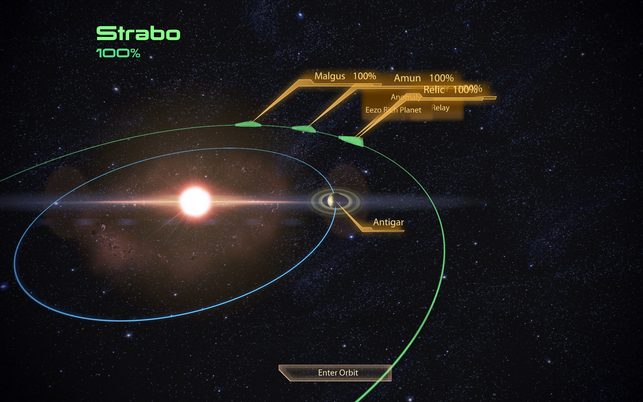
Antigar
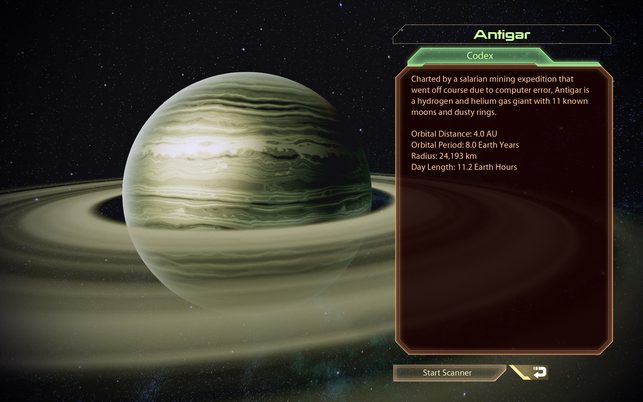
Charted by a salarian mining expedition that went off course due to computer error, Antigar is a hydrogen and helium gas giant with 11 known moons and dusty rings.
Orbital Distance: 4.0 AU
Orbital Period: 8.0 Earth Years
Radius: 24,193 km
Day Length: 11.2 Earth Hours
FAR RIM
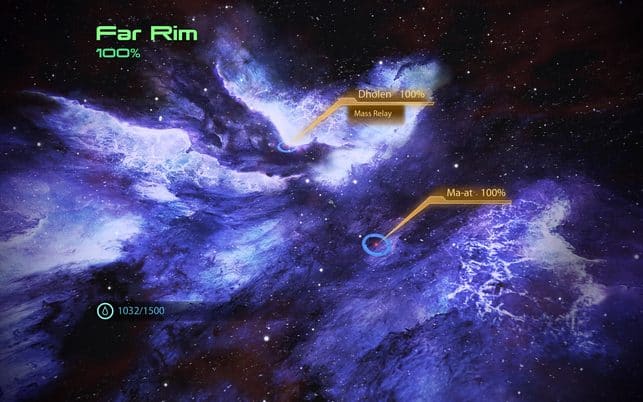
DHOLEN
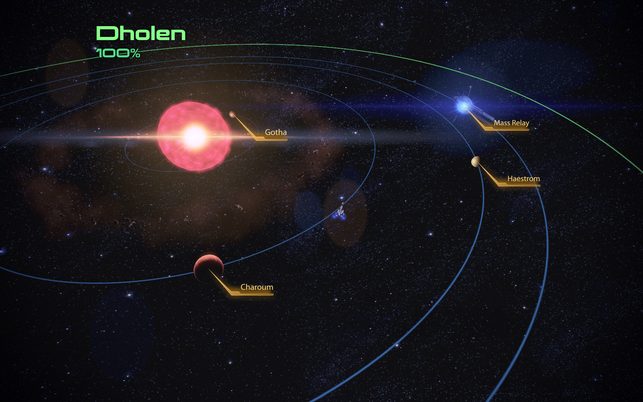
Charoum
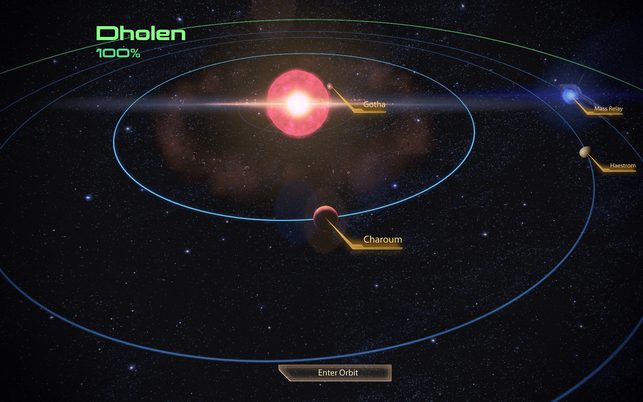
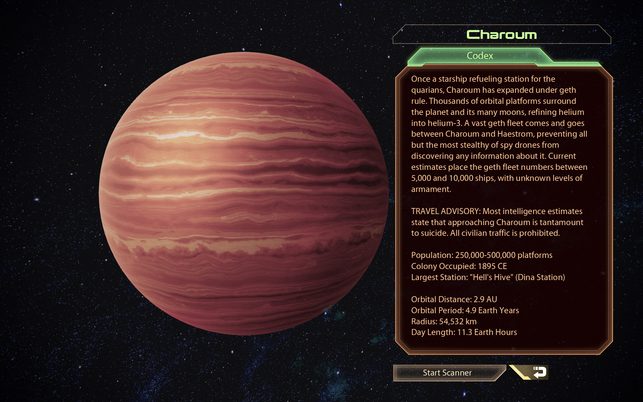
Once a starship refueling station for the quarians, Charoum has expanded under geth rule. Thousands of orbital platforms surround the planet and its many moons, refining helium into helium-3. A vast geth fleet comes and goes between Charoum and Haestrom, preventing all but the most stealthy of spy drones from discovering any information about it. Current estimates place the geth fleet numbers between 5,000 and 10,000 ships, with unknown levels of armament.
TRAVEL ADVISORY: Most intelligence estimates state that approaching Charoum is tantamount to suicide. All civilian traffic is prohibited.
Population: 250,000-500,000 platforms
Colony Occupied: 1895 CE
Largest Station: “Hell’s Hive” (Dina Station)
Orbital Distance: 2.9 AU
Orbital Period: 4.9 Earth Years
Radius: 54,532 km
Day Length: 11.3 Earth Hours
Gotha
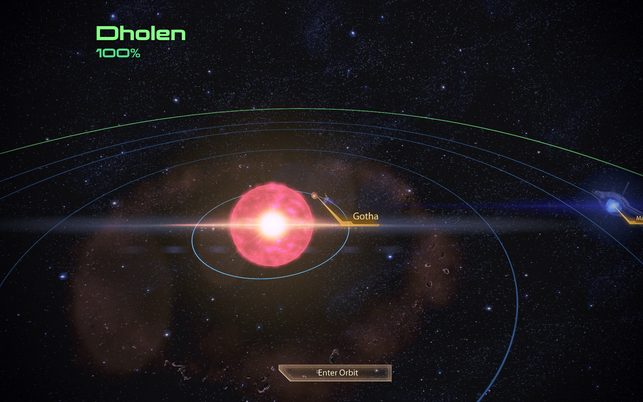
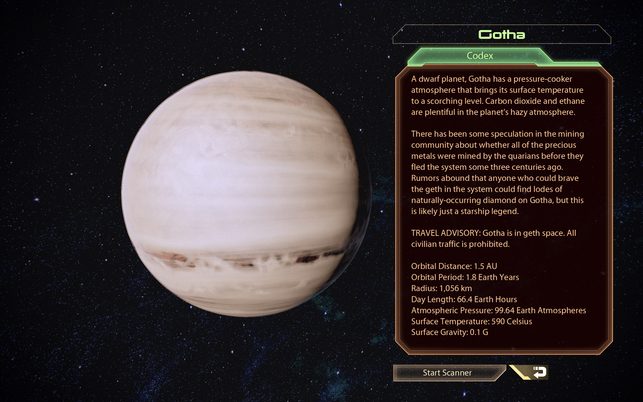
A dwarf planet, Gotha has a pressure-cooker atmosphere that brings its surface temperature to a scorching level. Carbon dioxide and ethane are plentiful in the planet’s hazy atmosphere.
There has been some speculation in the mining community about whether all of the precious metals were mined by the quarians before they fled the system some three centuries ago. Rumors abound that anyone who could brave the geth in the system could find lodes of naturally-occurring diamond on Gotha, but this is likely just a starship legend.
TRAVEL ADVISORY: Gotha is in geth space. All civilian traffic is prohibited.
Orbital Distance: 1.5 AU
Orbital Period: 1.8 Earth Years
Radius: 1,056 km
Day Length: 66.4 Earth Hours
Atmospheric Pressure: 99.64 Earth Atmospheres
Surface Temperature: 590 Celsius
Surface Gravity: 0.1 G
Haestrom
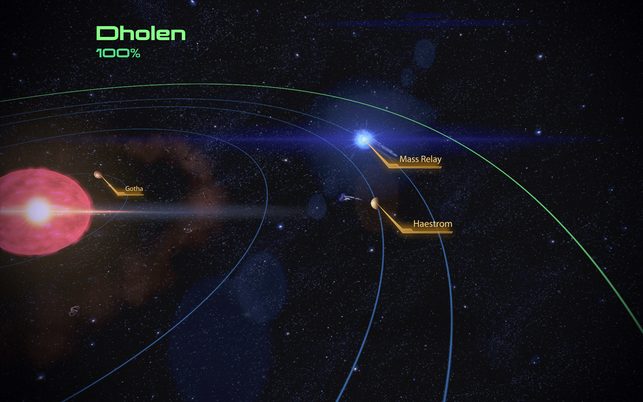
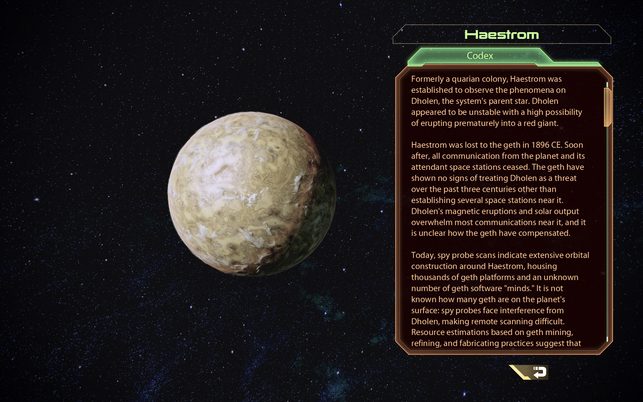
Formerly a quarian colony, Haestrom was established to observe the phenomena on Dholen, the system’s parent star. Dholen appeared to be unstable with a high possibility of erupting prematurely into a red giant.
Haestrom was lost to the geth in 1896 CE. Soon after, all communication from the planet and its attendant space stations ceased. The geth have shown no signs of treating Dholen as a threat over the past three centuries other than establishing several space stations near it. Dholen’s magnetic eruptions and solar output overwhelm most communications near it, and it is unclear how the geth have compensated.
Today, spy probe scans indicate extensive orbital construction around Haestrom, housing thousands of geth platforms and an unknown number of geth software “minds.” It is not known how many geth are on the planet’s surface: spy probes face interference from Dholen, making remote scanning difficult. Resource estimations based on geth mining, refining, and fabricating practices suggest that the planet has at least 20 more years of use before it is exhausted. Intelligence experts speculate that the geth have not exploited all of their resources because they wish to keep some in reserve for repairs.
TRAVEL ADVISORY: Haestrom is a geth stronghold. Military spy drones using cutting-edge stealth technology are the only vehicles that have returned unharmed from geth space. All civilian traffic is prohibited.
Orbital Distance: 6.3 AU
Orbital Period: 15.8 Earth Years
Radius: 6,721 km
Day Length: 18.5 Earth Hours
Atmospheric Pressure: 0.0 Earth Atmospheres
Surface Temperature: 44 Celsius
Surface Gravity: 1.2 G
MA-AT
Ammut
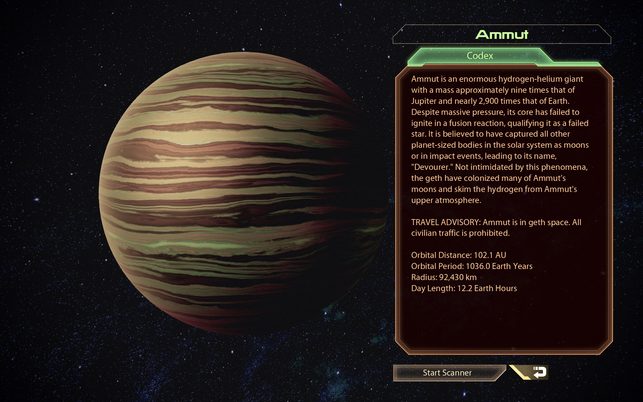
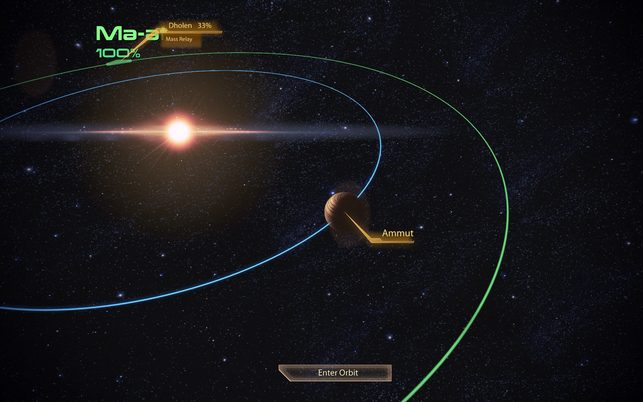
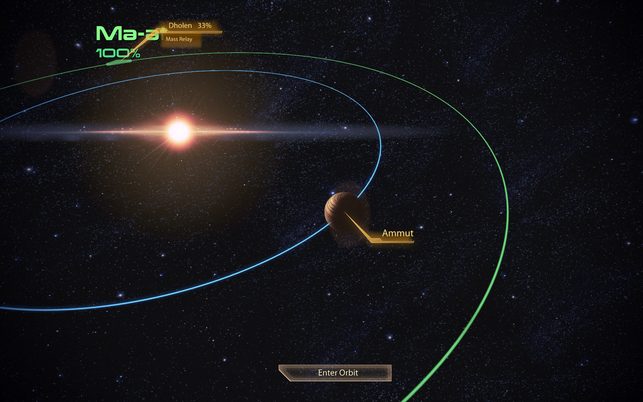
Ammut is an enormous hydrogen-helium giant with a mass approximately nine times that of Jupiter and nearly 2,900 times that of Earth. Despite massive pressure, its core has failed to ignite in a fusion reaction, qualifying it as a failed star. It is believed to have captured all other planet-sized bodies in the solar system as moons or in impact events, leading to its name, “Devourer.” Not intimidated by this phenomena, the geth have colonized many of Ammut’s moons and skim the hydrogen from Ammut’s upper atmosphere.
TRAVEL ADVISORY: Ammut is in geth space. All civilian traffic is prohibited.
Orbital Distance: 102.1 AU
Orbital Period: 1036.0 Earth Years
Radius: 92,430 km
Day Length: 12.2 Earth Hours
HADES NEXUS
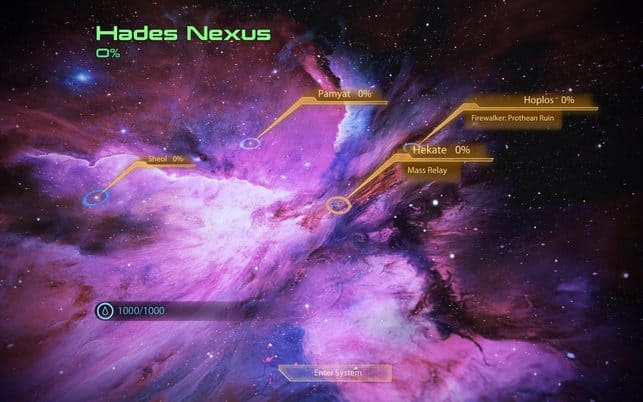
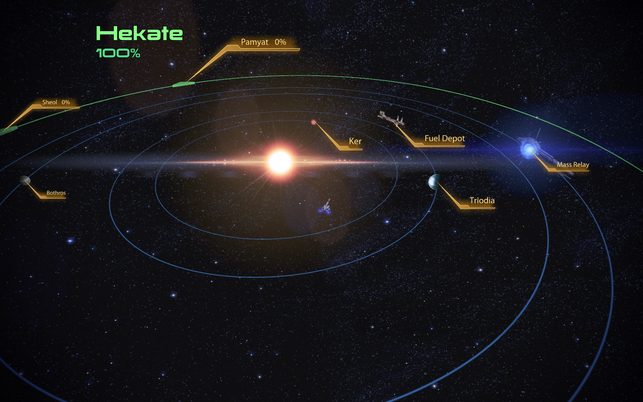
HEKATE
Bothros
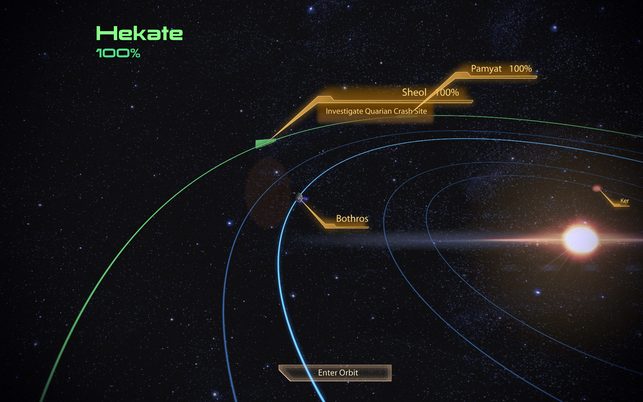
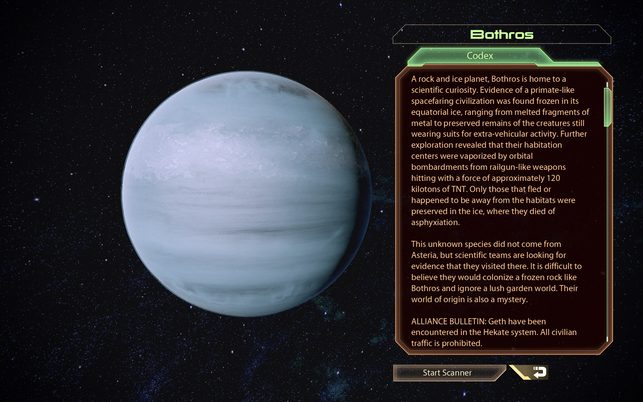
A rock and ice planet, Bothros is home to a scientific curiosity. Evidence of a primate-like spacefaring civilization was found frozen in its equatorial ice, ranging from melted fragments of metal to preserved remains of the creatures still wearing suits for extra-vehicular activity. Further exploration revealed that their habitation centers were vaporized by orbital bombardments from railgun-like weapons hitting with a force of approximately 120 kilotons of TNT. Only those that fled or happened to be away from the habitats were preserved in the ice, where they died of asphyxiation.
This unknown species did not come from Asteria, but scientific teams are looking for evidence that they visited there. It is difficult to believe they would colonize a frozen rock like Bothros and ignore a lush garden world. Their world of origin is also a mystery.
ALLIANCE BULLETIN: Geth have been encountered in the Hekate system. All civilian traffic is prohibited.
Orbital Distance: 8.5 AU
Orbital Period: 24.8 Earth Years
Radius: 7,191 km
Day Length: 51.0 Earth Hours
Atmospheric Pressure: Trace
Surface Temperature: -142 Celsius
Surface Gravity: 1.5 G
Ker
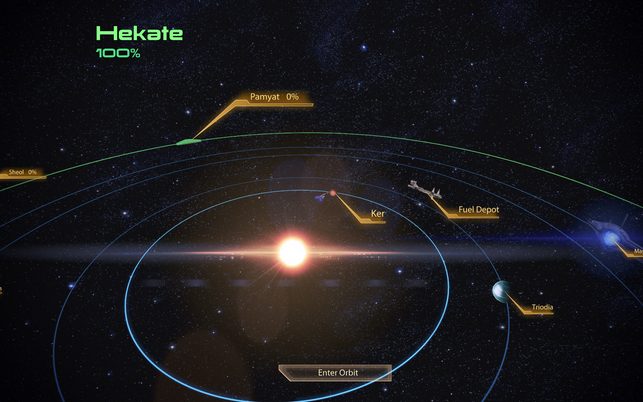
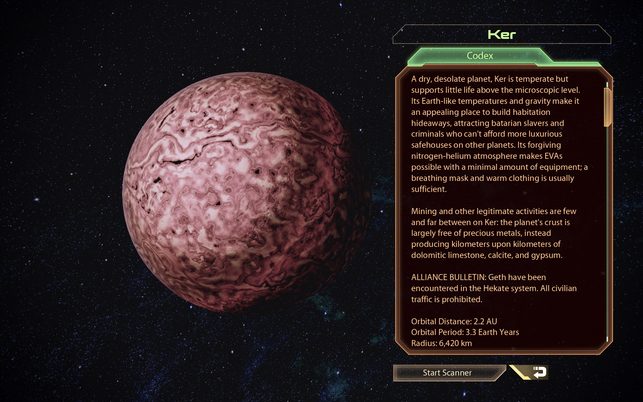
A dry, desolate planet, Ker is temperate but supports little life above the microscopic level. Its Earth-like temperatures and gravity make it an appealing place to build habitation hideaways, attracting batarian slavers and criminals who can’t afford more luxurious safehouses on other planets. Its forgiving nitrogen-helium atmosphere makes EVAS possible with a minimal amount of equipment; a breathing mask and warm clothing is usually sufficient.
Mining and other legitimate activities are few and far between on Ker: the planet’s crust is largely free of precious metals, instead producing kilometers upon kilometers of dolomitic limestone, calcite, and gypsum.
ALLIANCE BULLETIN: Geth have been encountered in the Hekate system. All civilian traffic is prohibited.
Orbital Distance: 2.2 AU
Orbital Period: 3.3 Earth Years
Radius: 6,420 km
Day Length: 61.7 Earth Hours
Atmospheric Pressure: 1.2 Earth Atmospheres
Surface Temperature: -4 Celsius
Surface Gravity: 1.1 G
Triodia
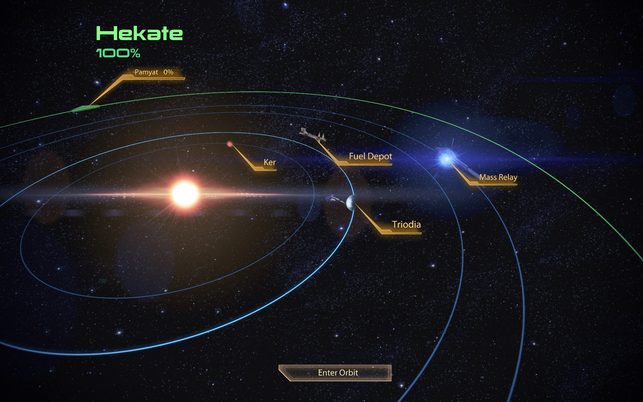
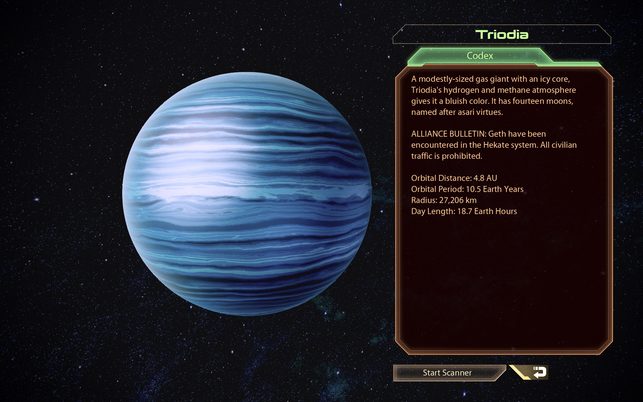
A modestly-sized gas giant with an icy core, Triodia’s hydrogen and methane atmosphere gives it a bluish color. It has fourteen moons, named after asari virtues.
ALLIANCE BULLETIN: Geth have been encountered in the Hekate system. All civilian traffic is prohibited.
Orbital Distance: 4.8 AU
Orbital Period: 10.5 Earth Years
Radius: 27,206 km
Day Length: 18.7 Earth Hours
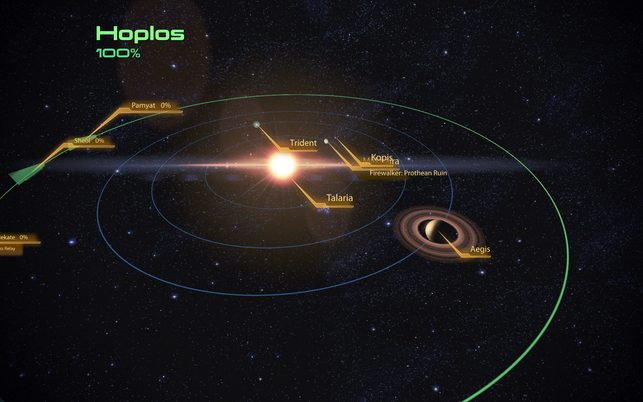
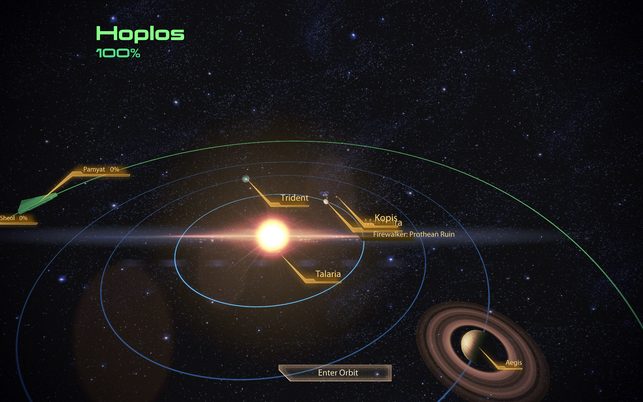
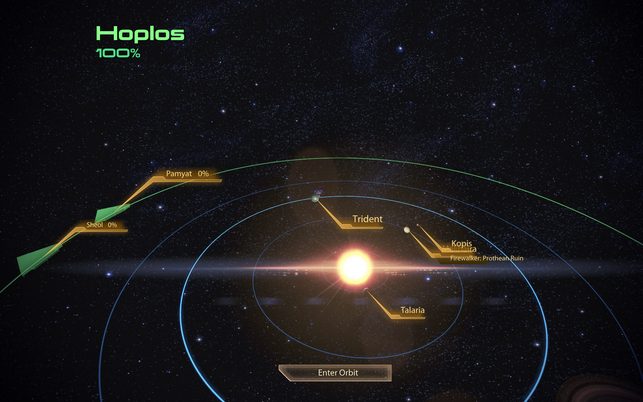
HOPLOS
Aegis
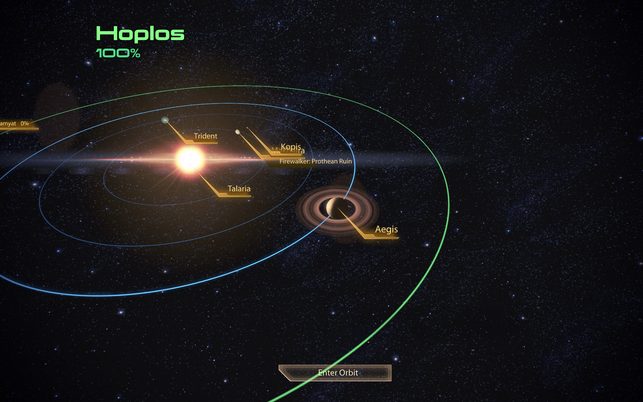
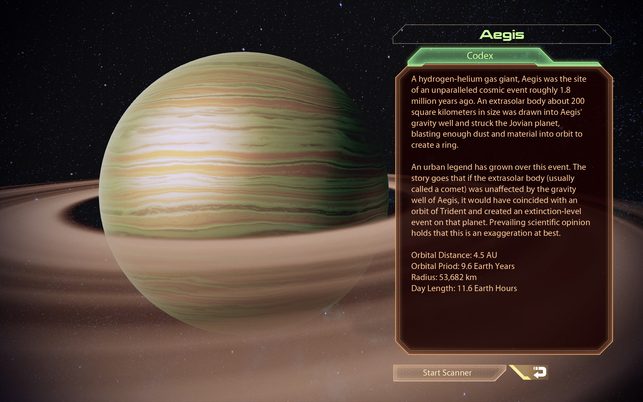
A hydrogen-helium gas giant, Aegis was the site of an unparalleled cosmic event roughly 1.8 million years ago. An extrasolar body about 200 square kilometers in size was drawn into Aegis’ gravity well and struck the Jovian planet, blasting enough dust and material into orbit to create a ring.
An urban legend has grown over this event. The story goes that if the extrasolar body (usually called a comet) was unaffected by the gravity well of Aegis, it would have coincided with an orbit of Trident and created an extinction-level event on that planet. Prevailing scientific opinion holds that this is an exaggeration at best.
Orbital Distance: 4.5 AU
Orbital Priod: 9.6 Earth Years
Radius: 53,682 km
Day Length: 11.6 Earth Hours
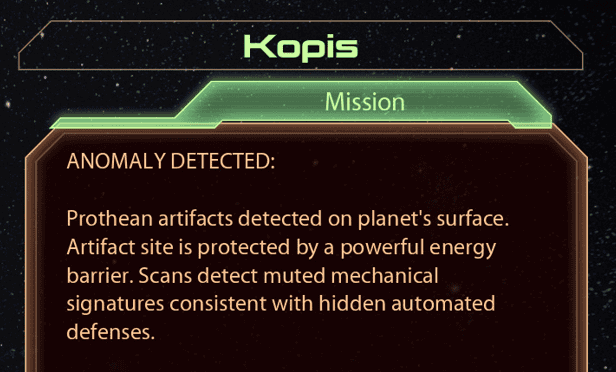
Kopis*
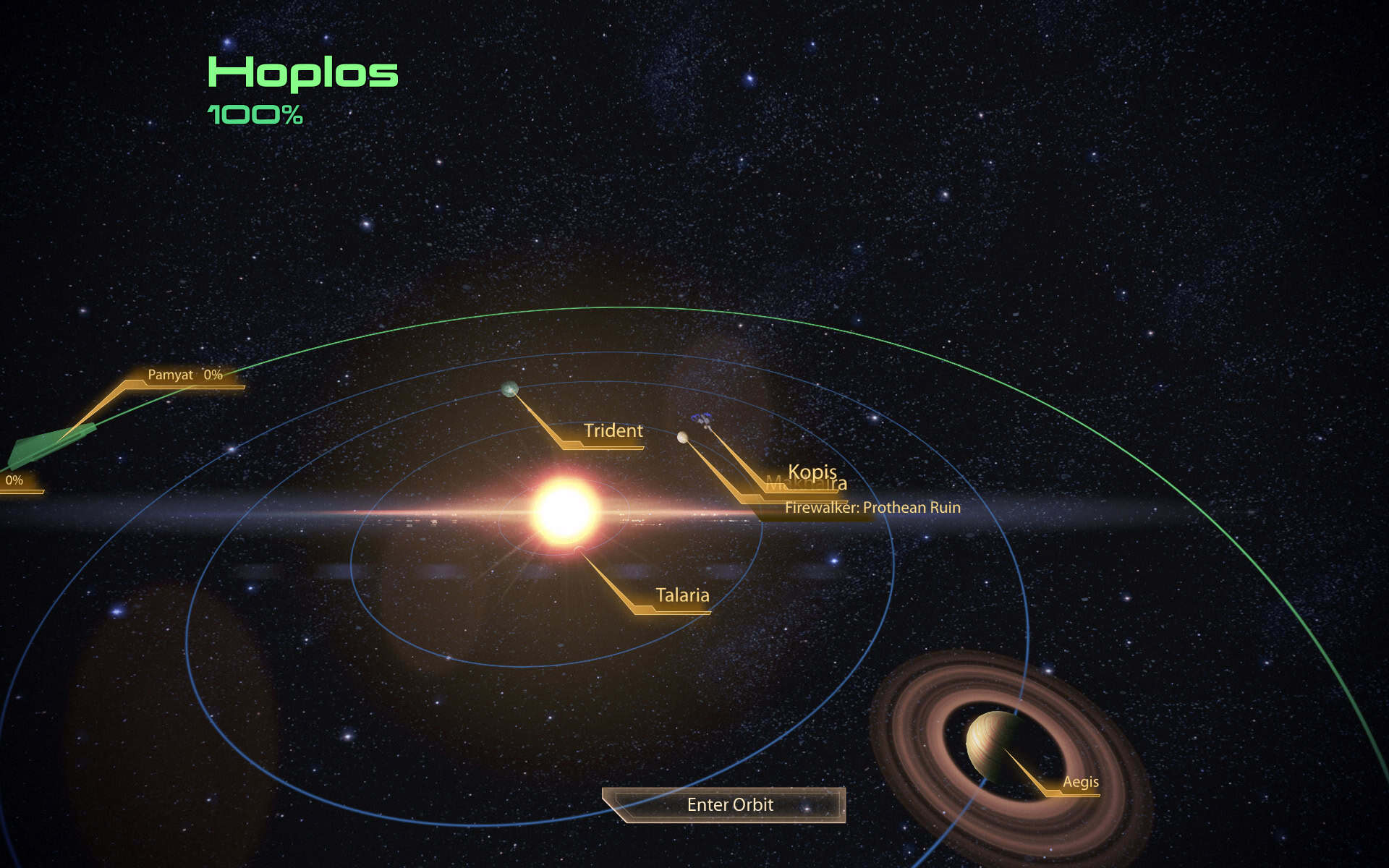
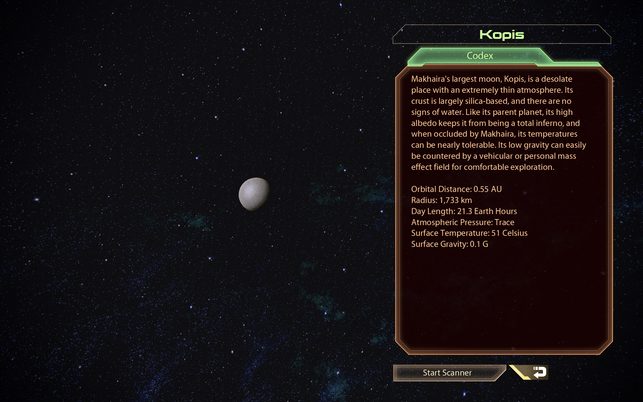
Makhaira’s largest moon, Kopis, is a desolate place with an extremely thin atmosphere. Its crust is largely silica-based, and there are no signs of water. Like its parent planet, its high albedo keeps it from being a total inferno, and when occluded by Makhaira, its temperatures can be nearly tolerable. Its low gravity can easily be countered by a vehicular or personal mass effect field for comfortable exploration.
Orbital Distance: 0.55 AU
Radius: 1,733 km
Day Length: 21.3 Earth Hours
Atmospheric Pressure: Trace
Surface Temperature: 51 Celsius
Surface Gravity: 0.1 G
Makhaira
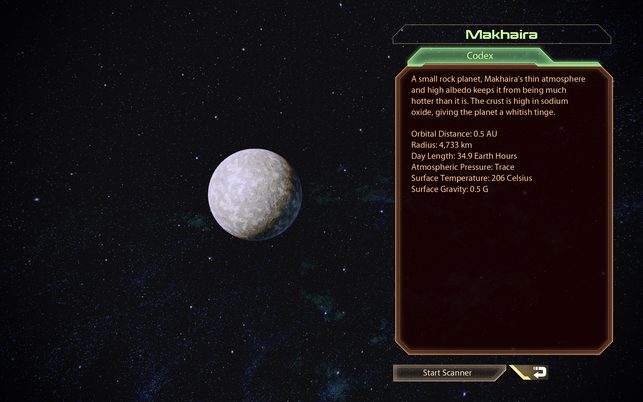
A small rock planet, Makhaira’s thin atmosphere and high albedo keeps it from being much hotter than it is. The crust is high in sodium oxide, giving the planet a whitish tinge.
Orbital Distance: 0.5 AU
Radius: 4,733 km
Day Length: 34.9 Earth Hours
Atmospheric Pressure: Trace
Surface Temperature: 206 Celsius
Surface Gravity: 0.5 G
Talaria
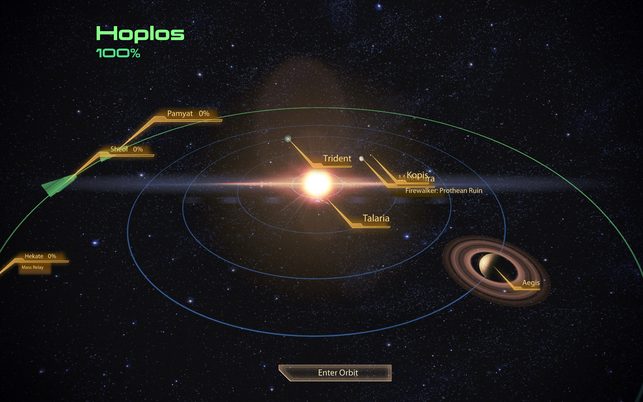
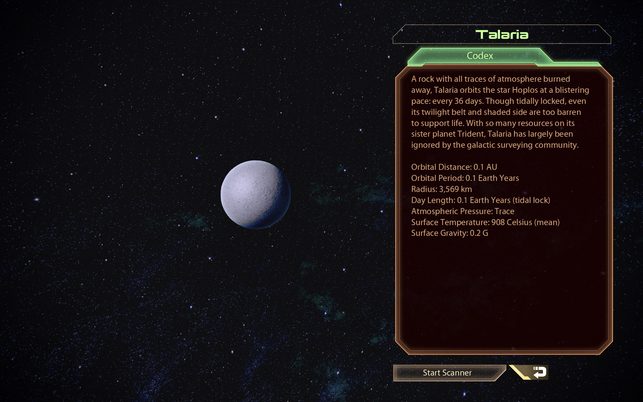
A rock with all traces of atmosphere burned away, Talaria orbits the star Hoplos at a blistering pace: every 36 days. Though tidally locked, even its twilight belt and shaded side are too barren to support life. With so many resources on its sister planet Trident, Talaria has largely been ignored by the galactic surveying community.
Orbital Distance: 0.1 AU
Orbital Period: 0.1 Earth Years
Radius: 3,569 km
Day Length: 0.1 Earth Years (tidal lock)
Atmospheric Pressure: Trace
Surface Temperature: 908 Celsius (mean)
Surface Gravity: 0.2 G
Trident
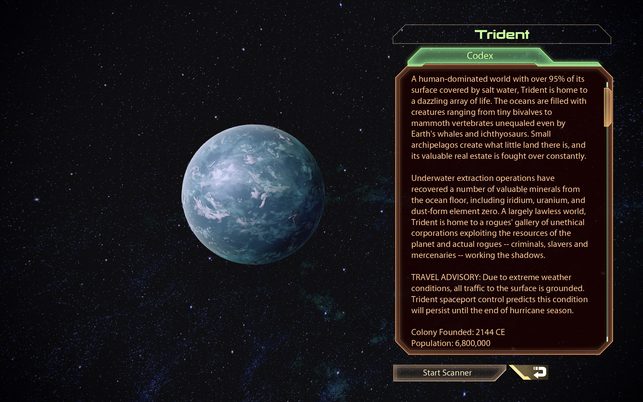
A human-dominated world with over 95% of its surface covered by salt water, Trident is home to a dazzling array of life. The oceans are filled with creatures ranging from tiny bivalves to mammoth vertebrates unequaled even by Earth’s whales and ichthyosaurs. Small archipelagos create what little land there is, and its valuable real estate is fought over constantly.
Underwater extraction operations have recovered a number of valuable minerals from the ocean floor, including iridium, uranium, and dust-form element zero. A largely lawless world, Trident is home to a rogues’ gallery of unethical corporations exploiting the resources of the planet and actual rogues — criminals, slavers and mercenaries — working the shadows.
TRAVEL ADVISORY: Due to extreme weather conditions, all traffic to the surface is grounded. Trident spaceport control predicts this condition will persist until the end of hurricane season.
Colony Founded: 2144 CE
Population: 6,800,000
Capital: New Cousteau
Orbital Distance: 2.0 AU
Orbital Period: 2.8 Earth Years
Radius: 6905 km
Day Length: 27.6 Earth Hours
Atmospheric Pressure: 1.4 Earth Atmospheres
Surface Temperature: 27 Celsius
Surface Gravity: 1.1 G
PAMYAT
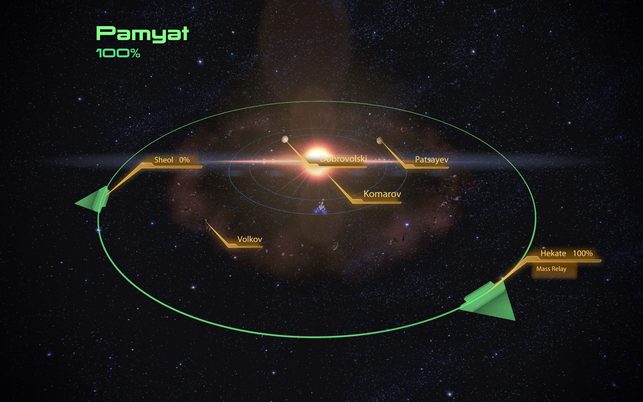
Dobrovolski
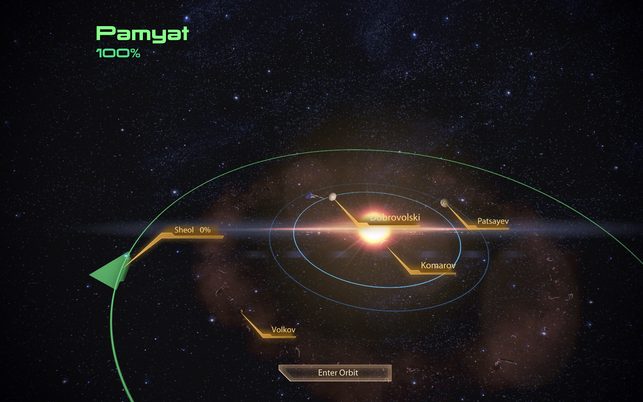
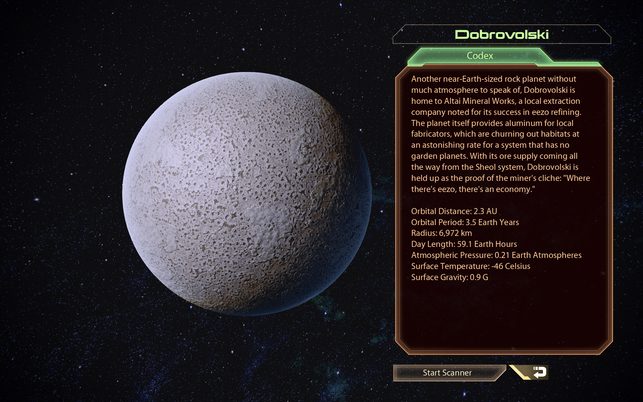
Another near-Earth-sized rock planet without much atmosphere to speak of, Dobrovolski is home to Altai Mineral Works, a local extraction company noted for its success in eezo refining. The planet itself provides aluminum for local fabricators, which are churning out habitats at an astonishing rate for a system that has no garden planets. With its ore supply coming all the way from the Sheol system, Dobrovolski is held up as the proof of the miner’s cliche: “Where there’s eezo, there’s an economy.”
Orbital Distance: 2.3 AU
Orbital Period: 3.5 Earth Years
Radius: 6,972 km
Day Length: 59.1 Earth Hours
Atmospheric Pressure: 0.21 Earth Atmospheres
Surface Temperature: -46 Celsius
Surface Gravity: 0.9 G
Komarov
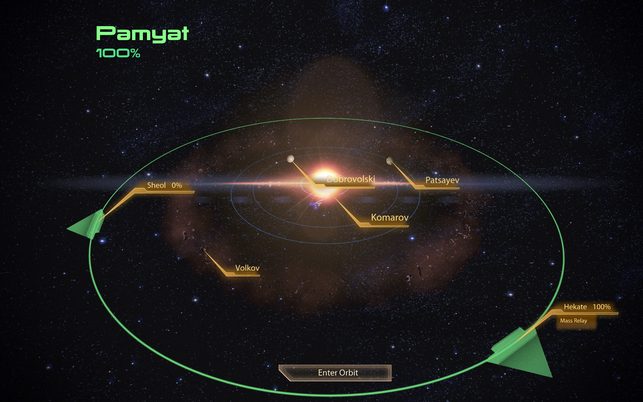
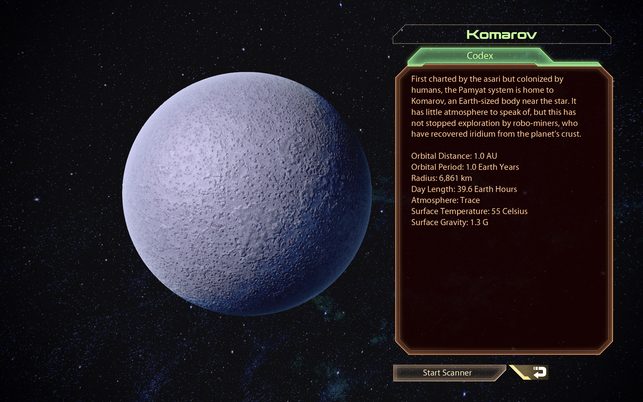
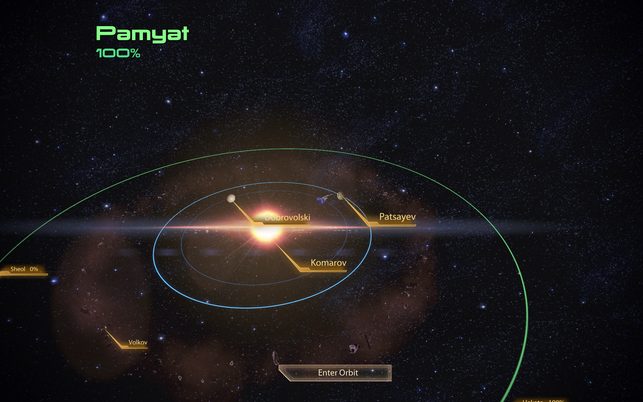
First charted by the asari but colonized by humans, the Pamyat system is home to Komarov, an Earth-sized body near the star. It has little atmosphere to speak of, but this has not stopped exploration by robo-miners, who have recovered iridium from the planet’s crust.
Orbital Distance: 1.0 AU
Orbital Period: 1.0 Earth Years
Radius: 6,861 km
Day Length: 39.6 Earth Hours
Atmosphere: Trace
Surface Temperature: 55 Celsius
Surface Gravity: 1.3 G
Patsayev
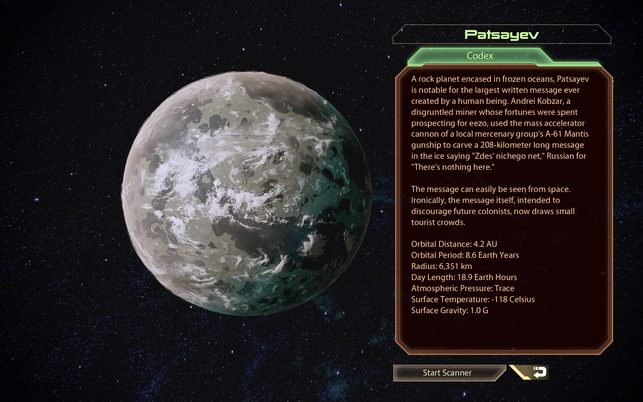
A rock planet encased in frozen oceans, Patsayev is notable for the largest written message ever created by a human being. Andrei Kobzar, a disgruntled miner whose fortunes were spent prospecting for eezo, used the mass accelerator cannon of a local mercenary group’s A-61 Mantis gunship to carve a 208-kilometer long message in the ice saying “Zdes’ nichego net,” Russian for “There’s nothing here.”
The message can easily be seen from space. Ironically, the message itself, intended to discourage future colonists, now draws small tourist crowds.
Orbital Distance: 4.2 AU
Orbital Period: 8.6 Earth Years
Radius: 6,351 km
Day Length: 18.9 Earth Hours
Atmospheric Pressure: Trace
Surface Temperature: -118 Celsius
Surface Gravity: 1.0 G
Volkov
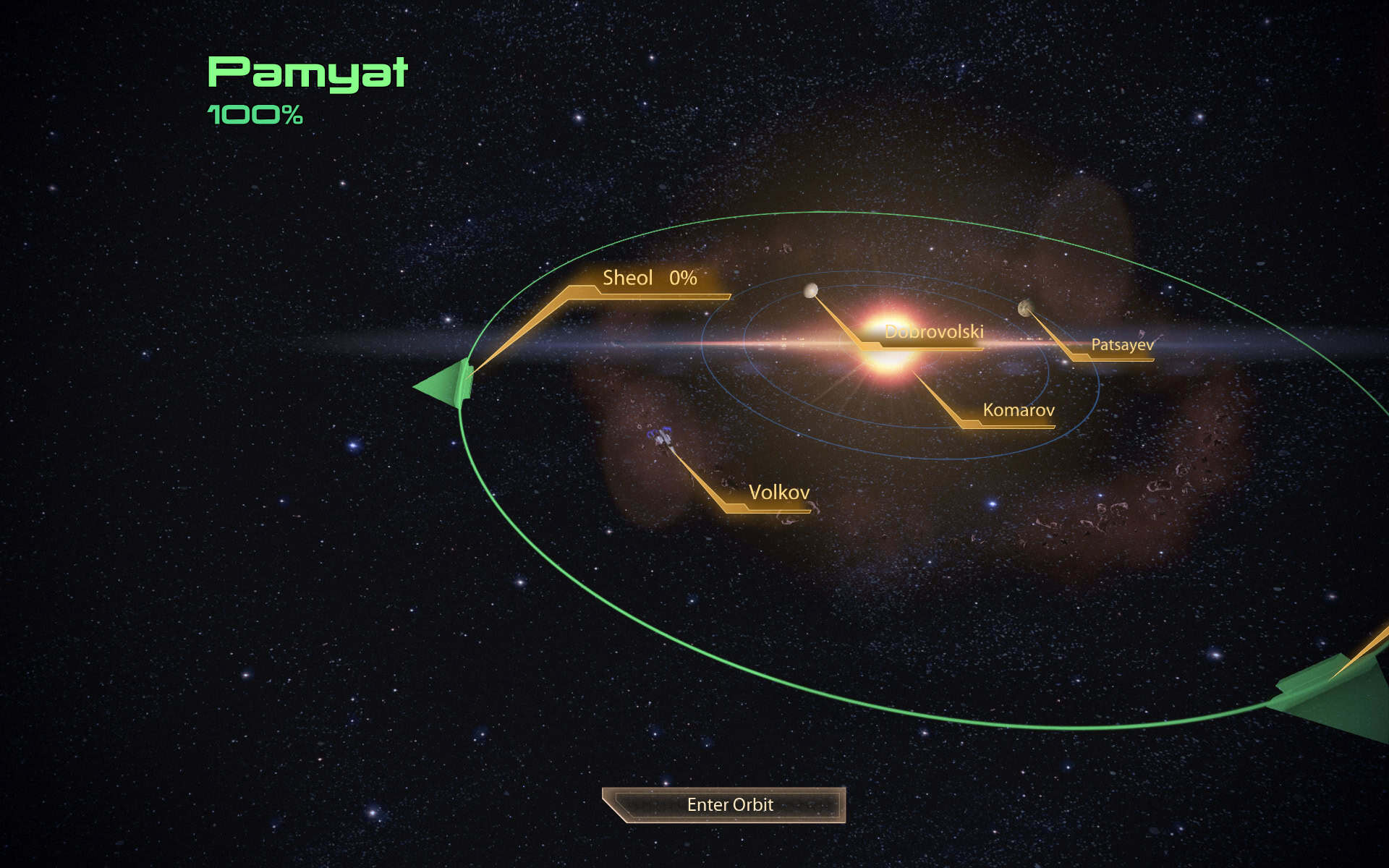
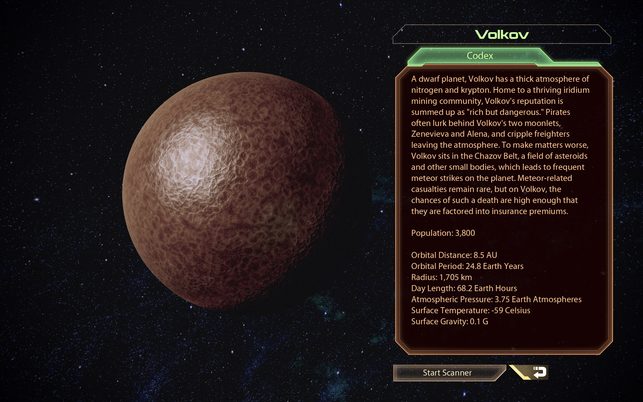
A dwarf planet, Volkov has a thick atmosphere of nitrogen and krypton. Home to a thriving iridium mining community, Volkov’s reputation is summed up as “rich but dangerous.” Pirates often lurk behind Volkov’s two moonlets, Zenevieva and Alena, and cripple freighters leaving the atmosphere. To make matters worse, Volkov sits in the Chazov Belt, a field of asteroids and other small bodies, which leads to frequent meteor strikes on the planet. Meteor-related casualties remain rare, but on Volkov, the chances of such a death are high enough that they are factored into insurance premiums.
Population: 3,800
Orbital Distance: 8.5 AU
Orbital Period: 24.8 Earth Years
Radius: 1,705 km
Day Length: 68.2 Earth Hours
Atmospheric Pressure: 3.75 Earth Atmospheres
Surface Temperature: -59 Celsius
Surface Gravity: 0.1 G
SHEOL
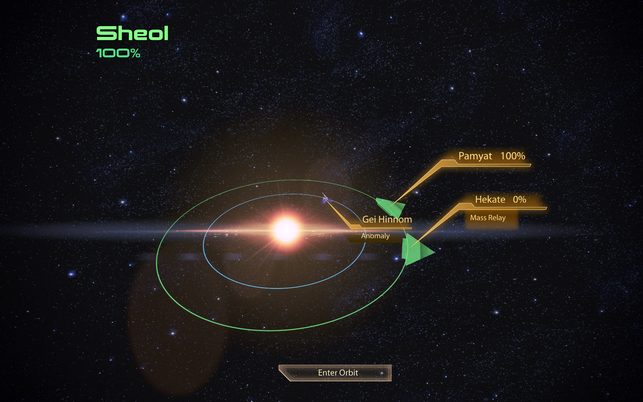
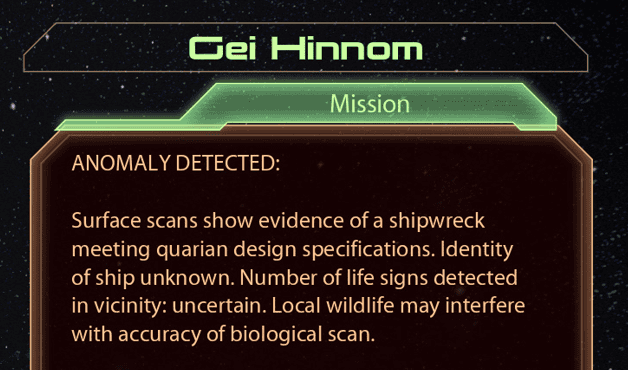
Gei Hinnom*
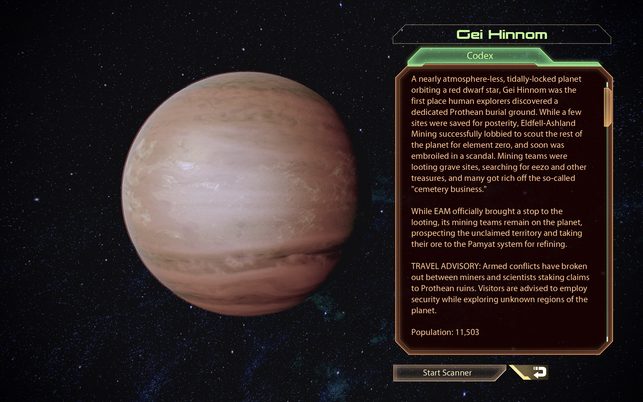
A nearly atmosphere-less, tidally-locked planet orbiting a red dwarf star, Gei Hinnom was the first place human explorers discovered a dedicated Prothean burial ground. While a few sites were saved for posterity, Eldfell-Ashland Mining successfully lobbied to scout the rest of the planet for element zero, and soon was embroiled in a scandal. Mining teams were looting grave sites, searching for eezo and other treasures, and many got rich off the so-called “cemetery business.”
While EAM officially brought a stop to the looting, its mining teams remain on the planet, prospecting the unclaimed territory and taking their ore to the Pamyat system for refining.
TRAVEL ADVISORY: Armed conflicts have broken out between miners and scientists staking claims to Prothean ruins. Visitors are advised to employ security while exploring unknown regions of the planet.
Population: 11,503
Orbital Distance: 0.83 AU
Orbital Period: 0.8 Earth Years
Radius: 2,379 km
Day Length: 0.8 Earth Years
Atmospheric Pressure: Trace
Surface Temperature: 35 Celsius (habitable zone)
108 Celsius/-120 Celsius (uninhabitable)
Surface Gravity: 0.1 G
HAWKING ETA
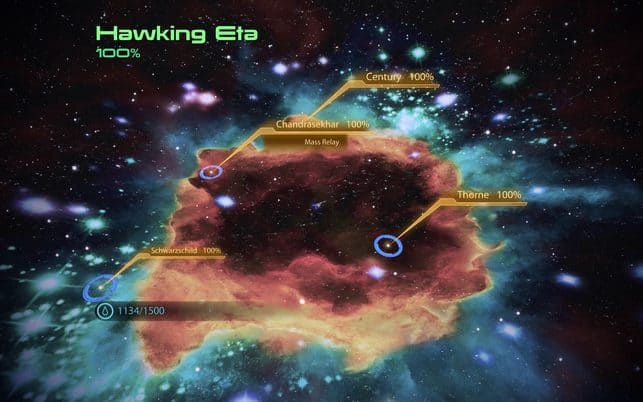
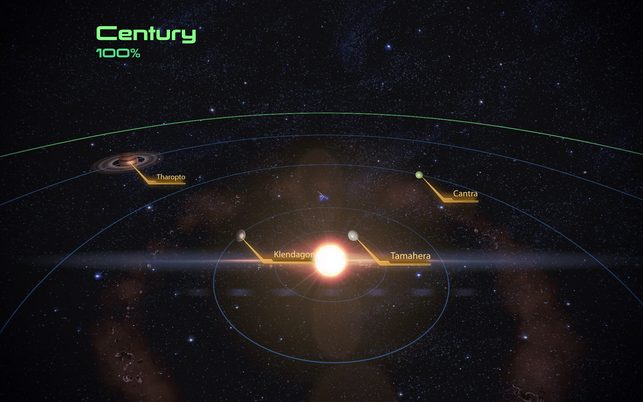
CENTURY
Cantra
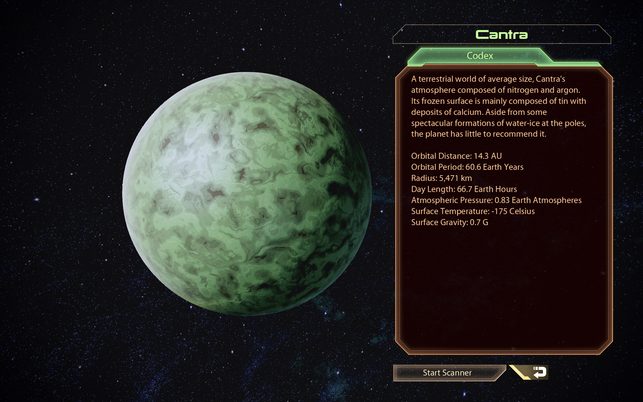
A terrestrial world of average size, Cantra’s atmosphere composed of nitrogen and argon. Its frozen surface is mainly composed of tin with deposits of calcium. Aside from some spectacular formations of water-ice at the poles, the planet has little to recommend it.
Orbital Distance: 14.3 AU
Orbital Period: 60.6 Earth Years
Radius: 5,471 km
Day Length: 66.7 Earth Hours
Atmospheric Pressure: 0.83 Earth Atmospheres
Surface Temperature: -175 Celsius
Surface Gravity: 0.7 G
Klendagon
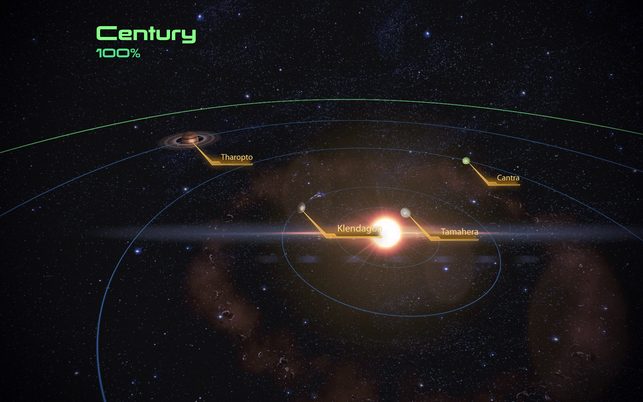
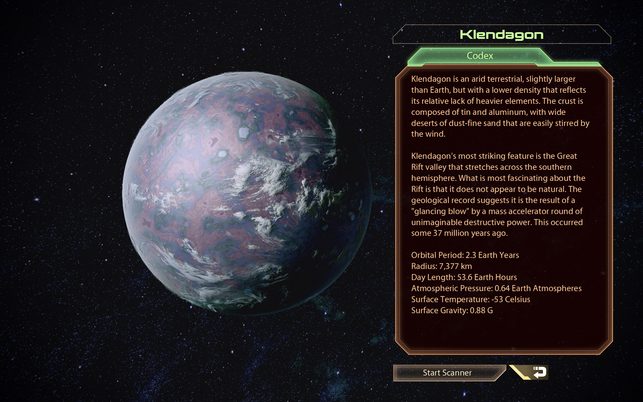
Klendagon is an arid terrestrial, slightly larger than Earth, but with a lower density that reflects its relative lack of heavier elements. The crust is composed of tin and aluminum, with wide deserts of dust-fine sand that are easily stirred by the wind.
Klendagon’s most striking feature is the Great Rift valley that stretches across the southern hemisphere. What is most fascinating about the Rift is that it does not appear to be natural. The geological record suggests it is the result of a “glancing blow” by a mass accelerator round of unimaginable destructive power. This occurred some 37 million years ago.
Orbital Period: 2.3 Earth Years
Radius: 7,377 km
Day Length: 53.6 Earth Hours
Atmospheric Pressure: 0.64 Earth Atmospheres
Surface Temperature: -53 Celsius
Surface Gravity: 0.88 G
Tamahera
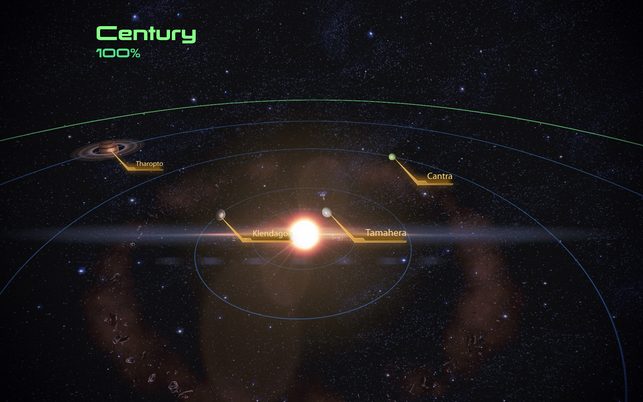
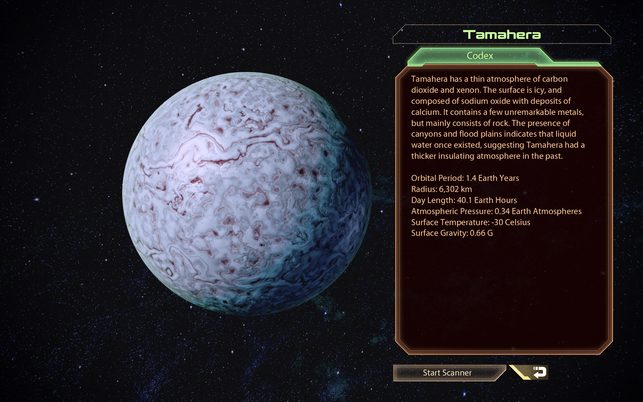
Tamahera has a thin atmosphere of carbon dioxide and xenon. The surface is icy, and composed of sodium oxide with deposits of calcium. It contains a few unremarkable metals, but mainly consists of rock. The presence of canyons and flood plains indicates that liquid water once existed, suggesting Tamahera had a thicker insulating atmosphere in the past.
Orbital Period: 1.4 Earth Years
Radius: 6,302 km
Day Length: 40.1 Earth Hours
Atmospheric Pressure: 0.34 Earth Atmospheres
Surface Temperature: -30 Celsius
Surface Gravity: 0.66 G
Tharopto
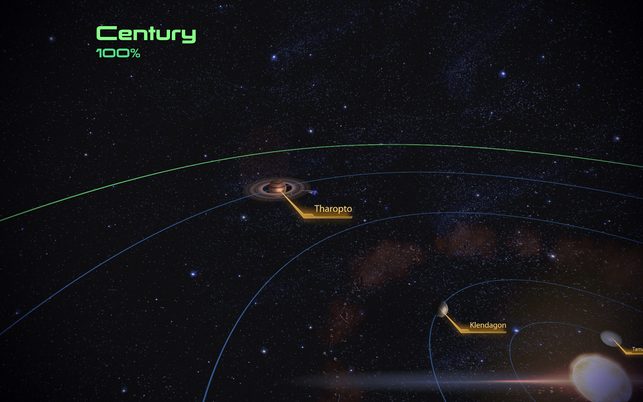
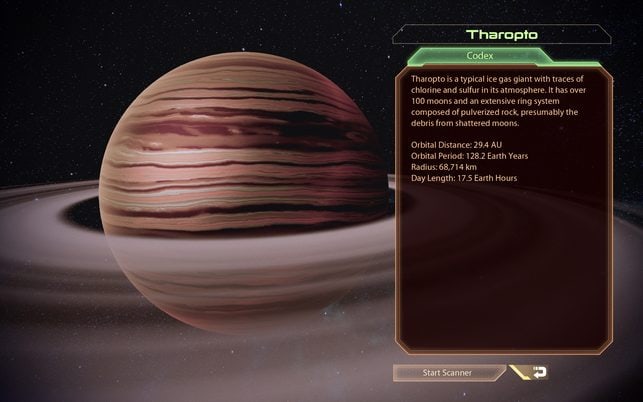
Tharopto is a typical ice gas giant with traces of chlorine and sulfur in its atmosphere. It has over 100 moons and an extensive ring system composed of pulverized rock, presumably the debris from shattered moons.
Orbital Distance: 29.4 AU
Orbital Period: 128.2 Earth Years
Radius: 68,714 km
Day Length: 17.5 Earth Hours
CHANDRASHEKAR
Hebat
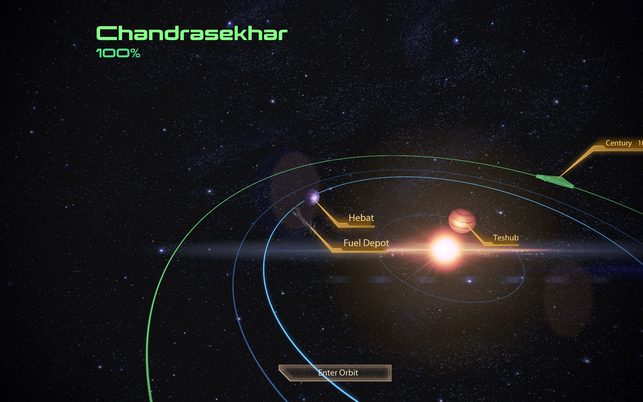
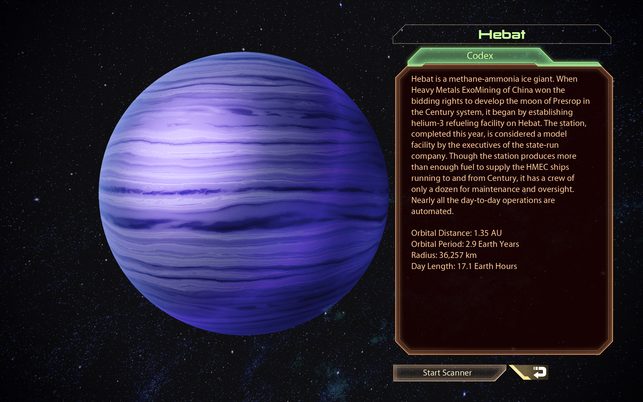
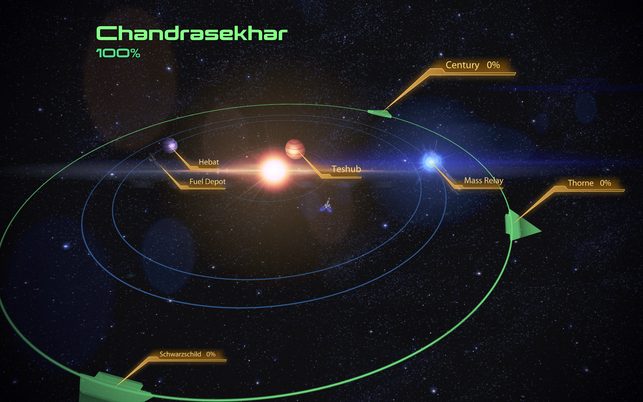
Hebat is a methane-ammonia ice giant. When Heavy Metals ExoMining of China won the bidding rights to develop the moon of Presrop in the Century system, it began by establishing helium-3 refueling facility on Hebat. The station, completed this year, is considered a model facility by the executives of the state-run company. Though the station produces more than enough fuel to supply the HMEC ships running to and from Century, it has a crew of only a dozen for maintenance and oversight. Nearly all the day-to-day operations are automated.
Orbital Distance: 1.35 AU
Orbital Period: 2.9 Earth Years
Radius: 36,257 km
Day Length: 17.1 Earth Hours
Teshub
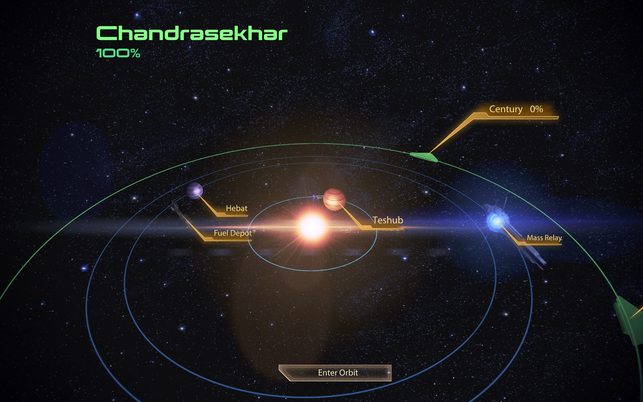
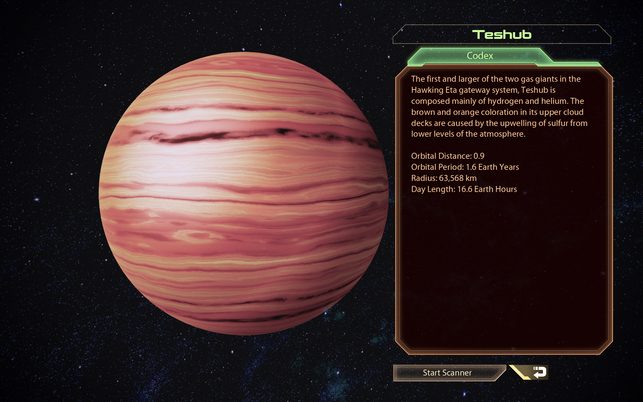
The first and larger of the two gas giants in the Hawking Eta gateway system, Teshub is composed mainly of hydrogen and helium. The brown and orange coloration in its upper cloud decks are caused by the upwelling of sulfur from lower levels of the atmosphere.
Orbital Distance: 0.9
Orbital Period: 1.6 Earth Years
Radius: 63,568 km
Day Length: 16.6 Earth Hours
SCHWARZSCHILD
Atahil
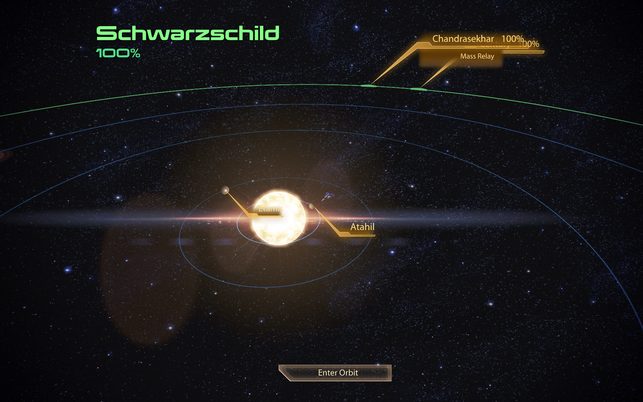
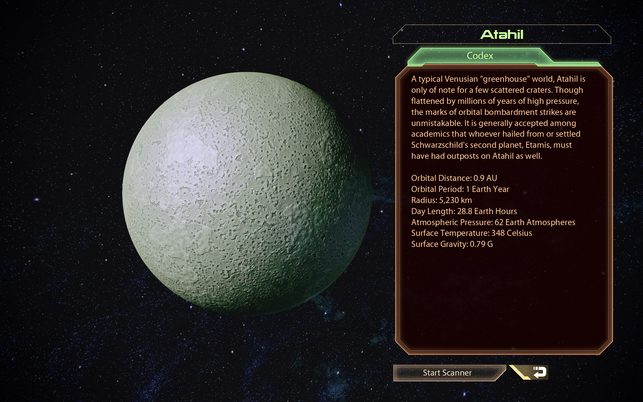
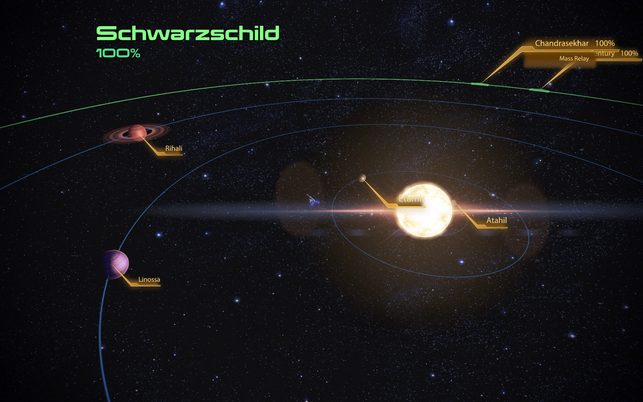
A typical Venusian “greenhouse” world, Atahil is only of note for a few scattered craters. Though flattened by millions of years of high pressure, the marks of orbital bombardment strikes are unmistakable. It is generally accepted among academics that whoever hailed from or settled Schwarzschild’s second planet, Etamis, must have had outposts on Atahil as well.
Orbital Distance: 0.9 AU
Orbital Period: 1 Earth Year
Radius: 5,230 km
Day Length: 28.8 Earth Hours
Atmospheric Pressure: 62 Earth Atmospheres
Surface Temperature: 348 Celsius
Surface Gravity: 0.79 G
Etamis
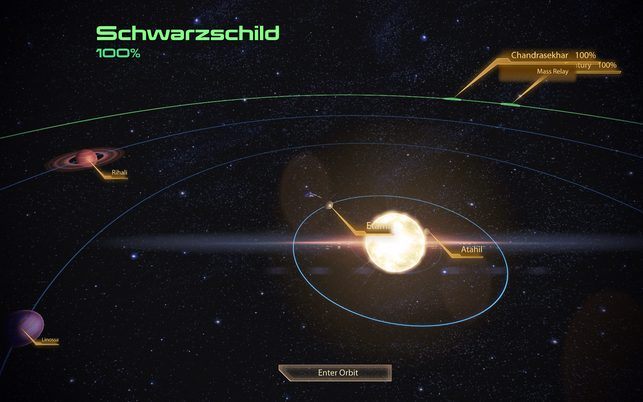
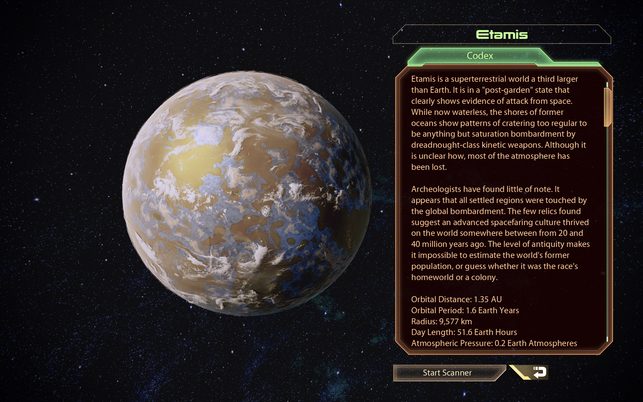
Etamis is a superterrestrial world a third larger than Earth. It is in a “post-garden” state that clearly shows evidence of attack from space. While now waterless, the shores of former oceans show patterns of cratering too regular to be anything but saturation bombardment by dreadnought-class kinetic weapons. Although it is unclear how, most of the atmosphere has been lost.
Archeologists have found little of note. It appears that all settled regions were touched by the global bombardment. The few relics found suggest an advanced spacefaring culture thrived on the world somewhere between from 20 and 40 million years ago. The level of antiquity makes it impossible to estimate the world’s former population, or guess whether it was the race’s homeworld or a colony.
Orbital Distance: 1.35 AU
Orbital Period: 1.6 Earth Years
Radius: 9,577 km
Day Length: 51.6 Earth Hours
Atmospheric Pressure: 0.2 Earth Atmospheres
Surface Temperature: -49.6 Celsius
Surface Gravity: 3.4 G
Linossa
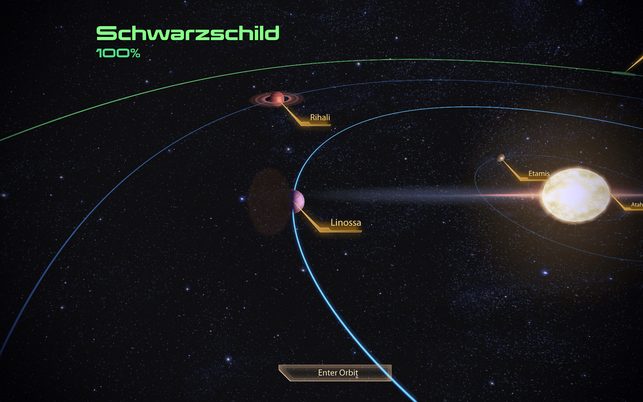
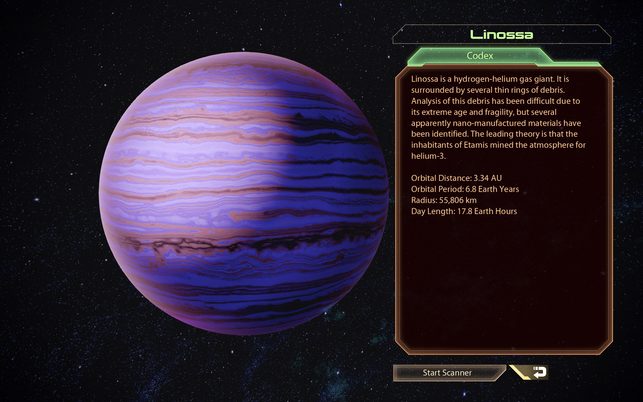
Linossa is a hydrogen-helium gas giant. It is surrounded by several thin rings of debris. Analysis of this debris has been difficult due to its extreme age and fragility, but several apparently nano-manufactured materials have been identified. The leading theory is that the inhabitants of Etamis mined the atmosphere for helium-3.
Orbital Distance: 3.34 AU
Orbital Period: 6.8 Earth Years
Radius: 55,806 km
Day Length: 17.8 Earth Hours
Rihali
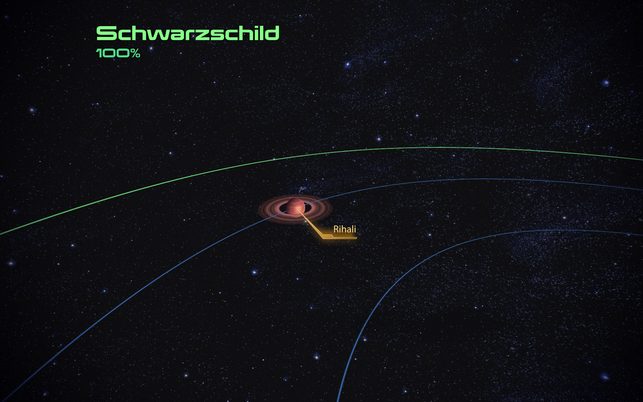
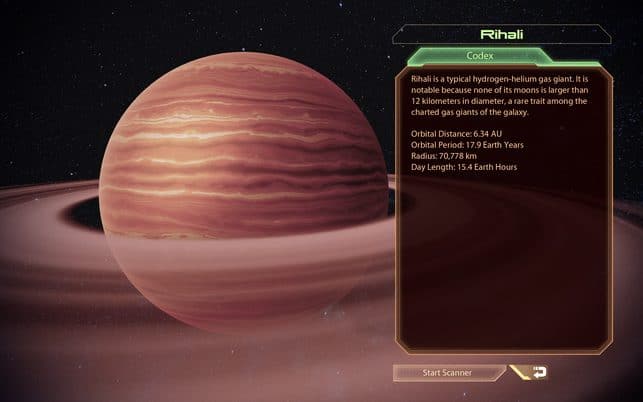
Rihali is a typical hydrogen-helium gas giant. It is notable because none of its moons is larger than 12 kilometers in diameter, a rare trait among the charted gas giants of the galaxy.
Orbital Distance: 6.34 AU
Orbital Period: 17.9 Earth Years
Radius: 70,778 km
Day Length: 15.4 Earth Hours
THORNE
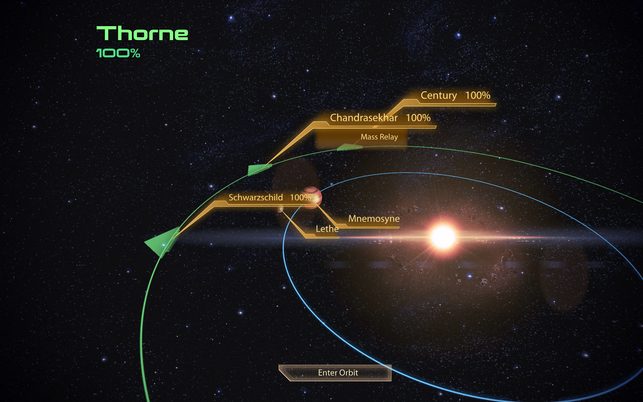
Lethe
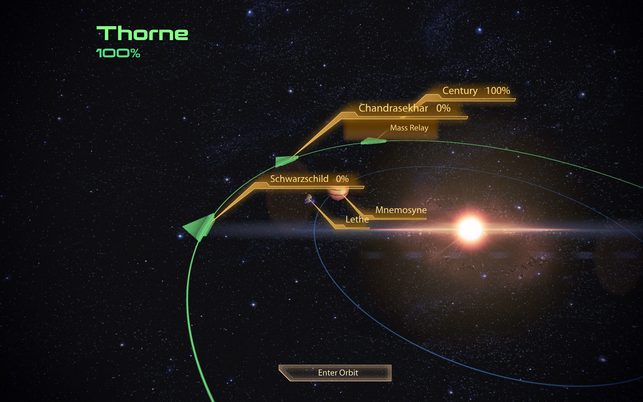
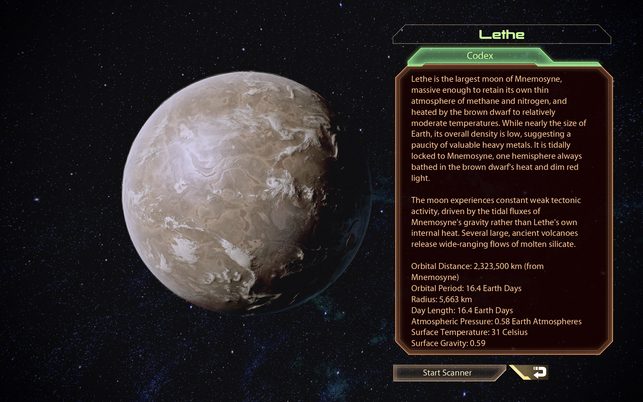
Lethe is the largest moon of Mnemosyne, massive enough to retain its own thin atmosphere of methane and nitrogen, and heated by the brown dwarf to relatively moderate temperatures. While nearly the size of Earth, its overall density is low, suggesting a paucity of valuable heavy metals. It is tidally locked to Mnemosyne, one hemisphere always bathed in the brown dwarf’s heat and dim red light.
The moon experiences constant weak tectonic activity, driven by the tidal fluxes of Mnemosyne’s gravity rather than Lethe’s own internal heat. Several large, ancient volcanoes release wide-ranging flows of molten silicate.
Orbital Distance: 2,323,500 km (from Mnemosyne)
Orbital Period: 16.4 Earth Days
Radius: 5,663 km
Day Length: 16.4 Earth Days
Atmospheric Pressure: 0.58 Earth Atmospheres
Surface Temperature: 31 Celsius
Surface Gravity: 0.59
Mnemosyne
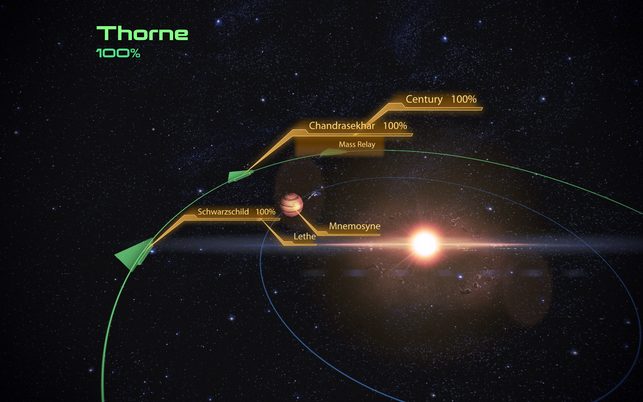
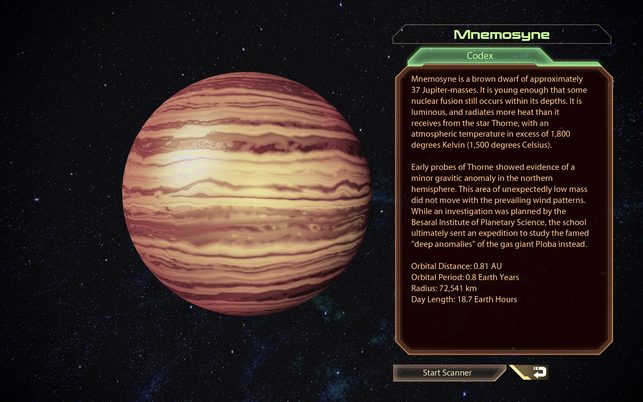
Mnemosyne is a brown dwarf of approximately 37 Jupiter-masses. It is young enough that some nuclear fusion still occurs within its depths. It is luminous, and radiates more heat than it receives from the star Thorne, with an atmospheric temperature in excess of 1,800 degrees Kelvin (1,500 degrees Celsius).
Early probes of Thorne showed evidence of a minor gravitic anomaly in the northern hemisphere. This area of unexpectedly low mass did not move with the prevailing wind patterns. While an investigation was planned by the Besaral Institute of Planetary Science, the school ultimately sent an expedition to study the famed “deep anomalies” of the gas giant Ploba instead.
Orbital Distance: 0.81 AU
Orbital Period: 0.8 Earth Years
Radius: 72,541 km
Day Length: 18.7 Earth Hours
HOURGLASS NEBULA
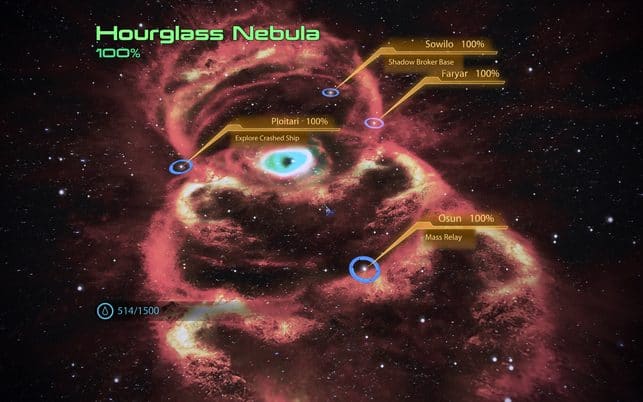
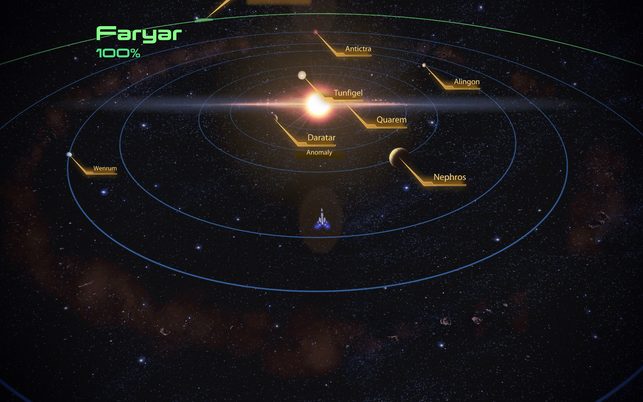
FARYAR
Alingon
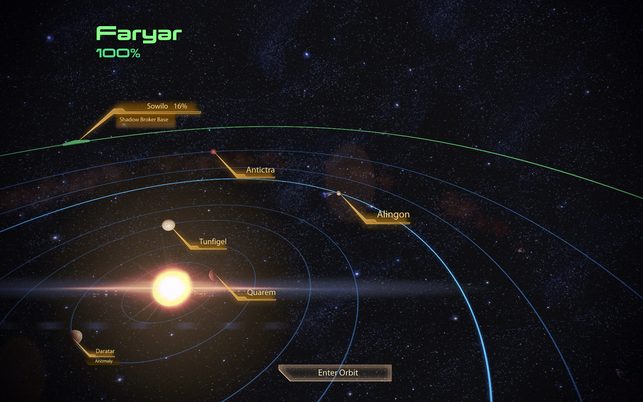
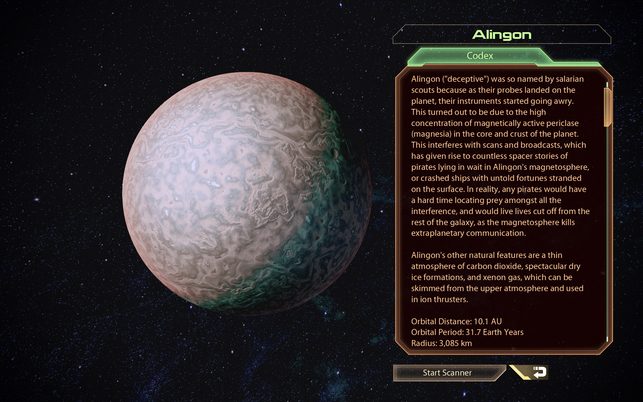
Alingon (“deceptive”) was so named by salarian scouts because as their probes landed on the planet, their instruments started going awry. This turned out to be due to the high concentration of magnetically active periclase (magnesia) in the core and crust of the planet. This interferes with scans and broadcasts, which has given rise to countless spacer stories of pirates lying in wait in Alingon’s magnetosphere, or crashed ships with untold fortunes stranded on the surface. In reality, any pirates would have a hard time locating prey amongst all the interference, and would live lives cut off from the rest of the galaxy, as the agnetosphere kills extraplanetary communication.
Alingon’s other natural features are a thin atmosphere of carbon dioxide, spectacular dry ice formations, and xenon gas, which can be skimmed from the upper atmosphere and used in ion thrusters.
Orbital Distance: 10.1 AU
Orbital Period: 31.7 Earth Years
Radius: 3,085 km
Day Length: 56.3 Earth Hours
Atmospheric Pressure: 0.04 Earth Atmospheres
Surface Temperature: -166 Celsius
Surface Gravity: 0.5 G
Antictra
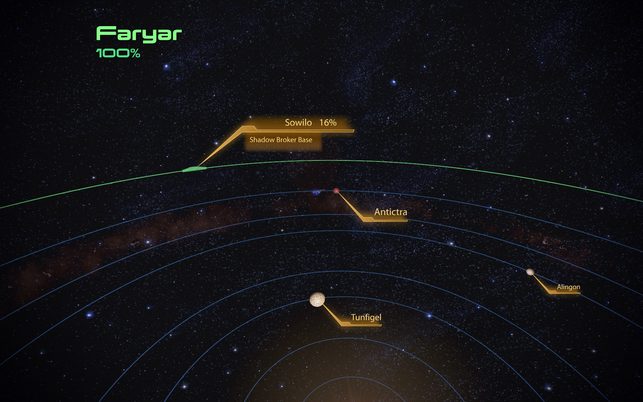
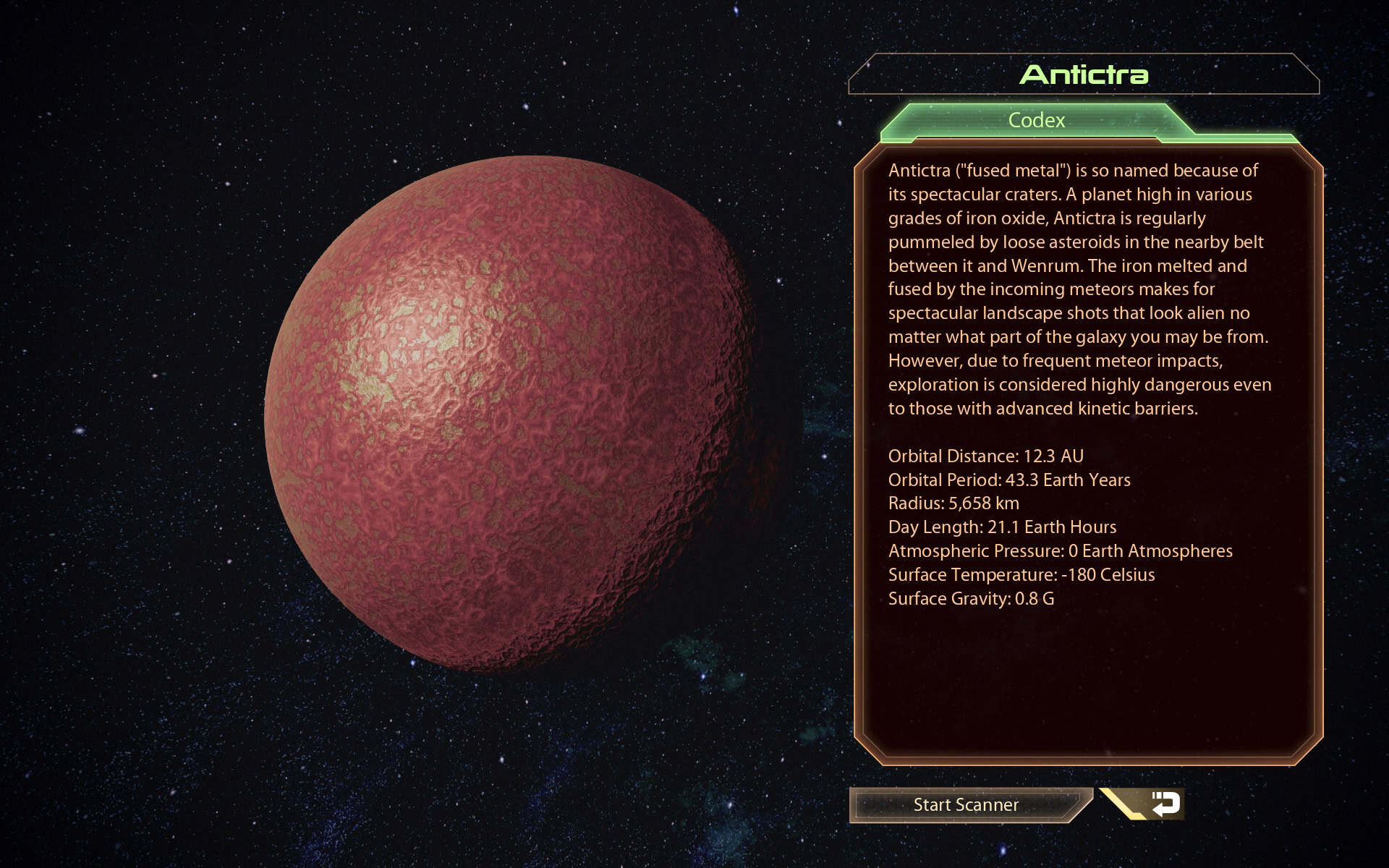
Antictra (“fused metal”) is so named because of its spectacular craters. A planet high in various grades of iron oxide, Antictra is regularly pummeled by loose asteroids in the nearby belt between it and Wenrum. The iron melted and fused by the incoming meteors makes for spectacular landscape shots that look alien no matter what part of the galaxy you may be from. However, due to frequent meteor impacts, exploration is considered highly dangerous even to those with advanced kinetic barriers.
Orbital Distance: 12.3 AU
Orbital Period: 43.3 Earth Years
Radius: 5,658 km
Day Length: 21.1 Earth Hours
Atmospheric Pressure: 0 Earth Atmospheres
Surface Temperature: -180 Celsius
Surface Gravity: 0.8 G
Daratar*
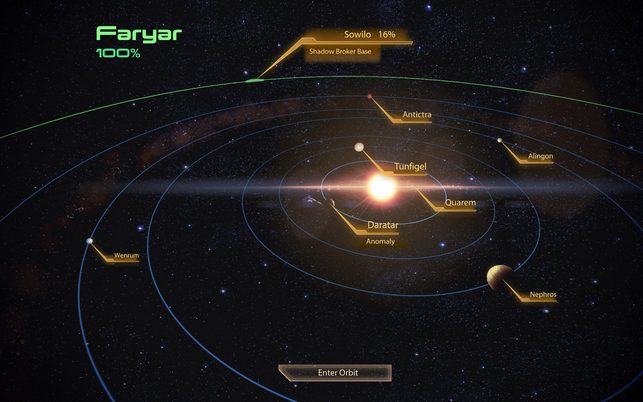
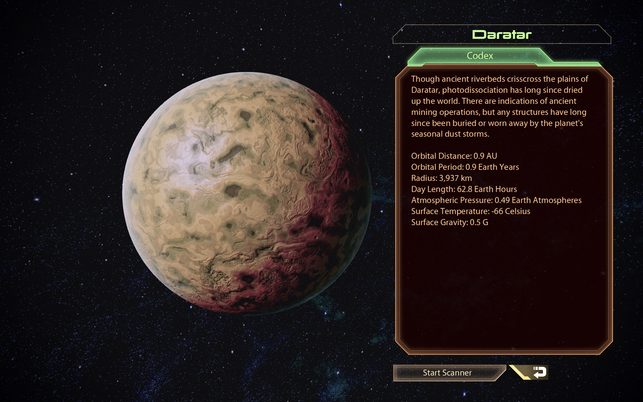
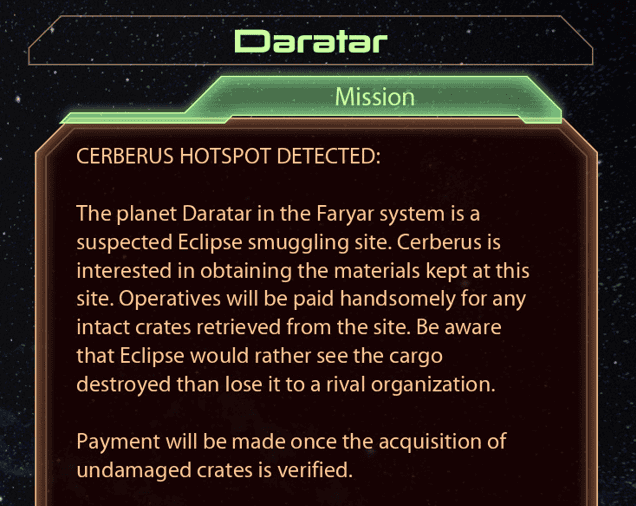
Though ancient riverbeds crisscross the plains of Daratar, photodissociation has long since dried up the world. There are indications of ancient mining operations, but any structures have long since been buried or worn away by the planet’s seasonal dust storms.
Orbital Distance: 0.9 AU
Orbital Period: 0.9 Earth Years
Radius: 3,937 km
Day Length: 62.8 Earth Hours
Atmospheric Pressure: 0.49 Earth Atmospheres
Surface Temperature: -66 Celsius
Surface Gravity: 0.5 G
Nephros
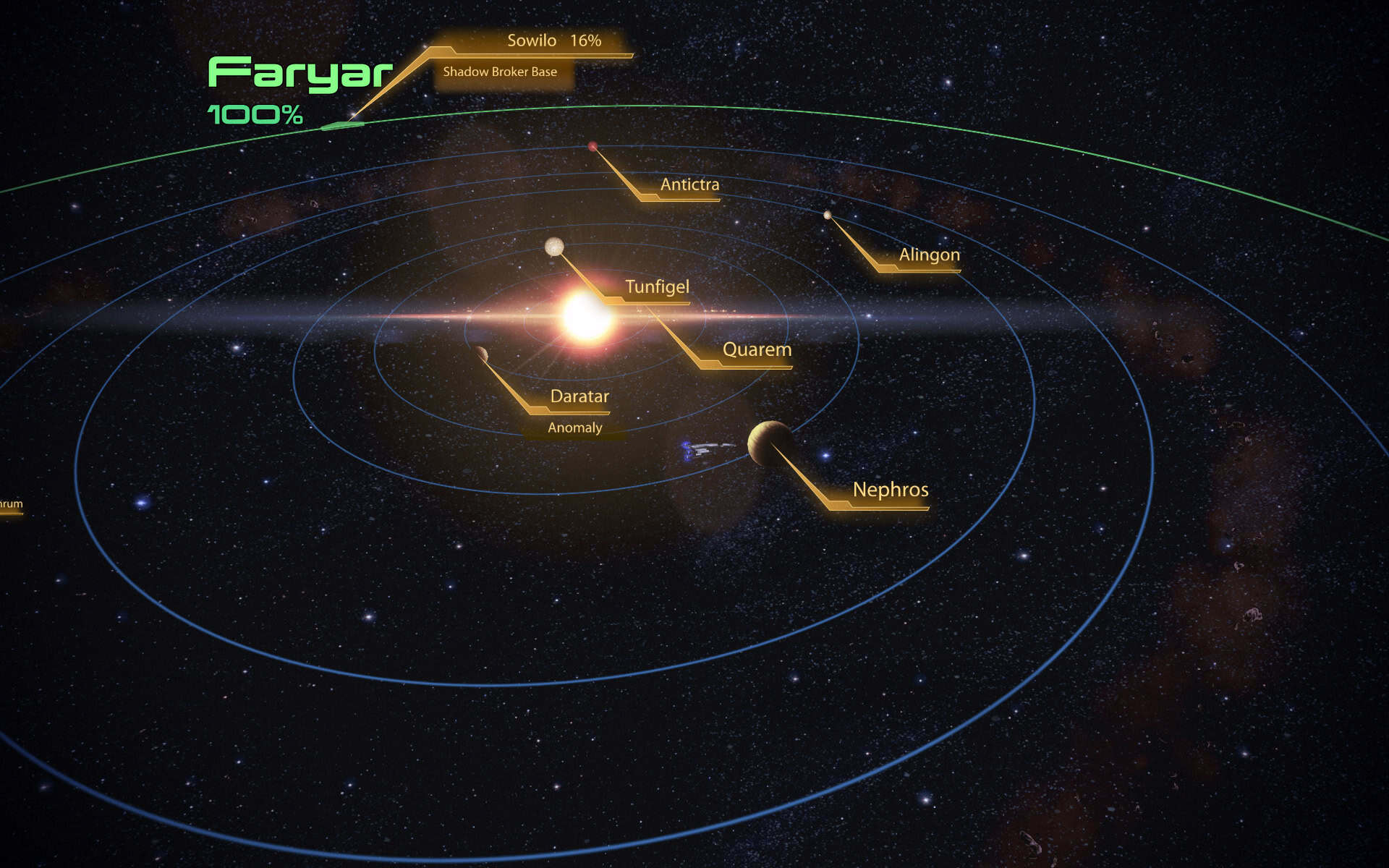
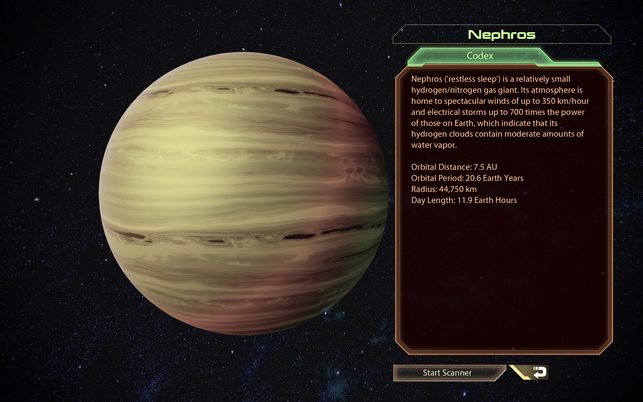
Nephros (‘restless sleep’) is a relatively small hydrogen/nitrogen gas giant. Its atmosphere is home to spectacular winds of up to 350 km/hour and electrical storms up to 700 times the power of those on Earth, which indicate that its hydrogen clouds contain moderate amounts of water vapor.
Orbital Distance: 7.5 AU
Orbital Period: 20.6 Earth Years
Radius: 44,750 km
Day Length: 11.9 Earth Hours
Quarem
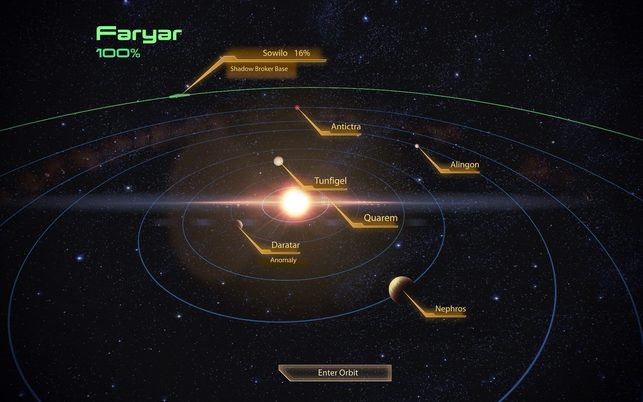
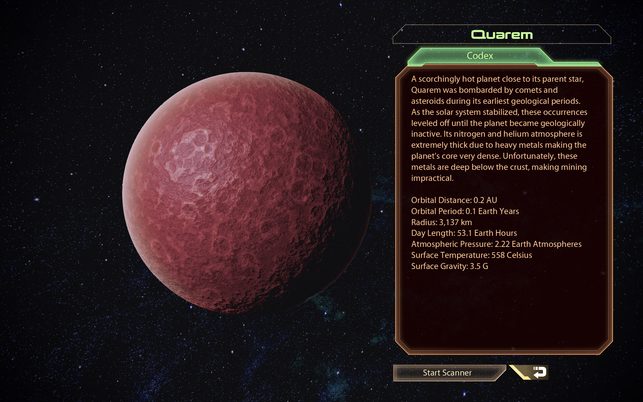
A scorchingly hot planet close to its parent star, Quarem was bombarded by comets and asteroids during its earliest geological periods. As the solar system stabilized, these occurrences leveled off until the planet became geologically inactive. Its nitrogen and helium atmosphere is extremely thick due to heavy metals making the planet’s core very dense. Unfortunately, these metals are deep below the crust, making mining impractical.
Orbital Distance: 0.2 AU
Orbital Period: 0.1 Earth Years
Radius: 3,137 km
Day Length: 53.1 Earth Hours
Atmospheric Pressure: 2.22 Earth Atmospheres
Surface Temperature: 558 Celsius
Surface Gravity: 3.5 G
Tunfigel
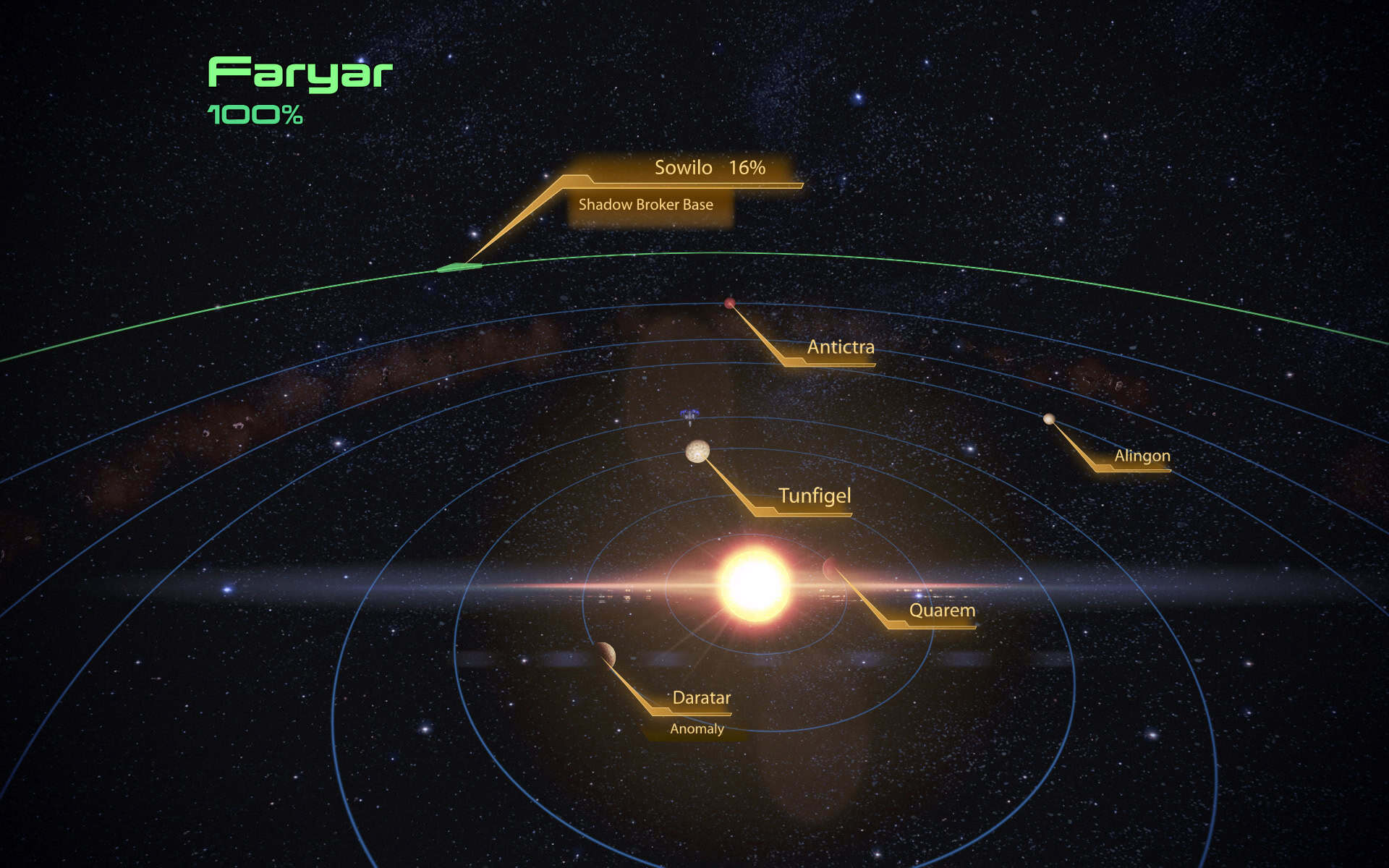
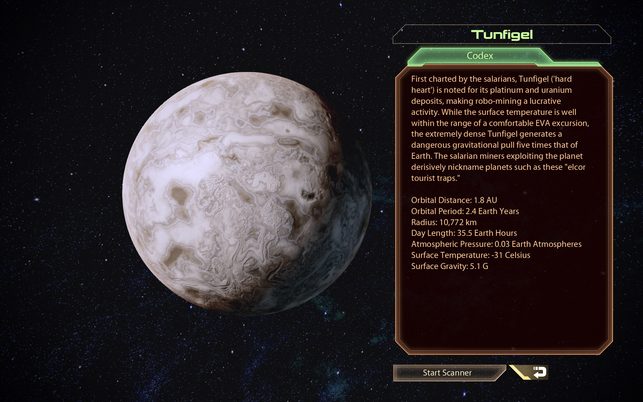
First charted by the salarians, Tunfigel (‘hard heart’) is noted for its platinum and uranium deposits, making robo-mining a lucrative activity. While the surface temperature is well within the range of a comfortable EVA excursion, the extremely dense Tunfigel generates a dangerous gravitational pull five times that of Earth. The salarian miners exploiting the planet derisively nickname planets such as these “elcor tourist traps.”
Orbital Distance: 1.8 AU
Orbital Period: 2.4 Earth Years
Radius: 10,772 km
Day Length: 35.5 Earth Hours
Atmospheric Pressure: 0.03 Earth Atmospheres
Surface Temperature: -31 Celsius
Surface Gravity: 5.1 G
Wenrum
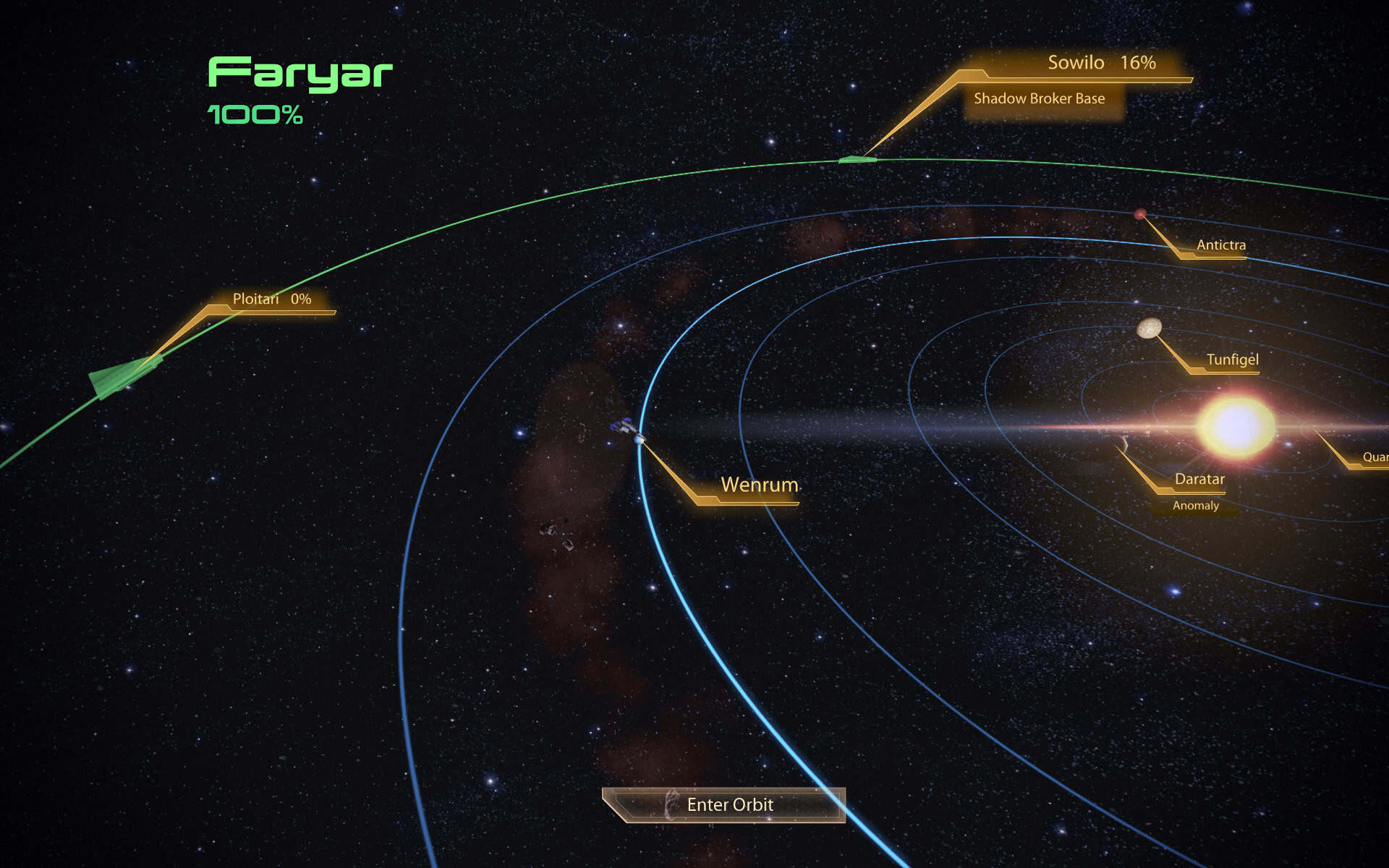
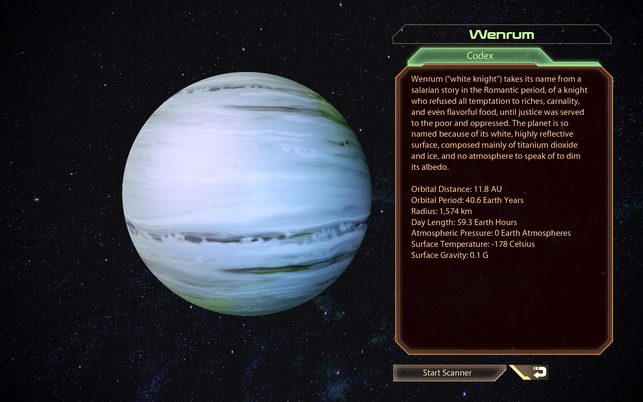
Wenrum (“white knight”) takes its name from a salarian story in the Romantic period, of a knight who refused all temptation to riches, carnality, and even flavorful food, until justice was served to the poor and oppressed. The planet is so named because of its white, highly reflective surface, composed mainly of titanium dioxide and ice, and no atmosphere to speak of to dim its albedo.
Orbital Distance: 11.8 AU
Orbital Period: 40.6 Earth Years
Radius: 1,574 km
Day Length: 59.3 Earth Hours
Atmospheric Pressure: 0 Earth Atmospheres
Surface Temperature: -178 Celsius
Surface Gravity: 0.1 G
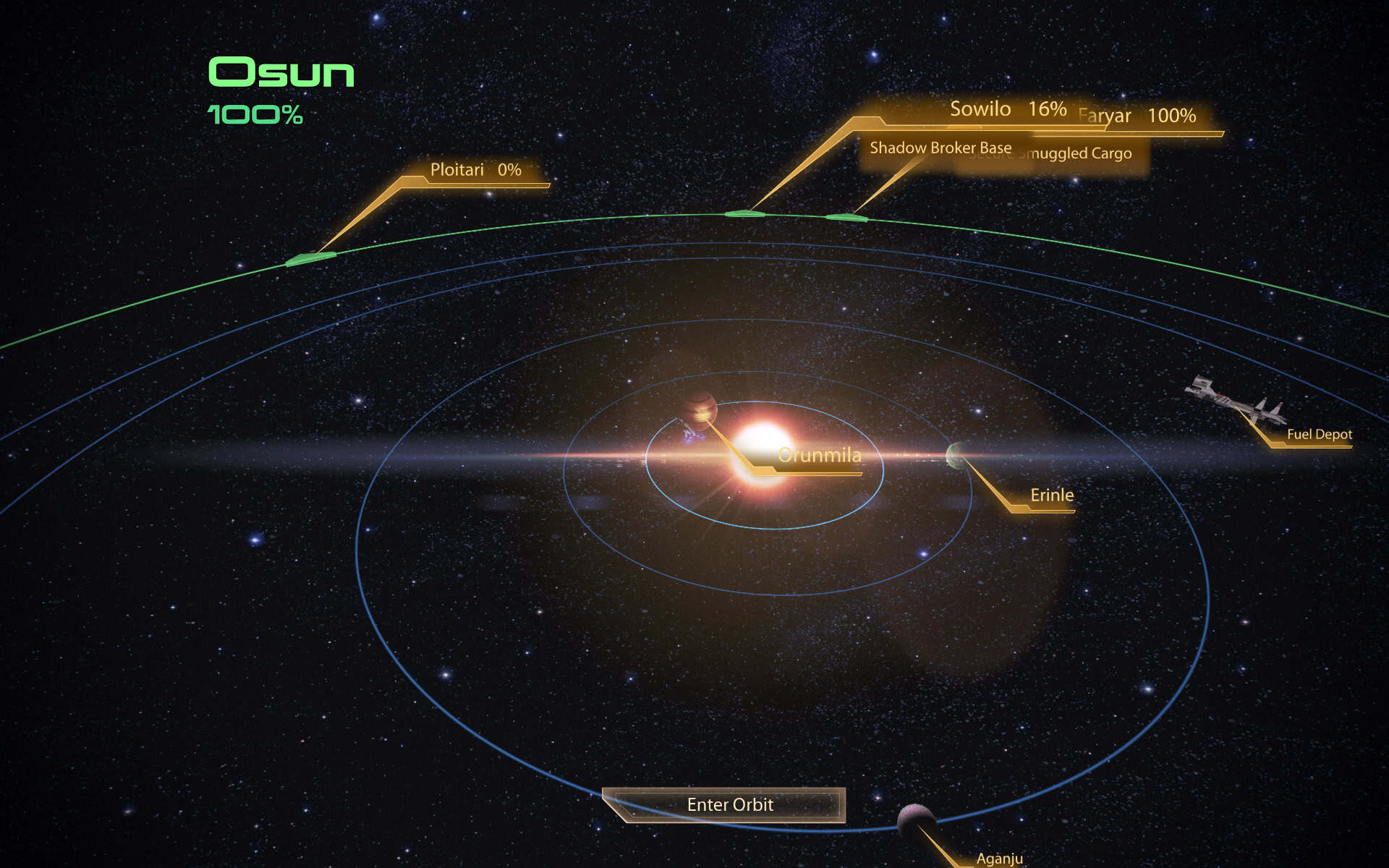
OSUN
Aganju
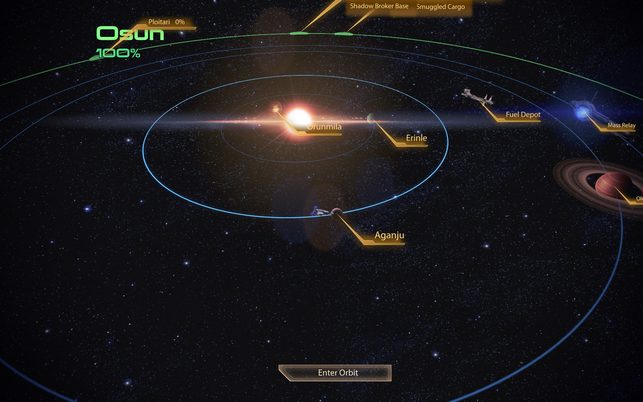
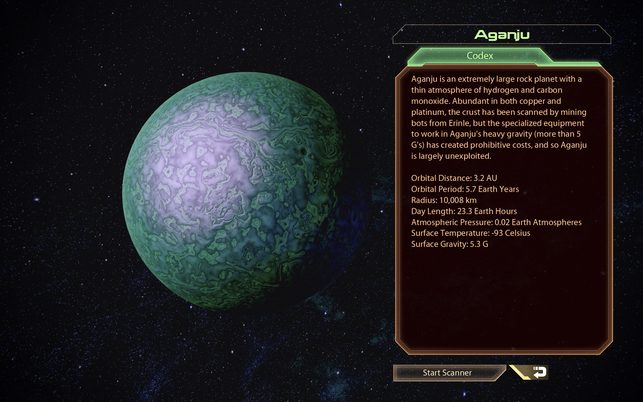
Aganju is an extremely large rock planet with a thin atmosphere of hydrogen and carbon monoxide. Abundant in both copper and platinum, the crust has been scanned by mining bots from Erinle, but the specialized equipment to work in Aganju’s heavy gravity (more than 5 G’s) has created prohibitive costs, and so Aganju is largely unexploited.
Orbital Distance: 3.2 AU
Orbital Period: 5.7 Earth Years
Radius: 10,008 km
Day Length: 23.3 Earth Hours
Atmospheric Pressure: 0.02 Earth Atmospheres
Surface Temperature: -93 Celsius
Surface Gravity: 5.3 G
Erinle
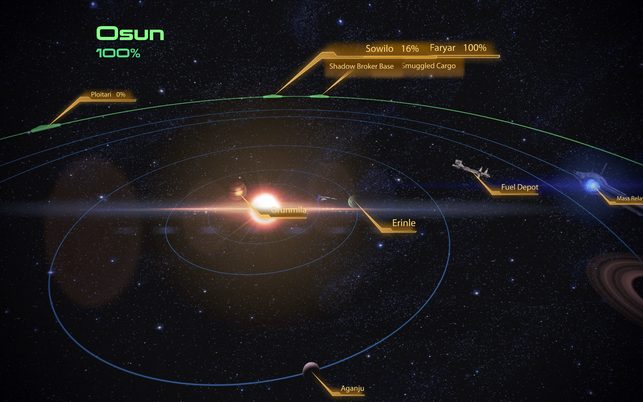
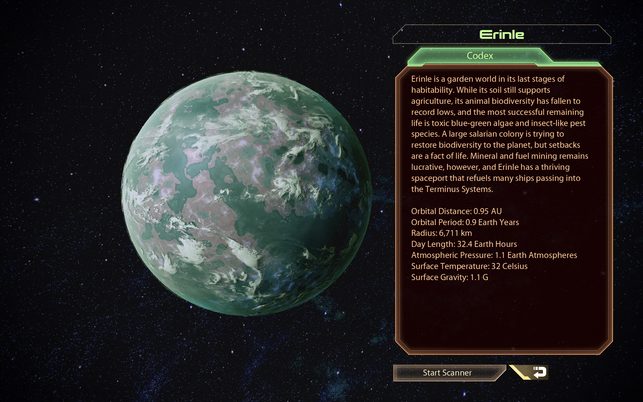
Erinle is a garden world in its last stages of habitability. While its soil still supports agriculture, its animal biodiversity has fallen to record lows, and the most successful remaining life is toxic blue-green algae and insect-like pest species. A large salarian colony is trying to restore biodiversity to the planet, but setbacks are a fact of life. Mineral and fuel mining remains lucrative, however, and Erinle has a thriving spaceport that refuels many ships passing into the Terminus Systems.
Orbital Distance: 0.95 AU
Orbital Period: 0.9 Earth Years
Radius: 6,711 km
Day Length: 32.4 Earth Hours
Atmospheric Pressure: 1.1 Earth Atmospheres
Surface Temperature: 32 Celsius
Surface Gravity: 1.1 G
Olokun
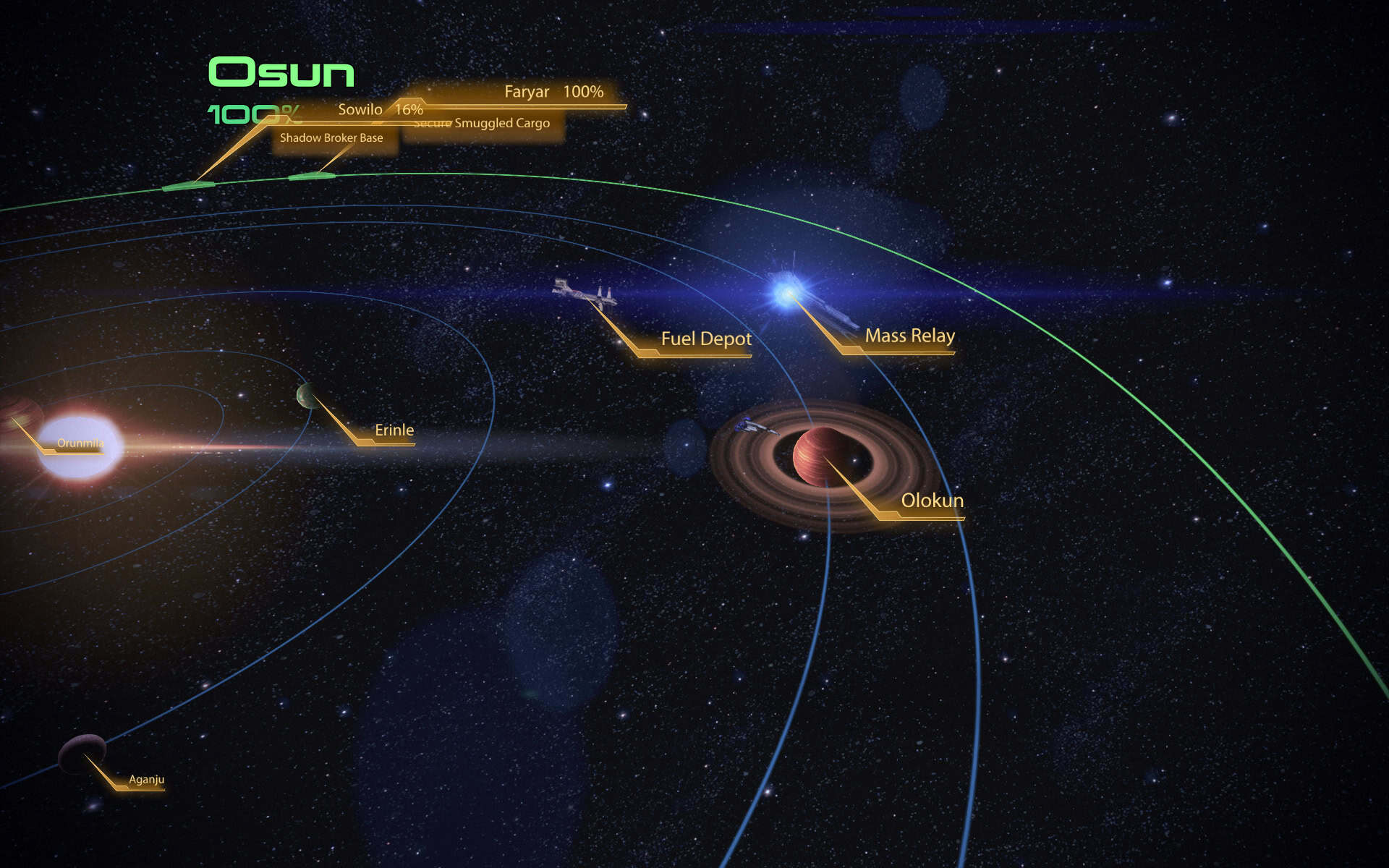
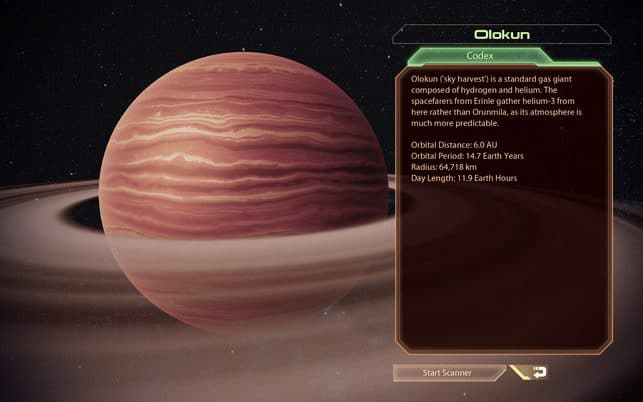
Olokun (‘sky harvest’) is a standard gas giant composed of hydrogen and helium. The spacefarers from Erinle gather helium-3 from here rather than Orunmila, as its atmosphere is much more predictable.
Orbital Distance: 6.0 AU
Orbital Period: 14.7 Earth Years
Radius: 64,718 km
Day Length: 11.9 Earth Hours
Orunmila
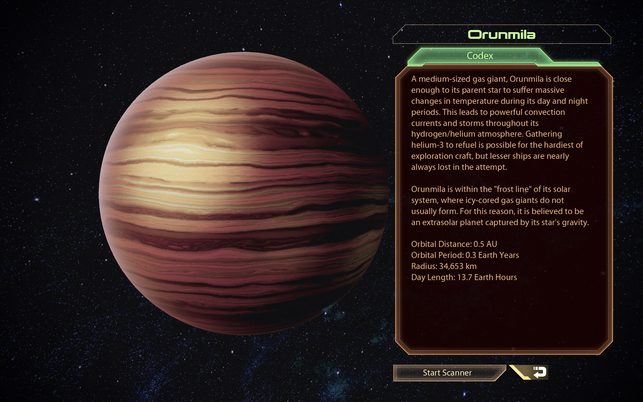
A medium-sized gas giant, Orunmila is close enough to its parent star to suffer massive changes in temperature during its day and night periods. This leads to powerful convection currents and storms throughout its hydrogen/helium atmosphere. Gathering helium-3 to refuel is possible for the hardiest of exploration craft, but lesser ships are nearly always lost in the attempt.
Orunmila is within the “frost line” of its solar system, where icy-cored gas giants do not usually form. For this reason, it is believed to be an extrasolar planet captured by its star’s gravity.
Orbital Distance: 0.5 AU
Orbital Period: 0.3 Earth Years
Radius: 34,653 km
Day Length: 13.7 Earth Hours
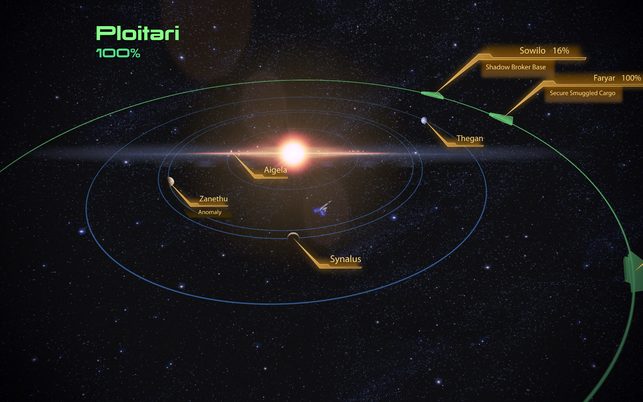
PLOITARI
Aigela
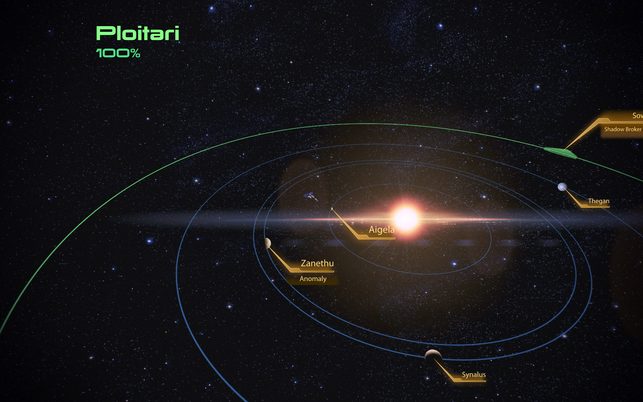
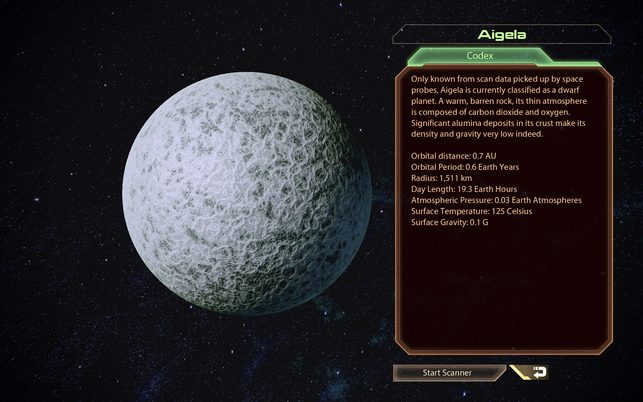
Only known from scan data picked up by space probes, Aigela is currently classified as a dwarf planet. A warm, barren rock, its thin atmosphere is composed of carbon dioxide and oxygen. Significant alumina deposits in its crust make its density and gravity very low indeed.
Orbital distance: 0.7 AU
Orbital Period: 0.6 Earth Years
Radius: 1,511 km
Day Length: 19.3 Earth Hours
Atmospheric Pressure: 0.03 Earth Atmospheres
Surface Temperature: 125 Celsius
Surface Gravity: 0.1 G
Synalus
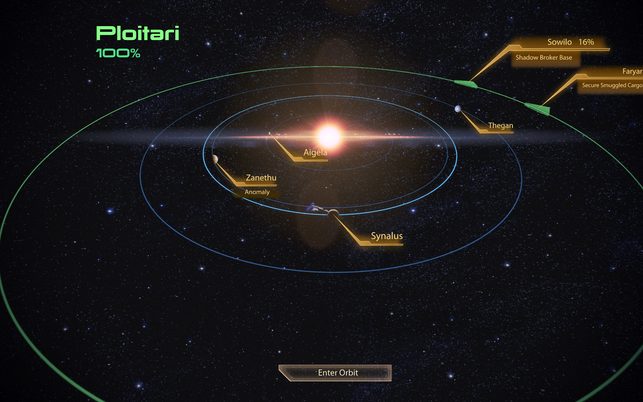
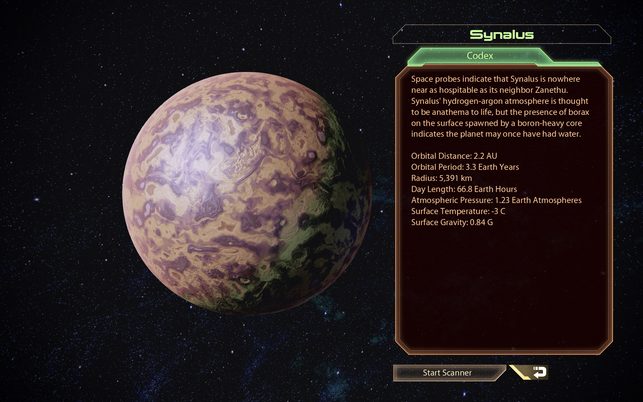
Space probes indicate that Synalus is nowhere near as hospitable as its neighbor Zanethu. Synalus’ hydrogen-argon atmosphere is thought to be anathema to life, but the presence of borax on the surface spawned by a boron-heavy core indicates the planet may once have had water.
Orbital Distance: 2.2 AU
Orbital Period: 3.3 Earth Years
Radius: 5,391 km
Day Length: 66.8 Earth Hours
Atmospheric Pressure: 1.23 Earth Atmospheres
Surface Temperature: -3 C
Surface Gravity: 0.84 G
Thegan
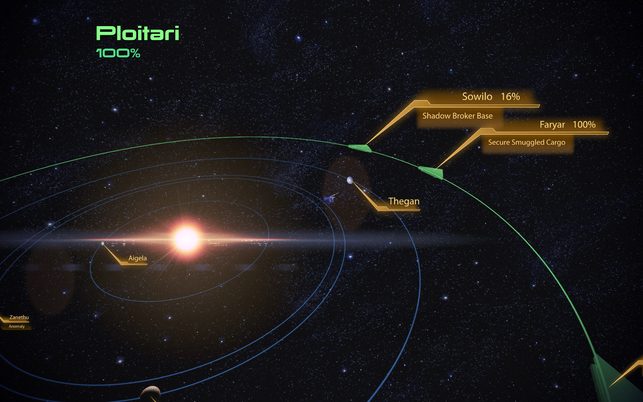
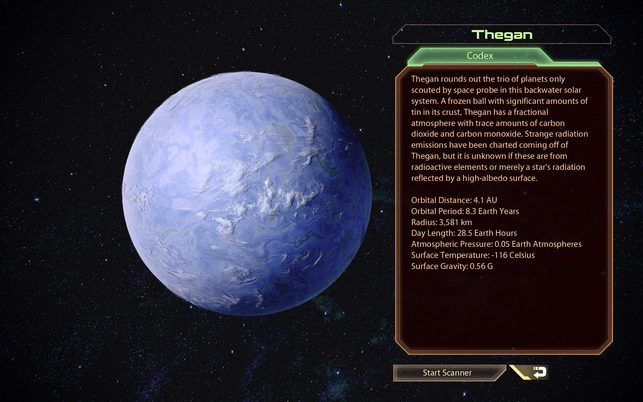
Thegan rounds out the trio of planets only scouted by space probe in this backwater solar system. A frozen ball with significant amounts of tin in its crust, Thegan has a fractional atmosphere with trace amounts of carbon dioxide and carbon monoxide. Strange radiation emissions have been charted coming off of
Thegan, but it is unknown if these are from radioactive elements or merely a star’s radiation reflected by a high-albedo surface.
Orbital Distance: 4.1 AU
Orbital Period: 8.3 Earth Years
Radius: 3,581 km
Day Length: 28.5 Earth Hours
Atmospheric Pressure: 0.05 Earth Atmospheres
Surface Temperature: -116 Celsius
Surface Gravity: 0.56 G
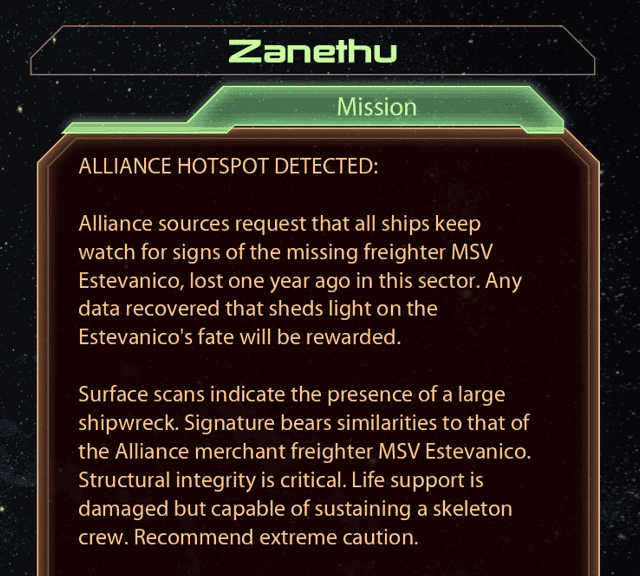
Zanethu*
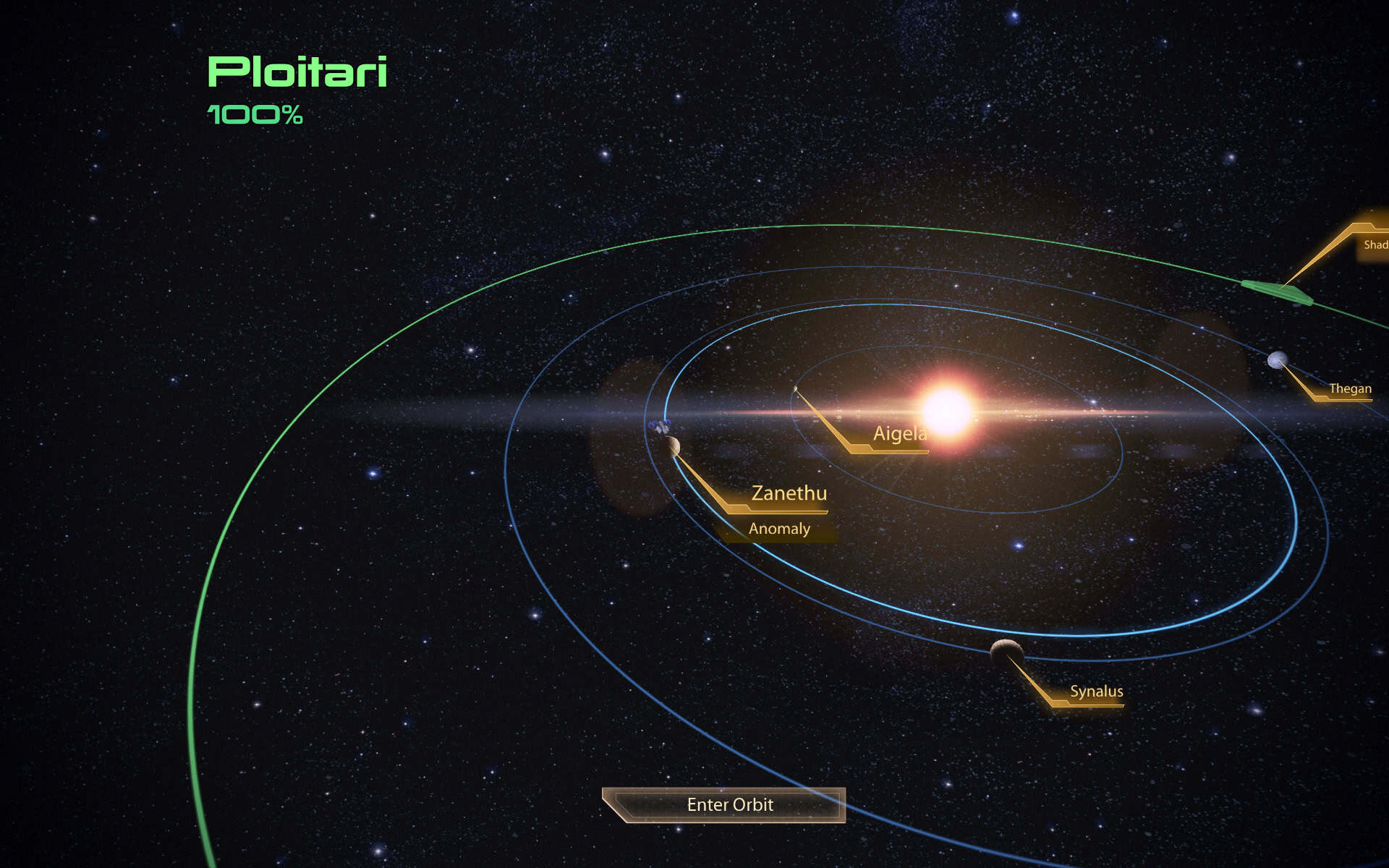
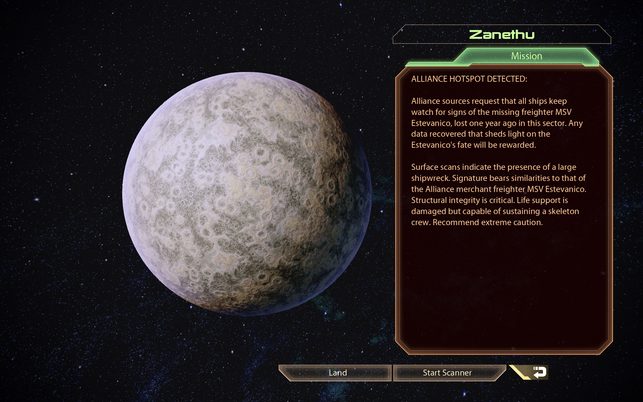
Believed to be a post-garden world, Zanethu has large deposits of calcium carbonate in its sedimentary rocks, indicating it may have once had plate tectonics and even plant life. Its swirling clouds of dust and snow may have occurred more recently and blocked the sun, creating a mass-extinction event. Its surface gravity is comfortable and its temperature tolerable by most sapient species.
Orbital Distance: 1.9 AU
Orbital Period: 2.6 Earth Years
Radius: 6,619 km
Day Length: 53.6 Earth Hours
Atmospheric Pressure: 0.38 Earth Atmospheres
Surface Temperature: -16 Celsius
Surface Gravity: 1.2G
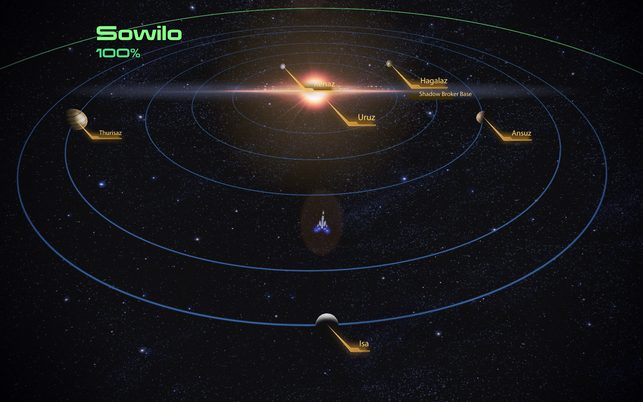
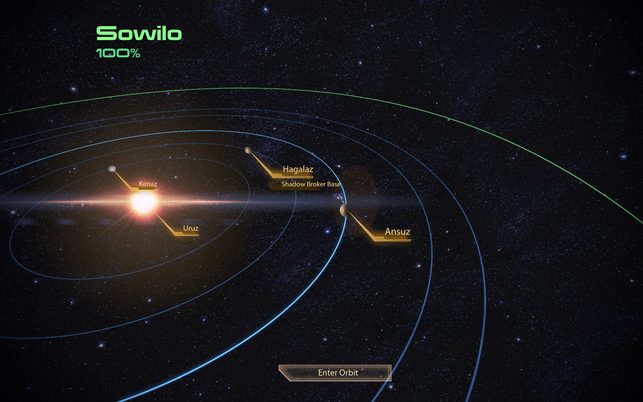
SOWILO
Ansuz
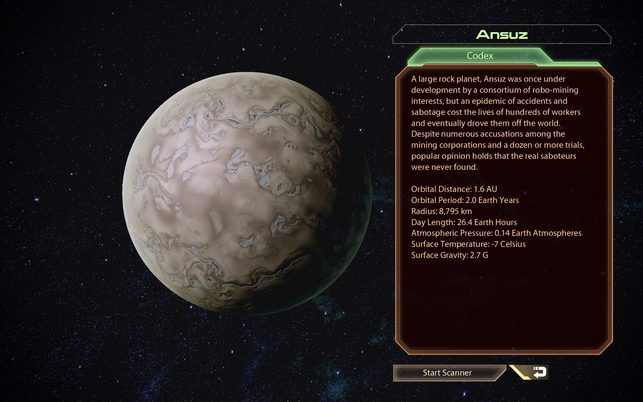
A large rock planet, Ansuz was once under development by a consortium of robo-mining interests, but an epidemic of accidents and sabotage cost the lives of hundreds of workers and eventually drove them off the world. Despite numerous accusations among the mining corporations and a dozen or more trials, popular opinion holds that the real saboteurs were never found.
Orbital Distance: 1.6 AU
Orbital Period: 2.0 Earth Years
Radius: 8,795 km
Day Length: 26.4 Earth Hours
Atmospheric Pressure: 0.14 Earth Atmospheres
Surface Temperature: -7 Celsius
Surface Gravity: 2.7 G
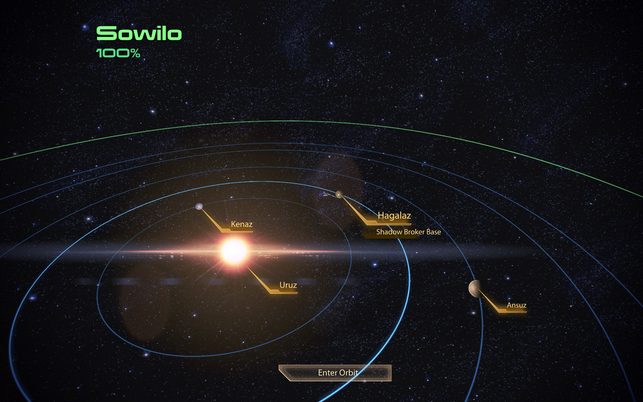
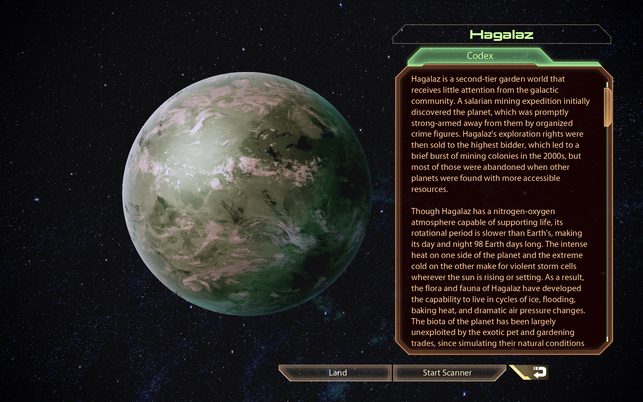
Hagalaz
Hagalaz is a second-tier garden world that receives little attention from the galactic community. A salarian mining expedition initially discovered the planet, which was promptly strong-armed away from them by organized crime figures. Hagalaz’s exploration rights were then sold to the highest bidder, which led to a brief burst of mining colonies in the 2000s, but most of those were abandoned when other planets were found with more accessible resources.
Though Hagalaz has a nitrogen-oxygen atmosphere capable of supporting life, its rotational period is slower than Earth’s, making its day and night 98 Earth days long. The intense heat on one side of the planet and the extreme cold on the other make for violent storm cells wherever the sun is rising or setting. As a result, the flora and fauna of Hagalaz have developed the capability to live in cycles of ice, flooding, baking heat, and dramatic air pressure changes. The biota of the planet has been largely unexploited by the exotic pet and gardening trades, since simulating their natural conditions is problematic for the average consumer.
Orbital Distance: 0.95 AU
Orbital Period: 1.0 Earth Years
Radius: 6,309 km
Day Length: 98.3 Earth Days
Atmospheric Pressure: 0.83 Earth Atmospheres
Surface Temperature: 72 Celsius (day) -64 Celsius (night)
Surface Gravity: 0.69 G
Isa
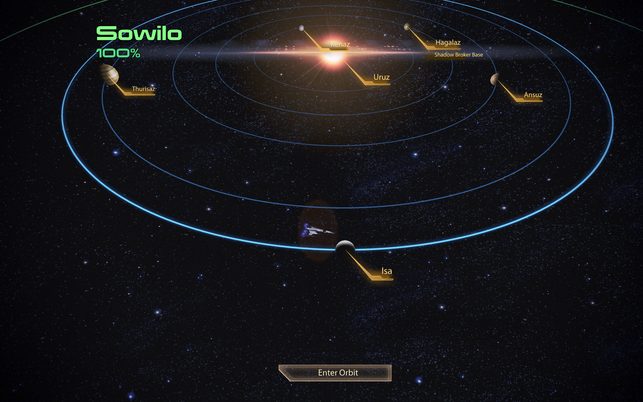
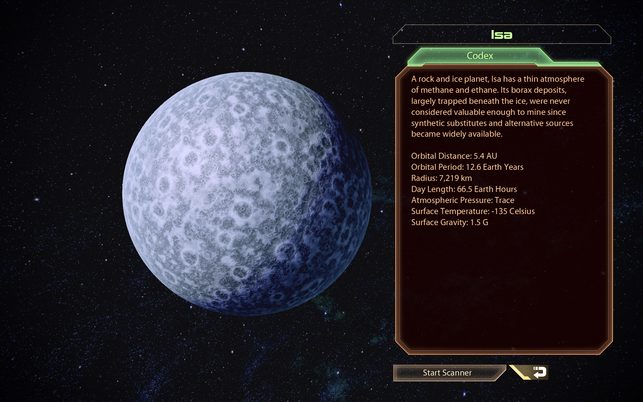
A rock and ice planet, Isa has a thin atmosphere of methane and ethane. Its borax deposits, largely trapped beneath the ice, were never considered valuable enough to mine since synthetic substitutes and alternative sources became widely available.
Orbital Distance: 5.4 AU
Orbital Period: 12.6 Earth Years
Radius: 7,219 km
Day Length: 66.5 Earth Hours
Atmospheric Pressure: Trace
Surface Temperature: -135 Celsius
Surface Gravity: 1.5 G
Kenaz
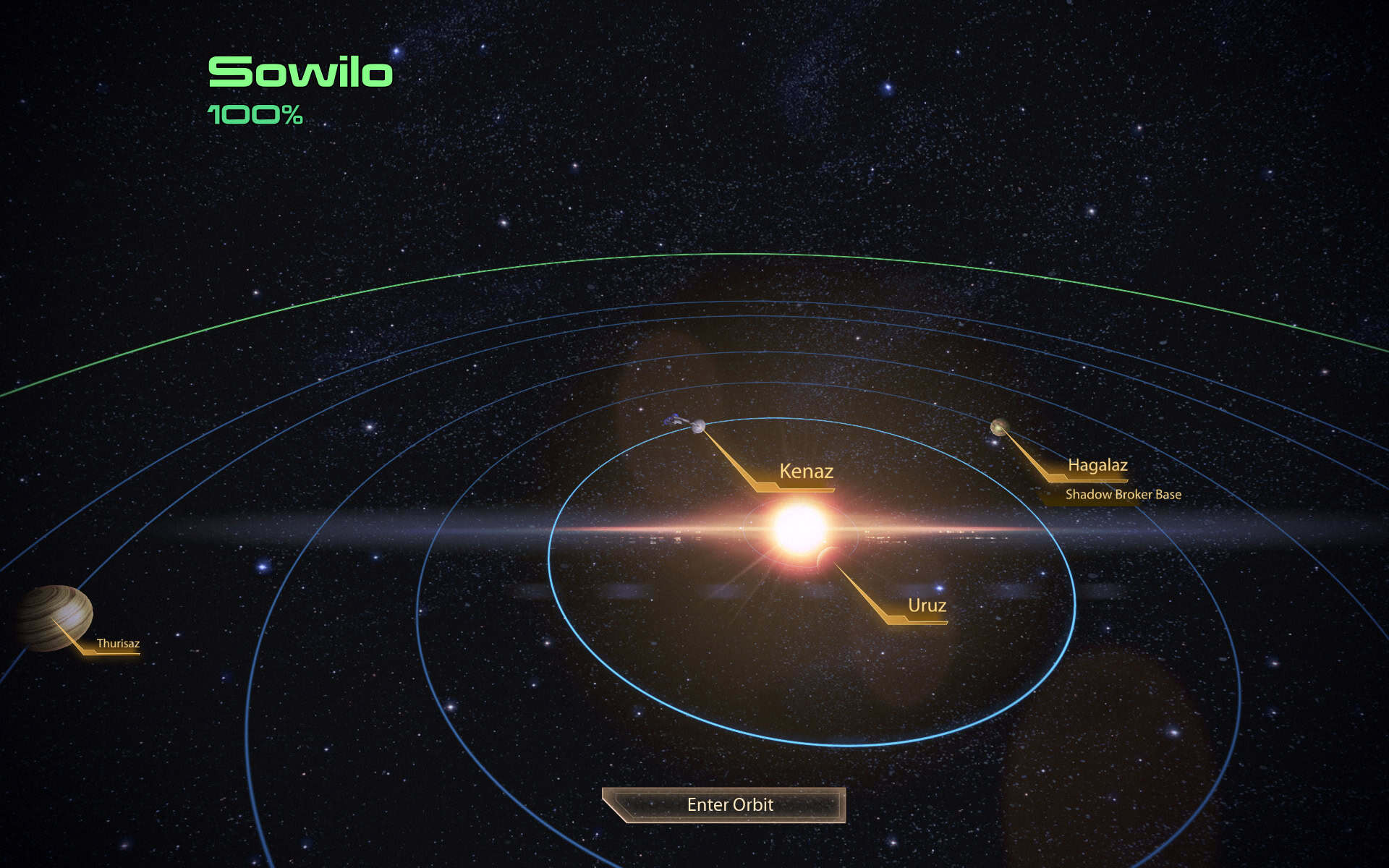
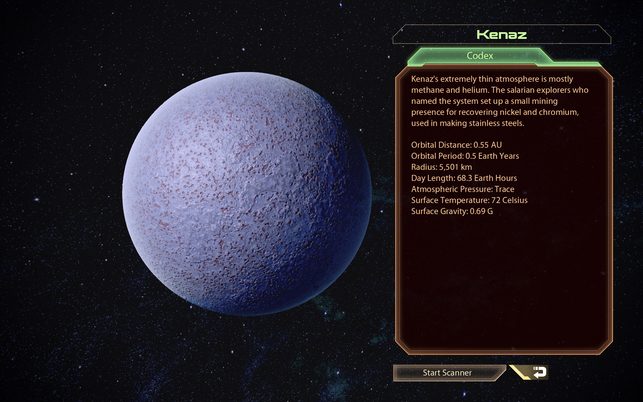
Kenaz’s extremely thin atmosphere is mostly methane and helium. The salarian explorers who named the system set up a small mining presence for recovering nickel and chromium, used in making stainless steels.
Orbital Distance: 0.55 AU
Orbital Period: 0.5 Earth Years
Radius: 5,501 km
Day Length: 68.3 Earth Hours
Atmospheric Pressure: Trace
Surface Temperature: 72 Celsius
Surface Gravity: 0.69 G
Thurisaz
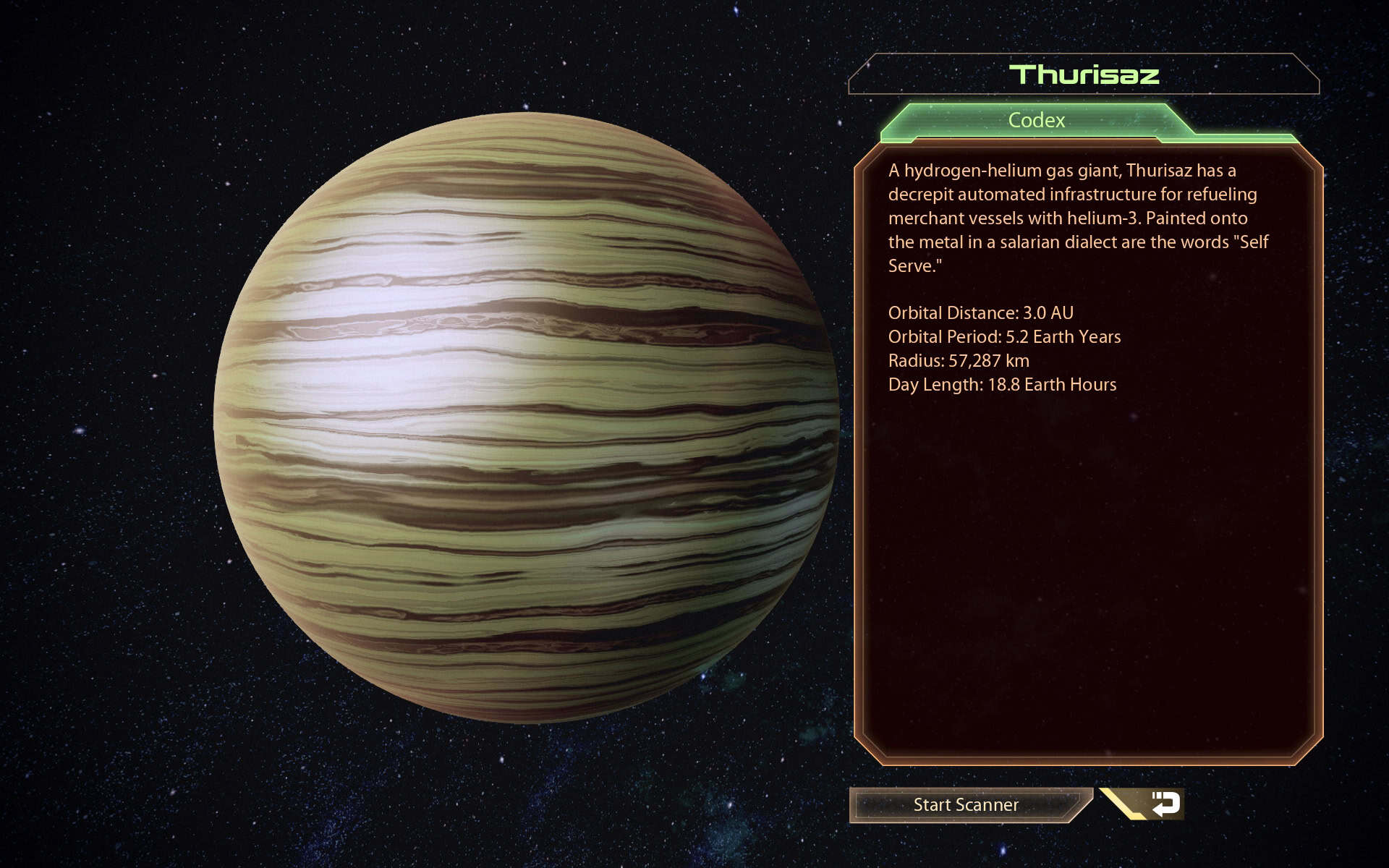
A hydrogen-helium gas giant, Thurisaz has a decrepit automated infrastructure for refueling merchant vessels with helium-3. Painted onto the metal in a salarian dialect are the words “Self Serve.”
Orbital Distance: 3.0 AU
Orbital Period: 5.2 Earth Years
Radius: 57,287 km
Day Length: 18.8 Earth Hours
Uruz
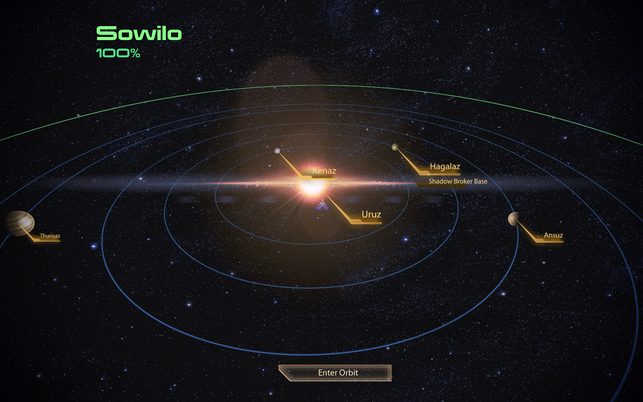
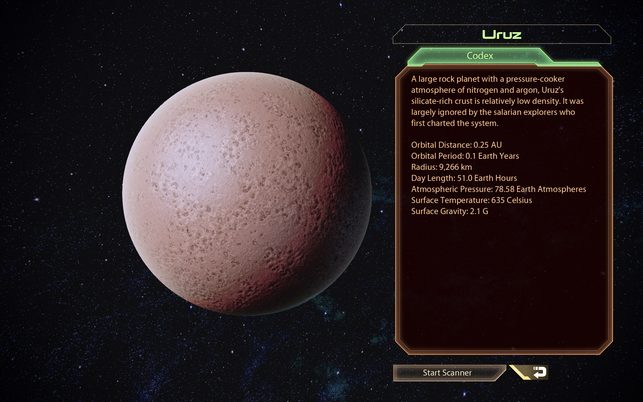
A large rock planet with a pressure-cooker atmosphere of nitrogen and argon, Uruz’s silicate-rich crust is relatively low density. It was largely ignored by the salarian explorers who first charted the system.
Orbital Distance: 0.25 AU
Orbital Period: 0.1 Earth Years
Radius: 9,266 km
Day Length: 51.0 Earth Hours
Atmospheric Pressure: 78.58 Earth Atmospheres
Surface Temperature: 635 Celsius
Surface Gravity: 2.1 G
ISMAR FRONTIER
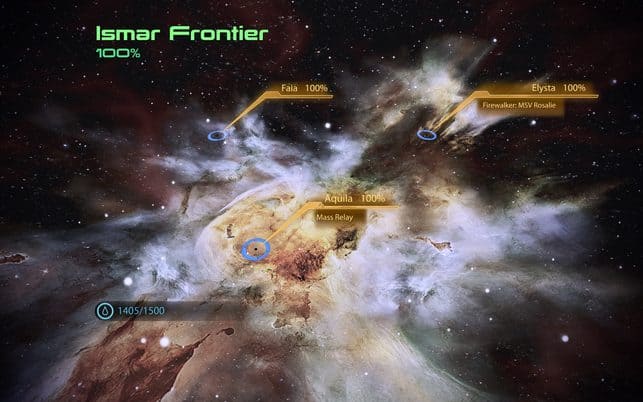
AQUILA
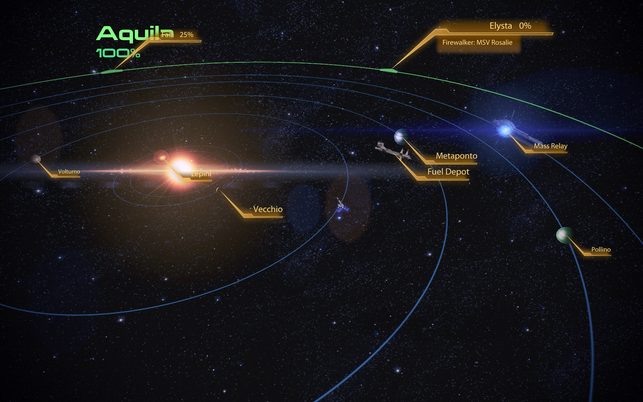
Lepini
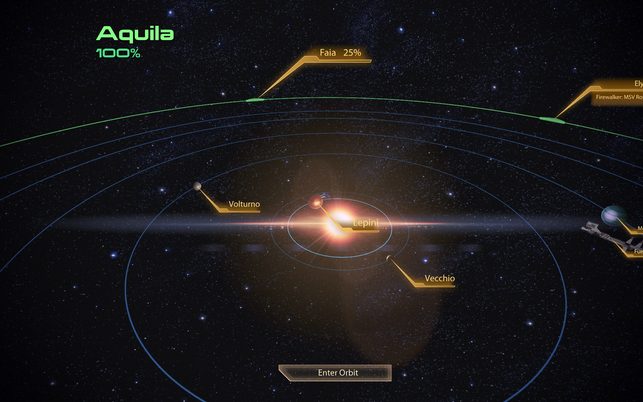
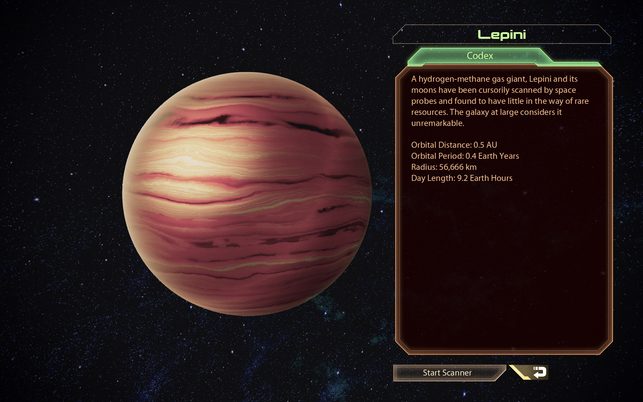
A hydrogen-methane gas giant, Lepini and its moons have been cursorily scanned by space probes and found to have little in the way of rare resources. The galaxy at large considers it unremarkable.
Orbital Distance: 0.5 AU
Orbital Period: 0.4 Earth Years
Radius: 56,666 km
Day Length: 9.2 Earth Hours
Metaponto
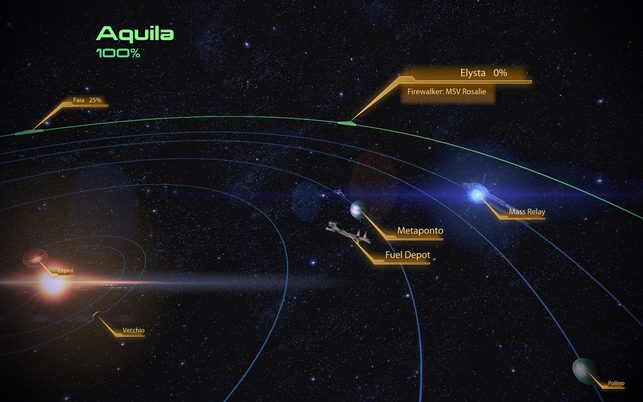
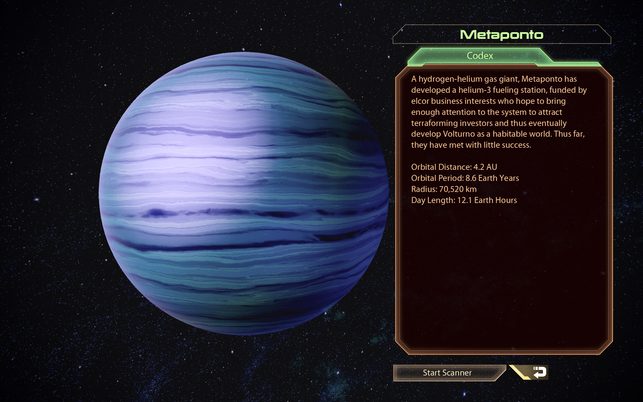
A hydrogen-helium gas giant, Metaponto has developed a helium-3 fueling station, funded by elcor business interests who hope to bring enough attention to the system to attract terraforming investors and thus eventually develop Volturno as a habitable world. Thus far, they have met with little success.
Orbital Distance: 4.2 AU
Orbital Period: 8.6 Earth Years
Radius: 70,520 km
Day Length: 12.1 Earth Hours
Pollino
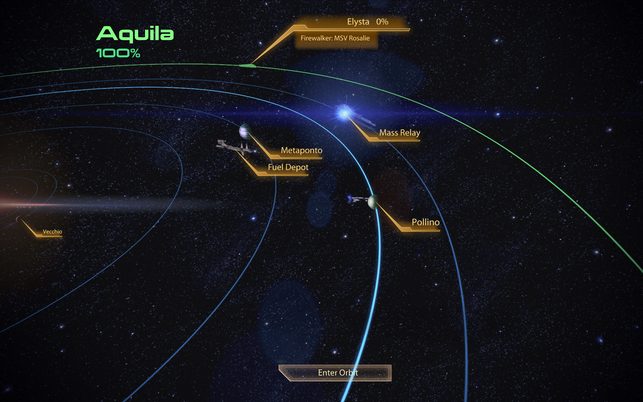
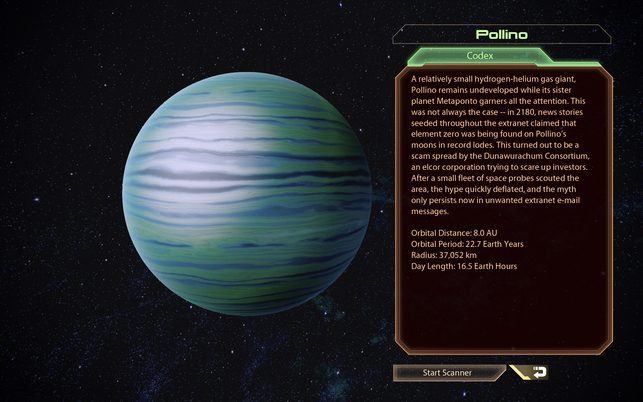
A relatively small hydrogen-helium gas giant, Pollino remains undeveloped while its sister planet Metaponto garners all the attention. This was not always the case — in 2180, news stories seeded throughout the extranet claimed that element zero was being found on Pollino’s moons in record lodes. This turned out to be a scam spread by the Dunawurachum Consortium, an elcor corporation trying to scare up investors. After a small fleet of space probes scouted the area, the hype quickly deflated, and the myth only persists now in unwanted extranet e-mail messages.
Orbital Distance: 8.0 AU
Orbital Period: 22.7 Earth Years
Radius: 37,052 km
Day Length: 16.5 Earth Hours
Vecchio
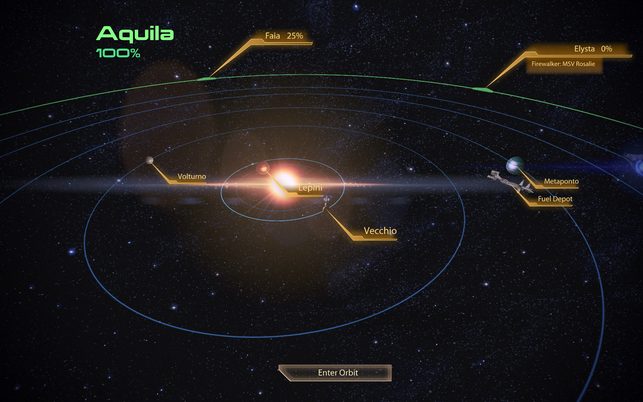
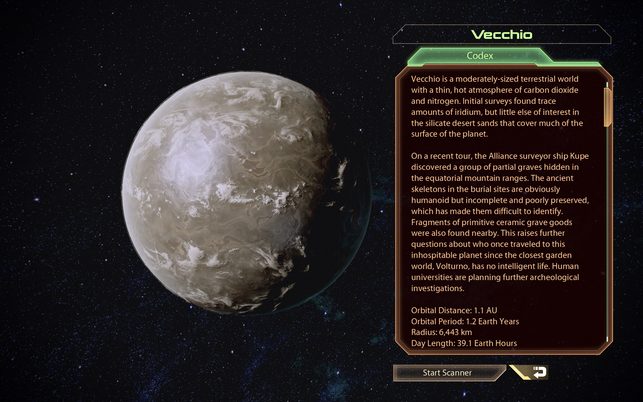
Vecchio is a moderately-sized terrestrial world with a thin, hot atmosphere of carbon dioxide and nitrogen. Initial surveys found trace
amounts of iridium, but little else of interest in the silicate desert sands that cover much of the surface of the planet.
On a recent tour, the Alliance surveyor ship Kupe discovered a group of partial graves hidden in the equatorial mountain ranges. The ancient skeletons in the burial sites are obviously humanoid but incomplete and poorly preserved, which has made them difficult to identify. Fragments of primitive ceramic grave goods were also found nearby. This raises further questions about who once traveled to this inhospitable planet since the closest garden world, Volturno, has no intelligent life. Human universities are planning further archeological investigations.
Orbital Distance: 1.1 AU
Orbital Period: 1.2 Earth Years
Radius: 6,443 km
Day Length: 39.1 Earth Hours
Atmospheric Pressure: 0.79 Earth Atmospheres
Surface Temperature: 58
Celsius Surface Gravity: 0.82 G
Volturno
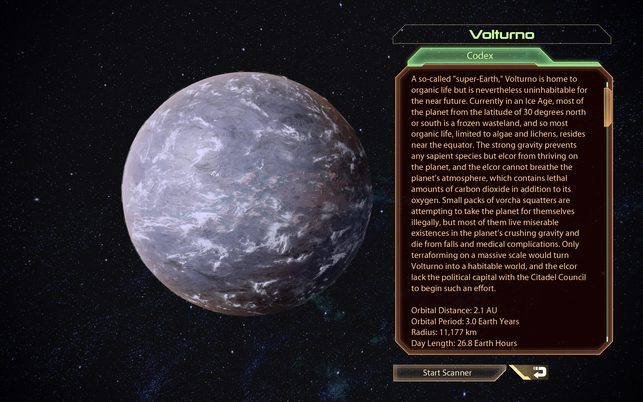
A so-called “super-Earth,” Volturno is home to organic life but is nevertheless uninhabitable for the near future. Currently in an Ice Age, most of the planet from the latitude of 30 degrees north or south is a frozen wasteland, and so most organic life, limited to algae and lichens, resides near the equator. The strong gravity prevents any sapient species but elcor from thriving on the planet, and the elcor cannot breathe the planet’s atmosphere, which contains lethal amounts of carbon dioxide in addition to its oxygen. Small packs of vorcha squatters are attempting to take the planet for themselves illegally, but most of them live miserable existences in the planet’s crushing gravity and die from falls and medical complications. Only terraforming on a massive scale would turn Volturno into a habitable world, and the elcor lack the political capital with the Citadel Council to begin such an effort.
Orbital Distance: 2.1 AU
Orbital Period: 3.0 Earth Years
Radius: 11,177 km
Day Length: 26.8 Earth Hours
Atmospheric Pressure: 0.83 Earth Atmospheres
Surface Temperature: -10 Celsius
Surface Gravity: 3.3 G
ELYSTA
Hesano
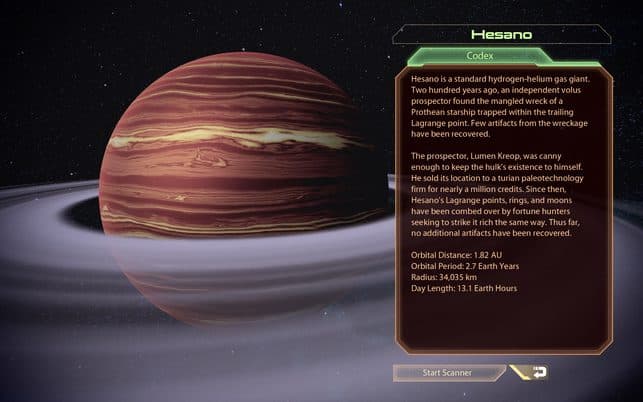
Hesano is a standard hydrogen-helium gas giant. Two hundred years ago, an independent volus prospector found the mangled wreck of a Prothean starship trapped within the trailing Lagrange point. Few artifacts from the wreckage have been recovered.
The prospector, Lumen Kreop, was canny enough to keep the hulk’s existence to himself. He sold its location to a turian paleotechnology firm for nearly a million credits. Since then, Hesano’s Lagrange points, rings, and moons have been combed over by fortune hunters seeking to strike it rich the same way. Thus far, no additional artifacts have been recovered.
Orbital Distance: 1.82 AU
Orbital Period: 2.7 Earth Years Radius: 34,035 km
Day Length: 13.1 Earth Hours
Melile
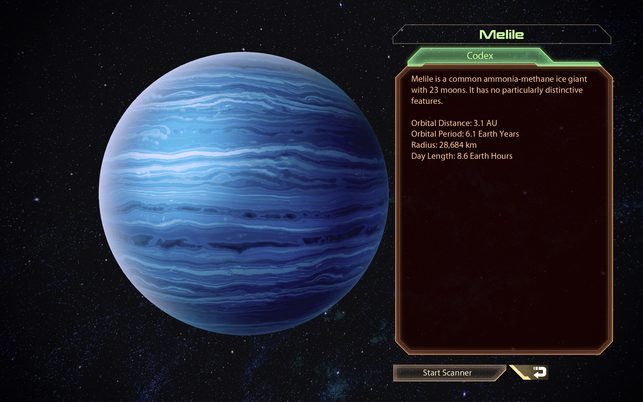
Melile is a common ammonia-methane ice giant with 23 moons. It has no particularly distinctive features.
Orbital Distance: 3.1 AU
Orbital Period: 6.1 Earth Years
Radius: 28,684 km
Day Length: 8.6 Earth Hours
Odasst
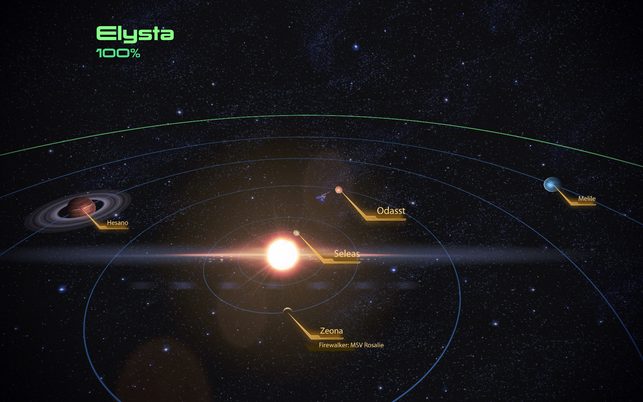
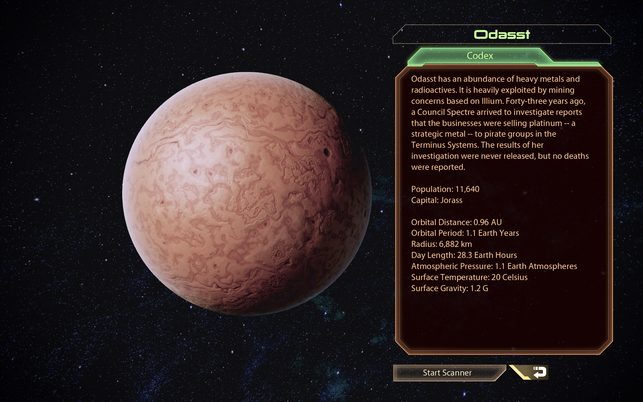
Odasst has an abundance of heavy metals and radioactives. It is heavily exploited by mining concerns based on Illium. Forty-three years ago, a Council Spectre arrived to investigate reports that the businesses were selling platinum — a strategic metal — to pirate groups in the Terminus Systems. The results of her
investigation were never released, but no deaths were reported.
Population: 11,640 Capital: Jorass
Orbital Distance: 0.96 AU
Orbital Period: 1.1 Earth Years
Radius: 6,882 km
Day Length: 28.3 Earth Hours
Atmospheric Pressure: 1.1 Earth Atmospheres
Surface Temperature: 20 Celsius
Surface Gravity: 1.2 G
Seleas
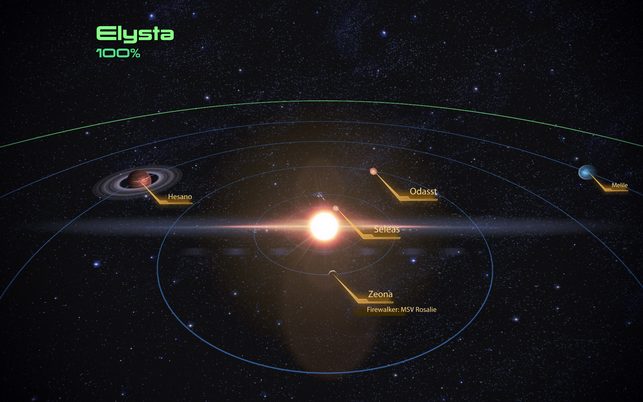
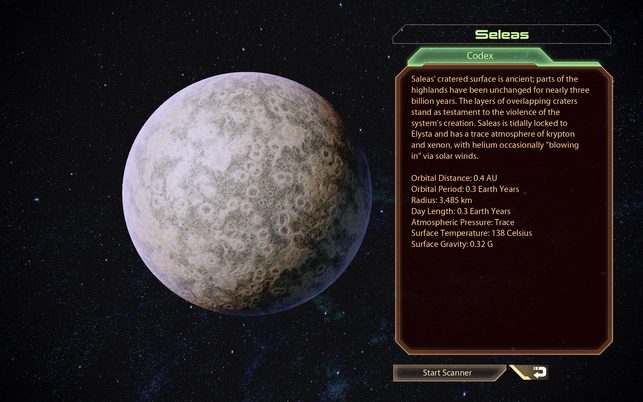
Saleas’ cratered surface is ancient; parts of the highlands have been unchanged for nearly three billion years. The layers of overlapping craters stand as testament to the violence of the system’s creation. Saleas is tidally locked to Elysta and has a trace atmosphere of krypton and xenon, with helium occasionally “blowing in” via solar winds.
Orbital Distance: 0.4 AU
Orbital Period: 0.3 Earth Years.
Radius: 3,485 km
Day Length: 0.3 Earth Years
Atmospheric Pressure: Trace
Surface Temperature: 138 Celsius
Surface Gravity: 0.32 G
Zeona*
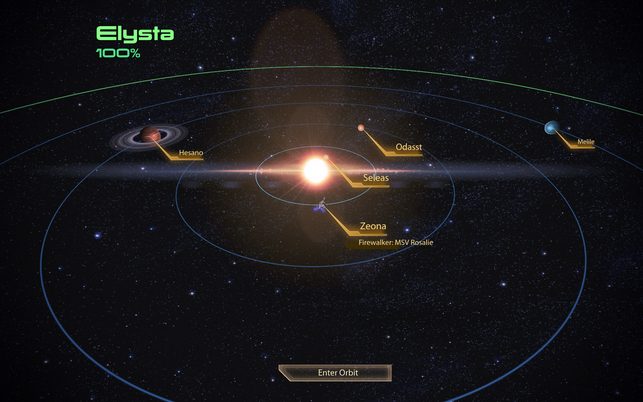
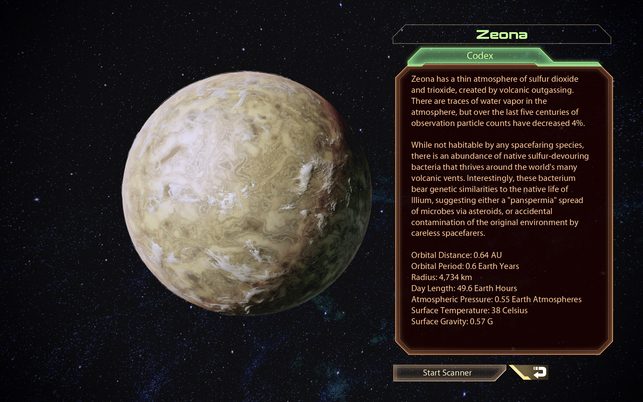
Zeona has a thin atmosphere of sulfur dioxide and trioxide, created by volcanic outgassing. There are traces of water vapor in the
atmosphere, but over the last five centuries of observation particle counts have decreased 4%.
While not habitable by any spacefaring species, there is an abundance of native sulfur-devouring bacteria that thrives around the world’s many volcanic vents. Interestingly, these bacterium bear genetic similarities to the native life of Illium, suggesting either a “panspermia” spread of microbes via asteroids, or accidental contamination of the original environment by careless spacefarers.
Orbital Distance: 0.64 AU
Orbital Period: 0.6 Earth Years
Radius: 4,734 km
Day Length: 49.6 Earth Hours
Atmospheric Pressure: 0.55 Earth Atmospheres
Surface Temperature: 38 Celsius
Surface Gravity: 0.57 G
FAIA
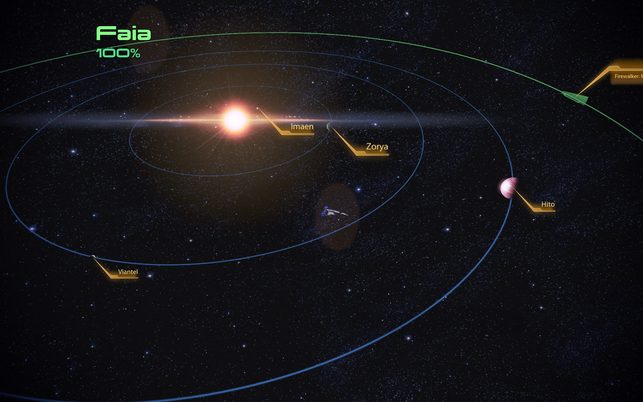
Hito
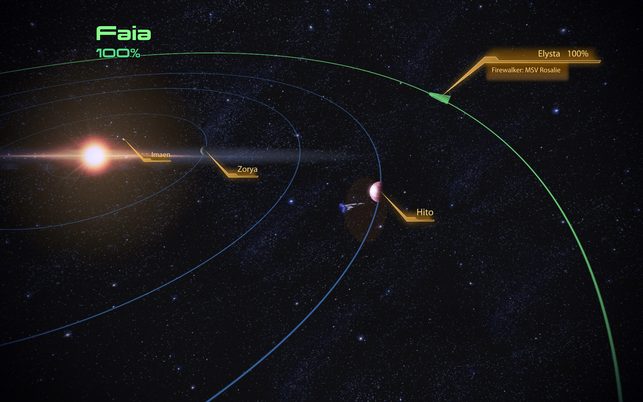
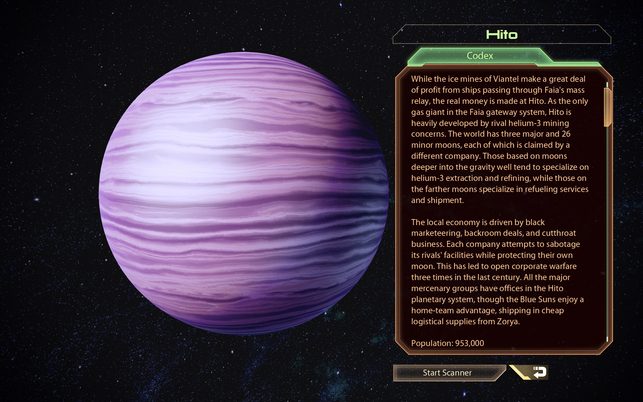
While the ice mines of Viantel make a great deal of profit from ships passing through Faia’s mass relay, the real money is made at Hito. As the only gas giant in the Faia gateway system, Hito is heavily developed by rival helium-3 mining concerns. The world has three major and 26 minor moons, each of which is claimed by a different company. Those based on moons deeper into the gravity well tend to specialize on helium-3 extraction and refining, while those on the farther moons specialize in refueling services and shipment.
The local economy is driven by black marketeering, backroom deals, and cutthroat business. Each company attempts to sabotage its rivals’ facilities while protecting their own moon. This has led to open corporate warfare three times in the last century. All the major mercenary groups have offices in the Hito planetary system, though the Blue Suns enjoy a home-team advantage, shipping in cheap logistical supplies from Zorya.
Population: 953,000
Capital: none; largest port is Shol Prime
Orbital Distance: 6.3 AU
Orbital Period: 15.8 Earth Years
Radius: 24,984 km
Day Length: 14.3 Earth Hours
Imaen
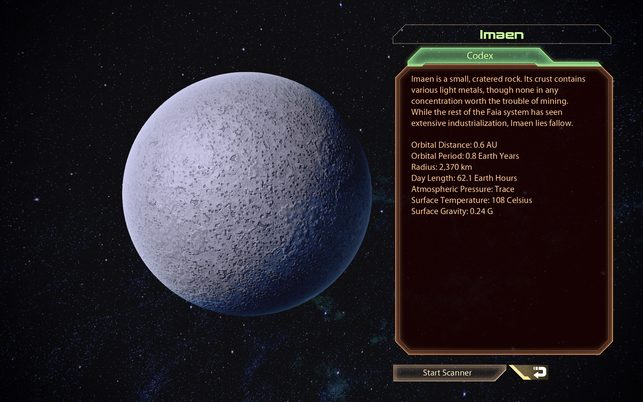
Imaen is a small, cratered rock. Its crust contains various light metals, though none in any concentration worth the trouble of mining. While the rest of the Faia system has seen extensive industrialization, Imaen lies fallow.
Orbital Distance: 0.6 AU
Orbital Period: 0.8 Earth Years
Radius: 2,370 km
Day Length: 62.1 Earth Hours
Atmospheric Pressure: Trace
Surface Temperature: 108 Celsius
Surface Gravity: 0.24 G
Viantel
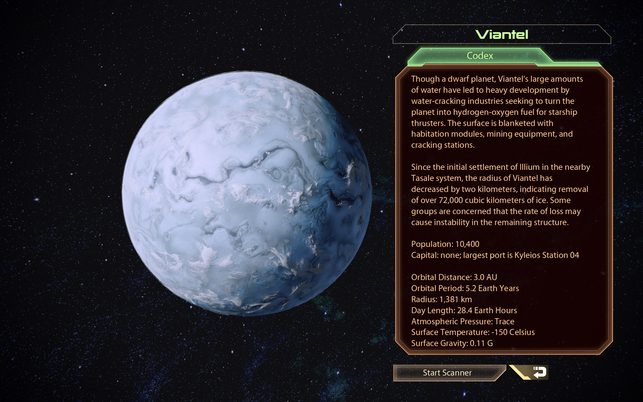
Though a dwarf planet, Viantel’s large amounts of water have led to heavy development by water-cracking industries seeking to turn the planet into hydrogen-oxygen fuel for starship thrusters. The surface is blanketed with habitation modules, mining equipment, and cracking stations.
Since the initial settlement of Illium in the nearby Tasale system, the radius of Viantel has decreased by two kilometers, indicating removal of over 72,000 cubic kilometers of ice. Some groups are concerned that the rate of loss may cause instability in the remaining structure.
Population: 10,400
Capital: none; largest port is Kyleios Station 04
Orbital Distance: 3.0 AU
Orbital Period: 5.2 Earth Years
Radius: 1,381 km
Day Length: 28.4 Earth Hours
Atmospheric Pressure: Trace
Surface Temperature: -150 Celsius
Surface Gravity: 0.11 G
Zorya
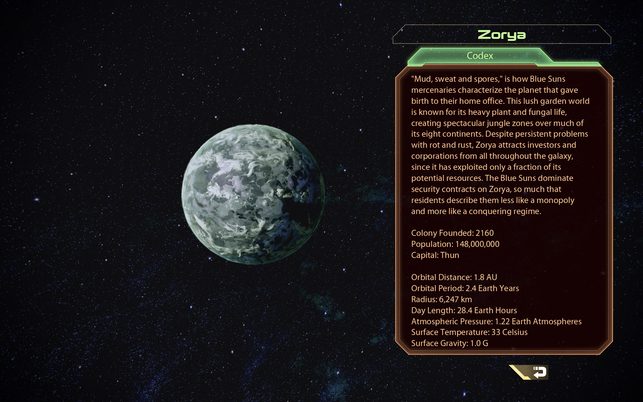
“Mud, sweat and spores,” is how Blue Suns mercenaries characterize the planet that gave birth to their home office. This lush garden world is known for its heavy plant and fungal life, creating spectacular jungle zones over much of its eight continents. Despite persistent problems with rot and rust, Zorya attracts investors and corporations from all throughout the galaxy, since it has exploited only a fraction of its potential resources. The Blue Suns dominate security contracts on Zorya, so much that residents describe them less like a monopoly and more like a conquering regime.
Colony Founded: 2160
Population: 148,000,000
Capital: Thun
Orbital Distance: 1.8 AU
Orbital Period: 2.4 Earth Years
Radius: 6,247 km
Day Length: 28.4 Earth Hours
Atmospheric Pressure: 1.22 Earth Atmospheres Surface Temperature: 33 Celsius
Surface Gravity: 1.0 G
KROGAN DMZ
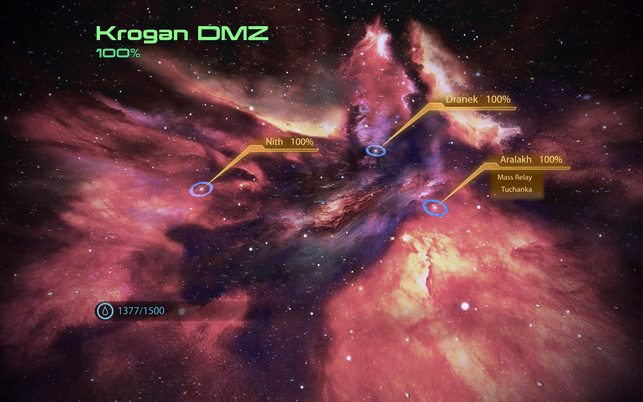
ARALAKH
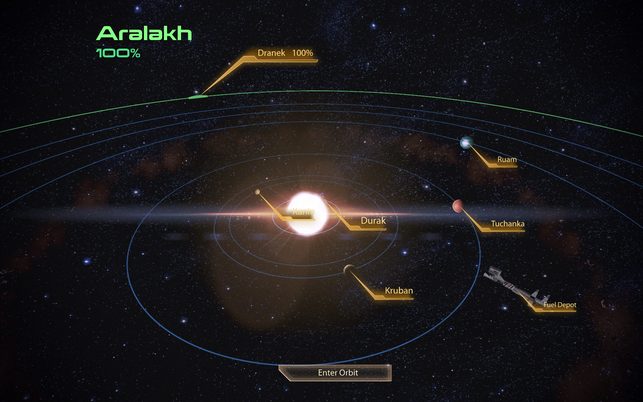
Durak
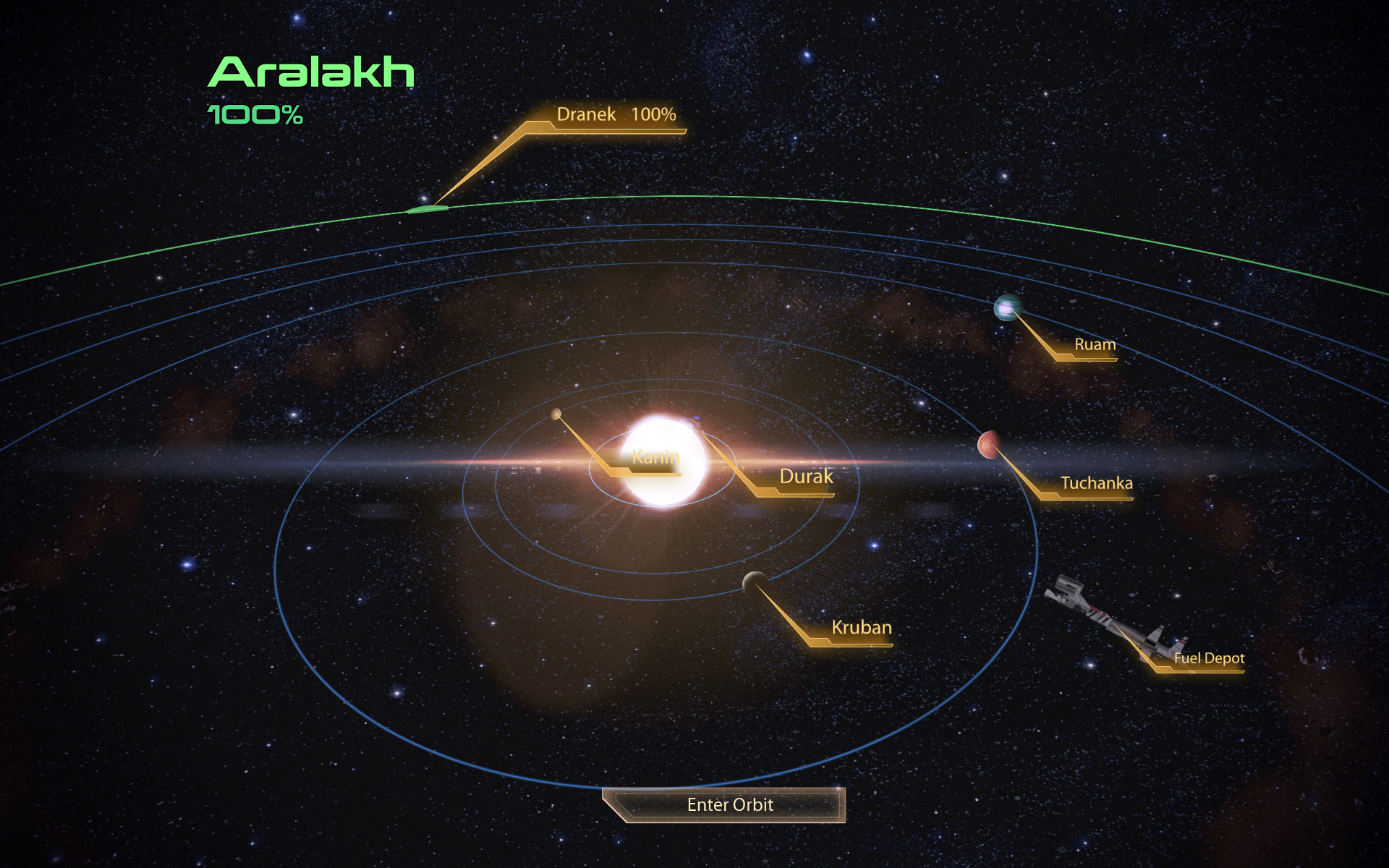
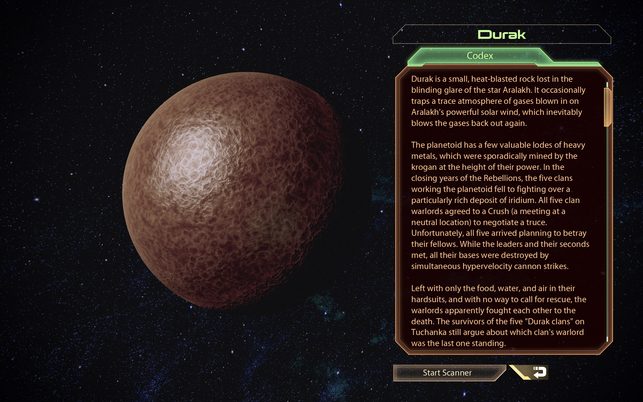
Durak is a small, heat-blasted rock lost in the blinding glare of the star Aralakh. It occasionally traps a trace atmosphere of gases blown in on Aralakh’s powerful solar wind, which inevitably blows the gases back out again.
The planetoid has a few valuable lodes of heavy metals, which were sporadically mined by the krogan at the height of their power. In the closing years of the Rebellions, the five clans working the planetoid fell to fighting over a particularly rich deposit of iridium. All five clan warlords agreed to a Crush (a meeting at a neutral location) to negotiate a truce. Unfortunately, all five arrived planning to betray their fellows. While the leaders and their seconds met, all their bases were destroyed by simultaneous hypervelocity cannon strikes.
Left with only the food, water, and air in their hardsuits, and with no way to call for rescue, the warlords apparently fought each other to the death. The survivors of the five “Durak clans” on Tuchanka still argue about which clan’s warlord was the last one standing.
Orbital Distance: 0.83 AU
Orbital Period: 0.6 Earth Years
Radius: 1,972 km
Orbital Period: 0.6 Earth Years
Atmospheric Pressure: Trace
Surface Temperature: 348 Celsius
Surface Gravity: 0.22 G
Kanin
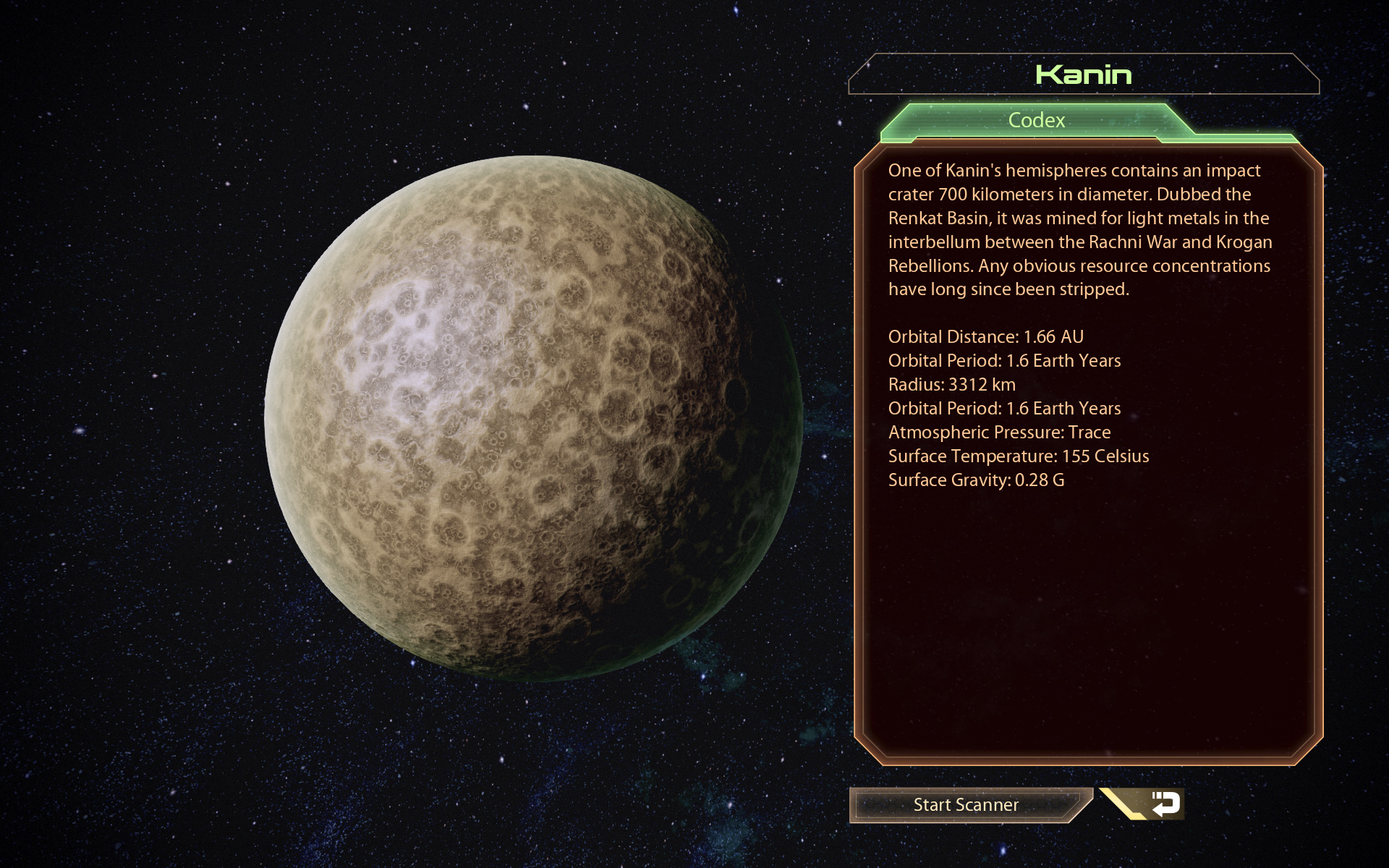
One of Kanin’s hemispheres contains an impact crater 700 kilometers in diameter. Dubbed the Renkat Basin, it was mined for light metals in the interbellum between the Rachni War and Krogan Rebellions. Any obvious resource concentrations have long since been stripped.
Orbital Distance: 1.66 AU
Orbital Period: 1.6 Earth Years
Radius: 3312 km
Orbital Period: 1.6 Earth Years
Atmospheric Pressure: Trace
Surface Temperature: 155 Celsius
Surface Gravity: 0.28 G
Kruban
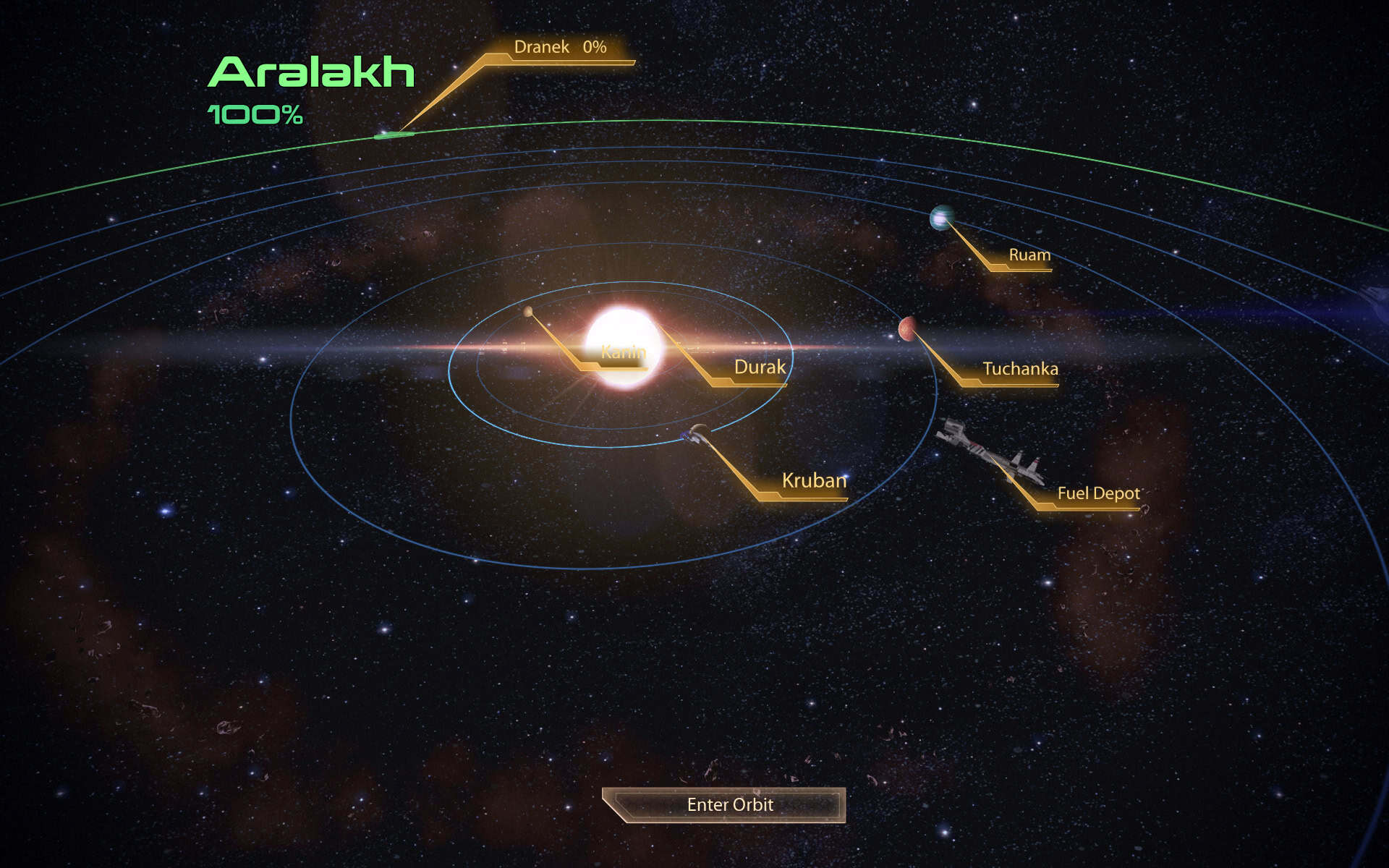
Kruban is a tidally-locked Venusian hothouse, its surface perpetually obscured by clouds of sulfur and carbon dioxides. The first group of krogan brought into orbit by the salarian uplift teams requested a trip to Kruban. The salarians at first thought the krogan were confused about the nature of Kruban’s environment; the planet is named for a krogan mythological paradise in which honorable warriors feast on the internal organs of their enemies. In fact, krogan astronomers had correctly deduced the nature of Kruban in the years before the global holocaust. In the two millennia since, Kruban had come to be thought of as an ideal test of one’s toughness.
Every year, a few krogan attempt to land on Kruban and exit their ships naked in an attempt to prove their “kroganhood.” The planet’s surface is littered with the crushed, corroded remains of their ships. Only one, Shath Norda, is known to have returned from the surface alive, albeit with most of his bones crushed and all four of his lungs damaged by sulfuric gas. Norda recovered from his trial, to the adulation of his people. Until he died in 1943, he could lie with any fertile female he wished.
Orbital Distance: 3.31 AU
Orbital Period: 4.6 Earth Years
Radius: 5,443 km
Orbital Period: 4.6 Earth Years
Atmospheric Pressure: 47.3 Earth Atmospheres
Surface Temperature: 728 Celsius
Surface Gravity: 0.7 G
Ruam
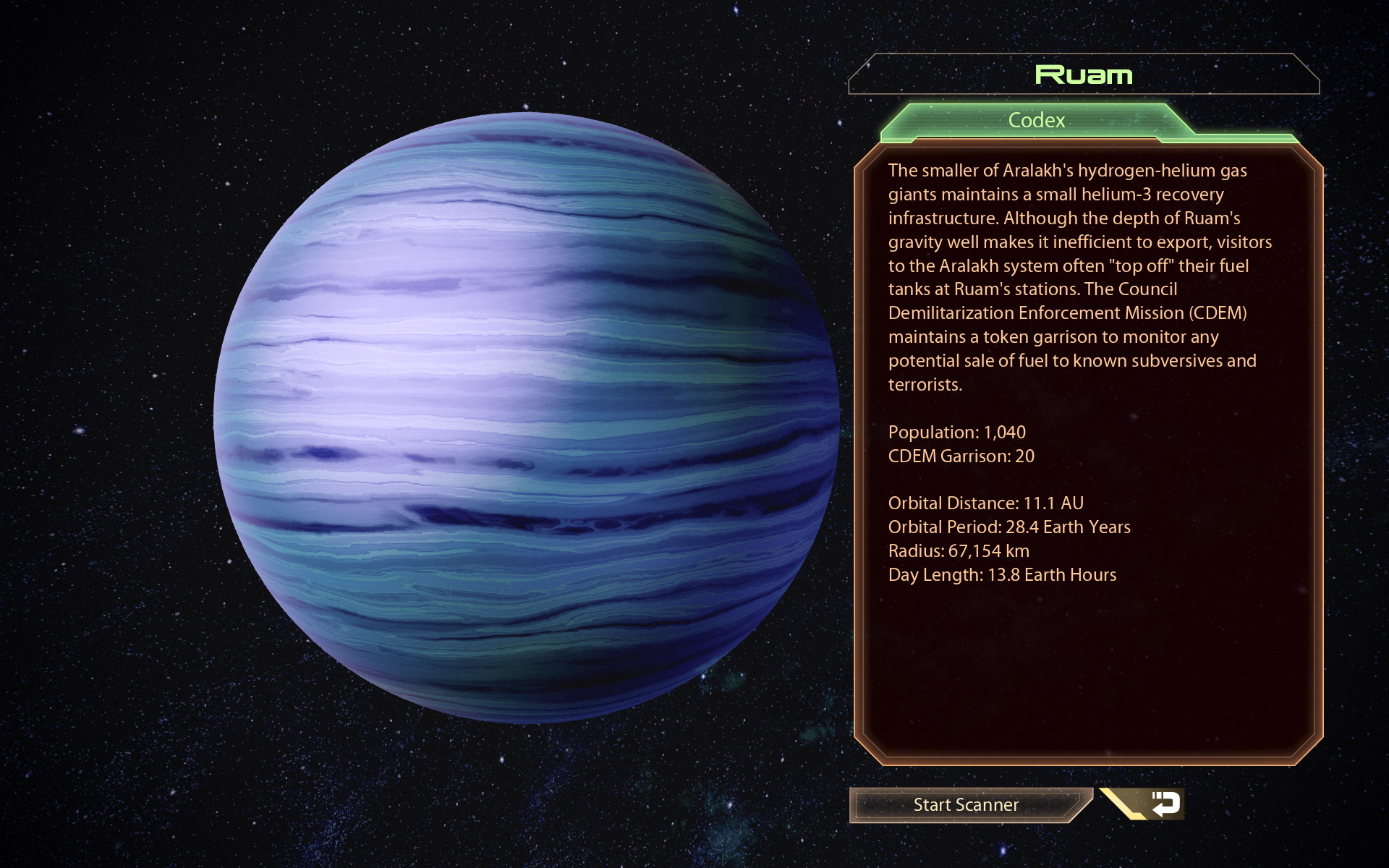
The smaller of Aralakh’s hydrogen-helium gas giants maintains a small helium-3 recovery infrastructure. Although the depth of Ruam’s gravity well makes it inefficient to export, visitors to the Aralakh system often “top off” their fuel tanks at Ruam’s stations. The Council Demilitarization Enforcement Mission (CDEM) maintains a token garrison to monitor any potential sale of fuel to known subversives and terrorists.
Population: 1,040
CDEM Garrison: 20
Orbital Distance: 11.1 AU
Orbital Period: 28.4 Earth Years
Radius: 67,154 km
Day Length: 13.8 Earth Hours
Tuchanka
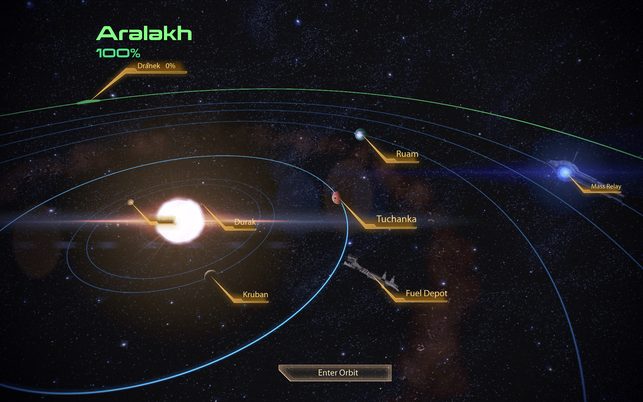
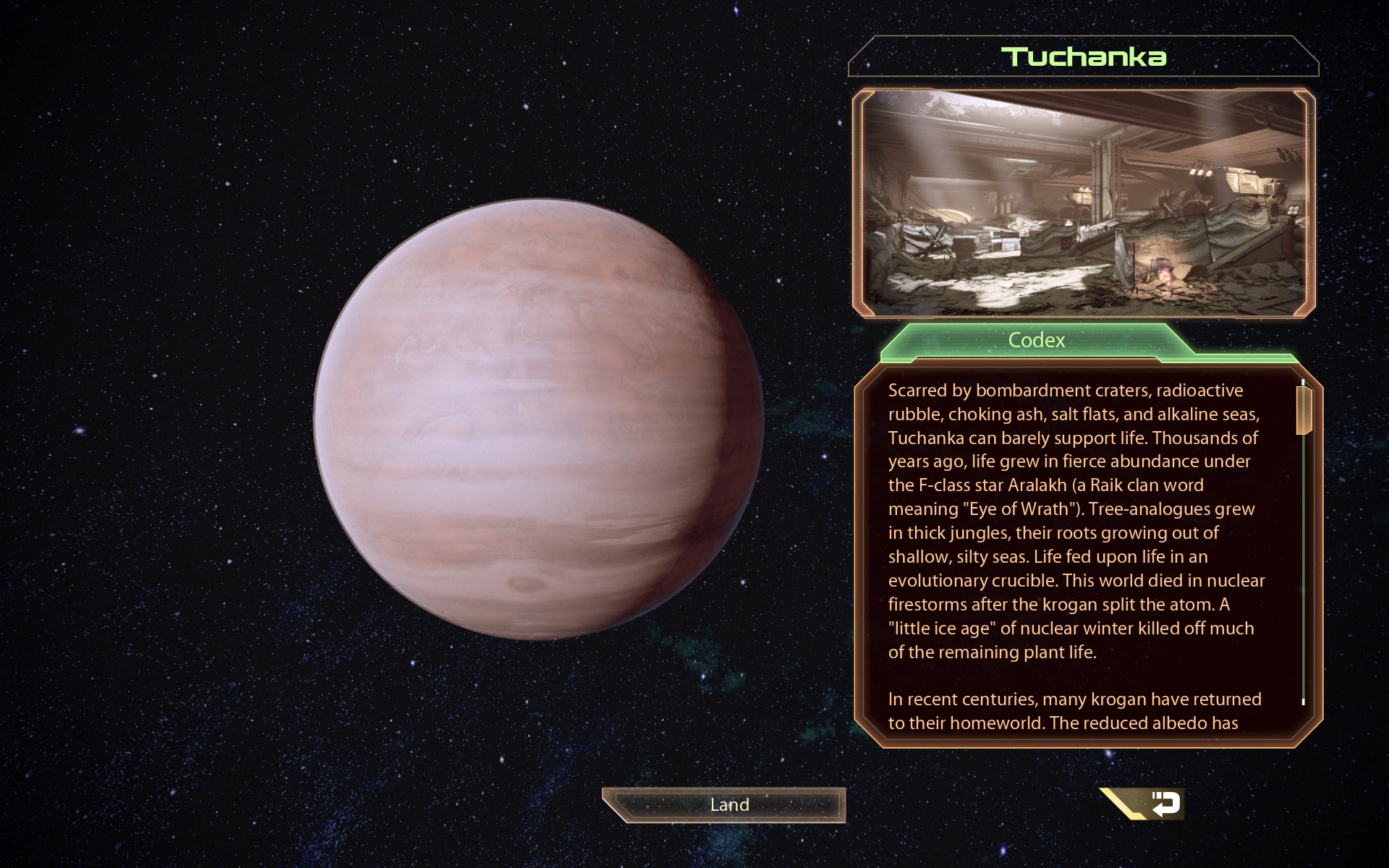
Scarred by bombardment craters, radioactive rubble, choking ash, salt flats, and alkaline seas, Tuchanka can barely support life. Thousands of years ago, life grew in fierce abundance under the F-class star Aralakh (a Raik clan word meaning “Eye of Wrath”). Tree-analogues grew in thick jungles, their roots growing out of shallow, silty seas. Life fed upon life in an evolutionary crucible. This world died in nuclear firestorms after the krogan split the atom. A “little ice age” of nuclear winter killed off much of the remaining plant life.
In recent centuries, many krogan have returned to their homeworld. The reduced albedo has caused global temperatures to rise. In order to maintain livable temperatures, a vast shroud was assembled at the L1 Lagrange point. It is maintained by the Council Demilitarization Enforcement Mission (CDEM), which is based on orbiting battlestations.
CDEM ADVISORY: Visitors to Tuchanka land at their own risk. The CDEM will not attempt to extract citizens threatened by clan warfare.
TRAVEL ADVISORY: The ecology of Tuchanka is deadly. Nearly every native species engages in some predatory behavior; even the remaining vegetation is carnivorous. Travel beyond guarded areas is strongly discouraged.
Population: 2.1 billion
Capital: currently Urdnot (since 2183)
CDEM Garrison: 2,400 (in orbital battlestations)
Orbital Distance: 5.3 AU
Orbital Period: 16.7 Earth Years
Radius: 8,293 km
Day Length: 21.4 Earth Hours
Atmospheric Pressure: 1.1 Earth Atmospheres
Surface Temperature: 72 Celsius (36 in shrouded areas)
Surface Gravity: 1.14 G
Vaul
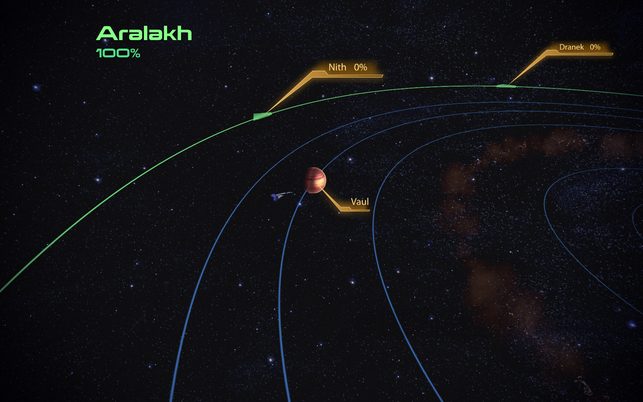
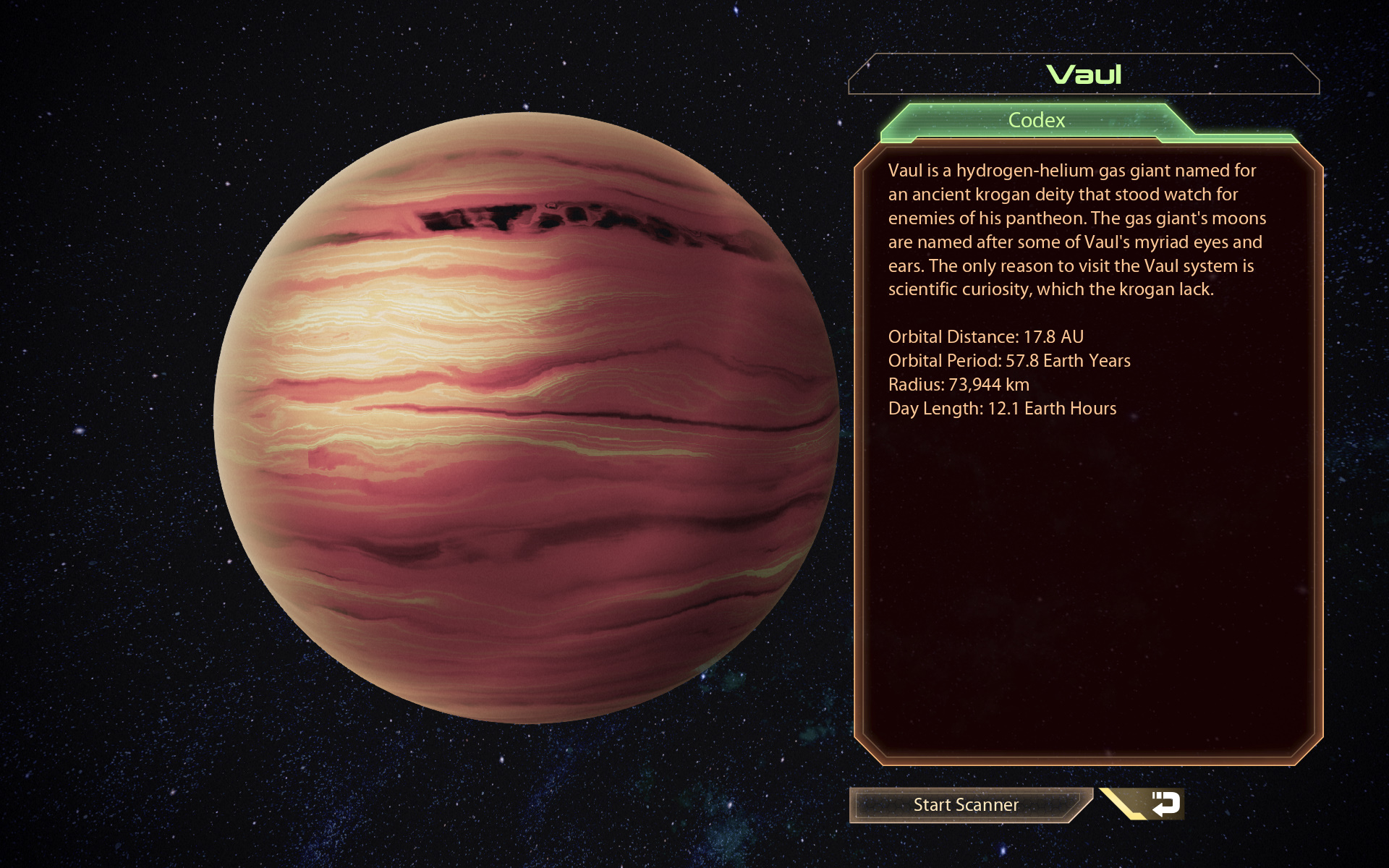
Vaul is a hydrogen-helium gas giant named for an ancient krogan deity that stood watch for enemies of his pantheon. The gas giant’s moons are named after some of Vaul’s myriad eyes and ears. The only reason to visit the Vaul system is scientific curiosity, which the krogan lack.
Orbital Distance: 17.8 AU
Orbital Period: 57.8 Earth Years
Radius: 73,944 km
Day Length: 12.1 Earth Hours
DRANEK
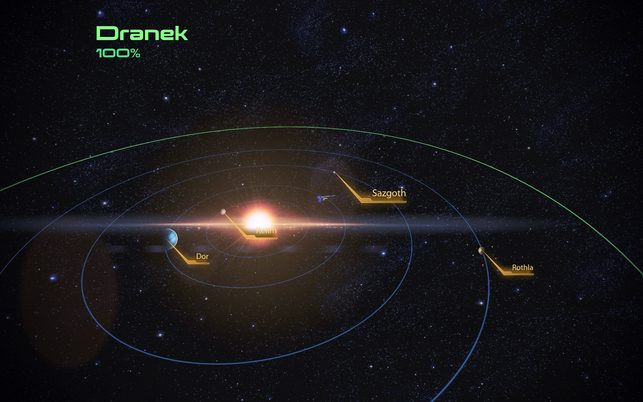
Dor
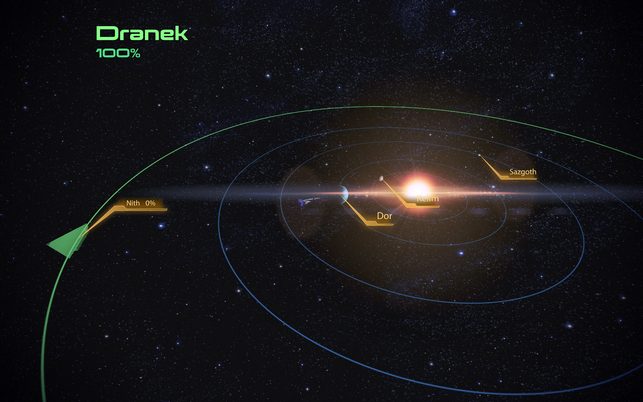
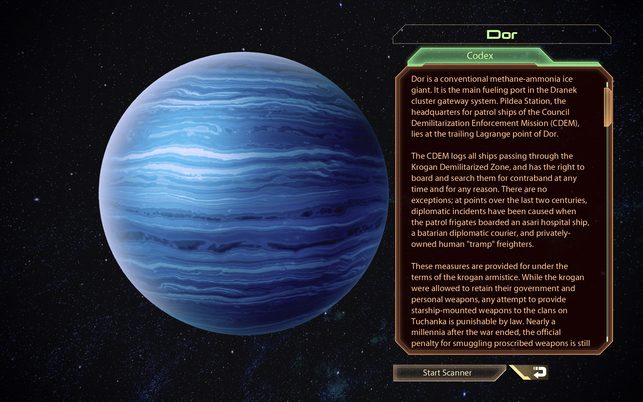
Dor is a conventional methane-ammonia ice giant. It is the main fueling port in the Dranek cluster gateway system. Pildea Station, the headquarters for patrol ships of the Council Demilitarization Enforcement Mission (CDEM), lies at the trailing Lagrange point of Dor.
The CDEM logs all ships passing through the Krogan Demilitarized Zone, and has the right to board and search them for contraband at any time and for any reason. There are no exceptions; at points over the last two centuries, diplomatic incidents have been caused when the patrol frigates boarded an asari hospital ship, a batarian diplomatic courier, and privately-owned human “tramp” freighters.
These measures are provided for under the terms of the krogan armistice. While the krogan were allowed to retain their government and personal weapons, any attempt to provide starship-mounted weapons to the clans on Tuchanka is punishable by law. Nearly a millennia after the war ended, the official
penalty for smuggling proscribed weapons is still death by spacing.
Population: 7,300
CDEM Garrison: 1,100 (not including patrol ship crews)
Orbital Distance: 0.36 AU
Orbital Period: 0.4 Earth Years
Radius: 25,588 km
Day Length: 18.4 Earth Hours
Kelim
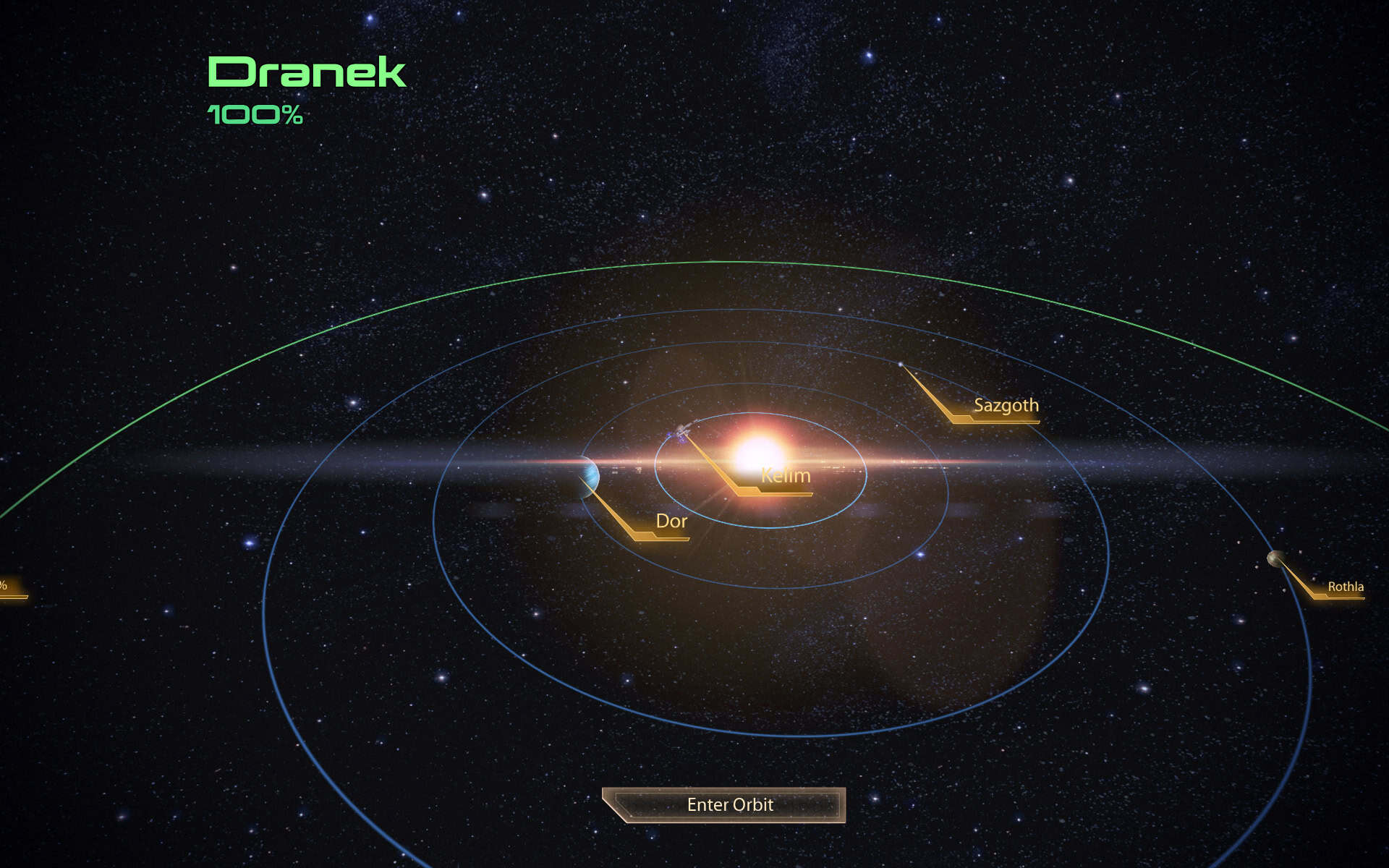
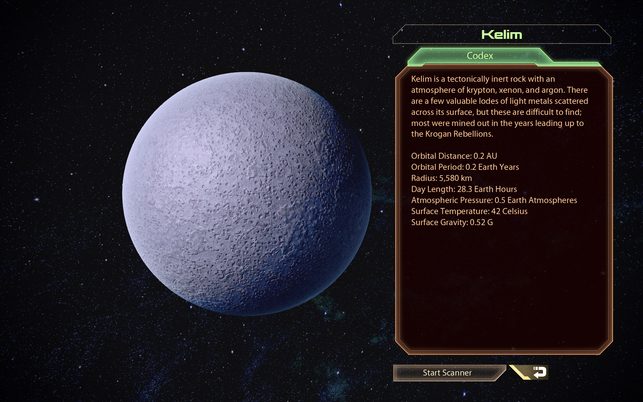
Kelim is a tectonically inert rock with an atmosphere of krypton, xenon, and argon. There are a few valuable lodes of light metals scattered across its surface, but these are difficult to find; most were mined out in the years leading up to the Krogan Rebellions.
Orbital Distance: 0.2 AU
Orbital Period: 0.2 Earth Years
Radius: 5,580 km
Day Length: 28.3 Earth Hours
Atmospheric Pressure: 0.5 Earth Atmospheres
Surface Temperature: 42 Celsius
Celsius Surface Gravity: 0.52 G
Rothla
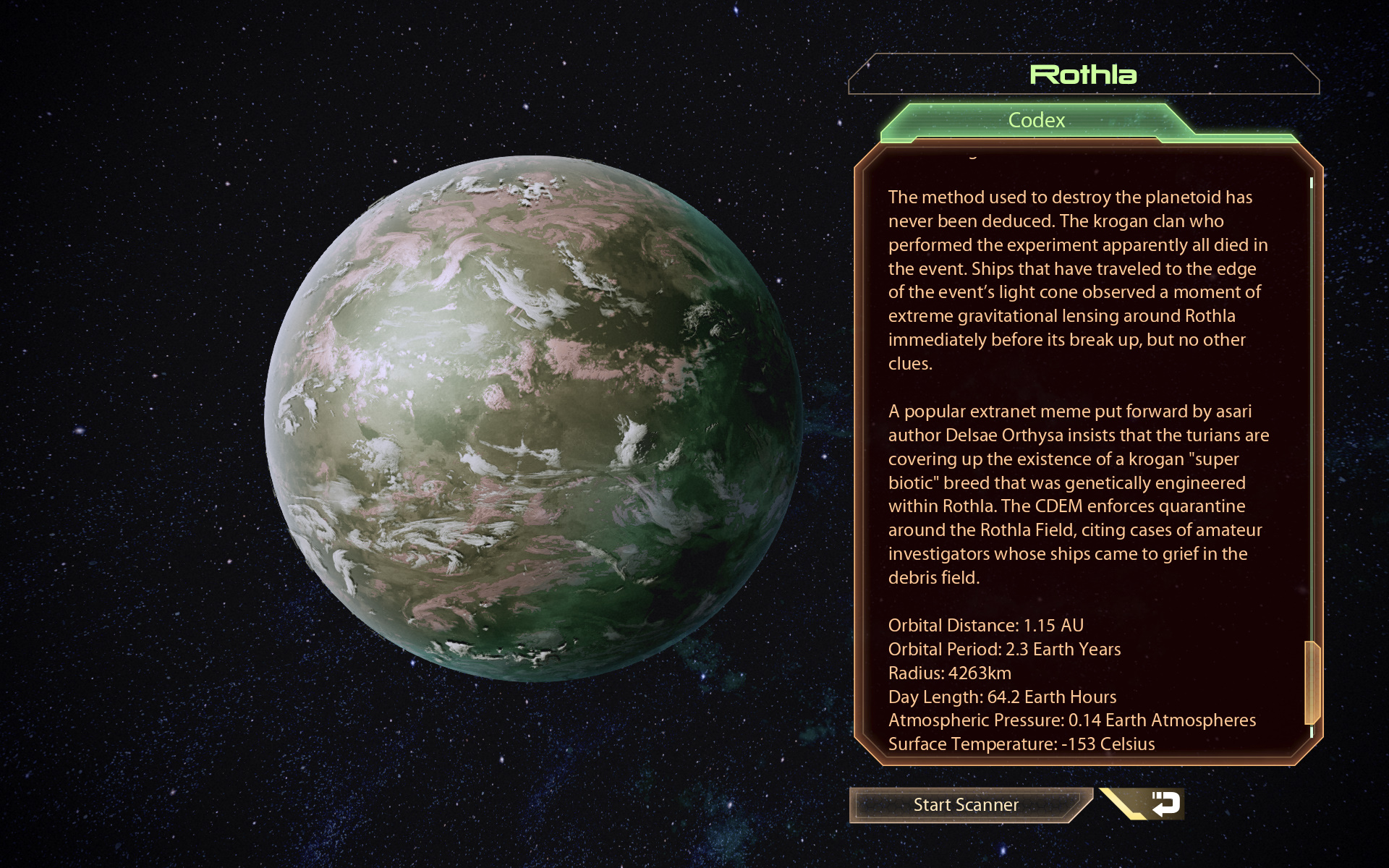
Once Rothla was a large ice dwarf with the statistics listed below. In the waning years of the Krogan Rebellions it was shattered into field of debris by what is assumed to have been the test of an exotic weapons system. In the wake of “the event,” the planetoid was reduced to a relatively contained field of thousands of tiny moonlets rotating around one another, colliding and ricocheting.
The method used to destroy the planetoid has never been deduced. The krogan clan who performed the experiment apparently all died in the event. Ships that have traveled to the edge of the event’s light cone observed a moment of extreme gravitational lensing around Rothla immediately before its break up, but no other clues.
A popular extranet meme put forward by asari author Delsae Orthysa insists that the turians are covering up the existence of a krogan “super biotic” breed that was genetically engineered within Rothla. The CDEM enforces quarantine around the Rothla Field, citing cases of amateur investigators whose ships came to grief in the debris field.
Orbital Distance: 1.15 AU
Orbital Period: 2.3 Earth Years
Radius: 4263km
Day Length: 64.2 Earth Hours
Atmospheric Pressure: 0.14 Earth Atmospheres
Surface Temperature: -153 Celsius
Sazgoth
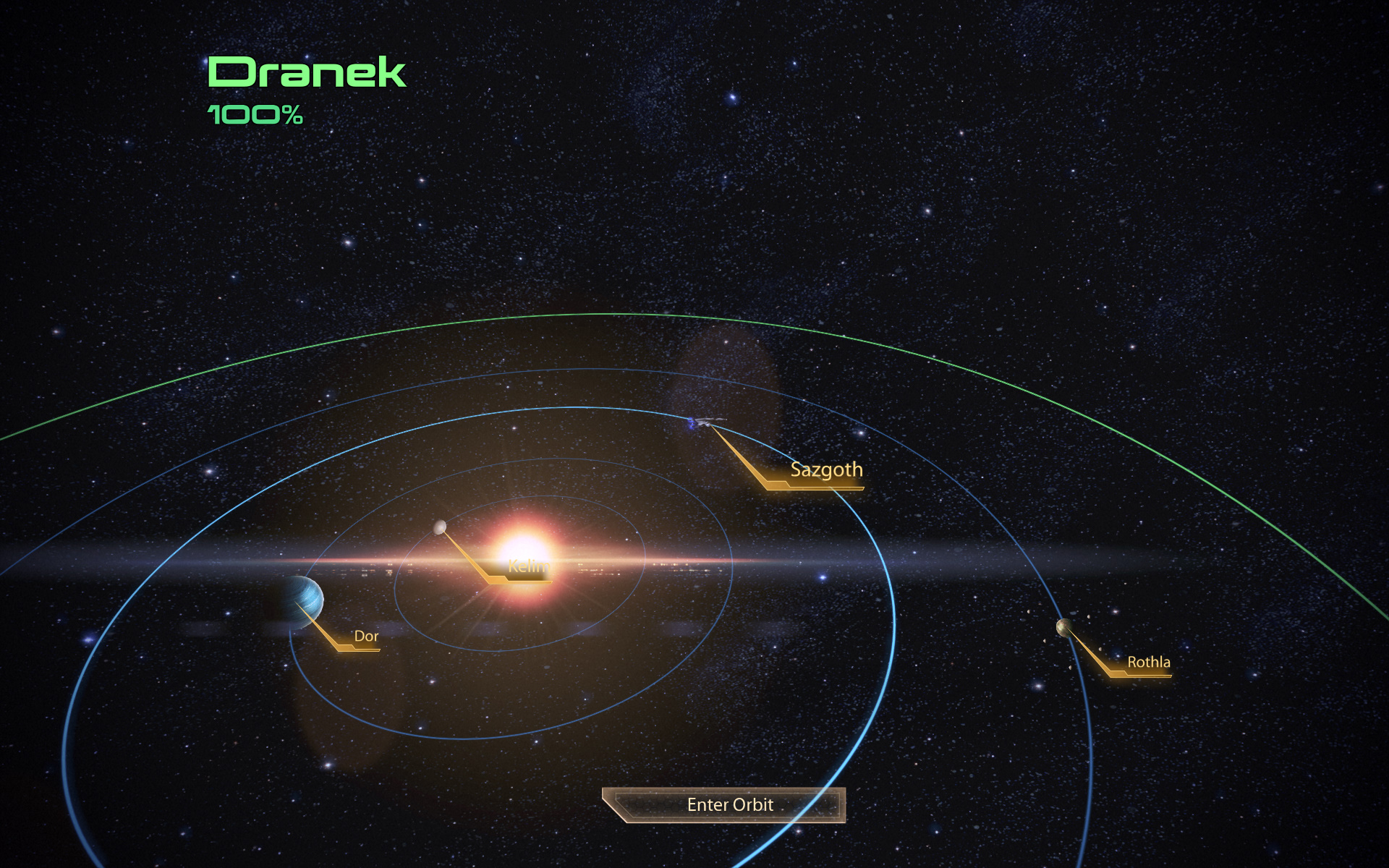
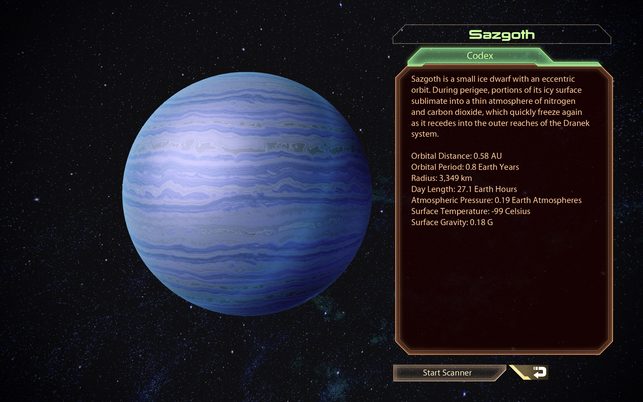
Sazgoth is a small ice dwarf with an eccentric orbit. During perigee, portions of its icy surface sublimate into a thin atmosphere of nitrogen and carbon dioxide, which quickly freeze again as it recedes into the outer reaches of the Dranek system.
Orbital Distance: 0.58 AU
Orbital Period: 0.8 Earth Years Radius: 3,349 km
Day Length: 27.1 Earth Hours
Atmospheric Pressure: 0.19 Earth Atmospheres
Surface Temperature: -99 Celsius
Surface Gravity: 0.18 G
NITH
Mantun
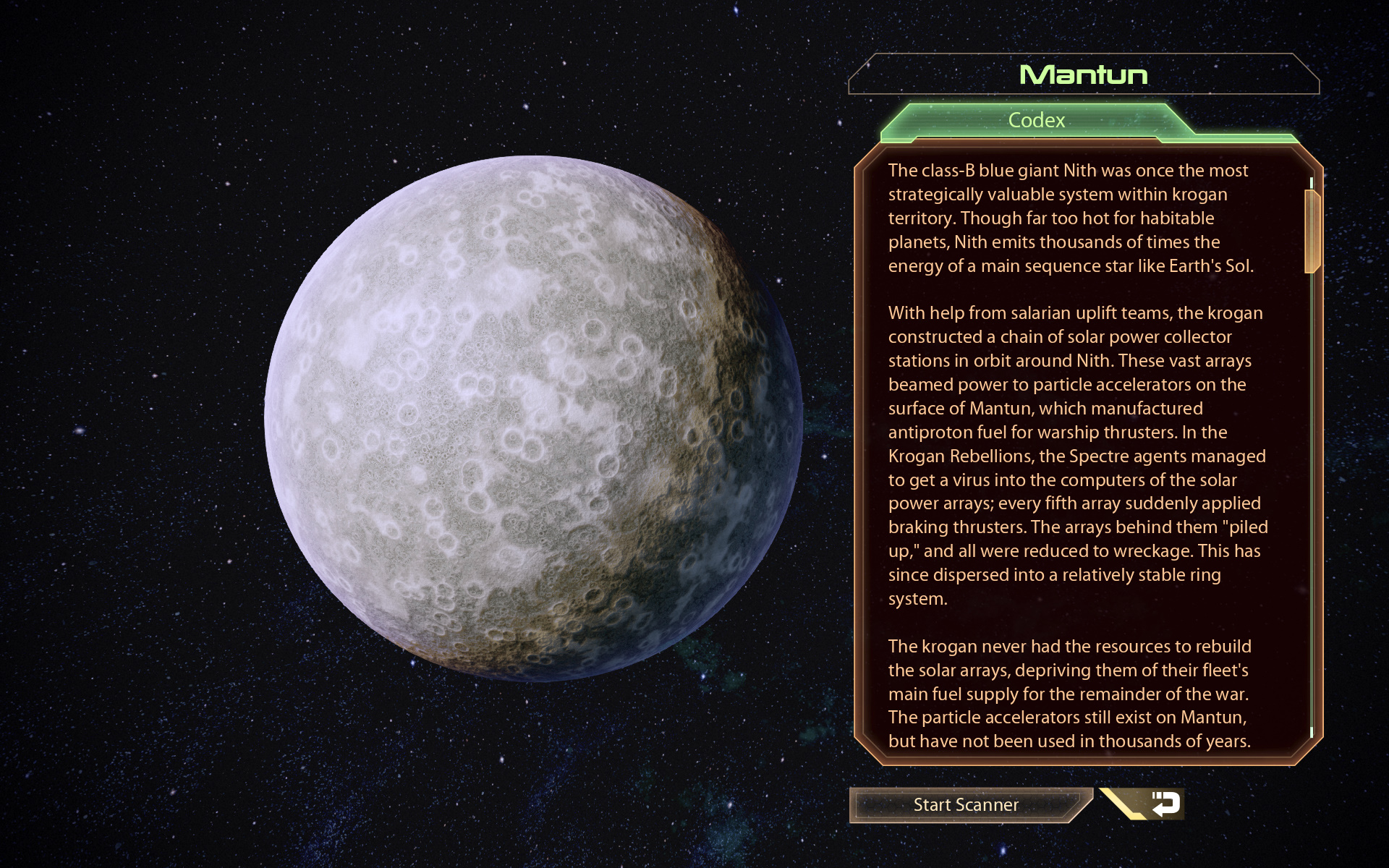
The class-B blue giant Nith was once the most strategically valuable system within krogan territory. Though far too hot for habitable planets, Nith emits thousands of times the energy of a main sequence star like Earth’s Sol.
With help from salarian uplift teams, the krogan constructed a chain of solar power collector stations in orbit around Nith. These vast arrays beamed power to particle accelerators on the surface of Mantun, which manufactured antiproton fuel for warship thrusters. In the Krogan Rebellions, the Spectre agents managed to get a virus into the computers of the solar power arrays; every fifth array suddenly applied braking thrusters. The arrays behind them “piled up,” and all were reduced to wreckage. This has since dispersed into a relatively stable ring system.
The krogan never had the resources to rebuild the solar arrays, depriving them of their fleet’s main fuel supply for the remainder of the war. The particle accelerators still exist on Mantun, but have not been used in thousands of years.
Orbital Distance: 57.2 AU
Orbital Period: 112.1 Earth Years
Radius: 2,150 km
Orbital Period: 112.1 Earth Years
Atmospheric Pressure: Trace
Surface Temperature: 641 Celsius
Surface Gravity: 0.28G
Tula
Tula’s methane-ammonia atmosphere traps the blistering heat of Nith, driving dayside temperatures up over 1000 degrees. While some lodes of useful metals are present, the planet’s incredible heat makes mining impractical.
Orbital Distance: 108.7 AU
Orbital Period: 293.9 Earth Years
Radius: 5,204 km
Day Length: 59.7 Earth Hours
Atmospheric Pressure: 0.54 Earth Atmospheres
Surface Temperature: 1,036 Celsius
Surface Gravity: 0.55 G
Vard
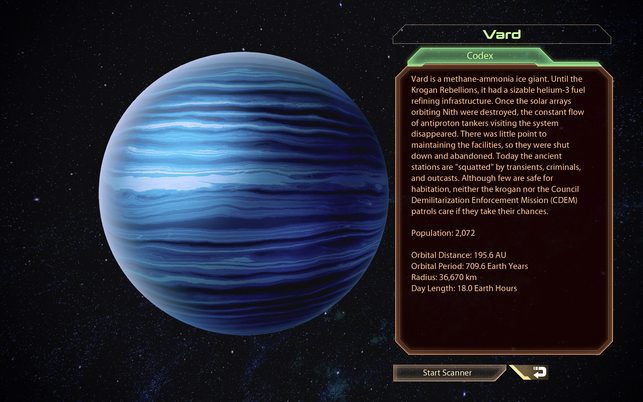
Vard is a methane-ammonia ice giant. Until the Krogan Rebellions, it had a sizable helium-3 fuel refining infrastructure. Once the solar arrays orbiting Nith were destroyed, the constant flow of antiproton tankers visiting the system disappeared. There was little point to maintaining the facilities, so they were shut down and abandoned. Today the ancient stations are “squatted” by transients, criminals, and outcasts. Although few are safe for habitation, neither the krogan nor the Council Demilitarization Enforcement Mission (CDEM) patrols care if they take their chances.
Population: 2,072
Orbital Distance: 195.6 AU
Orbital Period: 709.6 Earth Years
Radius: 36,670 km
Day Length: 18.0 Earth Hours
LOCAL CLUSTER
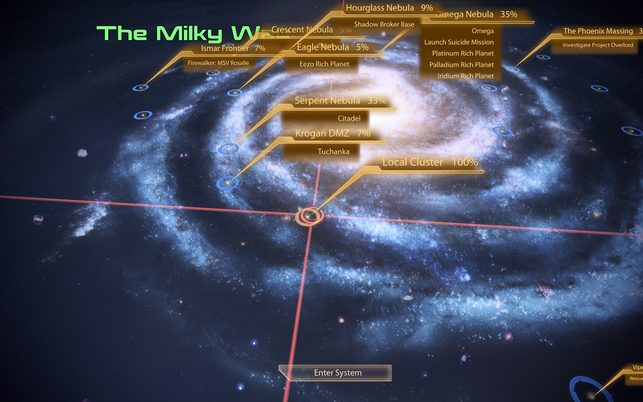
SOL
Mercury
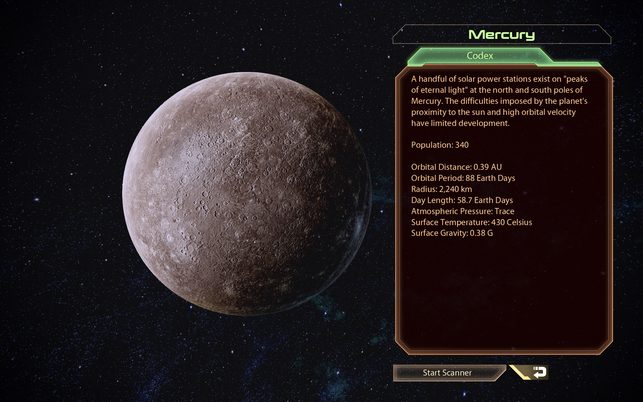
A handful of solar power stations exist on “peaks of eternal light” at the north and south poles of Mercury. The difficulties imposed by the planet’s proximity to the sun and high orbital velocity have limited development.
Population: 340
Orbital Distance: 0.39 AU
Orbital Period: 88 Earth Days
Radius: 2,440 km
Day Length: 58.7 Earth Days
Atmospheric Pressure: Trace
Surface Temperature: 430 Celsius
Surface Gravity: 0.38 G
Earth
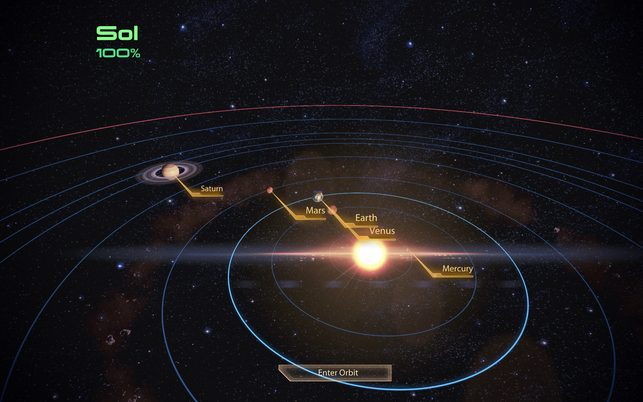
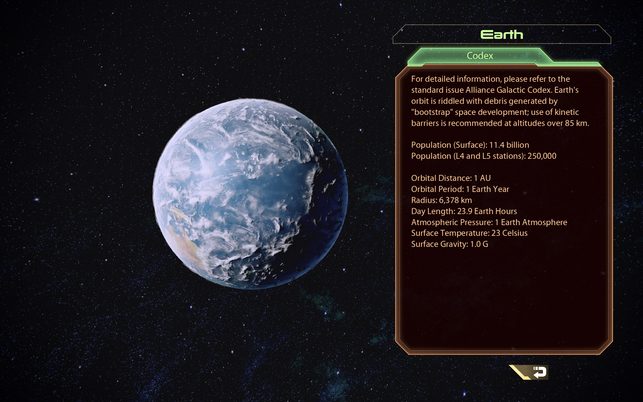
For detailed information, please refer to the standard issue Alliance Galactic Codex. Earth’s orbit is riddled with debris generated by “bootstrap” space development; use of kinetic barriers is recommended at altitudes over 85 km.
Population (Surface): 11.4 billion
Population (L4 and L5 stations): 250,000
Orbital Distance: 1 AU
Orbital Period: 1 Earth Year
Radius: 6,378 km
Day Length: 23.9 Earth Hours
Atmospheric Pressure: 1 Earth Atmosphere
Surface Temperature: 23 Celsius
Surface Gravity: 1.0 G
Venus
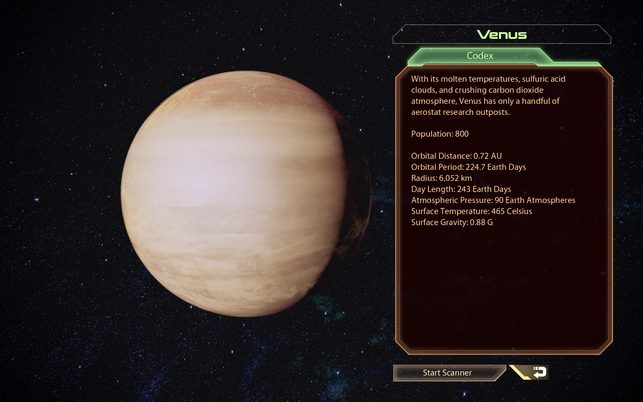
With its molten temperatures, sulphuric acid clouds, and crushing carbon dioxide atmosphere, Venus has only a handful of aerostat research outposts.
Population: 800
Orbital Distance: 0.72 AU
Orbital Period: 224.7 Earth Days
Radius: 6,052 km
Day Length: 243 Earth Days
Atmospheric Pressure: 90 Earth Atmospheres
Surface Temperature: 465 Celsius
Surface Gravity: 0.88 G
Mars
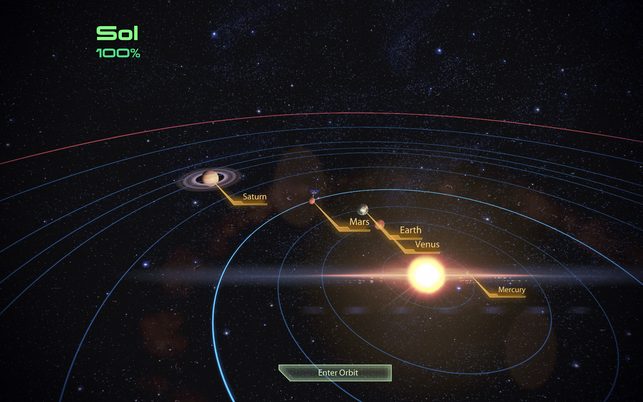
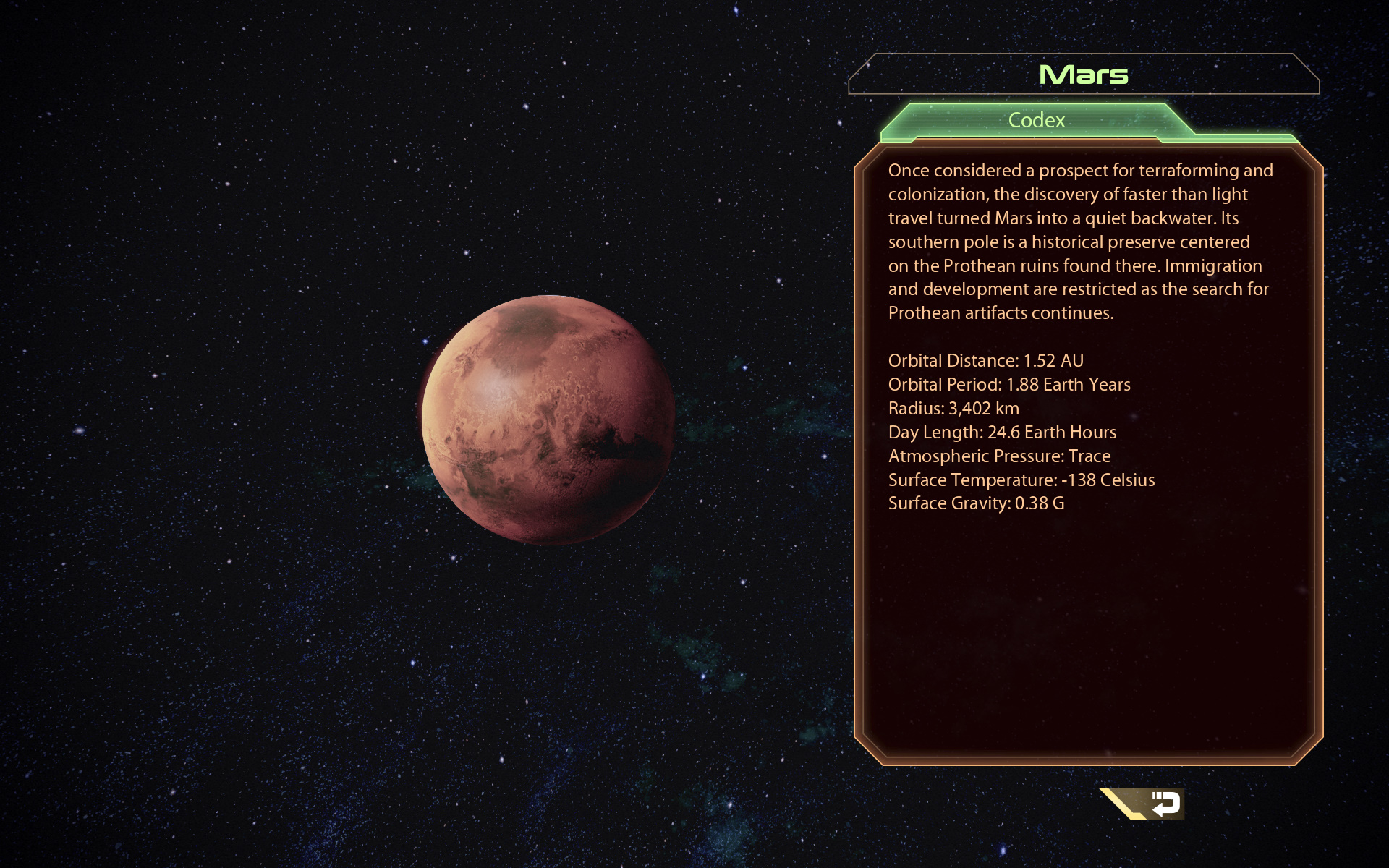
Once considered a prospect for terraforming and colonization, the discovery of faster than light travel turned Mars into a quiet backwater. Its southern pole is a historical preserve centered on the Prothean ruins found there. Immigration and development are restricted as the search for Prothean artifacts continues.
Orbital Distance: 1.52 AU
Orbital Period: 1.88 Earth Years
Radius: 3,402 km
Day Length: 24.6 Earth Hours
Atmospheric Pressure: Trace
Surface Temperature: -138 Celsius
Surface Gravity: 0.38 G
Uranus
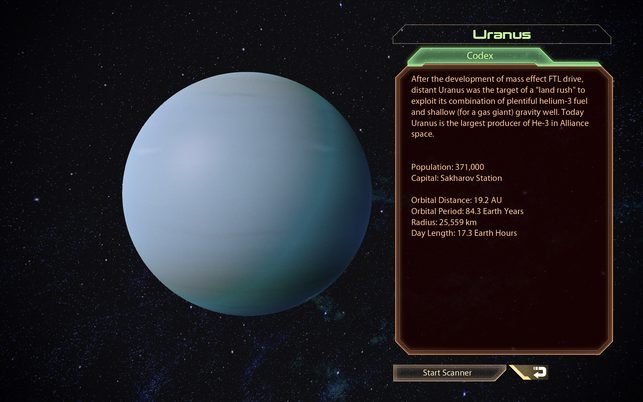
After the development of mass effect FTL drive, distant Uranus was the target of a “land rush” to exploit its combination of plentiful helium-3 fuel and shallow (for a gas giant) gravity well. Today Uranus is the largest producer of He-3 in Alliance space.
Population: 371,000
Capital: Sakharov Station
Orbital Distance: 19.2 AU
Orbital Period: 121.1 Earth Years
Radius: 25,559 km
Day Length: 17.3 Earth Hours
Neptune
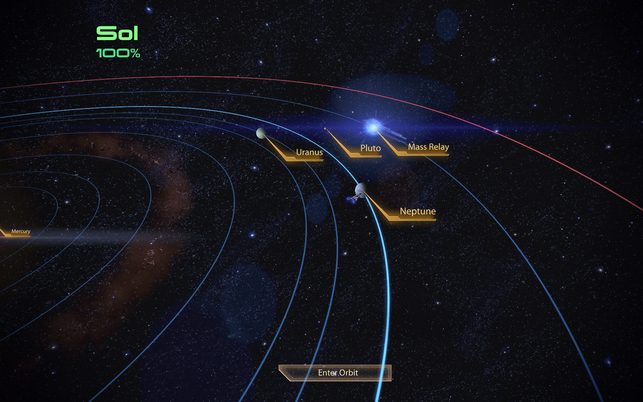
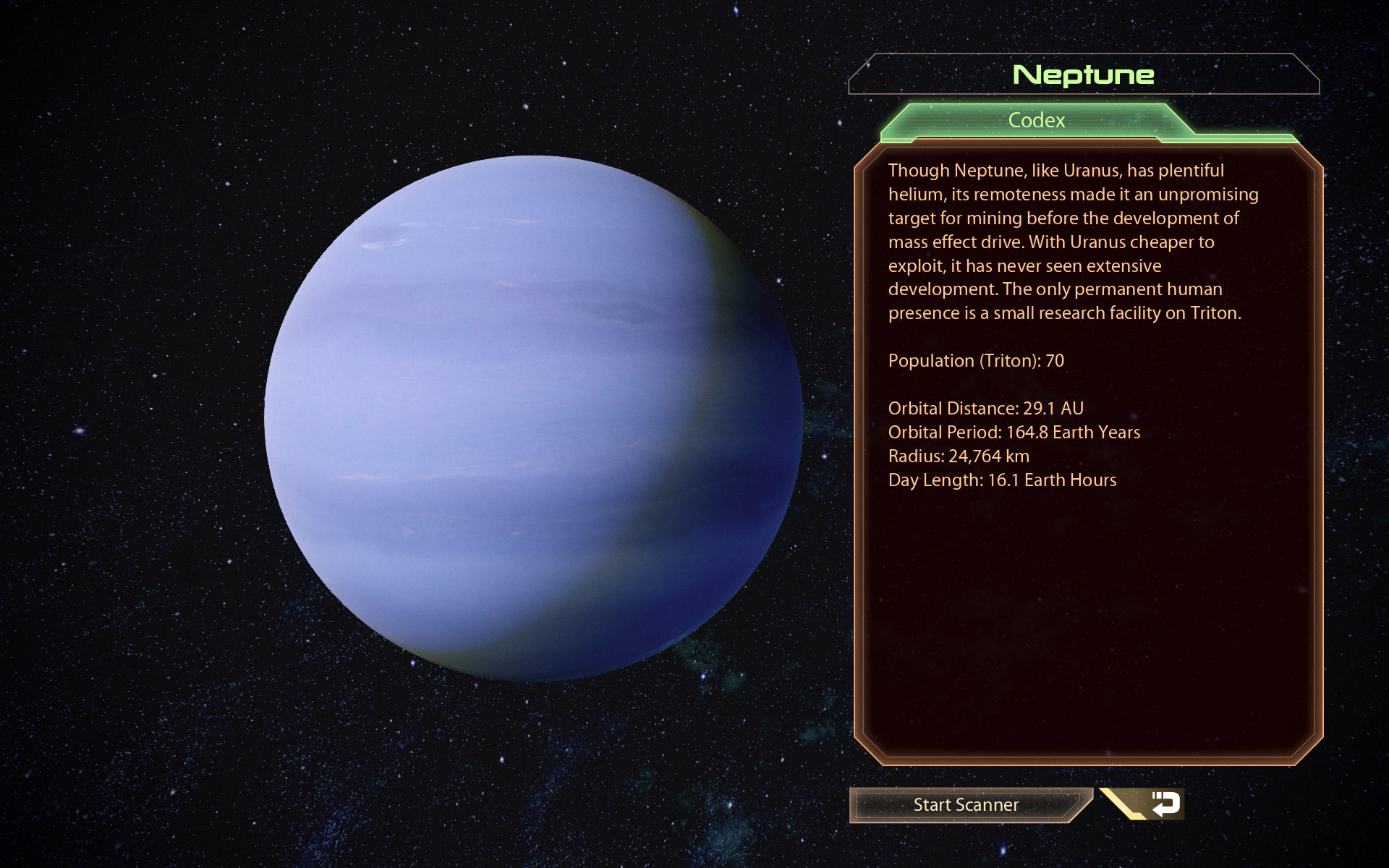
Though Neptune, like Uranus, has plentiful helium, its remoteness made it an unpromising target for mining before the development of mass effect drive. With Uranus cheaper to exploit, it has never seen extensive development. The only permanent human presence is a small research facility on Triton.
Population (Triton): 70
Orbital Distance: 29.1 AU
Orbital Period: 164.8 Earth Years
Radius: 24,764 km
Day Length: 16.1 Earth Hours
Jupiter
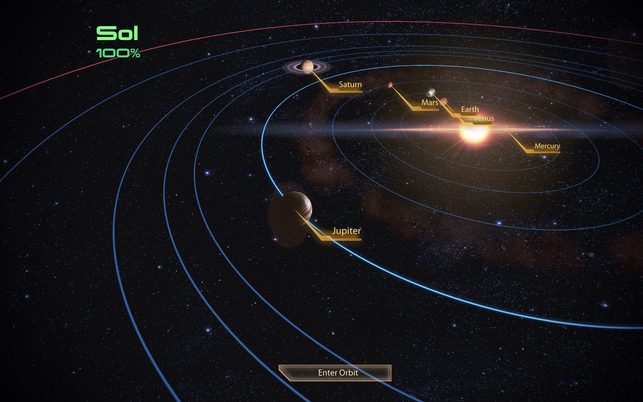
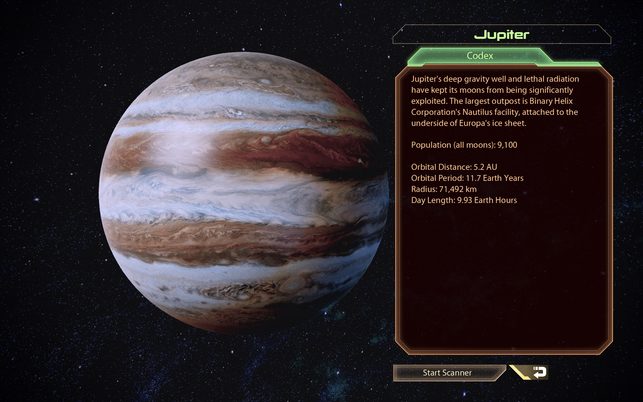
Jupiter’s deep gravity well and lethal radiation have kept its moons from being significantly exploited. The largest outpost is Binary Helix Corporation’s Nautilus facility, attached to the underside of Europa’s ice sheet.
Population (all moons): 9,100
Orbital Distance: 5.2 AU
Orbital Period: 11.7 Earth Years
Radius: 71,492 km
Day Length: 9.93 Earth Hours
Saturn
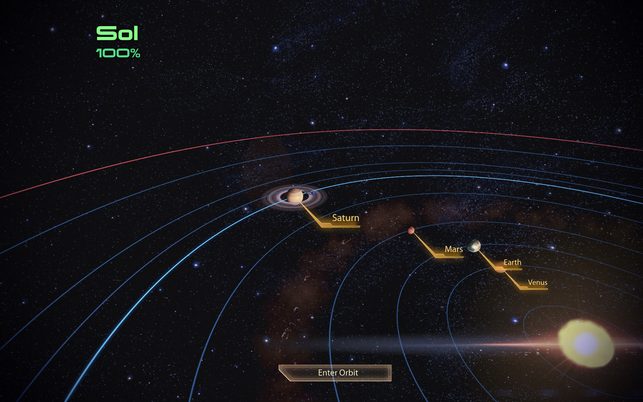
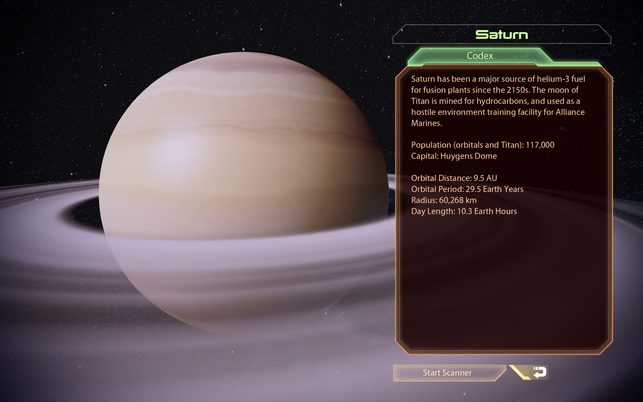
Saturn has been a major source of helium-3 fuel for fusion plants since the 2150s. The moon of Titan is mined for hydrocarbons, and used as a hostile environment training facility for Alliance Marines.
Population (orbitals and Titan): 117,000
Capital: Huygens Dome
Orbital Distance: 9.5 AU
Orbital Period: 29.5 Earth Years
Radius: 60,268 km
Day Length: 10.3 Earth Hours
Pluto
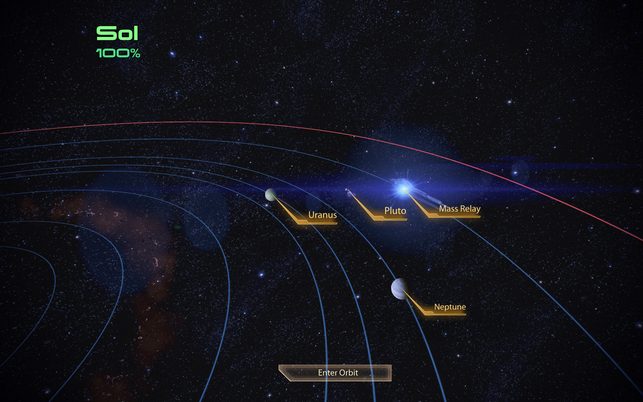
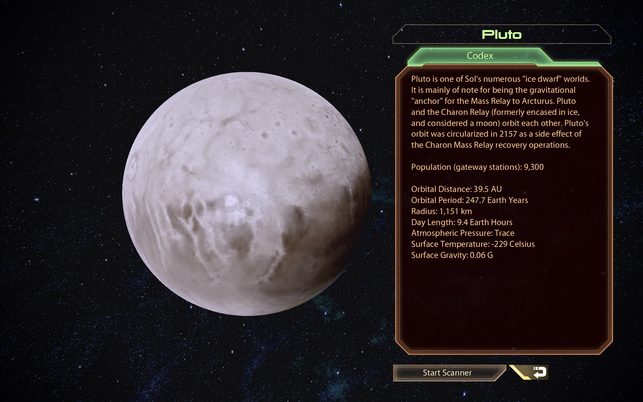
Pluto is one of Sol’s numerous “ice dwarf” worlds. It is mainly of note for being the gravitational “anchor” for the Mass Relay to Arcturus. Pluto and the Charon Relay (formerly encased in ice, and considered a moon) orbit each other. Pluto’s orbit was circularized in 2157 as a side effect of the Charon Mass Relay recovery operations.
Population (gateway stations): 9,300
Orbital Distance: 39.5 AU
Orbital Period: 247.7 Earth Years
Radius: 1,151 km
Day Length: 9.4 Earth Hours
Atmospheric Pressure: Trace
Surface Temperature: -229 Celsius
Surface Gravity: 0.06 G
MINOS WASTELAND
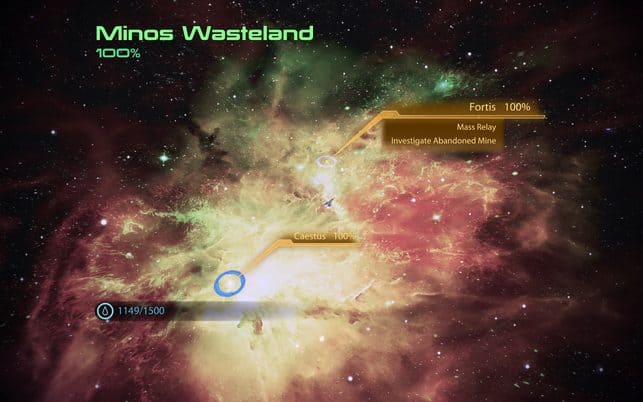
CAESTUS
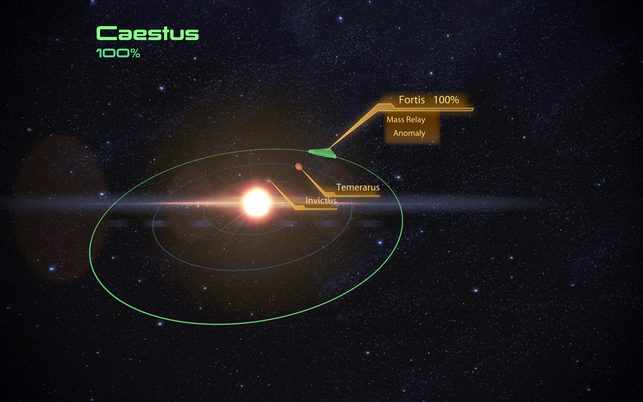
Invictus
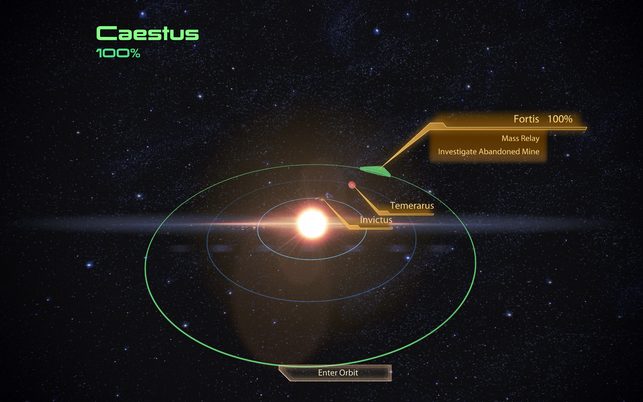
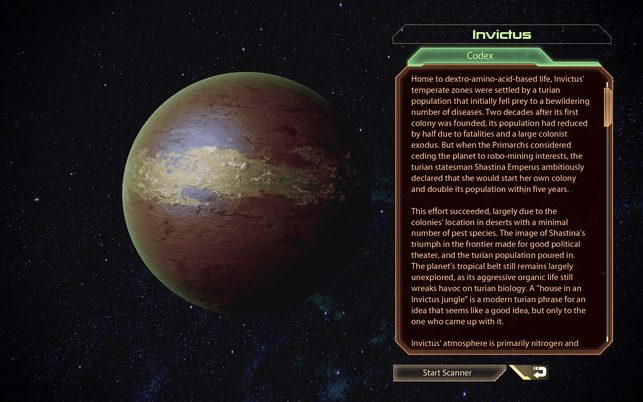
Home to dextro-amino-acid-based life, Invictus’ temperate zones were settled by a turian population that initially fell prey to a bewildering number of diseases. Two decades after its first colony was founded, its population had reduced by half due to fatalities and a large colonist exodus. But when the Primarchs considered ceding the planet to robo-mining interests, the turian statesman Shastina Emperus ambitiously declared that she would start her own colony and double its population within five years.
This effort succeeded, largely due to the colonies’ location in deserts with a minimal number of pest species. The image of Shastina’s triumph in the frontier made for good political theater, and the turian population poured in. The planet’s tropical belt still remains largely unexplored, as its aggressive organic life still wreaks havoc on turian biology. A “house in an Invictus jungle” is a modern turian phrase for an idea that seems like a good idea, but only to the one who came up with it.
Invictus’ atmosphere is primarily nitrogen and oxygen, and its surface crust varies but has high concentrations of alumina and silver. Because it can support life easily, criminals from throughout the Terminus Systems hide out on Invictus. Its official population is estimated to be half the number of sapients that are actually on the planet.
Colony Founded: 1939 CE
Population: 320,535,000 (est. 640,000,000 with illegals)
Capital: Shastinasio
Orbital Distance: 1.3 AU
Orbital Period: 1.5 Earth Years
Radius: 7,260 km
Day Length: 31.6 Earth Hours
Atmospheric Pressure: 1.15 Earth Atmospheres
Surface Temperature: 30 Celsius
Surface Gravity: 1.5 G
Temerarus
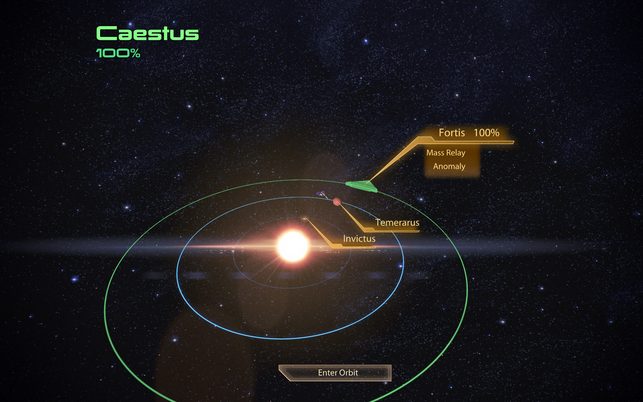
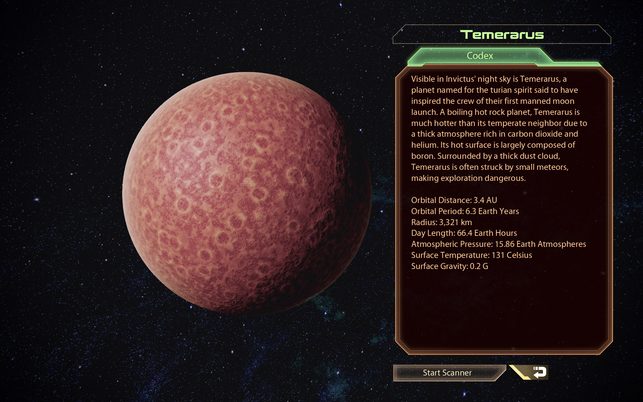
Visible in Invictus’ night sky is Temerarus, a planet named for the turian spirit said to have inspired the crew of their first manned moon launch. A boiling hot rock planet, Temerarus is much hotter than its temperate neighbor due to a thick atmosphere rich in carbon dioxide and helium. Its hot surface is largely composed of boron. Surrounded by a thick dust cloud, Temerarus is often struck by small meteors, making exploration dangerous.
Orbital Distance: 3.4 AU
Orbital Period: 6.3 Earth Years
Radius: 3,321 km
Day Length: 66.4 Earth Hours
Atmospheric Pressure: 15.86 Earth Atmospheres
Surface Temperature: 131 Celsius
Surface Gravity: 0.2 G
FORTIS
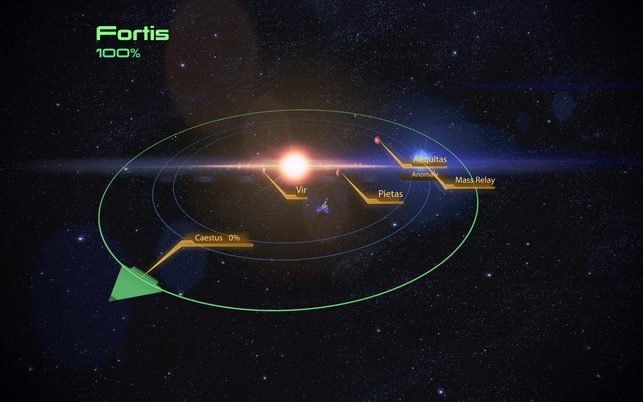
Aequitas*
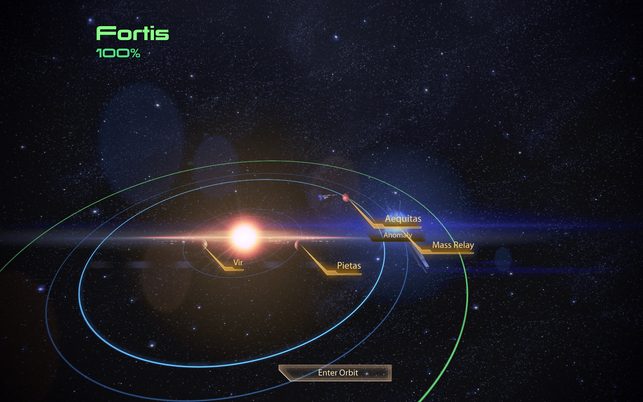
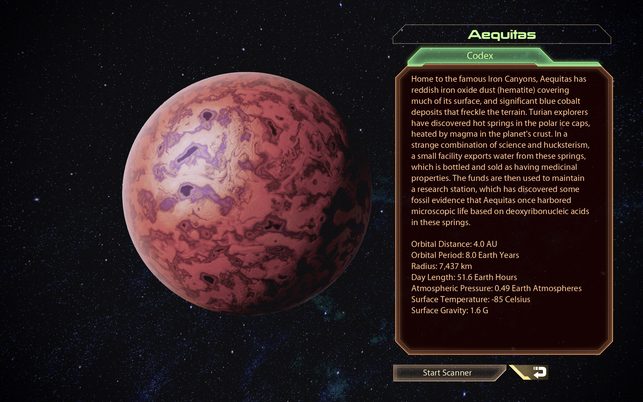
Home to the famous Iron Canyons, Aequitas has reddish iron oxide dust (hematite) covering much of its surface, and significant blue cobalt deposits that freckle the terrain. Turian explorers have discovered hot springs in the polar ice caps, heated by magma in the planet’s crust. In a strange combination of science and hucksterism, a small facility exports water from these springs, which is bottled and sold as having medicinal properties. The funds are then used to maintain a research station, which has discovered some fossil evidence that Aequitas once harbored microscopic life based on deoxyribonucleic acids in these springs.
Orbital Distance: 4.0 AU
Orbital Period: 8.0 Earth Years
Radius: 7,437 km
Day Length: 51.6 Earth Hours
Atmospheric Pressure: 0.49 Earth Atmospheres
Surface Temperature: -85 Celsius
Surface Gravity: 1.6 G
Pietas
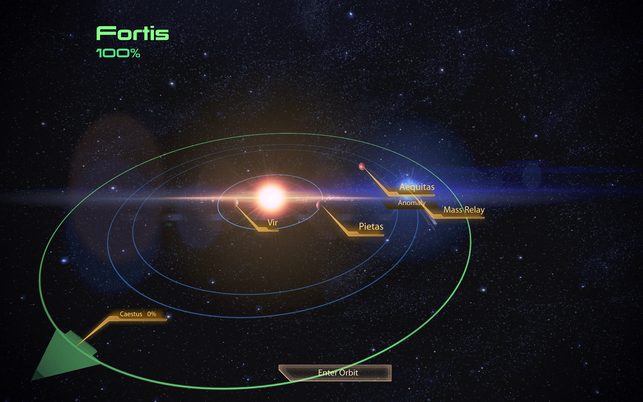
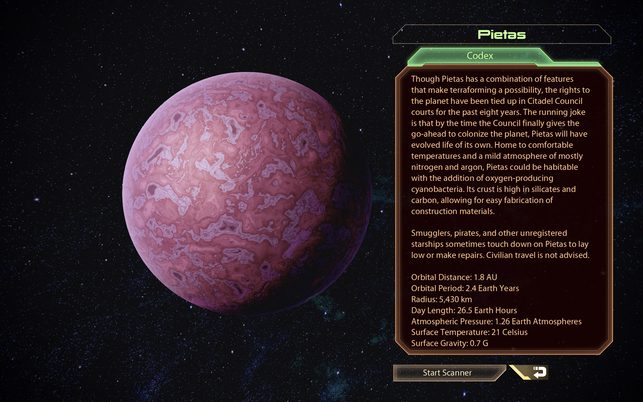
Though Pietas has a combination of features that make terraforming a possibility, the rights to the planet have been tied up in Citadel Council courts for the past eight years. The running joke is that by the time the Council finally gives the go-ahead to colonize the planet, Pietas will have evolved life of its own. Home to comfortable temperatures and a mild atmosphere of mostly nitrogen and argon, Pietas could be habitable with the addition of oxygen-producing cyanobacteria. Its crust is high in silicates and carbon, allowing for easy fabrication of construction materials.
Smugglers, pirates, and other unregistered starships sometimes touch down on Pietas to lay low or make repairs. Civilian travel is not advised.
Orbital Distance: 1.8 AU
Orbital Period: 2.4 Earth Years
Radius: 5,430 km
Day Length: 26.5 Earth Hours
Atmospheric Pressure: 1.26 Earth Atmospheres
Surface Temperature: 21 Celsius
Surface Gravity: 0.7 G
Vir
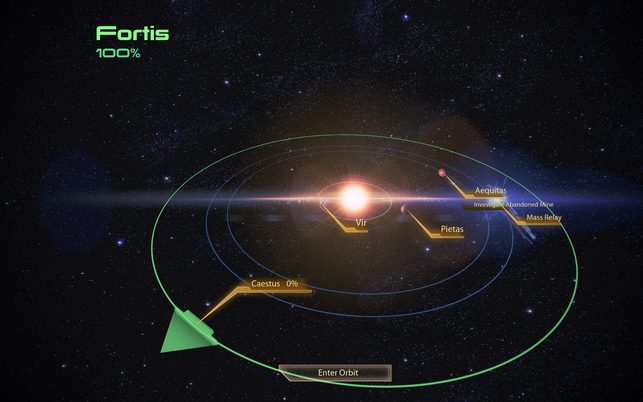
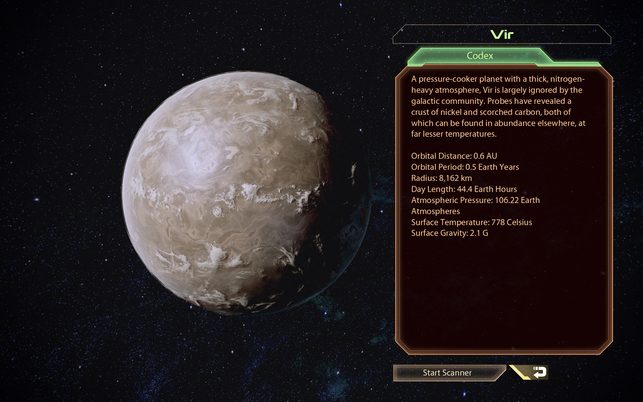
A pressure-cooker planet with a thick, nitrogen-heavy atmosphere, Vir is largely ignored by the galactic community. Probes have revealed a crust of nickel and scorched carbon, both of which can be found in abundance elsewhere, at far lesser temperatures.
Orbital Distance: 0.6 AU
Orbital Period: 0.5 Earth Years
Radius: 8,162 km
Day Length: 44.4 Earth Hours
Atmospheric Pressure: 106.22 Earth Atmospheres
Surface Temperature: 778 Celsius
Surface Gravity: 2.1 G
NUBIAN EXPANSE
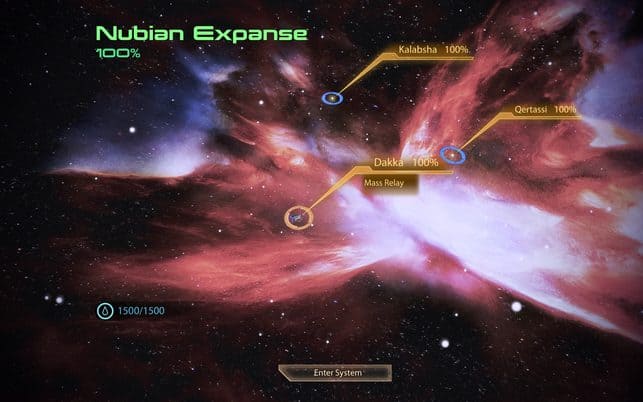
DAKKA
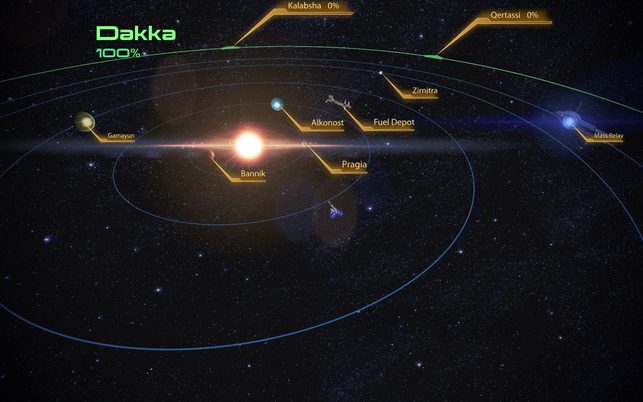
Alkonost
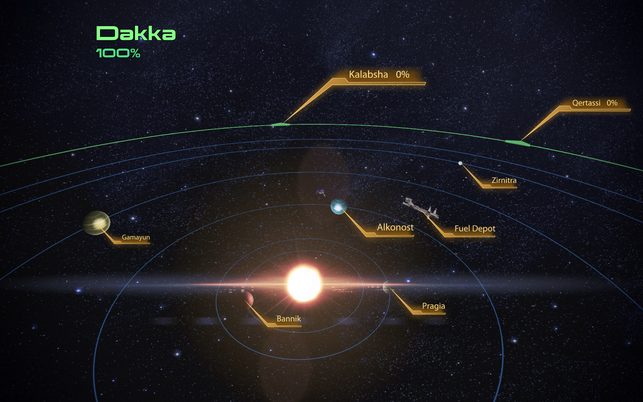
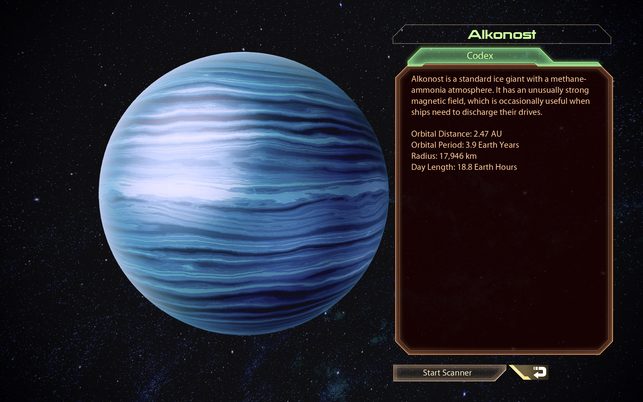
Alkonost is a standard ice giant with a methane-ammonia atmosphere. It has an unusually strong magnetic field, which is occasionally useful when ships need to discharge their drives.
Orbital Distance: 2.47 AU
Orbital Period: 3.9 Earth Years
Radius: 17,946 km
Day Length: 18.8 Earth Hours
Bannik
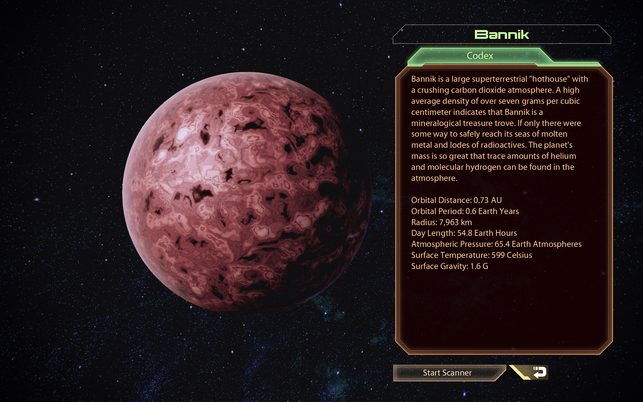
Bannik is a large superterrestrial “hothouse” with a crushing carbon dioxide atmosphere. A high average density of over seven grams per cubic centimeter indicates that Bannik is a mineralogical treasure trove. If only there were some way to safely reach its seas of molten metal and lodes of radioactives. The planet’s mass is so great that trace amounts of helium and molecular hydrogen can be found in the atmosphere.
Orbital Distance: 0.73 AU
Orbital Period: 0.6 Earth Years
Radius: 7,963 km
Day Length: 54.8 Earth Hours
Atmospheric Pressure: 65.4 Earth Atmospheres
Surface Temperature: 599 Celsius
Surface Gravity: 1.6 G
Gamayun
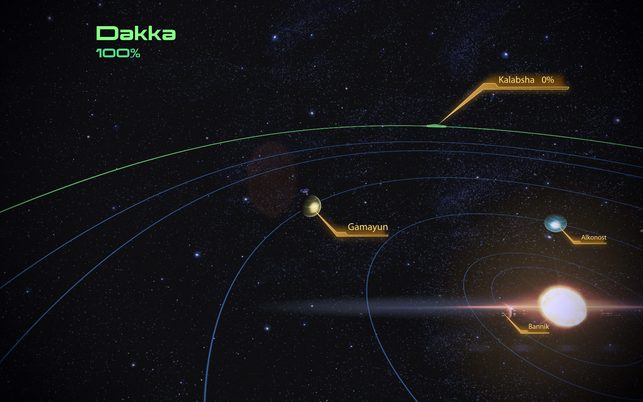
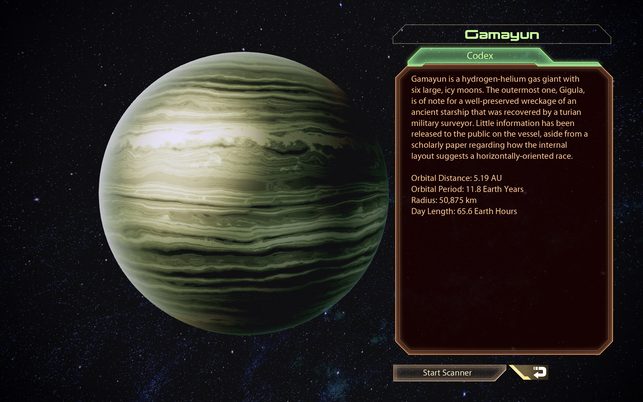
Gamayun is a hydrogen-helium gas giant with six large, icy moons. The outermost one, Gigula, is of note for a well-preserved wreckage of an ancient starship that was recovered by a turian military surveyor. Little information has been released to the public on the vessel, aside from a scholarly paper regarding how the internal layout suggests a horizontally-oriented race.
Orbital Distance: 5.19 AU
Orbital Period: 11.8 Earth Years
Radius: 50,875 km
Day Length: 65.6 Earth Hours
Pragia
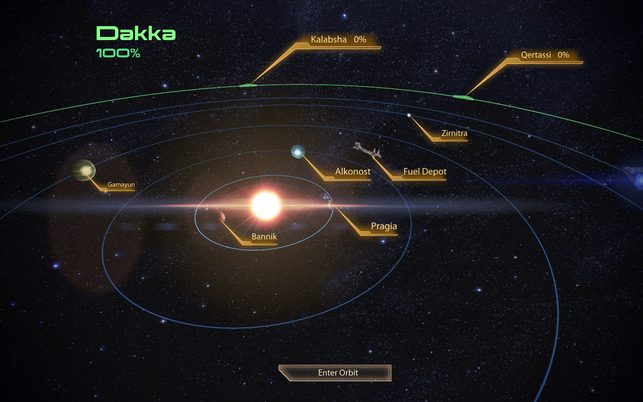
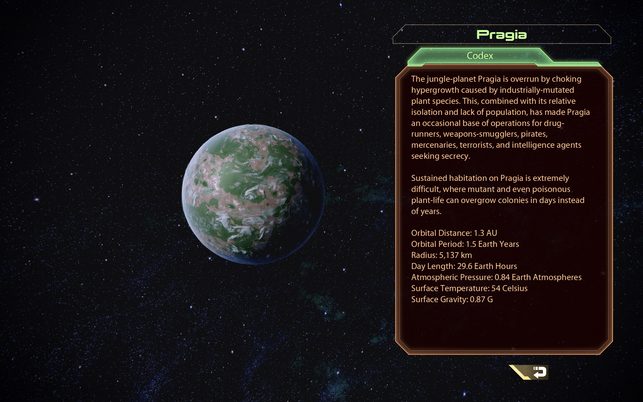
The jungle-planet Pragia is overrun by choking hypergrowth caused by industrially-mutated plant species. This, combined with its relative isolation and lack of population, has made Pragia an occasional base of operations for drug-runners, weapons-smugglers, pirates, mercenaries, terrorists, and intelligence agents seeking secrecy.
Sustained habitation on Pragia is extremely difficult, where mutant and even poisonous plant-life can overgrow colonies in days instead of years.
Orbital Distance: 1.3 AU
Orbital Period: 1.5 Earth Years
Radius: 5,137 km
Day Length: 29.6 Earth Hours
Atmospheric Pressure: 0.84 Earth Atmospheres
Surface Temperature: 54 Celsius
Surface Gravity: 0.87 G
Zirnitra
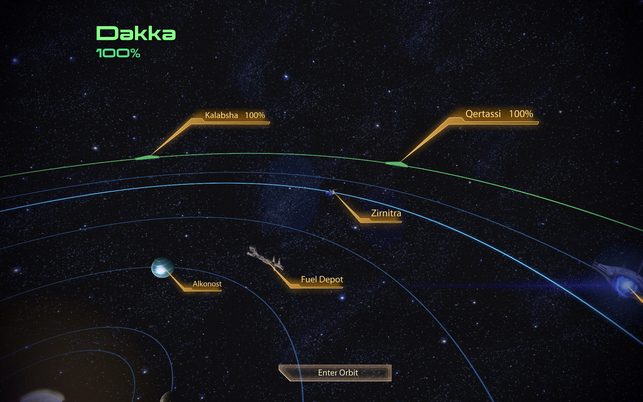
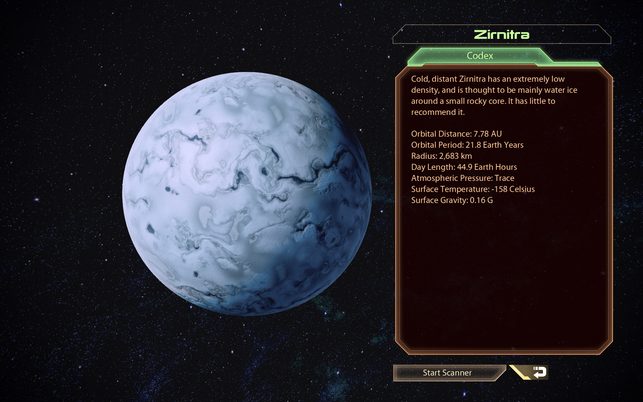
Cold, distant Zirnitra has an extremely low density, and is thought to be mainly water ice around a small rocky core. It has little to recommend it.
Orbital Distance: 7.78 AU
Orbital Period: 21.8 Earth Years
Radius: 2,683 km
Day Length: 44.9 Earth Hours
Atmospheric Pressure: Trace
Surface Temperature: -158 Celsius
Surface Gravity: 0.16 G
KALABSHA
Tefnut
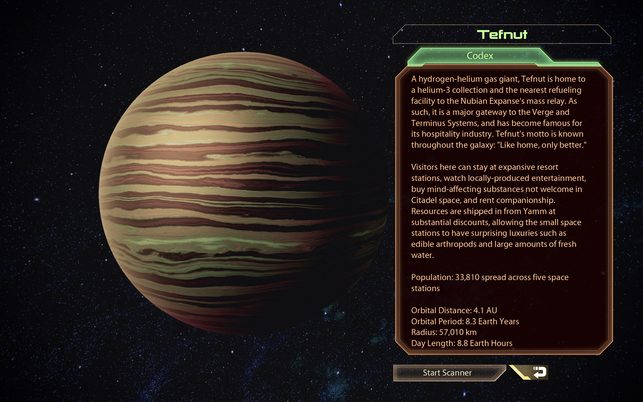
A hydrogen-helium gas giant, Tefnut is home to a helium-3 collection and the nearest refueling facility to the Nubian Expanse’s mass relay. As such, it is a major gateway to the Verge and Terminus Systems, and has become famous for its hospitality industry. Tefnut’s motto is known throughout the galaxy: “Like home, only better.”
Visitors here can stay at expansive resort stations, watch locally-produced entertainment, buy mind-affecting substances not welcome in Citadel space, and rent companionship. Resources are shipped in from Yamm at substantial discounts, allowing the small space stations to have surprising luxuries such as edible arthropods and large amounts of fresh water.
Population: 33,810 spread across five space stations
Orbital Distance: 4.1 AU
Orbital Period: 8.3 Earth Years
Radius: 57,010 km
Day Length: 8.8 Earth Hours
Yamm
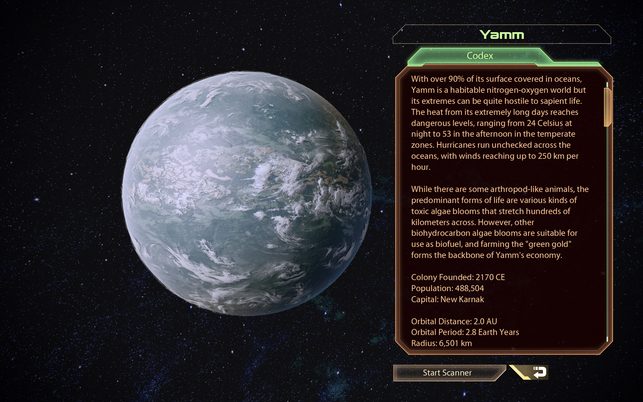
With over 90% of its surface covered in oceans, Yamm is a habitable nitrogen-oxygen world but its extremes can be quite hostile to sapient life. The heat from its extremely long days reaches dangerous levels, ranging from 24 Celsius at night to 53 in the afternoon in the temperate zones. Hurricanes run unchecked across the oceans, with winds reaching up to 250 km per hour.
While there are some arthropod-like animals, the predominant forms of life are various kinds of toxic algae blooms that stretch hundreds of kilometers across. However, other biohydrocarbon algae blooms are suitable for use as biofuel, and farming the “green gold” forms the backbone of Yamm’s economy.
Colony Founded: 2170 CE
Population: 488,504
Capital: New Karnak
Orbital Distance: 2.0 AU
Orbital Period: 2.8 Earth Years
Radius: 6,501 km
Day Length: 69.6 Earth Hours
Atmospheric Pressure: 1.8 Earth Atmospheres
Surface Temperature: 34 Celsius (temperate zone)
Surface Gravity: 1.1 G
QERTASSI
Norehsa
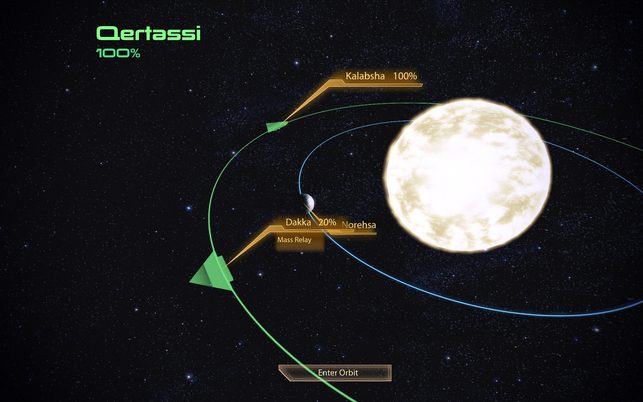
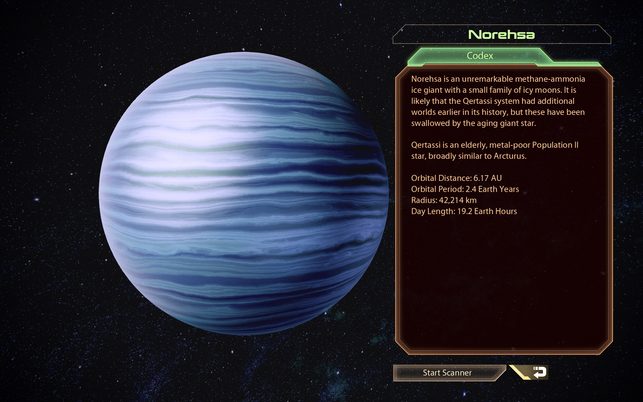
Norehsa is an unremarkable methane-ammonia ice giant with a small family of icy moons. It is likely that the Qertassi system had additional worlds earlier in its history, but these have been swallowed by the aging giant star.
Qertassi is an elderly, metal-poor Population II star, broadly similar to Arcturus.
Orbital Distance: 6.17 AU
Orbital Period: 2.4 Earth Years
Radius: 42,214 km
Day Length: 19.2 Earth Hours
OMEGA NEBULA
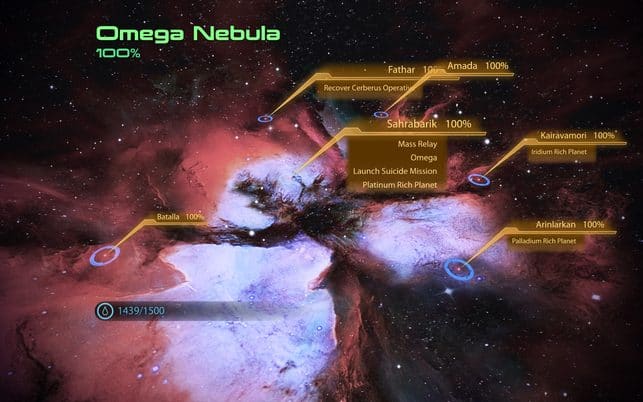
AMADA
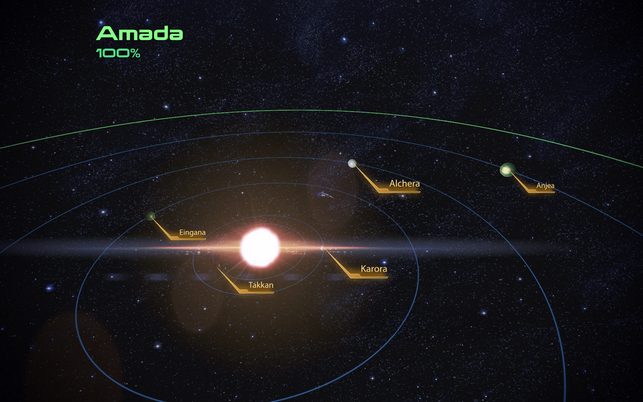
Alchera*
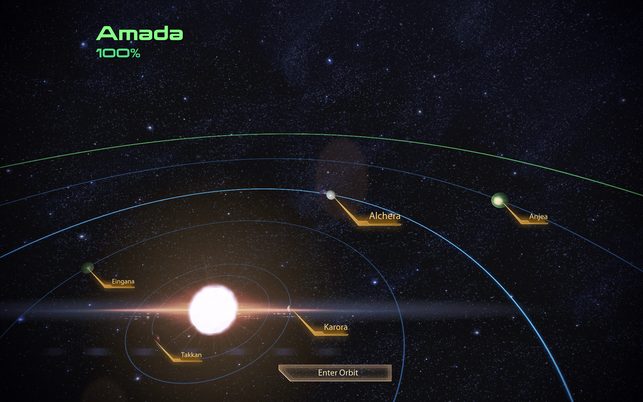
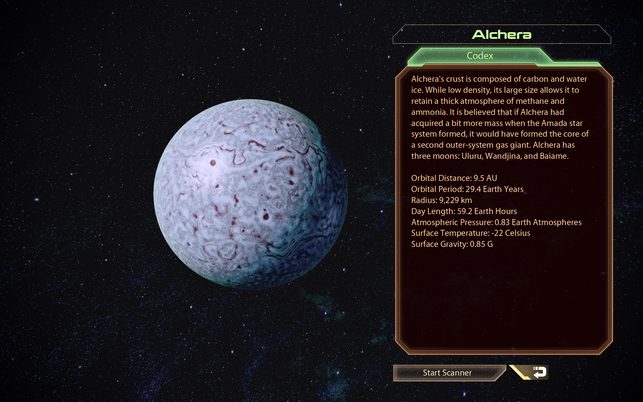
Alchera’s crust is composed of carbon and water ice. While low density, its large size allows it to retain a thick atmosphere of methane and ammonia. It is believed that if Alchera had acquired a bit more mass when the Amada star system formed, it would have formed the core of a second outer-system gas giant. Alchera has three moons: Uluru, Wandjina, and Baiame.
Orbital Distance: 9.5 AU
Orbital Period: 29.4 Earth Years
Radius: 9,229 km
Day Length: 59.2 Earth Hours
Atmospheric Pressure: 0.83 Earth Atmospheres
Surface Temperature: -22 Celsius
Surface Gravity: 0.85 G
Anjea
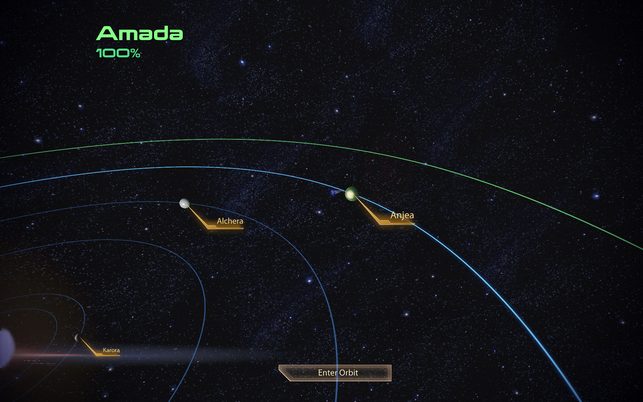
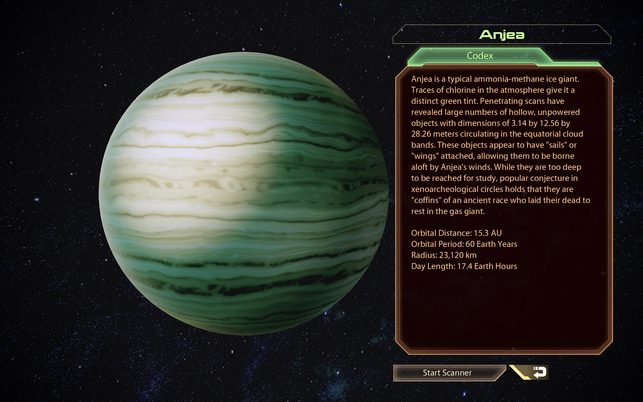
Anjea is a typical ammonia-methane ice giant. Traces of chlorine in the atmosphere give it a distinct green tint. Penetrating scans have revealed large numbers of hollow, unpowered objects with dimensions of 3.14 by 12.56 by 28.26 meters circulating in the equatorial cloud bands. These objects appear to have “sails” or “wings” attached, allowing them to be borne aloft by Anjea’s winds. While they are too deep to be reached for study, popular conjecture in xenoarcheological circles holds that they are “coffins” of an ancient race who laid their dead to rest in the gas giant.
Orbital Distance: 15.3 AU
Orbital Period: 60 Earth Years
Radius: 23,120 km
Day Length: 17.4 Earth Hours
Eingana
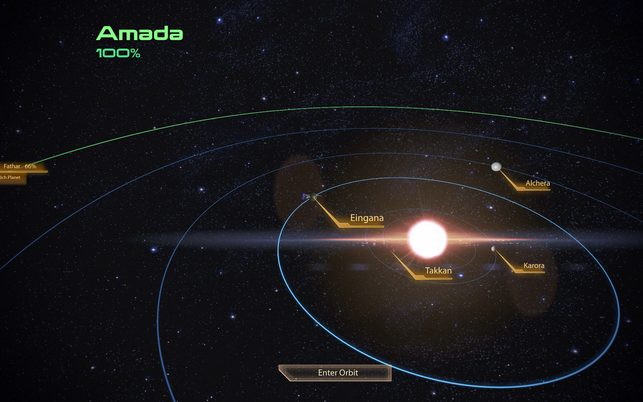
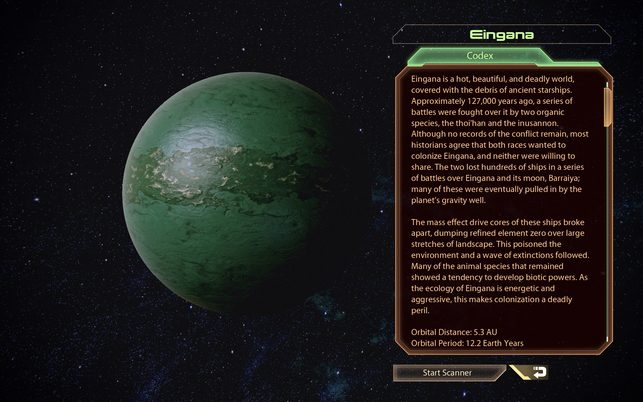
Eingana is a hot, beautiful, and deadly world, covered with the debris of ancient starships. Approximately 127,000 years ago, a series of battles were fought over it by two organic species, the thoi’han and the inusannon. Although no records of the conflict remain, most historians agree that both races wanted to colonize Eingana, and neither were willing to share. The two lost hundreds of ships in a series of battles over Eingana and its moon, Barraiya; many of these were eventually pulled in by the planet’s gravity well.
The mass effect drive cores of these ships broke apart, dumping refined element zero over large stretches of landscape. This poisoned the environment and a wave of extinctions followed. Many of the animal species that remained showed a tendency to develop biotic powers. As the ecology of Eingana is energetic and aggressive, this makes colonization a deadly peril.
Orbital Distance: 5.3 AU
Orbital Period: 12.2 Earth Years
Radius: 5,733 km
Day Length: 20.8 Earth Hours
Atmospheric Pressure: 0.84 Earth Atmospheres
Surface Temperature: 36 Celsius
Surface Gravity: 0.86 G
Karora
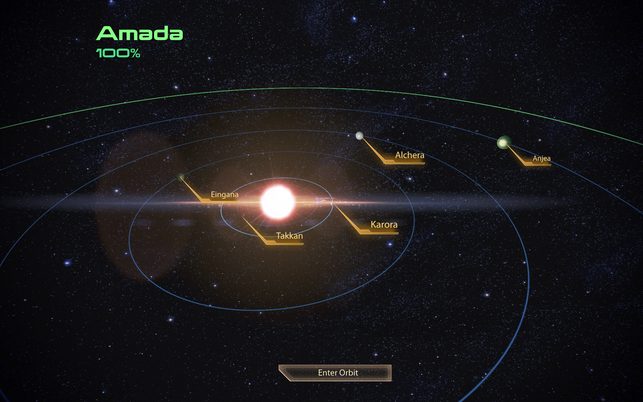
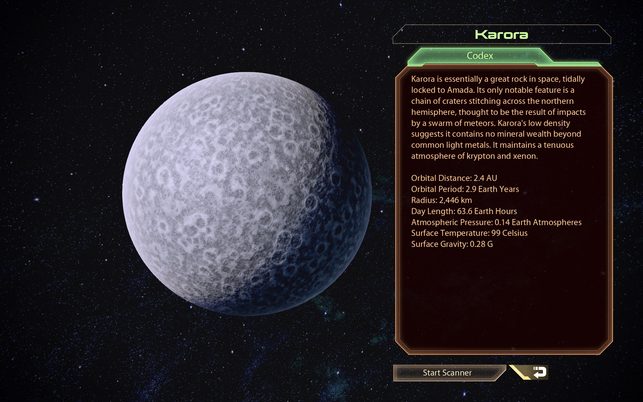
Karora is essentially a great rock in space, tidally locked to Amada. Its only notable feature is a chain of craters stitching across the northern hemisphere, thought to be the result of impacts by a swarm of meteors. Karora’s low density suggests it contains no mineral wealth beyond common light metals. It maintains a tenuous atmosphere of krypton and xenon.
Orbital Distance: 2.4 AU
Orbital Period: 2.9 Earth Years
Radius: 2,446 km
Day Length: 63.6 Earth Hours
Atmospheric Pressure: 0.14 Earth Atmospheres
Surface Temperature: 99 Celsius
Surface Gravity: 0.28 G
Takkan
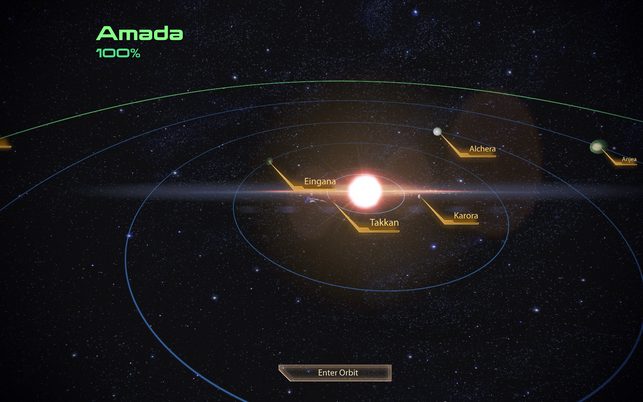
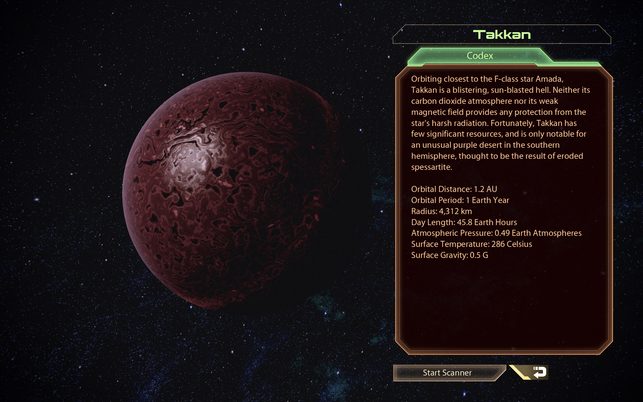
Orbiting closest to the F-class star Amada, Takkan is a blistering, sun-blasted hell. Neither its carbon dioxide atmosphere nor its weak magnetic field provides any protection from the star’s harsh radiation. Fortunately, Takkan has few significant resources, and is only notable for an unusual purple desert in the southern hemisphere, thought to be the result of eroded spessartite.
Orbital Distance: 1.2 AU
Orbital Period: 1 Earth Year
Radius: 4,312 km
Day Length: 45.8 Earth Hours
Atmospheric Pressure: 0.49 Earth Atmospheres
Surface Temperature: 286 Celsius
Surface Gravity: 0.5 G
ARINLARKAN
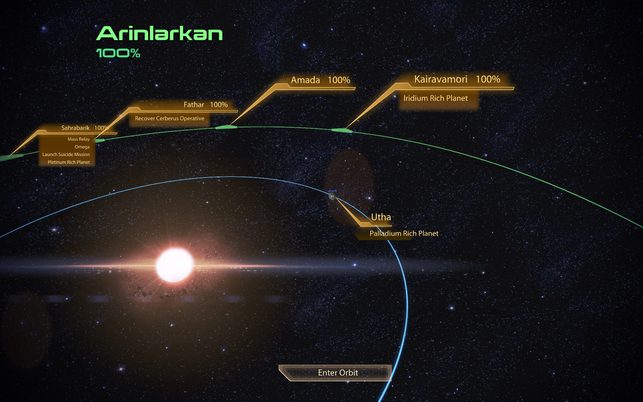
Utha
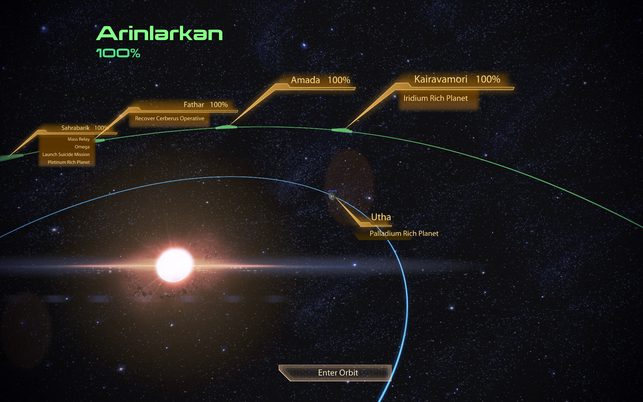
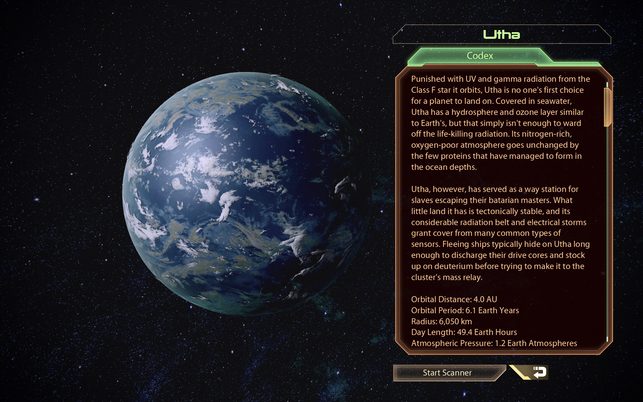
Punished with UV and gamma radiation from the Class F star it orbits, Utha is no one’s first choice for a planet to land on. Covered in seawater, Utha has a hydrosphere and ozone layer similar to Earth’s, but that simply isn’t enough to ward off the life-killing radiation. Its nitrogen-rich, oxygen-poor atmosphere goes unchanged by the few proteins that have managed to form in the ocean depths.
Utha, however, has served as a way station for slaves escaping their batarian masters. What little land it has is tectonically stable, and its considerable radiation belt and electrical storms grant cover from many common types of sensors. Fleeing ships typically hide on Utha long enough to discharge their drive cores and stock up on deuterium before trying to make it to the cluster’s mass relay.
Orbital Distance: 4.0 AU
Orbital Period: 6.1 Earth Years
Radius: 6,050 km
Day Length: 49.4 Earth Hours
Atmospheric Pressure: 1.2 Earth Atmospheres
Surface Temperature: 40 Celsius
Surface Gravity: 0.8 G
BATALLA
Logasiri
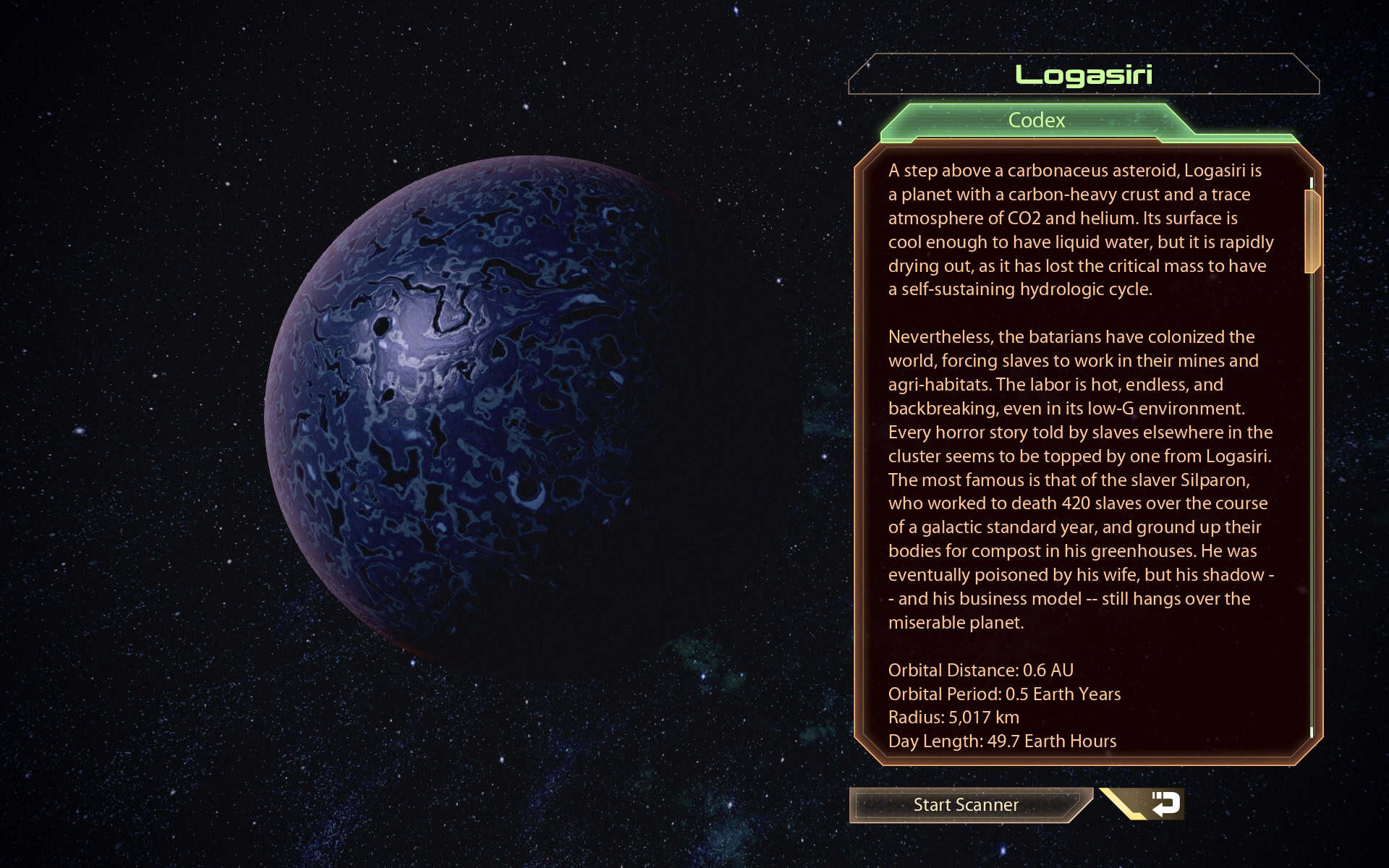
A step above a carbonaceus asteroid, Logasiri is a planet with a carbon-heavy crust and a trace atmosphere of CO2 and helium. Its surface is cool enough to have liquid water, but it is rapidly drying out, as it has lost the critical mass to have a self-sustaining hydrologic cycle.
Nevertheless, the batarians have colonized the world, forcing slaves to work in their mines and agri-habitats. The labor is hot, endless, and backbreaking, even in its low-G environment. Every horror story told by slaves elsewhere in the cluster seems to be topped by one from Logasiri. The most famous is that of the slaver Silparon, who worked to death 420 slaves over the course of a galactic standard year, and ground up their bodies for compost in his greenhouses. He was eventually poisoned by his wife, but his shadow – – and his business model – still hangs over the miserable planet.
Orbital Distance: 0,6 AU
Orbital Period: 0.5 Earth Years.
Radius: 5,017 km
Day Length: 49.7 Earth Hours
Atmospheric Pressure: Trace
Surface Temperature: 56 Celsius
Surface Gravity: 0.5 G
Nearog
Nearog is a hydrogen-methane gas giant whose moons were once home to Essul, a batarian warlord who terrorized the Terminus Systems. Attempting to unite a pirate army under his banner, he successfully conducted a rapid blitz against 11 habitable planets.
Fortunately for the rest of the galaxy, Essul’s crimes caught the attention of the Spectres, who deduced his hidden location and assassinated him. Essul’s empire, built on a hyperextended army, soon came crashing down. His lost stockpiles of element zero have become something of a legend, and foolish spacers have spent countless amounts of time and money searching the Batalla system, convinced they will be the ones that finally strike it rich.
Orbital Distance: 4.8 AU
Orbital Period: 11.8 Earth Years
Radius: 19,976 km
Day Length: 16.5 Earth Hours
Thunawaruno
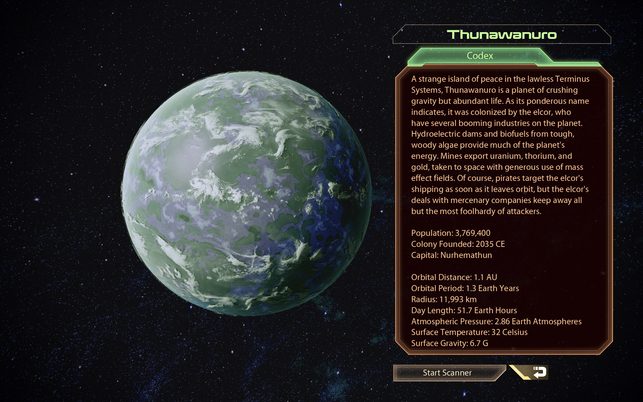
A strange island of peace in the lawless Terminus Systems, Thunawanuro is a planet of crushing gravity but abundant life. As its ponderous name indicates, it was colonized by the elcor, who have several booming industries on the planet. Hydroelectric dams and biofuels from tough, woody algae provide much of the planet’s energy. Mines export uranium, thorium, and gold, taken to space with generous use of mass effect fields. Of course, pirates target the elcor’s shipping as soon as it leaves orbit, but the elcor’s deals with mercenary companies keep away all but the most foolhardy of attackers.
Population: 3,769,400
Colony Founded: 2035 CE
Capital: Nurhemathun
Orbital Distance: 1.1 AU
Orbital Period: 1.3 Earth Years
Radius: 11,993 km
Day Length: 51.7 Earth Hours
Atmospheric Pressure: 2.86 Earth Atmospheres
Surface Temperature: 32 Celsius
Surface Gravity: 6.7 G
FATHAR
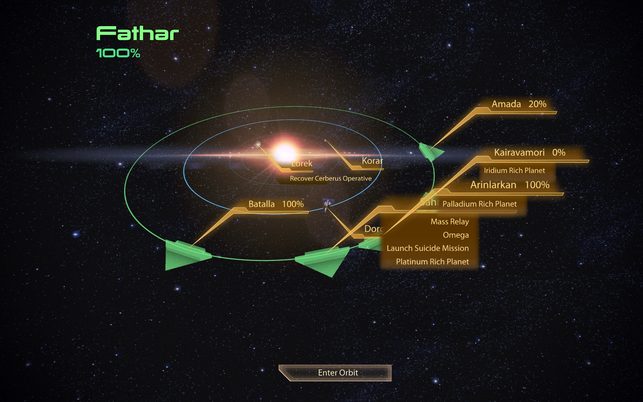
Dorgal
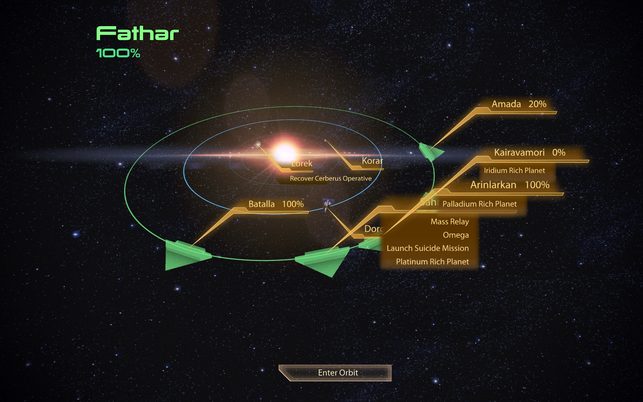
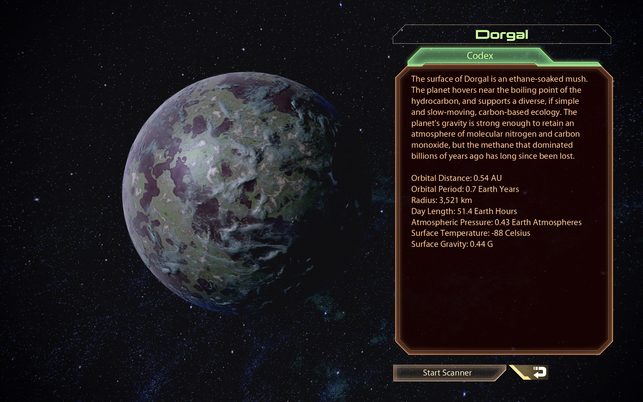
The surface of Dorgal is an ethane-soaked mush. The planet hovers near the boiling point of the hydrocarbon, and supports a diverse, if simple and slow-moving, carbon-based ecology. The planet’s gravity is strong enough to retain an atmosphere of molecular nitrogen and carbon monoxide, but the methane that dominated billions of years ago has long since been lost.
Orbital Distance: 0.54 AU
Orbital Period: 0.7 Earth Years
Radius: 3,521 km
Day Length: 51.4 Earth Hours
Atmospheric Pressure: 0.43 Earth Atmospheres
Surface Temperature: -88 Celsius
Surface Gravity: 0.44 G
Korar
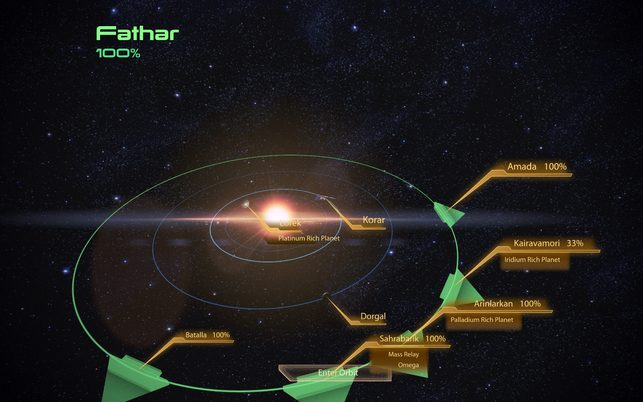
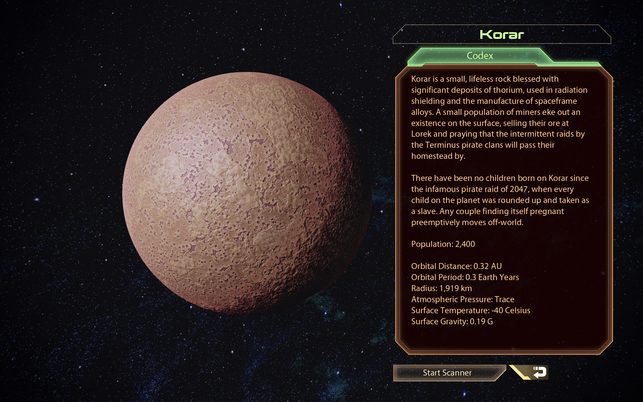
Korar is a small, lifeless rock blessed with significant deposits of thorium, used in radiation shielding and the manufacture of spaceframe alloys. A small population of miners eke out an existence on the surface, selling their ore at Lorek and praying that the intermittent raids by the Terminus pirate clans will pass their homestead by.
There have been no children born on Korar since the infamous pirate raid of 2047, when every child on the planet was rounded up and taken as a slave. Any couple finding itself pregnant preemptively moves off-world.
Population: 2,400
Orbital Distance: 0.32 AU
Orbital Period: 0.3 Earth Years
Radius: 1,919 km
Atmospheric Pressure: Trace
Surface Temperature: -40 Celsius
Surface Gravity: 0.19 G
Lorek*
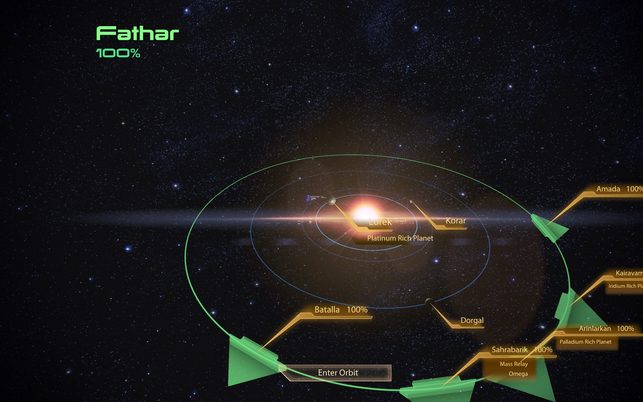
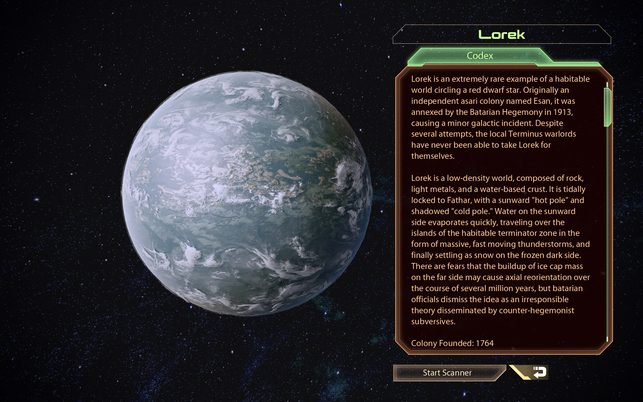
Lorek is an extremely rare example of a habitable world circling a red dwarf star. Originally an independent asari colony named Esan, it was annexed by the Batarian Hegemony in 1913, causing a minor galactic incident. Despite several attempts, the local Terminus warlords have never been able to take Lorek for themselves.
Lorek is a low-density world, composed of rock, light metals, and a water-based crust. It is tidally locked to Fathar, with a sunward “hot pole” and shadowed “cold pole.” Water on the sunward side evaporates quickly, traveling over the islands of the habitable terminator zone in the form of massive, fast moving thunderstorms, and finally settling as snow on the frozen dark side. There are fears that the buildup of ice cap mass on the far side may cause axial reorientation over the course of several million years, but batarian officials dismiss the idea as an irresponsible theory disseminated by counter-hegemonist subversives.
Colony Founded: 1764
Population: 4,700,000
Capital: Jalnor
Orbital Distance: 0.2 AU
Orbital Period: 59.6 Earth Days
Radius: 6,754 km
Orbital Period: 59.6 Earth Days
Atmospheric Pressure: 0.4 Earth Atmospheres
Surface Temperature: 40 Celsius
Surface Gravity: 0.6 G
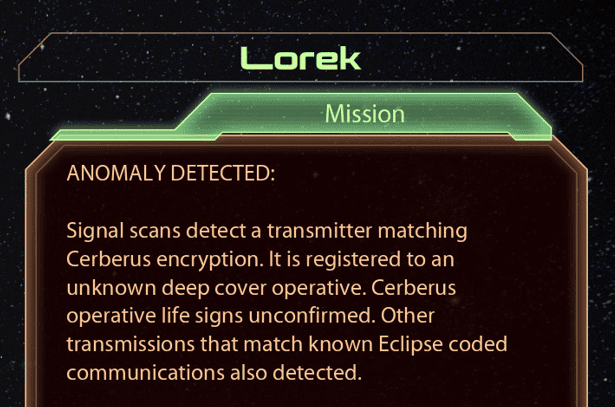
KAIRAVAMORI
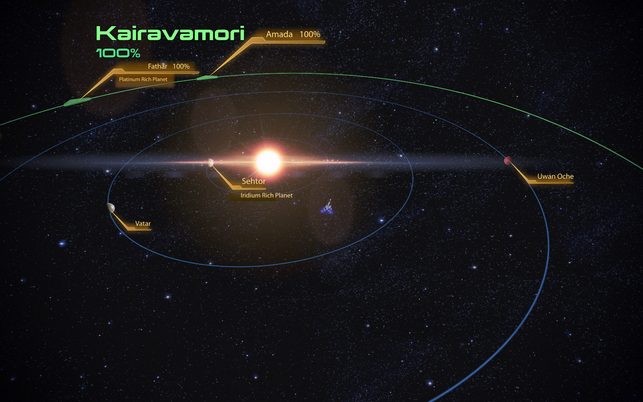
Sehtor
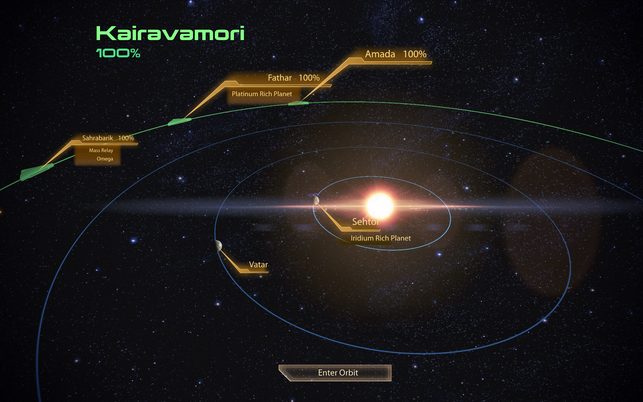
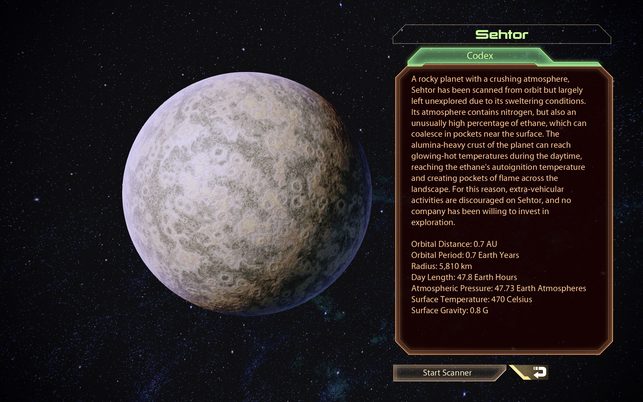
A rocky planet with a crushing atmosphere, Sehtor has been scanned from orbit but largely left unexplored due to its sweltering conditions. Its atmosphere contains nitrogen, but also an unusually high percentage of ethane, which can coalesce in pockets near the surface. The alumina-heavy crust of the planet can reach glowing-hot temperatures during the daytime, reaching the ethane’s autoignition temperature and creating pockets of flame across the landscape. For this reason, extra-vehicular activities are discouraged on Sehtor, and no company has been willing to invest in exploration.
Orbital Distance: 0.7 AU
Orbital Period: 0.7 Earth Years
Radius: 5,810 km
Day Length: 47.8 Earth Hours
Atmospheric Pressure: 47.73 Earth Atmospheres
Surface Temperature: 470 Celsius
Surface Gravity: 0.8 G
Uwan Oche
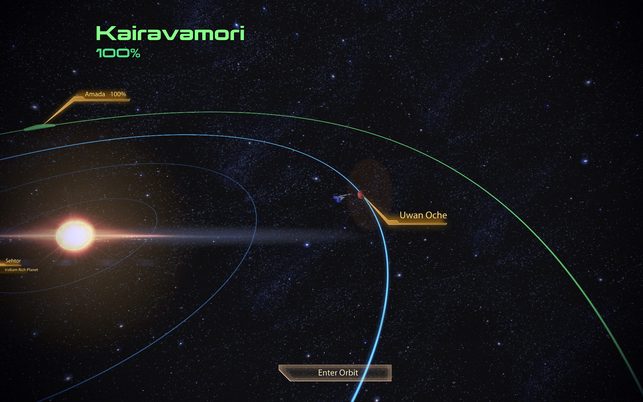
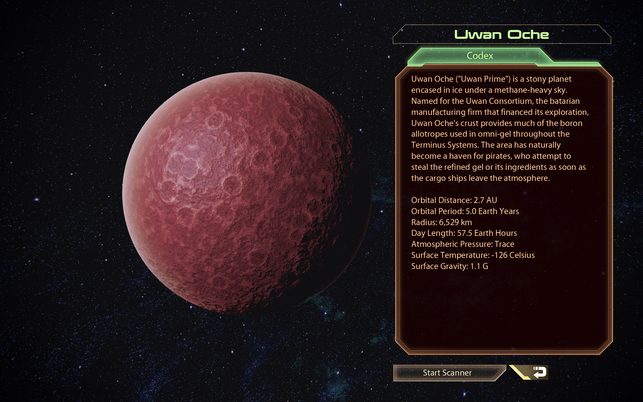
Uwan Oche (“Uwan Prime”) is a stony planet encased in ice under a methane-heavy sky. Named for the Uwan Consortium, the batarian manufacturing firm that financed its exploration, Uwan Oche’s crust provides much of the boron allotropes used in omni-gel throughout the Terminus Systems. The area has naturally become a haven for pirates, who attempt to steal the refined gel or its ingredients as soon as the cargo ships leave the atmosphere.
Orbital Distance: 2.7 AU
Orbital Period: 5.0 Earth Years
Radius: 6,529 km
Day Length: 57.5 Earth Hours
Atmospheric Pressure: Trace
Surface Temperature: -126 Celsius
Surface Gravity: 1.1 G
Vatar
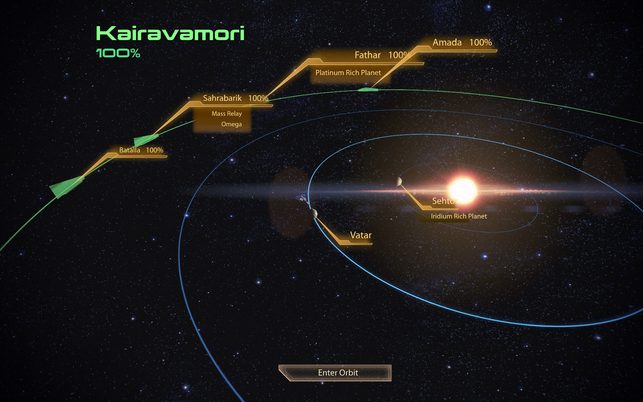
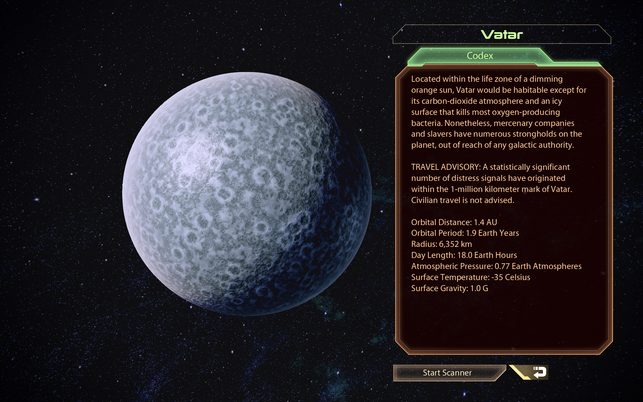
Located within the life zone of a dimming orange sun, Vatar would be habitable except for its carbon-dioxide atmosphere and an icy surface that kills most oxygen-producing bacteria. Nonetheless, mercenary companies and slavers have numerous strongholds on the planet, out of reach of any galactic authority.
TRAVEL ADVISORY: A statistically significant number of distress signals have originated within the 1-million kilometer mark of Vatar. Civilian travel is not advised.
Orbital Distance: 1.4 AU
Orbital Period: 1.9 Earth Years
Radius: 6,352 km
Day Length: 18.0 Earth Hours
Atmospheric Pressure: 0.77 Earth Atmospheres
Surface Temperature: -35 Celsius
Surface Gravity: 1.0 G
SAHARABARIK
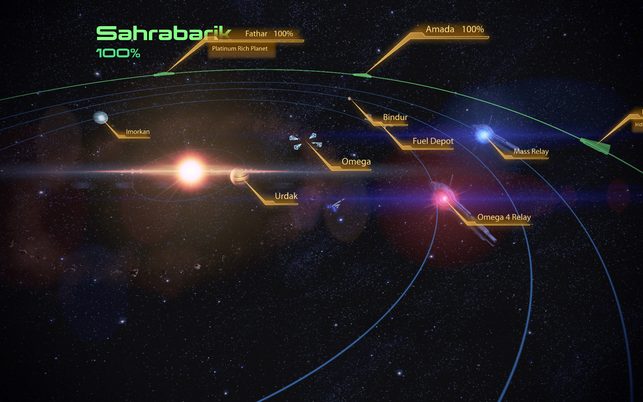
Bindur
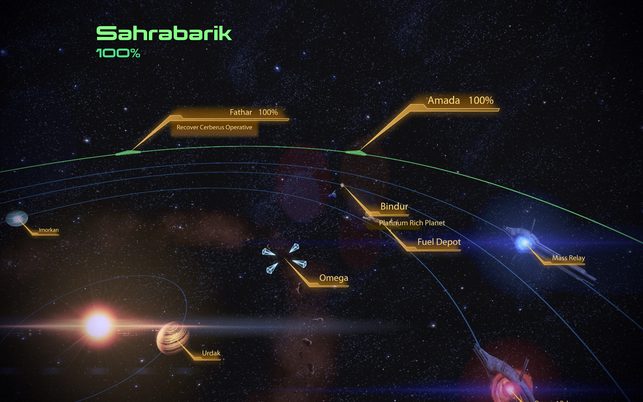
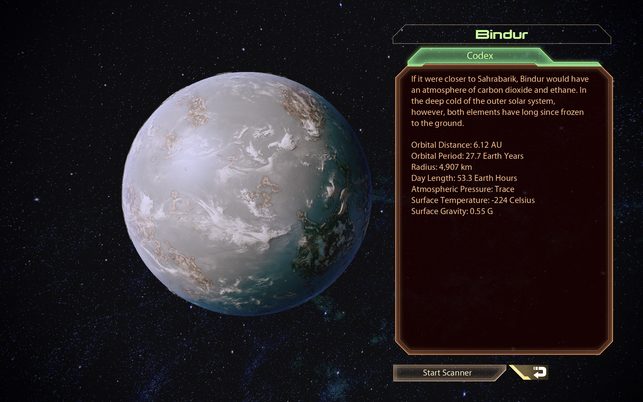
If it were closer to Sahrabarik, Bindur would have an atmosphere of carbon dioxide and ethane. In the deep cold of the outer solar system,
however, both elements have long since frozen to the ground.
Orbital Distance: 6.12 AU
Orbital Period: 27.7 Earth Years
Radius: 4,907 km
Day Length: 53.3 Earth Hours
Atmospheric Pressure: Trace
Surface Temperature: -224
Celsius Surface Gravity: 0.55 G
Imorkan
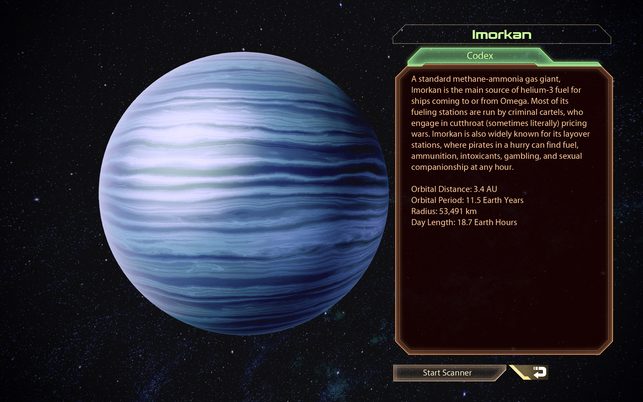
A standard methane-ammonia gas giant, Imorkan is the main source of helium-3 fuel for ships coming to or from Omega. Most of its fueling stations are run by criminal cartels, who engage in cutthroat (sometimes literally) pricing wars. Imorkan is also widely known for its layover stations, where pirates in a hurry can find fuel, ammunition, intoxicants, gambling, and sexual companionship at any hour.
Orbital Distance: 3.4 AU
Orbital Period: 11.5 Earth Years
Radius: 53,491 km
Day Length: 18.7 Earth Hours
Omega
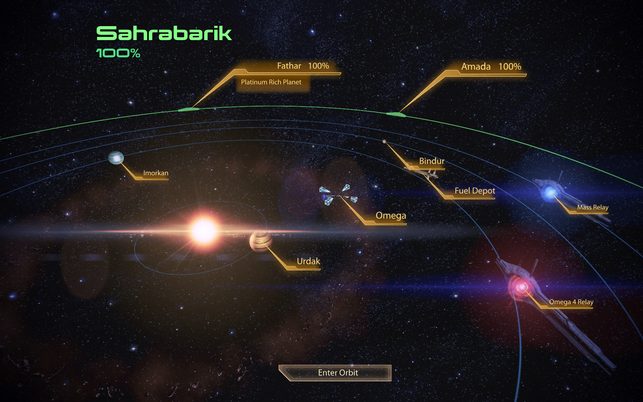
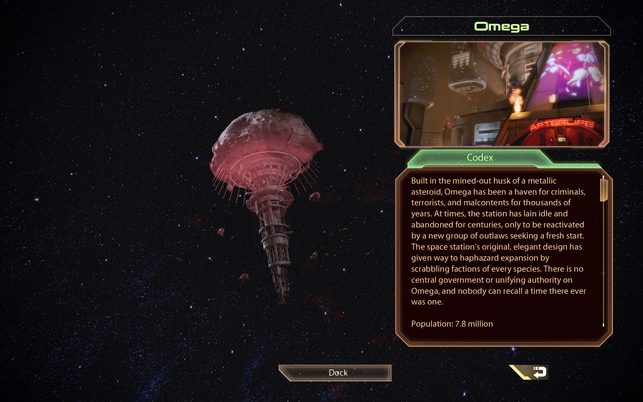
Built in the mined-out husk of a metallic asteroid, Omega has been a haven for criminals, terrorists, and malcontents for thousands of years. At times, the station has lain idle and abandoned for centuries, only to be reactivated by a new group of outlaws seeking a fresh start. The space station’s original, elegant design has given way to haphazard expansion by scrabbling factions of every species. There is no central government or unifying authority on Omega, and nobody can recall a time there ever was one.
Population: 7.8 million
Orbital Distance: 2.43 AU
Orbital Period: 6.9 Earth Years
Total Length: 44.7 km
Urdark
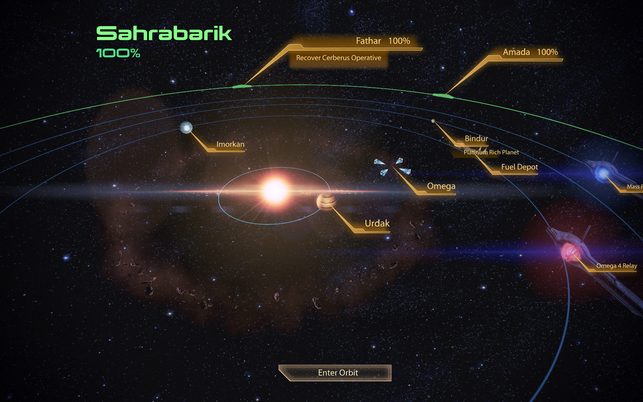
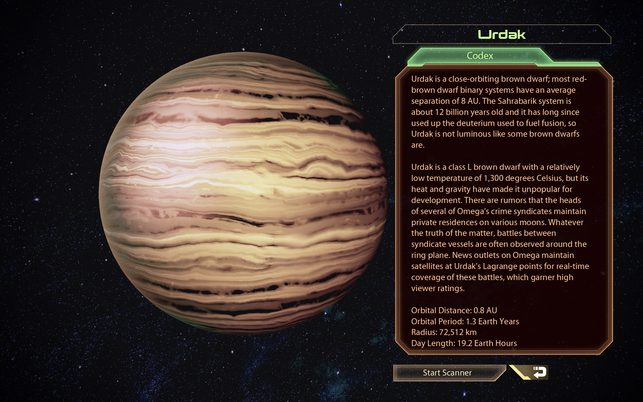
Urdak is a close-orbiting brown dwarf; most red-brown dwarf binary systems have an average separation of 8 AU. The Sahrabarik system is about 12 billion years old and it has long since used up the deuterium used to fuel fusion, so Urdak is not luminous like some brown dwarfs are.
Urdak is a class L brown dwarf with a relatively low temperature of 1,300 degrees Celsius, but its heat and gravity have made it unpopular for development. There are rumors that the heads of several of Omega’s crime syndicates maintain private residences on various moons. Whatever the truth of the matter, battles between syndicate vessels are often observed around the ring plane. News outlets on Omega maintain satellites at Urdak’s Lagrange points for real-time coverage of these battles, which garner high viewer ratings.
Orbital Distance: 0.8 AU
Orbital Period: 1.3 Earth Years
Radius: 72,512 km
Day Length: 19.2 Earth Hours
PYLOS NEBULA
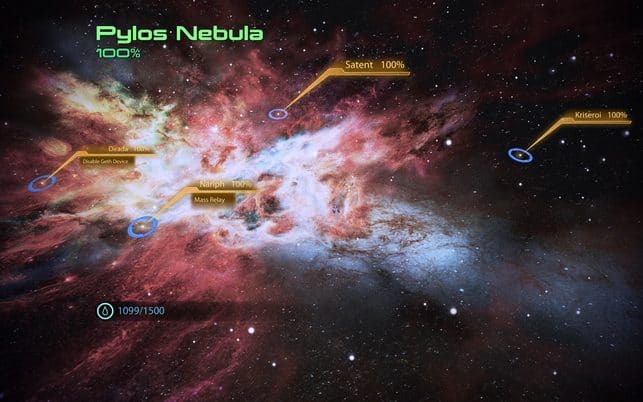
DIRADA
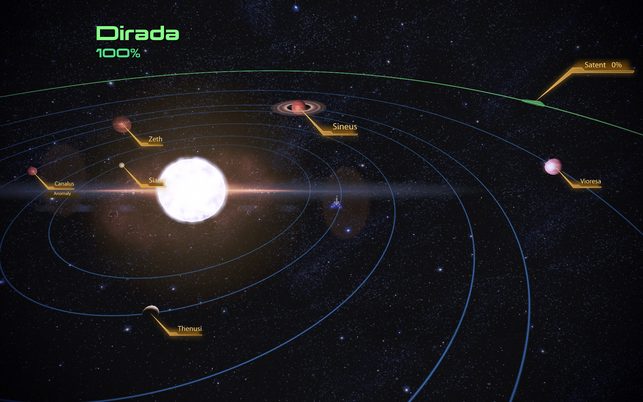
Canalus*
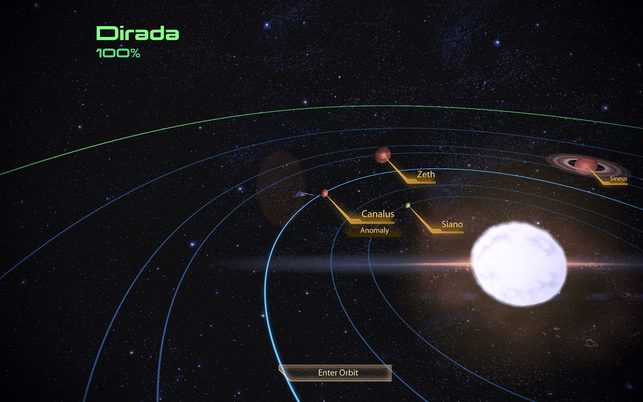
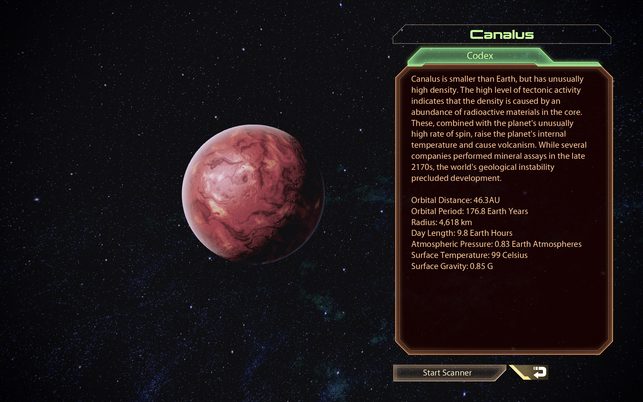
Canalus is smaller than Earth, but has unusually high density. The high level of tectonic activity indicates that the density is caused by an abundance of radioactive materials in the core. These, combined with the planet’s unusually high rate of spin, raise the planet’s internal temperature and cause volcanism. While several companies performed mineral assays in the late 2170s, the world’s geological instability precluded development.
Orbital Distance: 46.3AU
Orbital Period: 176.8 Earth Years
Radius: 4,618 km
Day Length: 9.8 Earth Hours
Atmospheric Pressure: 0.83 Earth Atmospheres
Surface Temperature: 99 Celsius
Surface Gravity: 0.85 G
Siano
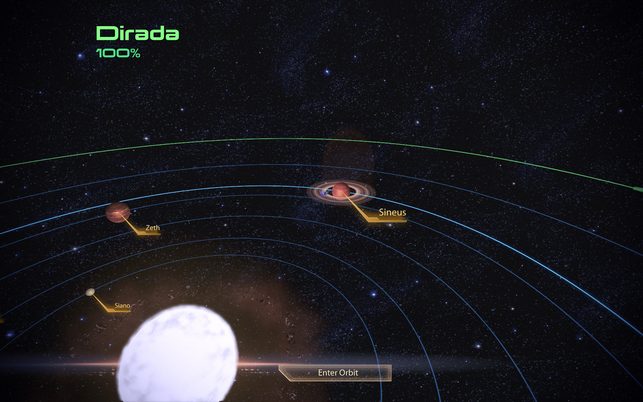
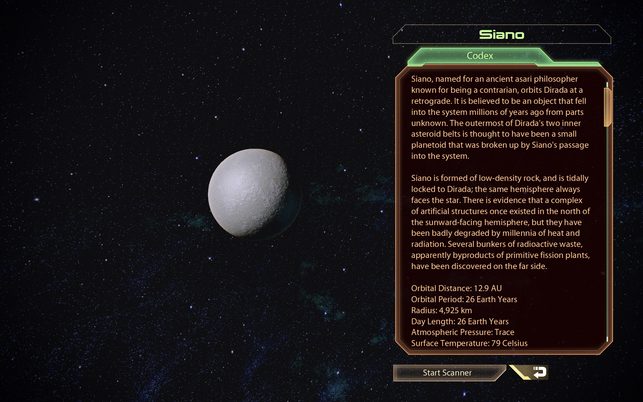
Siano, named for an ancient asari philosopher known for being a contrarian, orbits Dirada at a retrograde. It is believed to be an object that fell into the system millions of years ago from parts unknown. The outermost of Dirada’s two inner asteroid belts is thought to have been a small planetoid that was broken up by Siano’s passage into the system.
Siano is formed of low-density rock, and is tidally locked to Dirada; the same hemisphere always faces the star. There is evidence that a complex of artificial structures once existed in the north of the sunward-facing hemisphere, but they have been badly degraded by millennia of heat and radiation. Several bunkers of radioactive waste, apparently byproducts of primitive fission plants, have been discovered on the far side.
Orbital Distance: 12.9 AU
Orbital Period: 26 Earth Years
Radius: 4,925 km
Day Length: 26 Earth Years
Atmospheric Pressure: Trace
Surface Temperature: 79 Celsius
Surface Gravity: 0.47 G
Sineus
A standard hydrogen-helium gas giant, Sineus has more than 80 moons.
Orbital Distance: 138.9 AU
Orbital Period: 919.2 Earth Years
Radius: 63,748 km
Day Length: 16.4 Earth Hours
Thenusi
Thenusi is a small, barren rock. Though there is evidence that it once had an atmosphere of carbon dioxide, only trace amounts of krypton and xenon remain. Like Siano, it is tidally locked to Dirada.
Orbital Distance: 25.7 AU
Orbital Period: 73.1 Earth Years
Radius: 3,602 km
Day Length: 73.1 Earth Years
Atmospheric Pressure: Trace
Surface Temperature: -10 Celsius
Surface Gravity: 0.33 G
Vioresa
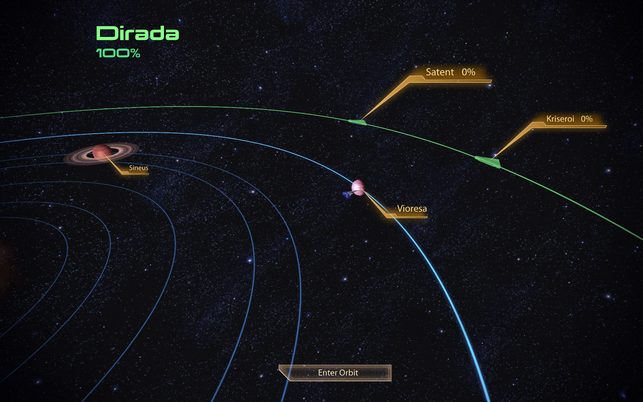
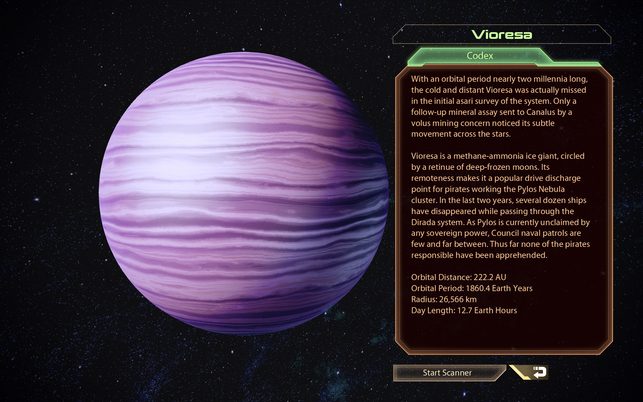
With an orbital period nearly two millennia long, the cold and distant Vioresa was actually missed in the initial asari survey of the system. Only a follow-up mineral assay sent to Canalus by a volus mining concern noticed its subtle movement across the stars.
Vioresa is a methane-ammonia ice giant, circled by a retinue of deep-frozen moons. Its remoteness makes it a popular drive discharge point for pirates working the Pylos Nebula cluster. In the last two years, several dozen ships have disappeared while passing through the Dirada system. As Pylos is currently unclaimed by any sovereign power, Council naval patrols are few and far between. Thus far none of the pirates responsible have been apprehended.
Orbital Distance: 222.2 AU
Orbital Period: 1860.4 Earth Years
Radius: 26,566 km
Day Length: 12.7 Earth Hours
Zeth
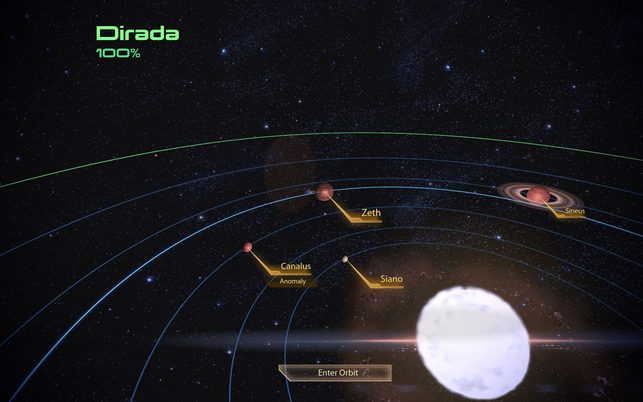
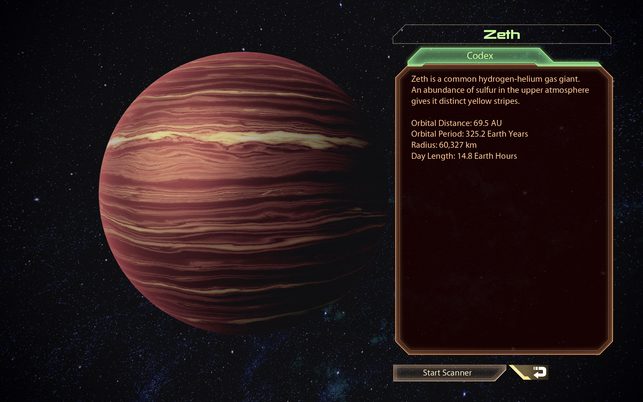
Zeth is a common hydrogen-helium gas giant.
An abundance of sulfur in the upper atmosphere gives it distinct yellow stripes.
Orbital Distance: 69.5 AU
Orbital Period: 325.2 Earth Years
Radius: 60,327 km
Day Length: 14.8 Earth Hours
KRISEROI
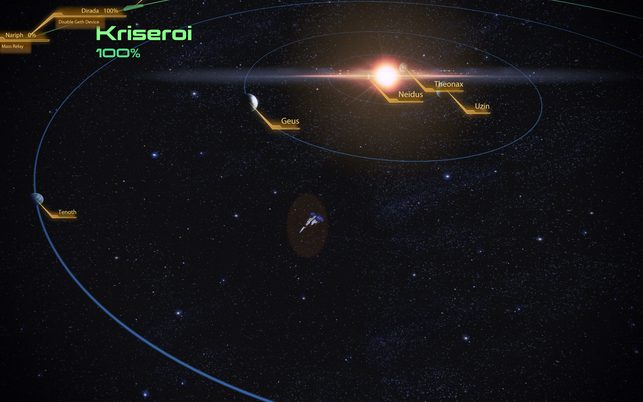
Geus
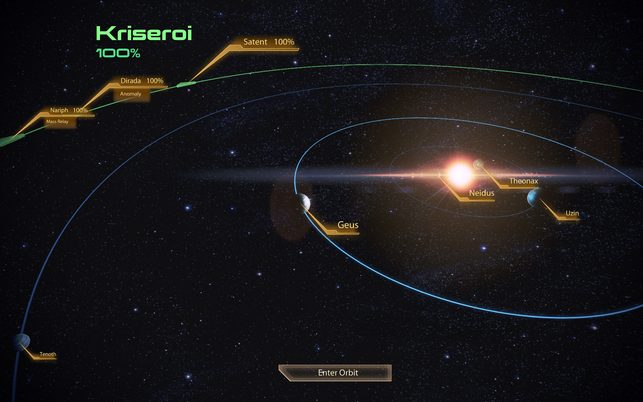
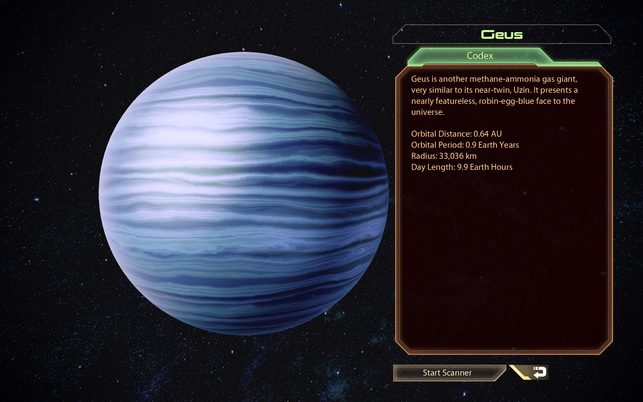
Geus is another methane-ammonia gas giant, very similar to its near-twin, Uzin. It presents a nearly featureless, robin-egg-blue face to the universe.
Orbital Distance: 0.64 AU
Orbital Period: 0.9 Earth Years
Radius: 33,036 km
Day Length: 9.9 Earth Hours
Neidus
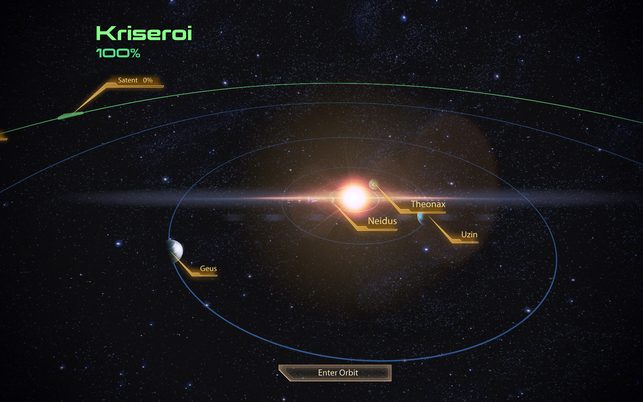
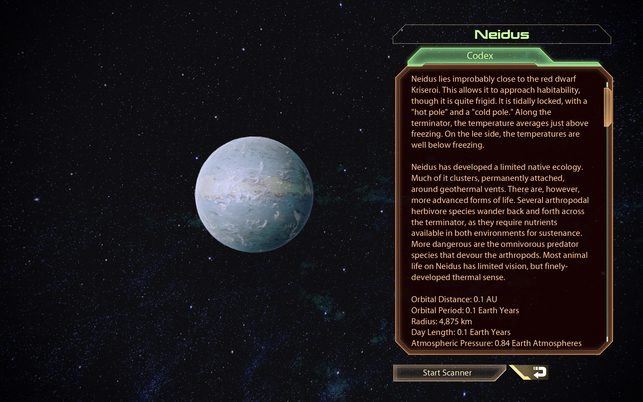
Neidus lies improbably close to the red dwarf Kriseroi. This allows it to approach habitability, though it is quite frigid. It is tidally locked, with a “hot pole” and a “cold pole.” Along the terminator, the temperature averages just above freezing. On the lee side, the temperatures are well below freezing.
Neidus has developed a limited native ecology. Much of it clusters, permanently attached, around geothermal vents. There are, however, more advanced forms of life. Several arthropodal herbivore species wander back and forth across the terminator, as they require nutrients available in both environments for sustenance. More dangerous are the omnivorous predator species that devour the arthropods. Most animal life on Neidus has limited vision, but finely-developed thermal sense.
Orbital Distance: 0.1 AU
Orbital Period: 0.1 Earth Years
Radius: 4,875 km
Day Length: 0.1 Earth Years
Atmospheric Pressure: 0.84 Earth Atmospheres
Surface Temperature: 2 Celsius
Surface Gravity: 0.87 G
Tenoth
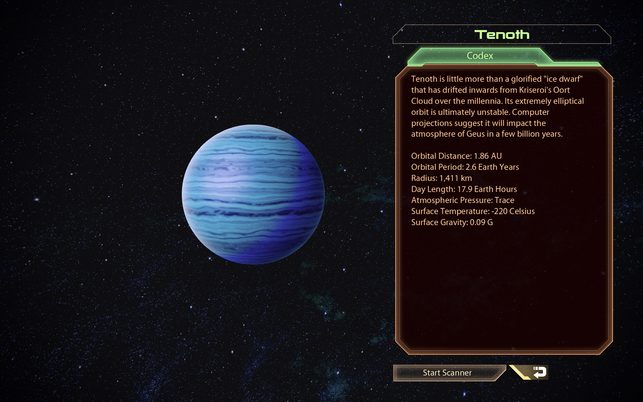
Tenoth is little more than a glorified “ice dwarf” that has drifted inwards from Kriseroi’s Oort Cloud over the millennia. Its extremely elliptical orbit is ultimately unstable. Computer projections suggest it will impact the atmosphere of Geus in a few billion years.
Orbital Distance: 1.86 AU
Orbital Period: 2.6 Earth Years
Radius: 1,411 km
Day Length: 17.9 Earth Hours
Atmospheric Pressure: Trace
Surface Temperature: -220 Celsius
Surface Gravity: 0.09 G
Theonax
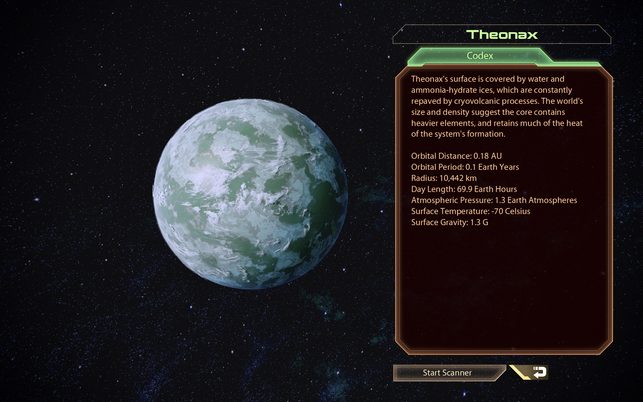
Theonax’s surface is covered by water and ammonia-hydrate ices, which are constantly repaved by cryovolcanic processes. The world’s size and density suggest the core contains heavier elements, and retains much of the heat of the system’s formation.
Orbital Distance: 0.18 AU
Orbital Period: 0.1 Earth Years
Radius: 10,442 km
Day Length: 69.9 Earth Hours
Atmospheric Pressure: 1.3 Earth Atmospheres
Surface Temperature: -70 Celsius
Surface Gravity: 1.3 G
Uzin
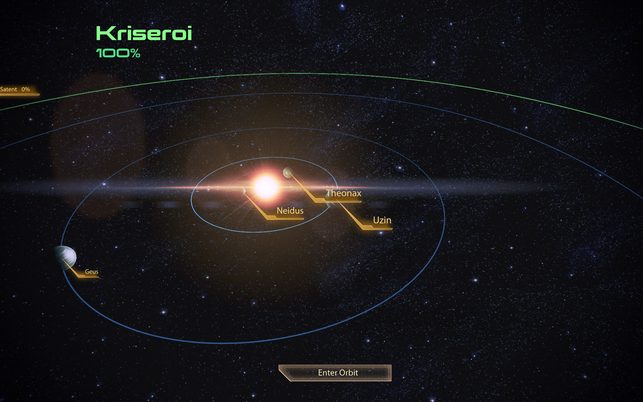
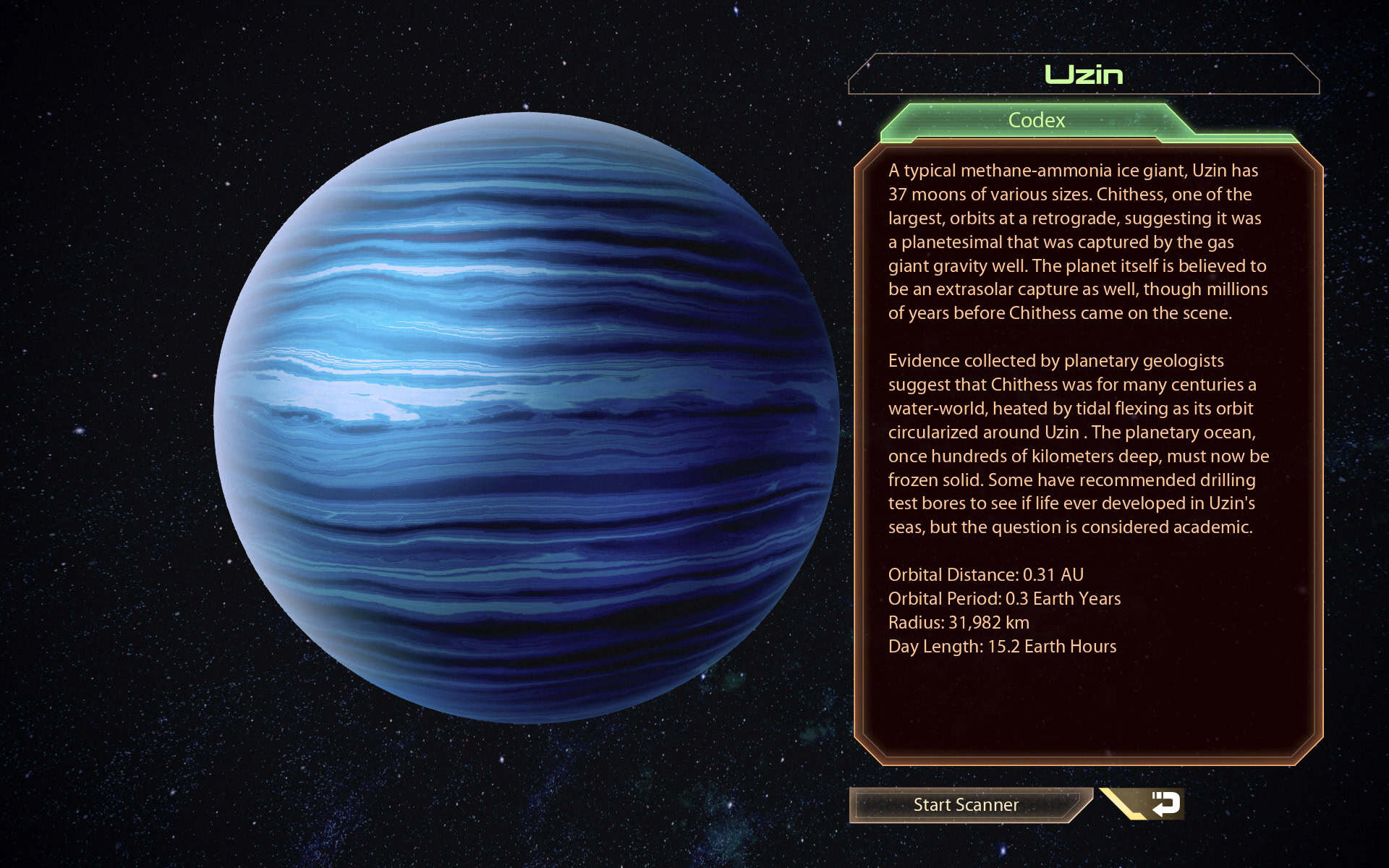
A typical methane-ammonia ice giant, Uzin has 37 moons of various sizes. Chithess, one of the largest, orbits at a retrograde, suggesting it was a planetesimal that was captured by the gas giant gravity well. The planet itself is believed to be an extrasolar capture as well, though millions of years before Chithess came on the scene.
Evidence collected by planetary geologists suggest that Chithess was for many centuries a water-world, heated by tidal flexing as its orbit circularized around Uzin. The planetary ocean, once hundreds of kilometers deep, must now be frozen solid. Some have recommended drilling test bores to see if life ever developed in Uzin’s seas, but the question is considered academic.
Orbital Distance: 0.31 AU
Orbital Period: 0.3 Earth Years
Radius: 31,982 km
Day Length: 15.2 Earth Hours
NARIPH
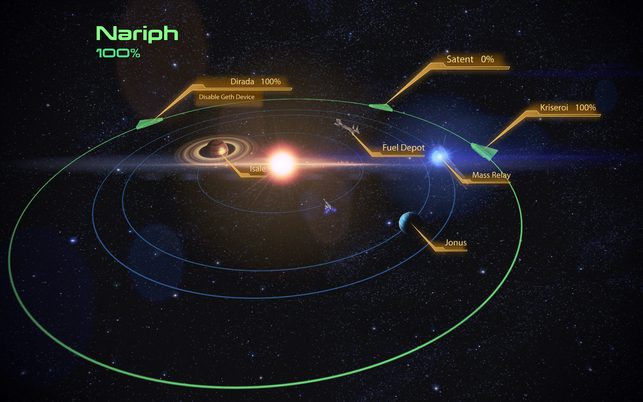
Isale
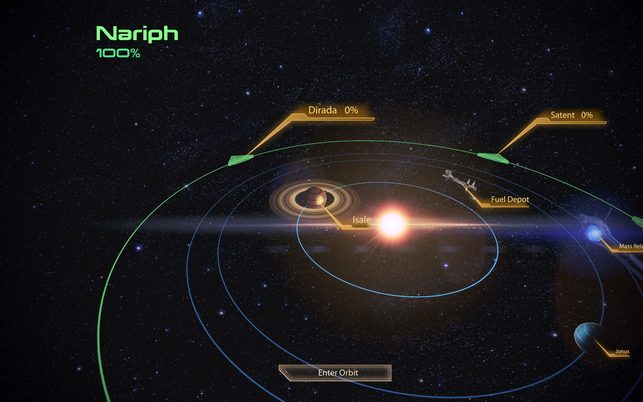
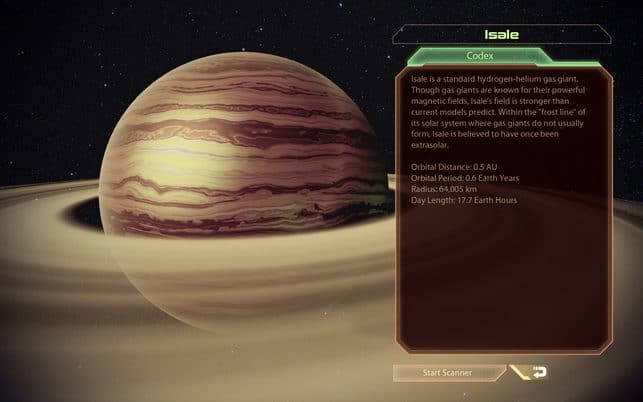
Isale is a standard hydrogen-helium gas giant. Though gas giants are known for their powerful magnetic fields, Isale’s field is stronger than current models predict. Within the “frost line” of its solar system where gas giants do not usually form, Isale is believed to have once been extrasolar.
Orbital Distance: 0.5 AU
Orbital Period: 0.6 Earth Years Radius: 64,005 km
Day Length: 17.7 Earth Hours
Jonus
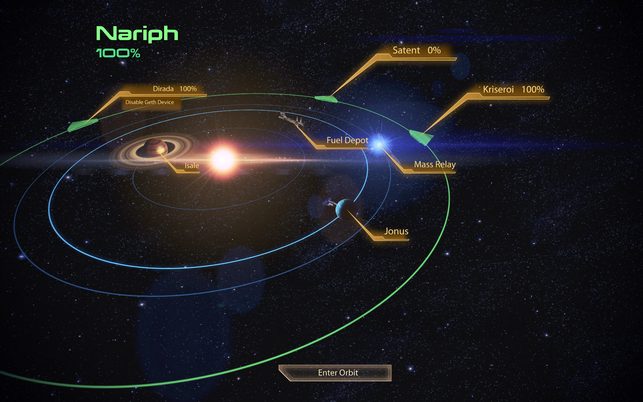
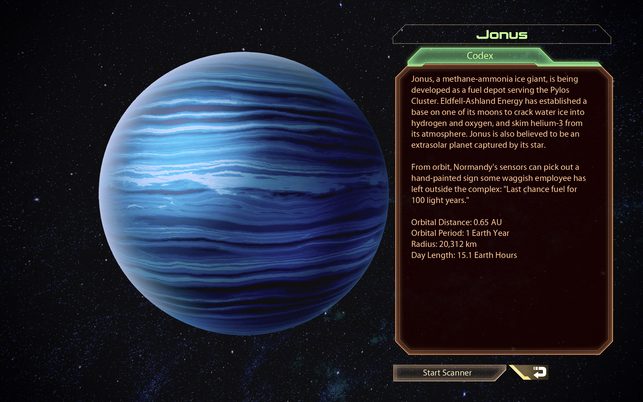
Jonus, a methane-ammonia ice giant, is being developed as a fuel depot serving the Pylos Cluster. Eldfell-Ashland Energy has established a base on one of its moons to crack water ice into hydrogen and oxygen, and skim helium-3 from its atmosphere. Jonus is also believed to be an extrasolar planet captured by its star.
From orbit, Normandy’s sensors can pick out a hand-painted sign some waggish employee has left outside the complex: “Last chance fuel for 100 light years.”
Orbital Distance: 0.65 AU
Orbital Period: 1 Earth Year
Radius: 20,312 km
Day Length: 15.1 Earth Hours
SATENT
Anedia
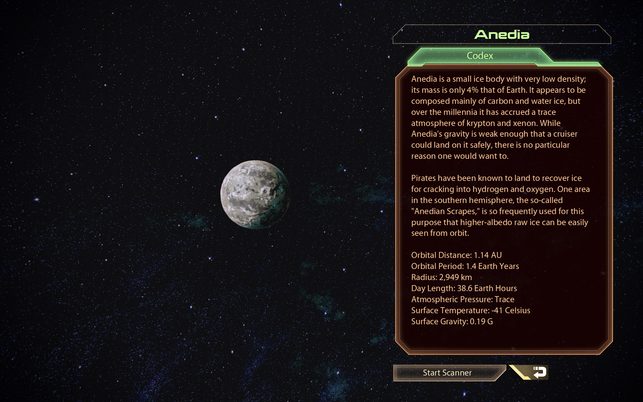
Anedia is a small ice body with very low density; its mass is only 4% that of Earth. It appears to be composed mainly of carbon and water ice, but over the millennia it has accrued a trace atmosphere of krypton and xenon. While Anedia’s gravity is weak enough that a cruiser could land on it safely, there is no particular reason one would want to.
Pirates have been known to land to recover ice for cracking into hydrogen and oxygen. One area in the southern hemisphere, the so-called “Anedian Scrapes,” is so frequently used for this purpose that higher-albedo raw ice can be easily seen from orbit.
Orbital Distance: 1.14 AU
Orbital Period: 1.4 Earth Years
Radius: 2,949 km
Day Length: 38.6 Earth Hours
Atmospheric Pressure: Trace
Surface Temperature: -41
Celsius Surface Gravity: 0.19 G
Boro
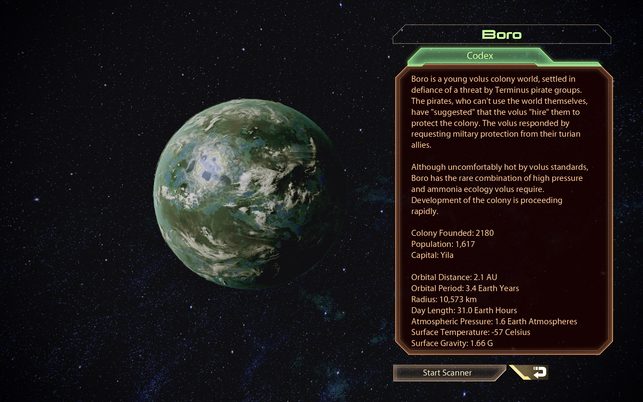
Boro is a young volus colony world, settled in defiance of a threat by Terminus pirate groups. The pirates, who can’t use the world themselves, have “suggested” that the volus “hire” them to protect the colony. The volus responded by requesting miltary protection from their turian allies.
Although uncomfortably hot by volus standards, Boro has the rare combination of high pressure and ammonia ecology volus require. Development of the colony is proceeding rapidly.
Colony Founded: 2180
Population: 1,617
Capital: Yila
Orbital Distance: 2.1 AU
Orbital Period: 3.4 Earth Years
Radius: 10,573 km
Day Length: 31.0 Earth Hours
Atmospheric Pressure: 1.6 Earth Atmospheres
Surface Temperature: -57 Celsius
Surface Gravity: 1.66 G
Nataisa
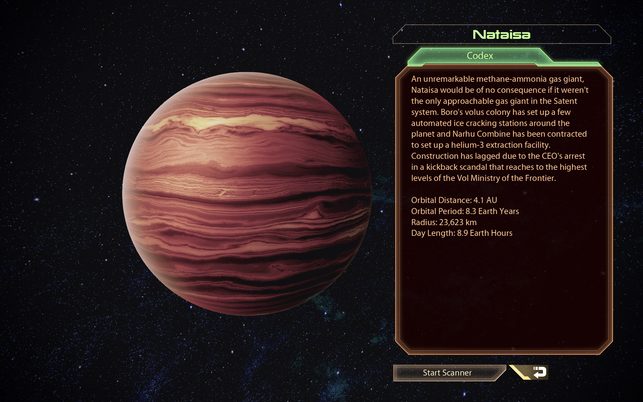
An unremarkable methane-ammonia gas giant, Nataisa would be of no consequence if it weren’t the only approachable gas giant in the Satent system. Boro’s volus colony has set up a few automated ice cracking stations around the planet and Narhu Combine has been contracted to set up a helium-3 extraction facility. Construction has lagged due to the CEO’s arrest in a kickback scandal that reaches to the highest levels of the Vol Ministry of the Frontier.
Orbital Distance: 4.1 AU
Orbital Period: 8.3 Earth Years
Radius: 23,623 km
Day Length: 8.9 Earth Hours
Raisaris
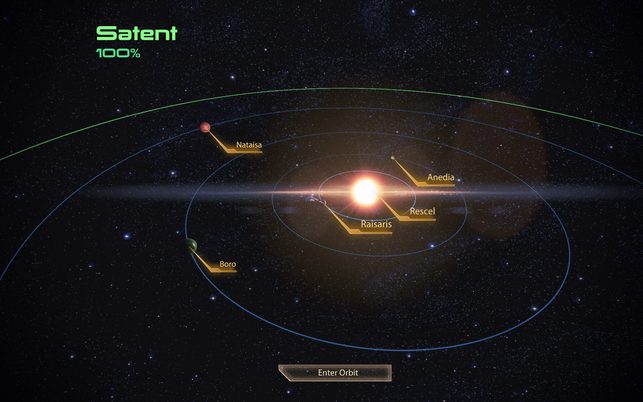
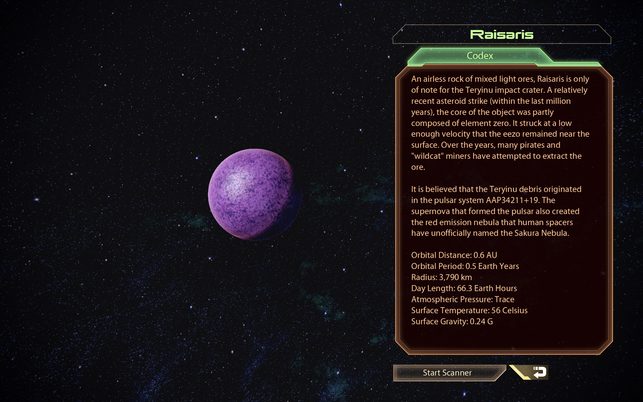
An airless rock of mixed light ores, Raisaris is only of note for the Teryinu impact crater. A relatively recent asteroid strike (within the last million years), the core of the object was partly composed of element zero. It struck at a low enough velocity that the eezo remained near the surface. Over the years, many pirates and “wildcat” miners have attempted to extract the ore.
It is believed that the Teryinu debris originated in the pulsar system AAP34211+19. The supernova that formed the pulsar also created the red emission nebula that human spacers have unofficially named the Sakura Nebula.
Orbital Distance: 0.6 AU
Orbital Period: 0.5 Earth Years
Radius: 3,790 km
Day Length: 66.3 Earth Hours
Atmospheric Pressure: Trace
Surface Temperature: 56 Celsius
Surface Gravity: 0.24 G
Rescel
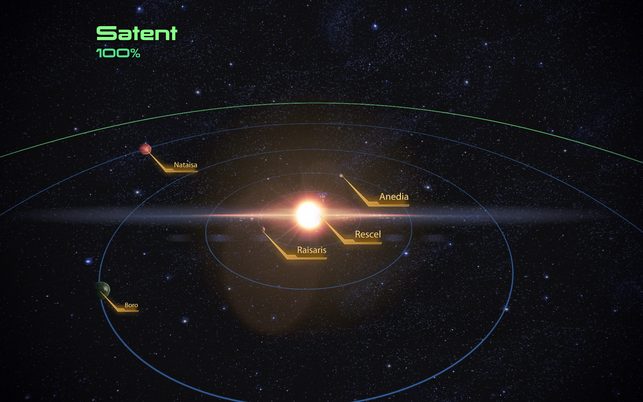
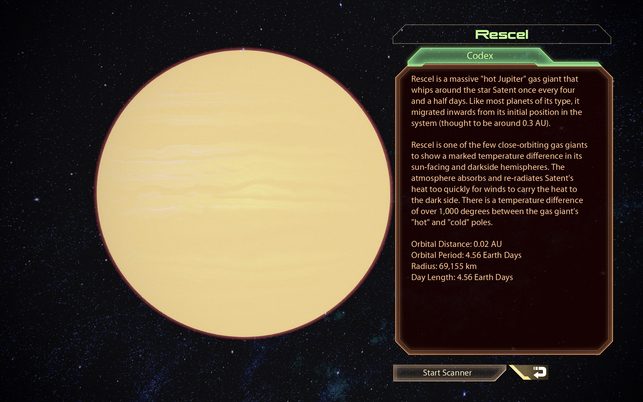
Rescel is a massive “hot Jupiter” gas giant that whips around the star Satent once every four and a half days. Like most planets of its type, it migrated inwards from its initial position in the system (thought to be around 0.3 AU).
Rescel is one of the few close-orbiting gas giants to show a marked temperature difference in its sun-facing and darkside hemispheres. The atmosphere absorbs and re-radiates Satent’s heat too quickly for winds to carry the heat to the dark side. There is a temperature difference of over 1,000 degrees between the gas giant’s “hot” and “cold” poles.
Orbital Distance: 0.02 AU
Orbital Period: 4.56 Earth Days
Radius: 69,155 km
Day Length: 4.56 Earth Days
ROSETTA NEBULA
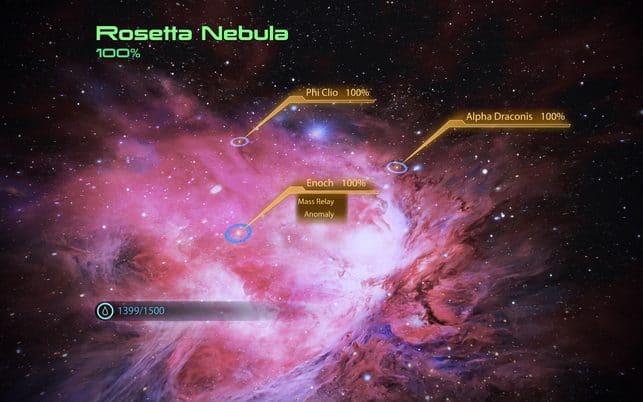
ALPHA DRACONIS
2175 AIEA
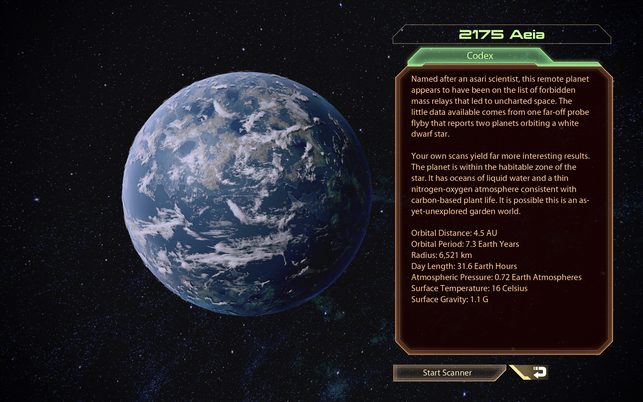
Named after an asari scientist, this remote planet appears to have been on the list of forbidden mass relays that led to uncharted space. The little data available comes from one far-off probe flyby that reports two planets orbiting a white dwarf star.
Your own scans yield far more interesting results. The planet is within the habitable zone of the star. It has oceans of liquid water and a thin nitrogen-oxygen atmosphere consistent with carbon-based plant life. It is possible this is an as-yet-unexplored garden world.
Orbital Distance: 4.5 AU
Orbital Period: 7.3 Earth Years
Radius: 6,521 km
Day Length: 31.6 Earth Hours
Atmospheric Pressure: 0.72 Earth Atmospheres
Surface Temperature: 16 Celsius
Surface Gravity: 1.1 G
2175 AR2
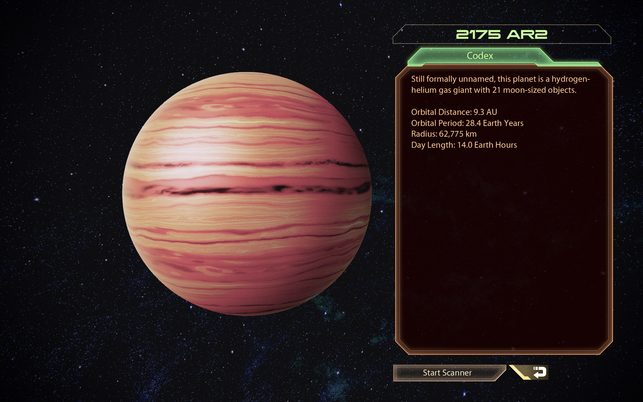
Still formally unnamed, this planet is a hydrogen-helium gas giant with 21 moon-sized objects.
Orbital Distance: 9.3 AU
Orbital Period: 28.4 Earth Years
Radius: 62,775 km
Day Length: 14.0 Earth Hours
ENOCH
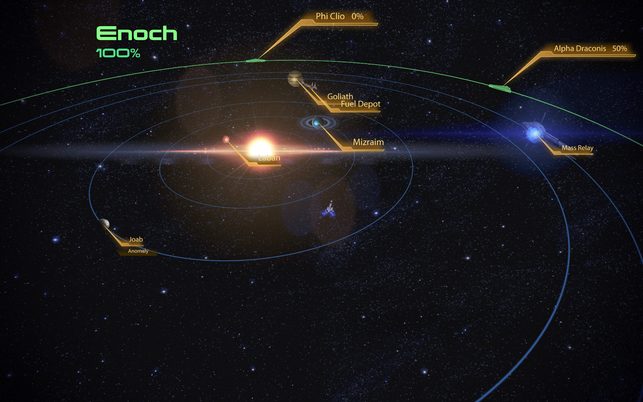
Goliath
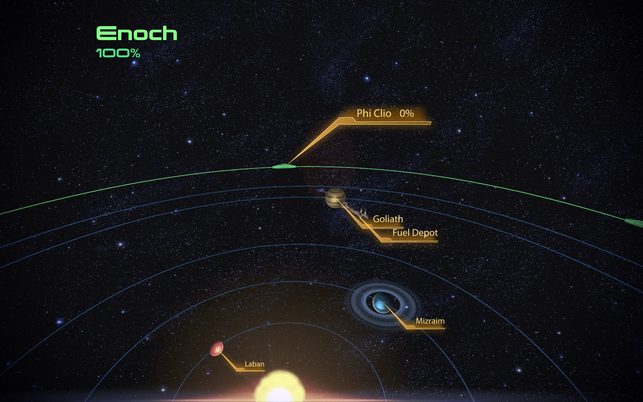
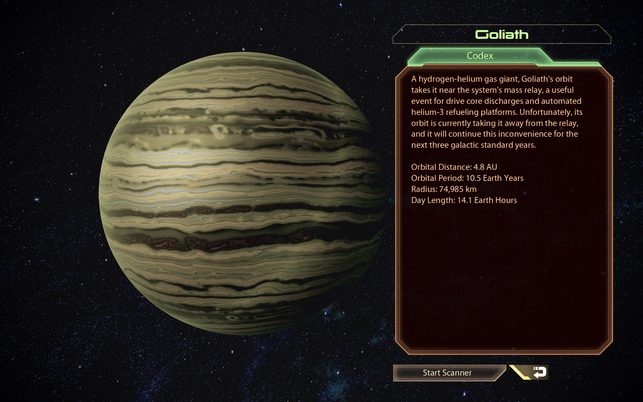
A hydrogen-helium gas giant, Goliath’s orbit takes it near the system’s mass relay, a useful event for drive core discharges and automated helium-3 refueling platforms. Unfortunately, its orbit is currently taking it away from the relay, and it will continue this inconvenience for the next three galactic standard years.
Orbital Distance: 4.8 AU
Orbital Period: 10.5 Earth Years
Radius: 74,985 km
Day Length: 14.1 Earth Hours
Joab*
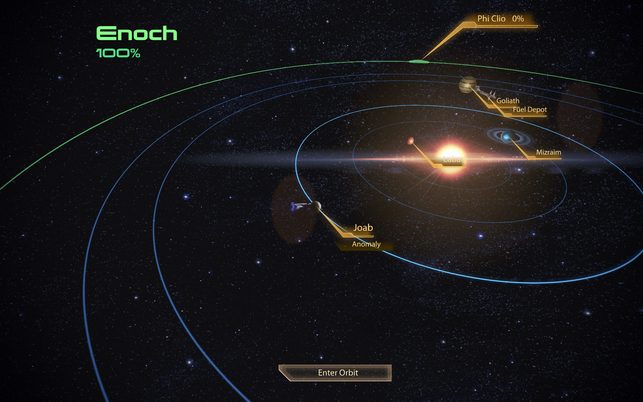
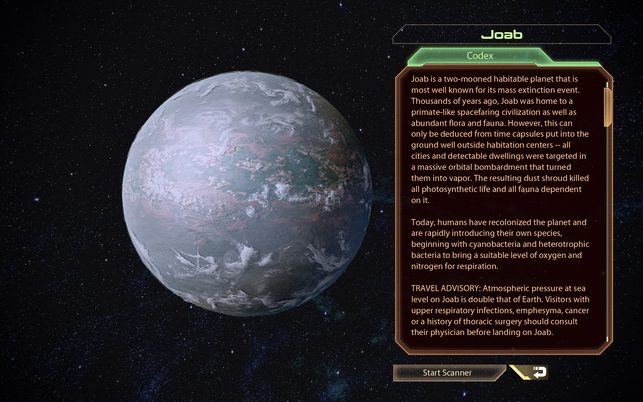
Joab is a two-mooned habitable planet that is most well known for its mass extinction event. Thousands of years ago, Joab was home to a primate-like spacefaring civilization as well as abundant flora and fauna. However, this can only be deduced from time capsules put into the ground well outside habitation centers — all cities and detectable dwellings were targeted in a massive orbital bombardment that turned them into vapor. The resulting dust shroud killed all photosynthetic life and all fauna dependent on it.
Today, humans have recolonized the planet and are rapidly introducing their own species, beginning with cyanobacteria and heterotrophic bacteria to bring a suitable level of oxygen and nitrogen for respiration.
TRAVEL ADVISORY: Atmospheric pressure at sea level on Joab is double that of Earth. Visitors with upper respiratory infections, emphesyma, cancer or a history of thoracic surgery should consult their physician before landing on Joab.
Population: 21,553,000
Colony Founded: 2171
Capital: New Jericho
Orbital Distance: 2.3 AU
Orbital Period: 3.5 Earth Years
Radius: 6,709 km
Day Length: 25.6 Earth Hours
Atmospheric Pressure: 2.18 Earth Atmospheres
Surface Temperature: 14 Celsius
Surface Gravity: 1.2 G
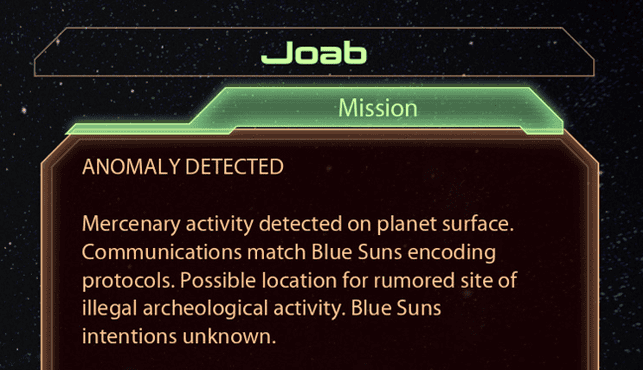
Laban
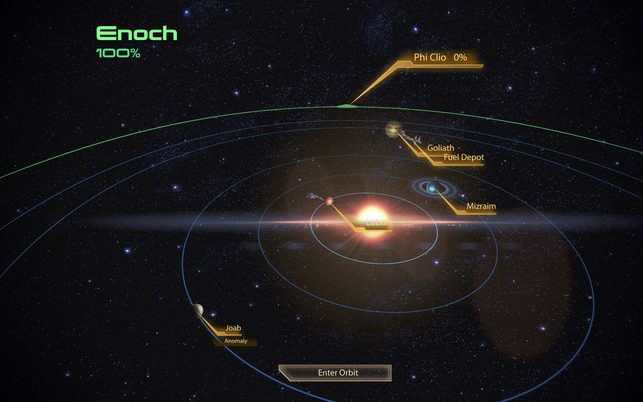
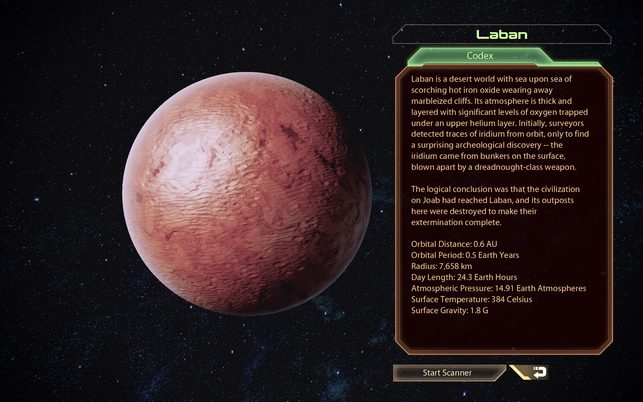
Laban is a desert world with sea upon sea of scorching hot iron oxide wearing away marbleized cliffs. Its atmosphere is thick and layered with significant levels of oxygen trapped under an upper helium layer. Initially, surveyors detected traces of iridium from orbit, only to find a surprising archeological discovery — the iridium came from bunkers on the surface, blown apart by a dreadnought-class weapon.
The logical conclusion was that the civilization on Joab had reached Laban, and its outposts here were destroyed to make their extermination complete.
Orbital Distance: 0.6 AU
Orbital Period: 0.5 Earth Years
Radius: 7.658 km
Day Length: 24.3 Earth Hours
Atmospheric Pressure: 14.91 Earth Atmospheres
surface Temperature: 384 Celsius
Surface Gravity: 1.8 G
Mizraim
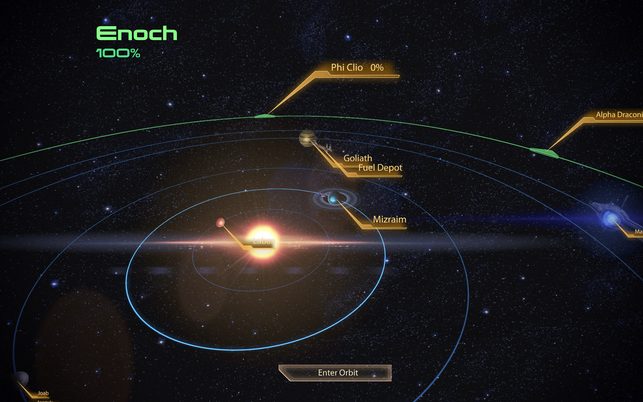
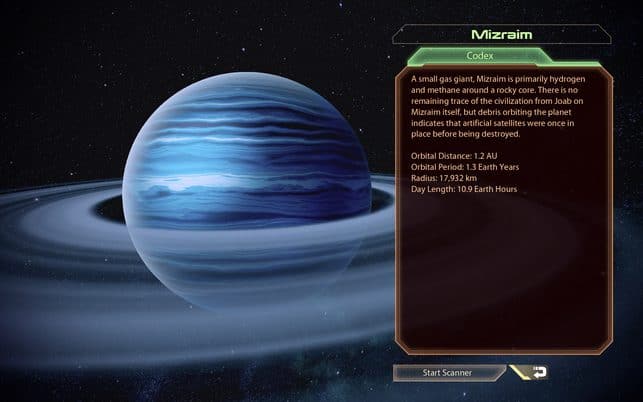
A small gas giant, Mizraim is primarily hydrogen and methane around a rocky core. There is no remaining trace of the civilization from Joab on Mizraim itself, but debris orbiting the planet indicates that artificial satellites were once in place before being destroyed.
Orbital Distance: 1.2 AU
Orbital Period: 1.3 Earth Years
Radius: 17,932 km
Day Length: 10.9 Earth Hours
PHI CLIO
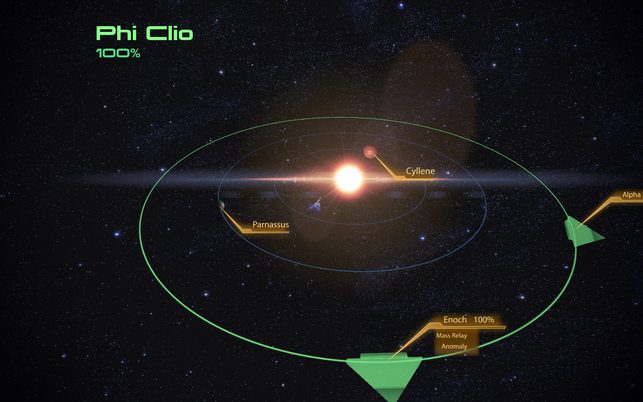
Cyllene
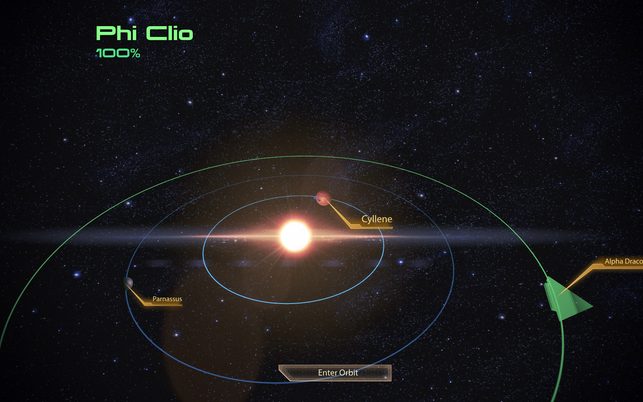
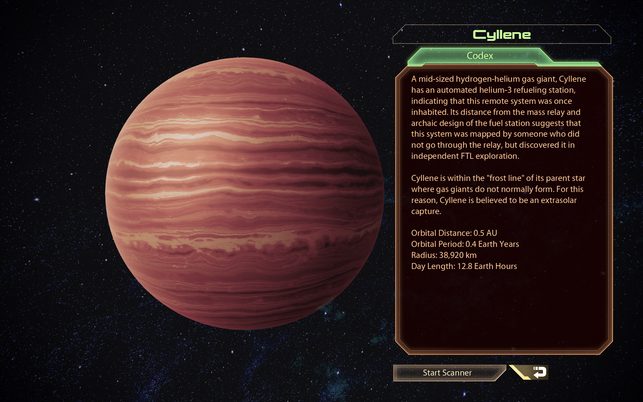
A mid-sized hydrogen-helium gas giant, Cyllene has an automated helium-3 refueling station, indicating that this remote system was once inhabited. Its distance from the mass relay and archaic design of the fuel station suggests that this system was mapped by someone who did not go through the relay, but discovered it in independent FTL exploration.
Cyllene is within the “frost line” of its parent star where gas giants do not normally form. For this reason, Cyllene is believed to be an extrasolar capture.
Orbital Distance: 0.5 AU
Orbital Period: 0.4 Earth Years
Radius: 38,920 km
Day Length: 12.8 Earth Hours
Parnassus
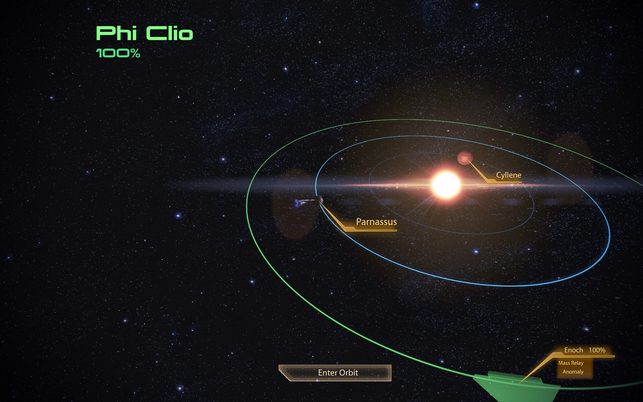
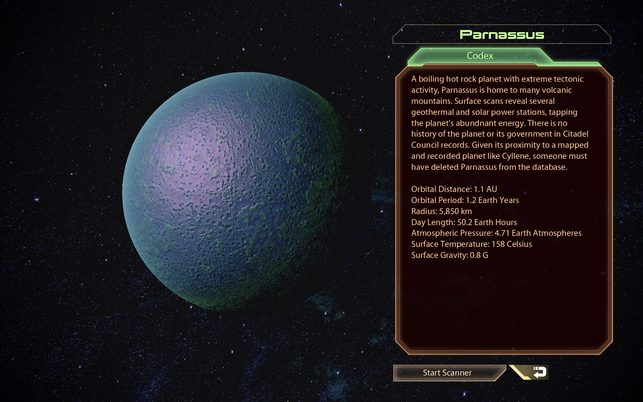
A boiling hot rock planet with extreme tectonic activity, Parnassus is home to many volcanic mountains. Surface scans reveal several geothermal and solar power stations, tapping the planet’s abundnant energy. There is no history of the planet or its government in Citadel Council records. Given its proximity to a mapped and recorded planet like Cyllene, someone must have deleted Parnassus from the database.
Orbital Distance: 1.1 AU
Orbital Period: 1.2 Earth Years
Radius: 5,850 km
Day Length: 50.2 Earth Hours
Atmospheric Pressure: 4.71 Earth Atmospheres
Surface Temperature: 158 Celsius
Surface Gravity: 0.8 G
SERPENT NEBULA
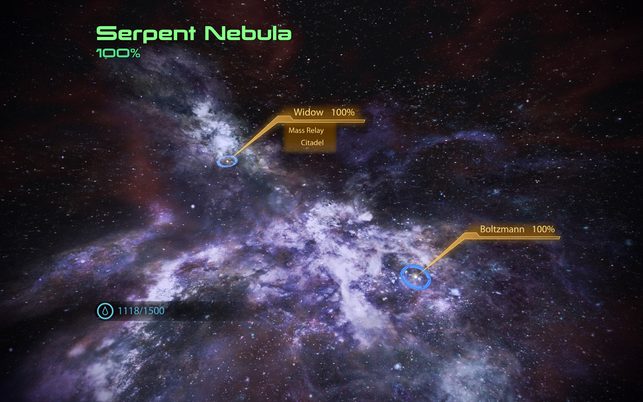
BOLTZMANN
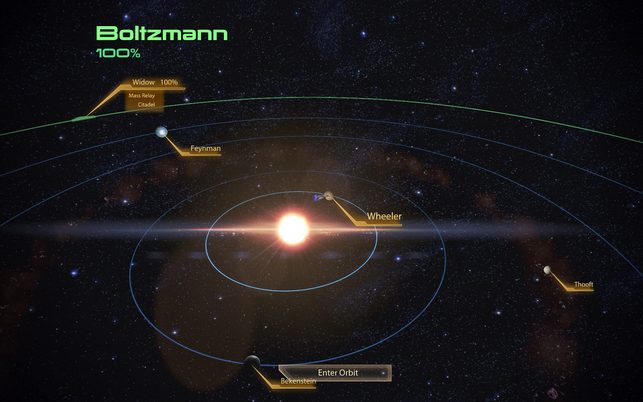
Bekenstein
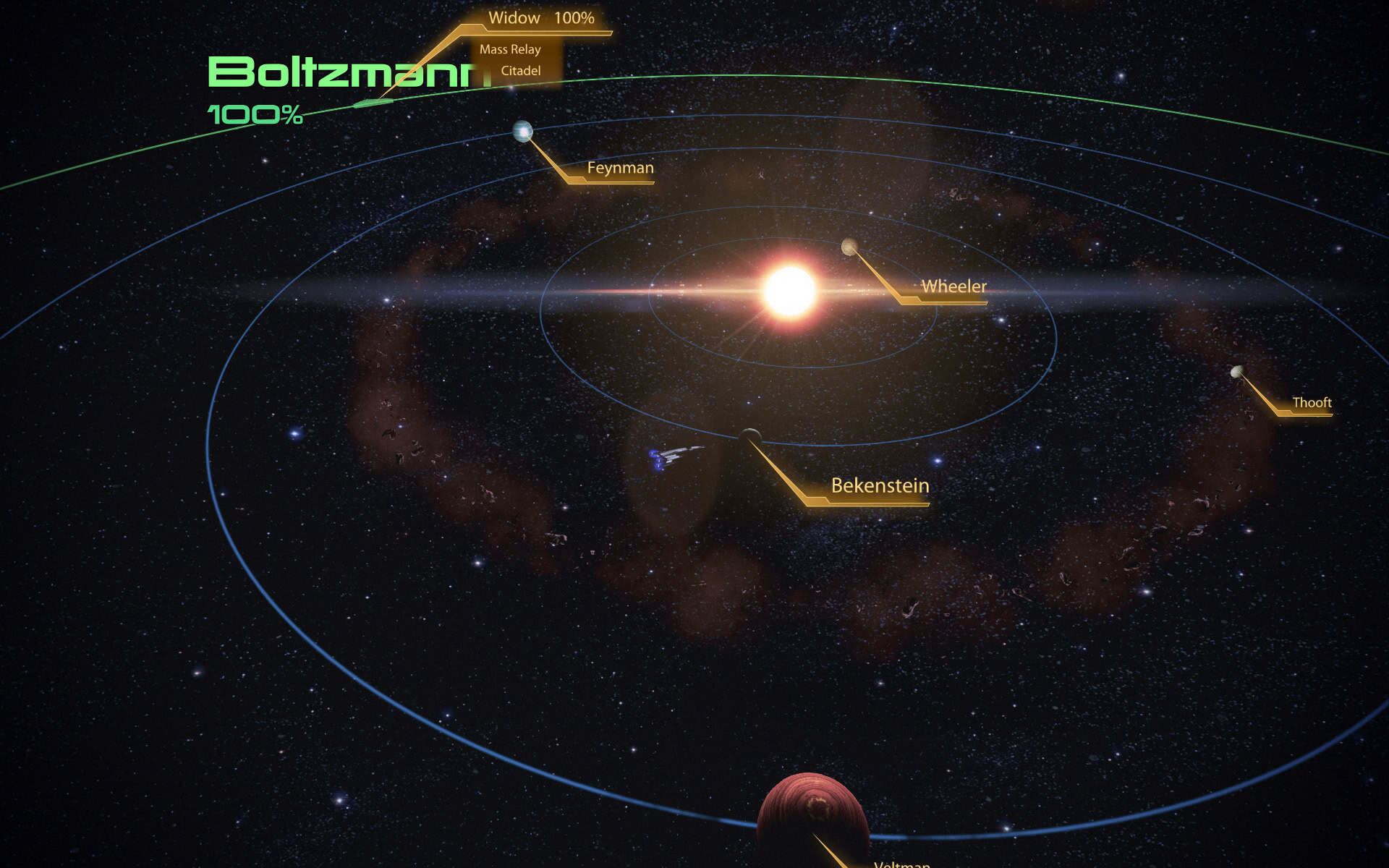
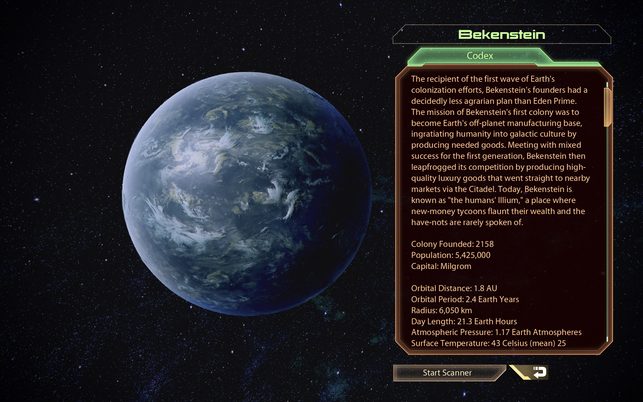
The recipient of the first wave of Earth’s colonization efforts, Bekenstein’s founders had a decidedly less agrarian plan than Eden Prime. The mission of Bekenstein’s first colony was to become Earth’s off-planet manufacturing base, ingratiating humanity into galactic culture by producing needed goods. Meeting with mixed success for the first generation, Bekenstein then leapfrogged its competition by producing high-quality luxury goods that went straight to nearby markets via the Citadel. Today, Bekenstein is known as “the humans’ Illium,” a place where new-money tycoons flaunt their wealth and the have-nots are rarely spoken of.
Colony Founded: 2158
Population: 5,425,000
Capital: Milgrom
Orbital Distance: 1.8 AU
Orbital Period: 2.4 Earth Years
Radius: 6,050 km
Day Length: 21.3 Earth Hours
Atmospheric Pressure: 1.17 Earth Atmospheres
Surface Temperature: 43 Celsius (mean) 25
Celsius (habitable zone)
Surface Gravity: 0.9 G
Feynman
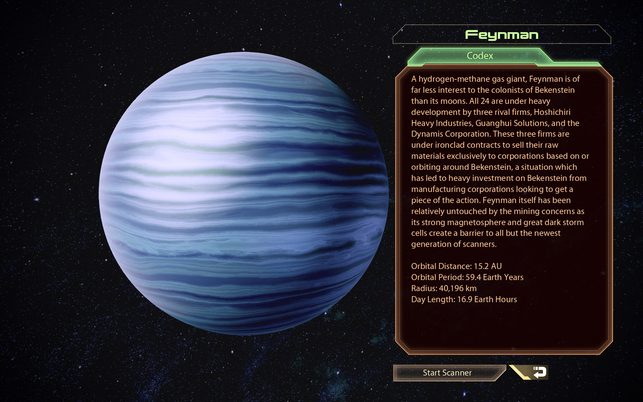
A hydrogen-methane gas giant, Feynman is of far less interest to the colonists of Bekenstein than its moons. All 24 are under heavy development by three rival firms, Hoshichiri Heavy Industries, Guanghui Solutions, and the Dynamis Corporation. These three firms are under ironclad contracts to sell their raw materials exclusively to corporations based on or orbiting around Bekenstein, a situation which has led to heavy investment on Bekenstein from manufacturing corporations looking to get a piece of the action. Feynman itself has been relatively untouched by the mining concerns as its strong magnetosphere and great dark storm cells create a barrier to all but the newest generation of scanners.
Orbital Distance: 15.2 AU
Orbital Period: 59.4 Earth Years
Radius: 40,196 km
Day Length: 16.9 Earth Hours
Thooft
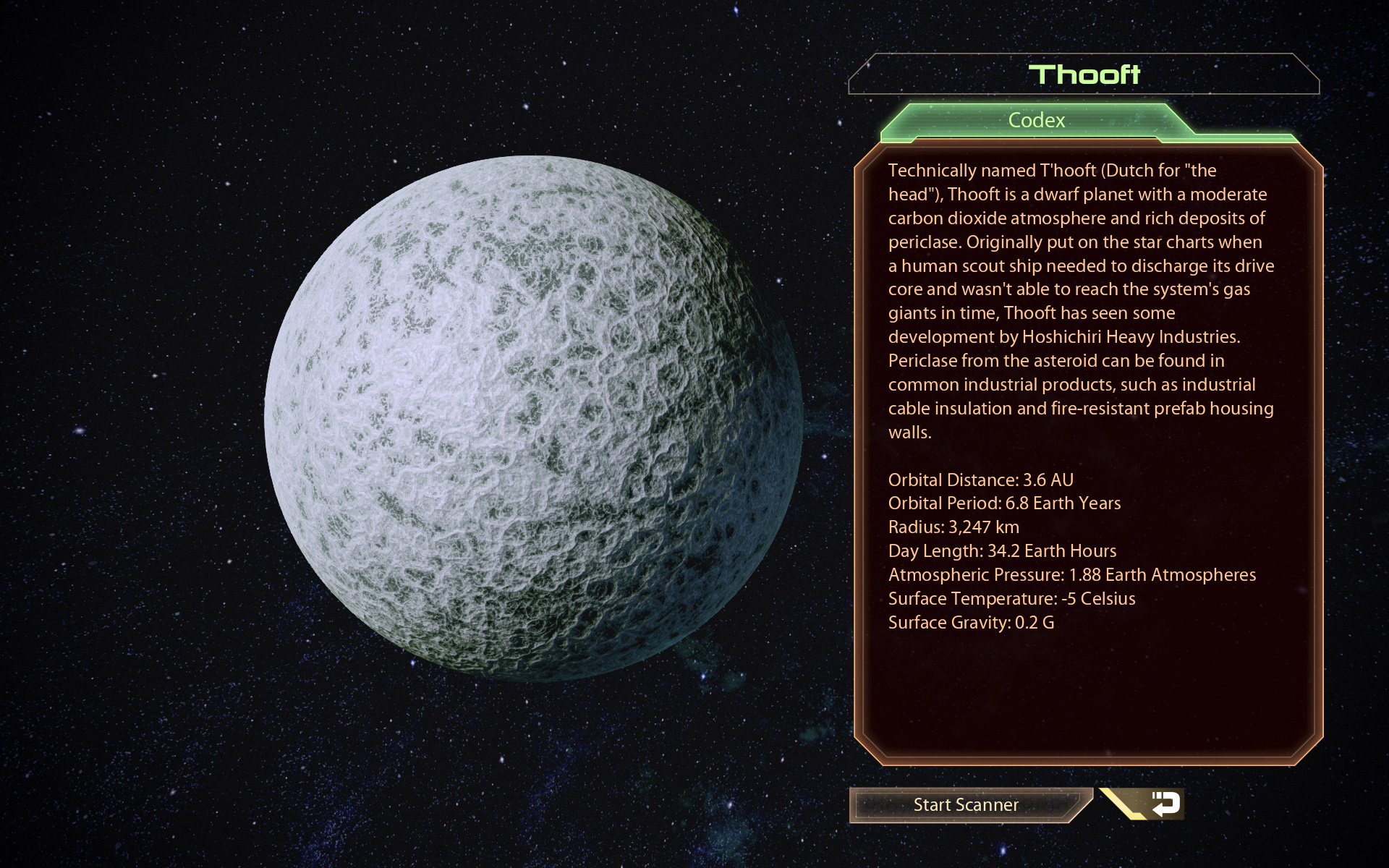
Technically named T’hooft (Dutch for “the head”), Thooft is a dwarf planet with a moderate carbon dioxide atmosphere and rich deposits of periclase. Originally put on the star charts when a human scout ship needed to discharge its drive core and wasn’t able to reach the system’s gas giants in time, Thooft has seen some development by Hoshichiri Heavy Industries. Periclase from the asteroid can be found in common industrial products, such as industrial cable insulation and fire-resistant prefab housing walls.
Orbital Distance: 3.6 AU
Orbital Period: 6.8 Earth Years Radius: 3,247 km
Day Length: 34.2 Earth Hours
Atmospheric Pressure: 1.88 Earth Atmospheres
Surface Temperature: -5 Celsius
Surface Gravity: 0.2 G
Veltman
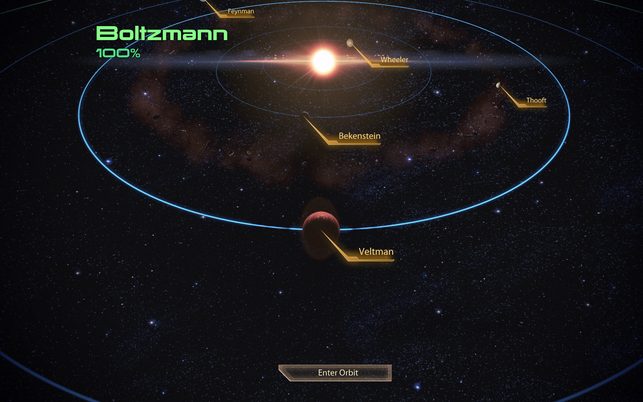
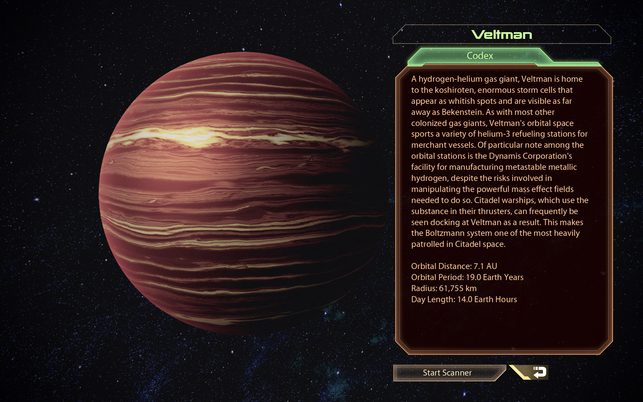
A hydrogen-helium gas giant, Veltman is home to the koshiroten, enormous storm cells that appear as whitish spots and are visible as far away as Bekenstein. As with most other colonized gas giants, Veltman’s orbital space sports a variety of helium-3 refueling stations for merchant vessels. Of particular note among the orbital stations is the Dynamis Corporation’s facility for manufacturing metastable metallic hydrogen, despite the risks involved in manipulating the powerful mass effect fields needed to do so. Citadel warships, which use the substance in their thrusters, can frequently be seen docking at Veltman as a result. This makes the Boltzmann system one of the most heavily patrolled in Citadel space.
Orbital Distance: 7.1 AU
Orbital Period: 19.0 Earth Years
Radius: 61,755 km
Day Length: 14.0 Earth Hours
Wheeler
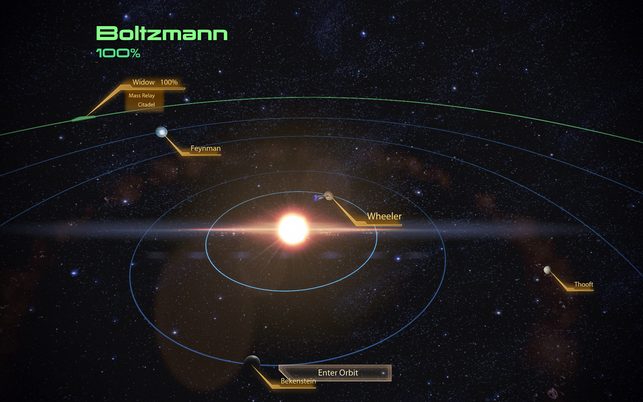
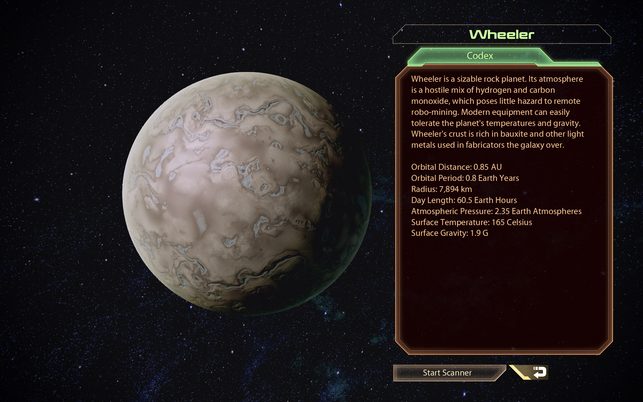
Wheeler is a sizable rock planet. Its atmosphere is a hostile mix of hydrogen and carbon
monoxide, which poses little hazard to remote robo-mining. Modern equipment can easily tolerate the planet’s temperatures and gravity. Wheeler’s crust is rich in bauxite and other light metals used in fabricators the galaxy over.
Orbital Distance: 0.85 AU
Orbital Period: 0.8 Earth Years
Radius: 7,894 km
Day Length: 60.5 Earth Hours
Atmospheric Pressure: 2.35 Earth Atmospheres
Surface Temperature: 165 Celsius
Surface Gravity: 1.9 G
WIDOW
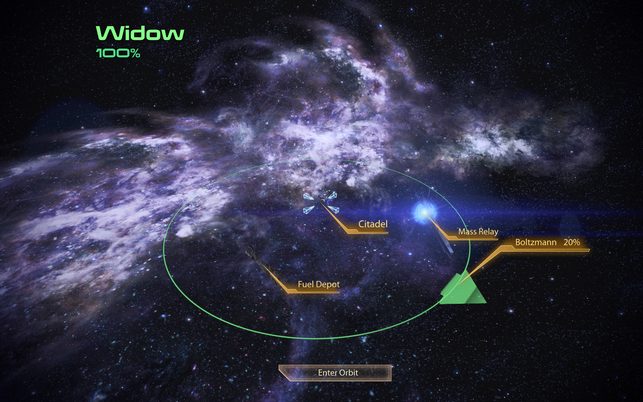
Citadel
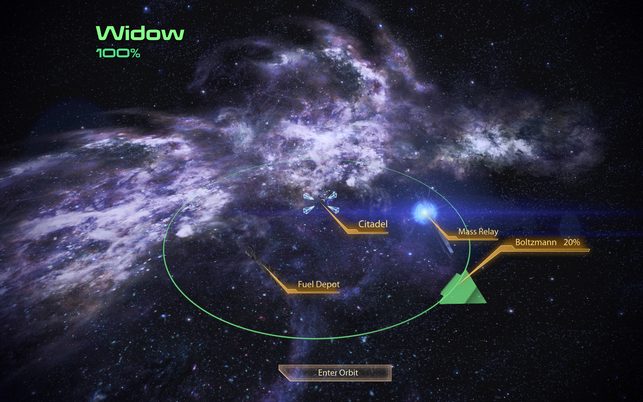
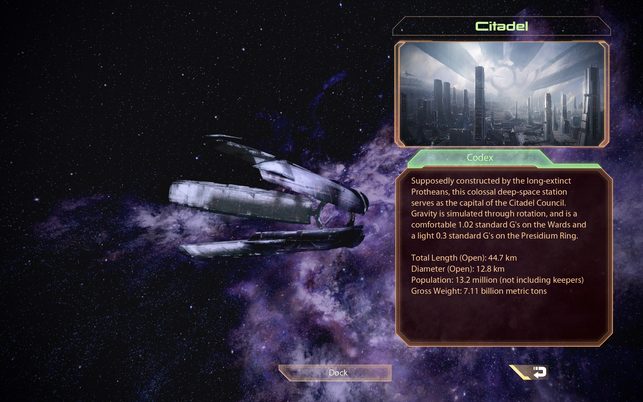
Supposedly constructed by the long-extinct Protheans, this colossal deep-space station serves as the capital of the Citadel Council. Gravity is simulated through rotation, and is a comfortable 1.02 standard G’s on the Wards and a light 0.3 standard G’s on the Presidium Ring.
Total Length (Open): 44.7 km
Diameter (Open): 12.8 km
Population: 13.2 million (not including keepers)
Gross Weight: 7.11 billion metric tons
SHADOW SEA
IERA
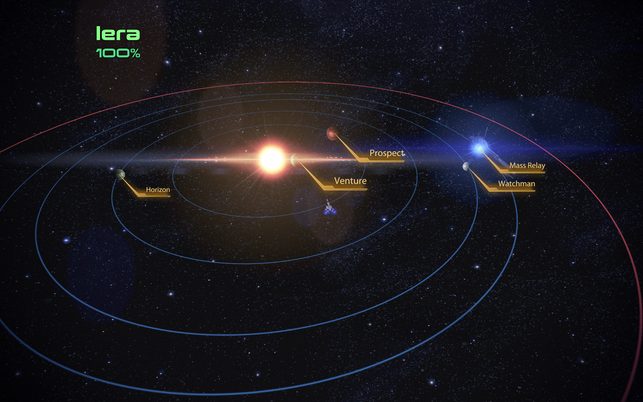
Horizon
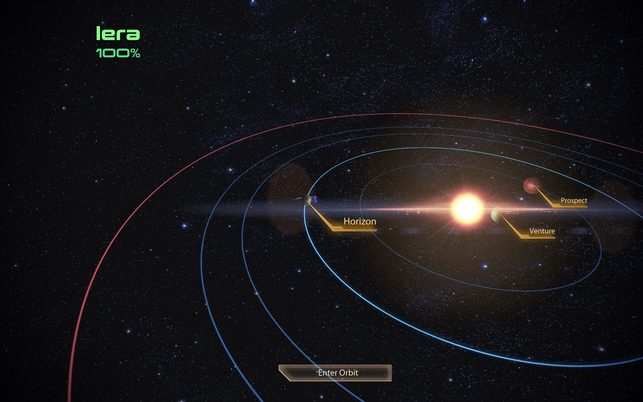
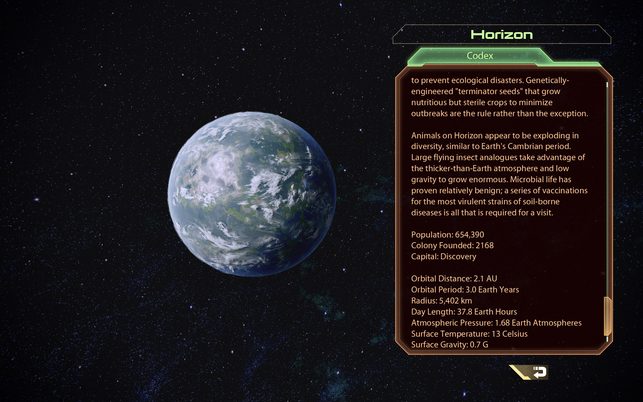
A temperate world that has hit the “sweet spot” for carbon-based life, Horizon has a nitrogen-oxygen atmosphere maintained by abundant indigenous photosynthetic plants and bacteria. While the native plants are not very palatable to humans, the soil conditions are such that a handful of introduced Earth species have flourished, and the colonists must take strict care to prevent ecological disasters. Genetically-engineered “terminator seeds” that grow nutritious but sterile crops to minimize outbreaks are the rule rather than the exception.
Animals on Horizon appear to be exploding in diversity, similar to Earth’s Cambrian period. Large flying insect analogues take advantage of the thicker-than-Earth atmosphere and low gravity to grow enormous. Microbial life has proven relatively benign; a series of vaccinations for the most virulent strains of soil-borne diseases is all that is required for a visit.
Population: 654,390
Colony Founded: 2168
Capital: Discovery
Orbital Distance: 2.1 AU
Orbital Period: 3.0 Earth Years
Radius: 5,402 km
Day Length: 37.8 Earth Hours
Atmospheric Pressure: 1.68 Earth Atmospheres
Surface Temperature: 13 Celsius
Surface Gravity: 0.7 G
Prospect
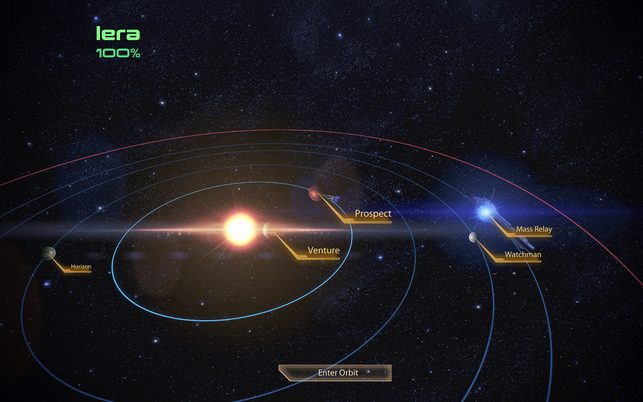
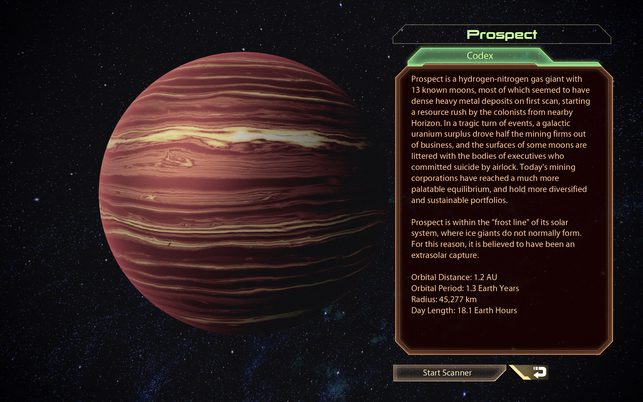
Prospect is a hydrogen-nitrogen gas giant with 13 known moons, most of which seemed to have dense heavy metal deposits on first scan, starting a resource rush by the colonists from nearby Horizon. In a tragic turn of events, a galactic uranium surplus drove half the mining firms out of business, and the surfaces of some moons are littered with the bodies of executives who committed suicide by airlock. Today’s mining corporations have reached a much more palatable equilibrium, and hold more diversified and sustainable portfolios.
Prospect is within the “frost line” of its solar system, where ice giants do not normally form. For this reason, it is believed to have been an extrasolar capture.
Orbital Distance: 1.2 AU
Orbital Period: 1.3 Earth Years
Radius: 45,277 km
Day Length: 18.1 Earth Hours
Venture
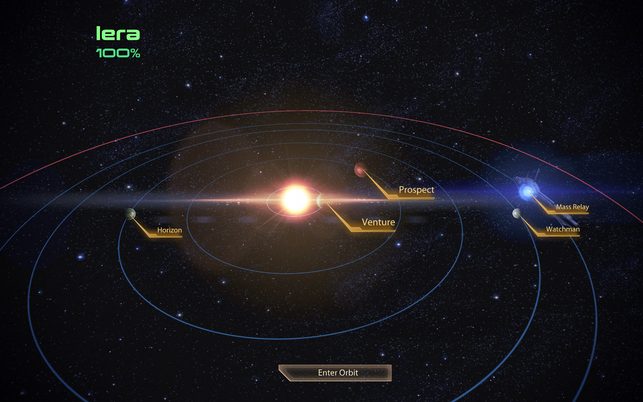
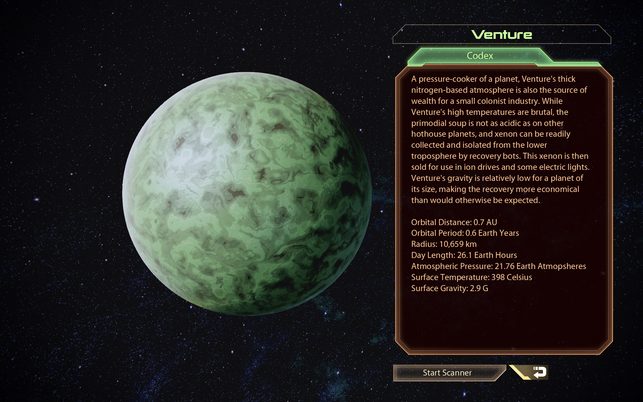
A pressure-cooker of a planet, Venture’s thick nitrogen-based atmosphere is also the source of wealth for a small colonist industry. While Venture’s high temperatures are brutal, the primodial soup is not as acidic as on other hothouse planets, and xenon can be readily collected and isolated from the lower troposphere by recovery bots. This xenon is then sold for use in ion drives and some electric lights. Venture’s gravity is relatively low for a planet of its size, making the recovery more economical than would otherwise be expected.
Orbital Distance: 0.7 AU
Orbital Period: 0.6 Earth Years
Radius: 10,659 km
Day Length: 26.1 Earth Hours
Atmospheric Pressure: 21.76 Earth Atmopsheres
Surface Temperature: 398 Celsius
Surface Gravity: 2.9 G
Watchman
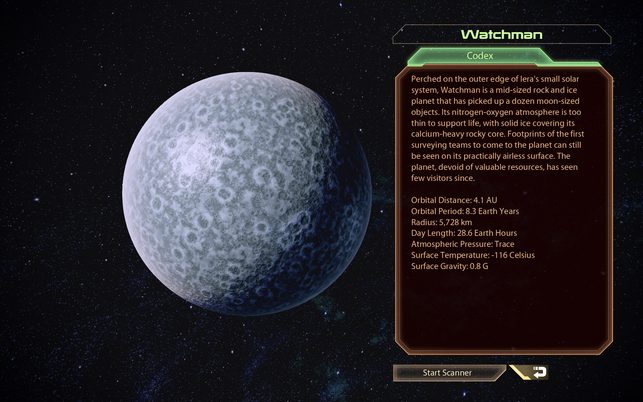
Perched on the outer edge of lera’s small solar system, Watchman is a mid-sized rock and ice planet that has picked up a dozen moon-sized objects. Its nitrogen-oxygen atmosphere is too thin to support life, with solid ice covering its calcium-heavy rocky core. Footprints of the first surveying teams to come to the planet can still be seen on its practically airless surface. The planet, devoid of valuable resources, has seen few visitors since.
Orbital Distance: 4.1 AU
Orbital Period: 8.3 Earth Years
Radius: 5,728 km
Day Length: 28.6 Earth Hours
Atmospheric Pressure: Trace
Surface Temperature: -116 Celsius
Surface Gravity: 0.8 G
THE PHOENIX MASSING
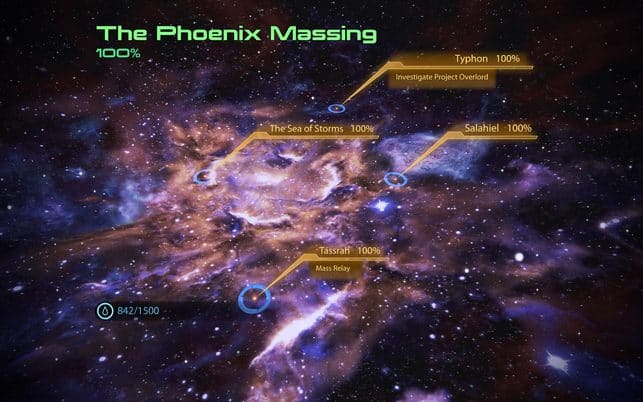
SALAHIEL
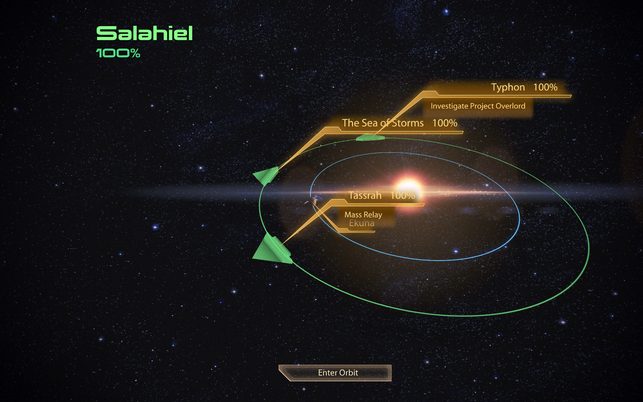
Ekuna
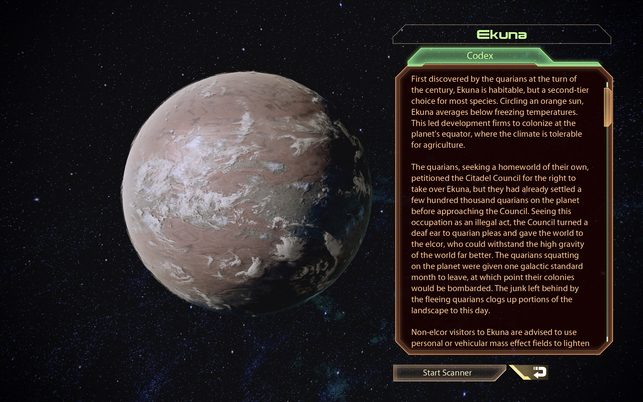
First discovered by the quarians at the turn of the century, Ekuna is habitable, but a second-tier choice for most species. Circling an orange sun, Ekuna averages below freezing temperatures. This led development firms to colonize at the planet’s equator, where the climate is tolerable for agriculture.
The quarians, seeking a homeworld of their own, petitioned the Citadel Council for the right to take over Ekuna, but they had already settled a few hundred thousand quarians on the planet before approaching the Council. Seeing this occupation as an illegal act, the Council turned a deaf ear to quarian pleas and gave the world to the elcor, who could withstand the high gravity of the world far better. The quarians squatting on the planet were given one galactic standard month to leave, at which point their colonies would be bombarded. The junk left behind by the fleeing quarians clogs up portions of the landscape to this day.
Non-elcor visitors to Ekuna are advised to use personal or vehicular mass effect fields to lighten the pressure, as the surface gravity will otherwise cause health and mechanical problems.
Colony Founded: 2103 CE
Population: 221,256,200
Capital: Bel Shadii (elcor: Durawunafon)
Orbital Distance: 1.6 AU
Orbital Period: 2.3 Earth Years
Radius: 10,206 km
Day Length: 36.4 Earth Hours
Atmospheric Pressure: 1.4 Earth Atmospheres
Surface Temperature: -37 Celsius (equator mean
temperature 15 Celsius)
Surface Gravity: 4.1 G
TASSRAH
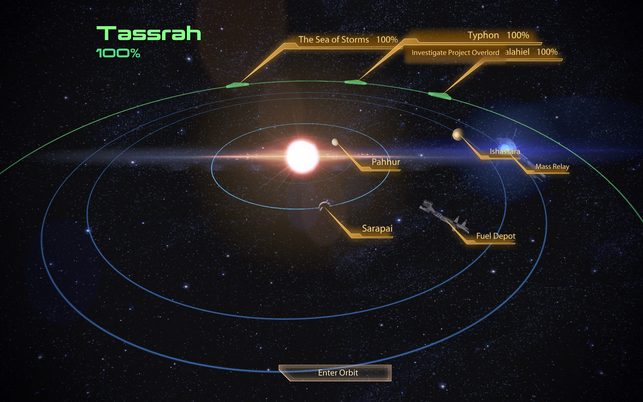
Ishassara
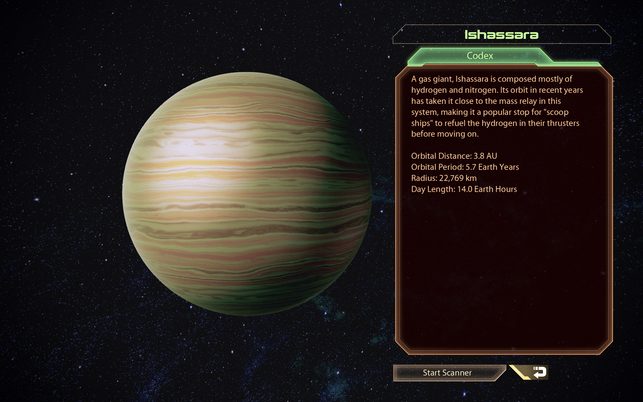
A gas giant, Ishassara is composed mostly of hydrogen and nitrogen. Its orbit in recent years has taken it close to the mass relay in this system, making it a popular stop for “scoop ships” to refuel the hydrogen in their thrusters before moving on.
Orbital Distance: 3.8 AU
Orbital Period: 5.7 Earth Years
Radius: 22,769 km
Day Length: 14.0 Earth Hours
Pahhur
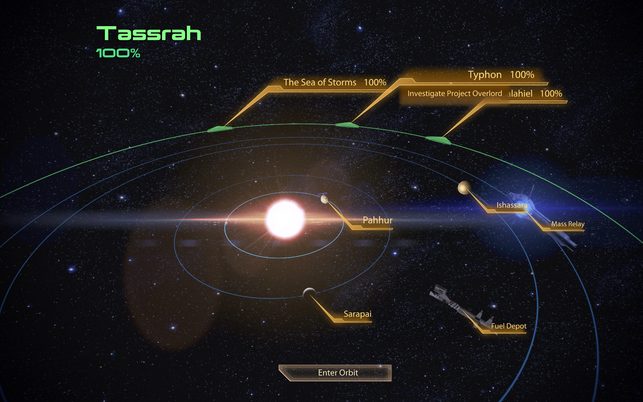
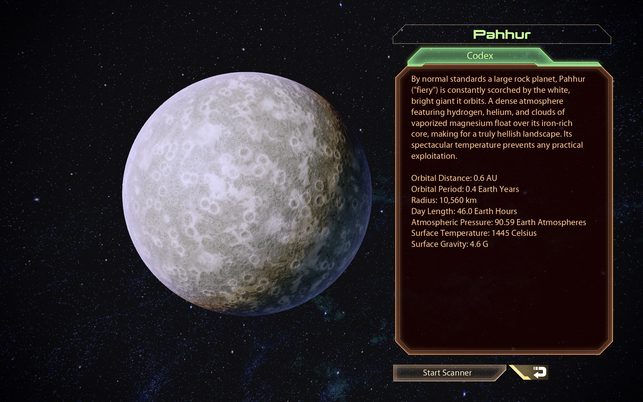
By normal standards a large rock planet, Pahhur (“fiery”) is constantly scorched by the white, bright giant it orbits. A dense atmosphere featuring hydrogen, helium, and clouds of vaporized magnesium float over its iron-rich core, making for a truly hellish landscape. Its spectacular temperature prevents any practical exploitation.
Orbital Distance: 0.6 AU
Orbital Period: 0.4 Earth Years
Radius: 10,560 km
Day Length: 46.0 Earth Hours
Atmospheric Pressure: 90.59 Earth Atmospheres
Surface Temperature: 1445 Celsius
Surface Gravity: 4.6 G
Sarapai
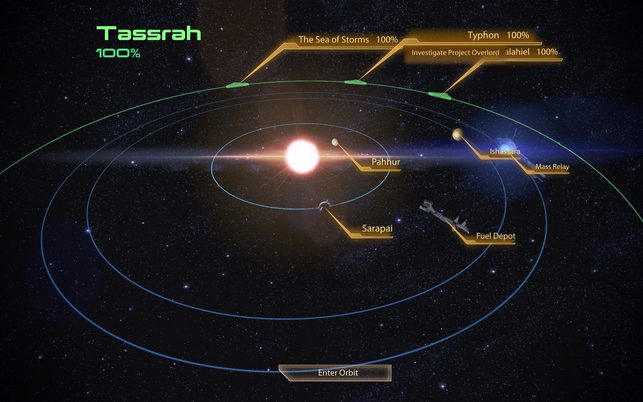
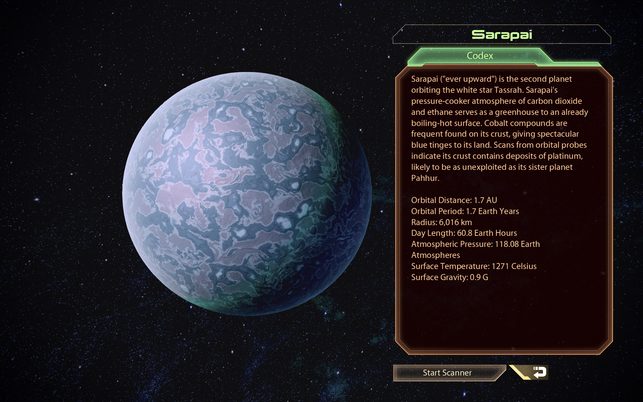
Sarapai (“ever upward”) is the second planet orbiting the white star Tassrah. Sarapai’s pressure-cooker atmosphere of carbon dioxide and ethane serves as a greenhouse to an already boiling-hot surface. Cobalt compounds are frequent found on its crust, giving spectacular blue tinges to its land. Scans from orbital probes indicate its crust contains deposits of platinum, likely to be as unexploited as its sister planet Pahhur.
Orbital Distance: 1.7 AU
Orbital Period: 1.7 Earth Years
Radius: 6,016 km
Day Length: 60.8 Earth Hours
Atmospheric Pressure: 118.08 Earth Atmospheres
Surface Temperature: 1271
Celsius Surface Gravity: 0.9 G
THE SEA OF STORMS
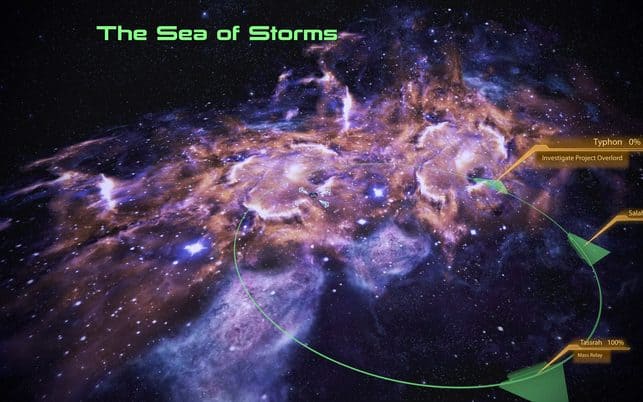
TYPHON
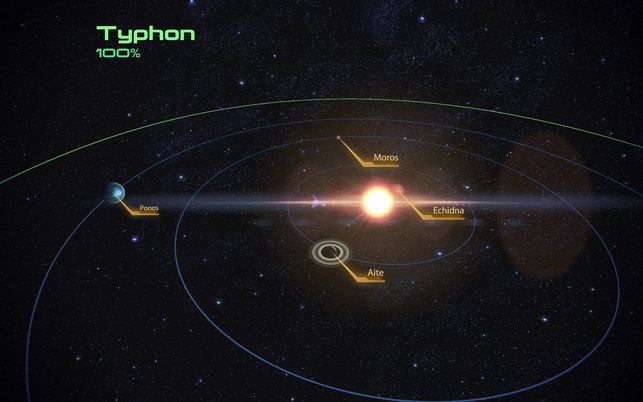
Aite
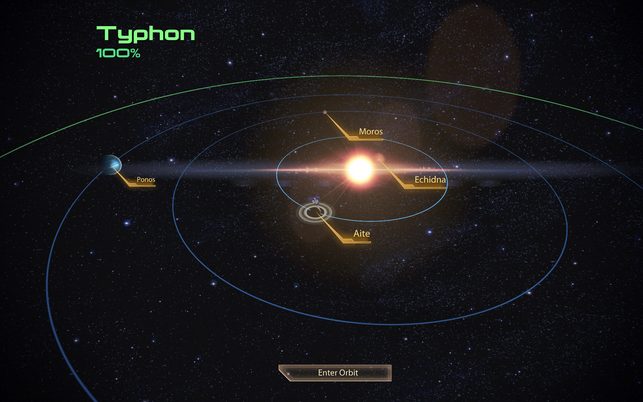
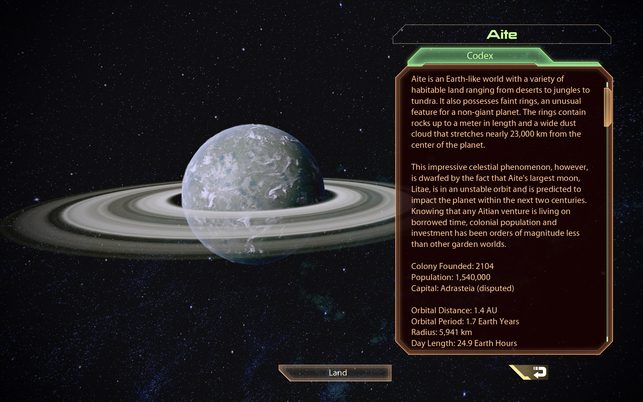
Aite is an Earth-like world with a variety of habitable land ranging from deserts to jungles to tundra. It also possesses faint rings, an unusual feature for a non-giant planet. The rings contain rocks up to a meter in length and a wide dust cloud that stretches nearly 23,000 km from the center of the planet.
This impressive celestial phenomenon, however, is dwarfed by the fact that Aite’s largest moon, Litae, is in an unstable orbit and is predicted to impact the planet within the next two centuries. Knowing that any Aitian venture is living on borrowed time, colonial population and investment has been orders of magnitude less than other garden worlds.
Colony Founded: 2104
Population: 1,540,000
Capital: Adrasteia (disputed)
Orbital Distance: 1.4 AU
Orbital Period: 1.7 Earth Years
Radius: 5,941 km
Day Length: 24.9 Earth Hours
Atmospheric Pressure: 0.6 Earth Atmospheres
Surface Temperature: 20 Celsius
Surface Gravity: 0.88 G
Echidna
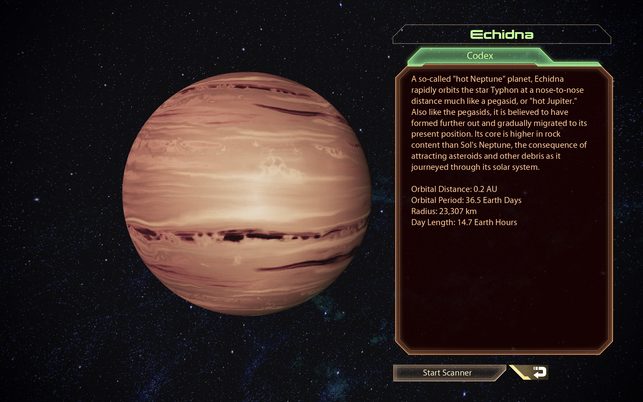
A so-called “hot Neptune” planet, Echidna rapidly orbits the star Typhon at a nose-to-nose distance much like a pegasid, or “hot Jupiter.”
Also like the pegasids, it is believed to have formed further out and gradually migrated to its present position. Its core is higher in rock content than Sol’s Neptune, the consequence of attracting asteroids and other debris as it journeyed through its solar system.
Orbital Distance: 0.2 AU
Orbital Period: 36.5 Earth Days
Radius: 23,307 km
Day Length: 14.7 Earth Hours
Moros
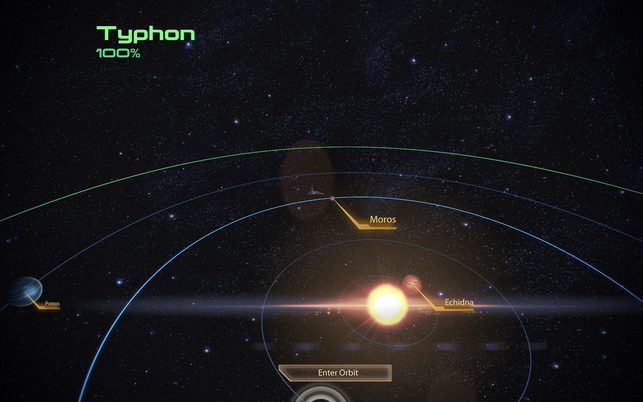
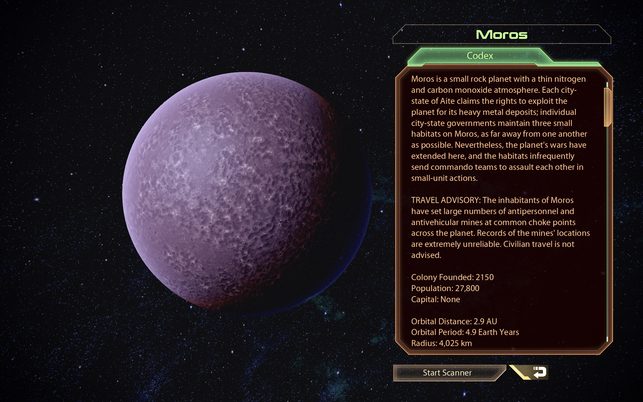
Moros is a small rock planet with a thin nitrogen and carbon monoxide atmosphere. Each city-state of Aite claims the rights to exploit the planet for its heavy metal deposits; individual city-state governments maintain three small habitats on Moros, as far away from one another as possible. Nevertheless, the planet’s wars have extended here, and the habitats infrequently send commando teams to assault each other in small-unit actions.
TRAVEL ADVISORY: The inhabitants of Moros have set large numbers of antipersonnel and antivehicular mines at common choke points across the planet. Records of the mines’ locations are extremely unreliable. Civilian travel is not advised.
Colony Founded: 2150
Population: 27,800
Capital: None
Orbital Distance: 2.9 AU
Orbital Period: 4.9 Earth Years
Radius: 4,025 km
Day Length: 60.7 Earth Hours
Atmospheric Pressure: 0.16 Earth Atmospheres
Surface Temperature: -73 Celsius
Surface Gravity: 0.35 G
Ponos
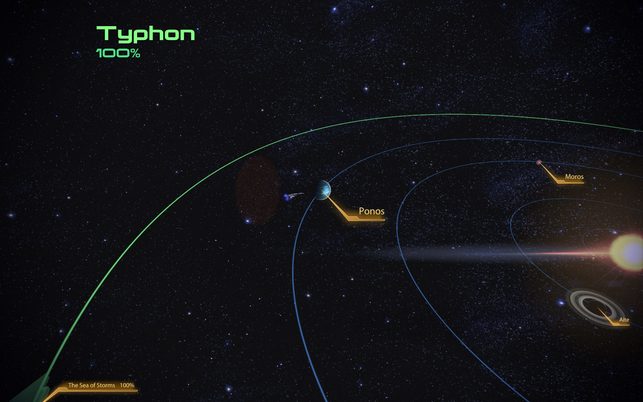
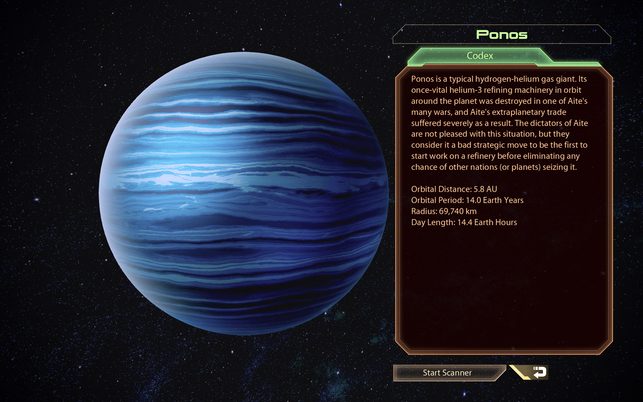
Ponos is a typical hydrogen-helium gas giant. Its once-vital helium-3 refining machinery in orbit around the planet was destroyed in one of Aite’s many wars, and Aite’s extraplanetary trade suffered severely as a result. The dictators of Aite are not pleased with this situation, but they consider it a bad strategic move to be the first to start work on a refinery before eliminating any chance of other nations (or planets) seizing it.
Orbital Distance: 5.8 AU
Orbital Period: 14.0 Earth Years
Radius: 69,740 km
Day Length: 14.4 Earth Hours
THE SHRIKE ABYSSAL
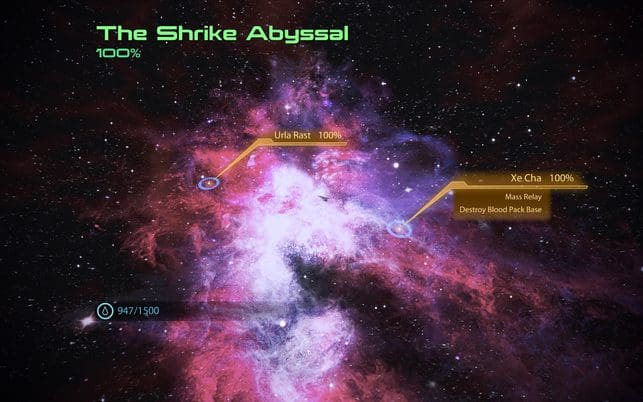
URLA RAST
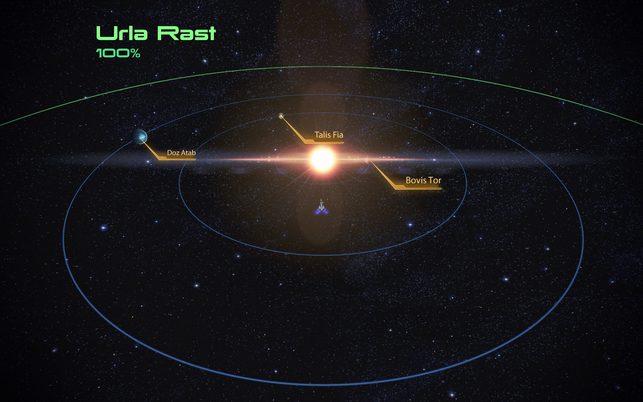
Bovis Tor
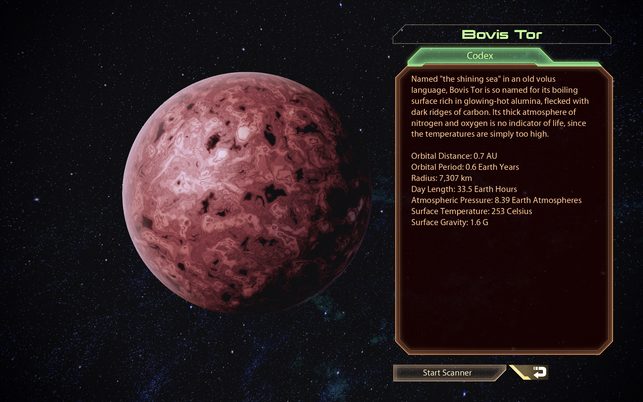
Named “the shining sea” in an old volus language, Bovis Tor is so named for its boiling surface rich in glowing-hot alumina, flecked with dark ridges of carbon. Its thick atmosphere of nitrogen and oxygen is no indicator of life, since the temperatures are simply too high.
Orbital Distance: 0.7 AU
Orbital Period: 0.6 Earth Years
Radius: 7,307 km
Day Length: 33.5 Earth Hours
Atmospheric Pressure: 8.39 Earth Atmospheres
Surface Temperature: 253 Celsius
Surface Gravity: 1.6 G
Doz Atab
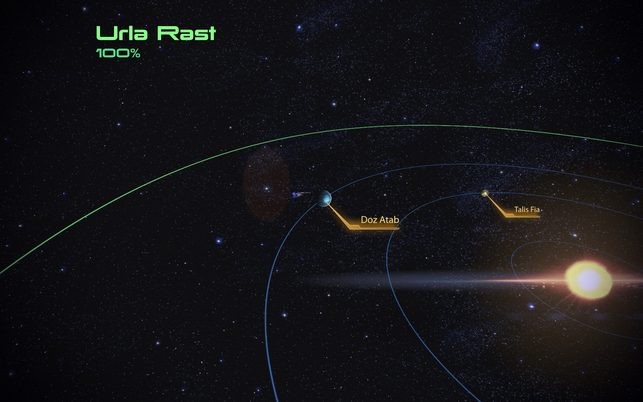
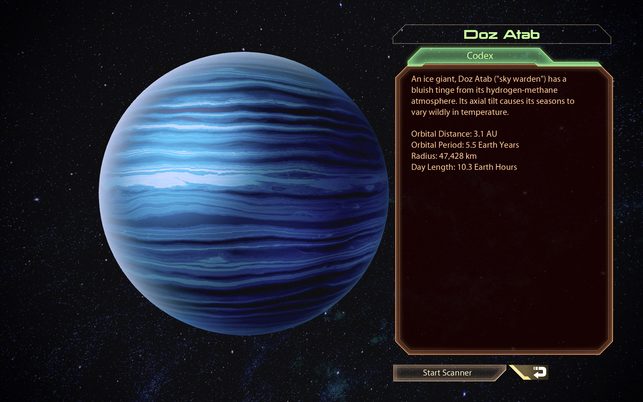
An ice giant, Doz Atab (“sky warden”) has a bluish tinge from its hydrogen-methane atmosphere. Its axial tilt causes its seasons to vary wildly in temperature.
Orbital Distance: 3.1 AU
Orbital Period: 5.5 Earth Years
Radius: 47,428 km
Day Length: 10.3 Earth Hours
Talis Fia
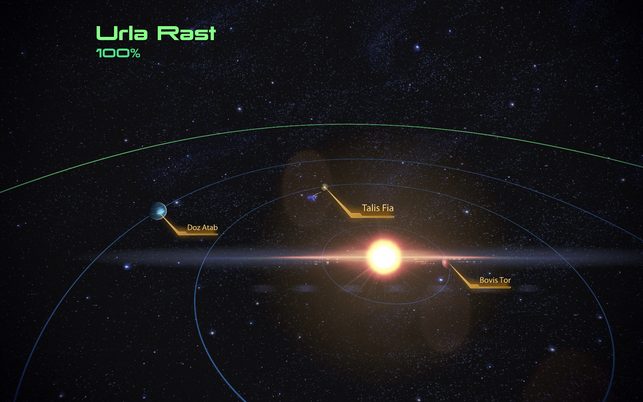
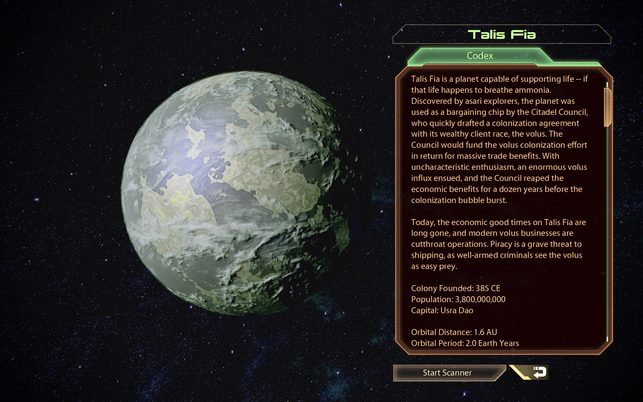
Talis Fia is a planet capable of supporting life — if that life happens to breathe ammonia. Discovered by asari explorers, the planet was used as a bargaining chip by the Citadel Council, who quickly drafted a colonization agreement with its wealthy client race, the volus. The Council would fund the volus colonization effort in return for massive trade benefits. With uncharacteristic enthusiasm, an enormous volus influx ensued, and the Council reaped the economic benefits for a dozen years before the colonization bubble burst.
Today, the economic good times on Talis Fia are long gone, and modern volus businesses are cutthroat operations. Piracy is a grave threat to shipping, as well-armed criminals see the volus as easy prey.
Colony Founded: 385 CE
Population: 3,800,000,000 Capital: Usra Dao
Orbital Distance: 1.6 AU
Orbital Period: 2.0 Earth Years
Radius: 7,550 km
Day Length: 33.8 Earth Hours
Atmospheric Pressure: 6.15 Earth Atmospheres
Surface Temperature: -25 Celsius
Surface Gravity: 1.7 G
XE CHA
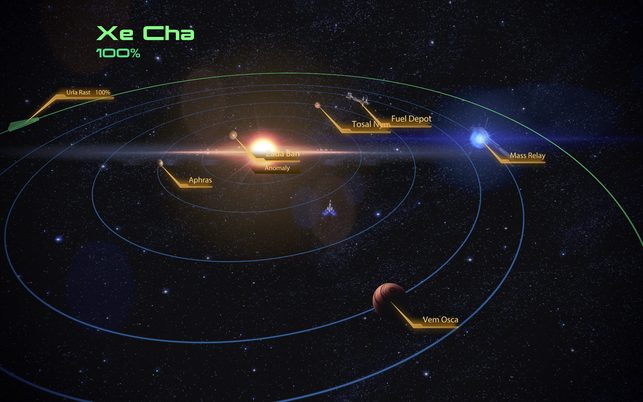
Aphras
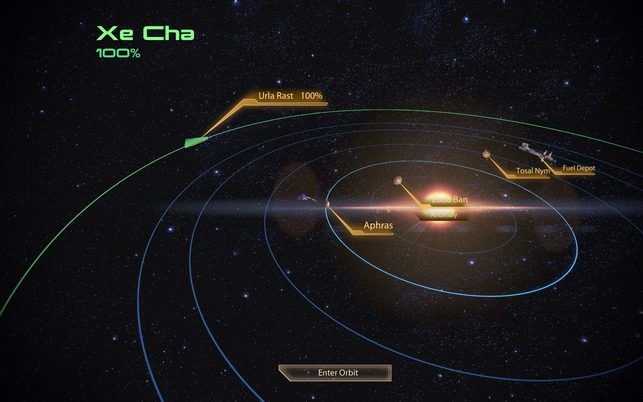
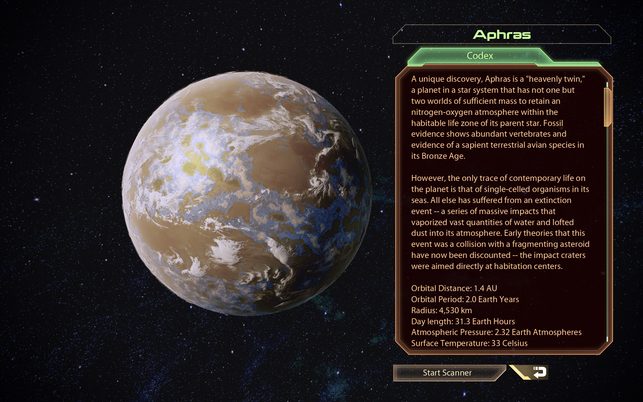
A unique discovery, Aphras is a “heavenly twin,” a planet in a star system that has not one but two worlds of sufficient mass to retain an nitrogen-oxygen atmosphere within the habitable life zone of its parent star. Fossil evidence shows abundant vertebrates and evidence of a sapient terrestrial avian species in its Bronze Age.
However, the only trace of contemporary life on the planet is that of single-celled organisms in its seas. All else has suffered from an extinction event — a series of massive impacts that vaporized vast quantities of water and lofted dust into its atmosphere. Early theories that this event was a collision with a fragmenting asteroid have now been discounted the impact craters were aimed directly at habitation centers.
Orbital Distance: 1.4 AU
Orbital Period: 2.0 Earth Years
Radius: 4,530 km
Day length: 31.3 Earth Hours
Atmospheric Pressure: 2.32 Earth Atmospheres
Surface Temperature: 33 Celsius
Surface Gravity: 0.7 G
Tosal Nym
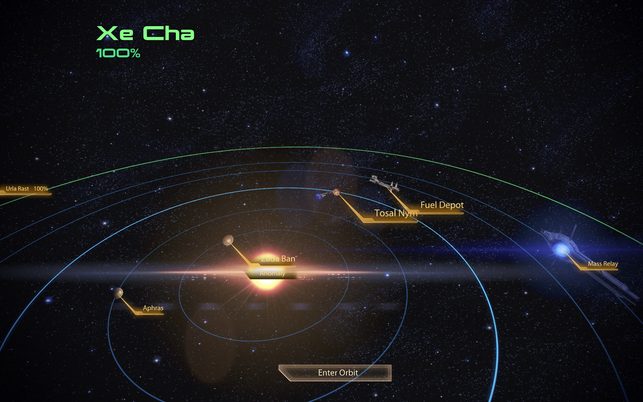
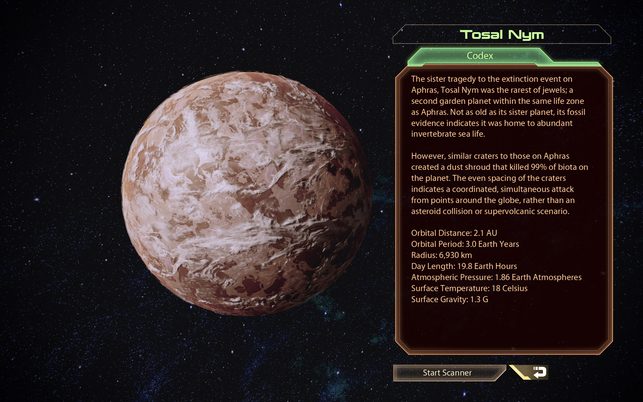
The sister tragedy to the extinction event on Aphras, Tosal Nym was the rarest of jewels; a second garden planet within the same life zone as Aphras. Not as old as its sister planet, its fossil evidence indicates it was home to abundant invertebrate sea life.
However, similar craters to those on Aphras created a dust shroud that killed 99% of biota on the planet. The even spacing of the craters indicates a coordinated, simultaneous attack from points around the globe, rather than an asteroid collision or supervolcanic scenario.
Orbital Distance: 2.1 AU
Orbital Period: 3.0 Earth Years
Radius: 6,930 km
Day Length: 19.8 Earth Hours
Atmospheric Pressure: 1.86 Earth Atmospheres
Surface Temperature: 18 Celsius
Surface Gravity: 1.3 G
Vem Osca
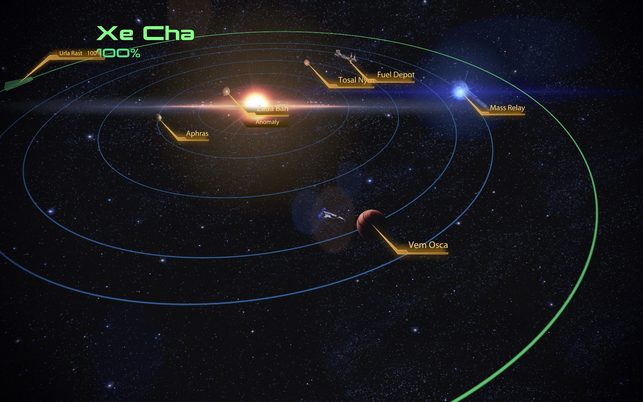
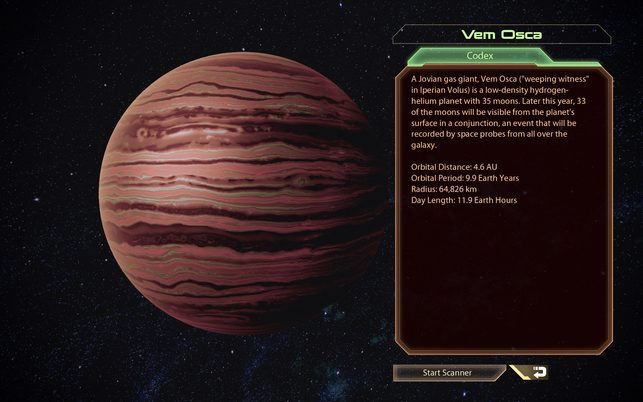
A Jovian gas giant, Vem Osca (“weeping witness” in Iperian Volus) is a low-density hydrogen-helium planet with 35 moons. Later this year, 33 of the moons will be visible from the planet’s surface in a conjunction, an event that will be recorded by space probes from all over the galaxy.
Orbital Distance: 4.6 AU
Orbital Period: 9.9 Earth Years
Radius: 64,826 km
Day Length: 11.9 Earth Hours
Zada Ban*
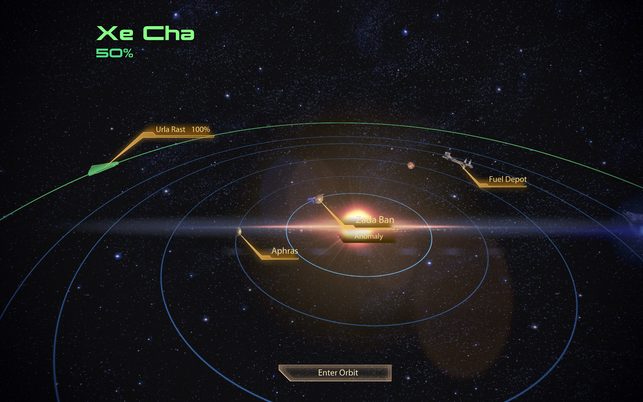
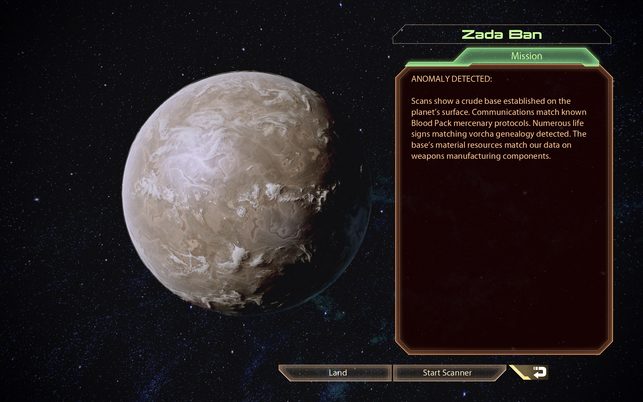
Zada Ban is a large, dense planet named for a volus god of punishment. Its crust is rich in uranium, eroded by winds to create large radioactive dust storms across its surface. The volus of Talis Fia have explored the planet thoroughly with space probes and telepresent robo-mining machines, and discovered they are not the first to exploit the planet. Plastics from a mining station approximately 50,000 years old can be found near the planet’s equator. Curiously, the mines nearby were not tapped out of uranium ore; they were instead abandoned at the height of their operation.
Colony Founded: 2154
Population: 22,500 (in orbital stations)
Capital: None, largest station is Dolo Station
Orbital Distance: 0.7 AU
Orbital Period: 0.9 Earth Years
Radius: 7,594 km
Day Length: 70.0 Earth Hours
Atmospheric Pressure: 0.0 Earth Atmospheres
Surface Temperature: 94 Celsius
Surface Gravity: 1.5 G