

You can also find a version of this codex on a Google doc file, which makes it easier to download it as a pdf.
Other Mass Effect codex can be found here.
Personal History Summary*
Note: Depends on Shepard’s background, will be filled later.
Aliens: Council Races
The three most politically important species in the galaxy
Asari

The asari were the first species to discover the Citadel. When the salarians arrived, it was the asari who proposed the establishment of the Citadel Council to maintain peace throughout the galaxy. Since then, the asari have served as the mediators and centrists of the Council.
An all-female race, the asari reproduce through a form of parthenogenesis. Each asari can attune her nervous system to that of another individual of any gender, and of any species, to reproduce. This capability has led to unseemly and inaccurate rumors about asari promiscuity.
Asari can live for over 1000 years, passing through three stages of life. In the Maiden stage, they wander restlessly, seeking new knowledge and experience. When the Matron stage begins, they ‘meld’ with interesting partners to produce their offspring. This ends when they reach the Matriarch stage, where they assume the roles of leaders and councilors.
Asari: Biology
Asari have a robust cellular regenerative system. While they do not heal faster than other species, asari are known to reach 1000 years of age.
Although asari have one gender, they are not asexual. An asari provides two copies of her own genes to her offspring. The second set is altered in a unique process called melding.
During melding, an asari consciously attunes her nervous system to her partner’s, sending and receiving electrical impulses directly through the skin. The partner can be another asari, or an alien of either gender. Effectively, the asari and her partner briefly become one unified nervous system.
This unique means of reproduction is the reason asari are talented biotics. Their evolved ability to consciously control nerve impulses is very similar to biotic training. Asari believe that their offspring acquire the best qualities of the “father” from the melded genes, but evidence is anecdotal.
Asari pass through three climacteric life stages, marked by biochemical and physiological changes. The Maiden stage begins at birth and is marked by the drive to explore and experience. Most young asari are curious and restless.
The Matron stage of life begins around the age of 350, though it can be triggered earlier if the individual melds frequently. This period is marked by a desire to settle in one area and raise children.
The Matriarch stage begins around 700, or earlier if the individual melds rarely. Matriarchs become active in their community as sages and councilors, dispensing wisdom from centuries of experience.
While each stage of life is marked by strong biological tendencies, individuals do make unexpected life choices. For example, there are Maidens who stay close to home rather than explore, Matrons who would rather work than build a family, and Matriarchs who have no interest in community affairs.
Asari: Culture
Because of their long lifespan, asari tend to have a ‘long view’ not common in other races. When they encounter a new species or situation, the asari are more comfortable with an extended period of passive observation and study than immediate action. They are unfazed that some of their investments or decisions may not pay off for decades or centuries. Matriarchs can seem to make incomprehensible decisions, but their insight is evident when their carefully-laid plans come to fruition. In interstellar relations, this long view manifests in an unspoken policy of centrism. The asari instinctively seek to maintain stable balances of economic, political, and military power.
Traditionally, asari spread their influence through cultural domination and intellectual superiority. They invite new species of advanced development to join the galactic community, knowing that their ideals and beliefs will inevitably influence the existing culture.
Asari: Military Doctrine
The asari military resembles a collection of tribal warrior bands with no national structure. Each community organizes its own unit as the locals see fit, and elect a leader to command them. Units from populous cities are large and well-equipped, while those from farm villages may be only a few women with small arms. There is no uniform; everyone wears what they like. The asari military is not an irregular militia, however; those who serve are full-time professionals.
The average asari huntress is in the maiden stage of her life and has devoted 20-30 years to studying the martial arts. Asari choose to be warriors at a young age, and their education from that point is dedicated to sharpening the mind and body for that sole purpose. When they retire, they possess an alarming proficiency for killing.
Huntresses fight individually or in pairs, depending on the tactics preferred in their town. One-on-one, a huntress is practically unbeatable, possessing profound tactical insight, a hunter’s eye, and a dancer’s grace and alacrity. Biotics are common enough that some capability is a requirement to be trained as a huntress; lack of biotic talent excludes a young asari from military service.
While fluid and mobile, asari can’t stand up in a firestorm the way a krogan, turian, or human could. Since their units are small and typically lack heavy armor and support weapons, they are almost incapable of fighting a conventional war, particularly one of a defensive nature. So asari units typically undertake special operations missions. Like an army of ninja, they are adept at ambush, infiltration, and assassination, demoralizing and defeating their enemies through intense, focused guerilla strikes.
As a popular turian saying puts it, ‘The asari are the finest warriors in the galaxy. Fortunately, there are not many of them.’
Asari: Religion
The pantheistic mainstream asari religion is siari, which translates roughly as ‘All is one.’ The faithful agree on certain core truths: the universe is a consciousness, every life within it is an aspect of the greater whole, and death is a merging of one’s spiritual energy back into the greater universal consciousness. Siarists don’t specifically believe in reincarnation; they believe that spiritual energy returned to the universal consciousness upon death will eventually be used to fill new mortal vessels.
Siari became popular after the asari left their homeworld and discovered their ability to ‘meld’ with nearly any form of life. This ability is seen as proof that all life is fundamentally similar. Siari priestesses see their role as promoting unity between the disparate shards of the universe’s awareness.
Before the rise of siari pantheism, asari religions were as diverse as their political opinions. The strongest survivor of those days is the monotheistic religion worshipping the goddess Athame. Like the asari, the goddess cycles through the triple aspects of maiden, matron, and matriarch.
Salarians
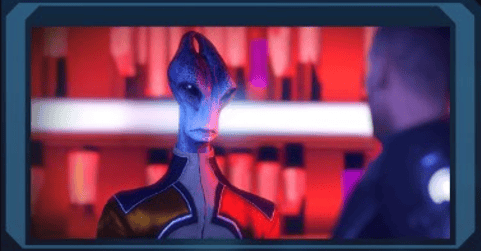
The second species to join the Citadel, the salarians are warm-blooded amphibians with a hyperactive metabolism. Salarians think fast, talk fast, and move fast. To salarians, other species seem sluggish and dull-witted. Unfortunately, their metabolic speed leaves them with a relatively short lifespan; salarians over the age of 40 are a rarity.
The salarians were responsible for advancing the development of the primitive krogan species to use as soldiers during the Rachni Wars. They were also behind the creation of the genophage bioweapon the turians used to quell the Krogan Rebellions several centuries later.
Salarians are known for their observational capability and non-linear thinking. This manifests as an aptitude for research and espionage. They are constantly experimenting and inventing, and it is generally accepted that they always know more than they’re letting on.
Salarians: Biology
Salarians are noted for their high-speed metabolism, which allows them to function on just one hour of sleep a day. Their minds and bodies work faster than most sapient races, making them seem restless or hyperactive. The drawback of this active metabolism is a short lifespan of around 40 human years.
The salarians are amphibian haplo-diploid egg-layers; unfertilized eggs produce males and fertilized eggs produce females. Once a year, a salarian female will lay a clutch of dozens of eggs. Social rules prevent all but a fraction from being fertilized. As a result, 90% of the species is male.
Salarians have photographic memories and rarely forget a fact. They also possess a form of
psychological ‘imprinting’, tending to defer to those they knew in their youth. Salarian hatching is a solemn ritual in which the clan Dalatrass (matriarch) isolates herself with the eggs. The young salarians psychologically imprint on her and tend to defer to her wishes.
During the hatching of daughters, the Dalatrasses of the mother and father’s clans are present at the imprinting. This ensures the offspring have equal loyalty to both, ensuring the desired dynastic and political unity.
Salarians: Culture
The rare salarian females are cloistered on their worlds out of tradition and respect. Powerful female Dalatrasses are dynasts and political kingpins. They determine the political course of their respective regions through shrewd negotiation. Though male salarians rise to positions of great authority in business, academia, or the military, they rarely have any input on politics.
Due to their method of reproduction, salarians have no concept of romantic love, sexual attraction, or the biological impulses and social rituals that complicate human lives. Male-female relationships are rare (due to the scarcity of females) and more akin to human friendship.
Sexuality is strictly for the purpose of reproduction. Ancient social codes determine who gets to fertilize eggs, which produces more daughters to continue a bloodline. Fertilization generally only occurs after months of negotiation between the parents’ clans, and is done for purposes of political and dynastic alliance. No salarian would imagine defying this code.
Salarian names are quite complex. A full name includes – in order – the name of a salarian’s planet, duchy, barony, fiefdom, family, and finally, the given name.
Salarians: Government
The salarian government is called the Salarian Union. It is a labyrinthine web of matrilineal bloodlines, with political alliances formed through interbreeding.
In many ways, the salarian political network functions like the noble families of Earth’s Medieval Europe. Structurally, the government consists of fiefdoms, baronies, duchies, planets, and marches (colonization clusters). These are human nicknames; the original salarian is unpronounceable. Each area is ruled by a single Dalatrass (matriarchal head-of-household) and represents an increasing amount of territory and prestige within the salarian political web.
Approaching 100 members, the first circle of a salarian’s clan comprises parents, siblings, uncles, aunts, and cousins. The next circle includes second cousins, etc., and escalates to well over 1000 members. The fourth or fifth circle of a clan numbers into the millions. Salarian loyalty is greatest to their first circle and diminishes from there. Their photographic memories allow salarians recognize all their myriad relatives.
Salarians: Military Doctrine
In principle, the salarian military is similar to the Alliance, a small volunteer army that focuses on maneuver warfare. What differentiates the salarians is not their equipment or doctrine, but their
intelligence services and rules of engagement. The salarians believe that a war should be won before it begins.
Conventional wisdom holds that the salarians know everything about everyone, and this is not far from the truth. In war, the unquestioned superiority of their intelligence services allows them to use their small military to maximum effectiveness. Well before fighting breaks out, they possess complete knowledge of their enemy’s positions, intentions, and timetable.
In every war the salarians have fought, they struck first and without warning. For the salarians, to know an enemy plans to attack and to let it happen is folly. To announce their own plans to attack is insanity. They find the human moral concepts of ‘do not fire until fired upon’ and ‘declare a war before prosecuting it’ incredibly naïve. In defensive wars, they execute devastating preemptive strikes hours before the enemy’s own attacks. On the offense, they have never telegraphed their intentions with a declaration of war before attacking.
Biotics are virtually unknown in the salarian military. Those with such abilities are considered too valuable to be used as cannon fodder and are assigned to the intelligence services.
While capable of defending themselves against most threats, the salarians know that they are small fish in a universe filled with sharks. As a point of survival, they have cultivated strong alliances with larger powers, particularly with the turians. Though the relationship between the two species was rocky at first due to the krogan uplift fiasco, the salarians take pains to keep this relationship strong enough that anyone who might threaten them risks turian intervention.
Salarians: Special Task Group
Salarian intelligence field agents are grouped into an organization called the Special Tasks Group. STG operators work in independent cells, performing dangerous missions such as counterterrorism, infiltration reconnaissance, assassination, and sabotage.
The STG is a proactive organization, puncturing worrisome trends before they become movements. At any time, a dozen groups are operating covertly within the lawless Terminus Systems, sowing dissent among the various factions. Civilian analysts also note how troublesome ‘hinge point’ individuals in Terminus frequently meet unexpected deaths.
STG operators are feared throughout the galaxy for their clear-eyed, remorseless practicality. They are willing to do whatever it takes to achieve their mission, even if it kills civilians or results in the team’s own destruction. In many ways, they are akin to the Council Spectres.
Recently, a number of STG cells have been redeployed from Salarian Union. It is assumed they are in the Terminus and Attican Traverse, investigating reports of geth activity beyond the Perseus Veil.
Turians
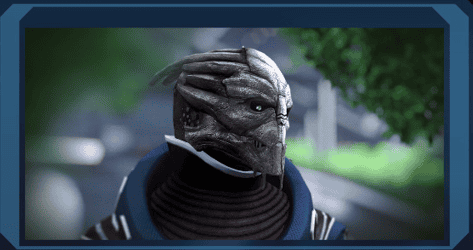
Roughly 1200 years ago, the turians were invited to join the Citadel Council to fulfill the role of galactic peacekeepers. The turians have the largest fleet in Citadel space, and they make up the single largest portion of the Council’s military forces.
As their territory and influence has spread, the turians have come to rely on the salarians for military intelligence and the asari for diplomacy. Despite a somewhat colonial attitude towards the rest of the galaxy, the ruling Hierarchy understands they would lose more than they would gain if the other two races were ever removed.
Turians come from an autocratic society that values discipline and possesses a strong sense of personal and collective honor. There is lingering animosity between turians and humans over the First Contact War of 2157, which is known as the ‘Relay 314 Incident’ to the turians. Officially, however, the two species are allies and they enjoy civil, if cool, diplomatic relations.
Turians: Biology
The turian homeworld, Palaven, has a metal-poor core, generating a weak magnetic field and allowing more solar radiation into the atmosphere. To deal with this, most forms of life on Palaven evolved some form of metallic ‘exoskeleton’ to protect themselves. Their reflective plate-like skin makes turians less susceptible to long-term, low-level radiation exposure, but they do not possess any sort of ‘natural armor’. A turian’s thick skin does not stop projectiles and directed energy bolts.
Although life on Palaven is carbon-based and oxygen-breathing, it is built on dextro-amino acids. This places the turians in a distinct minority on the galactic stage; the quarians are the only other known sapient dextro-protein race. The food of humans, asari, or salarians (who evolved in levo-amino acid-based biospheres), will at best pass through turian systems without providing any nutrition. At worst, it will trigger an allergic reaction that can be fatal if not immediately treated.
Turians: Culture
While turians are individuals with personal desires, their instinct is to equate the self with the group, and set aside personal desires for the good of all.
Turians are taught to have a strong sense of personal accountability, the ‘turian honor’ that other races find so remarkable. Turians are taught to own every decision they make, good or ill. The worst sin they can make in the eyes of their people is to lie about their own actions. Turians who murder will try to get away with it, but if directly questioned, most will confess the crime.
Turians have a strong inclination toward public service and self-sacrifice, so they tend to be poor entrepreneurs. To compensate, they accepted the mercantile volus as a client race, offering protection in exchange for their fiscal expertise.
The turian military is the center of their society. It is not just an armed force; it is an all-encompassing public works organization. The military police are also the civic police. The fire brigades serve the civilian population as well as military facilities. The corps of engineers builds and maintains spaceports, schools, water purification plants, and power stations. The merchant marine ensures that all worlds get needed resources.
Turians: Government
The turian government is a hierarchical meritocracy. While it has great potential for misuse, this is tempered by the civic duty and personal responsibility turians learn in childhood.
Turians have 27 citizenship tiers, beginning with civilians (client races and children). The initial period of military service is the second tier. Formal citizenship is conferred at the third tier, after boot camp. For client races, citizenship is granted after the individual musters out. Higher-ranked citizens are expected to lead and protect subordinates. Lower-ranked citizens are expected to obey and support superiors. Promotion to another tier of citizenship is based on the personal assessments of one’s superiors and co-rankers.
Throughout their lives, turians ascend to higher tiers and are occasionally ‘demoted’ to lower ones. The stigma associated with demotion lies not on the individual, but on those who promoted him when he wasn’t ready for additional responsibility. This curbs the tendency to promote individuals into positions beyond their capabilities.
Settling into a role and rank is not considered stagnation. Turians value knowing one’s own limitations more than being ambitious.
At the top are the Primarchs, who each rule a colonization cluster. The Primarchs vote on matters of national import. They otherwise maintain a ‘hands-off’ policy, trusting the citizens on each level below them to do their jobs competently.
Turians enjoy broad freedoms. So long as one completes his duties, and does not prevent others from completing theirs, nothing is forbidden. For example, there are no laws against recreational drug use, but if someone is unable to complete his duties due to drug use, his superiors step in. Judicial proceedings are ‘interventions.’ Peers express their concern, and try to convince the offender to change. If rehabilitation fails, turians have no qualms about sentencing dangerous individuals to life at hard labor for the state.
Turians: Military Doctrine
Although they lack the brutality of the krogan, the skill of the asari, and the virtuosity of the humans, the turian military has formidable discipline. Officers and NCOs are ‘lifers’ with years of field experience. Enlisted personnel are thoroughly trained and stay calm under fire. Turian units don’t break. Even if their entire line collapses, they fall back in order, setting ambushes as they go. A popular saying holds: ‘You will only see a turian’s back once he’s dead.’
Boot camp begins on the 15th birthday. Soldiers receive a year of training before being assigned to a field unit; officers train for even longer. Most serve until the age of 30, at which point they become part of the Reserves. Even if they suffer injuries preventing front-line service, most do support work behind the lines.
Biotics are uncommon. While admired for their exacting skills, biotics’ motives are not always fully trusted by the common soldier. The turians prefer to assign their biotics to specialist teams called Cabals.
Command and control is decentralized and flexible. Individual squads can call for artillery and air support. They make extensive use of combat drones for light duties, and practice combined arms: infantry operates with armor, supported by overhead gunships. Strategically, they are methodical and patient, and dislike risky operations.
Tradition is important. Each legion has a full-time staff of historians who chronicle its battle honors in detail. The oldest have records dating back to the turian Iron Age. If a legion is destroyed in battle, it is reconstituted rather than replaced.
The turians recruit auxiliary units from conquered or absorbed minor races. Auxiliaries are generally light infantry or armored cavalry units that screen and support the main turian formations. At the conclusion of their service in the Auxiliaries, recruits are granted turian citizenship.
Turians: Religion
Although turians have a strict moral code, their belief in individual responsibility means that the concepts of good and evil are simply the individual’s choice between egotism and altruism in any given decision. They have no concept of ‘good’ deities that encourage noble behavior or ‘evil’ ones that tempt individuals to misdeeds.
Turians believe that groups and areas have ‘spirits’ that transcend the individual. For example, a military unit would be considered to have a literal spirit that embodies the honor and courage it has displayed. A city’s spirit reflects the accomplishments and industry of its residents. An ancient tree’s spirit reflects the beauty and tranquility of the area it grows within.
These spirits are neither good nor evil, nor are they appealed to for intercession. Turians do not believe spirits can affect the world, but spirits can inspire the living. Prayers and rituals allow an individual to converse with a spirit for guidance or inspiration. For example, a turian who finds his loyalty tested may appeal to the spirit of his unit, hoping to reconnect with the pride and honor of the group. A turian who wishes to create a work of art may attempt to connect with the spirit of a beautiful location.
Turians enjoy absolute freedom of religion and can practice whatever appeals to them so long as it does not impede anyone’s ability to perform their duties. There are many practitioners of the asari ‘siarist’ philosophy. Since opening dialog with the human Systems Alliance, some turians have embraced Confucianism and Zen Buddhism.
Aliens: Extinct races
Spacefaring species that went extinct thousands of years before the present
Protheans
Fifty thousand years ago, the Protheans were the only spacefaring species in the galaxy. They vanished in a swift ‘galactic extinction’. Only the legacy of their empire remains. They are believed to have built the mass relays and the Citadel, which have allowed numerous species to explore and expand throughout the galaxy.
Prothean ruins are found on worlds across the galaxy. While surprisingly intact for their age, functioning examples of Prothean paleotechnology are rare. Time and generations of looters have picked their dead cities and derelict stations clean.
Some believe the Protheans meddled in the evolution of younger races. The hanar homeworld of Kahje, for example, shows clear evidence of former Prothean occupation. The presence of a former Prothean observation post on Mars has caused a rebirth of ‘interventionary evolutionists’ among humans. These individuals believe the god-myths of ancient civilizations are misremembered encounters with aliens.
Protheans: Beacon
The beacon was a Prothean artifact unearthed on the Alliance colony of Eden Prime. Its resemblance to the Prothean data banks recovered on Mars provoked immediate interest from the Alliance and the Citadel Council. It proved to be a solid state data storage device, part of a galaxy-spanning comm network similar to the modern extranet. Intact Prothean ‘paleo-technology’ is rare; the beacon seemed to promise another quantum leap of technology, akin to the discovery of the mass effect drive and relays.
Unfortunately, the beacon also drew the attention of the rogue Spectre Saren Arterius and his synthetic allies, the geth. A dawn raid by his flagship Sovereign resulted in hundreds of civilian casualties. The beacon was badly damaged. The motives behind the attack are still being investigated.
During the recovery operation, the beacon fired a pulse of energy at the Executive Officer of the Alliance frigate Normandy. Lieutenant Commander Shepard survived and appears to have suffered no ill effects. Afterwards, the beacon fell inert. The mechanism appears to be dead.
Protheans: Cypher
The Prothean beacon downloaded its knowledge into Lt. Commander Shepard on Eden Prime, causing confusing dreams and visions. While the imagery is becoming clearer with time, the meaning of the beacon communication remains elusive.
It has been suggested that Prothean data recording is highly dependent on a certain point of view, what Carl Jung described as the collective unconscious. The ‘cipher’ needed to comprehend the images implanted in Shepard’s mind is the cultural knowledge of a Prothean: the archetypes, biological instincts, and common experiences universal to the race. Since the Protheans have been dead for millennia, it may be impossible to acquire this ‘cipher’.
Rachni
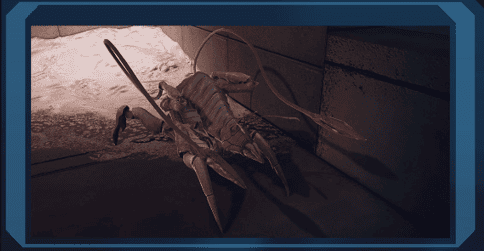
Though now extinct, the rachni once threatened every species in Citadel space. Over 2000 years ago, explorers foolishly opened a mass relay to a previously-unknown system and encountered something never seen before or since: a species of spacefaring insects guided by a hive-mind intelligence.
Unfortunately, the rachni were not peaceful, and the galaxy was plunged into a series of conflicts known as the Rachni Wars. Attempts to negotiate were futile, as it was impossible to make contact with the hive queens that guided the race from beneath the surface of their toxic homeworld.
The emergence of the krogan ended the Rachni Wars. Bred to survive the harshest environments, the krogan were able to strike at the queens in their lairs and reclaim conquered Council worlds. But when krogan fleets pressed them back to their homeworld, the rachni refused to surrender, and the krogan eradicated them from the galaxy.
Aliens: Non-Council Races
Spacefaring species without the political power to set galactic policy
Batarians
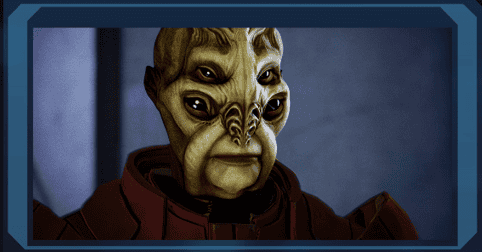
In the early 2160s, the Alliance began aggressive colonization of worlds in the Skyllian Verge, much to the dismay of the batarians who had been developing the region for several decades. In 2171, the batarians petitioned the Council to declare the Verge a “zone of batarian interest.” The Council refused, however, declaring unsettled worlds in the region open to human colonization.
In protest, the batarians closed their Citadel embassy and severed official diplomatic relations with the Council, effectively becoming a rogue state. They instigated a proxy war in the Verge by funneling money and weapons to criminal organizations, urging them to strike at human colonies.
Hostilities peaked with the Skyllian Blitz of 2176, an attack on the human capital of Elysium by batarian-funded pirates and slavers. In 2178, the Alliance retaliated with a crushing assault on the moon of Torfan, long used as a staging base by batarian-backed criminals. In the aftermath, the batarians retreated into their own systems, and are now rarely seen in Citadel space.
Elcor
The elcor are a Citadel species native to the high-gravity world Dekuuna. They are massive creatures, standing on four muscular legs for increased stability. Elcor move slowly, an evolved response to an environment where a fall can be lethal. This has colored their psychology, making them deliberate and conservative.
Elcor speech is ponderous and monotone. Among themselves, scent, slight movements, and subvocalized infrasound convey shades of meaning that make a human smile seem as subtle as a fireworks display. Since their subtlety can lead to misunderstandings with other species, the elcor often go out of their way to clarify when they are being sarcastic, amused, or angry.
Dekunna’s high gravity impedes mountain formation. Most of the world consists of flat, open plains, which prehistoric elcor wandered across in small family bands. Modern elcor still prefer open sky, and can become restless and uncomfortable on long starship journeys.
Geth
The geth are a humanoid race of networked Als. They were created by the quarians 300 years ago as tools of labor and war. When the geth showed signs of self-evolution, the quarians attempted to exterminate them. The geth won the resulting war. This example has led to legal, systematic repression of artificial intelligences in galactic society.
The geth possess a unique distributed intelligence. An individual has rudimentary animal instincts, but as their numbers and proximity increase, the apparent intelligence of each individual improves. In groups, they can reason, analyze situations, and use tactics as well as any organic race.
Geth space is located at the trailing end of the Perseus Arm, beyond the lawless Terminus Systems. The Perseus Veil, an obscuring ‘dark nebula’ of opaque gas and dust, lies between their space and the Terminus Systems.
Geth: Armatures
Armatures are quadruped all-terrain heavy weapons platforms, akin to the armored fighting vehicles of other races. Geth being synthetic intelligences, armatures are not crewed vehicles, but intelligent entities, capable of independent decision-making and learning.
Armatures are equipped with heavy kinetic barriers. Their main cannon, mounted on the articulated ‘head’ turret, appears to be a highly efficient conventional mass accelerator. It is capable of firing in anti-personnel and anti-tank modes. Some armatures carry drones into battle, presumably for reconnaissance purposes. Others host a swarm of insect-sized repair microbots.
Geth: Hoppers
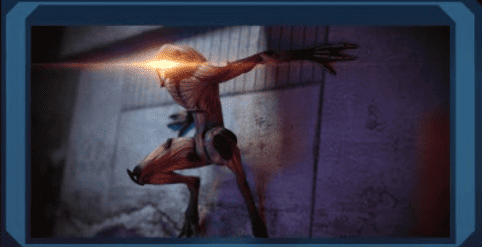
The geth models collectively dubbed ‘hoppers’ by Alliance forces are electronic warfare platforms. They can project electromagnetic radiation across a broad spectrum as an offensive weapon. They can also perform cyber warfare attacks against the onboard computers of body armor hardsuits and weapons, adversely affecting their performance.
The structure of hoppers consist of an advanced and highly elastic artificial muscle material. This allows a hopper to compress its entire body for powerful leaps. Hoppers also have thousands of molecule-scale ‘barbs’ on the surfaces of their hands and feet, which are used to cling to walls and ceilings.
Hoppers are very difficult targets, leaping from one surface to another in rapid succession.
The quarians have no record of any geth models similar to hoppers. This new morphotype must have been developed over the last three hundred years by the geth themselves. This is troubling proof that the geth are continuing to move towards technological singularity. Experts in synthetic life are intrigued that hoppers appear to be even more organic than the baseline geth.
The identified subtypes of hopper have been codenamed Sapper, Stalker, and Ghost.
Hanar
The hanar are a Citadel species known for excessive politeness. They speak with scrupulous precision, and take offense at improper language. Hanar that expect to deal with other species take special courses to help them unlearn their tendency to take offense at improper speech.
All hanar have two names. The Face Name is known to the world; the Soul Name is kept for use among close friends and relations. Hanar never refer to themselves in the first person in conversation with someone they know on a Face Name basis. To do so is considered egotistical, so instead they refer to themselves as “this one,” or the impersonal “it.”
Their homeworld, Kahje, has 90% ocean cover and orbits an energetic white star, resulting in a permanent blanket of clouds. Due to the presence of Prothean ruins on the world, many hanar worship them, and hanar myths often speak of an elder race that civilized them by teaching them language.
Keepers
When the asari discovered the Citadel, they also discovered the keepers, a docile multi-limbed insect race that seemingly exists only to maintain and repair the great Prothean station.
Early attempts to communicate with or study the keepers were failures, and it is now illegal to interfere with or impede keeper activity. Because they are completely non-threatening, keepers have become virtually invisible to everyone else.
Similarly, they seem indifferent to other species, except for their tendency to help new arrivals integrate themselves into the Citadel.
No matter how many keepers die due to old age, violence, or accident, they maintain a constant number. No one has discovered the source of new keepers, but some hypothesize they are genetic constructs: biological androids created somewhere deep in the inaccessible core of the Citadel itself.
Krogan
The krogan evolved in a hostile and vicious environment. Until the invention of gunpowder weapons, ‘eaten by predators’ was still the number one cause of krogan fatalities. Afterwards, it was ‘death by gunshot’.
When the salarians discovered them, the krogan were a brutal, primitive species struggling to survive a self-inflicted nuclear winter. The salarians culturally uplifted them, teaching them to use and build modern technology so they could serve as soldiers in the Rachni War.
Liberated from the harsh conditions of their homeworld, the quick-breeding krogan experienced an unprecedented population explosion. They began to colonize nearby worlds, even though these worlds were already inhabited. The Krogan Rebellions lasted nearly a century, only ending when the turians unleashed the genophage, a salarian-developed bioweapon that crushed all krogan resistance.
The genophage makes only one in 1000 pregnancies viable, and today the krogan are a slowly dying breed. Understandably, the krogan harbor a grudge against all other species, especially the turians.
Krogan: Culture
The harsh krogan homeworld conditioned the krogan psychology for toughness just as it did the body. Krogan have always had a tendency to be selfish, unsympathetic, and blunt. They respect strength and self-reliance and are neither surprised nor offended by treachery. The weak and selfless do not live long. In their culture, ‘looking out for number one’ is simply a matter of course.
After their defeat in the Rebellions, the very concept of krogan leadership was discredited. Where a warlord could once command enough power to bring entire solar systems to heel and become Overlord, these days it is rare for a single leader to have more than 1000 warriors swear allegiance to him. Most krogan trust and serve no one but themselves.
This solitary attitude stems in part from a deep sense of fatalism and futility, a profound social effect of the genophage that caused krogan numbers to dwindle to a relative handful. Not only are they angry that the entire galaxy seems out to get them, the krogan are also generally pessimistic about their race’s chances of survival. The surviving krogan see no point to building for the future; there will be no future. The krogan live with an attitude of ‘kill, pillage, and be selfish, for tomorrow we die’.
Krogan: Genophage
The genophage bioweapon was created to end the Krogan Rebellions. From the start, the krogan had overwhelmed the Council. Only timely first contact with the turians saved the Council races. The turians fought the krogan to a standstill, but sheer weight of krogan numbers indicated the war could not be won through conventional means. The turians collaborated with the salarians to genetically engineer a counter to the rapid breeding of the krogan.
The genophage virus gained the energy to replicate by ‘eating’ key genetic sequences. Every cell in every krogan had to be altered for the weapon to be foolproof; otherwise the krogan could have used gene therapy to fix the affected tissues. Once a genophage strain could find no more genes to eat, it would starve and die, limiting spin-off mutation and contamination. This ‘created’ genetic flaw is hereditary.
The salarians believed the genophage would be used as a deterrent, a position the turians viewed as naïve. Once the project was complete, the turians mass produced and deployed it. The krogan homeworld, their colonies, and all occupied worlds were infected.
The resulting mutation made only one in a thousand krogan pregnancies carry to term. It did not reduce fertility, but offspring viability. The rare females able to carry children to term became prizes the krogan warlords fought brutal battles over.
The krogan are a shadow of their former glory. While the Rebellions took place centuries ago, they are constantly reminded of the horror of the genophage, and of their inability to counter it. The release of the genophage is still controversial, bitterly debated in many circles.
Krogan: Krogan Rebellions
After the Rachni War, the quick-breeding krogan expanded at the expense of their neighbors. Warlords leveraged their veteran soldiers to seize living space while the Council races were still grateful. Over centuries, the krogan conquered world after world. There was always ‘just one more’ needed. When the Council finally demanded withdrawal from the asari colony of Lusia, krogan Overlord Kredak stormed off the Citadel, daring the Council to take their worlds back.
But the Council had taken precautions. The finest STG operators and asari huntresses had been drafted into a covert ‘observation force’, the Office of Special Tactics and Reconnaissance. The Spectres opened the war with crippling strategic strikes. Krogan planets went dark as computer viruses flooded the extranet. Sabotaged antimatter refineries disappeared in blue-white annihilation. Headquarters stations shattered into orbit-clogging debris, rammed by pre-placed suicide freighters.
Still, this only delayed the inevitable. The war would have been lost if not for first contact with the turians, who responded to krogan threats with a prompt declaration of war. Being on the far side of krogan space from the Council, the turians advanced rapidly into the lightly-defended krogan rear areas. The krogan responded by dropping space stations and asteroids on turian colonies. Three worlds were rendered completely uninhabitable.
This was precisely the wrong approach to take with the turians. Each is first and foremost a public servant, willing to risk his life to protect his comrades. Rather than increasing public war weariness, krogan tactics stiffened turian resolve.
The arrival of turian task forces saved many worlds from the warlords’ marauding fleets, but it took development of the genophage bioweapon to end the war. There were decades of unrest afterwards. Rogue warlords and holdout groups of insurgents refused to surrender, or disappeared into the frontier systems to become pirates.
Quarians
Driven from their home system by the geth nearly three centuries ago, most quarians now live aboard the Migrant Fleet, a flotilla of fifty thousand vessels ranging in size from passenger shuttles to mobile space stations.
Home to 17 million quarians, the flotilla understandably has scarce resources. Because of this, each quarian must go on a rite of passage known as the Pilgrimage when they come of age. They leave the fleet and only return once they have found something of value they can bring back to their people.
Other species tend to look down on the quarians for creating the geth and for the negative impact their fleet has when it enters a system. This has led to many myths and rumors about the quarians, including the belief that underneath their clothes and breathing masks, they are actually cybernetic creatures: a combination of organic and synthetic parts.
Quarians: Economy
The Migrant Fleet has little economic base, operating in a state of perpetual ‘hand-to-mouth’. While quarian ships include light manufacturing and assembly plants, they lack heavy industries such as refining and shipbuilding. The fleet has tankers for water purification and oxygen cracking, but the space-intensive nature of agriculture limits food production. A single disaster could destroy the fragile balance.
The quarians earn income in creative ways. Because the government is obliged to provide food, water, air, and medical support for every individual, the Conclave strategically determines the course of the Fleet to bring in resources and income. A species who suspects the Migrant Fleet is heading towards their space often offers a ‘gift’ of surplus starships, fuel, and resources to convince the Conclave to alter course.
As the Fleet passes through a system, swarms of mining vessels work over asteroids for metals and siliceous materials and cometary bodies for water ice and organics. Quarian miners are adept at locating and strip-mining space-borne resources. This sparks conflict with corporations already working the system. Large mining concerns spend millions on lobbyists and public relations portraying the quarians as locusts, devouring the resources of a system before moving on.
The greatest asset of the quarians is their rarified skills. Most are experienced miners. Due to their life of perpetual salvage and repair, they are skilled engineers and technicians. More than once, the very corporations that lobby against the quarians have made back room deals with the Fleet, arranging for skilled quarians to fill space engineering jobs that other species would demand higher wages for.
Quarians are widely hated among the working classes. ‘The quarians are coming to take our jobs’ is a common response to the Fleet’s approach.
Quarians: Government
Due to the quarians’ precarious existence and the need to enforce strict rationing, government is somewhat autocratic. The Migrant Fleet’s operations are directed by the Admiralty, a board of five military officers who are advised by a legislative body called the Conclave.
Each vessel in the Fleet has the right to send representatives to the Conclave aboard the flagship. The number of representatives is based on crew size. Larger clans, with bigger ships and more votes, form the cores of political blocs. Opposition comes from the Outriders’ Coalition, with delegates from thousands of smaller ships.
The Admiralty defers to the Conclave’s decisions in most circumstances. However, if all five members agree that a Conclave decision jeopardizes the survival of the Fleet, and cannot get the Conclave to address their concerns, they have the right to summarily overturn the legislative decision. After the Admiralty uses this extraordinary power, they must resign. If the Admiralty does not step down after using their veto, the rest of the military is obliged to arrest them.
Each ship captain has authority over his vessel, but is advised by an elected civilian Council, just as the Admiralty is advised by the Conclave. This relationship may range from cooperation to polite tolerance to outright hostility, but any captain who overrules his Council without good reason is relieved of command by the Admiralty.
Many quarian ships are owned by clans who pool their resources to purchase used vessels from private sellers. Large ships are prestigious for big, rich clans, but a small ship means status for a small clan with enough personal wealth to afford a private vessel. Clan vessel captains are not subject to dismissal by the Admiralty; abusive captains are a ‘family’ problem if they do not disrupt the operations of the fleet.
Quarians: Law and Defense
Although the Conclave establishes civil law much as any planet-based democracy, enforcement and trials are more unique. After the flight from the geth, there were few constables to police the millions of civilians aboard the Fleet, so the navy parceled out marine squads to maintain order and enforce the law. Today, quarian marines have evolved training and tactics akin to civilian police, but remain adept at combat in the confined spaces of a starship, and fully under the command of the military.
Once taken into custody, the accused is brought before the ship’s captain for judgment. While the ship’s Council may make recommendations, tradition holds that the captain has absolute authority in matters of discipline.
Most are lenient, assigning additional or more odious maintenance tasks aboard the ship. Persistent recidivists are ‘accidentally’ left on the next habitable world. This practice of abandoning criminals on other people’s planets is a point of friction between the quarians and the systems they pass through. Captains rarely have another choice; with space and resources at a premium, supporting a non-productive prison population is not an option.
In the early years, many quarian freighters were armed and used as irregular ‘privateers’. Civilian ships still show a strong preference for armament, making them unpopular targets for pirates. Though they have rebuilt their military, there are still mere hundreds of warships to protect tens of thousands of ships. The quarian navy follows strict routines of patrol, and takes no chances. If the intent of an approaching ship can’t be ascertained, they shoot to kill.
Quarians: Migrant Fleet
The Migrant Fleet is the largest concentration of starfaring vessels in the galaxy, sprawling across millions of kilometers. It can take days for the entire Fleet to pass through a mass relay.
When the quarians fled their homeworld, the Fleet was a motley aggregation of freighters, shuttles, industrial vessels, and the odd warship. After three centuries, all have been modified to support larger crews as comfortably as possible. As the quarians achieved stability, they began weeding out the ships least suitable for long-term habitation, selling them and pooling the money to buy larger and more spaceworthy hulls. This process is ongoing, as vessels wear out and break down.
While some ships enjoy dedicated cabins with full privacy and sanitary facilities, many more are former freighters, whose cargo bays and containers are pressurized and divided into family spaces using simple metal ‘cubicle’ bulkheads. The quarians enliven these austere spaces with colorful quilts and tapestries, which also help muffle sound.
The day-to-day operations of the fleet – traffic control, station-keeping, supply distribution, and so on – are under military jurisdiction. Though ship captains have the authority to deviate from their assigned positions and may leave the fleet at any time, they are assumed to do so at their own risk. As the Migrant Fleet moves around the galaxy, many ships split off to pursue individual goals, returning days or years later.
Quarians: Pilgrimage
When quarians of the Migrant Fleet reach young adulthood, they must leave their birth ship and find a new crew to accept them as permanent residents. To prove themselves, they must recover something of value. This is offered to their prospective captain as proof that they will not be a mere burden on the shoestring resources of the ship.
This process is called the Pilgrimage. Stripped of ritual, the Pilgrimage is merely an attempt to maintain genetic diversity within the small, relatively isolated population bases that make up the Migrant Fleet. If the young stayed and married within their birth vessel, the risk of inbreeding would increase sharply.
Quarians are surgically fitted with their various immunity-boosting implants in preparation for leaving on Pilgrimage. Having grown up within the sterile, controlled environments of the Migrant Fleet ships, quarians have virtually no natural immune system.
Quarians: Religion
The ancient quarians practiced ancestor worship. Even after abandoning faith for secularism, quarians continued to revere the wisdom of elders. As time passed and technology advanced, they inevitably turned their knowledge to preserving the personalities and memories of the elderly as computer virtual intelligences. These recordings became a repository of knowledge and wisdom, stored in a central databank and available through any extranet connection.
They held no illusions that this was a form of immortality; like all virtual intelligences, their electronically-preserved ancestors were not truly sapient. This was considered a surmountable problem; sapience could surely be reduced to simple mathematics.
The quarians began exhaustive research into creating artificial intelligence so they could learn to escape the bounds of mortality and give their ancestral records true awareness. Unfortunately, the life the quarians created did not accept the same truths they did. The geth destroyed the ancestor databanks when they took over.
In the centuries since they evacuated their homeworld, most quarians have returned to religion in various forms. Many believe that the rise of the geth and the destruction of their ‘ancestors’ were chastisement for arrogantly forsaking the old ways and venerating self-made idols.
Others have a more philosophical outlook, believing that their race was indeed arrogant, but no supernatural agency lay behind the geth revolt. Rather, the quarians’ actions wrought their own doom. Either way, every quarian would agree that their own hubris cost them their homeworld.
Volus
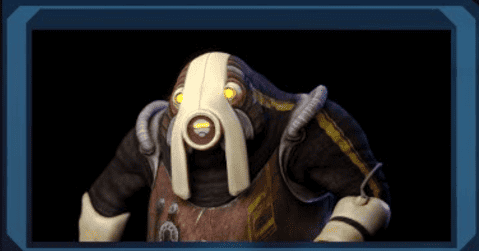
The volus are a member species of the Citadel with their own embassy, but they are also a client race of the turians. Centuries ago, they were voluntarily absorbed into the Hierarchy, effectively trading their mercantile prowess for turian military protection.
Irune, their homeworld, lies far beyond the normal life zone of its star. However, the world has a high- pressure greenhouse atmosphere that traps enough heat to support an ammonia-based biochemistry. As a result, the volus must wear pressure suits and breathers when dealing with other species as conventional nitrogen/oxygen air mixtures are poisonous to them, and in the low pressure atmospheres tolerable to most species, their flesh will actually split open.
Volus culture is tribal, bartering lands and even people to gain status. This culture of exchange inclines them to economic pursuits. It was the volus who authored the Unified Banking Act, and they continue to monitor and balance the Citadel economy.
Aliens: Non-sapient creatures
Common non-sapient life-forms
Husks
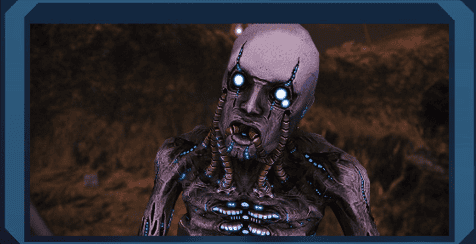
After the geth secure a location, they round up and impale dead and living bodies on mechanical spikes. The spikes rapidly transform these victims into withered husks, extracting water and trace minerals and replacing them with cybernetics.
The cybernetics re-animate the lifeless flesh and tissue, transforming the bodies into mindless killing machines. Some Alliance soldiers refer to the husk-generating spikes as Dragon’s Teeth, a reference to the mythological berserkers who sprang up from the earth wherever the teeth of the dragon Ares were planted.
Dragon’s Teeth and husks bear little resemblance to other pieces of geth technology. No one is sure why a synthetic race would bother to drain the miniscule amount of recoverable resources from organic corpses, though the value of reusing them as shock troops is obvious.
Thresher Maws
Thresher maws are subterranean carnivores that spend their entire lives eating or searching for something to eat. Threshers reproduce via spores that can lie dormant for millennia, yet are robust enough to survive prolonged periods in deep space and atmospheric re-entry. As a result, thresher spores appear on many worlds, spread by previous generations of space travelers.
The body of a thresher never entirely leaves the ground; only the head and tentacles erupt from the earth to attack. In addition to physical attacks, threshers have the ability to project toxic chemicals and emit bursts of infrasound as a shockwave weapon.
The Alliance first encountered threshers on the colony of Akuze in 2177. After contact was lost with the pioneer team, marine units were deployed to investigate. The shore parties were set upon by hungry threshers, and nearly the entire assault force was killed. Alliance forces recommend engaging threshers with vehicle-mounted heavy weapons.
Varren
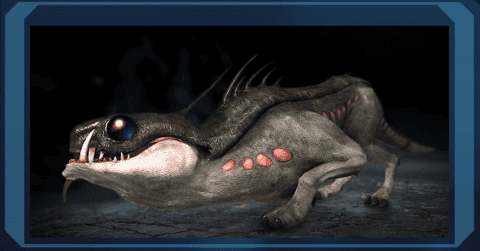
Varren are omnivores with a preference for living prey. Originally native to the krogan homeworld of Tuchanka, they are, like most life from Tuchanka, savage, clannish, and consummate survivors. They are pack hunters when vulnerable prey is readily available and become scavengers when outnumbered or outclassed.
Their supreme adaptability, vicious demeanor, and rapid breeding cycle have made them ubiquitous and dangerous pests on many worlds. Virtually everywhere the krogan have been, varren infestations have followed, wreaking havoc with the native ecology.
The krogan have had a love-hate relationship with varren for millennia, alternately fighting them for territory and embracing them as treasured companions. To this day, krogan raise them as beasts of war. A common subgenus of varren has metallic silver scales, leading to the rather unusual nickname ‘fishdogs’.
Citadel and Galactic government
A massive space station that serves as the political and economic capital of galactic culture
Citadel
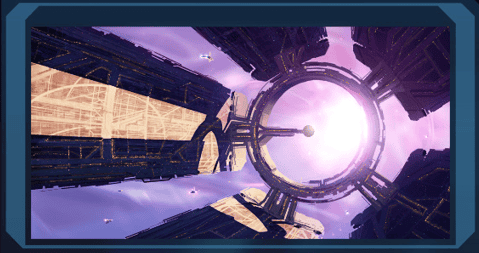
The Citadel is an ancient deep-space station, presumably constructed by the Protheans. Since the Prothean extinction, numerous species have come to call the Citadel home. It serves as the political, cultural, and financial capital of the galactic community. To represent their interests, most species maintain embassies on the Presidium, the Citadel’s inner ring.
The Citadel Tower, in the center of the Presidium, holds the Citadel Council chambers. Council affairs often have far-reaching effects on the rest of the galactic community. Five arms, known as the wards, extend from the Presidium. Their inner surfaces have been built into cities, populated by millions of inhabitants from across the galaxy.
The Citadel is virtually indestructible. If attacked, the station can close its arms to form a solid, impregnable shell. For as long as the station has existed, an enigmatic race called the keepers has maintained it.
Citadel Station: Citadel Security Services (C-Sec)
Citadel Security is a volunteer police service answering to the Citadel Council. The 200,000 constables of C-Sec are responsible for maintaining public order in the densely populated Citadel. They also provide pirate suppression, customs enforcement, and search-and-rescue throughout the Citadel cluster.
C-Sec has six divisions:
ENFORCEMENT – Uniformed officers who patrol the Citadel and respond to emergencies.
INVESTIGATION – Detectives who puzzle out the truth behind crimes and bring perpetrators to justice.
CUSTOMS – Screens the thousands of passengers and cargo containers that pass through the Citadel’s ports every day.
NETWORK – Deals with “cybercrimes” like identity and copyright theft, hacking and viral attacks, and illegal artificial intelligence.
SPECIAL RESPONSE – Deals with hostage situations, bombs, and heavily armed criminals. In the unlikely event that attackers board the Citadel, they are also the front line of defense, armed with military grade equipment.
PATROL – Naval arm, with ships stationed throughout the Citadel cluster. Unlike the other divisions, they are rarely seen at the Citadel, nor do they stay in one place long.
Joining C-Sec is prestigious; applications must be sponsored by a Citadel Councilor or the ambassador of an associate Council race. Generally, applicants have many years of distinguished service in the military or police forces of their nation, but an inexperienced applicant with demonstrable talent will be fairly considered.
C-Sec and the Spectres are often at odds. Many C-Sec members, notably current Executor Venari Pallin, believe that allowing Spectres to be ‘above the law’ is a dangerous practice; the actions of Saren Arterius lend credence to this position. The Spectres, in turn, are aggravated when C-Sec’s dedication to procedure and due process hampers their investigations.
Citadel Station: Presidium Ring
The Ring is an enclosed loop of park-like space serving as the connection point for the Wards. The interior walls are lined with the embassies of influential species and private residences for the galaxy’s elite.
The Presidium is full of ‘open-air’ restaurants, bars, and luxurious meeting areas. Gravity is about 1/3 Earth-normal. A holographic ‘sky’ is projected over the ‘ceiling’ of the ring. Unlike the 24/7 bustle of the Wards, the Presidium maintains a 20-hour day schedule, with a six-hour ‘night’ where lights are dimmed and the sky goes through a night cycle.
Offices and residences are often open to the interior. It is not unusual for embassies to have no exterior wall at all. This does not cause a crime problem due to the heavy C-Sec presence and ubiquitous monitoring devices on the Presidium. Thieves are quickly identified and apprehended.
The Ring is the location of the Citadel’s spaceports. Being closer to the center of spin, there is less motion for a ship to match, and the reduced spin gravity makes handling cargo easier. Hundreds of ships pass through the Citadel every day, and every species with an embassy is granted a private dock.
The Tower, at the center of the Ring, holds the administration of the Citadel Council. The Tower rises over a kilometer from the ring, appearing to thrust forward parallel to the ward arms. As the Tower is at the center of the spin axis, it experiences little centrifugal force. Gravity is maintained using mass effect fields at a 90-degree angle to the Ring and Wards.
A Consular dock can be found at the base of the Tower. While normally used for diplomatic couriers and Spectre business, the shuttles docked here can evacuate the Council government in an emergency.
Citadel Station: Serpent Nebula
The Citadel is surrounded by a blue-tinted reflection nebula. The light of the nebula is actually light from the Citadel, scattered and reflected back at the station.
At first, the Serpent Nebula was assumed to be made of microscopic construction debris. Prevailing theory holds that the Protheans used molecular nanotechnology to manufacture the incredibly durable materials used in the Citadel. But unlike other nebulae, the Serpent does not dissipate over time. Therefore, it must be replenished constantly. The current popular theory is that the non-recyclable waste collected by the Citadel’s keepers is somehow rendered down to the atomic or molecular level, and ejected into the cloud.
The thick nebula presents a navigation hazard. Beyond the relatively clear areas around the Citadel, electrical discharges are common. These are not blocked by kinetic barriers, and can severely damage metal-framed starships. In addition, some dense knots of dust can overwhelm the repulsion of kinetic barriers on smaller ships. If such a vessel is moving fast enough at the time, the effects are similar to being hit by a sandblaster.
Attempting to reach the Citadel through open space navigation is unadvisable; the only safe approach is through the various mass relays that orbit it.
Citadel Station: Statistics
Although the Citadel is equipped with mass-effect-generating element-zero cores, most of the gravity on the station is generated by the centrifugal force of rotation.
Rotation: 3.5 minutes per revolution
Rotational Gravity in Wards: 1.02 Earth
Rotational Gravity in Presidium: 0.3 Earth
Total Length (Open): 44.7 km
Diameter (Open): 12.8 km
Ward Length: 43.6 km
Ward Width: 330 m
Presidium Ring Diameter: 7.2 km
Presidium Ring Width: 553 m
Exterior Armor Thickness: 13 m
Population: 13.2 million (not including keepers)
Gross Weight: 7.11 billion metric tons
Height of the Presidium Tower: 1047 m
Citadel Station: Wards
The majority of the Citadel’s population lives in the Wards, the five massive arms of the station that house the residential and commercial districts. Many galactic races have established cultural enclaves here. Population density and cost of living are extremely high, akin to Earth cities such as Hong Kong and Singapore.
The Wards are open-topped, with skyscrapers rising from the superstructure. Towers are sealed against vacuum, as the breathable atmosphere envelope is only maintained to a height of about seven meters. The atmosphere is contained by the centrifugal force of rotation and a ‘membrane’ of dense, colorless sulphur hexafluoride gas, held in place by carefully managed mass effect fields.
The view from the Wards is spectacular. In the background, stars, Serpent Nebula, and the nearby blue giant called ‘the Widow’ move across the sky as the station rotates to stabilize itself. In the foreground, the lights of buildings and vehicles on the opposing Ward arms perpetually shine. The Citadel has no real day or night. While the station keeps to standard galactic time for political functions, businesses rarely close, and residents acclimate to sleep and work according to personal need rather than a day-night cycle.
Additions and modifications are constantly being constructed, though they must stay within certain specifications that will not compromise the operation of the station. Occasionally, the keepers will descend on an area of the Wards and move or change the architecture without explanation. Residents have learned to live with these inexplicable intrusions.
Citadel Council
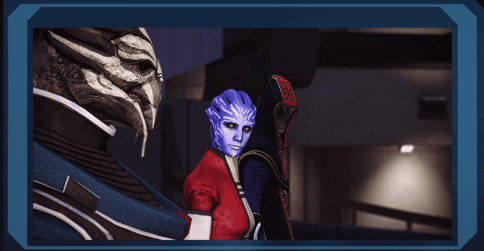
The Council is an executive committee composed of representatives from the Asari Republics, the Turian Hierarchy, and the Salarian Union. Though they have no official power over the independent governments of other species, the Council’s decisions carry great weight throughout the galaxy. No single Council race is strong enough to defy the other two, and all have a vested interest in compromise and cooperation.
Each of the Council species has general characteristics associated with the various aspects of governing the galaxy. The asari are typically seen as diplomats and mediators. The salarians gather intelligence and information. The turians provide the bulk of the military and peacekeeping forces.
Any species granted an embassy on the Citadel is considered an associate member, bound by the accords of the Citadel Conventions. Associate members may bring issues to the attention of the Council, though they have no input on the decision. The human Systems Alliance became an associate member of the Citadel in 2165.
Citadel Space
Citadel Space is an unofficial term referring to any region of space controlled by a species that acknowledges the authority of the Citadel Council. At first glance, it appears this territory encompasses most of the galaxy. In reality, however, less than 1% of the stars have been explored.
Even mass-effect-FTL drive is slow relative to the volume of the galaxy. Empty space and systems without suitable drive discharge sites are barriers to exploration. Only the mass relays allow ships to jump hundreds of light years in an instant, the key to expanding across an otherwise impassable galaxy.
Whenever a new relay is activated, the destination system is rapidly developed. From that hub, FTL drive is used to expand to nearby star clusters. The result is a number of densely-developed clusters thinly spread across the vast expanse of space, connected by the mass relay network.
Spectres
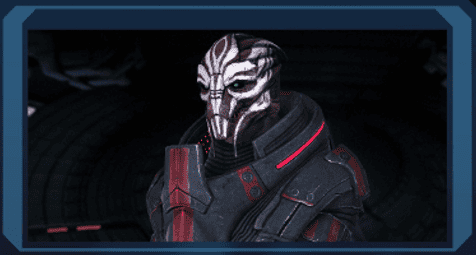
Spectres are agents from the Office of Special Tactics and Reconnaissance and answer only to the Citadel Council. They are elite military operatives, granted the authority to deal with threats to peace and stability in whatever way they deem necessary.
They operate independently or in groups of two or three. Some are empathetic peacekeepers, resolving disputes through diplomacy. Others are cold-blooded assassins, ruthlessly dispatching problem individuals. All get the job done, one way or another, often operating outside the bounds of galactic law.
The Spectres were founded after the salarians joined the Council. For many years, they operated in secrecy, as back-room ‘problem solvers’. Only after the Krogan Rebellions did their activities become publicized. Assignment of a Spectre is less contentious than a military deployment, but makes it clear that the Council is concerned about a situation.
Treaty of Farixen*
Due to the destructive potential of dreadnoughts, the Council races agreed at the Farixen Naval Conference to fix a ratio of dreadnought construction between themselves. At the top of the pyramid is the peacekeeping turian fleet. Below the turians are the other Council races, currently the asari and salarians. Council associate races are at the bottom. The human Systems Alliance is part of this last group.
The ratio of turian to Council to associate dreadnoughts is 5:3:1. For every dreadnought humans are permitted to build, the asari have three, and the turians five.
Humanity and the Systems Alliance
The Alliance is the government and military of humanity beyond Sol
First Contact War
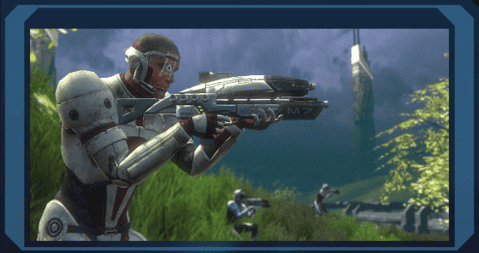
Humanity’s first contact with an alien race occurred in 2157. At that time, the Alliance allowed survey fleets to activate any dormant mass relays discovered, a practice considered dangerous and irresponsible by Council-aligned races. When a turian patrol discovered a human fleet attempting to activate a relay, they attacked. One human vessel survived, retreating to the colony of Shanxi.
The turians followed, quickly defeating the local forces. Shanxi was occupied, the first – and, to date, only – human world to be conquered by an alien species. The turians believed the handful of ships they defeated represented the bulk of human defenses. So they were unprepared when the Second Fleet under Admiral Kastanie Drescher launched a strong counteroffensive, evicting them from Shanxi.
The turians mobilized for full-scale war, drawing the attention of the rest of the galaxy. The Council quickly intervened, forcing a truce. Fortunately for humanity, the First Contact War was ended with a diplomatic solution.
Systems Alliance

The Systems Alliance is an independent supranational government representing the interests of humanity as a whole. The Alliance is responsible for the governance and defense of all extra-solar colonies and stations.
The Alliance grew out of the various national space programs as a matter of practicality. Sol’s planets had been explored and exploited through piecemeal national efforts. The expense of colonizing entire new solar systems could not be met by any one country. With humans knowing that alien contact was inevitable, there was enough political will to jointly fund an international effort.
Still, the Alliance was often disregarded by those on Earth until the First Contact War. While the national governments dithered and bickered over who should lead the effort to liberate Shanxi, the Alliance fleet struck decisively. Post-War public approval gave the Alliance the credibility to establish its own Parliament and become the galactic face of humanity.
Genetic Engineering
In the 22nd century, manipulation of the human genome became commonplace. Techniques of genetic engineering advanced to the point where the rich could custom-build fetuses that grew into stronger, smarter, and more attractive adults. In more permissive regions, custom-designed life forms and ‘uplifted’ animals occupied an ill-defined niche between ‘property’ and ‘sapient being’.
Travel to planets with unique forms of life brought an awareness that Earth’s unique biodiversity could be lost if spliced and hybridized to gain useful alien qualities. The Sudham-Wolcott Genetic Heritage Act was passed by the Systems Alliance Parliament in 2161. It imposed sharp restrictions on controversial uses of genetic engineering, but provided government subsidies for beneficial applications.
SCREENING AND THERAPY: Most governments provide free assessments and corrective therapy for genetic diseases in prospective parents. This has nearly eliminated everything from cystic fibrosis to nearsightedness. The earlier screening and therapy is performed, the more comprehensive the results. Though ideally performed on artificially fertilized zygotes in a lab, procedures are available for embryos in the womb and newborns, out of respect for personal beliefs.
ENHANCEMENT: Improvement of natural human abilities is legal, but adding new abilities is not. Treatments to improve strength, reflexes, mental acuity, or appearance are permitted; adding a tail or the ability to digest cellulose is not. Some genetic enhancement is provided for free to Alliance military recruits, but the average citizen must pay for the privilege. The process can take years to reach fruition in an adult.
ENGINEERING: Artificial hybridization of genes from compatible non-human species with human genetic code is illegal. Creation of designed life is broadly legal (and mainly used for terraforming and medical applications), but sentient creatures are heavily regulated, and creation of sapient life is outlawed by both the Systems Alliance and the Citadel Council.
Human Diplomatic Relations
Humanity has encountered many galactic species. Wars have been few, but mistrust is rife.
Politically, the Alliance is a peaceful trade partner of the TURIANS. As a practical matter, however, there is simmering antagonism and bigotry between both populations over the First Contact War of 2157.
The Alliance enjoys good relations with the ASARI, though many privately believe the Matriarchs are aristocratic and overcautious.
Though humans know better than to unconditionally trust any SALARIAN, their shared restless, reckless ways make them natural allies against the conservative turians and asari.
The KROGAN have no unified government, but individuals are generally treated as potential criminals, a reputation most krogan enjoy living down to.
The Alliance has no formal contact with the QUARIANS. Their Migrant Fleet has not yet passed through any human-settled system.
The batarians are rivals for control of the Skyllian Verge. They severed their treaties with the Citadel to prosecute a colonial conflict against the Alliance. Officially, there is no war, but neither is there any peace.
Systems Alliance: Geological Survey
As the human race expands its territory and raises the general standard of living, demand for industrial resources continues to grow. Many planets, moons and asteroids contain a wealth of resources, but many systems have barely been charted, let alone thoroughly surveyed. Unmanned probes are one solution, but they are often lost to space hazards, unforeseen circumstances, or theft by salvagers.
In recent years, AGeS, the Alliance Geological Service, has offered bounties to private individuals or teams willing to perform mineralogical surveys on the frontier. This survey data is made publicly available to further corporate development. Due to the cost of travel and the dangers of operating on hostile worlds, it is rarely a profitable endeavor.
LIGHT METALS – Metals with low atomic weight are often used in the construction of spacecraft and vehicles.
HEAVY METALS – Metals with higher atomic weights are used to construct equipment components. The platinum group elements are particularly useful.
RARE EARTHS – Most useful materials in this category are radioactives or magnets.
gases – Various gases are required to support all known forms of sapient life. Some are commonly used as fuel.
Systems Alliance: Military Jargon
ashore – When a ship’s crew leaves the vessel, they are “ashore.” Though normally used regarding planets, it can refer to boarding a space station.
aweigh – When a ship releases the equipment tethering it to a space station or surface dock, it is “aweigh.”
aye, aye – The proper way to acknowledge an order. If told to attack, the correct response is “Aye, aye, sir.” If asked “Are you proud to be a marine?” the correct response is “Yes, sir.”
ASAP – Pronounced “a-sap,” an acronym of “as soon as possible.”
belay – Stop, cease.
bridge – The navigation center of a spacecraft, where the steering is done.
captain’s mast – Non-judicial disciplinary proceedings by unit commanders.
CIC – Combat Information Center, the command center of a spacecraft. The CIC is filled with sensor displays to make sense out of the chaos of combat.
DC – Damage Control. The containment and repair of damage to a spacecraft.
ECM – Electronic Counter-Measures used to avoid enemy sensors, from passive emissions masking to active jamming.
EVA – Extra-Vehicular Activity. Time spent in a pressure suit, outside of a vehicle, spacecraft, or station.
flank – The flank is the “side” of a military formation. Since the soldiers are facing elsewhere, an enemy that can attack on the flank can often “turn it” or “roll it up.”
FNG – “Freaking” New Guy(s). A derisive term for inexperienced personnel.
groundside – The surface of a planet.
helmsman – The crewmember who pilots a spacecraft.
ladar – Light-amplified detection and ranging. An active sensor that bounces lasers off an object to determine its bearing and distance. Ladar has sufficient resolution that the data can be reconstructed into an image.
shore party – Spacecraft crew sent ashore on official business.
silent running – An old submariner’s term used aboard the Normandy to denote when stealth systems are active.
sitrep – Abbreviation of “situation report,” an evaluation of the current military situation.
spacer – Someone who has spent most of their life in space.
XO – Executive Officer, the second-in-command of an Alliance warship. The XO is responsible for administrative and personnel matters.
Systems Alliance: Military Ranks
The Alliance uses a modified version of the ranking system that has been used for hundreds of years. Soldiers are classified into rank-and-file enlisted personnel, experienced non-commissioned officers (NCOs), and specially trained officers.
The divide between naval personnel and ground forces (‘marines’) is small. Ground units are a specialized branch of the fleet, just as fighter squadrons are. This unity of command is imposed by the futility of fighting without control of orbit; without the navy, any army is pointless. The marines, as a matter of pride, maintain some of their traditional rank titles; for example, marines have Privates and Corporals instead of Servicemen.
In ascending order of responsibility, the ranks of the Alliance are:
ENLISTED
Serviceman 3rd Class / Private 2nd Class
Serviceman 2nd Class / Private 1st Class
Serviceman 1st Class / Corporal
NCOs
Service Chief
Gunnery Chief
Operations Chief
OFFICERS
2nd Lieutenant
1st Lieutenant
Staff Lieutenant
Lieutenant Commander
Staff Commander
Captain / Major
Rear Admiral / General
Admiral
Fleet Admiral
Timeline
2069 – Armstrong Outpost at Shackleton Crater becomes the first human settlement on Luna. It is formally founded on July 24, the 100th anniversary of the first lunar landing.
2103 – Lowell City in Eos Chasma becomes the first human settlement on Mars.
2137 – Eldfell-Ashland Energy Corporation demonstrates helium-3 fuel extraction from the atmosphere of Saturn.
2142 – Construction of Gagarin Station (Jump Zero) begins beyond the orbit of Pluto.
2148 – Prospectors discover the Prothean ruins at Promethei Planum on Mars.
2149 – Translation of Prothean data leads humans to the Charon mass relay. Systems Alliance founded to coordinate exploration and colonization of extra-solar worlds.
2151 – A shipping accident at Singapore International Spaceport exposes downwind communities to containers of dust-form element zero. Alliance begins construction of Arcturus Station.
2152 – Roughly 30% of the children born in Singapore after element zero exposure suffer from cancerous growths. Systems Alliance begins settlement of Earth’s first extra-solar colony world, the planet Demeter.
2154 – Commander Shepard born.
2155 – Systems Alliance occupies completed portions of Arcturus Station as a headquarters.
2156 – Some children of Singapore exhibit minor telekinetic abilities.
2157 – Turians encounter human explorers; First Contact War. Occupation and liberation of the human colony of Shanxi.
2158 – Humans learn potential of biotics. An international effort to track element zero exposures begins. Roughly 10% of exposed children show some level of biotic ability.
2160 – Systems Alliance Parliament formed.
2165 – Humans establish embassy on Citadel.
2170 – Batarian slavers attack the Alliance colony of Mindoir.
2176 – Skyllian Blitz – Pirates and slavers attacked Elysium, the human capital in the Skyllian Verge.
2177 – Thresher maws devour the Alliance colony of Akuze.
2178 – In retaliation for the Skyllian Blitz, an Alliance fleet wipes out an army of slavers on the moon of Torfan.
2183 – Current date.
Planets and locations
The Milky Way galaxy contains 200 to 400 billion stars, most with a host of planets.
Planets: Feros
Feros is a habitable world in the Attican Beta cluster. Two-thirds of the habitable surface is covered with the ruins of a crumbling Prothean megatropolis. In the millennia since the Prothean extinction, the ruins have been picked over by looters many times.
Feros was considered a poor prospect for colonization, as little open ground remains for agriculture. The only sizable fresh water sources are the poles, which are tapped by the decaying Prothean aqueduct systems. The dead cities, while in good condition considering their antiquity, are of uncertain stability. Ground level is congested by a dozen meters of fallen debris, and the air is fouled by dust.
In 2178, the human ExoGeni Corporation announced its intention to place a permanent colony on Feros, to thoroughly explore the ruins. The pioneer settlement was placed on the upper levels of several intact skyscrapers, using the surviving Prothean aqueducts and rooftop hydroponic gardens to support the population.
Planets: Ilos
Like the ancient human city of Troy, Ilos is a world known only through second-hand sources.
References to Ilos have been found at several other Prothean ruins, though direct study of the world is unlikely to occur.
llos lies in a remote area of the Terminus Systems only accessible by the legendary Mu Relay. Four thousand years ago, the Mu Relay was knocked out of position by a supernova and lost. Since then, llos and its cluster have been inaccessible.
Occasionally, a university will organize an expedition to chart a route to Ilos using conventional FTL drive. These never get beyond the planning stages due to the distance and danger. The journey could take years or decades, passing through the hostile Terminus Systems and dozens of unexplored systems.
Planets: Noveria
Noveria is a cool, rocky world, with most of its hydrosphere locked up in massive glaciers. A privately-chartered colony world, the planet is owned by the Noveria Development Corporation holding company. The NDC is funded by investment capital from two dozen high technology development firms, and administrated by an Executive Board representing their interests.
The investors built remote hot labs in isolated locations across Noveria’s surface. These facilities are used for research too dangerous or controversial to be performed elsewhere, as Noveria is technically not part of Citadel space and therefore exempt from Council law.
By special arrangement, Citadel Special Tactics and Reconnaissance agents have been granted extraterritorial privileges, but it remains to be seen how committed the Executive Board is to that principle. Given its unique situation, it is understandable that Noveria is often implicated in all manner of wild conspiracy theories.
Planets: Virmire
Virmire is a lush world located on the frontier of the Attican Traverse. Its vast seas and orbital position on the inner life zone have created a wide equatorial band of humid, tropical terrain. Only the political instability of the region has impeded efforts at colonization.
Many times, the Citadel has opened negotiations to settle Virmire with the various criminal gangs and petty dictatorships in the nearby Terminus Systems. All fell apart due to internal power shifts within the opposing parties. The Citadel has written off the colonization of Virmire as impossible without significant political change.
The Terminus powers themselves are unlikely to ever settle Virmire. Most lack the resources to support settlement of a virgin world, finding it more expedient to steal from their neighbors than build for themselves.
Region: Terminus Systems
The Terminus Systems are located on the far side of the Attican Traverse, beyond the space administered by the Citadel Council or claimed by the human Systems Alliance. It is populated by a loose affiliation of minor species, united only in their refusal to acknowledge the political authority of the Council or adhere to the Citadel Conventions.
Their independence comes at a price; the Terminus is fraught with conflict. War among the various species is common, as governments and dictators constantly rise and fall. The region is a haven for illegal activities, particularly piracy and the slave trade.
At least once a year, a fleet from Terminus invades the nearby Attican Traverse. These attacks are typically small raids against poorly-defended colonies. The Council rarely retaliates, as sending patrols into the Terminus Systems could unify the disparate species against their common foe, triggering a long and costly war.
Uncharted Worlds
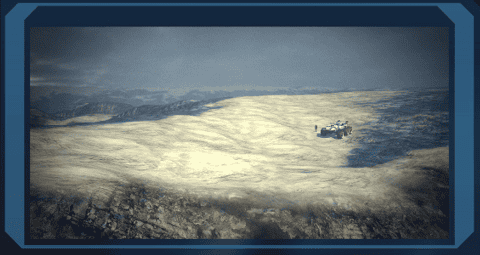
There are between two and four hundred billion stars in the galaxy, and less than 1% of them have ever been visited or had their systems properly surveyed.
Humanity’s early expansion into the Attican Traverse was haphazard; a desperate race to claim habitable planets where populations can be economically settled. Ignored in the wake of this land grab were thousands of less hospitable worlds, each potentially rich with industrial resources. The wealth of entire solar systems lies untapped, waiting for corporate survey teams or independent pioneers to discover and exploit them.
This, however, is not an easy task. In addition to the environmental hazards, the fact that uncharted worlds are largely ignored makes them popular bases for criminals, revolutionaries, cults, and others who wish to remain unnoticed by galactic society.
Stations: Acturus Station
The expense of bringing construction materials into the system was acceptable due to its strategic value. With three primary mass relays in addition to the secondary one to Sol, Arcturus is a major communications and military chokepoint. The Alliance 1st Fleet is based in Arcturus, where it can guard the gates to Sol and react to incursions in the three connected clusters. The Station also hosts the Systems Alliance Parliament and the Systems Alliance Military general headquarters. Its permanent population is approximately 45,000.
Arcturus is actually from the galactic halo, one of a cluster of 52 stars that are ‘crashing through’ the disc of the galaxy. In a billion years, Arcturus will be sailing through the depths of extragalactic dark space.
Stations: Gagarin Station
Gagarin Station is the largest deep space station built by humanity, a ‘Bernal Sphere’ design with a 500-meter-diameter habitable area. It was constructed beyond Pluto, nearly 80 Astronomical Units (12 billion kilometers) from Sol. Moving crew and material to this location bankrupted most of the backers.
Gagarin was placed at the inner edge of the ‘heliopause’ – the point at which the solar wind can no longer push back the interstellar medium. It was built to test a number of faster-than-light drive principles that theoretically could only occur in interstellar space. The station was nicknamed ‘Jump Zero’, as it was intended to be the jumping-off point for humanity’s expansion into the galaxy. Shortly after the station was completed, the Prothean ruins were discovered on Mars, rendering the entire effort moot.
After struggling to make a profit for a decade, Gagarin was sold to the Systems Alliance in 2159 for a fraction of its construction costs. The Alliance refurbished it as a research and training center for the recently discovered biotic phenomenon.
In 2169, the Biotic Acclimation and Training program was shut down and Gagarin became a general research facility. Its remote location and intentional isolation from the extranet makes it popular for dangerous research, particularly in the field of artificial intelligence. Humanity’s first stable Al, the Alliance-sponsored ‘Eliza’, achieved sapience at Gagarin in 2172.
Today, Gagarin Station has a permanent population of approximately 9000. A plan has been proposed to move it to the gravitationally stable barycenter point between Pluto and the Charon Relay, allowing it to serve as a gateway facility between the Sol and Arcturus systems. The high cost of safely moving its mass has delayed this indefinitely.
Ships and Vehicles
The technologies of space travel and surface mobility
FTL Drive
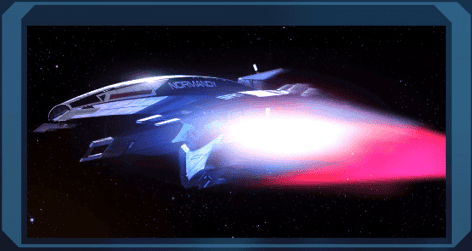
Faster-than-light drives use element zero cores to reduce the mass of the ship, allowing higher rates of acceleration. This effectively raises the speed of light within the mass effect field, allowing high speed travel with negligible relativistic time dilation effects.
Starships still require conventional thrusters (chemical rockets, commercial fusion torch, economy ion engine, or military antiproton drive) in addition to the FTL drive core. With only a core, a ship has no motive power.
The amount of eezo and power required for a drive increases exponentially to the mass being moved and the degree it is being lightened. Very massive ships or very high speeds are prohibitively expensive.
If the field collapses while the ship is moving at faster-than-light speed, the effects are catastrophic. The ship is snapped back to sublight velocity, the enormous excess energy shed in the form of lethal Cerenkov radiation.
FTL Drive: Appearance
New space travelers ask, ‘What does it look like outside a ship moving at faster-than-light speed?’ Part of the answer can be seen in a simple pane of glass. Light travels slower through glass than it does through open air; light also moves slower in conventional space than it does in a high-speed mass effect field. This causes refraction – any light entering at an angle is bent and separated into a spectrum. Objects outside the ship will appear refracted. The greater the difference between the objective (exterior) and subjective (interior) speeds of light, the greater the refraction.
As the subjective speed of light is raised within the field, objects outside will appear to red-shift, eventually becoming visible only to radio telescope antennae. High-energy electromagnetic sources normally hidden to the eye become visible in the high blue spectrum. As the speed of light continues to be raised, x-ray, gamma ray, and eventually cosmic ray sources become visible. Stars will be replaced by pulsars, the accretion discs of black holes, quasars, and gamma ray bursts.
To an outside observer, a ship within a mass effect drive envelope appears blue-shifted. If within a field that allows travel at twice the speed of light, any radiation it emits has twice the energy as normal. If the ship is in a field of about 200 times light speed, it radiates visible light as x-rays and gamma rays, and the infrared heat from the hull is blue-shifted up into the visible spectrum or higher.
Ships moving at FTL are visible at great distances, though their signature will only propagate at the speed of light.
FTL Drive: Drive Charge
As positive or negative electric current is passed through an FTL drive core, it acquires a static
electrical charge. Drives can be operated an average of 50 hours before they reach charge saturation. This changes proportional to the magnitude of mass reduction; a heavier or faster ship reaches saturation more quickly.
If the charge is allowed to build, the core will discharge into the hull of a ship. All ungrounded crew members are fried to a crisp, all electronic systems are burned out, and metal bulkheads may be melted and fused together.
The safest way to discharge a core is to land on a planet and establish a connection to the ground, like a lightning rod. Larger vessels like dreadnoughts cannot land and must discharge into a planetary magnetic field. The ship passes the charge from the drive core to the exterior armored hull, then dives into the magnetic field.
As the hull discharges, sheets of lightning jump away into the field, creating beautiful auroral displays on the planet. The ship must retract its sensors and weapons while dumping charge to prevent damage, leaving it blind and helpless. Discharging at a moon with a weak magnetic field can take days. Discharging into the powerful field of a gas giant may require less than an hour. Deep space facilities such as the Citadel often have special discharge facilities for visiting ships.
Military Ship Classifications
Larger warships are generally classified in one of four weights:
FRIGATES are small, fast ships used for scouting and screening larger vessels. Frigates often operate in wolf-pack flotillas.
CRUISERS are middle-weight combatants, faster than dreadnoughts, and more heavily-armed than frigates. Cruisers are the standard patrol unit, and often lead frigate flotillas.
DREADNOUGHTS are kilometer-long capital ships mounting heavy, long-range firepower. They are only deployed for the most vital missions.
CARRIERS are dreadnought-sized vessels that also carry large numbers of fighters.
Smaller vessels are almost exclusively used in a support role to the warships during combat:
FIGHTERS are one-man craft used to perform close-range attacks on enemy ships.
INTERCEPTORS are one-man craft optimized for destroying opposing fighters.
Starships: Crew Considerations
Cabins give each individual ten cubic meters of space. On larger vessels private rooms are common. As ships get smaller, the number of crew packed into a single wardroom increases. Asari prefer shared spaces even on large vessels, while krogan territorial instincts make it impossible for them to cohabitate even on the smallest ships.
On smaller vessels, ‘hot bunking’ is the norm. Crew members assigned to different watches share the same bunk. When one gets off-duty, he wakes up the person in the bunk. While that crewman is on duty, the first gets his rack time.
Spacecraft compartments can be isolated by air-tight doors in case of decompression. The cinematic vision of explosive decompression is fiction; holed compartments either take enough damage that occupants are killed instantly, or leak slowly enough that they are able to reach protective gear.
Compartments are equipped with Emergency Life Support Apparatus: fireproof plastic bubbles with air bottles. Small when stowed, ELSA comfortably accommodate one individual inflated. Damage control procedure cuts off ventilation to burning compartments. Without oxygen to consume, fires die in seconds. The compartment is re-pressurized afterwards for crew recovery.
Mass effect fields create an artificial gravity (a-grav) plane below the decks, preventing muscle atrophy and bone loss in zero-gee. Large vessels arrange their decks perpendicular to their thrust axis. The ‘highest’ decks are at the bow, and the ‘lowest’ at the engines. This allows a-grav to work with the inertial effects of thrust. Ships that can land arrange their decks laterally, so the crew can move about while the vessel is on the ground.
Warships normally turn off their a-grav systems during combat, reducing the heat generated by systems and increasing combat endurance. To provide a point of reference for navigating in zero-gee, floors are painted a different color from the walls and ceiling.
Starships: Cruisers
Cruiser-weight starships are the standard combat unit encountered away from large naval bases, the ‘poor bloody infantry’ of most fleets. Nimble scouting frigates have neither the punch nor the stamina to stand up to serious combat, and the mighty dreadnoughts are a strategic resource, carefully hoarded and committed to the most critical battles.
Cruisers perform routine independent ‘show the flag’ patrols in settled systems and lead flotillas of frigates in small engagements, such as pirate suppression campaigns. In major fleet engagements, cruiser squadrons support the dreadnought battle line by screening their flanks against enemies attempting to maneuver for a main gun ‘bow shot’ from their vulnerable broadsides.
Alliance cruisers are named after cities of Earth.
Starships: Dreadnought
The dreadnought is the ultimate arbiter of space warfare; millions of tons of metal, ceramic, and polymer dedicated to the projection of firepower against an enemy vessel of like ability. No sane commander would face a dreadnought with anything less than another dreadnought.
A dreadnought’s power lies in the length of its main gun. Dreadnoughts range from 800 meters to one kilometer long, with a main gun of commensurate length. An 800-meter mass accelerator is capable of accelerating one 2 kg. slug to a velocity of 283 km/s every two seconds. Each slug has the kinetic energy of 38 kilotons of TNT, three times the energy released by the fission weapon that destroyed Hiroshima.
When used to bombard planets, some of this kinetic energy is lost due to atmospheric re-entry friction. As a rule of thumb, each Earth-atmosphere of air pressure saps approximately 20% of a projectile’s impact energy.
The turian fleet presently has 37 dreadnoughts; the asari, 21; and the salarians, 16. Humanity has six, with an additional hull under construction at Arcturus Station. Alliance battleships are named for mountains of Earth.
Everest Class: Everest, Fuji, Elbrus
Kilimanjaro Class: Kilimanjaro, Tai Shan, Shasta, Aconcagua (under construction)
Starships: Fighters
Fighters are single-pilot combat small craft. They are lightweight enough that they can be economically fitted with powerful element zero cores, making them capable of greater acceleration and sharper maneuvers than starships.
Kinetic barrier shields changed starship battles from short, vicious bloodbaths to extended, indecisive slugging matches. Only the main gun of a dreadnaught could punch a mass accelerator slug through the barriers of an opposing dreadnought. This changed with the development of the fighter- launched mass disruptor torpedo, a short-ranged weapon that can penetrate kinetic barriers to destroy their projector assemblies.
Starship GARDIAN defenses must be overwhelmed through swarm tactics. Fighter groups can take heavy casualties pressing their torpedo attacks home. Once fighter-launched torpedoes have crippled an enemy’s barriers, the mass accelerators on frigates and cruisers can make short work of them.
Interceptors are a type of fighter optimized to attack other fighters, with no ability to damage starships. Interceptors are used to screen friendly units from incoming fighter attack.
Starships: Frigates
Frigates are light escort and scouting vessels. They often have extensive GARDIAN systems to provide anti-fighter screening for capital ships, and carry a squad of marines for security and groundside duty. Unlike larger vessels, frigates are able to land on planets.
Frigate drive systems allow them to achieve high FTL cruise speeds. They also have proportionally larger thrusters and lighter design mass, allowing them to maneuver more handily. In combat, speed and maneuverability make a frigate immune to the long-range fire of larger vessels; in the time it take projectiles to reach them, frigates are no longer where they were predicted to be.
In fleet combat, frigates are organized into ‘wolfpack’ flotillas of four to six. Wolfpacks speed through enemy formations, hunting enemy vessels whose kinetic barriers have been taken down by fighter- launched disruptor torpedoes. The wolfpack circle- strafes vulnerable targets, using their superior speed and maneuverability to evade return fire.
Alliance frigates are named for great battles in human history.
Starships: Heat management
Dispersal of heat generated by onboard systems is a critical issue for a ship. If it cannot deal with heat, the crew may be cooked within the hull.
Radiation is the only way to shed heat in a vacuum. Civilian vessels utilize large, fragile radiator panels that are impossible to armor. Warships use Diffuse Radiator Arrays (DRA), ceramic strips along the exterior of the armored hull. These make the ship appear striped to thermographic sensors. Since the arrangement of the strips depends on the internal configuration of the ship, the patterns for each vessel are unique and striking. On older ships, the DRA strips could become red- or white-hot. Dubbed ‘tiger stripes’ or ‘war paint’ by humans, the glowing DRA had a psychological impact on pirates and irregular forces.
Strip radiators are not as efficient as panels, but if damaged by enemy fire, the ship only loses a small portion of its total radiation capacity. In most cases, a vessel’s DRA alone allows it to cruise with no difficulties. Operations deep within a solar system can cause problems.
A ship engaged in combat can produce titanic amounts of heat from maneuvering burns and weapons fire. When fighting in a high-heat environment, warships employ high-efficiency ‘droplet’ heat sinks.
In a droplet system, tanks of liquid sodium or lithium absorb heat within the ship. The liquid is vented from spray nozzles near the bow as a thin sheet of millions of micrometer-scale droplets. The droplets are caught at the stern and recycled into the system. A droplet system can sink 10-100 times as much heat as DRA strips.
Droplet sheets resemble a surface ship’s wake through the water. The wake peels out in sharp turns, spreading a fan of droplets as the ship changes vectors and leaves the coolant behind.
Starships: Sensors
‘Light lag’ prevents sensing in real time at great distances. A ship firing its thrusters at the Charon Relay can be easily detected from Earth, 5.75 light- hours (six billion kilometers) away, but Earth will only see the event five hours and 45 minutes after it occurs. Due to the light-speed limit, defenders can’t see enemies coming until they have already arrived. Because there is FTL travel and communications but no FTL sensors, frigates are crucial for scouting and picket duties.
Passive sensors are used for long-range detection, while active sensors obtain short-range, high quality targeting data.
Passive sensors include visual, thermographic, and radio detectors that watch and listen for objects in space. A powered ship emits a great deal of energy; the heat of the life support systems; the radiation given off by power plants and electrical equipment; the exhaust of the thrusters. Starships stand out plainly against the near-absolute zero background of space. Passive sensors can be used during FTL travel, but incoming data is significantly distorted by the effects of the mass effect envelope and doppler shift.
Active sensors are radars and high resolution ladars (LAser Detection And Ranging) that emit a ‘ping’ of energy and ‘listen’ for return signals. Ladars have a narrower field of view than radar, but ladar resolution allows images of detected objects to be assembled. Active sensors are useless when a ship is moving at FTL speeds.
Normandy
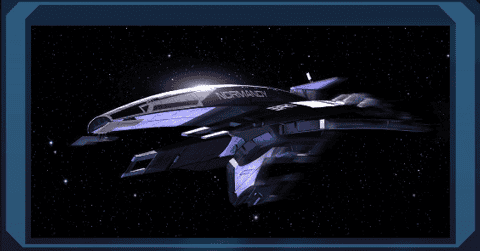
The Normandy is a prototype starship, developed by the human Systems Alliance with the assistance of the Citadel Council. It is optimized for scouting and reconnaissance missions in unstable regions, using state-of-the-art stealth technology.
For most ships, the heat generated through standard operations is easily detectable against the absolute-zero background of space. The Normandy, however, is able to temporarily sink this heat within the hull. Combined with refrigeration of the exterior hull, the ship can travel undetected for hours, or drift passively for days of covert observation. This is not without risk. The stored heat must eventually be radiated, or it will build to levels capable of cooking the crew alive.
Another component of the stealth system is the Normandy’s revolutionary Tantalus drive, a mass effect core twice the standard size. The Tantalus drive generates mass concentrations that the Normandy ‘falls into’, allowing it to move without the use of heat-emitting thrusters.
Sovereign
Sovereign is the flagship of the rogue Spectre Saren. An enormous dreadnought larger than any other ship in any known fleet, Sovereign is crewed with both geth and krogan. At two kilometers long, its spinal-mounted main gun is likely capable of penetrating another dreadnought’s kinetic barriers with a single shot.
How Saren acquired this incredible warship is unknown. The prevailing opinion is that Sovereign is a geth construct, while others believe it is a Prothean relic. Its design, however, hints at a more alien and mysterious origin.
The attack on Eden Prime demonstrated Sovereign’s ability to generate mass effect fields powerful enough to land on a planetary surface. This implies it has a massive element zero core, and the ability to generate staggering amounts of power.
Space Combat
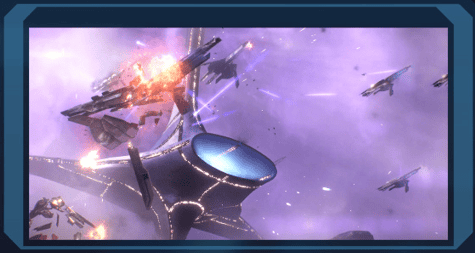
Ship mobility dominates space combat; the primary objective is to align the mass accelerator along the bow with the opposing vessel’s broadside. Battles typically play out as artillery duels fought at ranges measured in thousands of kilometers, though assaults through defended mass relays often occur at ‘knife fight’ ranges as close as a few dozen kilometers.
Most ship-to-ship engagements are skirmishes between patrol vessels of cruiser weight and below, with dreadnoughts and carriers only deployed in full-scale fleet actions. Battles in open space are short and often inconclusive, as the weaker opponent typically disengages.
Once a ship enters FTL flight the combat is effectively over; there are no sensors capable of tracking them, or weapons capable of damaging them. The only way to guarantee an enemy will stand and fight is to attack a location they have a vested interest in, such as a settled world or a
strategically-important mass relay.
Space Combat: Combat Endurance
Heat limits the length and intensity of ship-to-ship combat. Starships generate enormous heat when they fire high-energy weapons, perform maneuvering burns, and run on-board combat electronics.
In combat, warships produce heat more quickly than they can disperse it. As heat builds within a vessel, the crewed spaces become increasingly uncomfortable. Before the heat reaches lethal levels, a ship must win or retreat by entering FTL. After an FTL run, the ship halts, shuts down non-essential systems, and activates the heat radiation gear.
Combat endurance varies by ship design, and by the battle’s location. Battles in the deep cold of interstellar space can go on for some time. Engagements close to a star are brief. Since habitable worlds are usually close to a star, battles over them are frantic.
Vehicles: M35 Mako
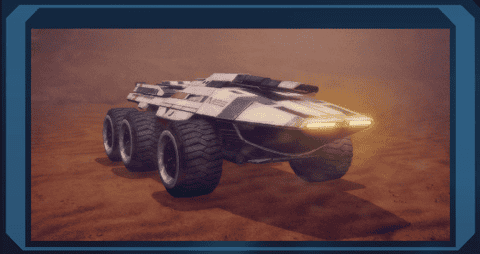
The ‘Mako’ infantry fighting vehicle was designed for the System Alliance’s frigates. Though the
interior is cramped, an M35 is small enough to be carried in the cargo bay and easily deployed on virtually any world.
With its turreted 155mm mass accelerator and coaxially-mounted machine gun, the Mako can provide a fire team with weapon support as well as mobility. Since Alliance marines may be required to fight on any world, the Mako is environmentally-sealed and equipped with microthrusters for use on low-gravity planetoids.
The Mako is powered by a sealed hydrogen-oxygen fuel cell, and includes a small element zero core. While not large enough to nullify the vehicle’s mass, the core can reduce it enough to be safely air-dropped. When used in conjunction with thrusters, it also allows the Mako to extricate itself from difficult terrain.
Vehicles: Combat Drones
Drones are small robots used to support and supplement organic soldiers on the battlefield. They have no artificial intelligence of any kind, but follow fixed, minimally adaptive programs. Most varieties employ mass effect levitation to improve mobility.
All modern armies rely on veritable fleets of drones for routine soldiering (static garrisons, patrols, etc.). The use of drones in non-critical duties keeps manpower needs down and reduces casualties in low intensity conflicts. Less advanced races and cultures with less sensitivity to casualties have correspondingly fewer drones in their inventory. Drones are of little use in conventional open field battles, as they are poorly armed and armored.
In addition to combat drones, support drones are used to assist organic units in the field. Reconnaissance drones are small, stealthy craft that screen combat units in the field and warn
commanders when enemies are spotted. Electronic Warfare drones supplement battlefield technicians, serving as mobile jammers and ELINT (ELectronic INTelligence gathering platforms. Military and civilian police utilize ‘dazzler drones’ equipped with powerful strobe lights to disorient and subdue intruders using nonlethal force.
Drone formations are officially referred to as wings (i.e., ‘Deploy the 4th Assault Drone Wing on the left flank!”). Common soldiers often refer to friendly formations as flocks and enemy formations as swarms.
Weapons: Disruptor Torpedoes
Disruptor torpedoes are powered projectiles with warheads that create random and unstable mass effect fields when triggered. These fields warp space-time in a localized area. The rapid,
asymmetrical mass changes cause the target to rip itself apart.
In flight, torpedoes use a mass-increasing field, making them too massive for enemy kinetic barriers to repulse. This extra mass gives torpedoes very sluggish acceleration, making them easy prey for defensive GARDIAN weapons. So, torpedoes have to be launched at very close range.
Torpedoes are the main anti-ship weapon used by fighters. They are launched from point-blank range in ‘ripple-fire’ waves reminiscent of the ancient Calliope rocket artillery launchers (thus their popular nickname ‘Callies’). By saturating defensive GARDIAN systems with multiple targets, at least a few will get through.
Weapons: GARDIAN
A ship’s General ARea Defense Integration Anti- spacecraft Network (GARDIAN) consists of anti-missile / anti-fighter laser turrets on the exterior hull. Because these are under computer control, the gunnery control officer needs to do little beyond turn the system on and designate targets as hostile.
Since lasers move at light speed, they cannot be dodged by anything moving at non-relativistic speeds. Unless the beam is aimed poorly, it will always hit its target. In the early stages of a battle, the GARDIAN fire is 100% accurate. It is not 100% lethal, but it doesn’t have to be. Damaged fighters must break off for repairs.
Lasers are limited by diffraction. The beam ‘spreads out’, decreasing the energy density (watts per m2) the weapon can place on a target. Any high-powered laser is a short-ranged weapon.
GARDIAN networks have another limitation: heat. Weapons-grade lasers require “cool-down” time, during which heat is transferred to sinks or radiators. As lasers fire, heat builds within them, reducing damage, range, and accuracy.
Fighters attack in swarms. The first few WILL be hit by GARDIAN, but as battle continues, the effects of laser overheat allow the attackers to press ever closer to the ship. Constant use will burn out a laser.
GARDIAN lasers typically operate in infrared frequencies. Shorter frequencies would offer superior stopping power and range, but degradation of focal arrays and mirrors would make them expensive to maintain, and most prefer mechanical reliability over bleeding-edge performance where lives are concerned. Salarians, however, use near-ultraviolet frequency lasers with six times the range, believing that having additional time to shoot down incoming missiles is more important.
Lasers are not blocked by the kinetic barriers of capital ships. However, the range of lasers limits their use to rare ‘knife fight’-range ship-to-ship combat.
Technology
The everyday pieces of technology that support the modern lifestyle
Biotics
Biotics is the ability of rare individuals to manipulate dark energy and create mass effect fields through the use of electrical impulses from the brain. Intense training and surgically-implanted amplifiers are necessary for a biotic to produce mass effect fields powerful enough for practical use. The relative strength of biotic abilities varies greatly among species and with each individual.
There are three branches of biotics. TELEKINESIS uses mass-lowering fields to levitate or impel objects. Mass-raising KINETIC FIELDS are used to block or pin objects. DISTORTION uses rapidly shifting mass fields to shred objects.
Most organic species are capable of developing biotic abilities, though there are risks involved. Biotics are the result of in-utero exposure to element zero. This usually causes fatal cancers in the victim, but in rare cases it coalesces into nodules within the fetus’s developing nervous system.
Biotics: Biotic Amps
Biotics manipulate mass effect fields using dozens of element zero nodules within their nervous systems that react to electric stimuli from the brain. Amplifiers allow biotics to synchronize the nodules so they can form fields large and strong enough for practical use. Amplifiers can improve a specific discipline or talent.
An implant is a surgically-embedded interface port into which amps are ‘plugged in’. On humans, the implant is usually placed at the base of the skull for convenient access, though the user must be careful to keep it free of contaminants.
Implant ports can fit a variety of amps, and there is a growing market for modifications and add-ons. The finest quality implants and amps are manufactured by asari artisans, but the Alliance’s L3 implants – first deployed in 2170 – are a significant step forward.
Biotics: Training
Biotic implants and amplifiers only provide the potential to create coherent mass effect fields. Whether biotics can actually do so is largely determined by their training.
Biotics must develop conscious control over their nervous systems, sending specific electrical impulses to the element zero nodules embedded in their nerves. They are taught to use their implants and amps with biofeedback devices and physical mnemonics. Specific gestures or muscle movements fire the proper sequence of nerves to activate a certain skill.
Conatix Industries pioneered biotic training with the Biotic Acclimation and Temperance Training program. Although BAaT did not achieve the desired results, many techniques taught are still used today.
Many human think tanks are trying to develop some form of biotic super soldier. Most are benign efforts to create more flexible troops. Others, less publicly known, are unapologetic attempts to create Nietzschean supermen.
Communications*
Real-time communication is possible thanks to networks of expensive mass relay comm buoys that can daisy-chain a transmission via lasers.
Comm buoys are maintained in patterns built outward from each mass relay. The buoys are little more than a cluster of primitive, miniature mass relays. Each individual buoy is connected to a partner on another buoy in the network, forming a corridor of low-mass space. Tightbeam communications lasers are piped through these ‘tubes’ of FTL space, allowing virtually instantaneous communication to anywhere on the network. The networks connect across regions by communications lasers through the mass relays.
With this system, the only communications delay is the light lag between the source or destination and the closest buoy. So long as all parties remain within half a light-second (150,000 km) of buoys, seamless real time communications are possible. Since buoys are maintained in all traveled areas, most enjoy unlimited instant communication. Ships only suffer communications lag when operating off established deep space routes, around uninhabited outer system gas giants, and other unsettled areas.
During wartime, comm buoy networks are the first target of attack. Once the network is severed, it can take anywhere from weeks to years to get a message out of a contested system. In systems where a buoy network has not yet been built or has been destroyed, rapid communication means ferrying information through high-speed courier ships and unmanned data drones.
Communications: Administration*
While comm buoys allow rapid transmission, there is a finite amount of bandwidth available. Given that trillions of people may be trying to pass a message through a given buoy at any one time, access to the network is parceled out on priority tiers.
The Citadel Council and the Spectres have absolute priority; if they are using all the bandwidth, everyone else must wait. Individual governments and their militaries enjoy the next-highest tier. During wartime, civilian communication can suffer hours or even days of lag. Intelligence agencies study ping time through various systems to predict military buildups.
Below the governments and militaries, bandwidth priority is sold to the highest bidder. Media conglomerates, particularly headline news networks, purchase higher priority to provide their viewers with timely information. Corporations that require timely information and response capability (for example, financial institutions and investment firms) also invest heavily in priority access. The funds acquired through sales of bandwidth are used to maintain and expand the communications infrastructure.
While everyone with a computer has guaranteed free and unlimited access to the galactic extranet, they are last in line for bandwidth and may have to wait for their requests to be processed. Bandwidth resale corporations use investment capital to purchase blocks of high priority access, made available by paid subscription.
Communications: Methodology
As the population of the galaxy increases and new worlds are settled, timely access for home users and frontier settlements with underdeveloped communication infrastructures is a growing problem. To ameliorate bandwidth issues, a sophisticated array of data caches and virtual intelligence search agent programs are available.
When a user submits a query, it is first routed to the data cache on their colony or star system. At the cache, the user’s search agent VI collates mountains of locally-stored data to find the desired material. If the information is not available locally, the query is passed along to neighboring systems, and then outward in an expanding network. VI search agents in those systems replicate the search. If the desired information is found, it is compressed into a ‘burst’ file and queued for transmission to the source system. The burst is assigned a priority based on the number of queries for it; the greater the number of queries, the higher the priority.
Credits (“Creds”)*
The standard credit was established by the Citadel’s Unified Banking Act as the currency of interstellar trade. The credit has a managed floating exchange rate, calculated in real time by the central bank to maintain the average value of all participating currencies. Some regional currencies are worth more than a credit, and some less.
Hard currency can be stolen or counterfeited, so electronic fund transfers are the norm. More importantly, physical transactions cannot be easily tracked, making them ideal for tax evasion or the purchase of illegal goods.
When the Alliance joined the Citadel, its various national treasuries were linked into the credit network. A human with a bank account of Mexican pesos, Japanese yen, or Indian rupees can purchase any item priced in credits at fair market value. All economies that participate in the credit network are required to price items in both local currency and credits.
Computers: Artificial Intelligence (AI)
An artificial intelligence is a self-aware computing system capable of learning and independent decision making. Creation of a conscious Al requires adaptive code, a slow, expensive education, and a specialized quantum computer called a ‘blue box’.
An Al cannot be transmitted across a communication channel or computer network. Without its blue box, an Al is no more than data files. Loading these files into a new blue box will create a new personality, as variations in the quantum hardware and runtime results create unpredictable variations.
The geth serve as a cautionary tale against the dangers of rogue Al, and in Citadel Space they are technically illegal. Advocacy groups argue, however, that an Al is a living, conscious entity deserving the same rights as organics. They argue that continued use of the term ‘artificial’ is institutionalized racism on the part of organic life; the term ‘synthetic’ is considered the politically correct alternative.
Computers: Virtual Intelligence (VI)
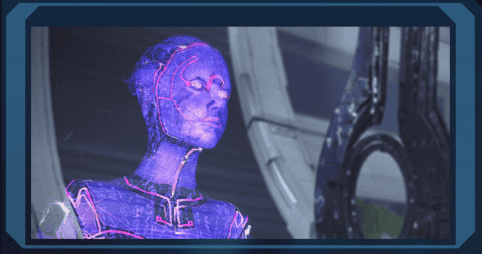
A virtual intelligence is an advanced form of user interface software. Vls use a variety of methods to simulate natural conversation, including an audio interface and an avatar personality to interact with. Although a VI can provide a convincing emulation of sentience, they are not self-aware, nor can they learn or take independent action.
Vls are used as operating systems on commercial and home computers. Minimal VI ‘agents’ are also available. Agents are compact and specialized. Some serve as personal secretaries, filtering calls and scheduling meetings based on user-defined priorities. Others are advanced search engines, propagating themselves across the extranet to collate user-requested data.
Commercial Vls in a variety of stock personalities are available at any software retailer. Boutique firms and hobbyists also build unique Vis to personal specification. Although software emulation of living personalities is illegal, reconstructions of famous historical figures are common.
Element Zero (“Eezo”)
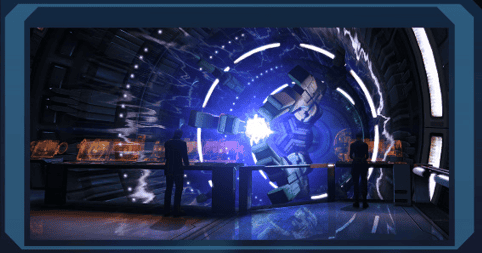
When subjected to an electrical current, the rare material dubbed element zero, or ‘eezo’, emits a dark energy field that raises or lowers the mass of all objects within it. This ‘mass effect’ is used in countless ways, from generating artificial gravity to manufacturing high-strength construction materials. It is most prominently used to enable faster-than-light space travel.
Eezo is generated when solid matter, such as a planet, is affected by the energy of a star going supernova. The material is common in the asteroid debris that orbits neutron stars and pulsars. These are dangerous places to mine, requiring extensive use of robotics, telepresence, and shielding to survive the incredible radiation from the dead star. Only a few major corporations can afford the set-up costs required to work these primary sources.
Humanity discovered refined element zero at the Prothean research station on Mars, allowing them to create mass effect fields and develop FTL travel.
Mass Effect Fields
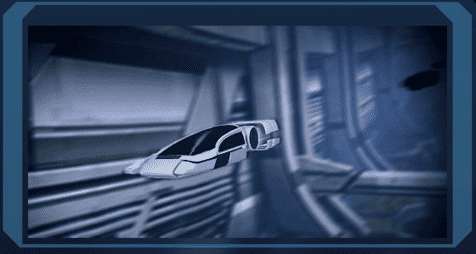
Element zero can increase or decrease the mass of a volume of space-time when subjected to an electrical current. With a positive current, mass is increased. With a negative current, mass is decreased. The stronger the current, the greater the magnitude of the dark energy mass effect.
In space, low-mass fields allow FTL travel and inexpensive surface-to-orbit transit. High-mass fields create artificial gravity and push space debris away from vessels. In manufacturing, low-mass fields permit the creation of evenly-blended alloys, while high mass compaction creates dense, sturdy construction materials.
The military makes extensive use of mobility enhancing technologies, with mass effect utilizing fighting vehicles standard front-line issue in most military forces. Mass effect fields are also essential in the creation of kinetic barriers or shields to protect against enemy fire.
Mass Relays
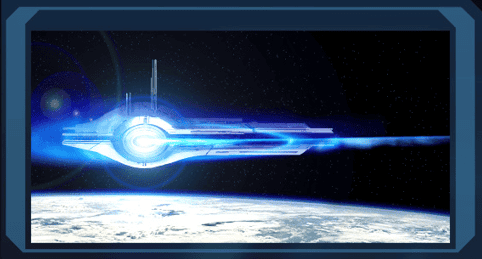
Mass relays are feats of Prothean engineering advanced far beyond the technology of any living species. They are enormous structures scattered throughout the stars, and can create corridors of virtually mass-free space, allowing instantaneous transit between locations separated by years or even centuries of travel using conventional FTL drives.
Primary mass relays can propel ships thousands of light years, often from one spiral arm of the galaxy to another. However, they have fixed one-to-one connections: a primary relay connects to one other primary relay, and nowhere else. Secondary relays can only propel ships across a few hundred light years, however they are omnidirectional: a secondary relay can send a ship to any other relay within its limited range.
There are many dormant primary relays whose corresponding twins have not yet been located. These are left inactive until their partner is charted, as established civilizations are unwilling to blindly open a passage that might connect them to a hostile species.
Omni-Tool
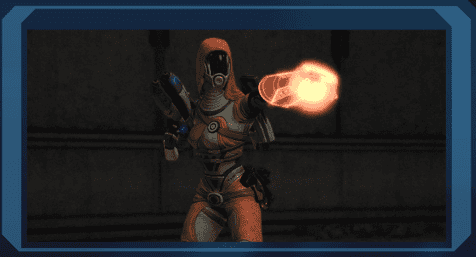
Omni-tools are handheld devices that combine a computer microframe, sensor analysis pack, and minifacturing fabricator. Versatile and reliable, an omni-tool can be used to analyze and adjust the functionality of most standard equipment, including weapons and armor, from a distance.
The fabrication module can rapidly assemble small three-dimensional objects from common, reusable industrial plastics, ceramics, and light alloys. This allows for field repairs and modifications to most standard items, as well as the reuse of salvaged equipment.
Omni-tools are standard issue for soldiers and first-in colonists.
Weapons, Armor and Equipment
Advances in technology have made individual soldiers more dangerous and survivable than ever before.
Body Armor
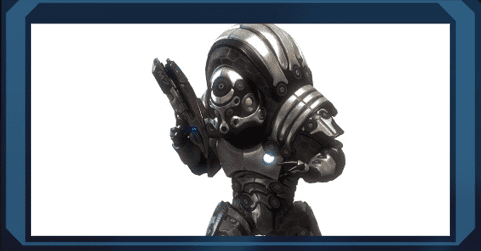
Combat hard-suits use a dual-layer system to protect the wearer. The inner layer consists of fabric armor with kinetic padding. Areas that don’t need to be flexible, such as the chest or shins, are reinforced with sheets of lightweight ablative ceramic.
The outer layer consists of automatically-generated kinetic barriers. Objects traveling above a certain speed will trigger the barrier’s reflex system and be deflected, provided there is enough energy left in the shield’s power cell.
Armored hard-suits are sealable to protect the wearer from extremes of temperature and atmosphere. Standard equipment includes an onboard mini-frame and a communications, navigation, and sensing suite. The mini-frame is designed to accept and display data from a weapon’s smart targeting system to make it easier to locate and eliminate enemies.
Kinetic Barriers (“Shields”)
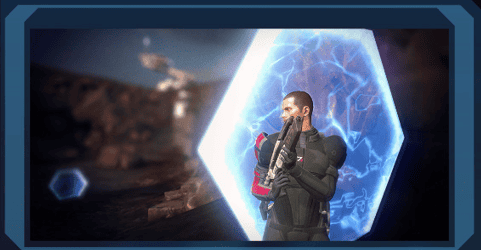
Kinetic barriers, commonly called ‘shields’, provide protection against most mass accelerator weapons. Whether on a starship or a soldier’s suit of armor, the basic principle remains the same.
Kinetic barriers are repulsive mass effect fields projected from tiny emitters. These shields safely deflect small objects traveling at rapid velocities. This affords protection from bullets and other dangerous projectiles, but still allows the user to sit down without knocking away their chair.
The shielding afforded by kinetic barriers does not protect against extremes of temperature, toxins, or radiation.
Mass Accelerators
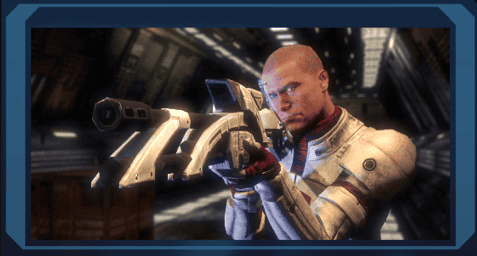
A mass accelerator propels a solid metal slug using precisely-controlled electromagnetic attraction and repulsion. The slug is designed to squash or shatter on impact, increasing the energy it transfers to the target. If this were not the case, it would simply punch a hole right through, doing minimal damage.
Accelerator design was revolutionized by element zero. A slug lightened by a mass effect field can be accelerated to greater speeds, permitting projectile velocities that were previously unattainable. If accelerated to a high enough velocity, a simple paint chip can impact with the same destructive force as a nuclear weapon.
However, mass accelerators produce recoil equal to their impact energy. This is mitigated somewhat by the mass effect fields that rounds are suspended within, but weapon recoil is still the prime limiting factor on slug velocity.
Medi-Gel
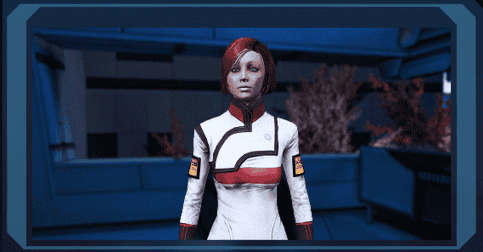
Medi-gel is a common medicinal salve used by paramedics, EMTs, and military personnel. It combines several useful applications: a local anesthetic, disinfectant, and clotting agent all in one. Once applied, the gel is designed to grip tight to flesh until subjected to a frequency of ultrasound. It is sealable against liquids – most notably blood – as well as contaminants and gases.
The gel is a genetically-engineered bioplasm created by the Sirta Foundation, a medical technology megacorp based on Earth. Technically, medi-gel violates Council laws against genetic engineering, but so far, it has proved far too useful to ban.
Small Arms
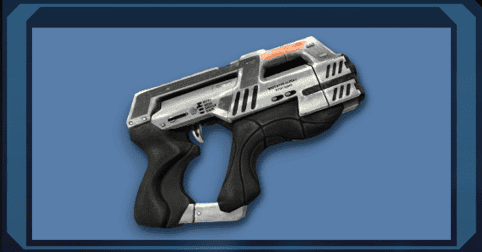
All modern infantry weapons from pistols to assault rifles use micro-scaled mass accelerator technology. Projectiles consist of tiny metal slugs suspended within a mass-reducing field, accelerated by magnetic force to speeds that inflict kinetic damage.
The ammo magazine is a simple block of metal. The gun’s internal computer calculates the mass needed to reach the target based on distance, gravity, and atmospheric pressure, then shears off an appropriate sized slug from the block. A single block can supply thousands of rounds, making ammo a non-issue during any engagement.
Top-line weapons also feature smart targeting that allows them to correct for weather and
environment. Firing on a target in a howling gale feels the same as it does on a calm day on a practice range. Smart targeting does not mean a bullet will automatically find the mark every time the trigger is pulled; it only makes it easier for the marksman to aim.
Upgrades*
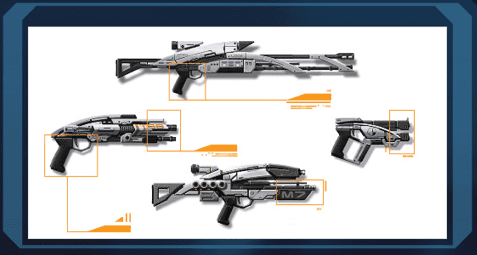
The development of practical minifacturing omni-tools allows modern militaries a great deal of
flexibility in equipment load-outs. A vast number of field modification kits, or ‘upgrades’, are available for common equipment such as weapons, armor, omni- tools, biotic amps, and even grenades.
An upgrade kit typically consists of less than a dozen unique parts and an optical storage disc. When loaded into an omni-tool, the OSD provides all technical specifications required to manufacture the tools and additional parts necessary to install the upgrade onto another piece of equipment. Assembly is typically modular, and installation can be completed in less than a minute.
Since omni-tools are designed to use common battlefield salvage materials such as plastics, ceramics, and light metals (rendered into semi-molten ‘omni-gel’ for quick use), it is quite possible for a trained soldier carrying upgrade kits to customize gear on the battlefield to fit the current tactical situation.
Other Mass Effect codex can be found here.