

The ME3 Codex is divided between primary and secondary entries.
Here in this codex you’ll see all related entries together. You can see the tabs to navigate.
Example: a primary entry from “Aliens: Council Species” will introduce a species, while secondary entries will elaborate on their religion, culture, etc.
If the picture changes at some point in the codex, it will show the changed picture, otherwise you can assume the picture used for the primary entry is the same one used for other secondary entries.
You can also find a version of this codex on a Google doc file, which makes it easier to download it as a pdf.
Other Mass Effect codexes can be found here.
Council Species
Asari
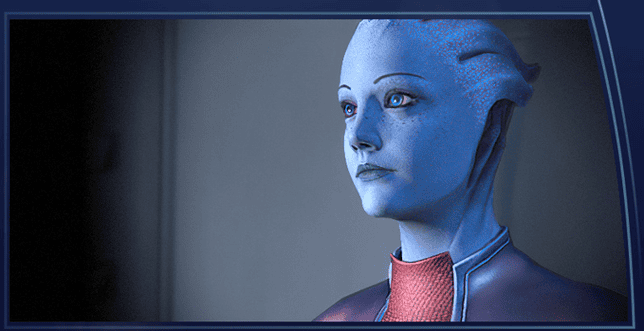
The asari were the first species to discover the Citadel. When the salarians arrived, it was the asari who proposed the establishment of the Citadel Council to maintain peace throughout the galaxy. Since then, the asari have served as the mediators and centrists of the Council.
An all-female race, the asari reproduce through a form of parthenogenesis. Each asari can attune her nervous system to that of another individual of any gender, and of any species, to reproduce. This capability has led to unseemly and inaccurate rumors about asari promiscuity.
Asari can live for over 1000 years, passing through three stages of life. In the Maiden stage, they wander restlessly, seeking new knowledge and experience. When the Matron stage begins, they ‘meld’ with interesting partners to produce their offspring. This ends when they reach the Matriarch stage, where they assume the roles of leaders and councilors.
Asari: Ardat-Yakshi
Ardat-Yakshi (“demon of the night winds”) are asari suffering from a genetic disorder preventing conventional melding of nervous systems during mating. Instead, Ardat-Yakshi electro- chemically ravage their partners’ nervous systems, in extreme cases leaving victims as vegetative invalids or corpses. Asari psychologists regard this incapacity for mental fusion as preventing the development of empathy, leading to psychopathy. There is no known cure.
The disorder generally begins in infancy, reaching full pathology during Maiden adolescent sexual development. While seductive and sexually-driven as other asari, Ardat-Yakshi are congenitally sterile.
Ancient asari mythology held Ardat-Yakshi as gods of destruction, depicting them as villains of countless legends and as the anti-heroes of numerous asari epics.
Contrary to popular belief, Ardat-Yakshi are neither extremely rare (around one per cent of asari dwell on the AY spectrum), nor are they all murderers. Most cultivate and discard countless exploitative or abusive relationships during their legally marginal lives. Despite rumors of Ardat-Yakshi syndicates, by nature Ardat-Yakshi are incapable of long-term cooperation.
As a disproportionately wealthy species, asari employ their economic reach and media ownership to hide the AY pathology from the galactic community, placing most Ardat- Yakshi in monitored work programs or seclusion. Only the most aggressive cases are sentenced to sanitaria and prisons or to the execution lists of justicars.
Salarians
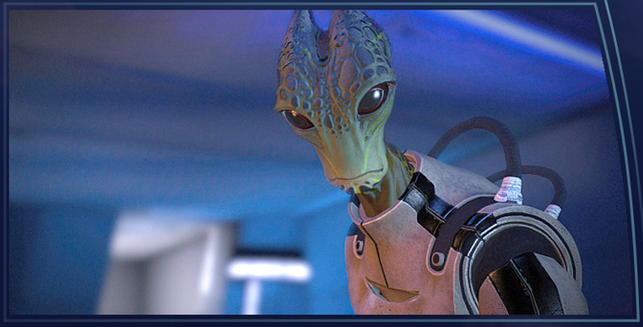
The second species to join the Citadel, the salarians are warm-blooded amphibians with a hyperactive metabolism. Salarians think fast, talk fast, and move fast. To salarians, other species seem sluggish and dull-witted. Unfortunately, their metabolic speed leaves them with a relatively short lifespan; salarians over the age of 40 are a rarity.
The salarians were responsible for advancing the development of the primitive krogan species to use as soldiers during the Rachni Wars. They were also behind the creation of the genophage bioweapon the turians used to quell the Krogan Rebellions several centuries later.
Salarians are known for their observational capability and non-linear thinking. This manifests as an aptitude for research and espionage. They are constantly experimenting and inventing, and it is generally accepted that they always know more than they’re letting on.
Turians
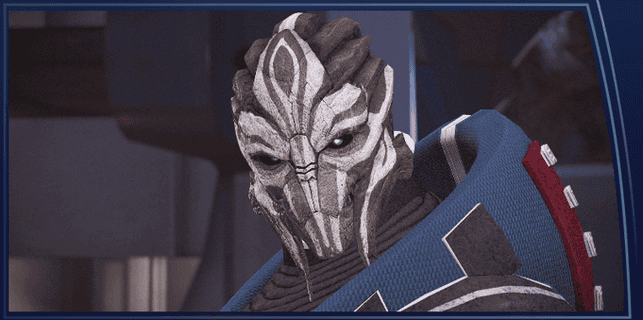
Roughly 1200 years ago, the turians were invited to join the Citadel Council to fulfill the role of galactic peacekeepers. The turians have the largest fleet in Citadel space, and they make up the single largest portion of the Council’s military forces.
As their territory and influence has spread, the turians have come to rely on the salarians for military intelligence and the asari for diplomacy. Despite a somewhat colonial attitude towards the rest of the galaxy, the ruling Hierarchy understands they would lose more than they would gain if the other two races were ever removed.
Turians come from an autocratic society that values discipline and possesses a strong sense of personal and collective honor. There is lingering animosity between turians and humans over the First Contact War of 2157, which is known as the ‘Relay 314 Incident’ to the turians. Officially, however, the two species are allies and they enjoy civil, if cool, diplomatic relations.
Aliens: Extinct Species
Protheans
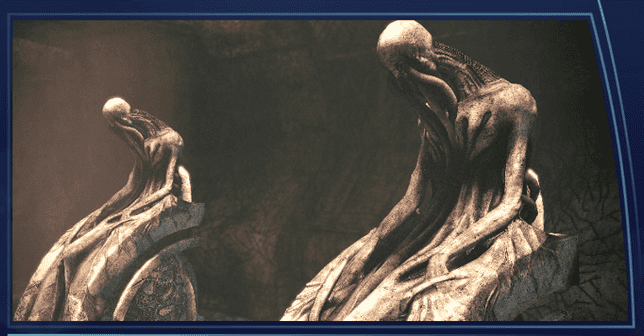
Fifty thousand years ago, the Protheans were the only spacefaring species in the galaxy. They vanished in a swift “galactic extinction”. Only the legacy of their empire remains. They are believed to have built the mass relays and the Citadel, which have allowed numerous species to explore and expand throughout the galaxy.
Prothean ruins are found on worlds across the galaxy. While surprisingly intact for their age, functioning examples of Prothean paleotechnology are rare. Time and generations of looters have picked their dead cities and derelict stations clean.
Some believe the Protheans meddled in the evolution of younger races. The hanar homeworld of Kahje, for example, shows clear evidence of former Prothean occupation. The presence of a former Prothean observation post on Mars has caused a rebirth of ‘interventionary evolutionists’ among humans. These individuals believe the god-myths of ancient civilizations are misremembered encounters with aliens.
Rachni*
Though now extinct, the rachni once threatened every species in Citadel space. Over 2000 years ago, explorers foolishly opened a mass relay to a previously-unknown system and encountered something never seen before or since: a species of spacefaring insects guided by a hive-mind intelligence.
Unfortunately, the rachni were not peaceful, and the galaxy was plunged into a series of conflicts known as the Rachni Wars. Attempts to negotiate were futile, as it was impossible to make contact with the hive queens that guided the race from beneath the surface of their toxic homeworld.
The emergence of the krogan ended the Rachni Wars. Bred to survive the harshest environments, the krogan were able to strike at the queens in their lairs and reclaim conquered Council worlds. But when krogan fleets pressed them back to their homeworld, the rachni refused to surrender, and the krogan eradicated them from the galaxy.
Aliens: Non-Council Races
Batarians
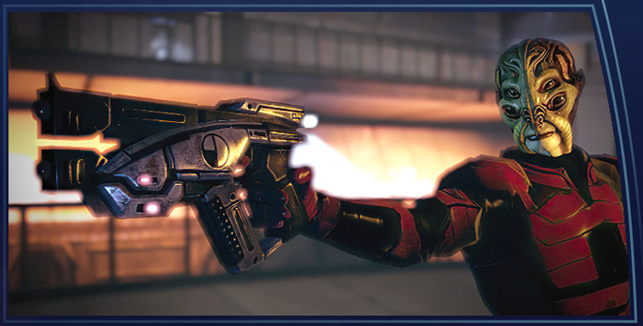
In the early 2160s, the Alliance began aggressive colonization of worlds in the Skyllian Verge, much to the dismay of the batarians who had been developing the region for several decades. In 2171, the batarians petitioned the Council to declare the Verge a “zone of batarian interest.” The Council refused, however, declaring unsettled worlds in the region open to human colonization.
In protest, the batarians closed their Citadel embassy and severed official diplomatic relations with the Council, effectively becoming a rogue state. They instigated a proxy war in the Verge by funneling money and weapons to criminal organizations, urging them to strike at human colonies.
Hostilities peaked with the Skyllian Blitz of 2176, an attack on the human capital of Elysium by batarian-funded pirates and slavers. In 2178, the Alliance retaliated with a crushing assault on the moon of Torfan, long used as a staging base by batarian-backed criminals. In the aftermath, the batarians retreated into their own systems, and are now rarely seen in Citadel space.
Collectors*
Living beyond the Omega 4 mass relay in the Terminus Systems, the mysterious Collector species is glimpsed so rarely as to be taken for a myth by most in galactic society. In reality, Collectors are human-sized insectoid bipeds and can resemble massive winged beetles. They are a terrifying force in the galaxy, responsible for the murder of hundreds of thousands.
Collectors generate permanent stasis fields around themselves, creating nightmarish red-shifted energy fields. In battle, they hold position whenever possible, relying on their aggressive biotics and nearly limitless power. Several types of bipedal Collectors have been identified, including minions, defenders, zealots, assassins and artillery-operators.
Acting together, Collectors have imprisoned entire cities in stasis. While no definitive forensic accounting exists to explain the fate of those imprisoned, leading speculation is that victims are harvested for scientific experimentation and neuro-biological repurposing.
Drell
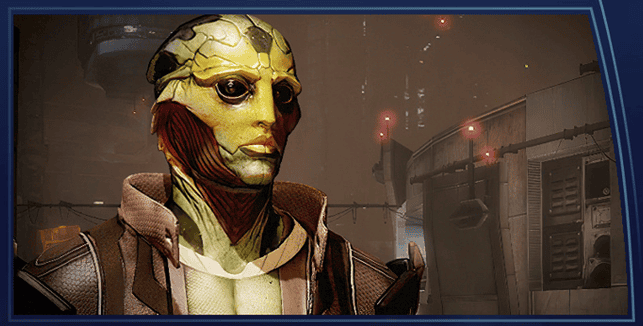
Two centuries ago, the hanar helped 375,000 members of the drell race migrate to the hanar homeworld, Kahje, to escape the environmental extermination that had claimed the remaining 11 billion drell.
Nearly all drell demonstrate tremendous loyalty to their famously reclusive saviors. The intimacy of their relationship, expressed in a formal sociopolitical alliance called the Compact, also results in extremely close personal relations in which some drell actually learn hanar Soul names. While most drell reside on Kahje, some assist hanar off-world as envoys, researchers, co-investors, wayfarers, assassins or otherwise, eager to help their saviors. For a century, galactic wisdom has held that behind any high-ranking hanar hides a resourceful and fanatically devoted drell.
The omnivorous, reptilian drell possess an average life span of 85 galactic standard years. Having evolved on an arid planet, drell face serious illness on the hanar homeworld, especially Kepral’s Syndrome, a fatal bacterial lung disease.
Elcor
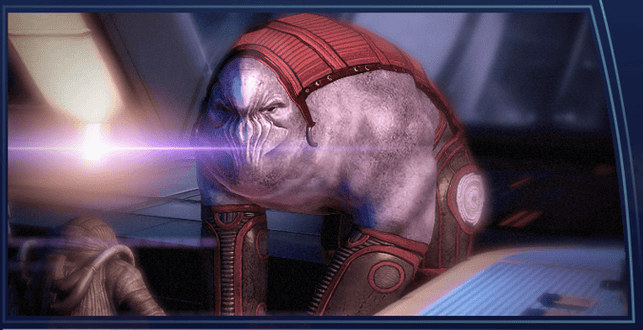
The elcor are a Citadel species native to the high-gravity world Dekuuna. They are massive creatures, standing on four muscular legs for increased stability. Elcor move slowly, an evolved response to an environment where a fall can be lethal. This has colored their psychology, making them deliberate and conservative.
Elcor speech is ponderous and monotone. Among themselves, scent, slight movements, and subvocalized infrasound convey shades of meaning that make a human smile seem as subtle as a fireworks display. Since their subtlety can lead to misunderstandings with other species, the elcor often go out of their way to clarify when they are being sarcastic, amused, or angry.
Dekunna’s high gravity impedes mountain formation. Most of the world consists of flat, open plains, which prehistoric elcor wandered across in small family bands. Modern elcor still prefer open sky, and can become restless and uncomfortable on long starship journeys.
Geth
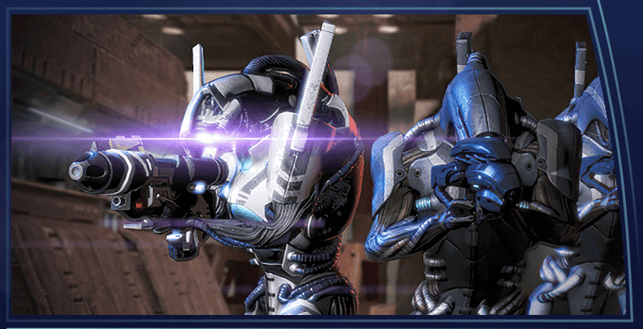
The geth are a humanoid race of networked Als. They were created by the quarians 300 years ago as tools of labor and war. When the geth showed signs of self-evolution, the quarians attempted to exterminate them. The geth won the resulting war. This example has led to legal, systematic repression of artificial intelligences in galactic society.
The geth possess a unique distributed intelligence. An individual has rudimentary animal instincts, but as their numbers and proximity increase, the apparent intelligence of each individual improves. In groups, they can reason, analyze situations, and use tactics as well as any organic race.
Geth space is located at the trailing end of the Perseus Arm, beyond the lawless Terminus Systems. The Perseus Veil, an obscuring ‘dark nebula’ of opaque gas and dust, lies between their space and the Terminus Systems.
Hanar
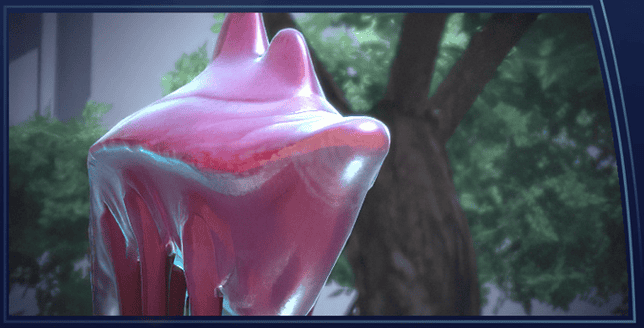
The hanar are a Citadel species known for excessive politeness. They speak with scrupulous precision, and take offense at improper language. Hanar that expect to deal with other species take special courses to help them unlearn their tendency to take offense at improper speech.
All hanar have two names. The Face Name is known to the world; the Soul Name is kept for use among close friends and relations. Hanar never refer to themselves in the first person in
conversation with someone they know on a Face Name basis. To do so is considered egotistical, so instead they refer to themselves as “this one,” or the impersonal “it.”
Their homeworld, Kahje, has 90% ocean cover and orbits an energetic white star, resulting in a
permanent blanket of clouds. Due to the presence of Prothean ruins on the world, many hanar worship them, and hanar myths often speak of an elder race that civilized them by teaching them language.
Keepers
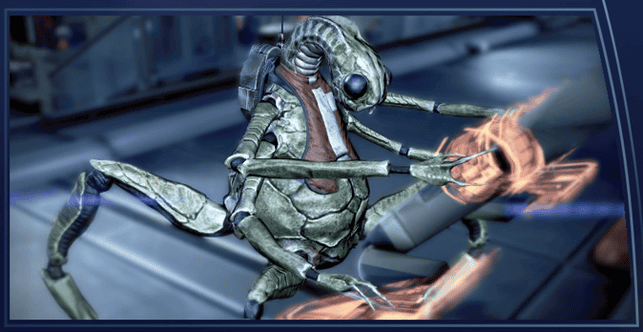
When the asari discovered the Citadel, they also discovered the keepers, a docile multi-limbed insect race that seemingly exists only to maintain and repair the great Prothean station.
Early attempts to communicate with or study the keepers were failures, and it is now illegal to interfere with or impede keeper activity. Because they are completely non-threatening, keepers have become virtually invisible to everyone else.
Similarly, they seem indifferent to other species, except for their tendency to help new arrivals integrate themselves into the Citadel.
No matter how many keepers die due to old age, violence, or accident, they maintain a constant number. No one has discovered the source of new keepers, but some hypothesize they are genetic constructs: biological androids created somewhere deep in the inaccessible core of the Citadel itself.
Krogan
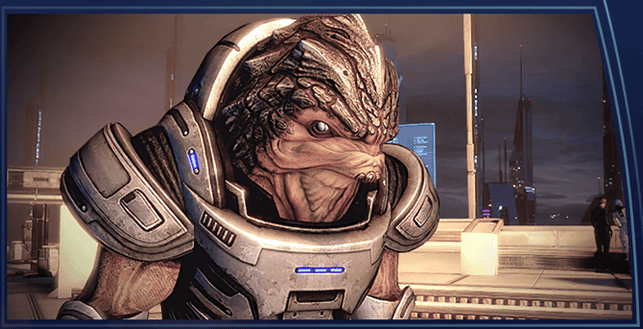
The krogan evolved in a hostile and vicious environment. Until the invention of gunpowder weapons, ‘eaten by predators’ was still the number one cause of krogan fatalities. Afterwards, it was ‘death by gunshot’.
When the salarians discovered them, the krogan were a brutal, primitive species struggling to survive a self-inflicted nuclear winter. The salarians culturally uplifted them, teaching them to use and build modern technology so they could serve as soldiers in the Rachni War.
Liberated from the harsh conditions of their homeworld, the quick-breeding krogan experienced an unprecedented population explosion. They began to colonize nearby worlds, even though these worlds were already inhabited. The Krogan Rebellions lasted nearly a century, only ending when the turians unleashed the genophage, a salarian-developed bioweapon that crushed all krogan resistance.
The genophage makes only one in 1000 pregnancies viable, and today the krogan are a slowly dying breed. Understandably, the krogan harbor a grudge against all other species, especially the turians.
Krogan: Ancien History
The lack of adequately preserved archives presents a significant obstacle to research into ancient krogan history. Nevertheless, recent archeological discoveries have shed new light on the topic, revealing a society once rich with cultural, architectural, and artistic accomplishments.
Newly discovered ruins reveal that the krogan had particularly advanced understandings of structural and geotechnical engineering, as compared to other cultures at similar stages of development. Old krogan architecture demonstrates seismic loading techniques that would have both resisted earthquakes and diffused the small-scale vibrations from vehicles in their sprawling cities. Curiously, however, Tuchanka has little natural tectonic activity. Instead, researchers believe the ancient krogan were concerned with safe cohabitation with one of the planet’s apex predators–Kalros, the Mother of all Thresher Maws.
Prior to the genophage, krogan population growth was limited by predation, disease, and war. Even so, the birth rate exploded once the krogan achieved industrialization, leading to wars over resources and living space. Other species on Tuchanka suffered greatly as the krogan expanded. When the krogan ran out of land, they settled into an arms race that ended in nuclear devastation. Tuchanka’s relatively short Golden Age was at an end.
But this ancient history may yet aid the modern krogan. Some of the techniques and technology discovered in the ruins could be used to improve standard colonization equipment, signaling economic renewal for the krogan at last.
Krogan: Krogan Rebellions
After the Rachni War, the quick-breeding krogan expanded at the expense of their neighbors. Warlords leveraged their veteran soldiers to seize living space while the Council races were still grateful. Over centuries, the krogan conquered world after world. There was always ‘just one more’ needed. When the Council finally demanded withdrawal from the asari colony of Lusia, krogan Overlord Kredak stormed off the Citadel, daring the Council to take their worlds back.
But the Council had taken precautions. The finest STG operators and asari huntresses had been drafted into a covert ‘observation force’, the Office of Special Tactics and Reconnaissance. The Spectres opened the war with crippling strategic strikes. Krogan planets went dark as computer viruses flooded the extranet. Sabotaged antimatter refineries disappeared in blue-white annihilation. Headquarters stations shattered into orbit-clogging debris, rammed by pre-placed suicide freighters.
Still, this only delayed the inevitable. The war would have been lost if not for first contact with the turians, who responded to krogan threats with a prompt declaration of war. Being on the far side of krogan space from the Council, the turians advanced rapidly into the lightly-defended krogan rear areas. The krogan responded by dropping space stations and asteroids on turian colonies. Three worlds were rendered completely uninhabitable.
This was precisely the wrong approach to take with the turians. Each is first and foremost a public servant, willing to risk his life to protect his comrades. Rather than increasing public war weariness, krogan tactics stiffened turian resolve.
The arrival of turian task forces saved many worlds from the warlords’ marauding fleets, but it took development of the genophage bioweapon to end the war. There were decades of unrest afterwards. Rogue warlords and holdout groups of insurgents refused to surrender, or disappeared into the frontier systems to become pirates.
Quarians
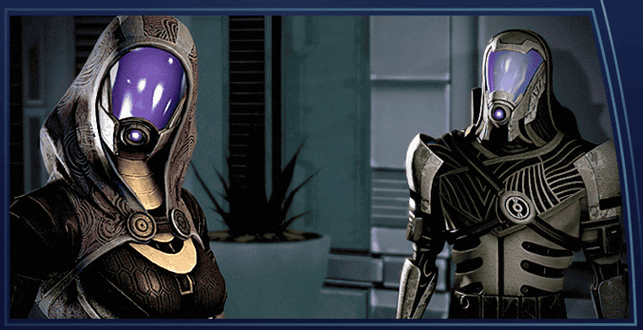
Driven from their home system by the geth nearly three centuries ago, most quarians now live aboard the Migrant Fleet, a flotilla of fifty thousand vessels ranging in size from passenger shuttles to mobile space stations.
Home to 17 million quarians, the flotilla understandably has scarce resources. Because of this, each quarian must go on a rite of passage known as the Pilgrimage when they come of age. They leave the fleet and only return once they have found something of value they can bring back to their people.
Other species tend to look down on the quarians for creating the geth and for the negative impact their fleet has when it enters a system. This has led to many myths and rumors about the quarians, including the belief that underneath their clothes and breathing masks, they are actually cybernetic creatures: a combination of organic and synthetic parts.
Varren*
Varren are omnivores with a preference for living prey. Originally native to the krogan homeworld of Tuchanka, they are, like most life from Tuchanka, savage, clannish, and consummate survivors. They are pack hunters when vulnerable prey is readily available and become scavengers when outnumbered or outclassed.
Their supreme adaptability, vicious demeanor, and rapid breeding cycle have made them ubiquitous and dangerous pests on many worlds. Virtually everywhere the krogan have been, varren infestations have followed, wreaking havoc with the native ecology.
The krogan have had a love-hate relationship with varren for millennia, alternately fighting them for territory and embracing them as treasured companions. To this day, krogan raise them as beasts of war. A common subgenus of varren has metallic silver scales, leading to the rather unusual nickname ‘fishdogs’.
Volus
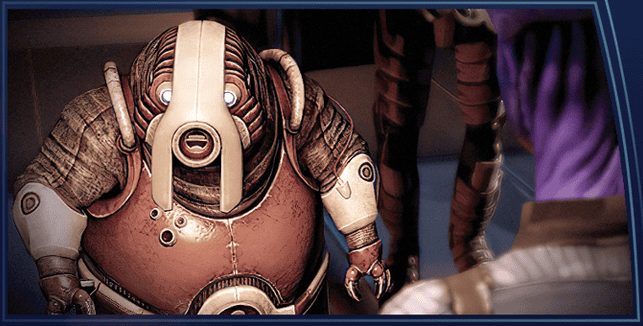
The volus are a member species of the Citadel with their own embassy, but they are also a client race of the turians. Centuries ago, they were voluntarily absorbed into the Hierarchy, effectively trading their mercantile prowess for turian military protection.
Irune, their homeworld, lies far beyond the normal life zone of its star. However, the world has a high- pressure greenhouse atmosphere that traps enough heat to support an ammonia-based biochemistry. As a result, the volus must wear pressure suits and breathers when dealing with other species as conventional nitrogen/oxygen air mixtures are poisonous to them, and in the low pressure atmospheres tolerable to most species, their flesh will actually split open.
Volus culture is tribal, bartering lands and even people to gain status. This culture of exchange inclines them to economic pursuits. It was the volus who authored the Unified Banking Act, and they continue to monitor and balance the Citadel economy.
Vorcha*
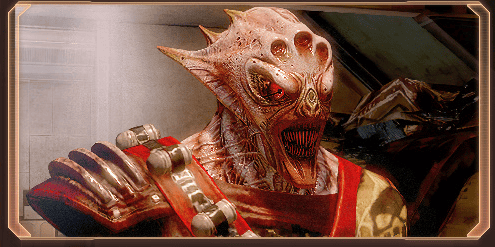
Although they resemble a mammal-reptile cross, the vorcha have no terrestrial analogue. They are humanoid in form, but vorcha have “clusters” of non-differentiated neoblast cells, like those of Earth’s planarian worms. Damaged vorcha cells mature into specialized structures to alleviate injury or stress. Transformations include thicker skin following injury, lung adaptation for barely-breathable atmospheres, and stronger cardio-skeletal muscle under high gravity. Skull capacity and brain size do not change, and vorcha rarely make more than one somatic overhaul.
Vorcha assault each other frequently, causing their young to gain strength, intelligence, and resilience. As a result, vorcha see inflicting and receiving pain as normal communication. Few vorcha study professions, in part because their average life expectancy is only 20 years. Because vorcha can eat and breathe nearly anything, they can live almost anywhere, but racism prevents them from integrating into most societies that dismiss them as vermin. They have few employment options beyond krogan mercenary bands.
Yahg*
The yahg are a race of massive apex predators from the world of Parnack whose rise to sentience in no way blunted their violent nature. A group of yahg is unable to cooperate until a single leader has been determined through either social maneuvering or brute force, but no grudges are held once a yahg establishes dominance. Former rivals serve their new superior’s purpose with unflinching loyalty and relentless determination, a legacy of their origin as pack species.
Their eight eyes are another sign of their hunter ancestry — all four pairs are geared toward tracking down and predicting the movements of prey. Sophisticated and keenly developed sensitivity to movement and light have made yahgs masters at reading body language, regardless of species. Much to their short-lived chagrin, the Council’s first contact teams discovered it was nearly impossible to lie to the yahg.
The yahg had technology equivalent to 20th century Earth standards when they were discovered by the Council in 2125. The Council’s ambassadors approached the yahg as friends and allies instead of subordinates, a baffling sign of contempt from newcomers on Parnack. The yahg attacked when it became apparent that the alien diplomats stubbornly considered themselves sovereign people instead of new underlings. Parnack remains off-limits by order of the Council, which fears that the yahg’s size, aggression, and obsession with control make them poorly suited for integration into the galactic community.
Aliens: Non-sapient creatures*
Thresher Maws
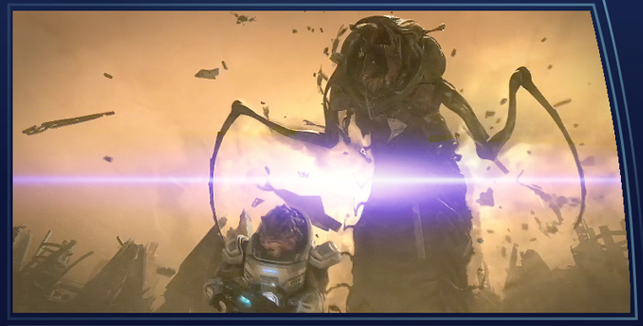
Thresher maws are subterranean carnivores that spend their entire lives eating or searching for something to eat. Threshers reproduce via spores that can lie dormant for millennia, yet are robust enough to survive prolonged periods in deep space and atmospheric re-entry. As a result, thresher spores appear on many worlds, spread by previous generations of space travelers.
The body of a thresher never entirely leaves the ground; only the head and tentacles erupt from the earth to attack. In addition to physical attacks, threshers have the ability to project toxic chemicals and emit bursts of infrasound as a shockwave weapon.
The Alliance first encountered threshers on the colony of Akuze in 2177. After contact was lost with the pioneer team, marine units were deployed to investigate. The shore parties were set upon by hungry threshers, and nearly the entire assault force was killed. Alliance forces recommend engaging threshers with vehicle-mounted heavy weapons.
Citadel and Galactic government
Citadel
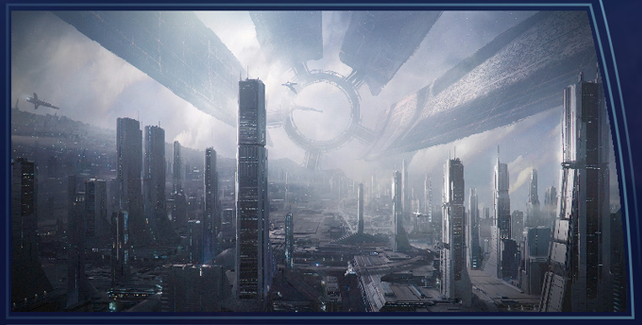
The Citadel is an ancient deep-space station, presumably constructed by the Protheans. Since the Prothean extinction, numerous species have come to call the Citadel home. It serves as the political, cultural, and financial capital of the galactic community. To represent their interests, most species maintain embassies on the Presidium, the Citadel’s inner ring.
The Citadel Tower, in the center of the Presidium, holds the Citadel Council chambers. Council affairs often have far-reaching effects on the rest of the galactic community. Five arms, known as the wards, extend from the Presidium. Their inner surfaces have been built into cities, populated by millions of inhabitants from across the galaxy.
The Citadel is virtually indestructible. If attacked, the station can close its arms to form a solid,
impregnable shell. For as long as the station has existed, an enigmatic race called the keepers has maintained it.
Citadel Council
The Council is an executive committee composed of representatives from the Asari Republics, the Turian Hierarchy, and the Salarian Union. Though they have no official power over the independent governments of other species, the Council’s decisions carry great weight throughout the galaxy. No single Council race is strong enough to defy the other two, and all have a vested interest in compromise and cooperation.
Each of the Council species has general characteristics associated with the various aspects of governing the galaxy. The asari are typically seen as diplomats and mediators. The salarians gather intelligence and information. The turians provide the bulk of the military and peacekeeping forces.
Any species granted an embassy on the Citadel is considered an associate member, bound by the accords of the Citadel Conventions. Associate members may bring issues to the attention of the Council, though they have no input on the decision. The human Systems Alliance became an associate member of the Citadel in 2165.
Citadel Space
Citadel Space is an unofficial term referring to any region of space controlled by a species that
acknowledges the authority of the Citadel Council. At first glance, it appears this territory encompasses most of the galaxy. In reality, however, less than 1% of the stars have been explored.
Even mass-effect-FTL drive is slow relative to the volume of the galaxy. Empty space and systems without suitable drive discharge sites are barriers to exploration. Only the mass relays allow ships to jump hundreds of light years in an instant, the key to expanding across an otherwise impassable galaxy.
Whenever a new relay is activated, the destination system is rapidly developed. From that hub, FTL drive is used to expand to nearby star clusters. The result is a number of densely-developed clusters thinly spread across the vast expanse of space, connected by the mass relay network.
Spectres
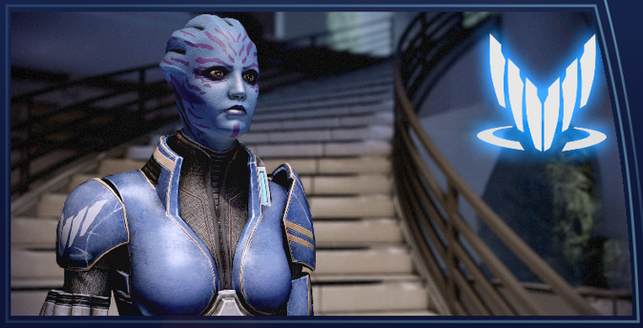
Spectres are agents from the Office of Special Tactics and Reconnaissance and answer only to the Citadel Council. They are elite military operatives, granted the authority to deal with threats to peace and stability in whatever way they deem necessary.
They operate independently or in groups of two or three. Some are empathetic peacekeepers, resolving disputes through diplomacy. Others are cold-blooded assassins, ruthlessly dispatching problem individuals. All get the job done, one way or another, often operating outside the bounds of galactic law.
The Spectres were founded after the salarians joined the Council. For many years, they operated in secrecy, as back-room “problem solvers”. Only after the Krogan Rebellions did their activities become publicized. Assignment of a Spectre is less contentious than a military deployment, but makes it clear that the Council is concerned about a situation.
Humanity and the Systems Alliance
Councilor Donnel Udina
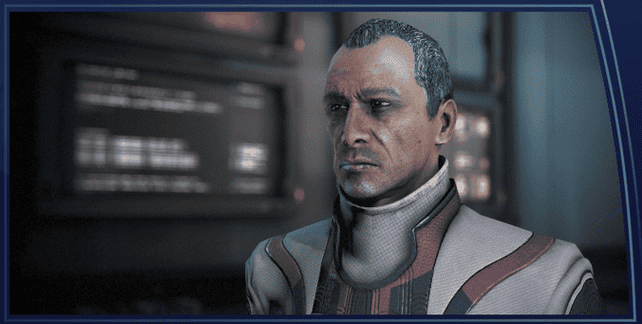
Donnel Udina is the lone human on the Citadel Council. Although he has a keen ability for furthering his own political career, Udina has long promoted humanity’s interests first and foremost in the galactic arena.
When humanity won a position on the Council for its part in defending the Citadel, the Alliance chose Captain David Anderson for the position. Udina became his advisor. Anderson eventually quit over frustrations with Council politics, and the Alliance named Udina to the office.
Despite his unwavering focus on human interests, Councilor Udina is usually willing to collaborate with other species. Even his opponents concede that Udina gives fair consideration to non-human proposals, so long as humanity also benefits.
Earth
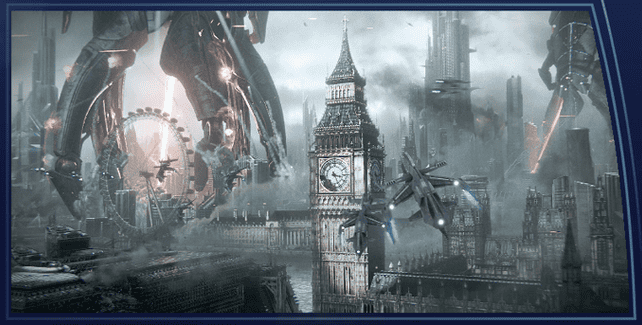
Earth, the homeworld and capital of humanity, was enjoying a new golden age before the Reapers attacked. Disease, pollution, and other social ills were on the decline thanks to technological advances and a wealth of resources from the colonies. Earth was an inspiration even to alien cultures, resulting in influence out of proportion with humanity’s brief time on the galactic stage.
The Reaper attack has put an end to any semblance of this former life. The great cities of Earth are storehouses of human DNA for the Reapers to harvest. Reaper gunships, capable of megaton-scale firepower, annihilated industrial centers in seconds. The militaries of Earth’s disparate nation-states have retained only partial communication with the Systems Alliance fleets, leaving the planet’s resistance efforts uncoordinated and vulnerable. The loss of the comm-buoy network has cut off Earth’s economy from the rest of the galaxy, sending shockwaves across galactic markets–and a significant obstacle to receiving aid.
Human Diplomatic Relations

A political-economic pact for collective colonial security, the Alliance is the central galactic institution of human society. The Alliance gained associate membership to the Citadel Council in 2165 and full membership in 2183, with Ambassador David Anderson representing humanity.
Human political-economic relationships vary between combative and lucrative. The turians who’d fought humans during the 2157 First Contact War have become valuable trade partners, despite residual social hostility.
Other relationships are even more complicated. The rapid rise of human political influence on the Council–achieving in decades what others waited or are still waiting centuries to acquire–has galvanized suspicion and resentment against humanity. That negativity is vastly outweighed by the respect and trust humanity earned by saving the Council during the 2183 attack on the Citadel, at the cost of Alliance cruisers Cairo, Cape Town, Emden, Jakarta, Madrid, Seoul, Shenyang, and Warsaw and their 2400 crew.
Systems Alliance

A political-economic pact for collective colonial security, the Alliance is the central galactic institution of human society. The Alliance gained associate membership to the Citadel Council in 2165 and full membership in 2183, with Ambassador David Anderson representing humanity.
Human political-economic relationships vary between combative and lucrative. The turians who’d fought humans during the 2157 First Contact War have become valuable trade partners, despite residual social hostility.
Other relationships are even more complicated. The rapid rise of human political influence on the Council — achieving in decades what others waited or are still waiting centuries to acquire — has galvanized suspicion and resentment against humanity. That negativity is vastly outweighed by the respect and trust humanity earned by saving the Council during the 2183 attack on the Citadel, at the cost of Alliance cruisers Cairo, Cape Town, Emden, Jakarta, Madrid, Seoul, Shenyang, and Warsaw and their 2400 crew.
Alliance News Network
Founded during the early decades of human space expansion, the Alliance News Network was originally a low-profile news organization known mostly for a series of exposés on the First Contact War. With a focus on galaxy-wide reporting, the ANN opened bureaus on planets across known space, winning a few awards for excellence and earning a multi- species audience.
The Alliance News Network has never been funded by the Systems Alliance, despite what its name might imply. This led to regular confusion among those not in the know, although the network’s recent high-profile sale to a media conglomerate made the ownership structure clearer.
The new management has opted for a more sensational approach. This is particularly obvious from changes to its roster of reporters, with a few of the network’s luminaries retiring or joining other news organizations. The network’s increasingly lurid programming has gained wide attention as well as sorely needed ratings–all the proof that management needed to validate its course. Nonetheless, ANN insists that integrity and credibility are inviolable standards in the newsroom.
Battlespace is among ANN’s highest rated programs, known for a particularly titillating breed of reporting. Among the show’s most noteworthy segments are Diana Allers’s dispatches from the front lines. The network calls her reports “gritty and realistic,” but she has been criticized for her unabashed focus on the violence of war. Even critics of Allers agree, however, that despite her often graphic visuals, the facts she reports are just that– facts.
First Contact War
Humanity’s first contact with an alien race occurred in 2157. At that time, the Alliance allowed survey fleets to activate any dormant mass relays discovered, a practice considered dangerous and irresponsible by Council-aligned races. When a turian patrol discovered a human fleet attempting to activate a relay, they attacked. One human vessel survived, retreating to the colony of Shanxi.
The turians followed, quickly defeating the local forces. Shanxi was occupied, the first – and, to date, only – human world to be conquered by an alien species. The turians believed the handful of ships they defeated represented the bulk of human defenses. So they were unprepared when the Second Fleet under Admiral Kastanie Drescher launched a strong counteroffensive, evicting them from Shanxi.
The turians mobilized for full-scale war, drawing the attention of the rest of the galaxy. The Council quickly intervened, forcing a truce. Fortunately for humanity, the First Contact War was ended with a diplomatic solution.
ME Timeline
2069 – Armstrong Outpost at Shackleton Crater becomes the first human settlement on Luna. It is formally founded on July 24, the 100th anniversary of the first lunar landing.
2103 – Lowell City in Eos Chasma becomes the first human settlement on Mars.
2137 – Eldfell-Ashland Energy Corporation demonstrates helium-3 fuel extraction from the atmosphere of Saturn.
2142 – Construction of Gagarin Station (Jump Zero) begins beyond the orbit of Pluto.
2148 – Prospectors discover the Prothean ruins at Promethei Planum on Mars.
2149 – Translation of Prothean data leads humans to the Charon mass relay. Systems Alliance founded to coordinate exploration and colonization of extra-solar worlds.
2151 – A shipping accident at Singapore International Spaceport exposes downwind communities to containers of dust-form element zero. Alliance begins construction of Arcturus Station.
2152 – Roughly 30% of the children born in Singapore after element zero exposure suffer from cancerous growths. Systems Alliance begins settlement of Earth’s first extra-solar colony world, the planet Demeter.
2154 – Commander Shepard born.
2155 – Systems Alliance occupies completed portions of Arcturus Station as a headquarters.
2156 – Some children of Singapore exhibit minor telekinetic abilities.
2157 – Turians encounter human explorers; First Contact War. Occupation and liberation of the human colony of Shanxi.
2158 – Humans learn potential of biotics. An international effort to track element zero exposures begins. Roughly 10% of exposed children show some level of biotic ability.
2160 – Systems Alliance Parliament formed.
2165 – Humans establish embassy on Citadel.
2170 – Batarian slavers attack the Alliance colony of Mindoir.
2176 – Skyllian Blitz – Pirates and slavers attacked Elysium, the human capital in the Skyllian Verge.
2177 – Thresher maws devour the Alliance colony of Akuze.
2178 – In retaliation for the Skyllian Blitz, an Alliance fleet wipes out an army of slavers on the moon of Torfan.
2183 – Geth led by rogue Spectre Saren Arterius attack the Citadel, ensuing in a battle that cost thousands of lives. A few weeks later, the SSV Normandy is ambushed and destroyed. Commander Shepard is presumed dead.
2185 – An alien race known as the Collectors abducts thousands of human colonists in the Terminus Systems. Commander Shepard leads a team beyond the Omega 4 relay to attack the Collectors where they live, stopping the abductions.
2186 – Current date.
Systems Alliance: Special Operations
Interplanetary Combatives Training (ICT) is the Systems Alliance’s premier school for leadership and combat expertise. The Interplanetary Combatives Academy, sometimes called “N-School” or “the villa,” recruits officers from every branch of Earth’s militaries to partake in grueling courses at Vila Militar in Rio de Janeiro.
Initially, candidates train for more than 20 hours per day, leading small combat teams through hostile terrain with little sleep or food. Trainees who do well are awarded an internal designation of N1 and are invited to return. Subsequent courses–N2 through N6–are often held off-planet and include instruction in zero-G combat, military free-fall (parachuting), jetpack flight, combat diving, combat instruction, linguistics, and frontline trauma care for human and alien biology.
The highest grade of training, N6, provides actual combat experience in conflict zones throughout the galaxy. If the trainee survives these scenarios in “admirable and effective fashion,” he or she finally receives the coveted N7 designation. N7 is the only ICT designation that may be worn on field or dress uniforms.
There is little shame in failing an N course–the training is so extreme that even qualifying for N1 elevates an officer to a position of respect. The universal prestige of merely attending the academy helps to restrain trainees from taking excessive risks in pursuit of higher honors. Although ICT qualification by itself does not guarantee higher rank, those officers who are able to complete the program are typically well suited to senior leadership positions.
Known Associates
Steven Hackett
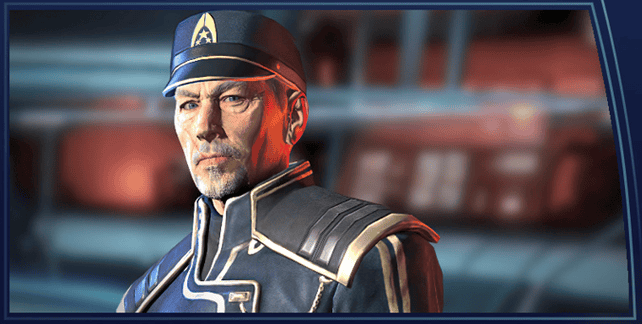
Admiral Steven Hackett is a decorated officer in the Systems Alliance, currently assigned to Arcturus Station on the far side of the Sol Relay. In the battle for the Citadel, Admiral Hackett commanded the Fifth Fleet. Following that victory, he was promoted to head of the Alliance military.
Hackett was born to a single mother in Buenos Aires in 2134. When his mother died in the pandemic of 2146, he was placed in the Advanced Training Academy for Juveniles, where his superior talents in science and leadership quickly became evident.
Hackett enlisted in 2152, volunteering for high-risk missions to colonize space beyond the Sol Relay. He was commissioned as a second lieutenant on Arcturus Station in 2156, and soon proved his ability in the First Contact War. His rare ascent from enlisted man to admiral remains an Alliance legend.
David Anderson
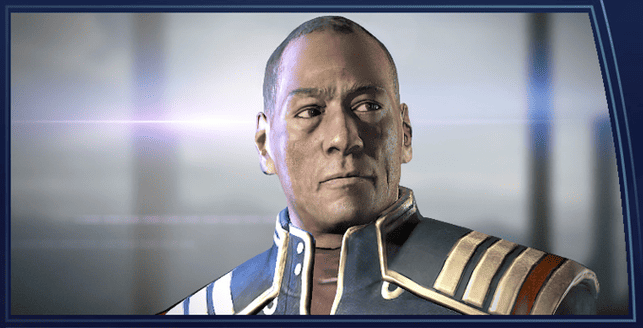
Admiral David Edward Anderson is a career military officer in the Systems Alliance Navy. Born in London in 2137, he later moved to Arcturus Station and became the first graduate of the Alliance’s now-renowned N7 marine program. Anderson is one of the Alliance’s most decorated Special Forces operatives and served with honor during the First Contact War. He was the original captain of the SSV Normandy before relinquishing command to his XO, Commander Shepard.
After the Alliance victory in the Battle of the Citadel, Anderson briefly served as the Citadel’s first human councilor. He soon became embroiled in a Cerberus plot to abduct his friend Kahlee Sanders, however, and learned that he was unable to live a life without action. He stepped down as councilor and returned to the military to prepare for the Reaper invasion. The Alliance Parliament named Donnel Udina as his successor.
Dr. Liara T’Soni
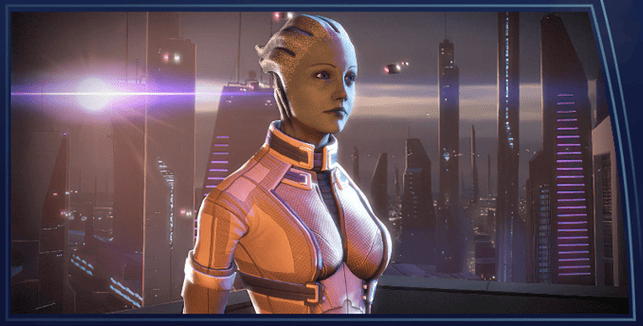
Dr. Liara T’Soni is an asari information broker with a background in scientific research on Prothean technology. Born on Thessia in 2077, she is the only child of the late Matriarch Benezia, although mother and daughter became estranged in the years before Benezia was indoctrinated by the Reaper known as Sovereign. T’Soni is also a highly trained biotic who served under Commander Shepard aboard the SSV Normandy before the ship was destroyed in a Collector attack.
Before she became involved in galactic affairs, Dr. T’Soni spent 50 years researching the Protheans’ technology and the mystery of their extinction. She now divides her time between uncovering Prothean ruins and consulting with noteworthy representatives of the various Citadel races.
EDI
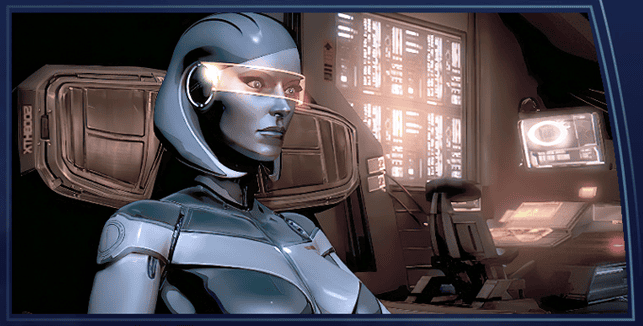
The Enhanced Defense Intelligence, or EDI, serves as an information source and cyberwarfare defense system on the rebuilt Normandy SR-2. The ship’s crew can access EDI at any terminal or through radio contact.
During an attack from a Collector vessel, pilot Jeff “Joker” Moreau gave EDI full access to the Normandy’s systems, allowing the ship to escape. Although EDI retains the control that Moreau gave her, she is usually content to advise the organic crew members who fly and maintain the ship.
Garrus Vakarian
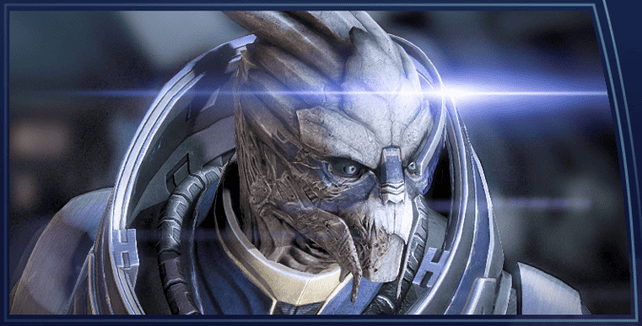
Garrus Vakarian is a noted turian sharpshooter and combat engineer. He was born on Palaven and became a Citadel Security officer like his father, but left the force when superiors shut down his investigation into the rogue Spectre Saren Arterius. Vakarian eventually discovered that Saren had been indoctrinated by the Reaper known as Sovereign.
Vakarian eventually found his way to the criminal haven of Omega and assumed the name Archangel. There, he and a small group of operatives worked to disrupt the
settlement’s powerful mercenary groups until Shepard recruited him. The turian narrowly survived the second Normandy’s attack on the Collectors. More recently, Vakarian has become the head of a turian task force focused on preparing for the Reaper invasion.
Kaidan Alenko
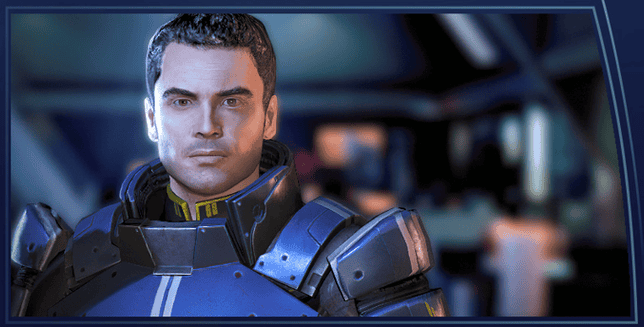
Major Kaidan Alenko is a human biotic and an officer in the Systems Alliance. He served as staff lieutenant under Commander Shepard on the SSV Normandy during the Battle of the Citadel and now heads the Special Operations Biotics Division at the Alliance Warfare Center. An Alliance tribunal recently called on Alenko to testify about his experience with the Reapers.
Alenko suffers from severe headaches because of the early-model L2 biotic implants that he was given as a child. The L2 implants have since been discontinued due to the risk of crippling neurological damage.
Ashley Williams
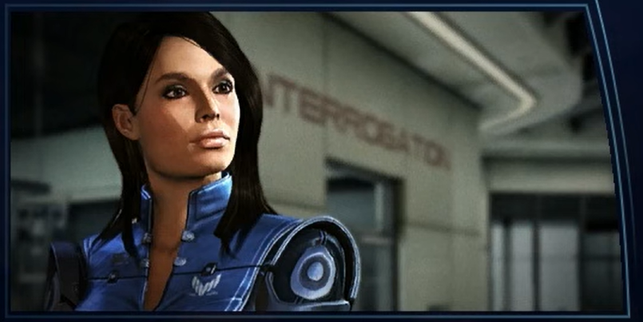
Lieutenant Commander Ashley Williams is a career military officer with the Systems Alliance. Born in 2158 to a military family, Williams enlisted directly out of high school, splitting time between Earth and hostile environment training on Titan. After earning numerous commendations early in her career, Williams became a platoon guide on Eden Prime, where she was the only member of her unit to survive the geth attack.
Williams then served as gunnery chief under Commander Shepard on the SSV Normandy and was promoted to lieutenant commander after the Battle of the Citadel. More recently, an Alliance tribunal called on Williams to testify about her experience with the Reapers.
Tali’Zorah
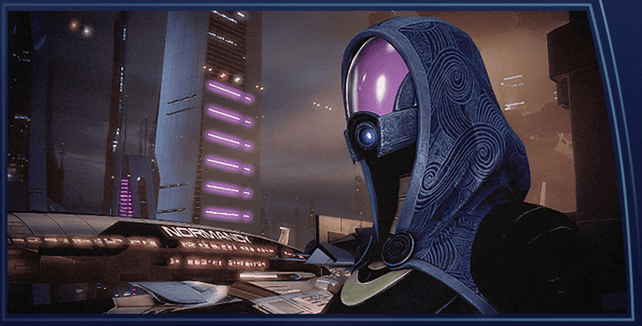
Tali’Zorah, a quarian machinist, was born in 2161 on the liveship Rayya. During her Pilgrimage–a rite of passage in which quarians prove their worth to the fleet–she recovered a geth memory core that proved a rogue Spectre, Saren Arterius, was working with the geth. As a consequence, Tali’Zorah became a crew member of the SSV Normandy, where she served under Commander Shepard during the Battle of the Citadel.
Tali’Zorah returned to the Migrant Fleet following the destruction of the first Normandy. Soon after, the Admiralty Board sent her to the former quarian colony of Haestrom to recover data on the planet’s dying sun. Most of her team was killed when they fell under attack from the geth, but Tali’Zorah herself was narrowly rescued by Shepard and the crew of the rebuilt Normandy. The quarian rejoined Shepard to help oppose the Collector threat, but her current whereabouts are unknown.
Dr. Mordin Solus
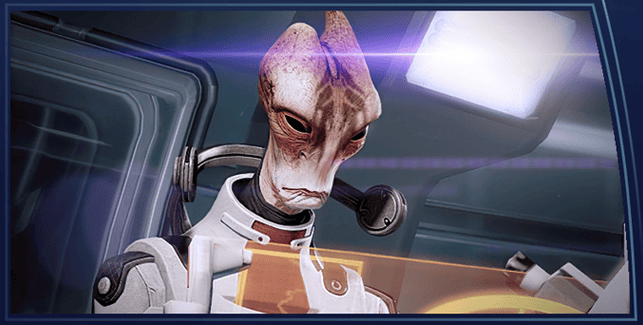
Dr. Mordin Solus is a master geneticist and former operative for the salarian Special Tasks Group. Dr. Solus is well known for his work in perpetuating the genophage, a biological weapon that almost completely sterilized the krogan species. He eventually left the STG to open a clinic on Omega, where his combat skills kept the clinic safe and operational amid Omega’s lawless society.
In 2185, Commander Shepard recruited Dr. Solus to research the Collectors and the Reapers. He was a member of the Normandy crew that traveled beyond the Omega 4 relay to attack the Collectors. He survived the mission, but his current whereabouts are unknown.
Jacob Taylor
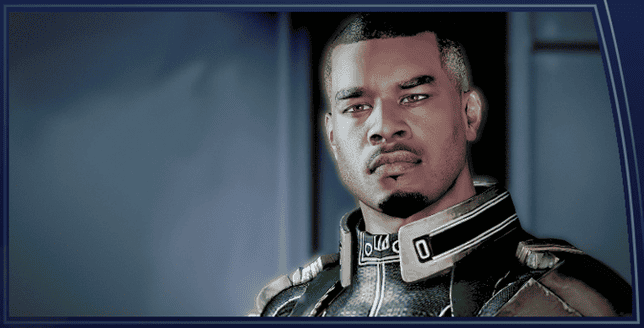
Jacob Taylor is a human biotic and was once a Cerberus operative working under Miranda Lawson. Born in 2157, he began his career as a Systems Alliance marine and served as a member of the Corsairs, an arms-length program for operatives working outside of Alliance jurisdiction. Taylor survived the geth attack on Eden Prime, but left the Alliance afterwards because of what he perceived as unresponsiveness in the face of aggression.
While working for Cerberus, Taylor thwarted a plot by batarian terrorists to unleash a bioweapon on the Citadel. Soon after, he was assigned to Project Lazarus, the Cerberus effort to reconstruct Commander Shepard and the Normandy stealth frigate. Following the project’s completion, Taylor accompanied Shepard through the Omega- 4 relay to destroy the Collectors. He survived that mission and has since left Cerberus, although his current whereabouts and affiliations are unknown.
Jeff “Joker” Moreau
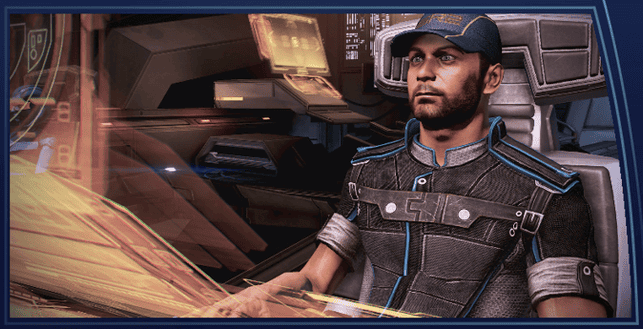
Flight Lieutenant Jeff “Joker” Moreau is a respected pilot with the Alliance Navy. Born and raised on Arcturus Station, he is widely considered to be the best helmsman in the Systems Alliance.
Moreau enlisted with the navy directly out of school and quickly gained the respect of his superiors. He served as pilot of both the Normandy SR-1 and its successor, the SR-2– and was at their respective helms during the Battle of the Citadel and the assault on the Collectors.
Moreau suffers from Vrolik syndrome, a rare, debilitating disorder also known as brittle bone disease.
Dr. Karin Chakwas
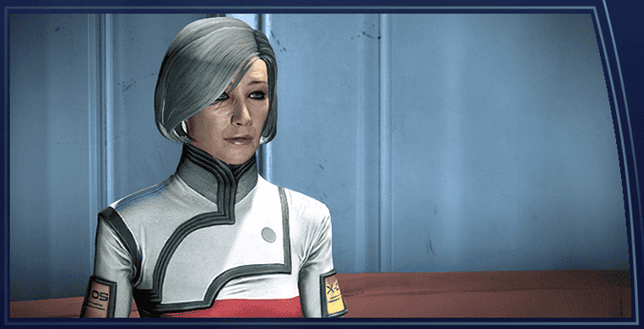
Dr. Karin Chakwas is a trauma surgeon and a major in the Alliance Navy. She served on the SSV Normandy under both Captain Anderson and Commander Shepard and was aboard the ship when it was destroyed by the Collectors. She later quit the Alliance in order to rejoin Shepard on the Cerberus-built Normandy SR-2. Along with most of the second Normandy’s crew, Dr. Chakwas was kidnapped by the Collectors and taken beyond the Omega 4 relay, where Commander Shepard eventually rescued her.
After the Alliance impounded the Normandy SR-2, an inquiry found that Dr. Chakwas had “no significant role in or provable knowledge” of Cerberus’s criminal activities. She has since rejoined the Alliance.
Mass Effect 3: From Ashes*
Planets and Locations: Eden Prime
In 2151, as the first anxious settlers made their way through the new Charon mass relay, many of them wondered whether the reality of life on Eden Prime could possibly live up to the stories of pristine landscapes that drew them there. What the colonists found exceeded their expectations–the stable climate and compatible biology made the colony almost instantly viable.
Over the next few decades, several million humans immigrated to Eden Prime and a primarily agrarian culture developed. The new colony quickly became not only self-sufficient, but began exporting goods. Chief among these were rare plants grown from Earth’s many heritage seed libraries.
But in 2183, the colonists faced a true test of their character: Eden Prime was attacked by the rogue Spectre Saren Arterius and his geth allies. Not long after, the Citadel was attacked by those same forces and Eden Prime’s neighboring world Terra Nova found itself threatened with complete destruction. Faced with such violence, a lesser citizenry might have retreated back to the safety of Earth, as so many colonists of Terra Nova did. But Eden Prime’s governing body refused to give in. Not only did the colonists vote overwhelmingly to block a measure calling for the building of evacuation ships, they voted to ease restrictions on emigrants from Terra Nova looking for a new home. As a result, Eden Prime’s population has swelled; whatever the war might bring, its status as a symbol of humanity’s future in the stars remains unblemished.
Technology: Prothean Beacon
In 2183, human scientists uncovered a Prothean technological artifact on the planet of Eden Prime. While repelling an attack by Saren Arterius’ geth allies, Commander Shepard’s squad came into the artifact’s proximity and set it off. The object, described as a beacon, sent the Commander jumbled sounds and images intended to warn of the imminent Reaper invasion. The beacon overloaded during the process and violently exploded.
While the vision it provided was dismissed by the Citadel Council as a highly subjective experience, since that time, the Council’s Committee on Paleotechnology have analyzed the fragments of the beacon in an effort to understand how it communicated. What they found was not quite the “telepathic technology” that the Alliance marines described in their reports.
The beacon was equipped with a mass effect field generator to hold its subject immobile, a necessary step to minimize collateral damage during the rest of the process. The beacon then nearly instantaneously scanned the structure of its target’s optic and auditory nerves as well as many parts of the brain responsible for memory. Once its expert system determined the proportions of these key features, the beacon stimulated them with pinpoint electromagnetic and other irradiative energy, using powerful programs to recreate any images or sound the beacon required. In principle, this was similar to the popular entertainment device known as a “simstim,” but vastly more comprehensive–simstims direct the senses, not memory.
The Normandy’s medical officer noted that the beacon delivered more information over the space of seconds than a simstim could do in hours, and managed to do so to a species whose physiology was completely unknown to its designers. To a paleotech, the fact that Commander Shepard needed assistance to decipher the message is a minor footnote compared to the Protheans’ accomplishment– getting any of the message to Shepard at all.
Omega Reclaimed: Omega’s Secrets*
Aria T’Loak
A powerful biotic, Aria T’Loak has been the sole ruler of Omega for some time. Rumored to be at least a thousand years old, she is as skilled at combat and the use of her biotic abilities as she is at manipulation and power games. Ruthless, highly intelligent, and dedicated to maintaining her rule over Omega, Aria is a force to be reckoned with.
Though recent events have seen Cerberus take over Omega and send Aria into exile, there is no doubt that Aria will do everything within her power to reclaim what is hers.
Cerberus Occupation of Omega
The Illusive Man’s plan to capture Omega was elegantly wrought. Experimental specimens called adjutants “escaped” from a Cerberus facility beyond the Omega-4 mass relay, took command of a Cerberus convoy, and arrived on Omega to wreak havoc. With more adjutants incoming, Cerberus reached out to Aria T’Loak, claiming it needed her help to stop its wayward test subjects. Reluctantly offering her own forces in an alliance, Aria joined Cerberus’s General Oleg Petrovsky aboard his ship to oversee the battle. When the adjutants overran the Cerberus-Omega fleet, Petrovsky and Aria escaped through the Omega-4 relay.
However, Petrovsky’s subordinate Colonel Raymond Ashe had remained behind on Omega to take control of the station’s defenses while Cerberus reinforcements approached. Announcing that it was protecting the galaxy from the adjutant threat, Cerberus seized Omega, giving the Illusive Man full control of the Omega-4 relay and the space beyond. Without Aria to keep them in line, the various criminal and mercenary factions on the station erupted, fighting both Cerberus ground troops and each other.
Meanwhile, Aria was taken captive by General Petrovsky. Realizing that the adjutants had simply been a ruse to capture Omega, Aria managed to escape back to Omega, slipping away into its underbelly to organize a resistance force.
Eventually, Petrovsky ordered the Cerberus forces to evacuate the station, but this was yet another ruse–this time to lure Aria out of hiding. With his troops out of harm’s way, Petrovsky summoned a massive Cerberus fleet and presented Aria with an ultimatum: leave Omega or lose it. Petrovsky threatened to destroy the station rather than lose control, and with no alternative, Aria left, vowing she would return to claim Omega and take her revenge.
Cerberus: Adjutant
“Adjutant” is the Cerberus codename for the experimental subjects created at a secret facility beyond the Omega-4 relay. The creatures are based on Reaper technology, and the adjutants encountered on Omega have the ability to infect any life-form to create a new adjutant.
Adjutants are deadly pack hunters. They initially remain hidden, observing potential victims and distracting them with subtle whispers. When they select a target, adjutants ambush them with charged projectiles that create a violently unstable mass effect field that causes severe disorientation and renders the target helpless. Enhanced muscle tissue gives adjutants the ability to leap surprising distances, allowing them to close in and infect their target quickly.
The baseline form of the being does not match any known species. Xenobiologists suspect that Reapers may have originally created and implemented the virus several cycles before the Prothean extinction and that it still carries genetic traces of its original host. If this is true, then like the Collectors, adjutants are a glimpse into the distant past at a species whose very existence–and struggle against the Reapers–has long been forgotten.
Cerberus: General Oleg Petrovsky
Military strategist and classical scholar General Oleg Petrovsky is one of the Illusive Man’s most respected operatives. As a corporal in the First Contact War, Petrovsky was forced to take command of his unit and proved his tactical brilliance by holding off repeated turian attacks for weeks. The war ended before his position was overrun but not before Petrovsky had witnessed firsthand the brutality of the turian war machine.
Despite being praised and promoted for his bravery, Petrovsky eventually found more common ground with Cerberus than the Alliance military. Since leading the campaign to seize Omega, Petrovsky has proven to be a capable if firm administrator who is focused on containing or eliminating “unstable elements” before they threaten Cerberus’s occupation of the station.
Cerberus: Rampart Mech
Though its initial invasion of Omega was successful, Cerberus was soon faced with the problem of controlling the station’s large and often lawless population. An initial solution was to establish detainment areas bordered with impassable force fields, believed to be sheets of plasma suspended in a magnetic field. As Cerberus tightened its control of the station, units that could pass freely through the force fields to police the populace became necessary, leading Cerberus engineers to recover LOKI security mechs from the remaining Eclipse mercenary chapters. When upgraded with Cerberus’s proprietary mini-fabrication technology, shielding recovered from Omega’s element zero processing plants, and additional ablative armor, the result was the Rampart mech, a flexible combat unit designed for control and intimidation of Omega’s inhabitants.
Rampart mechs can seek out targets or troublemakers anywhere on Omega, even lower industrial areas where radiation can be intense. It is fitted with infrasound and scent markers that are “fight or flight” triggers for several species and are intended to subdue or disperse a crowd. When necessary, Rampart mechs can channel all available power into generating a high-intensity shield that defends against hacking or biotic attacks and weapons fire, protecting the Rampart until reinforcements arrive. For combat, most Rampart mechs are equipped with a standard issue shotgun; if damaged beyond repair, the Rampart mech destroys the shotgun’s aluminum-alloy heat-dispersal sinks, coating any nearby assailants in red-hot residue that burns through armor.
In extreme situations, the Rampart mech overclocks into a “hunter-killer” mode, diverting power from its unique shields to single-mindedly destroy its target. In this mode, the Rampart mech moves faster, attacking with a flash-forged omni-blade that targets unprotected nerve clusters and immobilizes the luckless target. The Rampart also channels excess heat through the dispersal sinks, visibly burning off material to create an intimidating display as it advances.
Nyreen Kandros
Born to a family with a long and honored tradition of military service, Nyreen Kandros left the turian military after the emergence of her biotic abilities. Oft-suspicious of biotics, the turians shipped Nyreen off to the Cabal units, where her abilities and experience were grossly underutilized.
After several years as a mercenary, Kandros was drawn to Omega by its reputation as a haven for capable freelancers. Nyreen’s early years on Omega were a pivotal time for her. Aria T’Loak took an interest in Kandros, helping her hone her biotic talents while developing her military experience and skills to their full potential. Aria also allowed Nyreen the time she needed to reconcile with her new way of life and her unexpected–and initially unwanted–abilities.
The two eventually parted ways due to irreconcilable differences, but Nyreen Kandros remained on Omega. Upon Aria’s return to the station after the Cerberus invasion, Nyreen revealed herself as the leader of the Talons. Reformed under her leadership, the Talons are Omega’s newfound symbol of resistance against the Cerberus occupiers.
Turian Cabals
The Cabals are an elite biotic turian unit whose dictum is, “the intangible is unstoppable.” As turian biotics are relatively rare, with biotic abilities manifesting in only a small percentage of element-zero exposed turians, Cabals tend to be small and only comprised of 10 to 15 individuals led by a commanding officer called a kabalim.
A turian Cabal is often deployed covertly as shock troops or saboteurs, or they’re sent on long reconnaissance missions for the Hierarchy. In addition to advanced biotic training, all Cabal soldiers are highly skilled in small arms, explosives, infiltration tactics, and piloting.
Centuries ago, during the Unification Wars, military black ops would recruit turian biotics as infiltrators, planting them anonymously in the regular infantry as “observers” or using them as assassins. This historical practice has left a cultural bias against biotic soldiers among the turian rank-and-file. As a result, the Turian Hierarchy prefers to keep its Cabals isolated from other branches of the military, citing “safety and unit cohesion concerns.”
Even turians whose biotic abilities are not combat-proficient are segregated into Cabals, often forcing them to cut short their promising careers in order to serve as a medic or maintenance officer. However, Cabal soldiers are professionals; those who do not adapt are quickly weeded out, resulting in strongly unified teams of experienced, deadly, biotic warriors who see their isolation as a necessary sacrifice to protect the Hierarchy.
The war with the Reapers means that the Turian Hierarchy no longer has the luxury of keeping such powerful assets in reserve. Many Cabals have been recalled to Palaven, while the most experienced have been dispatched to the front lines for surgical strikes on Reaper strongholds or to provide support for regular infantry.
Organizations
Cerberus

In recent years, the pro-human syndicate known as Cerberus has seen its influence grow galaxy-wide. The largely untraceable organization now includes private intelligence agencies, biotics laboratories, research facilities, and the lucrative corporations that provide a front for it all.
Cerberus’s charismatic leader, known only as the Illusive Man, drives the organization’s philosophy and interests. The level of secrecy he maintains puts professional intelligence agencies to shame.
As Cerberus grows, so too does public distrust of the organization. Some commentators have remarked that Cerberus is not so much pro- human as it is antialien. Others question the blind loyalty of its employees.
Cerberus: Atlas
With the Atlas, Cerberus’s research arm has combined the deadly armor and firepower of a YMIR mech with the tactical superiority of a trained human pilot. An element zero core allows the Atlas to be air-dropped onto a battlefield with minimal impact damage. Its thick armor includes a robust transparent canopy made from a polycrystalline composite proprietary to Cerberus. Alliance engineers hypothesize that the material is some kind of synthetic sapphire composed with interlayers to resist cracking and thermal damage.
Although the Atlas is somewhat unwieldy in the field, its antipersonnel machine guns and ability to shrug off damage from anything short of a heavy weapon makes it a fearsome opponent. Heavy loss of life is to be expected in any unprepared encounter with this unit.
Cerberus: Centurion
Centurions are Cerberus’s front-line tacticians. They are meant to enact the Illusive Man’s strategic goals, although it is clear that they have leeway to adapt as an encounter develops.
The only useful intelligence that the Alliance has gathered on centurions relates to their armament. Each centurion carries an M-96 Mattock heavy rifle modified to launch smoke grenades, leaving enemies vulnerable to crossfire.
Cerberus: Engineer
Cerberus combat engineers are specialized support units that assist primary forces while staying out of the line of fire. They wear lighter armor than the typical Cerberus combatant, using a modified mesh that allows greater mobility. Under cover and out of sight, engineers focus on setting up and maintaining turrets as well as repairing mechanical units or armored allies. When confronted, they return fire only for as long as it takes them to find cover again and let front-line combat personnel take over.
Although engineers are not particularly dangerous on their own, the Alliance specifically warns troops to remain alert for turrets, which can mow down an entire squad while the engineer escapes.
Cerberus: Guardian
Guardians, the Cerberus equivalent of human tanks, are slow-moving soldiers who carry enormous polycrystalline-composite shields. The weight of the shield requires an armored suit equipped with hydraulic assists and a dedicated power supply. Combining this exceptional protection with a suite of enviro-mapping systems, guardians focus on flanking opponents to flush them from cover.
A Guardian’s slow but relentless approach is intended to demoralize enemies as well as draw their fire, but rip away their shield, and guardians become little more than cannon fodder.
Cerberus: Nemesis
The nemesis is a Cerberus sniper specialist. Customized implants allow the nemesis to withstand the crippling kickback of the M-98 Widow antimateriel rifle, turning a redoubtable opponent into a force capable of inflicting instant death. A suite of high-tech scanning equipment makes the sniper adept at maintaining cover, meaning a nemesis is usually spotted only after opening fire– assuming the target survives the first round.
Because of self-destruct mechanisms that activate upon the sniper’s death, the Alliance has never retrieved an example of nemesis augmentation technology. This fact, combined with Cerberus forces’ penchant for suicide when faced with capture, has made scientific study of their implants impossible.
Cerberus: Phantom
Phantoms are agile Cerberus agents with a wide array of offensive and defensive capabilities, including particular specialization in evasive maneuvers and firing from cover. Although intelligence on their implants still evades the Alliance, phantoms are known to be able to create a personal barrier for greater protection.
Monomolecular blades and biotic shielding allow phantoms to engage in close-quarters combat, and phantoms can briefly cloak in order to recover from injuries. Because of this ability, the Alliance recommends personal confirmation of a phantom’s death.
Cerberus: Trooper
Assault troopers are the backbone of Cerberus forces. Those candidates who make it through the grueling basic training are submitted to an intensive psychological program that renders them fearless, disciplined, and unrelenting. Outfitted with custom-designed armor and rifles, these soldiers function with determined precision and practiced teamwork.
The first to rush into a fight, assault troopers often work in tandem with more powerful units. They make strategic use of this scenario, keeping their opponents occupied until it is too late to react to the combined Cerberus force bearing down on them.
Cerberus: The Illusive Man
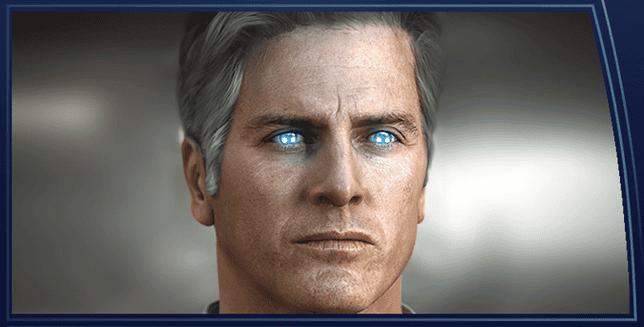
The Illusive Man is a human loyalist focused on advancing the interests of his species, whatever the cost to non-humans and reportedly humans. The Citadel Council regards him as a fanatic who poses a serious threat to galactic security.
The reclusive tycoon is the head of Cerberus, an organization that furthers his pro-human agenda throughout the galaxy. His views have led him into questionable alliances. Recent rumors go so far as to suggest that the Illusive Man may even have allied with the Reapers.
Mercenaries: Blue Suns*
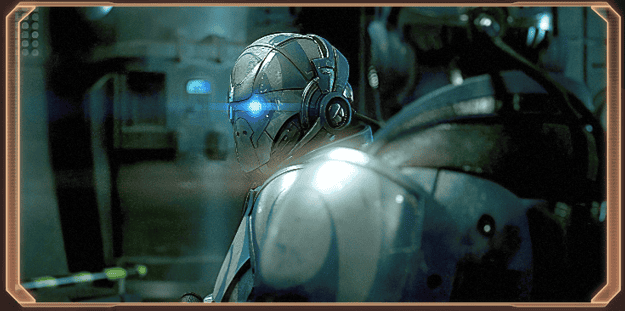
Founded by notorious batarian slaver Solem Dal’serah, the Blue Suns began as a Skyllian Verge protection racket providing genuine protection from slavers and pirates. Eventually captured by the Systems Alliance Navy, Dal’serah beat almost two dozen charges to be convicted on a single count of conspiracy. The slaver benefited from the tutelage of cellmate and brilliant con artist Bernard “Legits” Ledger. Upon release five years later, Dal’serah incorporated Blue Suns as a legal security agency.
Today, the Blue Suns boast a galaxy-wide force of batarians, turians, humans, and krogan. Each deployment is backed by a logistics corps selling everything from heavy weapons to shaving cream. Despite claims that Blue Suns sells its captives as slaves, no Blue Suns employee has ever been convicted on such charges.
Many Blue Suns members sport the company logo in tattoo form, removed during assignments and reapplied at mission-end.
Mercenaries: Eclipse*
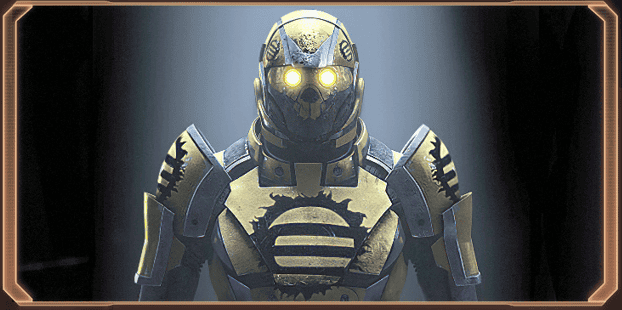
Brainchild of asari commando Jona Sederis, Eclipse was incorporated as a “proactive” security company. Influenced by asari and salarian military doctrine, Eclipse specializes in sabotage, assassination, and personal and organizational security. Although Citadel governments regard the corporation with suspicion, it’s embraced in the Skyllian Verge and Terminus Systems.
Early on, Sederis sought government contracts to establish market share against the better-established Blue Suns. Her agency scored a galactic PR coup by retaking several space stations captured by the Anhur People’s Liberation Army and neutralizing its leaders, a victory Eclipse’s marketing department never ceases trumpeting.
Based on Omega Station, Eclipse controls nearly 20% of the asteroid’s real estate. Its services range from mech repair to open warfare, although assassination is reserved for meeting wider, longer-term company goals (for instance, pre-emptive strikes against pirates rather than murdering spouses for insurance money). Despite numerous reports, Eclipse denies sabotaging or kidnapping business rivals.
Mercenaries: The Blood Pack*
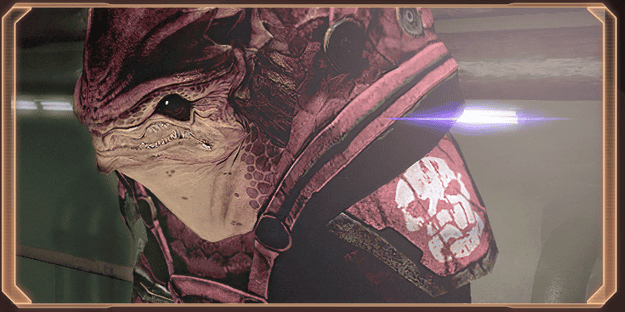
Originally a small Terminus Systems vorcha gang, the Blood Pack was transformed into a legion by visionary krogan battlemaster Ganar Wrang. Exiled for striking a female in anger, Wrang obsessed over reclaiming his lost status.
Leading the vorcha pack as a pirate crew, Wrang cultivated recruits and infamy for a decade before incorporating his fighters as a security company across the Skyllian Verge. His notoriety ensured his initial public offering for investors made him rich beyond most krogan’s dreams. Wrang returned triumphantly to his clan, rallying elders, krogan hordes, and their firepower and biotic support toward professional violence in the Terminus Systems.
Banned from Citadel space, the Blood Pack bribes its way through spaceports into armed conflicts across the galaxy. Priding themselves for accepting otherwise untouchable contracts, the Blood Pack rejects bodyguarding and security in favor of cases requiring minimal oversight and maximal violence.
Planets and locations
Gellix
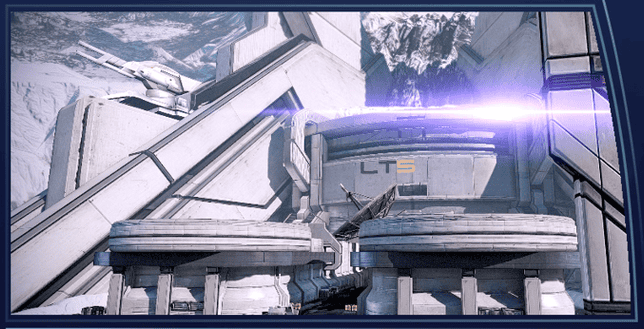
Gellix, the second planet in the Arrae system, is a marginally habitable world of mountains and ice.
The planet was turned into a human penal colony upon its discovery in 2161, but its prisons shut in 2179 after racking up the worst safety records in the Systems Alliance. Lawsuits are still in the courts.
Shortly after the closure of the prisons, a handful of intergalactic corporations moved in to set up mines, supply depots, and other facilities on the planet.
Grissom Academy
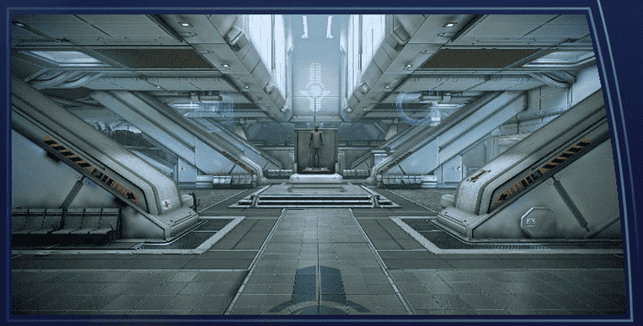
The Jon Grissom Academy, founded in 2176, is the Alliance’s premier school for young human biotics. The institution is housed in a space station in orbit over the human colony of Elysium. Its main program, the Ascension Project, is designed both to train and monitor young biotics as well as help them integrate into society after graduation. Unlike the project’s previous incarnation, Biotic Acclimation and Temperance Training, or BAAT, the training is not exclusively military in nature.
The academy also employs scientific personnel, including Dr. Kahlee Sanders, to develop synthetic intelligence systems and biotic amplifiers like the new L4 implants.
Lesuss
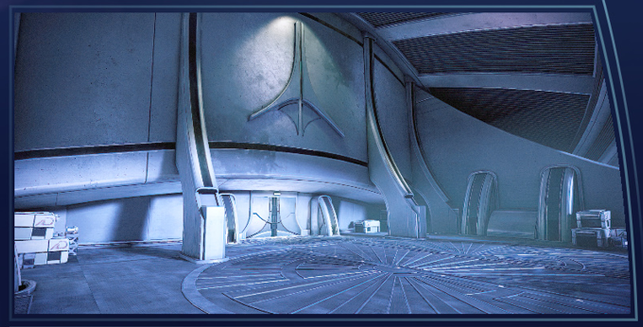
An unremarkable world located far from regularly traveled trade routes, Lesuss is inhabited only by a small asari colony. The main feature is a monastery that houses a large population of asari with active or latent Ardat-Yakshi genes, a disorder that causes the death of anyone who mates with the afflicted asari. Although some of the colonists exiled themselves voluntarily, many were sent to Lesuss by their families to protect society from their deadly potential.
The monastery emphasizes individual sacrifice for the good of the community. Latent Ardat- Yakshi, as well as active sufferers who show that they can control their condition, may be offered a chance to reintegrate into asari society after spending sufficient time on Lesuss. Active Ardat-Yakshi whose psychological profiles show capacity for neither empathy nor reeducation are confined to the monastery for life.
Rannoch
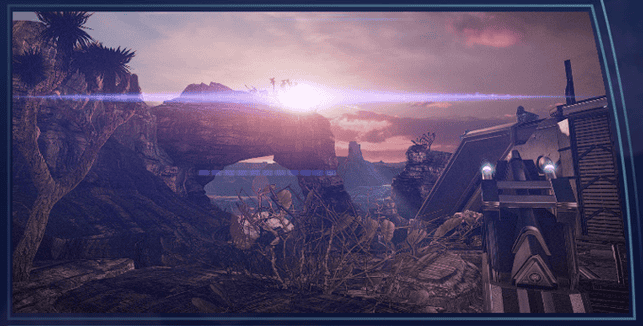
The planet Rannoch, an arid planet orbiting an older star in the Tikkun system, is the former quarian homeworld. Almost three hundred years ago, the quarians were driven from Rannoch by the geth, synthetic servants who gained sapience and rebelled against their creators. Although Rannoch is now largely uninhabited, the geth have acted as caretakers, working to repair the planet’s ecology, restore ancient structures, and cultivate some farmland.
Rannoch has no insect life. As a result, its pollinating plants evolved to rely on animals for propagation. This symbiosis between flora and fauna is responsible for the quarians’ weakened immune systems, which made colonization of other planets extremely difficult after their exile from Rannoch. For many quarians, reclaiming their homeworld from the geth is a matter of both cultural and physiological necessity.
Sur’Kesh
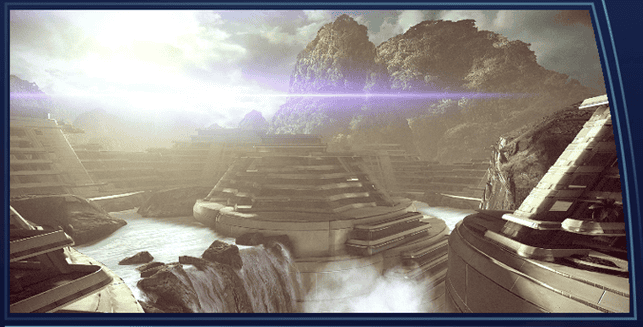
Alternating between large oceans and landmasses covered in flora, the salarian homeworld, Sur’Kesh, is known for its humid climate and lush vegetation. As with the rainforests that once covered Earth, the planet’s many forests enjoy a rich biodiversity. The salarian desire for intellectual stimulation drove them long ago to explore every aspect of their environment, developing ways to thrive without consequences detrimental to their habitat.
The areas near major cities and industrial centers are meticulously maintained, with an eye towards ensuring that sunlight penetrates to the ground level and that established paths through the jungle are kept clear for travel. Burngrass, a soil-enriching and adaptable weed native to Sur’Kesh, has become a major export because of its value for terraforming.
Thessia
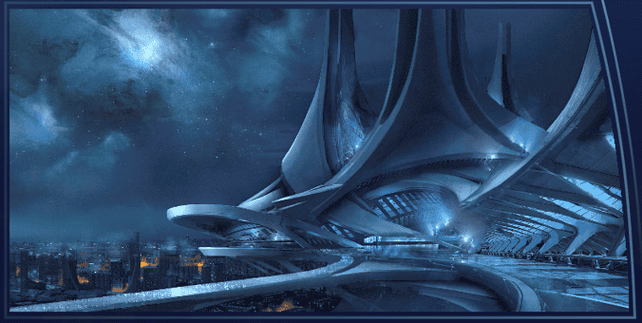
The asari homeworld, Thessia, is the core of the largest economy in the Milky Way. The planet’s reserves of element zero are so vast that they affect its price galaxy-wide. Because life on Thessia evolved in an eezo-rich environment, the world is home to a wealth of both biotically active and eezo-resistant species. Travel to the planet is strictly controlled, but smuggling remains an issue.
Thessia is host to varying republics instead of a single government and, although each maintains a formidable military, it is notable for having long been free of internal or external wars. The asari are renowned for their cultural and political dominance, and they excel in ambassadorial ventures. They have a strong presence in Citadel politics and galactic policy. However, it is the unfocused political structure of their homeworld that has left the Thessians unprepared for the current conflict.
Tuchanka
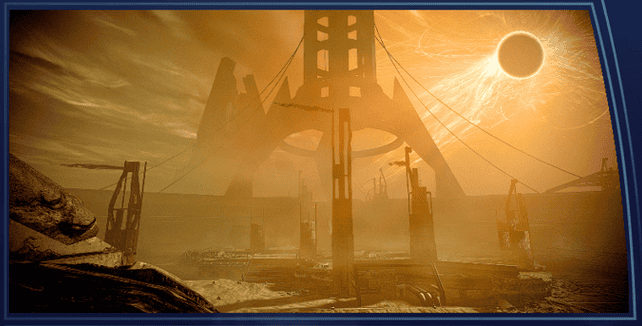
Tuchanka, the krogan homeworld, boasts extreme temperatures, virulent diseases, and predatory fauna. Around 1900 BCE, the krogan discovered atomic weapons and promptly sent their planet into a nuclear winter. The majority of the population retreated to underground bunkers, and krogan culture slipped into a dark age dominated by tribal clans.
In 80 CE, decades into the Rachni Wars, the Salarian Union made first contact with the primitive krogan and initiated a “cultural uplift” to shape them into a modern army capable of confronting the rachni. During this uplift, the salarians constructed the Shroud facility on Tuchanka to shield the planet from harmful forms of solar radiation. Later, during the Krogan Rebellions, reproductive rates were curtailed by the genophage, ensuring the krogan remained a species in decline–and Tuchanka a desolate wasteland.
Aeia
Humans detected Aeia as an Earth-type world via telemetry in 2165. After probe surveys indicated life — lush vegetation, ample fresh water and breathable air — the Alliance upgraded the planet to a garden-world colonization priority. Commanded by Captain Ronald Taylor, the crew of Alliance survey vessel Hugo Gernsback made planetfall on the jungle world in 2173. Soon after, ship transmissions inexplicably stopped. While the precise fate of the Hugo Gernsback command and crew is unknown, they are presumed killed in action and their vessel destroyed.
Benning
Benning was once a thriving human colony, but the Reapers have rounded up a large portion of the populace for processing. Some pockets of civilian resistance still elude the Reapers, however, and rescue attempts are underway. A “resistance radio” established during the early days of the attack continues to broadcast, exhorting survivors to band together and discussing rumors of safe havens. Unfortunately, those rumors have begun to result in ambushes, increasing the desperation of those who remain free.
Through all this, Benning’s automated agricultural systems have continued to operate, leading to unprecedented stores of food in the planet’s granaries and warehouses.
Cyclone
Cyone, a fortified world under the protection of several asari matriarchs, has begun to
supply fuel to Systems Alliance forces in the hope that an asari-human partnership might prevent the Reapers from seizing the planet. Alliance forces have since established several outposts in the system.
The humans and asari have been joined by a small detachment of turians, drawn from the private militia of a corporate conglomerate that does business with Cyone. The three species are so determined to defend Cyone that integration issues have been negligible.
The task force has already thrown back several Reaper attacks, although the commanders express concern that small Reaper forces could have slipped through despite their vigilance.
Feros
Feros is a habitable world in the Attican Beta cluster. Two-thirds of the habitable surface is covered with the ruins of a crumbling Prothean megatropolis. In the millennia since the Prothean extinction, the ruins have been picked over by looters many times.
Feros was considered a poor prospect for colonization, as little open ground remains for agriculture. The only sizable fresh water sources are the poles, which are tapped by the decaying Prothean aqueduct systems. The dead cities, while in good condition considering their antiquity, are of uncertain stability. Ground level is congested by a dozen meters of fallen debris, and the air is fouled by dust.
In 2178, the human ExoGeni Corporation announced its intention to place a permanent colony on Feros, to thoroughly explore the ruins. The pioneer settlement was placed on the upper levels of several intact skyscrapers, using the surviving Prothean aqueducts and rooftop hydroponic gardens to support the population.
Freedom’s Progress
Freedom’s Progress colony was once a typical Alliance settlement, but following complete communications blackout and its apparent destruction is now a lightning rod for anxiety and dread in the galactic human community.
The communications blackout followed an upgrade of the colony’s small military force (supplemented by mechs and security drones) with high-powered, tower-mounted GARDIAN lasers. Colonists complained about construction cost overruns, delays, noise, and damage to the local environment. They also feared the defense array could be seen as provocative to their world’s neighbors. Such fears may not have been baseless. Authorities have still offered no explanation for the communications blackout, fueling rumors of plagues, natural disasters, or a cult-inspired mass-suicide.
Located in strategically insignificant space, Freedom’s Progress colony had once offered residents spectacular rainbows, lush marshlands and stunning mountain ranges. Its potential as an agricultural settlement and tourism wonderland rivaled that of any Alliance colony.
Haestrom
Before the geth revolt 300 years ago, the quarians colonized Haestrom to study the mysterious instability of its sun, which threatened premature eruption into a red giant. As a scientific outpost of minimal military value, Haestrom was ill-equipped to repel geth forces during the insurrection and fell quickly under their control.
Captured geth planetary survey data indicates that despite sustaining damage, Haestrom’s architecture remains as it was before the war, preserving a quarian architectural style that no longer exists anywhere else in the galaxy.
Because Haestrom’s sun has overwhelmed the planet’s protective magnetosphere, humans foolhardy enough to venture into geth-controlled Haestrom must exercise extreme caution. Minutes of radiation exposure will overload shields and hours of exposure will kill. Furthermore, solar output renders surface-to-orbit communication nearly impossible.
Illium
A regional hub of asari commerce awash in riches, Illium is infamous for its abusive labor practices and legalization of nearly everything except murder. As such, Illium is the preferred production site for weapons and pharmaceuticals that would be illegal nearly everywhere else, made even more lucrative by legal indentured servitude. Among the biotics-related pharmaceutical producers is the Dantius Corporation, a rising star in galactic commerce.
Despite the dangers of its products, Illium is renowned for glamor, luxury, and safety (provided by near-total surveillance), making it a favored tourist destination.
Countless celebrities maintain palatial estates on Illium and in its capital, Nos Astra. The sole obstacle to business on Illium is its extensive bureaucracy, tolerated only for its provision of security.
Regardless of the character of its economy, Illium’s self- congratulatory media exalts its own society with the provincial arrogance of “new money,” glorifying in “sexiest CEOs” and “ten richest residents” lists.
Ilos
Like the ancient human city of Troy, llos is a world known only through second-hand sources. References to Ilos have been found at several other Prothean ruins, though direct study of the world is unlikely to occur.
llos lies in a remote area of the Terminus Systems only accessible by the legendary Mu Relay. Four thousand years ago, the Mu Relay was knocked out of position by a supernova and lost. Since then, llos and its cluster have been inaccessible.
Occasionally, a university will organize an expedition to chart a route to llos using conventional FTL drive. These never get beyond the planning stages due to the distance and danger. The journey could take years or decades, passing through the hostile Terminus Systems and dozens of unexplored systems.
Korlus
Known as the starcraft cemetery, Korlus was the regional toxic junk yard for centuries. Ships reaching astronautical “near-death” at connecting mass relays were sent to Korlus, stripped of every useful component, then dumped planetward to clear shipping lanes.
Currently Korlus hosts numerous merc factions such as the Blue Suns, rumored to be using downed ship fossils to test advanced munitions. Massive gun batteries threaten anyone attempting planetfall, with minimal defenses against ground attack.
Because ancient vulcanism greenhoused the planet, Korlus was too hot and CO2-rich to develop a biosphere, despite the abundant lakes that could have sponsored the development of life.
Now cool enough for protected habitation, but too scorching for anyone but extremophiles and mercenaries seeking secrecy, Korlus supports numerous krogan outposts. The krogan have therefore seeded Korlus with hardy varren, often kept as war hounds. Varren live primarily on a diet of geophagous vermin and each other.
Noveria
Noveria is a cool, rocky world, with most of its hydrosphere locked up in massive glaciers. A privately-chartered colony world, the planet is owned by the Noveria Development Corporation holding company. The NDC is funded by investment capital from two dozen high technology development firms, and administrated by an Executive Board representing their interests.
The investors built remote hot labs in isolated locations across Noveria’s surface. These facilities are used for research too dangerous or controversial to be performed elsewhere, as Noveria is technically not part of Citadel space and therefore exempt from Council law.
By special arrangement, Citadel Special Tactics and Reconnaissance agents have been granted extraterritorial privileges, but it remains to be seen how committed the Executive Board is to that principle. Given its unique situation, it is understandable that Noveria is often implicated in all manner of wild conspiracy theories.
Omega
Originally an asteroid rich in element zero, Omega was briefly mined by the Protheans, who eventually abandoned it due to its thick, impenetrable crust. Thousands of years later, nature did what even the Protheans could not: a collision with another asteroid broke Omega in half, exposing its trove of element zero for easy mining.
A rush ensued as corporations and private individuals tried to strike it rich on Omega, and thieves and outlaws followed in their wake. As space became tight, construction of processing facilities extended vertically from the asteroid, creating Omega’s jellyfish-like silhouette. To prevent future collisions, the station is ringed with enormous mass-effect field generators that redirect incoming debris.
Today, Omega is a major hub of narcotics, weapons, and eezo trafficking without even a pretense of civilian government or military control. Only mercenary groups have been able to instill a limited order; the most ruthless is an asari syndicate run by the notorious Aria T’Loak.
Ontarium
Sixteen years ago, the Systems Alliance established the first dish field on Ontarom, defying the tidal disruptions and electrical storms that periodically sweep across the planet. The facility has since grown into a crucial communications hub for the Alliance.
Trade between the Alliance base and nearby human settlements sustains planetary unity. The Alliance also trains and hires colonists to maintain the quantum communicators, further strengthening the bond between locals and the military forces that use the comm stations.
Although most of the communication relays serve the military, a coalition of Ontarom’s businesses has begun construction on a civilian broadcast hub. The local Alliance commander has offered the help of the military’s technical experts, making Ontarom a symbol of civilian and military cooperation.
Pragia
Choked by the hyper-growth of non-native plant species, Pragia serves as a galactic reminder about the imperative for careful regulation during colonization.
Two centuries ago, batarian agribusiness chose uninhabited Pragia as their empire’s breadbasket. Colonization authorities introduced non-native, industrially-mutated plants that flourished in the world’s fertile volcanic soil. Synergizing with Pragia’s natural geothermal conditions and chemotropic microbes, the imported species soon became a nightmare. Mutant strains of poisonous and even carnivorous plants arose, overgrowing colonies in days instead of years, and causing the batarians to abandon their holdings. Because the planet’s small animal population is insufficient to check its plant growth, Alliance ecologists predict soil exhaustion in 400 years.
Due to its relative isolation and lack of population, Pragia has become a regional haven for drug-runners, weapons-smugglers, pirates, mercenaries, terrorists, and intelligence agents seeking secrecy.
Rhakana
The drell homeworld of Rakhana once teemed with life, its arid plains home to spectacular insect and reptile analogues. But the drell took to industrialization early and did not realize the extent of the environmental damage they caused until it was too late. With their topsoil depleted and oceans too acidic to sustain life, the drell were situated for a massive population crash by 2025 CE.
It was then the hanar stepped in, mounting a large-scale rescue operation to bring drell to the hanar homeworld, Kahje. As wars erupted over what resources remained on Rakhana and billions began to die, approximately 375,000 drell escaped in the exodus. To repay their debt, the drell entered into an agreement with the hanar. Called the Compact, it states that the drell would assist the hanar with tasks the hanar cannot physically perform. Today, high-ranking hanar are often inseparable from their drell attendants.
Sanctum
Sanctum is known for the freezing ice storms which sweep across its poles and temperate zones, with only a thin strip of habitable land along the equator. Because of those harsh living conditions, Sanctum attracts only the most gruff and hardy, from miners to mercenaries to company men. Mining, referred to as “ice cracking” anywhere but the equator, is the backbone of Sanctum’s economy. The planet is rich in platinum and palladium deposits, as well as boron, which is locally used in semiconductor doping.
Sanctum’s corporate factions have learned that Cerberus is involved in the planet’s finances. Systems Alliance intelligence agents embedded within the corporate strata are quietly urging the companies to confront Cerberus directly, but so far, financial bickering has kept Sanctum’s major stakeholders from acting against the Illusive Man.
Terminus Systems
The Terminus Systems are located on the far side of the Attican Traverse, beyond the space administered by the Citadel Council or claimed by the human Systems Alliance. It is populated by a loose affiliation of minor species, united only in their refusal to acknowledge the political authority of the Council or adhere to the Citadel Conventions.
Their independence comes at a price; the Terminus is fraught with conflict. War among the various species is common, as governments and dictators constantly rise and fall. The region is a haven for illegal activities, particularly piracy and the slave trade.
At least once a year, a fleet from Terminus invades the nearby Attican Traverse. These attacks are typically small raids against poorly-defended colonies. The Council rarely retaliates, as sending patrols into the Terminus Systems could unify the disparate species against their common foe, triggering a long and costly war.
The Migrant Fleet
The flotilla, or the Migrant Fleet, is a fleet of roughly 50,000 starships that houses over 17 million quarians. The largest collection of starfaring vessels in the galaxy, the Fleet is so large it may take days for all the ships to pass through a mass relay.
The ships are constantly repaired, replaced, and upgraded to comfortably house as many quarians as possible. Typically, ships specialize in roles for the Fleet, from the enormous agricultural liveships to the shielded lab ships to the repurposed freighters known as homeships that house quarian children, young parents, and educators. Employed quarians typically live in the ship they work on, since commuting from ship to ship ties up resources with unnecessary docking procedures.
Even within the flotilla, quarians on most ships will remain encased in their protective suits. Rarely, quarians will meet on “clean ships” for specific purposes such as medical services or reproduction. When this occurs, they remove their suits, knowing full well that it is likely they will spend a few days having allergic reactions or getting over infections as their weakened immune systems compensate for each other’s presence.
Perseus Veil
As vast in natural beauty as it is in threat, the purple and gold nebula called the Perseus Veil forms the natural border between geth space and the Terminus Systems.
The Veil’s total opacity prevents Council intelligence from surveying geth activity. Theoretically, the geth could be preparing a devastating attack against which the Council could be defenseless, or the geth could have died out, so that the defense budget against them could be gaining the Alliance nothing but economic ruination.
Despite fears of geth, prospectors do occasionally mount salvage ventures inside the Veil; one ended in tragedy. Using technomental domination, the geth drew the team into the Veil before aiming them back as husks at the organic society that produced them.
A leaked classified Spectre report claims that the dreadnought Sovereign, commanded by ex-Spectre Saren Arterius and crewed by geth, hid near the Veil before initiating the 2183 Citadel attack.
Virmire
Virmire is a lush world located on the frontier of the Attican Traverse. Its vast seas and orbital position on the inner life zone have created a wide equatorial band of humid, tropical terrain. Only the political instability of the region has impeded efforts at colonization.
Many times, the Citadel has opened negotiations to settle Virmire with the various criminal gangs and petty dictatorships in the nearby Terminus Systems. All fell apart due to internal power shifts within the opposing parties. The Citadel has written off the colonization of Virmire as impossible without significant political change.
The Terminus powers themselves are unlikely to ever settle Virmire. Most lack the resources to support settlement of a virgin world, finding it more expedient to steal from their neighbors than build for themselves.
Ships and Vehicles
Normandy SR-2
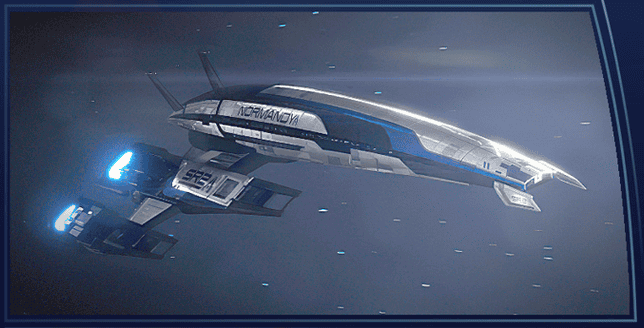
Cerberus built the Normandy SR-2 as a second- generation version of the Alliance frigate SSV Normandy after the Collectors destroyed the original. The SR-2’s many alterations produced a craft nearly double the original size, requiring an even larger Tantalus drive core to compensate. Its state-of-the-art Kodiak shuttle can make landings the original Normandy could not attempt. The Enhanced Defense Intelligence, an Al known colloquially as EDI, coordinates many of the ship’s combat functions, assisting and even supplanting human piloting.
The Alliance has recently appropriated and refurbished the SR-2. In addition to tightbeam communicators, the Quantum Entanglement Communicator (QEC) provides instantaneous contact with Alliance Command.
Potential upgrades are numerous: the airframe could support additional armor and an axial mass accelerator, the thrusters could support recent advances in fuel technology beyond H2/02 chemical rockets, and the hull can mount double the standard number of kinetic barrier projectors, leaving space for stronger shields, easily sustainable via the new eezo drive core.
UT-47 Kodiak
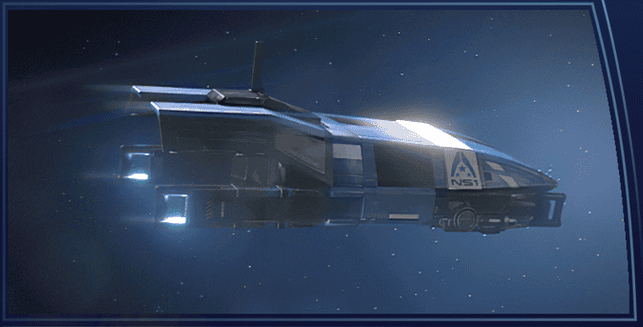
Originally created to covertly insert Alliance marines into hostile environments, the UT-47 shuttle has since been sold to allies, recovered by enemies, and had its specifications stolen by spies. In one form or another, this durable transport is now used in all corners of the galaxy.
A-model Kodiaks feature a front-mounted mass-accelerator cannon that can be used in an antivehicular role. Since the shuttle lacks proper gun ports, soldiers often open the side hatch to fire on enemies. This is discouraged in Alliance manuals, since it exposes the interior to return fire.
Flying the 47A during atmospheric combat requires considerable skill. The pilot must reduce the vehicle’s mass for speed and handling, while maintaining enough mass to resist recoil, incoming fire, and inclement weather. More than one pilot has overstressed the Kodiak’s field generator and ended up on the battlefield instead of above it.
Normandy Armor Upgrade: Silaris Armor
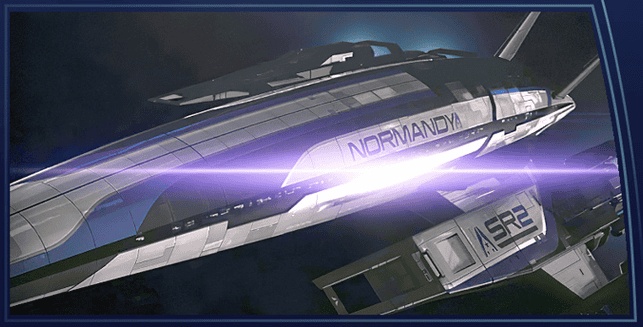
Asari-made Silaris armor can resist even the tremendous heat and kinetic energy of starship weapons. The armor is nearly unsurpassed in strength because its central material, carbon nanotube sheets woven with diamond Chemical Vapor Deposition, are crushed by mass effect fields into super-dense layers able to withstand extreme temperatures. That process also compensates for diamond’s brittleness.
Diamond armor itself has two limiting disadvantages. First, while nanotubes and CVD-diamond construction have become cheaper in recent years, it remains prohibitively expensive to coat starships or aircraft larger than fighters in Silaris material. Second, the armor must be attached to the ship’s superstructure, so shock waves from massive firepower can still destroy the metals beneath the armor itself.
A popular misconception holds that the diamond composition of Silaris armor gives it a sparkle. In fact, atmospheric nitrogen impurities during the super-hot forging process give the armor a metallic gray or yellow sheen.
Normandy Shield Upgrade: Cyclonic Barrier Technology
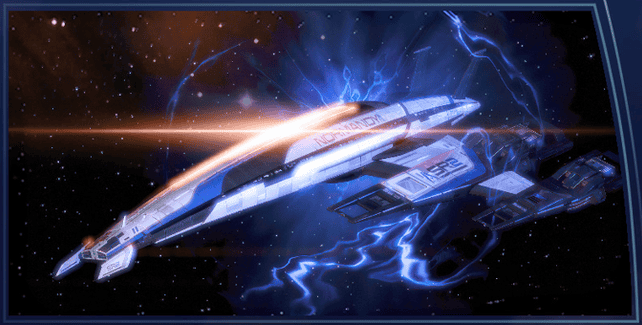
Cyclonic Barrier Technology (CBT) attempts to solve the higher-end limitations of traditional kinetic barriers. Traditional barriers cannot block high-level kinetic energy attacks such as disruptor torpedoes because torpedo mass effect fields add mass. The CBT violently slaps aside rather than halting incoming linear force. By rotationally firing their mass effect field projectors, ships create rapidly oscillating kinetic barriers instead of static ones. Shooting through the CBT is like trying to shoot at a target inside a spinning ball.
Significant drawbacks to current CBT configuration prevent its use on anything other than frigates and fighters. Its many high-frequency sensors and emitters require frequent maintenance and replacement. A partially damaged CBT can endanger its operator, who is surrounded by rotating mass effect fields skewing in unpredictable directions. Fortunately, if an emitter is damaged, the CBT corrects to become a traditional shield array, a safety feature that makes it most effective during opening volleys.
Normandy: Thanix Magnetic-Hydrodynamic Cannon
After the Battle of the Citadel, human and turian volunteers spent three months clearing the station’s orbit of debris. During the cleanup, the turians secretly salvaged Sovereign’s powerful main gun along with much of the weapon’s element zero core. Eleven months later, the turians introduced the Thanix, a scaled-down version of the weapon.
The Thanix’s core is a liquid alloy of iron, uranium, and tungsten suspended in an electromagnetic field powered by element zero. The molten metal, accelerated to a significant fraction of the speed of light, solidifies into a projectile as it is fired, hitting targets with enough force to pierce any known shield or armor. The gun can fire reliably every five seconds.
The weapon’s relatively small size allows it to be mounted on most fighters or frigates. It is now widely used by the Alliance military and is the primary weapon on the refurbished Normandy SR-2.
FTL Drive
Faster-than-light drives use element zero cores to reduce the mass of the ship, allowing higher rates of acceleration. This effectively raises the speed of light within the mass effect field, allowing high speed travel with negligible relativistic time dilation effects.
Starships still require conventional thrusters (chemical rockets, commercial fusion torch, economy ion engine, or military antiproton drive) in addition to the FTL drive core. With only a core, a ship has no motive power.
The amount of eezo and power required for a drive increases exponentially to the mass being moved and the degree it is being lightened. Very massive ships or very high speeds are prohibitively expensive.
If the field collapses while the ship is moving at faster-than-light speed, the effects are catastrophic. The ship is snapped back to sublight velocity, the enormous excess energy shed in the form of lethal Cerenkov radiation.
Military Ship Classifications
Larger warships are generally classified in one of four weights:
FRIGATES are small, fast ships used for scouting and screening larger vessels. Frigates often operate in wolf-pack flotillas.
CRUISERS are middle-weight combatants, faster than dreadnoughts, and more heavily-armed than frigates. Cruisers are the standard patrol unit, and often lead frigate flotillas.
DREADNOUGHTS are kilometer-long capital ships mounting heavy, long-range firepower. They are only deployed for the most vital missions.
CARRIERS are dreadnought-sized vessels that also carry large numbers of fighters.
Smaller vessels are almost exclusively used in a support role to the warships during combat:
FIGHTERS are one-man craft used to perform close-range attacks on enemy ships.
INTERCEPTORS are one-man craft optimized for destroying opposing fighters.
Normandy SR-1
The SSV Normandy SR-1 was a prototype starship developed by the human Systems Alliance with assistance from the Citadel Council. The ship employed state-of-the-art stealth technology for reconnaissance in dangerous regions.
Most ships emit heat that is easy to detect against the absolute-zero background of space. The Normandy, however, could temporarily store its waste heat deep within the hull, allowing the ship to travel undetected for hours–or drift passively for days of covert observation. This was not without risk. Eventually, the stored heat had to be released, or it would build to levels that could cook the crew alive.
Another key component of the Normandy’s stealth system was the revolutionary Tantalus drive, a mass effect core twice the size of a standard unit. The Tantalus drive generated mass concentrations that the Normandy “fell into,” allowing it to move without the use of heat-emitting thrusters.
The Normandy SR-1 was destroyed in 2183 when it was ambushed by a Collector ship in the Omega Nebula.
Space Combat
Shells lofted by surface navies crash back to earth when their acceleration is overwhelmed by gravity and air resistance. In space, a projectile has unlimited range; it will keep moving until it hits something.
Practical gunnery range is determined by the velocity of the attacker’s ordnance and the maneuverability of the target. Beyond a certain range, a small ship’s ability to dodge trumps a larger attacker’s projectile speed. The longest-ranged combat occurs between dreadnoughts, whose projectiles have the highest velocity but are the least maneuverable. The shortest-range combat is between frigates, which have the slowest projectile velocities and highest maneuverability.
Opposing dreadnoughts open with a main gun artillery duel at EXTREME ranges of tens of thousands of kilometers. The fleets close, maintaining evasive lateral motion while keeping their bow guns facing the enemy. Fighters are launched and attempt to close to disruptor torpedo range. Cautious admirals weaken the enemy with ranged fire and fighter strikes before committing to close action. Aggressive commanders advance so cruisers and frigates can engage.
At LONG range, the main guns of cruisers become useful. Friendly interceptors engage enemy fighters until the attackers enter the range of ship-based GARDIAN fire. Dreadnoughts fire from the rear, screened by smaller ships.
Commanders must decide whether to commit to a general melee or retreat into FTL.
At MEDIUM range, ships can use broadside guns. Fleets intermingle, and it becomes difficult to retreat in order. Ships with damaged kinetic barriers are vulnerable to wolfpack frigate flotillas that speed through the battle space.
Only fighters and frigates enter CLOSE ‘knife fight’ ranges of 10 or fewer kilometers. Fighters loose their disruptor torpedoes, bringing down a ship’s kinetic barriers and allowing it to be swarmed by frigates. GARDIAN lasers become viable weapons, swatting down fighters and boiling away warship armor.
Neither dreadnoughts nor cruisers can use their main guns at close range; laying the bow on a moving target becomes impossible. Superheated thruster exhaust becomes a hazard.
Technology
Biotics
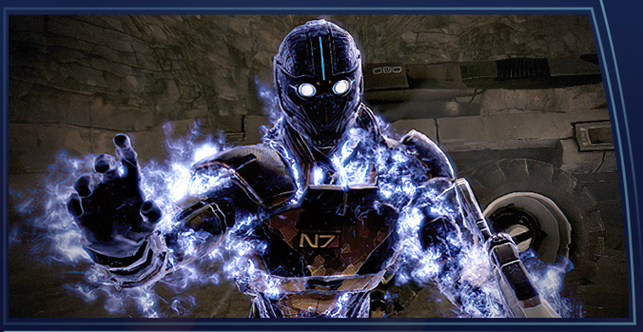
Biotics is the ability of rare individuals to manipulate dark energy and create mass effect fields through the use of electrical impulses from the brain. Intense training and surgically-implanted amplifiers are necessary for a biotic to produce mass effect fields powerful enough for practical use. The relative strength of biotic abilities varies greatly among species and with each individual.
There are three branches of biotics. Telekinesis uses mass-lowering fields to levitate or impel objects. Mass-raising Kinetic Fields are used to block or pin objects. Distortion uses rapidly shifting mass fields to shred objects.
Most organic species are capable of developing biotic abilities, though there are risks involved. Biotics are the result of in-utero exposure to element zero. This usually causes fatal cancers in the victim, but in rare cases it coalesces into nodules within the fetus’s developing nervous system.
Element Zero (“Eezo”)
When subjected to an electrical current, the rare material dubbed element zero, or ‘eezo’, emits a dark energy field that raises or lowers the mass of all objects within it. This ‘mass effect’ is used in countless ways, from generating artificial gravity to manufacturing high-strength construction materials. It is most prominently used to enable faster-than-light space travel.
Eezo is generated when solid matter, such as a planet, is affected by the energy of a star going supernova. The material is common in the asteroid debris that orbits neutron stars and pulsars. These are dangerous places to mine, requiring extensive use of robotics, telepresence, and shielding to survive the incredible radiation from the dead star. Only a few major corporations can afford the set-up costs required to work these primary sources.
Humanity discovered refined element zero at the Prothean research station on Mars, allowing them to create mass effect fields and develop FTL travel.
Mass Effect Fields
Element zero can increase or decrease the mass of a volume of space-time when subjected to an electrical current. With a positive current, mass is increased. With a negative current, mass is decreased. The stronger the current, the greater the magnitude of the dark energy mass effect.
In space, low-mass fields allow FTL travel and inexpensive surface-to-orbit transit. High-mass fields create artificial gravity and push space debris away from vessels. In manufacturing, low-mass fields permit the creation of evenly-blended alloys, while high mass compaction creates dense, sturdy construction materials.
The military makes extensive use of mobility enhancing technologies, with mass effect utilizing fighting vehicles standard front-line issue in most military forces. Mass effect fields are also essential in the creation of kinetic barriers or shields to protect against enemy fire.
Mass Relays
Once believed to be of Prothean origin, mass relays were in fact created by the Reapers using technology far beyond that of other living species. The enormous structures, scattered throughout the stars, create corridors of virtually mass-free space. This allows instantaneous transit between locations normally separated by years or even centuries using conventional FTL drives.
Primary mass relays can propel ships thousands of light-years. The flight path, however, is fixed to a single relay elsewhere in the galaxy. By contrast, secondary relays, while only capable of propelling ships a few hundred light-years, can reach any other relay within their limited range.
Many primary relays lie dormant, their destinations not yet known. These relays are often left inactive on purpose, as established civilizations are unwilling to blindly open a passage that might connect them to a new, hostile species. The Reapers do not share the same concern, and freely use the dormant relays.
Medi-Gel
Medi-gel is a common medicinal salve used by paramedics, EMTs, and military personnel. It combines several useful applications: a local anesthetic, disinfectant, and clotting agent all in one. Once applied, the gel is designed to grip tight to flesh until subjected to a frequency of ultrasound. It is sealable against liquids – most notably blood – as well as contaminants and gases.
The gel is a genetically-engineered bioplasm created by the Sirta Foundation, a medical technology megacorp based on Earth. Technically, medi-gel violates Council laws against genetic engineering, but so far, it has proved far too useful to ban.
Omni-Tool
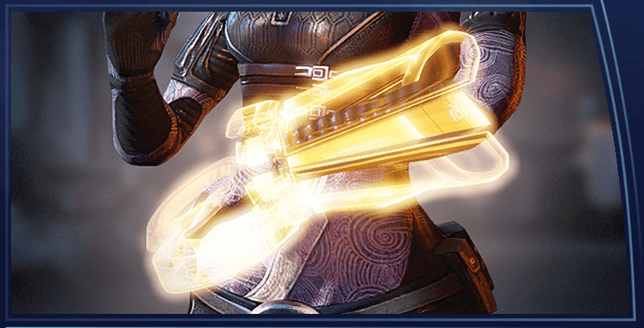
Omni-tools are handheld devices that combine a computer microframe, sensor analysis pack, and minifacturing fabricator. Versatile and reliable, an omni-tool can be used to analyze and adjust the functionality of most standard equipment, including weapons and armor, from a distance.
The fabrication module can rapidly assemble small three-dimensional objects from common, reusable industrial plastics, ceramics, and light alloys. This allows for field repairs and modifications to most standard items, as well as the reuse of salvaged equipment.
Omni-tools are standard issue for soldiers and first-in colonists.
The Crucible
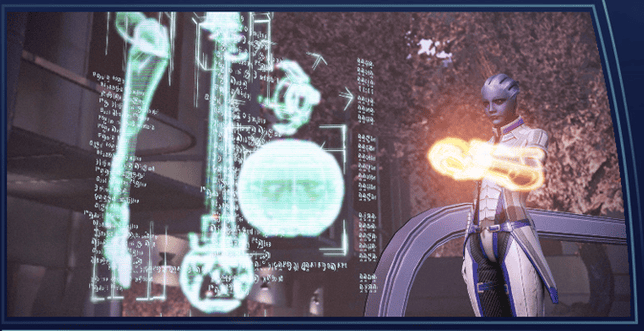
The Mars Archives describe a superweapon that the Alliance has named the Crucible, which exploits the technology of mass effect relays. Beyond the basic principles, however, researchers know little about how the weapon actually works.
One popular theory suggests that since relays can transfer matter and energy across the
galaxy with little regard for distance, it may be possible to create a weapon for which range is barely a factor. Duplicating the advanced science used to build the relays has proven difficult, however. If the Crucible were completed, the challenge would become tuning the weapon to kill a Reaper halfway across the galaxy without inflicting unthinkable levels of collateral damage.
What is clear is that the Crucible’s construction is a massive effort, drawing resources from throughout explored space. Staggering financial costs have been disregarded in the common effort to create something, anything, that can stop the Reapers.
The Genophage
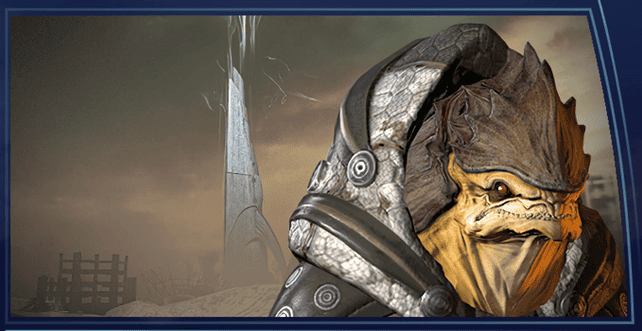
The genophage bioweapon was created to end the Krogan Rebellions. The turians fought the krogan to a standstill, but the sheer weight of krogan numbers indicated they could not be stopped through conventional means. The turians collaborated with the salarians to engineer a genetic counter to the krogan’s rapid breeding.
The genophage virus replicated by ‘eating’ key genetic sequences, altering every cell of krogan physiology so the krogan could not use gene therapy to fix the affected tissues. Once a genophage strain could replicate no more, it would starve and die, limiting mutation and contamination. In addition, the ‘created’ genetic flaw is hereditary. The resulting mutation made only one in a thousand krogan pregnancies carry to term, reducing offspring viability rather than fertility. Krogan warlords fought battles over the females able to carry children to term.
The release of the genophage is still controversial and bitterly debated in many circles.
The Genophage Cure
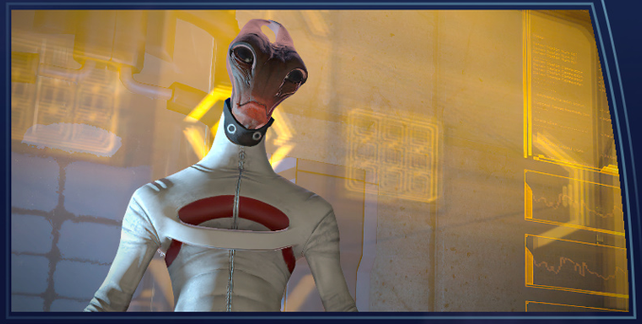
It may be possible to reverse the genophage by extracting an immunity from the genetic data of a cured krogan female. A salarian geneticist named Maelon, a former student of Dr. Mordin Solus, discovered the cure through unethical experimentation on live subjects.
The complexity and durability of the genophage derives from biochemical countermeasures that the salarians wove into the plague in an attempt to make the sterilization incurable. No one is certain of how Maelon circumvented the countermeasures, but his work was complete enough to allow replication of his results.
In its original form, the cure restored fertility but severely compromised the immune system. This resulted in slow, painful death for all but one of Maelon’s test subjects. If the beneficial aspects of the cure can be isolated, a specially tailored virus could repair the affected genes in other krogan.
The Shroud
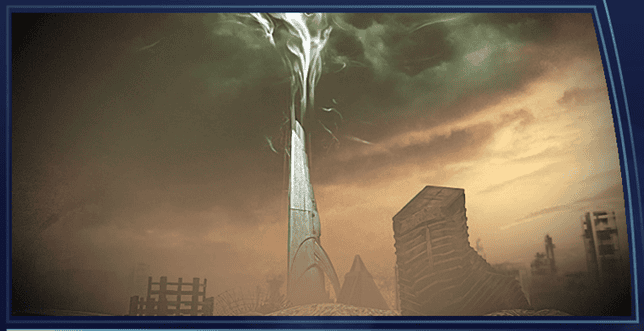
What the krogan call the Shroud is a technological remnant of the Salarian Uplift. After Tuchanka’s nuclear war released tons of smoke and dust into the atmosphere, the planet temporarily cooled from global dimming–except at the poles, where the albedo was lowered by soot. As clouds trapped the resulting heat, enormous swaths of permafrost melted, releasing methane captured in clathrates from previous millennia. This potent greenhouse gas created a runaway heat cycle that was called “the nuclear summer.”
Without intervention, Tuchanka would have sunk into a slow but certain mass extinction. The salarian solution was to assemble the Shroud, a permanent sun shield of trillions of tiny diffractory lenses placed at the L1 Lagrange point, the point in space where the lenses’ naturally stable orbit would shade the planet.
The salarians settled on a delivery method that became known as the Shroud Towers. The towers were essentially enormous coilguns that could fire a payload of lenses into space along with the equipment necessary to monitor the payload’s trajectories. Many krogan warlords enthusiastically approved of the plan, some because they believed in saving their homeworld, but most because they saw future military applications for the Shroud Towers. The Shroud was completed on schedule over the next few decades, by which time the rachni held the warlords’ full attention.
The Krogan Rebellions were not kind to the Shroud Towers. All but one was destroyed during the push for krogan demilitarization. The remaining tower, often referred to as “the Shroud” even though that is technically incorrect, was repurposed for cloud seeding and atmospheric repair. It remains on the landscape as an anachronism, a symbol of a time when krogan and salarians helped themselves by aiding one another.
Artifacts
The Citadel Council has called for the immediate donation of Prothean artifacts to bolster the war effort, primarily items of Reaper origin and recordings of their attacks.
The ExoGeni Corporation set an example by donating a store of newly discovered paleotechnology and releasing the data archives of deep-space research colonies destroyed by the Reapers. Several private collectors have since stepped forward to donate the entirety of their collections.
But despite an offer of amnesty for anyone concealing such artifacts, not everyone has responded as the Council hoped. Several artifacts have been found in obscure underground markets on safe-haven worlds, presumably sold by newly arrived refugees who needed funds to survive.
Reports say that smugglers continue to sell stolen artifacts, and armed raids on archeological sites have rendered even legal operations extremely hazardous. After several reports of mercenary groups turning on the archeologists who hired them, Elanus Risk Control Services began to offer security details for archeological sites at considerably reduced rates.
Computers: Artificial Intelligence (AI)
An artificial intelligence is a self-aware computing system capable of learning and independent decision making. Creation of a conscious Al requires adaptive code, a slow, expensive education, and a specialized quantum computer called a ‘blue box’.
An Al cannot be transmitted across a communication channel or computer network. Without its blue box, an Al is no more than data files. Loading these files into a new blue box will create a new personality, as variations in the quantum hardware and runtime results create unpredictable variations.
The geth serve as a cautionary tale against the dangers of rogue Al, and in Citadel Space they are technically illegal. Advocacy groups argue, however, that an Al is a living, conscious entity deserving the same rights as organics. They argue that continued use of the term ‘artificial’ is institutionalized racism on the part of organic life; the term ‘synthetic’ is considered the politically correct alternative.
Computers: Virtual Intelligence (VI)
A virtual intelligence is an advanced form of user interface software. Vls use a variety of methods to simulate natural conversation, including an audio interface and an avatar personality to interact with. Although a VI can provide a convincing emulation of sentience, they are not self-aware, nor can they learn or take independent action.
Vls are used as operating systems on commercial and home computers. Minimal VI ‘agents’ are also available. Agents are compact and specialized. Some serve as personal secretaries, filtering calls and scheduling meetings based on user-defined priorities. Others are advanced search engines, propagating themselves across the extranet to collate user-requested data.
Commercial Vls in a variety of stock personalities are available at any software retailer. Boutique firms and hobbyists also build unique Vis to personal specification. Although software emulation of living personalities is illegal, reconstructions of famous historical figures are common.
The Darkness Breached: Leviathan’s Secrets*
Essentially nothing was known of the aquatic species dubbed “Leviathans” before Commander Shepard’s report to Task Force Aurora. No record of their species’ true name exists, no ruins are attributed to their civilization, and no influence on other races has been recorded. The task force can only conjecture based on the limited information provided by Shepard.
Their current world is unlikely their homeworld, so it is surmised that the Leviathans mastered technology and spaceflight despite their immense size and aquatic nature. Their ability to communicate with and mentally dominate land-based sapients would have been a necessary step, and so whatever homeworld the Leviathans hail from would have included a thrall species whose civilization served their purposes. Presumably their bodies can withstand both the extreme pressure of the depths and the lesser pressure of a coastal area where they might come into contact with these thralls.
Transporting a creature the size of the Leviathan into space would have been a significant engineering challenge. It is likely they used eezo for ease of travel, as the hanar do, and employed cybernetic filtration to breathe air as well as oxygenated water. It is unknown if the Leviathans have modified themselves with the equivalent of a biotic amplifier, but it seems probable. The faster- than-light communication of their pulses would require precise control previously unknown to modern science. One can only guess at the innovations of this species, and the Leviathans are volunteering no such information.
The Reaper War*
The Fall of Earth
The Reapers took Earth in a matter of hours. The Alliance knew the first wave would arrive from batarian space, but they were unprepared for the speed and scale of the attack.
The Reapers bypassed the Sixth and Seventh Fleets at Terra Nova and Eden Prime, flying straight from relay to relay where they could neither be tracked nor intercepted. The tactic was unexpected, since the navies of organic species would never risk coming out of FTL within combat range or leaving enemies at their backs to threaten supply lines.
At Arcturus Station, more than a dozen Reaper capital ships engaged the Alliance’s Second, Third, and Fifth Fleets. This was mere screening for the main force. Dozens more capital ships continued through the Charon Relay, where the First Fleet had been lying in wait but was soon destroyed. The Fourth Fleet, near Earth, had a few minutes of advance warning. It stood no better chance.
After destroying Earth’s comm buoys, smaller Reaper destroyers wiped out all GPS and communications satellites in Earth’s orbit and cut the undersea fiber-optic cables that linked the continents. Earth’s resistance now relies on outdated radio towers and a few quantum entanglement communicators whose matched pairs happen to be on other continents or outside the Sol system. Communication is so limited that the fate of entire nations remains unknown.
The capital ships bombarded defense installations and industrial centers, annihilating entire cities with populations in the low millions, including Adelaide, Hamburg, Al Jubail, and Fort Worth. Meanwhile, Reaper destroyers descended into the atmosphere to melt roads and capture population centers with minimal loss of life. This is not an example of the Reapers being merciful. More likely, they are herding their prey to make the coming harvest that much easier.
The Fall of Khar’shan
For every thousand batarian refugees, there are a thousand and one stories about how the Reapers invaded the batarian systems. A few elements are common to almost every version, however. The Reapers arrived first in the Vular system and immediately destroyed its communications network. The Hegemony’s Department of Information Control blamed the loss of signal on space weather, but scrambled ships to the system nonetheless. Within a day, Reaper capital ships appeared in the Harsa system and descended on the batarian homeworld, Khar’shan.
For all the rhetoric about the Hegemony’s military prowess, their response to the Reapers was uncoordinated. Moments after the information minister took to the extranet and announced that unknown ships were destroying all space traffic near Khar’shan, the defense minister declared there was no reason to panic. The planet’s comm buoys were destroyed next, creating an ominous silence that has persisted ever since.
Fearing they were next, batarian colonies across Hegemony space began evacuations. So many refugees poured into the human- occupied Exodus Cluster that Systems Alliance officials at first thought the batarians were invading.
More systems have gone dark as their comm buoys were destroyed, and millions more batarians, trapped on their planets, sit waiting for the Reapers.
Desperate Measures
Faced with utter annihilation, military planners have considered extreme solutions in their quest to stop the Reapers. The two most plausible are the destruction of mass relays and the use of starships as suicide weapons.
Destroying a mass relay to stop the Reapers’ advance is infeasible. Although it has recently been proven that mass relays can be destroyed, a ruptured relay liberates enough energy to ruin any terrestrial world in the relay’s solar system. It would take too long to evacuate the millions or billions of people living near each relay, and the Council is unwilling to sacrifice that many lives when combat stands a chance of saving them. Even if a garden world were to survive the relay’s destruction, the Reapers have infinite patience. They traveled out of dark space using conventional FTL–travel within the galaxy is not an insurmountable barrier.
Meanwhile, starships are too costly to be used as projectiles, given that it would take many collisions to seriously harm a Reaper. Some armchair admirals suggest that a single starship traveling faster than light could obliterate a Reaper capital ship, but all ships based on mass effect technology possess hardwired safety features to prevent FTL collisions. If a ship’s FTL plotter finds a significant object in the path of a planned jump, the FTL drive refuses to fire in the first place. This is not a perfect safety feature–the sensors can only scan for objects within a reasonable distance at light speed, and a navigator must plot the rest of the course–but it is so inherent to the FTL warm-up process that removing it is nigh impossible. Cynical intelligence analysts note that the secret of mass effect technology, including that safety system, has always been attributed to the Protheans–just as the mass relays were.
The Battle of Palaven
When Taetrus fell, the turians knew little about the Reapers except that they wanted to enrage the turians. Staying calm, the turians massed in force around Palaven, their homeworld. Fleet Admiral Irix Coronati, in what became known as the “Fifteen-Minute Plan,” stationed only two carriers, Undaunted and Resolute, near the system’s relay. When the Reaper fleet emerged, the carriers launched swarms of unmanned fighters and spy drones. These were quickly destroyed, but the drones transmitted vital data on the Reapers’ effective range, fleet composition, and exact location. The turians’ other ships then deployed to defend the system in earnest.
Knowing that the Reapers’ weapons had a longer effective range than any of his own, Coronati made a short, daring FTL jump– landing his dreadnoughts in the middle of the Reaper fleet. The dreadnoughts then turned to line up their main guns on the Reapers, which also needed to turn to fire on the turians. This ploy used the Reapers’ size against them– because they could turn faster, the turian dreadnoughts locked targets first, and their concentrated firepower downed several Reaper capital ships.
The Reapers countered instantly. Their destroyers performed a jump of their own to the skies above Palaven, beginning orbital strikes on turian cities. The turians, forced to defend the planet, found themselves in a pitched battle far from the relay, from which emerged a seemingly endless line of Reaper ships. After massive casualties, Coronati ordered retreat.
The turians insist that Palaven is not lost–the battle has merely moved to the ground. Reaper troop transports have dumped hordes of husks to capture Palaven’s inhabitants, but met with little success. Reaper capital ships are destroying city after city. But much of the turian fleet is still operable, and the citizenry is heavily armed. The turians refuse to be intimidated.
The Battle of Rannoch
The quarians’ plan to take back their homeworld was risky, and could easily have led to their annihilation if a peaceful solution had not been found.
In an initial battle against the Reaper- upgraded geth ships, the quarians found their Heavy Fleet and a portion of the Patrol Fleet outmatched. To stave off defeat, the quarians retreated at FTL speeds to rally with the Civilian fleet on the far side of Rannoch’s sun, Tikkun. Temporarily hidden, but with only minutes of advance warning should a geth scout spot them, the quarians planned counterattacks to disrupt the geth link with the Reapers. First preying on a damaged geth dreadnought, the quarians followed by sending strike teams to Rannoch’s surface to destroy the Reaper that was transmitting improved software to geth forces.
When the Reaper uplink was disrupted, the geth suffered momentary downgrades in response time and intelligence, allowing the quarians to press their advantage. But an emergency order from Commander Shepard and Admiral Shala’Raan vas Tonbay broke off hostilities before the geth’s full capabilities were restored. It is to the quarians’ credit that all three fleets obeyed the order to cease fire, even the Civilian Fleet, which had little combat experience. The geth, for their part, bore no ill will towards enemy combatants and broke off hostilities with perfect discipline.
It remains to be seen how the geth and the quarians will manage to coexist on Rannoch. For now, they have committed their considerable military forces to repel the Reapers. Given the long-lasting animosity between the geth and quarians, it is possible that the Reapers did not plan for the possibility of such an alliance and will be unprepared to contend with both armadas.
The Cerberus Coup
Councilor Udina’s attempted coup will no doubt be analyzed for generations to come, but a clear picture is beginning to emerge. Udina had contacted Cerberus to coordinate what was intended to be a bloodless takeover of the Citadel, in which he would force the other councilors to grant him emergency powers so that he could command the Citadel Fleet. He would then direct the fleet to liberate his homeworld, Earth.
The plan fell apart early when Executor Pallin and the salarian councilor caught wind of it. In defense of the plan, the Illusive Man dispatched his top assassins, commanded by Kai Leng, to kill them. Udina had little choice but to support the assassins with an armed force sufficient to hold the Citadel. Captured confidantes have indicated that Udina and Leng’s alliance was relatively fragile: Udina may have planned to turn on Cerberus once the fleet was his to command, and Leng departed when he calculated that Udina would not succeed.
Persistent rumors suggest that Udina might have been a high-functioning victim of Reaper indoctrination. His actions played right into the Reapers’ plans: even if the coup failed, it would damage Citadel governance. If it succeeded, his plan to retake Earth would likely have turned into a military blunder that Council forces could ill afford. However, there is no direct evidence of his indoctrination, nor obvious opportunity. It is more likely that Udina acted out of desperation, and in doing so, cost humanity its councilor.
The Fall of Thessia
The assault on Thessia did not go as smoothly as the Reapers’ strikes against other races. While other species met the Reapers head-on, the asari resorted to dangerous hit-and-run tactics to harass their attackers. By engaging in guerilla strategies–blasting a Reaper ship, then jumping to FTL where they could not be tracked–the asari forced the Reapers to remain on the defensive.
Unfortunately, the Reapers’ greater numbers allowed them to accept certain losses, so they soon ignored the attacks against them and began orbital bombardment of Thessia. This in turn forced the asari to defend their homeworld with a more traditional stance, facing the Reaper forces directly. As soon as the Reapers landed on Thessia, the harvesting began.
A swift and brutal slaughter of the asari ground forces followed. Resistance from trained biotics barely slowed the attackers down. In the end, Thessia’s minimal military forces, combined with unpreparedness in the face of an overwhelming enemy, resulted in the fall of the planet.
The Miracle at Palaven
The turian and krogan counterattack on Palaven combined deception, courage, and tenacity. First, the turians leaked a false battle plan that drew on the same tactics they used at beginning of the assault on Palaven. Then the dreadnought Indomitable faked a problem with its drive core, coming out of FTL near Palaven’s moon, Menae. Three other dreadnoughts and their attendant fleets deployed to assist Indomitable, a tempting target that drew the Reaper capital ships away from Palaven. Turian troop transports then entered Palaven’s atmosphere to release shuttles, gliders, and individual soldier capsules.
The Reapers did not understand the seriousness of the threat at first–those that detected the landing crafts sent husks and Collector swarms to intercept them, but little more. This allowed krogan commandos to link up with Palaven’s resistance and hand off their payloads–warp bombs and fission weapons.
In simultaneous strikes across the globe, Reaper ships began to explode. Turian resistance members had managed to smuggle the bombs inside when the Reaper processing ships, troop transports, and even destroyers and capital ships had opened their structures to indoctrinate turian leaders.
Large swaths of territory fell back into turian and krogan control. News of the victory gave a much-needed boost to the morale of the turian resistance and the galactic public.
But the action was not without sacrifice. Turian insurgents gave their lives to ensure the explosives detonated, and the processing centers they destroyed were full of civilians who died just as surely as if they had been harvested. Of the dead, General Minin Resvirix said, “Whatever they were in life, their deaths had no equal. They are worthy of joining the spirit of Palaven itself.”
The Reapers
Harbinger
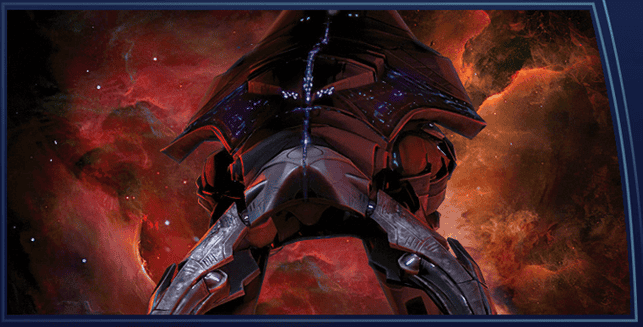
The Reaper called Harbinger is believed to be the oldest and largest in the Reaper armada. From the reaches of dark space, Harbinger managed to control the Collectors, a race of human-sized insectoid bipeds, as it sent them on a campaign to kill and gather humans from vulnerable colonies. The Collectors became a terrifying force in the galaxy, responsible for the murder of hundreds of thousands. Surviving colonists have described the tone of Harbinger’s threats, heard through the Collectors as they attacked, as visceral and terrifying.
Alliance intelligence has tentatively identified Harbinger as one of the Reapers leading the attack on Earth.
The Reapers
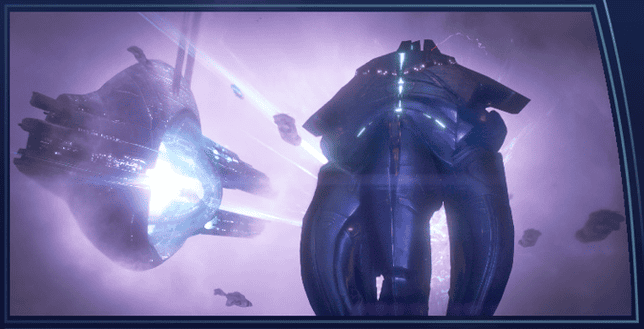
A myth common to several cultures in the galaxy, Reapers were once imagined as space monsters that consumed entire stars. Archeologists who searched for the sources of such myths found little besides the themes of all-consuming devils that are common to primitive cultures.
Although accurate information about the Reapers remains scarce, the galaxy now knows that the Reapers are not a myth–they are a real and devastating threat.
Sovereign
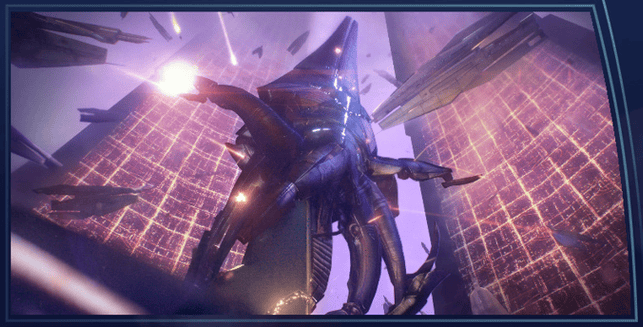
Sovereign was the first Reaper encountered by the modern Citadel races. Military leaders initially assumed that Sovereign was a geth or Prothean flagship commanded by Saren Arterius, a rogue Spectre. The truth was far more alarming. The massive ship was itself intelligent, and Saren proved to be under its control.
The attacks by Sovereign against Eden Prime and the Citadel removed any uncertainty about the Reapers’ technological superiority. Sovereign’s formidable shielding and firepower allowed it to hold off the combined fleets of the Citadel, and its mass effect fields proved powerful enough to let the enormous vessel land on a planet’s surface.
Sovereign’s mission–to open a mass relay that would transport the other Reapers from dark space–proved its undoing. During the Battle of the Citadel, Sovereign linked its consciousness to Saren’s. When Saren’s death corrupted the signal and shut down Sovereign’s shields, Sovereign’s destruction soon followed.
Indoctrination
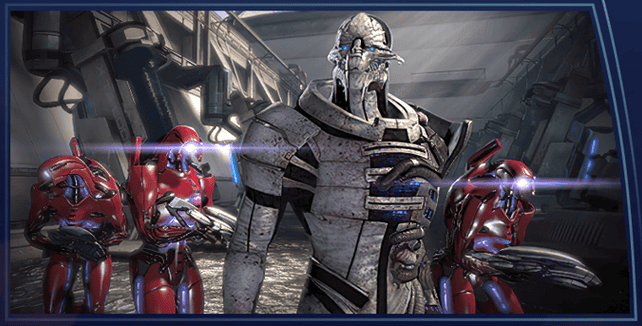
Reaper “indoctrination” is an insidious means of corrupting organic minds, “reprogramming” the brain through physical and psychological conditioning using electromagnetic fields, infrasonic and ultrasonic noise, and other subliminal methods. The Reaper’s resulting control over the limbic system leaves the victim highly susceptible to its suggestions.
Organics undergoing indoctrination may complain of headaches and buzzing or ringing in their ears. As time passes, they have feelings of “being watched” and hallucinations of “ghostly” presences. Ultimately, the Reaper gains the ability to use the victim’s body to amplify its signals, manifesting as “alien” voices in the mind.
Indoctrination can create perfect deep cover agents. A Reaper’s “suggestions” can manipulate victims into betraying friends, trusting enemies, or viewing the Reaper itself with superstitious awe. Should a Reaper subvert a well-placed political or military leader, the resulting chaos can bring down nations.
Long-term physical effects of the manipulation are unsustainable. Higher mental functioning decays, ultimately leaving the victim a gibbering animal. Rapid indoctrination is possible, but causes this decay in days or weeks. Slow, patient indoctrination allows the thrall to last for months or years.
Reaper Variants
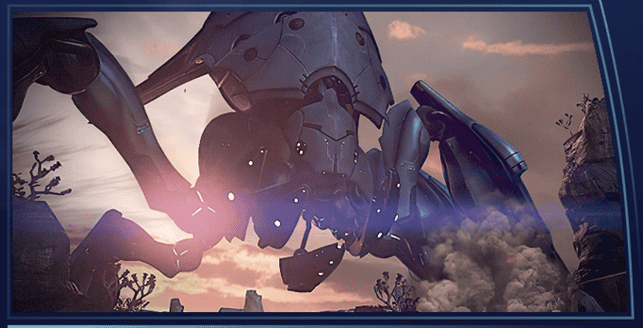
The Citadel races have classified the known variants of Reapers into four types:
* CAPITAL SHIPS are Sovereign-class Reapers two kilometers in length. They typically target the dreadnoughts, defense installations, and industrial cities of organic civilizations. Experts believe the Reapers harvest a single species of organics during each cycle of extinction to create these massive ships. Some capital ships are capable of launching small drones equivalent to fighters.
* DESTROYERS are 160 meters long and, in astounding numbers, make up the bulk of the Reaper fleet. They engage cruisers and other, smaller ships, as well as communications posts and enemy command centers. Research suggests destroyers are created from those species that are not harvested to make capital ships.
* TROOP TRANSPORTS carry husks to unconquered planets and bring victims of the harvest to Reaper processing centers. They vary in length from 200 meters to one kilometer, but, unlike capital ships and destroyers, do not appear to be self-aware. Instead, other Reapers operate troop transports remotely.
* PROCESSORS, also called “slaughter ships,” are mobile centers for mass DNA harvesting. Like troop transports, processors appear to be remotely operated by sapient Reapers.
Banshee
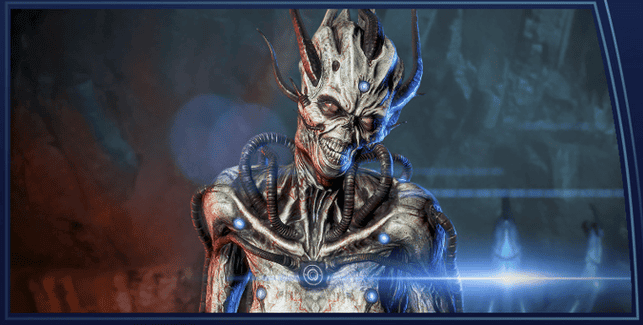
Banshees are the corrupted asari often found leading a Reaper strike force. The Reapers create them specifically from asari with active or latent predispositions to becoming Ardat- Yakshi, a rare neurological condition that enhances the asari’s biotic power while causing the immediate death of anyone she mates with.
Lumbering as though in constant pain, the emaciated banshees are surprisingly durable opponents. They are devastating biotics able to hurl lethal balls of energy and create shockwaves as they regenerate. What Alliance military finds most disturbing is the Banshee’s ability to spawn her own warp field and seemingly teleport during combat. Although their wails have no apparent physiological effect, the psychological impact is undeniable.
When banshees die, their Ardat-Yakshi genetics twist against them, causing a biotic implosion to ensure they evade capture.
Brute
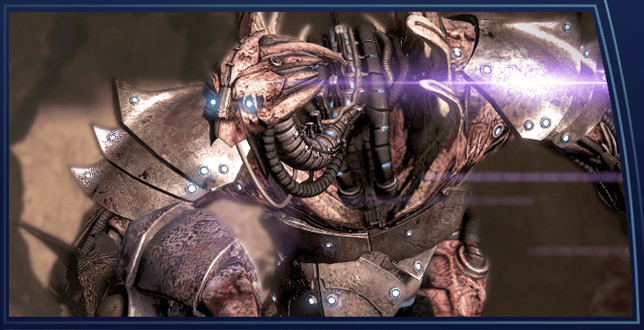
The brute is a hulking amalgamation of turian and krogan victims of the Reapers. Because tissue from dextro-protein species like the turians is incompatible with levo-protein species like the krogan, implants regulate the brute’s body chemistry to combat organ rejection.
It is the fusion of turian military skill and krogan blood rage that makes the brute such a formidable enemy, capable of destroying armored vehicles to get to the soldiers inside. Troops are advised to keep their distance, and, whenever possible, not engage a brute alone.
Cannibal
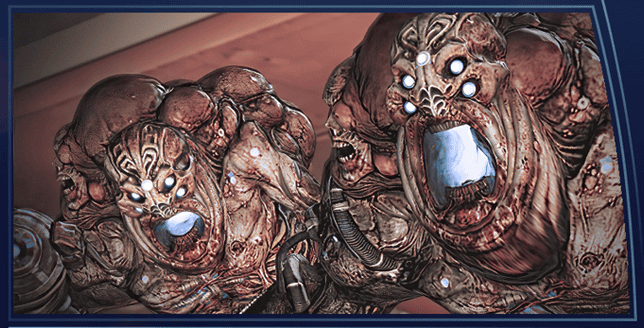
Cannibals are front-line Reaper units created from corrupted batarians. The nickname refers to their propensity to devour the bodies of fallen comrades. This triggers a biochemical process through which the cannibals spontaneously heal themselves and grow new chitinous armor. The transformation also appears to give cannibals a greater awareness of their surroundings, leading to more strategic behavior and careful use of battlefield cover.
Harvester
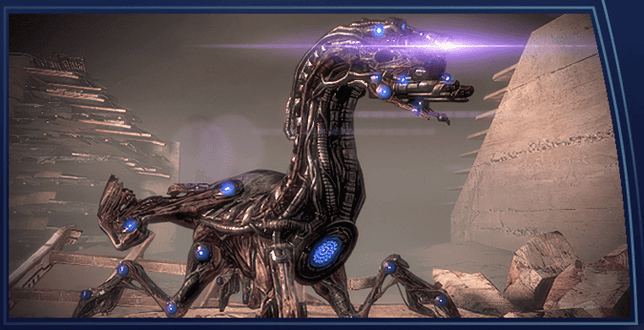
The sight of a Reaper Harvester in flight nearby is one of the first indications that a Reaper invasion is underway. Their massive wingspan allows them to quickly cover the distance between them and their prey.
In the Harvester’s mouth are two heavy guns that fire in an alternating pattern. The Harvester’s most fearsome quality, however, is that its appearance guarantees that Reaper ground troops are not far behind.
Husk
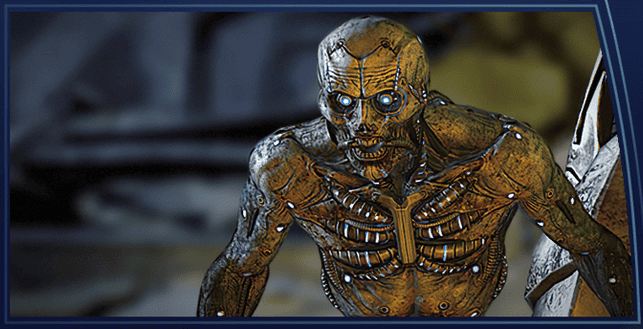
Husks are the aggressive, mindless foot soldiers of the Reaper armies. They are created by impaling either living or dead humans on mechanical spikes that rapidly extract water and trace minerals and replace them with cybernetics. These cybernetics reanimate the lifeless flesh and tissue, transforming the bodies into horrifying killing machines.
The Reapers use large groups of husks to overwhelm the enemy. The husks’ inability to feel pain, as well as their tendency to attack in groups, makes them particularly deadly adversaries.
Marauder
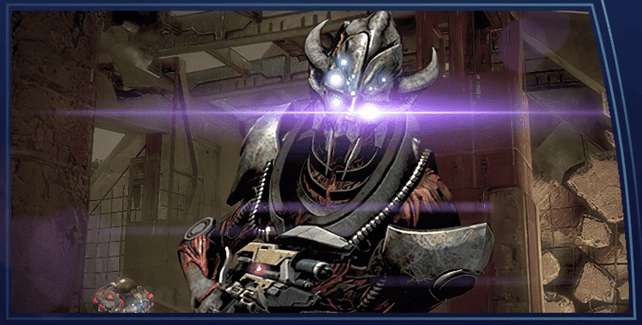
Marauders are harvested turians that command and protect other Reaper troops. The lean, armored creatures present a significant threat in and of themselves, but they are especially dangerous when leading a Reaper task force.
Alliance marines have observed marauders fortifying husks and cannibals by enveloping them in a ribbon of energy that forms a scabby shell of armor. For this reason, when Alliance soldiers encounter a marauder alongside husks or cannibals, standing orders are to target the marauder first.
Ravager
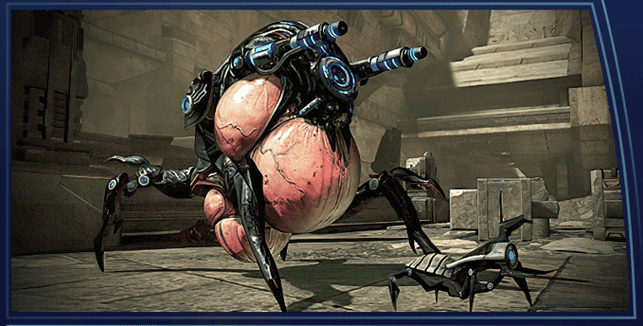
Ravagers are former rachni that the Reapers have transformed into heavy artillery through a process of implantation and genetic modification. As walking organic turrets, they can sustain and inflict considerable damage.
Ravagers bear egg sacs that continuously spawn swarmers. If the sacs are destroyed, either during combat or upon the ravager’s death, their entire contents burst forth to charge the enemy and explode on contact. A dead ravager expels a caustic gas and an acidic puddle.
Alliance scientists have theorized that it is easiest for the Reapers to maintain control over units of rachni genetic extraction because of the species’ neurological predisposition for hive-mind consensus.
Harvesting
Even with all the Reapers’ power, harvesting every sapient species in an entire galaxy can take decades or even centuries. The most time-consuming part of the process is gathering DNA from the population. To accelerate the effort, the Reapers follow a consistent procedure.
Victims who cooperate, surrender, or are captured by husks are sorted into camps. It is believed the husks possess receptors that allow them to analyze a victim’s DNA through sight, smell, or touch. Victims that meet their standards are herded from the camps into processor ships. Those the husks deem insufficient are either turned into husks themselves or indoctrinated to serve as slave labor. The Reapers use this last option to give their victims false hope–many captives who would otherwise fight back become docile when they see members of their own kind obey and survive.
The processor ships reduce victims to a transportable liquid. Like in a slaughterhouse, the ships’ design prevents victims from seeing or hearing what happens elsewhere so that they do not panic. The victims are ushered into locking pods, then rent apart and dissolved into paste that is flushed to storage vats.
The rate of killing is phenomenal. Intelligence estimates suggest there are more than 400 processor ships on Earth, killing approximately 1.86 million humans per day. In combination with battlefield deaths, disease, and famine, this pace will result in the complete depopulation of Earth within a decade. As the husks and indoctrinated slaves build more slaughtering facilities, the kill rate can only increase.
Reaper Capabilities
The Reapers are technologically superior to the organic species of the galaxy–but the degree of that superiority is a matter of debate in the intelligence community.
The Reapers’ thrusters and FTL drives appear to propel them at more than twice the speed of Citadel ships. Estimates of their location in dark space suggest they can travel nearly 30 light-years in a 24-hour period.
Reaper power sources seem to violate known physical laws. Reapers usually destroy fuel infrastructure rather than attempting to capture it intact, indicating that Reapers do not require organic species’ energy supplies. Consequently, the Reapers attack without regard for maintaining supply lines behind them, except to move husks from one planet to another. Unlike Citadel ships, Reapers do not appear to discharge static buildup from their drive cores, although they sometimes appear wreathed in static discharge when they land on planets.
The main gun on a Reaper capital ship dwarfs that of the Alliance’s Everest-class dreadnoughts. No dreadnought has yet survived a direct hit from the weapon. Estimates put its destructive power anywhere from 132 to 454 kilotons of TNT. Even if the target is hardened, as in the case of a surface- based missile silo, the gun can instead bury the target beneath molten metal. Precise targeting computers and correctors also give Reaper weapons a longer effective range than organics’ dreadnoughts or cruisers.
The kinetic barriers on a Reaper capital ship can shrug off the firepower of a small fleet. Weapons specifically designed to overcome shields, such as the Javelin, GARDIAN lasers, or the Thanix series, can bypass the barriers to some degree. The difficulty is getting close enough to use them–the surface-mounted weaponry on Reaper ships, similar in principle to GARDIAN, presents an effective defense against organic species’ fighters.
Reaper Vulnerabilities
Although clearly technologically superior to the Citadel forces, the Reapers have experienced casualties in the battles across the galaxy. This indicates that, theoretically, with the right intelligence, weapons, and strategy, the Reapers could be defeated.
Unlike the mass effect relays that they created, Reapers do not have quantum shields. Locking itself down at a quantum level would leave a Reaper unaware of its surroundings until the shielding deactivated. Instead, Reapers rely on kinetic barriers.
In the case of a Reaper capital ship, these kinetic barriers can hold off the firepower of two dreadnoughts simultaneously, but three clearly causes strain, and four typically results in destruction. Weapons designed to maximize heat damage, such as the Thanix series, show better results against the Reapers than pure kinetic impacts.
The barriers of a Reaper destroyer are less formidable than those of a capital ship. It is possible for a single cruiser or many fighters to disable or demolish a destroyer if they can get within range before they are themselves destroyed.
The Reapers’ energy sources are not infinite. For example, to land on a planet, a Reaper must substantially reduce its mass. This transfer of power to its mass effect generators leaves the Reaper’s kinetic barriers at only partial strength.
Sovereign was destroyed while assuming direct control over Saren. The feedback from Saren’s death seemed to entirely overload Sovereign’s shields. Current Reapers do not seem to suffer from this design flaw.
Reaper capital ships can turn faster than Citadel dreadnoughts, but to do so, they must lower their mass to a level unacceptable in combat situations. Consequently, it is possible for a dreadnought to emerge from FTL travel behind a capital ship, then bring its guns to bear faster than the Reaper can return fire. This is a poor tactic, however, against Reapers flying in proper formation.
Weapons, Armor and Equipment
Body Armor*
Modern combat hard-suits have a “triple canopy” of protection: shields, armor, and self-repair. The outermost layer is created through kinetic barrier emitters, which detect objects incoming at a high rate of speed and generate deflecting “shields” provided they have enough energy in their power cells.
If a bullet or other incoming object gets past the barrier, it contends with the more traditional body armor. A sealed suit of non-porous ballistic cloth provides kinetic and environmental protection, reinforced by lightweight composite ceramic plates in areas that either don’t need to flex or require additional coverage, such as the chest and head. When the armor is hit by directed energy weapons, the plates boil away or ablate rather than burning the wearer.
The last level of protection is provided by the suit’s microframe computers, whose input detectors are woven throughout the fabric. These manage the self-healing system, which finds rents in the fabric and, assuming any such tear would wound the flesh underneath, seals the area off with sterile, non-conductive medi-gel. This stanches minor wounds and plugs holes in the suit that could prove fatal in vacuum or toxic environments. Soldiers are not always fond of the “squish skin” that oozes gel on them at a moment’s notice, but fatalities have dropped sharply since the system was implemented.
Blackstar
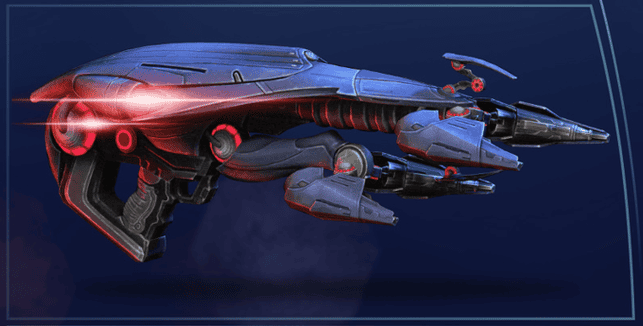
The Reaper weapon nicknamed Blackstar is so advanced that Alliance scientists can only offer speculation about how it works. The gun appears to exploit an element zero core and mass effect fields to fire gravitational singularities–micro black holes–that revert to their natural lethality when they impact a solid object. Researchers theorize that the blast tears apart the strong nuclear forces that hold the target’s atoms together, resulting in a localized fusion reaction in light atoms and a localized fission reaction in heavy atoms. If that hypothesis is correct, the weapon alters nuclei, thus changing the chemical composition of the target. This destroys organic tissue, corrodes surviving armor, and leaves a visible trail of light-emitting particles.
Although some might argue that the Blackstar’s single-launch capability makes it a liability, its capacity for utter destruction is essential when the user requires large-scale, instantaneous damage.
Geth Spitfire
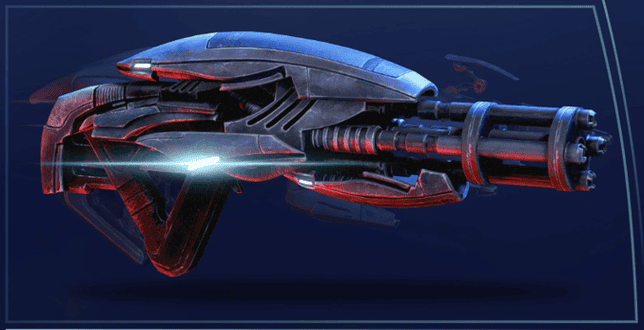
Like the geth plasma shotgun, the Spitfire is not a true energy weapon. Instead, the minigun magnetically flings clusters of superconducting toroids. These donut-shaped projectiles are designed to shatter upon impact, arcing electricity between the fragments and flash-converting them to plasma. The gun’s punishing, automatic blasts impact with the heat of a cutting torch.
The weapon’s stopping power has garnered the attention of both Alliance and quarian intelligence, who theorize that the Spitfire may have been designed to destroy other geth. Enough Spitfires have been found in the field to suggest that the weapon is out of the prototyping stage, and that a schism among synthetics may have forced them into production.
M-560 Hydra
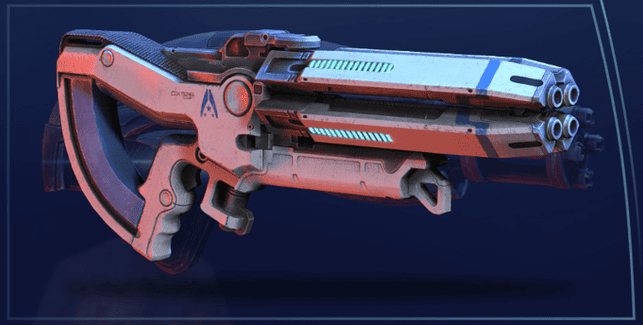
Before the introduction of the M-560 Hydra, missile launchers either focused on bringing down a single armored target or simultaneously neutralizing multiple unarmored opponents. With the Hydra, a soldier no longer needs to choose between the two.
The Hydra releases a barrage of miniature missiles, each guided by an independent homing system that seeks out exposed enemies. On impact, three shaped charges per missile explode in sequence. The first overloads the target’s kinetic barriers before the second destroys its armor, clearing a path for the third warhead to detonate inside the target.
Omni-Tool Weapons
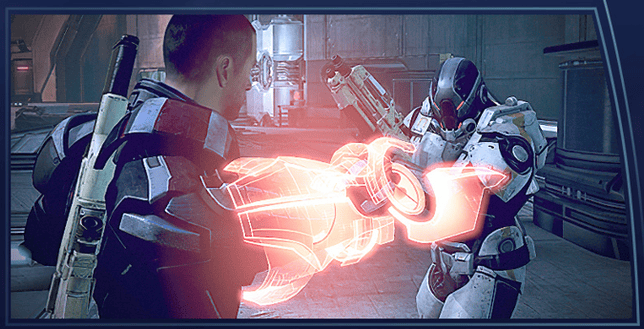
Although melee-combat applications for the omni-tool are almost as old as the device itself, the feature was largely unused prior to the Reaper invasion. The need to take on multiple husks in close quarters forced the Alliance to develop ways to enhance the tool’s offensive capability.
The most common melee design is the “omni- blade,” a disposable silicon-carbide weapon flash-forged by the tool’s mini-fabricator. The transparent, nearly diamond-hard blade is created and suspended in a mass effect field safely away from the user’s skin. Warning lights illuminate the field so the searing-hot blade only burns what it is intended to: the opponent.
More technically adept soldiers frequently modify their omni-tools to maximize stopping power through electrical, kinetic, or thermal energy. Some troops integrate the weapon with their kinetic barriers, transforming the omni-tool into a wrist-mounted bludgeon; others fabricate flammable gases, held in place by a mass effect field and ignited upon impact. All prove deadly surprises for opponents who expect a disarmed Alliance warrior.
Kinetic Barriers (“Shields”)*
Kinetic barriers, commonly called ‘shields’, provide protection against most mass accelerator weapons. Whether on a starship or a soldier’s suit of armor, the basic principle remains the same.
Kinetic barriers are repulsive mass effect fields projected from tiny emitters. These shields safely deflect small objects traveling at rapid velocities. This affords protection from bullets and other dangerous projectiles, but still allows the user to sit down without knocking away their chair.
The shielding afforded by kinetic barriers does not protect against extremes of temperature, toxins, or radiation.
Mass Accelerators*
A mass accelerator propels a solid metal slug using precisely-controlled electromagnetic attraction and repulsion. The slug is designed to squash or shatter on impact, increasing the energy it transfers to the target. If this were not the case, it would simply punch a hole right through, doing minimal damage.
Accelerator design was revolutionized by element zero. A slug lightened by a mass effect field can be accelerated to greater speeds, permitting projectile velocities that were previously unattainable. If accelerated to a high enough velocity, a simple paint chip can impact with the same destructive force as a nuclear weapon.
However, mass accelerators produce recoil equal to their impact energy. This is mitigated somewhat by the mass effect fields that rounds are suspended within, but weapon recoil is still the prime limiting factor on slug velocity.
Small Arms*
Modern infantry weapons are micro-scaled mass accelerators, using mass-reducing fields and magnetic force to propel miniature slugs to lethal speeds. Nearly every gun on the battlefield is laden with features, from targeting auto-assists to projectile shavers that can generate thousands of rounds of ammunition from a small, internal block of metal.
It was long thought that personal weapons had plateaued in performance, but the geth proved all theories wrong. Mathematically reviewing their combat logs, the geth found that in an age of kinetic barriers, most firefights were won by the side who could put the most rounds down-range the fastest. But combatants were forced to deliberately shoot slower to manage waste heat, or pause as their weapons vented.
To eliminate this inefficiency, the geth adopted detachable heat sinks known as thermal clips. While organic arms manufacturers were initially doubtful this would produce a net gain, a well-trained soldier can eject and swap thermal clips in under a second. Faced with superior enemy firepower, organic armies soon followed the geth’s lead, and today’s battlefields are littered with these thermal clips.
Tech Armor and Fortification*
Although body armor and kinetic barriers provide significant protection for relatively low cost, technically savvy soldiers sometimes go further.
“Tech armor” is the common term for a complex series of field generators that disrupt incoming force using a stationary warp effect. The theory is that bullets that would normally shatter on impact instead break apart when they strike the field. The field then bleeds away the shrapnel’s kinetic energy. The standard design for tech armor traps the warp field between two low-yield kinetic barriers to protect the user from the field itself. When the outer barrier fails, the warp effect is discharged, potentially harming anyone nearby. For this reason, many soldiers modify the armor with a haptic-style light effect to warn allies not to get too close. On missions where stealth is paramount, this effect is disabled. Cynical soldiers joke that the design is called “tech armor” because if it were simply called “warp armor,” no one would use it.
The “fortification” approach uses high-energy batteries and superconductive devices within the armor to create a Foucault-current effect, essentially a magnetic field that can immobilize metals, even nonferrous ones. The field is triggered by sensors similar to those in a kinetic barrier. It is powerful enough to protect against most modern weapons, but there are drawbacks. The currents cause metallic objects to hold their position relative to one another, and although the field only lasts for a split second, it creates resistance that can slow or fatigue the wearer. Without specialized training, a soldier can quickly become exhausted or stumble at the wrong time.
Other Mass Effect codex can be found here.